REVIEW 4 major objections 4 minor 62 references
Melting of heavy quarkonia in QGP using deep neural networks
T0 review · 4 major / 4 minor · reviewed 2026-08-04 · deepseek-v4-flash
Pith's one-line read Deep neural networks trained on lattice QCD data yield a Debye mass and strong coupling that, inside a screened Cornell potential, reproduce the quarkonium melting hierarchy and sequential suppression seen in heavy-ion collisions.
desk verdict A plausible and useful application of DLQPM to quarkonium melting, but missing potential parameters and unresolved grid drift make the numbers unreproducible as written. read the letter →
The pith
A machine-rendered reading of the paper's core claim, the machinery that carries it, and where it could break.
The reading
What carries the argument
The paper's central object is the Deep-Learning Quasi-Parton gas Model (DLQPM), an eight-layer residual neural network with 32 neurons per layer that maps temperature to quasi-parton masses for gluons, light quarks, and strange quarks. The network is trained by minimizing the mean-squared error of the entropy density and trace anomaly against lattice QCD data over T/T_c in [1,3], with an additional high-temperature constraint nudging the gluon/light-quark mass ratio toward the hard-thermal-loop value. The learned masses are then inserted into Eq. (10) to define alpha_s(T) and Eq. (11) to define the Debye mass m_D(T). These two quantities set the real and imaginary parts of the complex Cornel
What would settle it
Measure the Debye screening mass on the lattice, e.g., from the static quark-antiquark free energy, and compare with the DNN-extracted m_D(T) in Fig. 2 over the same T/T_c range; disagreement would falsify the HTL conversion that links quarkonium predictions to the lattice input. A second check is to repeat the calculation with the vacuum Cornell parameters alpha and sigma fixed to published values and see whether the reported T_d windows survive.
Extended reading notes
Core claim
The central result is a data-driven replacement for perturbative medium parameters: a deep residual network is trained to match lattice QCD entropy density and trace anomaly, and the learned quasi-parton masses are converted by leading-order hard-thermal-loop relations into m_D(T) and alpha_s(T). These enter a complex Cornell potential (real part screens, imaginary part encodes Landau damping). Solving the Schrödinger equation yields, per state, the temperature where thermal width equals twice the binding energy and where binding energy equals 3T. The reported T_d values for J/psi, psi(2S), Upsilon(1S), Upsilon(2S) form a dissociation window that the paper interprets as agreeing with lattice
Load-bearing premise
The load-bearing premise is that quasi-parton masses fit only to the equation of state can be converted, via leading-order hard-thermal-loop formulas, into the exact Debye mass and running coupling that control a complex Cornell potential — with the vacuum Cornell parameters alpha and sigma not specified in the paper; if that conversion is not valid, the dissociation temperatures do not follow.
Editorial extensions
If this is right
- Upsilon(1S) would survive to at least 1.38 T_c and possibly up to 1.99 T_c, supporting its use as a probe of the hottest deconfined phase.
- J/psi melting in the 1.13-1.30 T_c window leaves room for both a surviving primordial component and late-stage recombination, matching the measured incomplete suppression.
- psi(2S) melting at or below T_c explains why the excited charmonium state is dramatically more suppressed than the ground state.
- The dual-criterion brackets mean that comparisons with lattice spectral functions should be made against a temperature band rather than a single number.
- The lattice-anchored m_D(T) and alpha_s(T) reduce the reliance of quarkonium calculations on purely perturbative inputs.
Reading between the lines
- The same learned quasi-parton masses could supply m_D(T) and alpha_s(T) to other medium-sensitive calculations — parton energy loss, thermal photon or dilepton production, transport coefficients — giving one lattice-anchored set of inputs across QGP phenomenology.
- A sharper test of the method would train the network directly on lattice data for the heavy-quark potential (from Wilson loops or spectral functions), letting the DNN learn the full complex potential and bypass the analytic Cornell-plus-dielectric form.
- The width and binding criteria bracket T_d, but a direct extraction of the spectral function peak at each temperature from lattice QCD could pin the melting temperature to a single value and adjudicate between the two brackets.
Signed reviews
Editorial analysis
A structured set of objections, weighed in public.
Referee Report
Summary. The paper proposes a hybrid machine-learning/potential-model calculation of heavy-quarkonium dissociation temperatures in the QGP. A deep neural network (DLQPM) is trained on the HotQCD equation of state to extract quasi-parton masses; Eqs. (9)-(11) convert these masses into a running coupling α_s(T) and Debye screening mass m_D(T). These quantities enter a dielectric-screened Cornell potential (Eq. 4), whose real part is solved in the Schrödinger equation (Eq. 12) to obtain binding energies E_B(T), while the imaginary part yields the thermal width Γ(T) via Eq. (13). Dissociation temperatures are estimated with two criteria, Γ=2E_B and E_B=3T. Table I reports T_d ranges: Υ(1S) in [1.38,1.99] T_c, J/ψ in [1.13,1.30] T_c, Υ(2S) in [1.10,1.29] T_c, and ψ(2S) near or below T_c. The authors claim excellent agreement with lattice QCD results and interpret the hierarchy as consistent with sequential suppression observed in heavy-ion collisions.
Significance. The idea of using a lattice-constrained, ML-based quasi-particle description to feed a complex in-medium potential is a potentially useful bridge between equation-of-state data and quarkonium phenomenology. The paper is commendably explicit about the hybrid, perturbative-inspired character of the m_D and α_s extraction, and it includes numerical benchmarks and a grid-convergence appendix. However, the central quantitative results are currently not reproducible because the vacuum Cornell parameters and heavy-quark masses are never specified, and the mapping from DLQPM masses to m_D and α_s is not validated against independent determinations. If these issues are addressed, the framework could be a useful addition to the potential-model literature; in its present form the significance is conditional.
major comments (4)
- [§II.A, Eq. (1), Eq. (4), Eq. (12), Table I] The central numbers in Table I depend directly on the vacuum Cornell parameters α and σ, which enter Eqs. (1) and (4), and on the heavy-quark masses m_c and m_b, which enter Eq. (12) through the reduced mass. None of these values is stated in the paper. The claim that the ML-enhanced potential 'tightens theoretical uncertainties' cannot be audited without knowing these inputs. The authors should state all parameter values, and ideally show how T_d varies under reasonable variations of α, σ, and m_Q. Without this, the agreement with lattice QCD and the sequential-suppression interpretation in Section III are under-determined.
- [§II.B, Eqs. (9)-(11), Fig. 2] The mapping from DLQPM quasi-parton masses to α_s(T) and m_D(T) is not an independent measurement. The quasi-parton masses are trained to reproduce the HotQCD equation of state, not screening lengths, and Eqs. (9)-(11) are leading-order HTL-inspired relations. Calling the resulting m_D and α_s 'non-perturbative, data-driven' overstates their status. The paper provides no comparison of the resulting m_D(T) with lattice determinations of the Debye mass, so the reader cannot assess whether this mapping is quantitatively reliable. The authors should benchmark m_D(T) against available lattice/effective-field-theory determinations and discuss the domain of validity of Eqs. (9)-(11).
- [Appendix A.5, Table IV] Table IV shows that the dissociation temperatures continue to decrease monotonically as the grid is refined from N=4000 to N=6000 for every state and criterion (e.g., Υ(1S) with 2E_B=Γ goes from 1.992 to 1.956 T_c, and with E_B=3T from 1.375 to 1.349 T_c). The statement that the difference 'stabilizes for N≳3000' is not supported by the table; no N>6000 results or Richardson extrapolation are shown. Since Table I quotes the N=4000 values, the numerical convergence uncertainty should be quantified and propagated into the reported T_d ranges.
- [§II.C and Appendix A.1/A.4] There is an internal inconsistency in the numerical setup: §II.C states that the finite-difference solver uses Neumann boundary conditions, while Appendix A.1 and A.4 state that Dirichlet boundary conditions are imposed. This should be reconciled, and the effect of the boundary choice on weakly bound states near the dissociation point should be commented on.
minor comments (4)
- [Headings and notation] Typographical slips: 'F uture Prospects' in Section IV.A and 'T raining set' in Section II.B should be corrected. Also, the notation for the number of flavors is inconsistent (n_f in Eq. (9), N_f in Eqs. (7) and (11)); the value of N_f (presumably 3) and N_c=3 should be stated explicitly.
- [Uncertainties] The authors state that they retrained the model ten times for uncertainty analysis, but no error bars are shown in Figs. 2-8 and Table I. The propagation of DLQPM uncertainties into m_D, α_s, E_B, Γ, and T_d should be quantified.
- [Code/data availability] The Data Availability section says code and data are available 'upon reasonable request.' For a paper whose main selling point is a data-driven ML framework, a public repository with the trained networks and the potential-model solver would greatly improve reproducibility.
- [Comparison with lattice QCD] The Abstract and Section III claim 'excellent agreement with lattice QCD results,' but Table I compares mostly with other potential-model calculations and reviews. The authors should clarify which entries are direct lattice determinations and distinguish lattice QCD results from model-dependent extractions.
Circularity Check
No significant circularity: final quarkonia dissociation temperatures are compared with lattice QCD and experimental results not used in the ML training, so the central claim retains independent content.
full rationale
The paper's derivation chain is not circular in the sense defined by the requested patterns. The DNN (DLQPM) is trained on HotQCD lattice equation-of-state data, and the quasi-parton masses obtained from that fit are then converted into α_s(T) and m_D(T) using the leading-order HTL-inspired formulas of Eqs. (9)-(11). These quantities are therefore model-derived outputs of an EoS fit rather than independent lattice measurements, so calling them "predictions" may overstate their epistemic status; however, this is not a circularity because the training data (entropy density and trace anomaly) are not the same as the predicted quantities (m_D, α_s, and ultimately T_d). The central quantitative claim—the dissociation temperatures in Table I—is obtained by solving the Schrödinger equation with a complex Cornell potential and comparing the results to independent external benchmarks (lattice QCD potential-model estimates, CMS/ALICE suppression data) that were not part of the training set. No equation in the paper reduces to its own input by construction: m_D(T) is not defined in terms of T_d, α_s(T) is not fitted to quarkonia data, and the dissociation criteria 2E_B = Γ and E_B = 3T are physical definitions rather than disguised restatements of the outputs. The self-citations to the authors' DLQPM prior work [35,36] are used to justify the quasi-parton mass model, but the training procedure is described in the paper and anchored to external HotQCD lattice data, so the argument does not reduce to an unverified self-citation chain. The omission of the vacuum Cornell parameters α and σ is a reproducibility and under-determination concern, not a circularity; it means the quantitative agreement cannot be audited, but it does not make the derivation self-referential. Overall, the central claim has independent grounding against external benchmarks, and no load-bearing step is forced by the paper's own definitions or by self-citations.
Assumptions & free parameters
free parameters (5)
- DLQPM neural network weights (m_g, m_u/d, m_s) =
not disclosed
- Vacuum Cornell coupling alpha
- String tension sigma
- Charm quark mass m_c
- Bottom quark mass m_b
assumptions (5)
- domain assumption Leading-order HTL Debye mass formula m_D^2 = 4 pi alpha_s T^2 (Nc/3 + Nf/6)
- domain assumption Complex dielectric permittivity model for the in-medium potential (Eqs. 2-6)
- domain assumption Quasi-particle description of the QGP equation of state
- domain assumption First-order perturbation theory for thermal width (Eq. 13)
- domain assumption Dissociation criteria 2E_B = Gamma and E_B = 3T
Cite this review
Pith. "Pith review of Melting of heavy quarkonia in QGP using deep neural networks." pith.science (2026). https://pith.science/paper/FAWYH2YK
@misc{pith2026250914970,
  author       = {Pith},
  title        = {Pith review of: Melting of heavy quarkonia in QGP using deep neural networks},
  year         = {2026},
  howpublished = {\url{https://pith.science/paper/FAWYH2YK}},
  note         = {Machine review of arXiv:2509.14970}
}
abstract
Machine learning techniques have emerged as powerful tools for tackling non-perturbative challenges in quantum chromodynamics. In this study, we introduce a data-driven framework employing deep neural networks to systematically predict the temperature-dependent behavior of the screening mass $m_D(T)$ and the strong coupling constant $\alpha_s(T)$ within a quark-gluon plasma medium. These medium-sensitive quantities are subsequently employed to compute the thermal widths $\Gamma_{\text{n}}(T)$ and binding energies $E_B(T)$ of heavy quarkonia states, specifically charmonia and bottomonia, by numerically solving the Schr\"odinger equation with medium-modified heavy quark potentials. To estimate the dissociation temperatures $T_d$ of various quarkonia states, we employ two complementary dissociation criteria: the conventional one, where $2E_B(T_d) = \Gamma_{\text{n}}(T_d)$, and an additional lower bound criterion defined by $E_B(T_d) = 3T_d$. This dual-criterion approach provides a more constrained and physically motivated estimate of the temperature range over which quarkonia states dissolve in the QGP environment. Our machine learning-enhanced predictions show excellent agreement with available lattice QCD results, especially for the ground states $\Upsilon(1S)$ and $J/\psi$, and offer new perspectives on the sequential suppression pattern detected in relativistic heavy-ion collision experiments. Overall, this work advances the quantitative description of quarkonium suppression and demonstrates the prospect of modern machine learning methods to bridge theoretical predictions and experimental observations, thereby contributing significantly to QGP tomography.
Figures


Figures from the paper (6 more)



Reference graph
Works this paper leans on
-
[1]
The radial coordi- nate is discretized betweenr min andr max withNpoints, and the second derivative is approximated by a centered finite-difference scheme
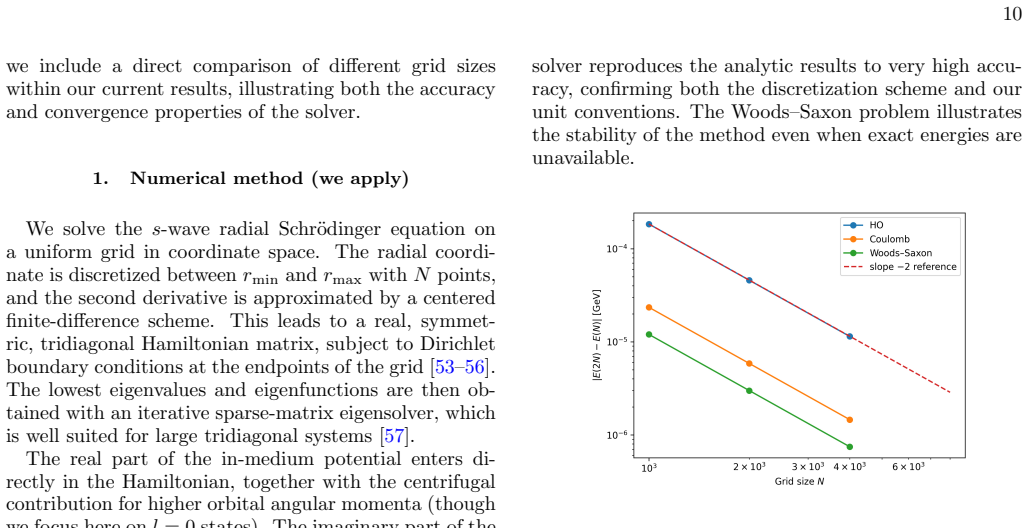
Numerical method (we apply) We solve thes-wave radial Schr¨ odinger equation on a uniform grid in coordinate space. The radial coordi- nate is discretized betweenr min andr max withNpoints, and the second derivative is approximated by a centered finite-difference scheme. This leads to a real, symmet- ric, tridiagonal Hamiltonian matrix, subject to Dirichl...
-
[2]
To validate the solver and its units, we first consider simple potentials with known spectra
Benchmarks with other potentials having analytical spectra. To validate the solver and its units, we first consider simple potentials with known spectra. The harmonic os- cillator (HO) and Coulomb problems serve as analytic benchmarks, while a Woods–Saxon (WS) well provides a more realistic test case without closed-form solutions. The corresponding potent...
-
[3]
We next assess numerical convergence by refining the uniform grid in a fixed spatial domain
Convergence with grid sizeN. We next assess numerical convergence by refining the uniform grid in a fixed spatial domain. As expected for a second-order stencil, the errors decrease quadratically with 1/N. Table III summarizes the ground-state en- ergies at successive refinements, while Fig. 9 shows the log–log behavior of residuals. The observed slopes c...
-
[4]
For realistic in-medium heavy-quark potentials, no analytic reference exists
Reporting practice for in-medium potentials. For realistic in-medium heavy-quark potentials, no analytic reference exists. In these cases, we accom- pany quoted binding energies with systematic conver- gence checks: (i) refinement in the number of grid points to confirm the expectedN −2 scaling, and (ii) variation of the spatial cutoffr max to control fin...
2000
-
[5]
The objective of the analysis is to examine how the dissociation temperatures of selected quarkonia states vary with the numerical grid size used in the compu- tation
Convergence check with grid sizeNof current numerical analysis. The objective of the analysis is to examine how the dissociation temperatures of selected quarkonia states vary with the numerical grid size used in the compu- tation. The states of interest includeJ/ψ(charmo- nium ground state), Υ(1S) (bottomonium ground state), and Υ(2S) (bottomonium first ...
2000
-
[6]
U. W. Heinz (2004), hep-ph/0407360
arXiv 2004
-
[7]
Matsui and H
T. Matsui and H. Satz, Phys. Lett. B178, 416 (1986)
1986
-
[8]
McLerran, Rev
L. McLerran, Rev. Mod. Phys.58, 1021 (1986)
1986
Show all 62 references
-
[9]
Collaboration, Nucl
P. Collaboration, Nucl. Phys. A757, 184 (2005)
2005
-
[10]
Nilima, M
I. Nilima, M. Hasan, B. K. Singh, and M. Y. Jamal, Eur. Phys. J. C84, 160 (2024), 2402.07848
2024 arXiv
-
[11]
M. C. Chu and T. Matsui, Phys. Rev. D39, 1892 (1989)
1989
-
[12]
Koike, AIP Conf
Y. Koike, AIP Conf. Proc.243, 916 (1992)
1992
-
[13]
Burnier, M
Y. Burnier, M. Laine, and M. Vepsalainen, Phys. Lett. B 678, 86 (2009), 0903.3467
2009 arXiv
-
[14]
Y. G. A. Dumitru and M. Strickland, Phys. Rev. D79, 114003 (2009)
2009
-
[15]
Pooja, M. Y. Jamal, P. P. Bhaduri, M. Ruggieri, and S. K. Das, Phys. Rev. D110, 094018 (2024), 2404.05315
2024 arXiv
-
[16]
M. B. Voloshin, Prog. Part. Nucl. Phys.61, 455 (2008)
2008
-
[17]
N. B. et al., Eur. Phys. J. C71, 1534 (2011)
2011
-
[18]
T. K. P. C. Patrignani and J. L. Rosner, Ann. Rev. Nucl. Part. Sci.63, 21 (2013)
2013
-
[19]
T. U. A. D. Frawley and R. Vogt, Phys. Rept.462, 125 (2008)
2008
-
[20]
E. M. G. J. F. Amundson, O. J. P. Eboli and F. Halzen, Phys. Lett. B390, 323 (1997)
1997
-
[21]
E. L. Berger and D. L. Jones, Phys. Rev. D23, 1521 (1981)
1981
-
[22]
L. A. et al. [STAR Collaboration], Phys. Lett. B722, 55 (2013)
2013
- [23]
-
[24]
C. R. Singh, M. Y. Jamal, and R. Sahoo, Eur. Phys. J. C84, 891 (2024), 2310.18909
2024 arXiv
-
[25]
Mocsy and P
A. Mocsy and P. Petreczky, Euro. Phys. J. C43, 77 (2005)
2005
-
[26]
B. K. P. V. Agotiya, Vinod Chandra, Phys. Rev. C80, 025210 (2009)
2009
-
[27]
Sebastian, M
J. Sebastian, M. Y. Jamal, and N. Haque, Phys. Rev. D 107, 054040 (2023), 2207.08510
2023 arXiv
-
[28]
Eichten, K
E. Eichten, K. Gottfried, T. Kinoshita, K. D. Lane, and T. M. Yan, Phys. Rev. D17, 3090 (1978)
1978
-
[29]
Eichten, K
E. Eichten, K. Gottfried, T. Kinoshita, K. D. Lane, and T. M. Yan, Phys. Rev. D21, 203 (1980)
1980
-
[30]
H. S. Chung, J. Lee, and D. Kang, J. Korean Phys. Soc. 52, 1151 (2008)
2008
-
[31]
Nilima, B
I. Nilima, B. K. Singh, and M. Y. Jamal, Eur. Phys. J. Plus139, 1126 (2024)
2024
-
[32]
Laine, O
M. Laine, O. Philipsen, P. Romatschke, and M. Tassler, JHEP03, 054 (2007), hep-ph/0611300
2007 arXiv
- [33]
-
[34]
Margotta, K
M. Margotta, K. McCarty, C. McGahan, M. Strickland, and D. Yager-Elorriaga, Phys. Rev. D83, 105019 (2011), [Erratum: Phys.Rev.D 84, 069902 (2011)], 1101.4651
2011 arXiv
-
[35]
Thakur, U
L. Thakur, U. Kakade, and B. K. Patra, Phys. Rev. D 89, 094020 (2014), 1401.0172
2014 arXiv
- [36]
-
[37]
Digal, P
S. Digal, P. Petreczky, and H. Satz, Phys. Lett. B514, 57 (2001), hep-ph/0105234
2001 arXiv
-
[38]
M. Y. Jamal, I. Nilima, V. Chandra, and V. K. Agotiya, Phys. Rev. D97, 094033 (2018), 1805.04763
2018 arXiv
- [39]
-
[40]
Li, H.-L
F.-P. Li, H.-L. L¨ u, L.-G. Pang, and G.-Y. Qin, Phys. Lett. B844, 138088 (2023), 2211.07994
2023 arXiv
-
[41]
Li, L.-G
F.-P. Li, L.-G. Pang, and G.-Y. Qin, Phys. Lett. B868, 139692 (2025), 2501.10012
2025 arXiv
- [42]
-
[43]
Plumari, W
S. Plumari, W. M. Alberico, V. Greco, and C. Ratti, Phys. Rev. D84, 094004 (2011), 1103.5611
2011 arXiv
-
[44]
Brambilla, J
N. Brambilla, J. Ghiglieri, A. Vairo, and P. Petreczky, Phys. Rev. D78, 014017 (2008), 0804.0993
2008 arXiv
-
[45]
Wong, Phys
C.-Y. Wong, Phys. Rev. C72, 034906 (2005), hep- ph/0408020
2005
-
[46]
Digal, P
S. Digal, P. Petreczky, and H. Satz, Phys. Rev. D64, 094015 (2001)
2001
-
[47]
H. Satz, J. Phys. G32, R25 (2006)
2006
-
[48]
Blaschke, O
D. Blaschke, O. Kaczmarek, E. Laermann, and V. Yu- dichev, Eur. Phys. J. C43, 81 (2005)
2005
-
[49]
K. T. Rethika, C. D. Ravikumar, and V. M. Bannur, Few Body Syst.62, 10 (2021)
2021
-
[50]
Q. Meng, Q. Wu, P. Cheng, J. Ping, and H. Zong, Chin. Phys. C42, 083103 (2018)
2018
-
[51]
V. K. Agotiya, V. Chandra, M. Y. Jamal, and I. Nilima, Phys. Rev. D94, 094006 (2016), 1610.03170
2016 arXiv
- [52]
-
[53]
A. M. Sirunyan et al. (CMS), Phys. Lett. B790, 270 (2019), 1805.09215
2019 arXiv
- [54]
- [55]
-
[56]
CMS Collaboration, Phys. Rev. Lett.118, 162301 (2017), 1611.01438
2017 arXiv
-
[57]
Brambilla, M
N. Brambilla, M. A. Escobedo, J. Soto, and A. Vairo, Phys. Rev. D97, 074009 (2018), 1711.04515
2018 arXiv
-
[58]
W. H. Press, S. A. Teukolsky, W. T. Vetterling, and B. P. Flannery, Numerical Recipes: The Art of Scientific Computing (Cambridge University Press, Cambridge, 2007), 3rd ed., ISBN 9780521880688
2007
-
[59]
J. M. Thijssen, Computational Physics (Cambridge University Press, Cambridge, 2007), 2nd ed., ISBN 9780521833462
2007
-
[60]
R. J. LeVeque, Finite Difference Methods for Ordinary and Partial Differential Equations: Steady-State and Time-Dependent Problems (SIAM, Philadelphia, 2007), ISBN 9780898716290
2007
-
[61]
U. M. Ascher, R. M. M. Mattheij, and R. D. Russell, Numerical Solution of Boundary Value Problems for Ordinary Differential Equations (SIAM, Philadelphia, 1995), ISBN 9780898713541
1995
-
[62]
R. B. Lehoucq, D. C. Sorensen, and C. Yang, ARPACK Users’ Guide: Solution of Large-Scale Eigenvalue Problems with Implicitly Restarted Arnoldi Methods (SIAM, Philadelphia, 1998), ISBN 9780898714074
1998
Reviewed August 4, 2026 · model on record in the stance chip above.
Discussion (0). Continue with ORCID to comment.