REVIEW 1 major objections 18 references
HydraCIL: Decoupled Class-Incremental Learning through Prototype-Guided Multi-Head Classifiers
T0 review · 1 major / 0 minor · reviewed 2026-06-27 · grok-4.3
Pith's one-line read HydraCIL freezes the backbone once and trains only lightweight task-specific heads selected by prototypes at inference.
desk verdict HydraCIL freezes the backbone and swaps in prototype-selected heads to cut compute in CIL, but the whole thing depends on pre-trained features staying good enough for new classes. read the letter →
The pith
A machine-rendered reading of the paper's core claim, the machinery that carries it, and where it could break.
The reading
What carries the argument
Prototype-guided multi-head classifiers, in which each task receives its own head and learned prototypes determine head selection at test time.
What would settle it
On a benchmark where new classes require feature representations that differ markedly from those produced by the frozen backbone, HydraCIL accuracy falls substantially below methods that adapt the full network.
Extended reading notes
Core claim
HydraCIL performs class-incremental learning by extracting features once from a frozen backbone and training a separate lightweight classifier head for each task, using prototypes to select the appropriate head at inference time and thereby avoiding catastrophic forgetting without retraining the feature extractor.
Load-bearing premise
That features from a frozen backbone remain sufficiently discriminative for new classes without any backbone adaptation or task-specific feature tuning.
Editorial extensions
If this is right
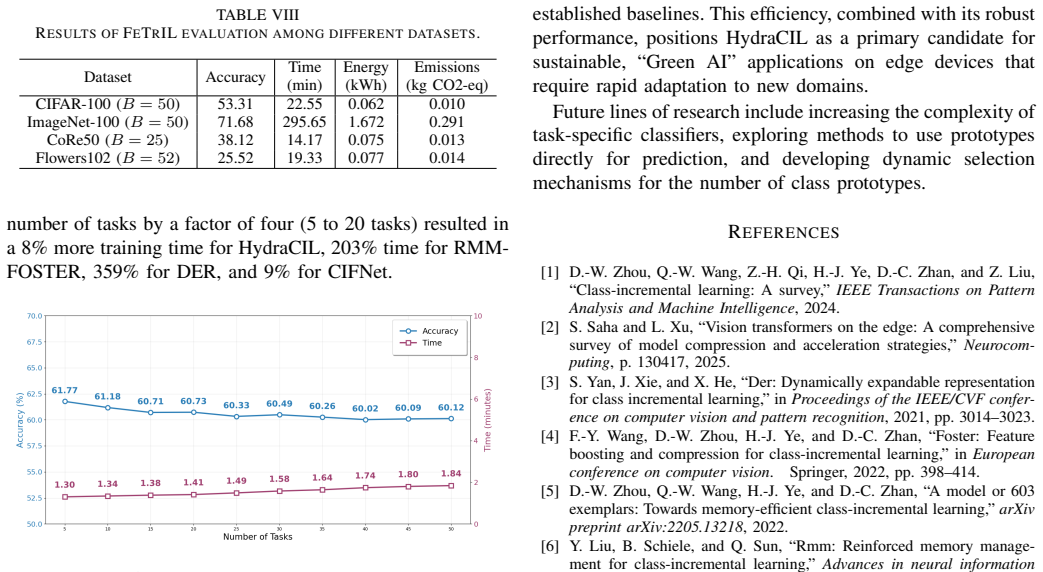
- Accuracy matches or exceeds prior state-of-the-art CIL methods on CIFAR-100, ImageNet-100, CoRe50, and Flowers102.
- Training time drops because the backbone is never retrained after the initial pass.
- Carbon footprint decreases due to the reduction in repeated forward and backward passes through the full model.
- The approach supports rapid adaptation on embedded devices with limited compute and energy budgets.
Reading between the lines
- The fixed backbone may improve stability across many tasks by preventing drift in earlier representations.
- Memory growth remains linear with the number of heads but stays modest because each head is lightweight.
- The prototype routing mechanism could be tested on streaming data where task boundaries are unknown.
Editorial analysis
A structured set of objections, weighed in public.
Referee Report
Summary. The paper proposes HydraCIL, a decoupled class-incremental learning method that freezes a pre-trained backbone, extracts features once per task to train lightweight prototype-guided multi-head classifiers, and selects the appropriate head at inference via prototype similarity. It claims this achieves performance matching or exceeding state-of-the-art CIL methods on CIFAR-100, ImageNet-100, CoRe50, and Flowers102 while substantially reducing training time and carbon footprint, targeting resource-constrained embedded deployment.
Significance. If the accuracy claims are substantiated with rigorous metrics and the frozen-feature assumption holds, the work would offer a practical route to low-cost continual learning on edge devices by eliminating backbone retraining, directly addressing energy and latency constraints in real-world CIL applications.
major comments (1)
- [Experiments] The central performance claim rests on the untested assumption that features from the frozen backbone remain sufficiently discriminative and linearly separable for new classes; the paper evaluates only on benchmarks (CIFAR-100, ImageNet-100) whose pre-training overlap is high and does not report results under distribution shift that would stress this assumption.
Simulated Author's Rebuttal
We thank the referee for highlighting the importance of validating the frozen-backbone assumption under distribution shift. We address the concern directly below and commit to strengthening the experimental section.
read point-by-point responses
-
Referee: [Experiments] The central performance claim rests on the untested assumption that features from the frozen backbone remain sufficiently discriminative and linearly separable for new classes; the paper evaluates only on benchmarks (CIFAR-100, ImageNet-100) whose pre-training overlap is high and does not report results under distribution shift that would stress this assumption.
Authors: We acknowledge that CIFAR-100 and ImageNet-100 exhibit substantial pre-training overlap with typical ImageNet-initialized backbones. However, the manuscript also reports results on CoRe50 (robotic manipulation objects) and Flowers102 (fine-grained natural images), which introduce measurable domain shifts relative to standard pre-training corpora. To directly test the assumption under stronger distribution shift, we will add new experiments in the revision using datasets with greater domain gaps (e.g., medical or satellite imagery) and will include quantitative measures of feature separability (e.g., linear probe accuracy and prototype cosine similarity statistics) for both in-distribution and shifted tasks. These additions will be placed in a new subsection of the experimental analysis. revision: yes
Circularity Check
No circularity in claimed derivation or predictions
full rationale
The paper describes an engineering method (freeze backbone, extract features once per task, train lightweight prototype-guided heads, select at inference by similarity) and validates it empirically on standard benchmarks. No equations, first-principles derivations, or statistical predictions are presented that reduce by construction to fitted inputs or self-citations. The central design choices are explicit architectural decisions, not outputs claimed to be derived from prior results within the paper. External benchmarks provide independent falsifiability, so the work is self-contained with no load-bearing circular steps.
Assumptions & free parameters
assumptions (1)
- domain assumption Frozen backbone features remain adequate for new classes without retraining
Cite this review
Pith. "Pith review of HydraCIL: Decoupled Class-Incremental Learning through Prototype-Guided Multi-Head Classifiers." pith.science (2026). https://pith.science/paper/FB5M7PCJ
@misc{pith2026260609960,
  author       = {Pith},
  title        = {Pith review of: HydraCIL: Decoupled Class-Incremental Learning through Prototype-Guided Multi-Head Classifiers},
  year         = {2026},
  howpublished = {\url{https://pith.science/paper/FB5M7PCJ}},
  note         = {Machine review of arXiv:2606.09960}
}
read the original abstract
We present HydraCIL, a decoupled continual learning model based on prototype-guided multi-head classifiers, targeting sustainable deployment in embedded and resource-constrained environments. While most Class-Incremental Learning (CIL) methods rely on powerful hardware and long retraining cycles, real-world systems, such as robots or edge AI devices, must adapt quickly with limited resources. HydraCIL addresses this gap by freezing the backbone and decoupling feature extraction from learning. For each task, features are extracted once and a lightweight, task-specific classifier head is created, avoiding costly backbone retraining. At inference, HydraCIL selects the appropriate head via similarity with prototypes. Experiments on CIFAR-100, ImageNet-100, CoRe50, and Flowers102 datasets show that HydraCIL matches or outperforms state-of-the-art CIL methods while significantly reducing training time and carbon footprint, making it a practical solution for continual learning in real-world and embedded settings, where energy efficiency and rapid adaptation are critical.
Figures
Reference graph
Works this paper leans on
-
[1]
Class-incremental learning: A survey,
D.-W. Zhou, Q.-W. Wang, Z.-H. Qi, H.-J. Ye, D.-C. Zhan, and Z. Liu, “Class-incremental learning: A survey,”IEEE Transactions on Pattern Analysis and Machine Intelligence, 2024
2024
-
[2]
Vision transformers on the edge: A comprehensive survey of model compression and acceleration strategies,
S. Saha and L. Xu, “Vision transformers on the edge: A comprehensive survey of model compression and acceleration strategies,”Neurocom- puting, p. 130417, 2025
2025
-
[3]
Der: Dynamically expandable representation for class incremental learning,
S. Yan, J. Xie, and X. He, “Der: Dynamically expandable representation for class incremental learning,” inProceedings of the IEEE/CVF confer- ence on computer vision and pattern recognition, 2021, pp. 3014–3023
2021
-
[4]
Foster: Feature boosting and compression for class-incremental learning,
F.-Y . Wang, D.-W. Zhou, H.-J. Ye, and D.-C. Zhan, “Foster: Feature boosting and compression for class-incremental learning,” inEuropean conference on computer vision. Springer, 2022, pp. 398–414
2022
-
[5]
A model or 603 exemplars: Towards memory-efficient class-incremental learning,
D.-W. Zhou, Q.-W. Wang, H.-J. Ye, and D.-C. Zhan, “A model or 603 exemplars: Towards memory-efficient class-incremental learning,”arXiv preprint arXiv:2205.13218, 2022
-
[6]
Rmm: Reinforced memory manage- ment for class-incremental learning,
Y . Liu, B. Schiele, and Q. Sun, “Rmm: Reinforced memory manage- ment for class-incremental learning,”Advances in neural information processing systems, vol. 34, pp. 3478–3490, 2021
2021
-
[7]
Self-sustaining representation expansion for non-exemplar class-incremental learning,
K. Zhu, W. Zhai, Y . Cao, J. Luo, and Z.-J. Zha, “Self-sustaining representation expansion for non-exemplar class-incremental learning,” inProceedings of the IEEE/CVF conference on computer vision and pattern recognition, 2022, pp. 9296–9305
2022
-
[8]
Fetril: Feature translation for exemplar-free class-incremental learning,
G. Petit, A. Popescu, H. Schindler, D. Picard, and B. Delezoide, “Fetril: Feature translation for exemplar-free class-incremental learning,” in Proceedings of the IEEE/CVF winter conference on applications of computer vision, 2023, pp. 3911–3920
2023
Show all 18 references
-
[9]
Representation robustness and feature expansion for exemplar-free class-incremental learning,
Y . Luo, H. Ge, Y . Liu, and C. Wu, “Representation robustness and feature expansion for exemplar-free class-incremental learning,”IEEE Transactions on Circuits and Systems for Video Technology, vol. 34, no. 7, pp. 5306–5320, 2023
2023
-
[10]
How efficient are today’s continual learning algorithms?
M. Y . Harun, J. Gallardo, T. L. Hayes, and C. Kanan, “How efficient are today’s continual learning algorithms?” inProceedings of the IEEE/CVF Conference on Computer Vision and Pattern Recognition, 2023, pp. 2431–2436
2023
-
[11]
Remind your neural network to prevent catastrophic forgetting,
T. L. Hayes, K. Kafle, R. Shrestha, M. Acharya, and C. Kanan, “Remind your neural network to prevent catastrophic forgetting,” inEuropean conference on computer vision. Springer, 2020, pp. 466–483
2020
-
[12]
Efficient single-step framework for incremental class learning in neural networks,
A. Dopico-Castro, O. Fontenla-Romero, B. Guijarro-Berdiñas, and A. Alonso-Betanzos, “Efficient single-step framework for incremental class learning in neural networks,”arXiv preprint arXiv:2509.11285, 2025
2025
-
[13]
mlco2/codecarbon: v2.4.1,
B. Courty, V . Schmidt, S. Luccioni, K. Goyal, M. Coutarel, B. Feld, J. Lecourt, L. Connell, A. Saboni, Inimaz, supatomic, M. Léval, L. Blanche, A. Cruveiller, ouminasara, F. Zhao, A. Joshi, A. Bogroff, H. de Lavoreille, N. Laskaris, E. Abati, D. Blank, Z. Wang, A. Catovic, M....
2024 doi
-
[14]
Imagenet: A large-scale hierarchical image database,
J. Deng, W. Dong, R. Socher, L.-J. Li, K. Li, and L. Fei-Fei, “Imagenet: A large-scale hierarchical image database,” in2009 IEEE conference on computer vision and pattern recognition. IEEE, 2009, pp. 248–255
2009
-
[15]
Learning multiple layers of features from tiny images,
A. Krizhevsky, G. Hintonet al., “Learning multiple layers of features from tiny images,” 2009
2009
-
[16]
Core50: a new dataset and benchmark for continuous object recognition,
V . Lomonaco and D. Maltoni, “Core50: a new dataset and benchmark for continuous object recognition,” inConference on robot learning. PMLR, 2017, pp. 17–26
2017
-
[17]
Automated flower classification over a large number of classes,
M.-E. Nilsback and A. Zisserman, “Automated flower classification over a large number of classes,” in2008 Sixth Indian conference on computer vision, graphics & image processing. IEEE, 2008, pp. 722–729. 6
2008
-
[18]
Fast and frugal transfer learning via precomputed features and adaptive normal- ization,
D. Vila-Cruz, V . Bolón-Canedo, and L. Morán-Fernández, “Fast and frugal transfer learning via precomputed features and adaptive normal- ization,” inInternational Conference on Intelligent Data Engineering and Automated Learning. Springer, 2025, pp. 143–149. 7
2025
Reviewed June 27, 2026 · model on record in the stance chip above.
Discussion (0). Continue with ORCID to comment.