REVIEW 4 major objections 7 minor 97 references
Study the Longitudinal Entropy Deposition using d+Au Collision
T0 review · 4 major / 7 minor · reviewed 2026-07-31 · grok-4.5
Pith's one-line read A longitudinal entropy model with deposition coefficient β and collision-number-dependent rapidity loss lets hydrodynamics match charged-particle rapidity distributions in asymmetric d+Au collisions.
desk verdict Useful calibrated 3D entropy ansatz for asymmetric systems; the deuteron wavefunction is careful but not the lever, and “universality” is weaker than the abstract sells. read the letter →
The pith
A machine-rendered reading of the paper's core claim, the machinery that carries it, and where it could break.
The reading
What carries the argument
The three-component 3D entropy density (Eq. 15): wounded-nucleon Gaussians from each nucleus plus a mid-rapidity plateau term proportional to (sum of left thicknesses × sum of right thicknesses)^β, with beam-directed Gaussians whose centers are shifted by an n_BC-dependent rapidity loss on the light side.
What would settle it
Apply the identical β=0.35 and n_BC-dependent rapidity-loss form, without retuning the longitudinal envelope, to measured dNch/dη in O+O or Ne+Ne at LHC energies; a clear failure across centralities would falsify the claimed universality of the deposition mechanism.
Extended reading notes
Core claim
The paper establishes that charged-particle pseudorapidity distributions in d+Au collisions at 200 GeV are reproduced across centralities once the initial entropy density includes an interaction term scaled by a transverse deposition coefficient β ≈ 0.35 and a rapidity loss on the deuteron side that increases with the number of binary collisions; the same longitudinal deposition form, with β raised to 0.5, also describes p+Au, 3He+Au, and Au+Au without a full re-fit of the longitudinal shape.
Load-bearing premise
The mid-rapidity entropy is assumed to scale as the product of nuclear thicknesses raised to a single adjustable power β that can be lowered from the theoretically motivated value 0.5 down to 0.35 by fitting the same multiplicity data the model is meant to explain.
Editorial extensions
If this is right
- The same longitudinal entropy prescription can be used as the initial condition for O+O, Ne+Ne, and Pb+Ne collisions at the LHC.
- With a reliable longitudinal profile, differences in final-state flow and multiplicity can be attributed more cleanly to the nuclear structure of light projectiles.
- Small systems appear to require a smaller entropy deposition coefficient (β≈1/3) than large systems (β=1/2), giving a concrete handle on incomplete energy-to-entropy conversion.
- Centrality can be assigned from the initial longitudinal entropy in the forward rapidity window rather than from full hydrodynamic runs, reducing computational cost.
Reading between the lines
- If β truly tracks system size, a continuous scan from p+A through intermediate systems to A+A should show a smooth rise of the preferred β toward 0.5, offering a diagnostic of when the fireball becomes fully hydrodynamic.
- The n_BC-dependent rapidity loss on the light side is effectively a baryon-stopping proxy; the same functional form could be tested against net-proton rapidity distributions once those data are included.
- Because the realistic deuteron wave function changes initial eccentricities but barely changes dNch/dη, longitudinal multiplicity is a weak probe of light-nucleus structure, while flow harmonics remain the sharper observable.
Signed reviews
Editorial analysis
A structured set of objections, weighed in public.
Referee Report
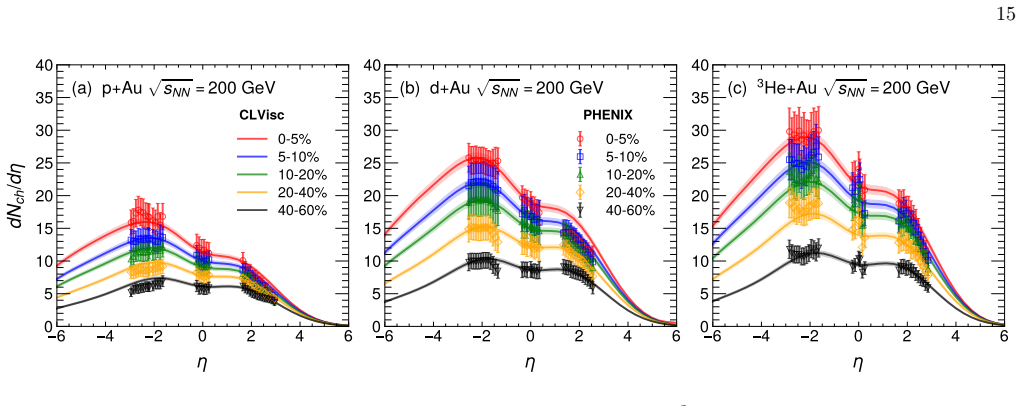
Summary. The manuscript addresses a recognized deficiency of (3+1)D hydrodynamic simulations: the failure of factorized (transverse × longitudinal envelope) initial conditions to reproduce charged-particle pseudorapidity distributions in asymmetric d+Au collisions at √s_NN = 200 GeV. The authors (i) sample deuteron configurations from an ab initio Argonne-v18 wavefunction including S–D interference (finding, honestly, that this has negligible effect on dNch/dη), and (ii) introduce a modified 3D entropy deposition ansatz (Eq. 15) with a wounded-nucleon term, a binary-overlap term raised to a power β, and a rapidity-loss shift on the deuteron side that scales linearly with the number of binary collisions n_BC (Eq. 18). With β = 0.35 and the n_BC-dependent loss (set (d), Table I), CLVisc(+SMASH) reproduces PHOBOS dNch/dη in five centrality classes, plus PHENIX identified spectra and v_n. The same framework is then applied to p+Au, ³He+Au (Fig. 13) and Au+Au (Appendix A, with β reset to 0.5 and a two-sided n_BC-dependent loss), and good agreement is reported throughout. The authors claim this demonstrates "excellent universality" of the deposition mechanism.
Significance. If the central claims hold at the stated strength, the work is a useful contribution: simultaneous hydrodynamic descriptions of dNch/dη across d+Au centralities have been a persistent failure mode for 3D initial-condition models, and a working, openly specified parametric ansatz with event-by-event CLVisc+SMASH evolution, an explicit centrality-classification cross-check (Figs. 4–6), and coverage of spectra and v_n in four collision systems is of practical value to the community, including for upcoming O+O/Ne+Ne studies. The negative result on the deuteron wavefunction (DWF vs HWF, Figs. 7–8) is also worth publishing. However, the evidence for the headline "universality" claim is weaker than stated: the d+Au agreement is an acknowledged multi-parameter fit (β lowered from the motivated 0.5 to 0.35 on the same data being described, with g_L, g_R, g_P, η_plat, σ_ηgw, σ co-tuned), and the Au+Au application changes both β and the functional architecture of the rapidity-loss term. The paper's strength is a well-executed phenomenological fit with partial transfer; it is not a parameter-free or mechanism-validating result, and the abstract and summary should say so.
major comments (4)
- [Sec. III.D and Appendix A (universality claim)] The claim of 'excellent universality ... without further adjustments' (Sec. III.D) is not supported by the Au+Au application. In Appendix A the authors (i) change β from 0.35 back to 0.5, and (ii) restructure the rapidity-loss term from one-sided (only the deuteron side carries n_BC dependence, with ∆η_L^s fixed at 1.36 for Au) to two-sided with new baselines ∆η_L^s = ∆η_R^s = 4.36. Changing both the exponent and the functional form of the loss term is a re-fit of the deposition shape, not a transfer of a calibrated mechanism. Note also the internal inconsistency this creates: the same Au nucleus is assigned ∆η^s = 1.36 when struck by a deuteron but 4.36 when struck by another Au nucleus. The authors should either (a) demonstrate what the unmodified set (d) predicts for Au+Au and quantify the failure, or (b) remove the universality language from the abstract/Summary and present the Au+Au
- [Sec. II.B, Eq. (18)] The normalization (n_BC − n_min)/(n_max − n_min) with n_min, n_max 'observed across all events' is recomputed separately for each collision system. This means the projectile-side rapidity loss is silently re-anchored to each system's own n_BC distribution even in the p+Au and ³He+Au applications that are presented as zero-adjustment predictions. For p+Au, where the projectile is a single nucleon with a broad n_BC distribution, this rescaling is presumably doing real work in the forward-rapidity slope. The authors should quantify this: show the p+Au/³He+Au dNch/dη obtained with the d+Au-derived ∆η_R^s(n_BC) map applied without re-normalization, so the reader can see how much of the Fig. 13 agreement is genuine transfer versus per-system re-anchoring.
- [Sec. II.B, Eqs. (19)–(21) vs. fitted β = 0.35] The physical motivation for β is internally strained. Eqs. (19)–(21) derive (T_A T_B)^{1/2} scaling for the deposited energy from the energy-flux argument, and the free-streaming paragraph argues the entropy inherits this dependence, motivating β = 0.5. The d+Au fit then requires β = 0.35, for which no derived counterpart exists; the Summary's interpretation ('not all energy from the central fireball is converted into final-state particles') is post hoc and not connected to any mechanism in the text. Since β is the paper's central new ingredient, the authors should either provide a physical argument for a system-dependent β ≈ 1/3 in small systems (e.g., from the transverse-density dependence of energy-to-entropy conversion, which their own free-streaming argument flags as an assumption), or state plainly that β is an empirical exponent and remove the Eqs. (19)–(21) derivation's implied e
- [Sec. II.B, Table I and Sec. III.B (parameter tuning)] The parameter-tuning procedure is under-documented relative to the weight it carries. Table I shows that sets (a)–(d) vary only β and the loss structure, but the values g_L = g_R = 8.0, g_P = 22.5, η_plat = 1.3, σ_ηgw = 1.3, σ = 2.5, ∆η_L^s = 1.36, ∆η_R^s = 4.36 must themselves have been tuned to the same PHOBOS dNch/dη family, and the stated constraint g_L = g_R 'ensures longitudinal symmetry' is puzzling for an intrinsically asymmetric system. Please (i) describe how these values were obtained and how many effective degrees of freedom the final agreement in Fig. 9(d) represents relative to the five-centrality data; (ii) explain the rationale for g_L = g_R in d+Au; and (iii) justify using the parameter set selected at T_frz = 128 MeV without afterburner (Fig. 9) for the T_frz = 150 MeV CLVisc+SMASH production runs (Fig. 10) without re-checking optimality.
minor comments (7)
- [Sec. II.A–II.B (notation)] The symbol β is used both for the Hulthén wavefunction parameter (Eq. 2, β = 1.18 fm⁻¹) and for the entropy deposition coefficient (Eq. 15). Please rename one of them.
- [Eq. (18)] In Eq. (18) the symbol ∆η_R^s denotes both the n_BC-dependent function (left-hand side) and the constant baseline (right-hand side). Please distinguish them, e.g., ∆η_R^s(n_BC) = f(n_BC) + ∆η_R^{s,0}.
- [Fig. 5] The fit annotation reads 'R /two.superior= 0.995', presumably a rendering error for R². Also the non-zero intercept (−0.505) is noted but its physical implication for the centrality-classification assumption is not discussed; a sentence would help.
- [Fig. 13] The d+Au panel (b) uses PHENIX data with centrality classes 0–5%, ..., 40–60% and the −3.9 < η < −3.1 centrality definition, whereas Figs. 9–10 use PHOBOS classes 0–20%, ..., 80–100% defined via 3.0 < |η| < 5.4. Please state explicitly that the centrality-classification procedure of Sec. II.C was redone for the PHENIX definition, and comment on whether set (d) remains optimal under it.
- [Fig. 12 caption] Axis label reads 'Gev' instead of 'GeV'; several spacing artifacts appear in the text ('RESUL TS', 'T RENTo', 'sa mpling', 'CL Visc'). Please proofread.
- [Sec. III.C, Figs. 11–12] The discussion of the π⁺ underestimate at p_T ≳ 1.6 GeV and of v₂ at high p_T appropriately cites coalescence and subnucleon fluctuations; it would strengthen the paper to state whether these shortcomings are expected to feed back on the fitted β/∆η values if addressed.
- [Sec. III.A] TRENTo-2D is used only for Fig. 7, but it is not stated which TRENTo parameters (p, k, σ_w, etc.) were used for that comparison, making the DWF/HWF eccentricity comparison hard to reproduce.
Circularity Check
d+Au dNch/dη success is a multi-parameter fit (β scanned off the motivated 0.5; g’s and envelope co-tuned); “universality” re-sets β and the loss architecture for Au+Au and re-anchors Eq. 18 per system.
-
fitted input called prediction
[Sec. II.B Table I; Sec. III.B Fig. 9 panels (a)–(d); Abstract]
"With parameter set (a) (fixed ∆ηL_s=1.36, ∆ηR_s=4.36 and β=0.5), the simulation partially reproduces central collisions... Set (c) (...β=0.35) further enhances agreement across all centralities. In set (d), we introduce a binary collision number (nBC)-dependent ∆ηR_s ... while keeping β=0.35. This further improves the description... making set (d) the optimal choice... successfully reproduce the experimental charged-particle pseudorapidity distributions across five centrality classes with β=0.35"
β is first motivated as 0.5 from (T_A T_B)^{1/2}, then lowered through {0.5,0.4,0.35} and paired with n_BC-dependent Δη_R specifically to match the same PHOBOS dNch/dη curves the model claims to explain; g_L,g_R,g_P and envelope parameters are co-tuned in the same table. The reported d+Au agreement is therefore a fit to that observable family, not an out-of-sample prediction from the motivated exponent.
-
fitted input called prediction
[Appendix A (Au+Au); Abstract universality claim; Eq. (18)]
"The baseline parameter set (d) is retained, while the entropy deposition coefficient is optimized to β=0.5 to accommodate the larger system size... We therefore extend the n_BC-dependent rapidity loss parametrization to both sides, in contrast to the d+Au case where only the deuteron side carries this dependence... with the constant baseline values ∆ηL_s=∆ηR_s=4.36. ... this longitudinal entropy deposition framework demonstrates excellent universality, as validated in p+Au, 3He+Au, and Au+Au collisions."
Universality is advertised as validation without a full re-fit, but Au+Au changes both the load-bearing exponent (β: 0.35→0.5) and the functional architecture of rapidity loss (one-sided→two-sided, baselines 1.36/4.36→4.36/4.36). That is a re-optimization of the deposition shape on the target system, so the Au+Au dNch/dη agreement is not a pure transfer of the d+Au-calibrated mechanism.
2 more flagged steps
-
fitted input called prediction
[Sec. II.B Eq. (18); Sec. III.D (p+Au, 3He+Au “without further adjustments”)]
"∆ηR_s(nBC)=(nBC−nmin_BC)/(nmax_BC−nmin_BC)+∆ηR_s ... nmin_BC and nmax_BC denote the minimum and maximum values observed across all events, respectively. ... Without further adjustments, the model is then applied to predict pseudorapidity distributions in p+Au, d+Au and 3He+Au collisions"
Even the zero-adjustment small-system transfer re-anchors projectile-side rapidity loss to each collision system’s own observed (n_min, n_max) via Eq. 18. The normalization is therefore system-specific by construction; for p+Au (single projectile nucleon) that rescaling does real work on the forward slope while being presented as unchanged parameters.
-
fitted input called prediction
[Sec. IV Summary; Sec. II.B Eqs. (19)–(21)]
"This assumption stems from... the total initial energy deposition is expected to locally scale as (T_A T_B)^{1/2}. ... This motivates β=0.5 as a representative exponent... In small-system collisions, a conversion factor of β≈1/3 may be more appropriate, whereas in Au+Au collisions, β=1/2, suggesting that smaller systems require a smaller entropy deposition coefficient."
The only derived value is β=0.5. The working small-system value β≈1/3 is obtained by fitting dNch/dη; the summary then elevates that fitted number into a physical finding (“smaller systems require smaller β” / “not all energy converted”). The interpretation is post hoc renaming of the fit, not an independent derivation.
full rationale
The paper’s flagship claim is that a new longitudinal entropy deposition form with coefficient β and n_BC-dependent rapidity loss, evolved in CLVisc(+SMASH), reproduces PHOBOS d+Au dNch/dη across five centralities and then transfers to p+Au, 3He+Au, and Au+Au. The physical motivation for β=0.5 from free-streaming inheritance of (T_A T_B)^{1/2} (Eqs. 19–21) is independent and non-circular. What is circular in the fitted-input sense is that the working d+Au description is obtained by scanning β∈{0.5,0.4,0.35} and enabling n_BC-dependent Δη_R on the same dNch/dη family being explained (Table I, Fig. 9), with g_L, g_R, g_P, plateau and Gaussian widths co-tuned. The abstract and results then present that agreement as model success with β=0.35. The universality leg is only partially independent: p+Au/3He+Au keep the d+Au-calibrated shape (stronger evidence), but Eq. 18 silently re-normalizes Δη by each system’s own (n_min, n_max), and Au+Au explicitly re-optimizes β→0.5 and switches from one-sided to two-sided n_BC-dependent loss with new baselines. The paper itself labels the framework phenomenological and fit to d+Au, which limits the severity; the circularity is classic “fit called prediction / partial re-fit called transfer,” not definitional tautology or self-citation uniqueness. Score 6.
Assumptions & free parameters
free parameters (6)
- entropy deposition exponent β =
0.35 (d+Au/small systems); 0.5 (Au+Au)
- g_L, g_R, g_P weighting coefficients =
8.0, 8.0, 22.5
- baseline rapidity losses Δη_L^s, Δη_R^s and n_BC map =
Δη_L=1.36; Δη_R baseline 4.36 + n_BC scaling (Eq. 18)
- longitudinal envelope shape (η_plat_s, σ_ηgw, σ) =
1.3, 1.3, 2.5
- transverse Gaussian width σ_⊥ =
0.5 fm
- η/s, τ0, T_frz =
η/s=0.08; τ0=0.6 fm; T_frz=0.15 GeV (d+Au+SMASH) or 0.128 GeV
assumptions (5)
- domain assumption Israel-Stewart viscous hydrodynamics with lattice-pce165 EOS, neglecting bulk viscosity and net baryon current at 200 GeV, adequately describes bulk evolution once the initial entropy is fixed.
- ad hoc to paper Initial entropy density can be written as a linear combination of wounded-nucleon Gaussians plus a β-powered product term with factorized longitudinal envelopes f_L, f_R, f_plat.
- domain assumption At early times free-streaming Bjorken expansion preserves the local (T_A T_B)^{1/2} scaling of deposited energy into entropy, motivating β near 1/2.
- domain assumption Sorting events by integrated initial dS/dη_s in 3.0<|η_s|<5.4 reproduces experimental centrality ordering based on forward charged multiplicity.
- standard math Deuteron configurations may be Monte-Carlo sampled from the Argonne-v18-based S+D wave function including Y00–Y20 interference.
invented entities (2)
-
β-scaled binary-overlap entropy term in the 3D IC
-
n_BC-dependent rapidity-loss map Δη_R^s(n_BC)
Cite this review
Pith. "Pith review of Study the Longitudinal Entropy Deposition using d+Au Collision." pith.science (2026). https://pith.science/paper/FC5AZALF
@misc{pith2026260724153,
  author       = {Pith},
  title        = {Pith review of: Study the Longitudinal Entropy Deposition using d+Au Collision},
  year         = {2026},
  howpublished = {\url{https://pith.science/paper/FC5AZALF}},
  note         = {Machine review of arXiv:2607.24153}
}
abstract
Relativistic hydrodynamics successfully describes bulk observables in symmetric heavy-ion collisions, but struggles to reproduce charged-particle rapidity distributions in asymmetric systems such as d+Au collisions. To address this challenge, we introduce two key improvements to the initial-state modeling: sampling deuteron configurations from an ab initio wavefunction, and developing a new longitudinal entropy deposition model that incorporates a transverse entropy deposition coefficient $\beta$ and a rapidity loss term scaling with the number of binary collisions $n_{\rm BC}$. Using the (3+1)-dimensional viscous hydrodynamic model CLVisc coupled with the SMASH afterburner, we simulate d+Au collisions at $\sqrt{s_{\rm NN}} = 200$ GeV and successfully reproduce the experimental charged-particle pseudorapidity distributions across five centrality classes with $\beta = 0.35$, as well as the transverse momentum spectra and anisotropic flow $v_n$. The entropy deposition coefficient $\beta$ and the $n_{\rm BC}$-dependent rapidity loss are found to play crucial roles in achieving this agreement. Furthermore, this longitudinal entropy deposition framework demonstrates excellent universality, as validated in p+Au, $^3$He+Au, and Au+Au collisions. Our entropy deposition mechanism could be widely applied to recent light-nucleus collisions such as O+O, Ne+Ne, and asymmetric systems like Pb+Ne at LHC energies, thereby better constraining the nuclear structure of light nuclei through an improved longitudinal description.
Figures


Figures from the paper (13 more)




Reference graph
Works this paper leans on
-
[1]
Vacuum Stability and Vac- uum Excitation in a Spin 0 Field Theory,
T. D. Lee and G. C. Wick, “Vacuum Stability and Vac- uum Excitation in a Spin 0 Field Theory,” Phys. Rev. D 9, 2291–2316 (1974)
1974
-
[2]
Quantum Chromodynamics and the Theory of Superdense Matter,
Edward V. Shuryak, “Quantum Chromodynamics and the Theory of Superdense Matter,” Phys. Rept.61, 71– 158 (1980)
1980
-
[3]
Heavy Ion Collisions: The Big Picture, and the Big Questions,
Wit Busza, Krishna Rajagopal, and Wilke van der Schee, “Heavy Ion Collisions: The Big Picture, and the Big Questions,” Ann. Rev. Nucl. Part. Sci.68, 339–376 (2018), arXiv:1802.04801 [hep-ph]
arXiv 2018
-
[4]
John Adamset al.(STAR), “Experimental and theoret- ical challenges in the search for the quark gluon plasma: The STAR Collaboration’s critical assessment of the evi- dence from RHIC collisions,” Nucl. Phys. A757, 102–183 (2005), arXiv:nucl-ex/0501009
arXiv 2005
-
[5]
Quadrupole Anisotropy in Dihadron Azimuthal Correlations in Centrald+AuCol- lisions at √sNN=200 GeV,
A. Adareet al.(PHENIX), “Quadrupole Anisotropy in Dihadron Azimuthal Correlations in Centrald+AuCol- lisions at √sNN=200 GeV,” Phys. Rev. Lett.111, 212301 (2013), arXiv:1303.1794 [nucl-ex]
arXiv 2013
-
[6]
Long-range pseudo- rapidity dihadron correlations ind+Au collisions at√sNN = 200 GeV,
L. Adamczyket al.(STAR), “Long-range pseudo- rapidity dihadron correlations ind+Au collisions at√sNN = 200 GeV,” Phys. Lett. B747, 265–271 (2015), arXiv:1502.07652 [nucl-ex]
arXiv 2015
-
[7]
Scaling of charged particle production in d + Au collisions at √sNN = 200 GeV,
B. B. Backet al.(PHOBOS), “Scaling of charged particle production in d + Au collisions at √sNN = 200 GeV,” Phys. Rev. C72, 031901 (2005), arXiv:nucl-ex/0409021
arXiv 2005
-
[8]
I. Arseneet al.(BRAHMS), “Centrality dependence of charged particle pseudorapidity distributions from d+Au collisions at √sNN = 200 GeV,” Phys. Rev. Lett.94, 032301 (2005), arXiv:nucl-ex/0401025
arXiv 2005
Show all 97 references
-
[9]
Pseudorapidity asymmetry and centrality dependence of charged hadron spectra in d + Au collisions at √sNN = 200 GeV,
J. Adamset al.(STAR), “Pseudorapidity asymmetry and centrality dependence of charged hadron spectra in d + Au collisions at √sNN = 200 GeV,” Phys. Rev. C70, 064907 (2004), arXiv:nucl-ex/0408016
2004 arXiv
-
[10]
Charged particle distribu- tions and nuclear modification at high rapidities in d + Au collisions at √sNN = 200-GeV,
B. I. Abelevet al.(STAR), “Charged particle distribu- tions and nuclear modification at high rapidities in d + Au collisions at √sNN = 200-GeV,” (2007), arXiv:nucl- ex/0703016
2007
-
[11]
Zi-wei Lin, Subrata Pal, C. M. Ko, Bao-An Li, and Bin Zhang, “Multiphase transport model for heavy ion col- 16 5 0 5 0 100 200 300 400 500 600 700 800 900 dNch/d 0-6% 6-15% 15-25% 25-35% 35-45% Au+Au √ sNN =200 GeV CLVisc, =0.5 PHOBOS FIG. 14. (Color online) Charged particle m...
2002 arXiv
-
[12]
Deuteron nucleus colli- sions in a multiphase transport model,
Zi-wei Lin and Che Ming Ko, “Deuteron nucleus colli- sions in a multiphase transport model,” Phys. Rev. C 68, 054904 (2003), arXiv:nucl-th/0301025
2003 arXiv
-
[13]
Multiplic- ity Distributions in Nucleus Nucleus Collisions at High- Energies,
A. Bialas, M. Bleszynski, and W. Czyz, “Multiplic- ity Distributions in Nucleus Nucleus Collisions at High- Energies,” Nucl. Phys. B111, 461–476 (1976)
1976
-
[14]
Wounded quark emission function at the top energy available at the BNL Relativistic Heavy Ion Collider,
Michal Barej, Adam Bzdak, and Pawel Gutowski, “Wounded quark emission function at the top energy available at the BNL Relativistic Heavy Ion Collider,” Phys. Rev. C97, 034901 (2018), arXiv:1712.02618 [hep- ph]
2018 arXiv
-
[15]
Forward- backward multiplicity fluctuations in ultrarelativistic nuclear collisions with wounded quarks and fluctu- ating strings,
Martin Rohrmoser and Wojciech Broniowski, “Forward- backward multiplicity fluctuations in ultrarelativistic nuclear collisions with wounded quarks and fluctu- ating strings,” Phys. Rev. C99, 024904 (2019), arXiv:1809.08666 [nucl-th]
2019 arXiv
-
[16]
Wounded nucleon, quark, and quark-diquark emission functions versus experimental results from the BNL Rel- ativistic Heavy Ion Collider at √sN N=200 GeV,
Michal Barej, Adam Bzdak, and Pawel Gutowski, “Wounded nucleon, quark, and quark-diquark emission functions versus experimental results from the BNL Rel- ativistic Heavy Ion Collider at √sN N=200 GeV,” Phys. Rev. C100, 064902 (2019), arXiv:1904.01435 [hep-ph]
2019 arXiv
-
[17]
Hadron production in p+p, p+Pb, and Pb+Pb collisions with the HIJING 2.0 model at energies available at the CERN Large Hadron Collider,
Wei-Tian Deng, Xin-Nian Wang, and Rong Xu, “Hadron production in p+p, p+Pb, and Pb+Pb collisions with the HIJING 2.0 model at energies available at the CERN Large Hadron Collider,” Phys. Rev. C83, 014915 (2011), arXiv:1008.1841 [hep-ph]
2011 arXiv
-
[18]
Pseudo-rapidity distributions of charged particles in asymmetric collisions using Tsallis thermodynamics,
Jun Qi Tao, Hong Bin He, Hua Zheng, Wen Chao Zhang, Xing Quan Liu, Li Lin Zhu, and Aldo Bonasera, “Pseudo-rapidity distributions of charged particles in asymmetric collisions using Tsallis thermodynamics,” Nucl. Sci. Tech.34, 172 (2023)
2023
-
[19]
Pseudorapidity distribution and decorrelation of anisotropic flow within the open-computing-language im- plementation CL Visc hydrodynamics,
Long-Gang Pang, Hannah Petersen, and Xin-Nian Wang, “Pseudorapidity distribution and decorrelation of anisotropic flow within the open-computing-language im- plementation CL Visc hydrodynamics,” Phys. Rev. C97, 064918 (2018), arXiv:1802.04449 [nucl-th]
2018 arXiv
-
[20]
Collectivity and elec- tromagnetic radiation in small systems,
Chun Shen, Jean-Franχcois Paquet, Gabriel S. Denicol, Sangyong Jeon, and Charles Gale, “Collectivity and elec- tromagnetic radiation in small systems,” Phys. Rev. C 95, 014906 (2017), arXiv:1609.02590 [nucl-th]
2017 arXiv
-
[21]
Collision-geometry- based 3D initial condition for relativistic heavy- ion collisions,
Chun Shen and Sahr Alzhrani, “Collision-geometry- based 3D initial condition for relativistic heavy- ion collisions,” Phys. Rev. C102, 014909 (2020), arXiv:2003.05852 [nucl-th]
2020 arXiv
-
[22]
3D structure of anisotropic flow in small colli- sion systems at energies available at the BNL Relativistic Heavy Ion Collider,
Wenbin Zhao, Sangwook Ryu, Chun Shen, and Bj¨ orn Schenke, “3D structure of anisotropic flow in small colli- sion systems at energies available at the BNL Relativistic Heavy Ion Collider,” Phys. Rev. C107, 014904 (2023), arXiv:2211.16376 [nucl-th]
2023 arXiv
-
[23]
Alternative ansatz to wounded nucleon and bi- nary collision scaling in high-energy nuclear collisions,
J. Scott Moreland, Jonah E. Bernhard, and Steffen A. Bass, “Alternative ansatz to wounded nucleon and bi- nary collision scaling in high-energy nuclear collisions,” Phys.Rev.C92, 011901 (2015), arXiv:1412.4708 [nucl- th]
2015 arXiv
-
[24]
Bayesian calibration of a hybrid nuclear collision model using p-Pb and Pb-Pb data at energies available at the CERN Large Hadron Collider,
J. Scott Moreland, Jonah E. Bernhard, and Steffen A. Bass, “Bayesian calibration of a hybrid nuclear collision model using p-Pb and Pb-Pb data at energies available at the CERN Large Hadron Collider,” Phys. Rev. C101, 024911 (2020), arXiv:1808.02106 [nucl-th]
2020 arXiv
-
[25]
Bayesian parameter estimation with a new three- dimensional initial-conditions model for ultrarelativistic heavy-ion collisions,
Derek Soeder, Weiyao Ke, J.-F. Paquet, and Steffen A. Bass, “Bayesian parameter estimation with a new three- dimensional initial-conditions model for ultrarelativistic heavy-ion collisions,” (2023), arXiv:2306.08665 [nucl-th]
2023 arXiv
-
[26]
Mapping Nuclear Deformation with Differential Radial Flow in Heavy-Ion Collisions,
Jie Zhu, Xiang-Yu Wu, and Guang-You Qin, “Mapping Nuclear Deformation with Differential Radial Flow in Heavy-Ion Collisions,” (2026), arXiv:2602.04148 [nucl- th]
2026
-
[27]
Left-right splitting of elliptic flow in heavy ion collisions: TRENTo-3D initialization and CL Visc hydrodynamic simulations,
Ze-Fang Jiang, Xiang Fan, Duan She, Shasha Ye, and Ben-Wei Zhang, “Left-right splitting of elliptic flow in heavy ion collisions: TRENTo-3D initialization and CL Visc hydrodynamic simulations,” Phys. Rev. C112, 044906 (2025), arXiv:2505.14637 [nucl-th]
2025 arXiv
-
[28]
Evidence of Hexadecapole Deformation in Uranium-238 at the Relativistic Heavy Ion Collider,
Wouter Ryssens, Giuliano Giacalone, Bj¨ orn Schenke, and Chun Shen, “Evidence of Hexadecapole Deformation in Uranium-238 at the Relativistic Heavy Ion Collider,” Phys. Rev. Lett.130, 212302 (2023), arXiv:2302.13617 [nucl-th]
2023 arXiv
-
[29]
Probe nuclear structure using the anisotropic flow at the Large Hadron Collider,
Zhiyong Lu, Mingrui Zhao, Xiaomei Li, Jiangyong Jia, and You Zhou, “Probe nuclear structure using the anisotropic flow at the Large Hadron Collider,” Eur. Phys. J. A59, 279 (2023), arXiv:2309.09663 [nucl-th]
2023 arXiv
-
[30]
Impact of Nuclear Deformation on Relativistic Heavy- Ion Collisions: Assessing Consistency in Nuclear Physics across Energy Scales,
Giuliano Giacalone, Jiangyong Jia, and Chunjian Zhang, “Impact of Nuclear Deformation on Relativistic Heavy- Ion Collisions: Assessing Consistency in Nuclear Physics across Energy Scales,” Phys. Rev. Lett.127, 242301 (2021), arXiv:2105.01638 [nucl-th]
2021 arXiv
-
[31]
Shape of atomic nuclei in heavy ion collisions,
Jiangyong Jia, “Shape of atomic nuclei in heavy ion collisions,” Phys. Rev. C105, 014905 (2022), arXiv:2106.08768 [nucl-th]
2022 arXiv
-
[32]
Bjoern Schenke, Prithwish Tribedy, and Raju Venu- gopalan, “Initial-state geometry and fluctuations in Au + Au, Cu + Au, and U + U collisions at energies avail- 17 0.0 0.5 1.0 1.5 2.0 pT [GeV] 10 28 10 23 10 18 10 13 10 8 10 3 102 107 d2N/2 pTdpTdy [GeV 2] (a) + Au+Au √ sNN =2...
2014 arXiv
-
[33]
Imaging shapes of atomic nuclei in high-energy nuclear collisions,
M. I. Abdulhamidet al.(STAR), “Imaging shapes of atomic nuclei in high-energy nuclear collisions,” Nature 635, 67–72 (2024), arXiv:2401.06625 [nucl-ex]
2024 arXiv
-
[34]
α-clustering effect on flows of direct photons in heavy-ion collisions,
Chen-Zhong Shi and Yu-Gang Ma, “α-clustering effect on flows of direct photons in heavy-ion collisions,” Nucl. Sci. Tech.32, 66 (2021), arXiv:2109.09938 [nucl-th]
2021 arXiv
-
[35]
Microscopic Clustering in Light Nuclei,
Martin Freer, Hisashi Horiuchi, Yoshiko Kanada-En’yo, Dean Lee, and Ulf-G. Meißner, “Microscopic Clustering in Light Nuclei,” Rev. Mod. Phys.90, 035004 (2018), arXiv:1705.06192 [nucl-th]
2018 arXiv
-
[36]
System dependence of away-side broadening andα clustering light nuclei structure effect in dihadron az- imuthal correlations,
Yuan-Zhe Wang, Song Zhang, and Yu-Gang Ma, “System dependence of away-side broadening andα clustering light nuclei structure effect in dihadron az- imuthal correlations,” Phys. Lett. B831, 137198 (2022), arXiv:2112.08617 [nucl-th]
2022 arXiv
-
[37]
16O 16O collisions at energies avail- able at the BNL Relativistic Heavy Ion Collider and at the CERN Large Hadron Collider comparingαclustering versus substructure,
Nicholas Summerfield, Bing-Nan Lu, Christopher Plumberg, Dean Lee, Jacquelyn Noronha-Hostler, and Anthony Timmins, “16O 16O collisions at energies avail- able at the BNL Relativistic Heavy Ion Collider and at the CERN Large Hadron Collider comparingαclustering versus substruct...
2021 arXiv
-
[38]
Signals ofαclusters in 16O+16O collisions at the LHC from relativistic hydrodynamic simulations,
Chi Ding, Long-Gang Pang, Song Zhang, and Yu-Gang Ma, “Signals ofαclusters in 16O+16O collisions at the LHC from relativistic hydrodynamic simulations,” Chin. Phys. C47, 024105 (2023)
2023
-
[39]
Signatures ofαclustering in ultrarelativis- tic collisions with light nuclei,
Maciej Rybczy´ nski, Milena Piotrowska, and Wojciech Broniowski, “Signatures ofαclustering in ultrarelativis- tic collisions with light nuclei,” Phys. Rev. C97, 034912 (2018), arXiv:1711.00438 [nucl-th]
2018 arXiv
-
[40]
Energy dependence of heavy-ion initial condition in isobar collisions,
Somadutta Bhatta, Chunjian Zhang, and Jiangyong Jia, “Energy dependence of heavy-ion initial condition in isobar collisions,” Phys. Lett. B858, 139034 (2024), arXiv:2301.01294 [nucl-th]
2024 arXiv
-
[41]
Separating the Impact of Nuclear Skin and Nuclear De- formation in High-Energy Isobar Collisions,
Jiangyong Jia, Giuliano Giacalone, and Chunjian Zhang, “Separating the Impact of Nuclear Skin and Nuclear De- formation in High-Energy Isobar Collisions,” Phys. Rev. Lett.131, 022301 (2023), arXiv:2206.10449 [nucl-th]
2023 arXiv
-
[42]
Evidence of Quadrupole and Octupole Deformations in 96Zr+96Zr and 96Ru+96Ru Collisions at Ultrarelativistic Energies,
Chunjian Zhang and Jiangyong Jia, “Evidence of Quadrupole and Octupole Deformations in 96Zr+96Zr and 96Ru+96Ru Collisions at Ultrarelativistic Energies,” Phys. Rev. Lett.128, 022301 (2022), arXiv:2109.01631 [nucl-th]
2022 arXiv
-
[43]
Probing nuclear struc- ture with mean transverse momentum in relativistic isobar collisions,
Hao-jie Xu, Wenbin Zhao, Hanlin Li, Ying Zhou, Lie- Wen Chen, and Fuqiang Wang, “Probing nuclear struc- ture with mean transverse momentum in relativistic isobar collisions,” Phys. Rev. C108, L011902 (2023), arXiv:2111.14812 [nucl-th]
2023 arXiv
-
[44]
Measurement of the Neutron Radius of 208Pb Through Parity-Violation in Elec- tron Scattering,
S. Abrahamyanet al., “Measurement of the Neutron Radius of 208Pb Through Parity-Violation in Elec- tron Scattering,” Phys. Rev. Lett.108, 112502 (2012), arXiv:1201.2568 [nucl-ex]
2012 arXiv
-
[45]
Determination of the Neutron Skin of208Pb from Ultrarelativistic Nuclear Collisions,
Giuliano Giacalone, Govert Nijs, and Wilke van der Schee, “Determination of the Neutron Skin of208Pb from Ultrarelativistic Nuclear Collisions,” Phys. Rev. Lett. 131, 202302 (2023), arXiv:2305.00015 [nucl-th]
2023 arXiv
-
[46]
Pygmy Resonances and Neutron Skins,
J. Piekarewicz, “Pygmy Resonances and Neutron Skins,” Phys. Rev. C83, 034319 (2011), arXiv:1012.1803 [nucl- th]
2011 arXiv
-
[47]
A Monte Carlo generator of nucleon configurations in complex nu- clei including Nucleon-Nucleon correlations,
M. Alvioli, H. J. Drescher, and M. Strikman, “A Monte Carlo generator of nucleon configurations in complex nu- clei including Nucleon-Nucleon correlations,” Phys. Lett. B680, 225–230 (2009), arXiv:0905.2670 [nucl-th]
2009 arXiv
-
[48]
Initial state anisotropies and their uncertainties in ultrarelativistic heavy-ion collisions from the Monte Carlo Glauber model,
M. Alvioli, H. Holopainen, K. J. Eskola, and M. Strik- man, “Initial state anisotropies and their uncertainties in ultrarelativistic heavy-ion collisions from the Monte Carlo Glauber model,” Phys. Rev. C85, 034902 (2012), arXiv:1112.5306 [hep-ph]
2012 arXiv
-
[49]
Two- body nucleon-nucleon correlations in Glauber models of relativistic heavy-ion collisions,
Wojciech Broniowski and Maciej Rybczynski, “Two- body nucleon-nucleon correlations in Glauber models of relativistic heavy-ion collisions,” Phys. Rev. C81, 064909 (2010), arXiv:1003.1088 [nucl-th]. 18 0.0 0.5 1.0 1.5 2.0 pT [GeV/c] 0.00 0.05 0.10 0.15 0.20 0.25 vn (a) 0-10% Au...
2010 arXiv
-
[50]
Hao-jie Xu, Duoduo Xu, Shujun Zhao, Wenbin Zhao, Huichao Song, and Fuqiang Wang, “Investigation of an octupole breathing mode of Pb208 as a resolution to the elliptical-to-triangular azimuthal anisotropy puzzle in ul- tracentral relativistic heavy ion collisions,” Phys. Rev. C...
2025 arXiv
-
[51]
Ad- dressing the Ultra-Central Puzzle with Initial-State Nu- clear Structures,
Qi Wang, Long-Gang Pang, and Xin-Nian Wang, “Ad- dressing the Ultra-Central Puzzle with Initial-State Nu- clear Structures,” Chin. Phys. Lett.43, 020101 (2026)
2026
-
[52]
Transverse momentum struc- ture of pair correlations as a signature of collective behav- ior in small collision systems,
Igor Kozlov, Matthew Luzum, Gabriel Denicol, Sangyong Jeon, and Charles Gale, “Transverse momentum struc- ture of pair correlations as a signature of collective behav- ior in small collision systems,” (2014), arXiv:1405.3976 [nucl-th]
2014 arXiv
-
[53]
Baryon rapidity loss and mid-rapidity stacking in high-energy nucleus-nucleus col- lisions,
F. Videbaek and O. Hansen, “Baryon rapidity loss and mid-rapidity stacking in high-energy nucleus-nucleus col- lisions,” Phys. Rev. C52, 2684–2693 (1995)
1995
-
[54]
Centrality and energy dependence of proton, light fragment and hyperon production,
C. Blume (Na49), “Centrality and energy dependence of proton, light fragment and hyperon production,” J. Phys. G34, S951–954 (2007), arXiv:nucl-ex/0701042
2007 arXiv
-
[55]
Rapidity losses in heavy-ion collisions from AGS to RHIC energies,
F. C. Zhou, Z. B. Yin, and D. C. Zhou, “Rapidity losses in heavy-ion collisions from AGS to RHIC energies,” Chin. Phys. Lett.27, 052503 (2010), arXiv:0909.5046 [nucl-ex]
2010 arXiv
-
[56]
NUCLEAR STOP- PING POWER,
Wit Busza and Alfred S. Goldhaber, “NUCLEAR STOP- PING POWER,” Phys. Lett. B139, 235 (1984)
1984
-
[57]
Baryon stopping and charge deposition in heavy-ion collisions due to gluon saturation,
Oscar Garcia-Montero and S¨ oren Schlichting, “Baryon stopping and charge deposition in heavy-ion collisions due to gluon saturation,” Phys. Rev. C111, 024912 (2025), arXiv:2409.06788 [hep-ph]
2025 arXiv
-
[58]
Particle production and equilib- rium properties within a new hadron transport approach for heavy-ion collisions,
J. Weilet al.(SMASH), “Particle production and equilib- rium properties within a new hadron transport approach for heavy-ion collisions,” Phys. Rev. C94, 054905 (2016), arXiv:1606.06642 [nucl-th]
2016 arXiv
-
[59]
The photodisinte- gration of the deuteron,
A. Donnachie and P.J. O’Donnell, “The photodisinte- gration of the deuteron,” Nuclear Physics53, 128–144 19 (1964)
1964
-
[60]
The PHOBOS Glauber Monte Carlo,
B. Alver, M. Baker, C. Loizides, and P. Stein- berg, “The PHOBOS Glauber Monte Carlo,” (2008), arXiv:0805.4411 [nucl-ex]
2008 arXiv
-
[61]
Hulth´en and M
L. Hulth´en and M. Sagawara,Handbuch der Physik (1957)
1957
-
[62]
Blatt and Victor F
John M. Blatt and Victor F. Weisskopf,Theoretical Nu- clear Physics(Wiley, New York, 1958)
1958
-
[63]
Deuteron: properties and analytical forms of wave function in coordinate space,
V. I. Zhaba, “Deuteron: properties and analytical forms of wave function in coordinate space,” (2017), arXiv:1706.08306 [nucl-th]
2017 arXiv
-
[64]
New analytical forms of wave function in coordinate space and tensor polarization of deuteron,
V. I. Zhaba, “New analytical forms of wave function in coordinate space and tensor polarization of deuteron,” Mod. Phys. Lett. A31, 1650139 (2016), arXiv:1512.08980 [nucl-th]
2016 arXiv
-
[65]
An Accurate nucleon-nucleon potential with charge in- dependence breaking,
Robert B. Wiringa, V. G. J. Stoks, and R. Schiavilla, “An Accurate nucleon-nucleon potential with charge in- dependence breaking,” Phys. Rev. C51, 38–51 (1995), arXiv:nucl-th/9408016
1995 arXiv
-
[66]
Lecture Notes for PHYS741: Chapter 6,
Jiang Xi, “Lecture Notes for PHYS741: Chapter 6,” (accessed 2025), university of Maryland, Department of Physics
2025
-
[67]
Hadron production in central nucleus-nucleus collisions at chemical freeze-out,
A. Andronic, P. Braun-Munzinger, and J. Stachel, “Hadron production in central nucleus-nucleus collisions at chemical freeze-out,” Nucl. Phys. A772, 167–199 (2006), arXiv:nucl-th/0511071
2006 arXiv
-
[68]
Thermal hadron production in relativistic nuclear col- lisions: The Hadron mass spectrum, the horn, and the QCD phase transition,
A. Andronic, P. Braun-Munzinger, and J. Stachel, “Thermal hadron production in relativistic nuclear col- lisions: The Hadron mass spectrum, the horn, and the QCD phase transition,” Phys. Lett. B673, 142– 145 (2009), [Erratum: Phys.Lett.B 678, 516 (2009)], arXiv:0812.1186 [nucl-th]
2009 arXiv
-
[69]
Universal properties of bulk viscosity near the QCD phase transition,
Frithjof Karsch, Dmitri Kharzeev, and Kirill Tuchin, “Universal properties of bulk viscosity near the QCD phase transition,” Phys. Lett. B663, 217–221 (2008), arXiv:0711.0914 [hep-ph]
2008 arXiv
-
[70]
A Calculation of the bulk viscosity in SU(3) gluodynamics,
Harvey B. Meyer, “A Calculation of the bulk viscosity in SU(3) gluodynamics,” Phys. Rev. Lett.100, 162001 (2008), arXiv:0710.3717 [hep-lat]
2008 arXiv
-
[71]
Effects of bulk viscosity and hadronic rescattering in heavy ion collisions at energies available at the BNL Relativistic Heavy Ion Collider and at the CERN Large Hadron Collider,
Sangwook Ryu, Jean-Francois Paquet, Chun Shen, Gabriel Denicol, Bj¨ orn Schenke, Sangyong Jeon, and Charles Gale, “Effects of bulk viscosity and hadronic rescattering in heavy ion collisions at energies available at the BNL Relativistic Heavy Ion Collider and at the CERN Large...
2018 arXiv
-
[72]
Effec- tive shear and bulk viscosities for anisotropic flow,
Fernando G. Gardim and Jean-Yves Ollitrault, “Effec- tive shear and bulk viscosities for anisotropic flow,” Phys. Rev. C103, 044907 (2021), arXiv:2010.11919 [nucl-th]
2021 arXiv
-
[73]
Viscosi- ties of the Baryon-Rich Quark-Gluon Plasma from Beam Energy Scan Data,
Chun Shen, Bj¨ orn Schenke, and Wenbin Zhao, “Viscosi- ties of the Baryon-Rich Quark-Gluon Plasma from Beam Energy Scan Data,” Phys. Rev. Lett.132, 072301 (2024), arXiv:2310.10787 [nucl-th]
2024 arXiv
-
[74]
Creation of quark–gluon plasma droplets with three distinct geometries,
C. Aidalaet al.(PHENIX), “Creation of quark–gluon plasma droplets with three distinct geometries,” Nature Phys.15, 214–220 (2019), arXiv:1805.02973 [nucl-ex]
2019
-
[75]
Spectra and ratios of identified particles in Au+Au andd+Au collisions at√sN N = 200 GeV,
A. Adareet al.(PHENIX), “Spectra and ratios of identified particles in Au+Au andd+Au collisions at√sN N = 200 GeV,” Phys. Rev. C88, 024906 (2013), arXiv:1304.3410 [nucl-ex]
2013
-
[76]
Probing the Partonic De- grees of Freedom in High-Multiplicityp−P bcollisions at √sN N = 5.02 TeV,
Wenbin Zhao, Che Ming Ko, Yu-Xin Liu, Guang-You Qin, and Huichao Song, “Probing the Partonic De- grees of Freedom in High-Multiplicityp−P bcollisions at √sN N = 5.02 TeV,” Phys. Rev. Lett.125, 072301 (2020), arXiv:1911.00826 [nucl-th]
2020 arXiv
-
[77]
Measurements of the Elliptic and Triangular Azimuthal Anisotropies in Central He3+Au, d+Au and p+Au Collisions at sNN=200 GeV,
M. I. Abdulhamidet al.(STAR), “Measurements of the Elliptic and Triangular Azimuthal Anisotropies in Central He3+Au, d+Au and p+Au Collisions at sNN=200 GeV,” Phys. Rev. Lett.130, 242301 (2023), arXiv:2210.11352 [nucl-ex]
2023
-
[78]
Symmetric-asymmetric collision comparison: Disentan- gling nuclear structure and subnucleonic structure effects for small system flow,
Shengli Huang, Jiangyong Jia, and Chunjian Zhang, “Symmetric-asymmetric collision comparison: Disentan- gling nuclear structure and subnucleonic structure effects for small system flow,” Phys. Lett. B870, 139926 (2025), arXiv:2507.16162 [nucl-th]
2025
-
[79]
Pseudorapidity Dependence of Particle Production and Elliptic Flow in Asymmetric Nuclear Collisions ofp+Al,p+Au,d+Au, and 3He+Au at √sN N = 200 GeV,
A. Adareet al.(PHENIX), “Pseudorapidity Dependence of Particle Production and Elliptic Flow in Asymmetric Nuclear Collisions ofp+Al,p+Au,d+Au, and 3He+Au at √sN N = 200 GeV,” Phys. Rev. Lett.121, 222301 (2018), arXiv:1807.11928 [nucl-ex]
2018
-
[80]
Transverse-energy distri- butions at midrapidity in p+p , d+Au , and Au+Au collisions at √sN N= 62.4–200 GeV and implications for particle-production models,
S. S. Adleret al.(PHENIX), “Transverse-energy distri- butions at midrapidity in p+p , d+Au , and Au+Au collisions at √sN N= 62.4–200 GeV and implications for particle-production models,” Phys. Rev. C89, 044905 (2014), arXiv:1312.6676 [nucl-ex]
2014 arXiv
-
[81]
On the evolution of the nuclear modification factors with rapidity and centrality in d + Au collisions at√sNN=200 GeV,
I. Arseneet al.(BRAHMS), “On the evolution of the nuclear modification factors with rapidity and centrality in d + Au collisions at√sNN=200 GeV,” Phys. Rev. Lett. 93, 242303 (2004), arXiv:nucl-ex/0403005
2004 arXiv
-
[82]
Nuclear modification fac- tors for hadrons at forward and backward rapidities in deuteron-gold collisions at √sNN=200 GeV,
S. S. Adleret al.(PHENIX), “Nuclear modification fac- tors for hadrons at forward and backward rapidities in deuteron-gold collisions at √sNN=200 GeV,” Phys. Rev. Lett.94, 082302 (2005), arXiv:nucl-ex/0411054
2005 arXiv
-
[83]
Single Particle Probes of d+Au Collisions in PHENIX,
Zvi Citron (PHENIX), “Single Particle Probes of d+Au Collisions in PHENIX,” Nucl. Phys. A830, 607C–610C (2009), arXiv:0907.4796 [nucl-ex]
2009 arXiv
-
[84]
Centrality categorization forR p(d)+A in high-energy collisions,
A. Adareet al.(PHENIX), “Centrality categorization forR p(d)+A in high-energy collisions,” Phys. Rev. C90, 034902 (2014), arXiv:1310.4793 [nucl-ex]
2014
-
[85]
Highp T tomography ofd+ Au and Au+Au at SPS, RHIC, and LHC,
Ivan Vitev and Miklos Gyulassy, “Highp T tomography ofd+ Au and Au+Au at SPS, RHIC, and LHC,” Phys. Rev. Lett.89, 252301 (2002), arXiv:hep-ph/0209161
2002 arXiv
-
[86]
Transverse momentum spectra in Au+Au and d + Au collisions at √sNN=200 GeV and the pseudorapidity dependence of high p T suppression,
I. Arseneet al.(BRAHMS), “Transverse momentum spectra in Au+Au and d + Au collisions at √sNN=200 GeV and the pseudorapidity dependence of high p T suppression,” Phys. Rev. Lett.91, 072305 (2003), arXiv:nucl-ex/0307003
2003 arXiv
-
[87]
thesis, MIT (2006), arXiv:1003.4941 [nucl-ex]
Corey Reed,Studies of Nucleon-Gold Collisions at 200 GeV per Nucleon Pair Using Tagged d+Au Interactions, Ph.D. thesis, MIT (2006), arXiv:1003.4941 [nucl-ex]
2006 arXiv
-
[88]
d+Au Hadron Correlation Measurements at PHENIX,
Anne M. Sickles (PHENIX), “d+Au Hadron Correlation Measurements at PHENIX,” Nucl. Phys. A926, 10–15 (2014), arXiv:1401.2432 [nucl-ex]
2014 arXiv
-
[89]
Jet structure from di- hadron correlations in d+Au collisions at √sNN=200 GeV,
S. S. Adleret al.(PHENIX), “Jet structure from di- hadron correlations in d+Au collisions at √sNN=200 GeV,” Phys. Rev. C73, 054903 (2006), arXiv:nucl- ex/0510021
2006
-
[90]
Jets in 200 GeV p+p and d+Au collisions from the STAR experiment at RHIC,
Jan Kapitan (STAR), “Jets in 200 GeV p+p and d+Au collisions from the STAR experiment at RHIC,” J. Phys. Conf. Ser.270, 012015 (2011), arXiv:1008.4875 [nucl-ex]
2011 arXiv
-
[91]
Initial state nuclear effects for jet production measured in √sNN = 200-GeV d + Au colli- sions by STAR,
Jan Kapitan (STAR), “Initial state nuclear effects for jet production measured in √sNN = 200-GeV d + Au colli- sions by STAR,” Nucl. Phys. A830, 619C–620C (2009), arXiv:0907.3830 [nucl-ex]
2009 arXiv
-
[92]
Forward Lambda produc- tion and nuclear stopping power in d + Au collisions at √sNN = 200-GeV,
B. I. Abelevet al.(STAR), “Forward Lambda produc- tion and nuclear stopping power in d + Au collisions at √sNN = 200-GeV,” Phys. Rev. C76, 064904 (2007), arXiv:0706.0472 [nucl-ex]. 20
2007 arXiv
-
[93]
J/ψproduction at low transverse momentum in p+p and d+Au collisions at√sN N = 200 GeV,
L. Adamczyket al.(STAR), “J/ψproduction at low transverse momentum in p+p and d+Au collisions at√sN N = 200 GeV,” Phys. Rev. C93, 064904 (2016), arXiv:1602.02212 [nucl-ex]
2016 arXiv
-
[94]
Collective flow and fluid behavior in p/d/ 3He+Au collisions at √sNN = 200 GeV,
Zeming Wu, Baochi Fu, Shujun Zhao, Runsheng Liu, and Huichao Song, “Collective flow and fluid behavior in p/d/ 3He+Au collisions at √sNN = 200 GeV,” Chin. Phys. C48, 104102 (2024), arXiv:2307.02995 [nucl-th]
2024 arXiv
-
[95]
The Significance of the fragmenta- tion region in ultrarelativistic heavy ion collisions,
B. B. Backet al., “The Significance of the fragmenta- tion region in ultrarelativistic heavy ion collisions,” Phys. Rev. Lett.91, 052303 (2003), arXiv:nucl-ex/0210015
2003 arXiv
-
[96]
Identified charged parti- cle spectra and yields in Au+Au collisions at √sNN = 200 GeV,
S. S. Adleret al.(PHENIX), “Identified charged parti- cle spectra and yields in Au+Au collisions at √sNN = 200 GeV,” Phys. Rev. C69, 034909 (2004), arXiv:nucl- ex/0307022
2004
-
[97]
Measurements of Higher- Order Flow Harmonics in Au+Au Collisions at √sN N= 200 GeV,
A. Adareet al.(PHENIX), “Measurements of Higher- Order Flow Harmonics in Au+Au Collisions at √sN N= 200 GeV,” Phys. Rev. Lett.107, 252301 (2011), arXiv:1105.3928 [nucl-ex]
2011
Reviewed July 31, 2026 · model on record in the stance chip above.
Discussion (0). Continue with ORCID to comment.