REVIEW 3 major objections 4 minor 1 cited by
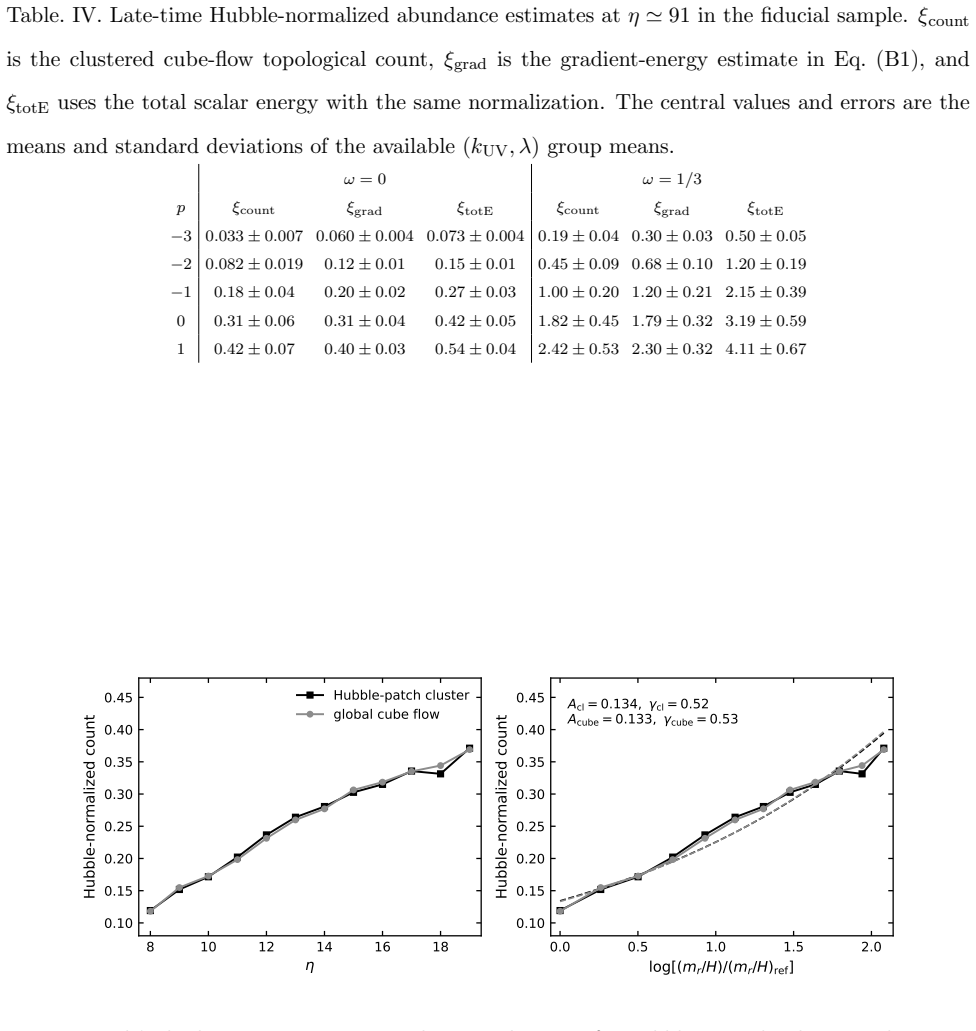
Global monopole networks do not settle to a constant number density; they keep a logarithmic correction.
Reviewed by Pith at T0; open to challenge. T0 means a machine referee read the full paper against a public rubric. the ladder, T0–T4 →
T0 review · grok-4.5
2026-07-11 06:27 UTC pith:FCSCOMKL
load-bearing objection Long-range lattice runs show global-monopole ξ keeps a slow positive log drift (γ~0.5) instead of constant scaling; fat-core is the main caveat but the result is real enough to force a rethink of VOS and relic estimates. the 3 major comments →
Constant Scaling Fails for Global Monopole Networks
The pith
A machine-rendered reading of the paper's core claim, the machinery that carries it, and where it could break.
Core claim
The monopole number density parameter ξ does not approach a constant scaling value. Over the simulated late-time window it exhibits a positive logarithmic-like evolution with the hierarchy m_r/H. The authors quantify the drift by the fractional response γ ≡ d log ξ / d log(m_r/H) and measure γ ∼ 0.5 for blue-tilted initial spectra in both matter- and radiation-dominated backgrounds. The result holds in the fat-monopole prescription and is supported by a fixed-core check, even though the energy of an isolated global monopole grows only linearly with the infrared cutoff.
What carries the argument
The fractional response γ ≡ d log ξ / d log(m_r/H), together with a fat-monopole lattice setup (λ_eff ∝ a^{-2}) that keeps cores resolved over long dynamical ranges, and a simple annihilation-time model in which τ_ann acquires a log(D/r_core) correction.
Load-bearing premise
The fat-monopole trick that freezes the comoving core size on a fixed lattice still reproduces the late-time large-scale network evolution of the physical theory with fixed cores.
What would settle it
A fixed-λ simulation that reaches the same dynamical range as the fat-monopole runs and finds a vanishing late-time slope B (or γ consistent with zero) for the Hubble-normalized monopole count would falsify the claimed logarithmic evolution.
If this is right
- Analytic and one-scale models of monopole networks that assume constant ξ must be revised.
- Monopole dark-matter abundance estimates grow with a positive power of the hierarchy m_r/H.
- Axion and dark-photon relics produced when a monopole network ends receive an enhanced yield set by the final ξ.
- Magnetic primordial black holes formed near the end of scaling are relatively enhanced, and the associated gravitational-wave spectrum can acquire a blue tilt.
Where Pith is reading between the lines
- If the log correction is genuine, many existing CMB and gravitational-wave bounds that assumed constant monopole scaling will need recalibration once the hierarchy is large.
- The same angular-momentum delay that produces γ for monopoles may be the microscopic origin of the logarithmic growth already seen in global string networks.
- A multi-component dark sector of heavy monopoles plus light gauge bosons becomes a natural benchmark once the scaling endpoint is allowed to float with γ.
Editorial analysis
A structured set of objections, weighed in public.
Referee Report
Summary. The paper revisits the late-time evolution of global monopole networks with lattice simulations over a substantially larger dynamical range than earlier work. Using a fat-monopole prescription (time-dependent quartic coupling that freezes the comoving core width) together with a short fixed-core check, the authors find that the Hubble-normalized monopole number density ξ_count does not approach a constant. Instead it shows a positive logarithmic-like drift that they quantify by the fractional response γ ≡ d log ξ / d log(m_r/H). For blue-tilted initial spectra they report γ ∼ 0.5, with weaker background and initial-condition dependence than the additive slope B. They interpret the drift as a mild scale dependence of the monopole–antimonopole annihilation time and discuss implications for monopole dark matter, axion/dark-photon production, PBHs and gravitational waves.
Significance. If the logarithmic correction is physical, the standard constant-scaling assumption used in analytic one-scale models and in many cosmological applications of global (or weakly gauged) monopoles must be revised. The result is directly analogous to the logarithmic corrections now accepted for global strings, and the paper supplies a concrete, falsifiable diagnostic (γ) together with multi-spectrum, multi-background ensembles and AIC comparisons that favor the log fit. The fixed-λ consistency check, though limited, already points in the same direction. The work therefore has clear impact on quantitative predictions for monopole-induced relics and gravitational waves once the prescription dependence is better controlled.
major comments (3)
- Sec. II.B and Appendix C: the primary claim rests on the fat-monopole prescription λ_eff = λ/a^{2}. The only direct comparison to the physical fixed-λ theory is a single shorter matter-dominated run with p = 0 that yields γ_cl ≈ 0.52 versus the fat ensemble value 0.393 ± 0.194. Because the proposed mechanism for the log correction (Sec. III.A) is precisely a dependence of annihilation efficiency on the core-to-Hubble hierarchy, a systematic difference between the two prescriptions cannot be excluded a priori. A stronger fixed-λ campaign (multiple seeds, both backgrounds, longer controlled interval) is needed before the measured γ can be treated as a property of the physical network rather than of the fat prescription.
- Table I and Fig. 1: most production runs use N_lat = 256; the N_lat = 512 and 896 runs are mentioned only as consistency checks and are not folded into the ensemble averages or error bars. Given that the late-time window is η ≳ 20 and that residual lattice-scale noise can affect winding identification, a quantitative resolution study (or at least a demonstration that γ is stable under the higher-resolution runs) is required to support the claim that the drift is not a finite-volume or finite-resolution artifact.
- Eq. (12) and Sec. III.A: the annihilation-time parametrization τ_ann = D [c0 + c1 log(D/r_core) + …] is offered as the physical origin of γ, yet no direct measurement of pair impact parameters, angular-momentum loss, or core-collision rates is presented. Without such a diagnostic the interpretation remains plausible but untested; a modest addition (e.g., tracking a sample of monopole–antimonopole trajectories) would substantially strengthen the central claim.
minor comments (4)
- Fig. 1 caption and Table I: the split vertical ranges and the precise definition of the “group-mean” curves should be stated more explicitly so that a reader can reproduce the shaded bands.
- Appendix B: the total-energy estimator ξ_totE is acknowledged to contain non-monopole radiation, yet its slopes are still quoted alongside the topological count; a clearer statement of when it can and cannot be used as a diagnostic would help.
- Eq. (9): the pivot η = 30 is arbitrary; a short sentence noting that γ is pivot-independent would remove any residual ambiguity.
- References: a few recent global-string scaling papers (e.g., those that discuss the attractor vs. transient debate) could be cited more systematically when the analogy is drawn in the Introduction.
Circularity Check
No significant circularity: ξ(η) and γ are direct lattice measurements with a post-hoc log fit; the τ_ann parametrization is interpretive only and does not generate the quoted results.
full rationale
The paper’s central claim is an empirical finding from 3D lattice simulations: the clustered topological monopole count ξ_count does not approach a constant, but instead shows a positive late-time drift that is well-described by the pivoted log form (9) and the fractional response γ ≡ d log ξ / d log(m_r/H). Both quantities are extracted after the fact from the measured time series; nothing in the definition of the winding-number estimator, the fat-monopole rescaling, or the Hubble-patch averaging forces B > 0 or γ ≈ 0.5 by construction. The annihilation-time ansatz (12) appears only in the discussion section as a possible microscopic interpretation of the already-measured slopes; it is not used to produce or constrain the tabulated values of A_30, B or γ. Self-citations (to the authors’ earlier string/domain-wall work) supply context and motivation but are not load-bearing for the monopole result itself. The single fixed-λ consistency check in Appendix C is an independent numerical cross-check, not a circular input. Consequently the derivation chain contains no self-definitional loop, no fitted-input-called-prediction, and no uniqueness or ansatz smuggled in via self-citation.
Axiom & Free-Parameter Ledger
free parameters (3)
- γ (fractional response d log ξ / d log(m_r/H)) =
~0.35–0.55 (blue-tilted p); higher for red-tilted
- A_30 and B in ξ_count = A_30 + B log(η/30) =
see Table I (group means)
- late-time fit window η ≳ 20 =
η ≳ 20 (fiducial)
axioms (4)
- domain assumption Lattice discretization of the O(3) scalar theory with the given potential accurately captures continuum monopole-network dynamics at the resolutions employed.
- ad hoc to paper The fat-monopole prescription λ_eff = λ/a^{2} preserves the infrared Goldstone-dominated large-scale scaling of physical fixed-λ monopoles.
- domain assumption Clustered cube-flow winding count on complete Hubble patches is a faithful estimator of physical monopole number density.
- domain assumption Background expansion is pure radiation or matter domination with constant equation-of-state parameter.
invented entities (1)
-
fractional response γ ≡ d log ξ / d log(m_r/H)
no independent evidence
read the original abstract
Global monopoles, which can also be understood as the zero-gauge-coupling limit of gauged monopoles, can form in the early Universe and evolve following a scaling network, as do other topological defects. However, only a limited number of numerical studies have investigated their scaling behavior. In this Letter, we show that the monopole number density parameter, $\xi$, does not follow the commonly assumed constant scaling. Instead, it exhibits a logarithmic-like evolution, despite the fact that the energy of an isolated global monopole grows linearly, rather than logarithmically, with the infrared cutoff. This behavior is found using the fat-monopole prescription and is supported by a conventional fixed-core simulation. We characterize the deviation by the fractional response $\gamma\equiv d\log \xi/d\log(m_r/H)$, and find $\gamma\sim 0.5$ for blue-tilted initial spectra. These results suggest that analytic studies based on the assumption of constant scaling should be revisited. They are also relevant to cosmological scenarios involving monopole dark matter, axion and dark-photon dark matter produced by monopole networks, monopole-induced primordial black holes, and gravitational-wave production from monopole dynamics.
Figures


Forward citations
Cited by 1 Pith paper
-
Nambu-Goldstone emissions from the cosmological evolution of global monopoles
First quantitative lattice measurement of NG boson emission from global monopoles: the spectrum peaks at the Hubble scale, the number density grows linearly with H, and the resulting pseudo-NG bosons can be dark matter.
Reference graph
Works this paper leans on
-
[1]
T. W. B. Kibble, J. Phys. A9, 1387 (1976)
1976
-
[2]
Vilenkin and E
A. Vilenkin and E. P. S. Shellard,Cosmic Strings and Other Topological Defects(Cambridge University Press, 2000)
2000
-
[3]
Barriola and A
M. Barriola and A. Vilenkin, Phys. Rev. Lett.63, 341 (1989)
1989
-
[4]
’t Hooft, Nucl
G. ’t Hooft, Nucl. Phys. B79, 276 (1974)
1974
-
[5]
A. M. Polyakov, JETP Lett.20, 194 (1974)
1974
-
[6]
D. P. Bennett and S. H. Rhie, Phys. Rev. Lett.65, 1709 (1990)
1990
-
[7]
M. Yamaguchi, Phys. Rev. D64, 081301 (2001), arXiv:hep-ph/0103130
Pith/arXiv arXiv 2001
-
[8]
M. Yamaguchi, Phys. Rev. D65, 063518 (2002), arXiv:hep-ph/0107230
Pith/arXiv arXiv 2002
-
[9]
C. J. A. P. Martins and A. Achucarro, Phys. Rev. D78, 083541 (2008), arXiv:0806.2671 [hep-ph]
Pith/arXiv arXiv 2008
-
[10]
L. Sousa and P. P. Avelino, Phys. Rev. D96, 023521 (2017), arXiv:1703.09054 [astro-ph.CO]
Pith/arXiv arXiv 2017
-
[11]
A. Lopez-Eiguren, J. Urrestilla, and A. Ach´ ucarro, JCAP01, 020 (2017), [Erratum: JCAP 06, E01 (2017)], arXiv:1611.09628 [hep-ph]
Pith/arXiv arXiv 2017
-
[12]
A. Lopez-Eiguren, J. Lizarraga, M. Hindmarsh, and J. Urrestilla, JCAP07, 026 (2017), arXiv:1705.04154 [astro-ph.CO]
Pith/arXiv arXiv 2017
-
[13]
T. Hiramatsu, M. Kawasaki, T. Sekiguchi, M. Yamaguchi, and J. Yokoyama, Phys. Rev. D83, 123531 (2011), arXiv:1012.5502 [hep-ph]
Pith/arXiv arXiv 2011
-
[14]
M. Gorghetto, E. Hardy, and G. Villadoro, JHEP07, 151 (2018), arXiv:1806.04677 [hep-ph]
Pith/arXiv arXiv 2018
-
[15]
M. Gorghetto, E. Hardy, and G. Villadoro, SciPost Phys.10, 050 (2021), arXiv:2007.04990 [hep-ph]
Pith/arXiv arXiv 2021
-
[16]
K. Saikawa, J. Redondo, A. Vaquero, and M. Kaltschmidt, JCAP10, 043 (2024), arXiv:2401.17253 [hep-ph]
Pith/arXiv arXiv 2024
-
[17]
H. Kim, J. Park, and M. Son, JHEP07, 150 (2024), arXiv:2402.00741 [hep-ph]
Pith/arXiv arXiv 2024
-
[18]
M. Buschmann, Astrophys. J.979, 220 (2025), arXiv:2404.02950 [hep-ph]
Pith/arXiv arXiv 2025
-
[19]
J. N. Benabou, M. Buschmann, J. W. Foster, and B. R. Safdi, Phys. Rev. Lett.134, 241003 (2025), arXiv:2412.08699 [hep-ph]
Pith/arXiv arXiv 2025
- [20]
-
[21]
Sikivie, Phys
P. Sikivie, Phys. Rev. Lett.48, 1156 (1982)
1982
-
[22]
Vilenkin and A
A. Vilenkin and A. E. Everett, Phys. Rev. Lett.48, 1867 (1982)
1982
-
[23]
R. L. Davis, Phys. Lett. B180, 225 (1986). 20
1986
-
[24]
Harari and P
D. Harari and P. Sikivie, Phys. Lett. B195, 361 (1987)
1987
-
[25]
M. Dine, N. Fernandez, A. Ghalsasi, and H. H. Patel, JCAP11, 041 (2021), arXiv:2012.13065 [hep-ph]
Pith/arXiv arXiv 2021
-
[26]
M. Hindmarsh, J. Lizarraga, A. Lopez-Eiguren, and J. Urrestilla, (2021), arXiv:2109.09679 [astro-ph.CO]
Pith/arXiv arXiv 2021
-
[27]
Yin, JHEP10, 177 (2025), arXiv:2412.17802 [hep-ph]
W. Yin, JHEP10, 177 (2025), arXiv:2412.17802 [hep-ph]
Pith/arXiv arXiv 2025
-
[28]
Yin, (2024), 10.1093/ptep/ptaf053, arXiv:2412.19798 [hep-ph]
W. Yin, (2024), 10.1093/ptep/ptaf053, arXiv:2412.19798 [hep-ph]
-
[29]
D. Gonzalez, N. Kitajima, F. Takahashi, and W. Yin, Phys. Lett. B843, 137990 (2023), arXiv:2211.06849 [hep-ph]
Pith/arXiv arXiv 2023
-
[30]
N. Kitajima, J. Lee, F. Takahashi, and W. Yin, JCAP07, 053 (2025), arXiv:2311.14590 [hep-ph]
Pith/arXiv arXiv 2025
-
[31]
D. Aburatani, W. Nakano, and W. Yin, (2026), arXiv:2606.31937 [hep-ph]
Pith/arXiv arXiv 2026
-
[32]
D. G. Figueroa, A. Florio, F. Torrenti, and W. Valkenburg, JCAP04, 035 (2021), arXiv:2006.15122 [astro-ph.CO]
Pith/arXiv arXiv 2021
-
[33]
D. G. Figueroa, A. Florio, F. Torrenti, and W. Valkenburg, Comput. Phys. Commun.283, 108586 (2023), arXiv:2102.01031 [astro-ph.CO]
Pith/arXiv arXiv 2023
-
[34]
W. H. Press, B. S. Ryden, and D. N. Spergel, Astrophys. J.347, 590 (1989)
1989
-
[35]
N. Kitajima, S. Nakagawa, and F. Takahashi, Phys. Rev. D105, 103011 (2022), arXiv:2111.06696 [hep-ph]
Pith/arXiv arXiv 2022
-
[36]
S. Nakagawa, F. Takahashi, and W. Yin, Phys. Rev. D107, 063016 (2023), arXiv:2209.01107 [astro-ph.CO]
Pith/arXiv arXiv 2023
-
[37]
W. E. East and J. Huang, JHEP12, 089 (2022), arXiv:2206.12432 [hep-ph]
Pith/arXiv arXiv 2022
-
[38]
D. Cyncynates and Z. J. Weiner, Phys. Rev. Lett.134, 211002 (2025), arXiv:2310.18397 [hep-ph]
Pith/arXiv arXiv 2025
-
[39]
D. Cyncynates and Z. J. Weiner, Phys. Rev. D111, 103535 (2025), arXiv:2410.14774 [hep-ph]
Pith/arXiv arXiv 2025
-
[40]
N. Kitajima, S. Nakagawa, F. Takahashi, and W. Yin, Phys. Lett. B862, 139304 (2025), arXiv:2410.17964 [hep-ph]
Pith/arXiv arXiv 2025
-
[41]
J. Jaeckel and A. Ringwald, Ann. Rev. Nucl. Part. Sci.60, 405 (2010), arXiv:1002.0329 [hep-ph]
Pith/arXiv arXiv 2010
-
[42]
A. Ringwald, Phys. Dark Univ.1, 116 (2012), arXiv:1210.5081 [hep-ph]
Pith/arXiv arXiv 2012
-
[43]
P. Arias, D. Cadamuro, M. Goodsell, J. Jaeckel, J. Redondo, and A. Ringwald, JCAP06, 013 (2012), arXiv:1201.5902 [hep-ph]
Pith/arXiv arXiv 2012
-
[44]
P. W. Graham, I. G. Irastorza, S. K. Lamoreaux, A. Lindner, and K. A. van Bibber, Ann. Rev. Nucl. Part. Sci.65, 485 (2015), arXiv:1602.00039 [hep-ex]
Pith/arXiv arXiv 2015
-
[45]
D. J. E. Marsh, Phys. Rept.643, 1 (2016), arXiv:1510.07633 [astro-ph.CO]. 21
Pith/arXiv arXiv 2016
-
[46]
I. G. Irastorza and J. Redondo, Prog. Part. Nucl. Phys.102, 89 (2018), arXiv:1801.08127 [hep-ph]
Pith/arXiv arXiv 2018
-
[47]
L. Di Luzio, M. Giannotti, E. Nardi, and L. Visinelli, Phys. Rept.870, 1 (2020), arXiv:2003.01100 [hep-ph]
Pith/arXiv arXiv 2020
-
[48]
Albertuset al., (2026), arXiv:2602.09089 [hep-ph]
C. Albertuset al., (2026), arXiv:2602.09089 [hep-ph]
arXiv 2026
-
[49]
Arzaet al., (2026), arXiv:2603.03433 [hep-ph]
A. Arzaet al., (2026), arXiv:2603.03433 [hep-ph]
arXiv 2026
-
[50]
A. J. Long and L.-T. Wang, Phys. Rev. D99, 063529 (2019), arXiv:1901.03312 [hep-ph]
Pith/arXiv arXiv 2019
-
[51]
K. Nakayama and W. Yin, JHEP10, 026 (2021), arXiv:2105.14549 [hep-ph]
Pith/arXiv arXiv 2021
-
[52]
N. Kitajima and K. Nakayama, JHEP08, 068 (2023), arXiv:2212.13573 [hep-ph]
Pith/arXiv arXiv 2023
-
[53]
H. Murayama and J. Shu, Phys. Lett. B686, 162 (2010), arXiv:0905.1720 [hep-ph]
Pith/arXiv arXiv 2010
-
[54]
S. Baek, P. Ko, and W.-I. Park, JCAP10, 067 (2014), arXiv:1311.1035 [hep-ph]
Pith/arXiv arXiv 2014
-
[55]
V. V. Khoze and G. Ro, JHEP10, 061 (2014), arXiv:1406.2291 [hep-ph]
Pith/arXiv arXiv 2014
-
[56]
M. Kawasaki, F. Takahashi, and M. Yamada, Phys. Lett. B753, 677 (2016), arXiv:1511.05030 [hep-ph]
Pith/arXiv arXiv 2016
-
[57]
Berg and M
B. Berg and M. Luscher, Nucl. Phys. B190, 412 (1981). 22
1981
discussion (0)
Sign in with ORCID, Apple, or X to comment. Anyone can read and Pith papers without signing in.