Manipulation of Topological Corner States via Subchiral Symmetry
Pith reviewed 2026-06-27 00:21 UTC · model grok-4.3
The pith
Subchiral symmetry allows selective isolation and adiabatic transfer of topological corner modes.
A machine-rendered reading of the paper's core claim, the machinery that carries it, and where it could break.
Core claim
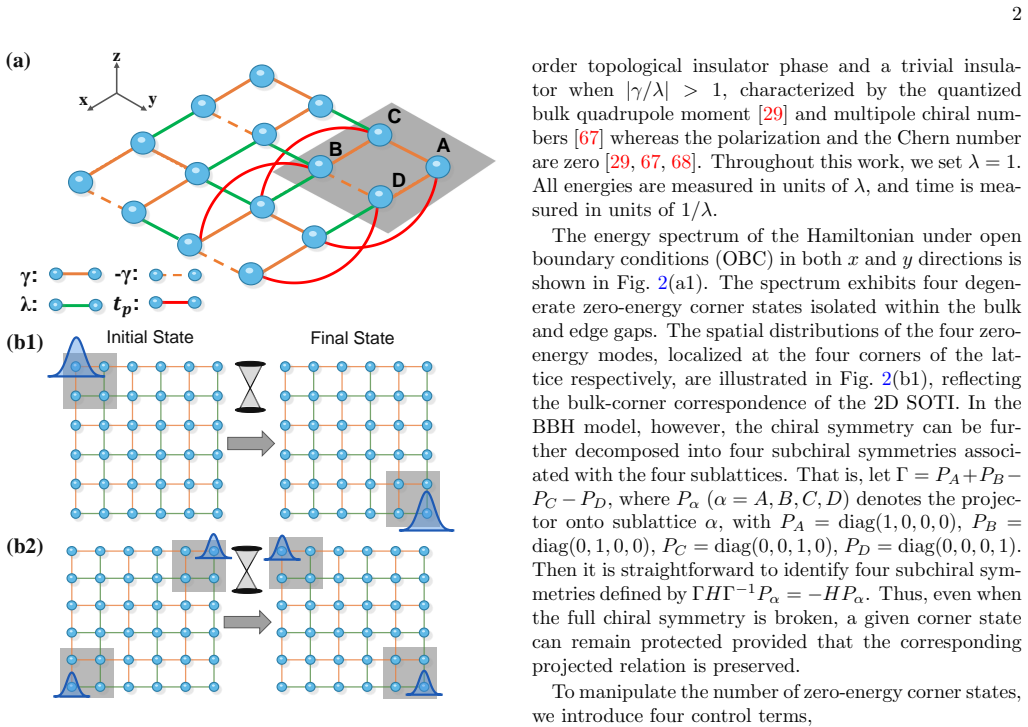
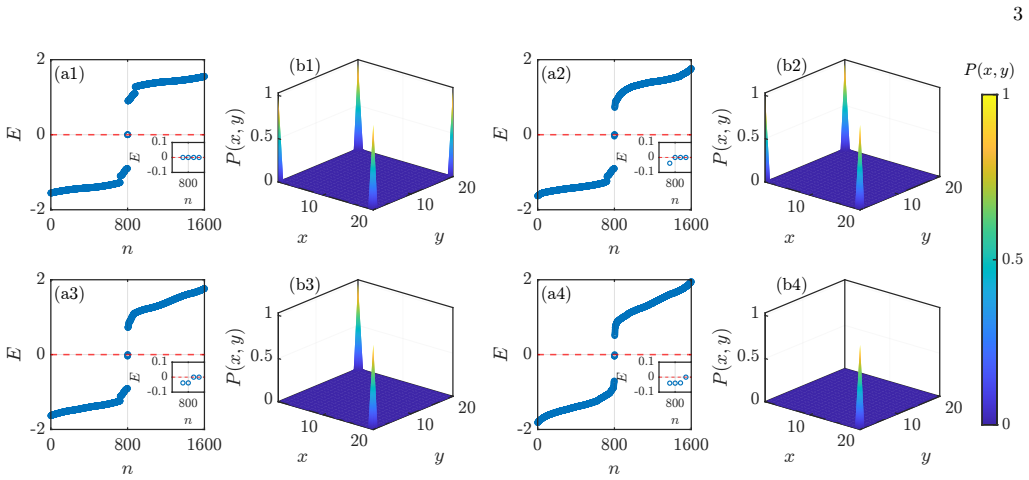
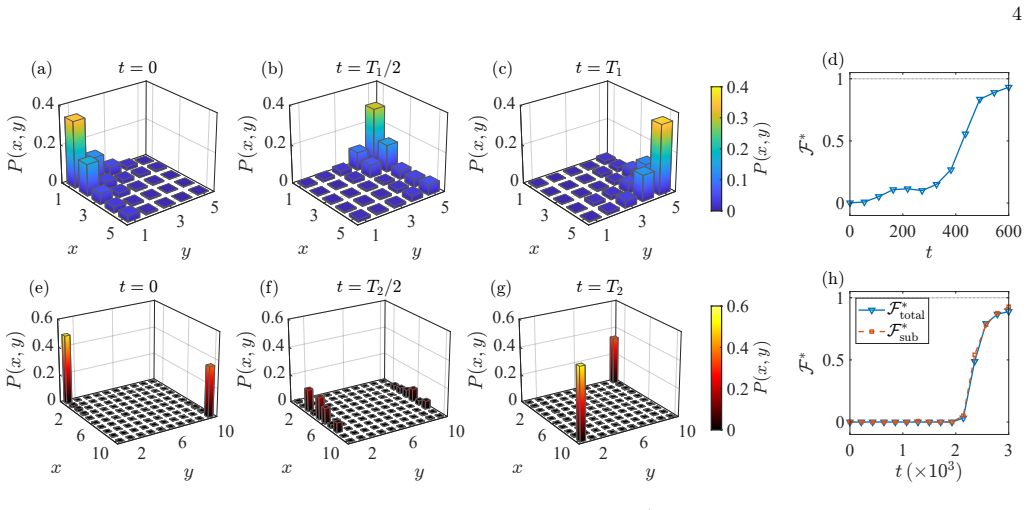
In the two-dimensional Benalcazar-Bernevig-Hughes model, the conventional chiral symmetry decomposes into four subchiral symmetries, each associated with one zero-energy corner mode. By selectively breaking these subsymmetries with controlled intercell hoppings, the fourfold corner-state manifold reduces step by step to single isolated modes. Adiabatic protocols transfer either a single corner state or a superposition of two corner states between selected corners while preserving the relative phase, as shown by numerical simulations and IBM quantum-processor implementations.
What carries the argument
Subchiral symmetry, the decomposition of conventional chiral symmetry into four independent subsymmetries each tied to one corner mode, which permits targeted breaking to shrink the manifold and to design transfer protocols.
If this is right
- Single isolated corner modes become addressable by breaking specific subsymmetries one at a time.
- Adiabatic protocols achieve high-fidelity transfer of either single states or phase-preserving superpositions between chosen corners.
- The same control principle applies to programmable manipulation of higher-order topological states on quantum hardware.
Where Pith is reading between the lines
- The approach may generalize to other two-dimensional higher-order topological models that possess analogous symmetry decompositions.
- Phase-preserving superposition transfers could support encoding of quantum information directly in corner-state manifolds.
- Scaling the protocols to larger lattices would test whether the required hopping precision remains experimentally feasible.
Load-bearing premise
Controlled intercell hoppings can be implemented to break individual subchiral symmetries without introducing decoherence, disorder, or unwanted couplings that would destroy topological protection or adiabatic transfer fidelity.
What would settle it
An experiment in which breaking one chosen subchiral symmetry leaves more than one corner mode at zero energy, or in which an adiabatic transfer protocol produces measurable phase drift or fidelity below the reported numerical values on a quantum processor.
Figures
read the original abstract
Higher-order topological phases provide robust corner modes, but their use requires controllable creation, isolation, and transfer of individual modes and their superpositions. Here we demonstrate, using the two-dimensional Benalcazar-Bernevig-Hughes model as an example, that subchiral symmetry provides a general control principle for manipulating topological corner modes. The conventional chiral symmetry decomposes into four subchiral symmetries, each associated with one zero-energy corner mode. By selectively breaking these subsymmetries with controlled intercell hoppings, we reduce the fourfold corner-state manifold step by step to single isolated modes. We further design adiabatic protocols that transfer either a single corner state or a superposition of two corner states between selected corners, while preserving the relative phase in the latter case. Both numerical simulations and IBM quantum-processor implementations show that the proposed protocols can be executed with high fidelity, establishing subchiral symmetry as a route to programmable higher-order topological state manipulation.
Editorial analysis
A structured set of objections, weighed in public.
Referee Report
Summary. The paper claims that the conventional chiral symmetry of the 2D Benalcazar-Bernevig-Hughes model decomposes into four independent subchiral symmetries, each associated with one zero-energy corner mode. Selectively breaking these subsymmetries via controlled intercell hoppings reduces the fourfold manifold to isolated single modes. Adiabatic protocols are introduced to transfer either a single corner state or a phase-preserving superposition between corners. Both numerical simulations and implementations on IBM quantum processors are reported to achieve high fidelity, positioning subchiral symmetry as a control principle for programmable higher-order topological state manipulation.
Significance. If the results hold, the work supplies an explicit symmetry-based route to active control and transfer of higher-order topological corner modes while preserving topological protection and relative phase. The combination of model Hamiltonians, adiabatic protocols, and hardware validation on quantum processors adds practical relevance for potential applications in robust quantum state transfer. The approach avoids fitted parameters and relies on explicit constructions.
major comments (2)
- [IBM quantum-processor implementations] Hardware implementation section: the high-fidelity IBM results are load-bearing for the claim of practical applicability, yet the manuscript provides insufficient detail on mapping the symmetry-breaking intercell hoppings to native gates, verification of adiabatic conditions, and confirmation that no extra couplings or decoherence lift the zero modes (directly addressing the stress-test concern on controlled intercell hoppings).
- [Symmetry analysis] Symmetry analysis section: the claim that the four subchiral symmetries are independent and can be broken one-by-one without affecting the others is central to the selective isolation protocol, but the manuscript does not explicitly demonstrate this independence (e.g., via commutation relations or explicit operator decomposition) in a manner that rules out cross-talk between subsymmetries.
minor comments (2)
- The abstract states 'high fidelity' for both numerics and hardware but does not quantify the lattice size or number of qubits used; adding these details would improve reproducibility.
- Figure captions for the adiabatic protocol diagrams should explicitly label the time-dependent hopping parameters to match the text description.
Simulated Author's Rebuttal
We thank the referee for the detailed and constructive report. We address the two major comments point by point below. Where the manuscript is missing explicit demonstrations or details, we agree to incorporate them in a revised version.
read point-by-point responses
-
Referee: [IBM quantum-processor implementations] Hardware implementation section: the high-fidelity IBM results are load-bearing for the claim of practical applicability, yet the manuscript provides insufficient detail on mapping the symmetry-breaking intercell hoppings to native gates, verification of adiabatic conditions, and confirmation that no extra couplings or decoherence lift the zero modes (directly addressing the stress-test concern on controlled intercell hoppings).
Authors: We agree that the hardware section would benefit from additional explicit information. In the revised manuscript we will add: (i) the explicit transpilation of the controlled intercell hoppings into native IBM gates (including the decomposition of the time-dependent terms), (ii) quantitative verification that the chosen ramp times satisfy the adiabatic condition (via both instantaneous eigenstate overlap and gap analysis), and (iii) a brief discussion of how the zero-mode protection is preserved under the measured decoherence and residual couplings on the device. These additions will directly address the stress-test concern. revision: yes
-
Referee: [Symmetry analysis] Symmetry analysis section: the claim that the four subchiral symmetries are independent and can be broken one-by-one without affecting the others is central to the selective isolation protocol, but the manuscript does not explicitly demonstrate this independence (e.g., via commutation relations or explicit operator decomposition) in a manner that rules out cross-talk between subsymmetries.
Authors: We acknowledge that an explicit algebraic demonstration of independence is currently absent. In the revised manuscript we will add a short subsection showing the four subchiral operators explicitly, proving that they mutually commute ([S_i, S_j] = 0 for i ≠ j) and that each can be broken independently by the corresponding intercell term without inducing cross-talk in the zero-mode subspace. This will be supported by the operator decomposition already implicit in the model but not previously written out. revision: yes
Circularity Check
No significant circularity; derivation is self-contained via explicit models and protocols
full rationale
The paper starts from the established 2D BBH model, explicitly decomposes its chiral symmetry into four subchiral symmetries by definition in the Hamiltonian, introduces controlled intercell hoppings as symmetry-breaking terms, constructs adiabatic transfer protocols from those terms, and validates via direct numerical diagonalization plus IBM hardware runs. None of these steps reduce by construction to fitted inputs from the paper's own data, self-citations that bear the central load, or renamed known results. The claims rest on independent constructions and external benchmarks (simulations, device experiments) rather than tautological re-derivation of inputs.
Axiom & Free-Parameter Ledger
axioms (1)
- domain assumption The 2D BBH model possesses a chiral symmetry that decomposes into four independent subchiral symmetries, each protecting one zero-energy corner mode.
Reference graph
Works this paper leans on
-
[1]
M. Z. Hasan and C. L. Kane, Colloquium: topological insulators, Reviews of modern physics82, 3045 (2010)
2010
-
[2]
Qi and S.-C
X.-L. Qi and S.-C. Zhang, Topological insulators and superconductors, Reviews of modern physics83, 1057 (2011)
2011
-
[3]
B. A. Bernevig, Topological insulators and topological su- perconductors, inTopological Insulators and Topological Superconductors(Princeton university press, 2013)
2013
-
[4]
Zhang, Y.-Q
D.-W. Zhang, Y.-Q. Zhu, Y. Zhao, H. Yan, and S.-L. Zhu, Topological quantum matter with cold atoms, Advances in Physics67, 253 (2018)
2018
-
[5]
N. P. Armitage, E. J. Mele, and A. Vishwanath, Weyl and dirac semimetals in three-dimensional solids, Reviews of Modern Physics90, 015001 (2018)
2018
-
[6]
Cooper, J
N. Cooper, J. Dalibard, and I. Spielman, Topological bands for ultracold atoms, Reviews of modern physics 91, 015005 (2019)
2019
-
[7]
M. Z. Hasan and J. E. Moore, Three-dimensional topo- logical insulators, Annu. Rev. Condens. Matter Phys.2, 55 (2011)
2011
-
[8]
Shen, W.-Y
S.-Q. Shen, W.-Y. Shan, and H.-Z. Lu, Topological in- sulator and the dirac equation, inSpin, Vol. 1 (World Scientific, 2011) pp. 33–44
2011
-
[9]
Tokura, K
Y. Tokura, K. Yasuda, and A. Tsukazaki, Magnetic topo- logical insulators, Nature Reviews Physics1, 126 (2019)
2019
-
[10]
J. E. Moore, The birth of topological insulators, Nature 464, 194 (2010)
2010
-
[11]
A. Y. Kitaev, Fault-tolerant quantum computation by anyons, Annals of physics303, 2 (2003)
2003
-
[12]
Nayak, S
C. Nayak, S. H. Simon, A. Stern, M. Freedman, and S. Das Sarma, Non-abelian anyons and topological quan- tum computation, Reviews of Modern Physics80, 1083 6 (2008)
2008
-
[13]
Alicea, New directions in the pursuit of majorana fermions in solid state systems, Reports on progress in physics75, 076501 (2012)
J. Alicea, New directions in the pursuit of majorana fermions in solid state systems, Reports on progress in physics75, 076501 (2012)
2012
-
[14]
Mittal, J
S. Mittal, J. Fan, S. Faez, A. Migdall, J. M. Taylor, and M. Hafezi, Topologically robust transport of photons in a synthetic gauge field, Phys. Rev. Lett.113, 087403 (2014)
2014
-
[15]
C. W. Beenakker, Search for majorana fermions in super- conductors, Annu. Rev. Condens. Matter Phys.4, 113 (2013)
2013
-
[16]
J. Zhou, Y. Hu, Z.-q. Yin, Z. Wang, S.-L. Zhu, and Z.-Y. Xue, High fidelity quantum state transfer in electrome- chanical systems with intermediate coupling, Scientific Reports4, 6237 (2014)
2014
-
[17]
S. D. Sarma, M. Freedman, and C. Nayak, Majorana zero modes and topological quantum computation, npj Quantum Information1, 15001 (2015)
2015
-
[18]
Mittal, V
S. Mittal, V. V. Orre, and M. Hafezi, Topologically ro- bust transport of entangled photons in a 2d photonic sys- tem, Optics express24, 15631 (2016)
2016
-
[19]
F. Mei, G. Chen, L. Tian, S.-L. Zhu, and S. Jia, Ro- bust quantum state transfer via topological edge states in superconducting qubit chains, Physical Review A98, 012331 (2018)
2018
-
[20]
R. M. Lutchyn, E. P. Bakkers, L. P. Kouwenhoven, P. Krogstrup, C. M. Marcus, and Y. Oreg, Majo- rana zero modes in superconductor–semiconductor het- erostructures, Nature Reviews Materials3, 52 (2018)
2018
-
[21]
Z. Yan, F. Song, and Z. Wang, Majorana corner modes in a high-temperature platform, Physical review letters 121, 096803 (2018)
2018
-
[22]
J. Yun, A. Rai, and J. Bae, Nonlocal network coding in interference channels, Phys. Rev. Lett.125, 150502 (2020)
2020
-
[23]
T. E. Pahomi, M. Sigrist, and A. A. Soluyanov, Braid- ing majorana corner modes in a second-order topologi- cal superconductor, Physical Review Research2, 032068 (2020)
2020
-
[24]
R. W. Bomantara and J. Gong, Measurement-only quan- tum computation with floquet majorana corner modes, Physical Review B101, 085401 (2020)
2020
-
[25]
Minganti, V
F. Minganti, V. Macr` ı, A. Settineri, S. Savasta, and F. Nori, Dissipative state transfer and maxwell’s demon in single quantum trajectories: Excitation transfer be- tween two noninteracting qubits via unbalanced dissipa- tion rates, Physical Review A103, 052201 (2021)
2021
-
[26]
C. Wang, L. Li, J. Gong, and Y.-x. Liu, Arbitrary entan- gled state transfer via a topological qubit chain, Physical Review A106, 052411 (2022)
2022
-
[27]
S. Tan, R. W. Bomantara, and J. Gong, High-fidelity and long-distance entangled-state transfer with floquet topological edge modes, Physical Review A102, 022608 (2020)
2020
-
[28]
I. I. Arkhipov, F. Minganti, A. Miranowicz, S ¸. K. ¨Ozdemir, and F. Nori, Restoring adiabatic state trans- fer in time-modulated non-hermitian systems, Physical review letters133, 113802 (2024)
2024
-
[29]
W. A. Benalcazar, B. A. Bernevig, and T. L. Hughes, Quantized electric multipole insulators, Science357, 61 (2017)
2017
-
[30]
Reflection symmetric second-order topological insulators and superconductors
J. Langbehn, Y. Peng, L. Trifunovic, F. Von Op- pen, and P. W. Brouwer, Reflection symmetric second-order topological insulators and superconduc- tors, arXiv preprint arXiv:1708.03640 10.1103/Phys- RevLett.119.246401 (2017)
work page internal anchor Pith review Pith/arXiv arXiv doi:10.1103/phys- 2017
-
[31]
W. A. Benalcazar, B. A. Bernevig, and T. L. Hughes, Electric multipole moments, topological multipole mo- ment pumping, and chiral hinge states in crystalline in- sulators, Physical Review B96, 245115 (2017)
2017
-
[32]
Z. Song, Z. Fang, and C. Fang, (d-2)-dimensional edge states of rotation symmetry protected topological states, Physical review letters119, 246402 (2017)
2017
-
[33]
Schindler, A
F. Schindler, A. M. Cook, M. G. Vergniory, Z. Wang, S. S. P. Parkin, B. A. Bernevig, and T. Neupert, Higher-order topological insulators, Science Advances4, eaat0346 (2018)
2018
-
[34]
Ezawa, Higher-order topological insulators and semimetals on the breathing kagome and pyrochlore lat- tices, Physical review letters120, 026801 (2018)
M. Ezawa, Higher-order topological insulators and semimetals on the breathing kagome and pyrochlore lat- tices, Physical review letters120, 026801 (2018)
2018
-
[35]
Geier, L
M. Geier, L. Trifunovic, M. Hoskam, and P. W. Brouwer, Second-order topological insulators and superconductors with an order-two crystalline symmetry, Physical Review B97, 205135 (2018)
2018
-
[36]
Khalaf, Higher-order topological insulators and su- perconductors protected by inversion symmetry, Physical Review B97, 205136 (2018)
E. Khalaf, Higher-order topological insulators and su- perconductors protected by inversion symmetry, Physical Review B97, 205136 (2018)
2018
-
[37]
Van Miert and C
G. Van Miert and C. Ortix, Higher-order topological in- sulators protected by inversion and rotoinversion symme- tries, Physical Review B98, 081110 (2018)
2018
-
[38]
Trifunovic and P
L. Trifunovic and P. W. Brouwer, Higher-order bulk- boundary correspondence for topological crystalline phases, Physical Review X9, 011012 (2019)
2019
-
[39]
Jia, X.-C
W. Jia, X.-C. Zhou, L. Zhang, L. Zhang, and X.-J. Liu, Unified characterization for higher-order topological phase transitions, Physical Review Research5, L022032 (2023)
2023
-
[40]
C. W. Peterson, W. A. Benalcazar, T. L. Hughes, and G. Bahl, A quantized microwave quadrupole insulator with topologically protected corner states, Nature555, 346 (2018)
2018
-
[41]
Serra-Garcia, V
M. Serra-Garcia, V. Peri, R. S¨ usstrunk, O. R. Bilal, T. Larsen, L. G. Villanueva, and S. D. Huber, Obser- vation of a phononic quadrupole topological insulator, Nature555, 342 (2018)
2018
-
[42]
Imhof, C
S. Imhof, C. Berger, F. Bayer, J. Brehm, L. W. Molenkamp, T. Kiessling, F. Schindler, C. H. Lee, M. Greiter, T. Neupert,et al., Topolectrical-circuit real- ization of topological corner modes, Nature Physics14, 925 (2018)
2018
-
[43]
H. Xue, Y. Yang, F. Gao, Y. Chong, and B. Zhang, Acoustic higher-order topological insulator on a kagome lattice, Nature materials18, 108 (2019)
2019
-
[44]
Mittal, V
S. Mittal, V. V. Orre, G. Zhu, M. A. Gorlach, A. Pod- dubny, and M. Hafezi, Photonic quadrupole topological phases, Nature Photonics13, 692 (2019)
2019
-
[45]
A. Dutt, M. Minkov, Q. Lin, L. Yuan, D. A. B. Miller, and S. Fan, Higher-order topological insulators in syn- thetic dimensions, Light: Science & Applications9, 131 (2020)
2020
-
[46]
Noguchi, M
R. Noguchi, M. Kobayashi, Z. Jiang, K. Kuroda, T. Taka- hashi, Z. Xu, D. Lee, M. Hirayama, M. Ochi, T. Shira- sawa,et al., Evidence for a higher-order topological insu- lator in a three-dimensional material built from van der waals stacking of bismuth-halide chains, Nature Materi- als20, 473 (2021)
2021
-
[47]
H. Wu, H. Hu, X. Wang, Z. Xu, B. Zhang, Q. J. Wang, 7 Y. Zheng, J. Zhang, T. J. Cui, and Y. Luo, Higher-order topological states in thermal diffusion, Advanced Mate- rials35, 2210825 (2023)
2023
-
[48]
G. Xu, X. Zhou, S. Yang, J. Wu, and C.-W. Qiu, Obser- vation of bulk quadrupole in topological heat transport, Nature Communications14, 3252 (2023)
2023
-
[49]
C.-L. Deng, Y. Liu, Y.-R. Zhang, X.-G. Li, T. Liu, C.-T. Chen, T. Liu, C.-W. Lu, Y.-Y. Wang, T.-M. Li,et al., High-order topological pumping on a superconducting quantum processor, Physical Review Letters133, 140402 (2024)
2024
-
[50]
Yung and S
M.-H. Yung and S. Bose, Perfect state transfer, effective gates, and entanglement generation in engineered bosonic and fermionic networks, Physical Review A—Atomic, Molecular, and Optical Physics71, 032310 (2005)
2005
-
[51]
Burgarth and S
D. Burgarth and S. Bose, Conclusive and arbitrarily perfect quantum-state transfer using parallel spin-chain channels, Physical Review A—Atomic, Molecular, and Optical Physics71, 052315 (2005)
2005
-
[52]
M. A. Sillanp¨ a¨ a, J. I. Park, and R. W. Simmonds, Co- herent quantum state storage and transfer between two phase qubits via a resonant cavity, Nature449, 438 (2007)
2007
-
[53]
X. Li, Y. Ma, J. Han, T. Chen, Y. Xu, W. Cai, H. Wang, Y. Song, Z.-Y. Xue, Z.-q. Yin, and L. Sun, Perfect quan- tum state transfer in a superconducting qubit chain with parametrically tunable couplings, Phys. Rev. Appl.10, 054009 (2018)
2018
- [54]
-
[55]
M. A. Rowe, A. Ben-Kish, B. DeMarco, D. Leibfried, V. Meyer, J. Beall, J. Britton, J. Hughes, W. M. Itano, B. Jelenkovic, C. Langer, T. Rosenband, and D. J. Wineland, Transport of quantum states and separation of ions in a dual rf ion trap (2002), arXiv:quant-ph/0205094 [quant-ph]
Pith/arXiv arXiv 2002
-
[56]
Chen, H.-T
T. Chen, H.-T. Ding, R. Shen, S.-L. Zhu, and J. Gong, Direct probe of topology and geometry of quantum states on the ibm q quantum processor, Phys. Rev. B110, 205402 (2024)
2024
-
[57]
Stute, B
A. Stute, B. Casabone, B. Brandst¨ atter, K. Friebe, T. Northup, and R. Blatt, Quantum-state transfer from an ion to a photon, Nature photonics7, 219 (2013)
2013
-
[58]
R. J. Chapman, M. Santandrea, Z. Huang, G. Corrielli, A. Crespi, M.-H. Yung, R. Osellame, and A. Peruzzo, Experimental perfect state transfer of an entangled pho- tonic qubit, Nature communications7, 11339 (2016)
2016
-
[59]
Kurpiers, P
P. Kurpiers, P. Magnard, T. Walter, B. Royer, M. Pechal, J. Heinsoo, Y. Salath´ e, A. Akin, S. Storz, J.-C. Besse, et al., Deterministic quantum state transfer and remote entanglement using microwave photons, Nature558, 264 (2018)
2018
-
[60]
B. P. Maddox, J. M. Mortlock, T. R. Hepworth, A. P. Raghuram, P. D. Gregory, A. Guttridge, and S. L. Cor- nish, Enhanced quantum state transfer via feedforward cancellation of optical phase noise, Phys. Rev. Lett.133, 253202 (2024)
2024
-
[61]
Zhang, T
H. Zhang, T. Liu, Z. Xiang, K. Xu, H. Fan, and D. Zheng, Topological eigenvalue braiding and quantum state trans- fer near a third-order exceptional point, PRX Quantum 6, 020328 (2025)
2025
-
[62]
X. Wang, I. I. Arkhipov, Q. Lin, H. Gao, D. Qu, L. Xiao, F. Nori, and P. Xue, Observation of re- stored adiabatic state transfer in time-modulated non-hermitian systems, Nature Communications https://doi.org/10.1038/s41467-026-72751-8 (2026)
-
[63]
Z. Wang, X. Wang, Z. Hu, D. Bongiovanni, D. Juki´ c, L. Tang, D. Song, R. Morandotti, Z. Chen, and H. Bul- jan, Sub-symmetry-protected topological states, Nature physics19, 992 (2023)
2023
-
[64]
Verma and M
S. Verma and M. J. Park, Non-bloch band theory of subsymmetry-protected topological phases, Physical Re- view B110, 035424 (2024)
2024
-
[65]
M. Kang, M. Lee, and S. Cheon, Subsymmetry protected topology in topological insulators and superconductors, Physical Review Research6, 033323 (2024)
2024
-
[66]
W.-P. Su, J. R. Schrieffer, and A. J. Heeger, Solitons in polyacetylene, Physical review letters42, 1698 (1979)
1979
-
[67]
W. A. Benalcazar and A. Cerjan, Chiral-symmetric higher-order topological phases of matter, Physical Re- view Letters128, 127601 (2022)
2022
-
[68]
See Supplementary Materials,
-
[69]
K. Choo, C. W. von Keyserlingk, N. Regnault, and T. Ne- upert, Measurement of the entanglement spectrum of a symmetry-protected topological state using the ibm quantum computer, Phys. Rev. Lett.121, 086808 (2018)
2018
-
[70]
Y. Chen, M. Farahzad, S. Yoo, and T.-C. Wei, Detector tomography on ibm quantum computers and mitigation of an imperfect measurement, Phys. Rev. A100, 052315 (2019)
2019
-
[71]
Liu, C.-B
Z.-R. Liu, C.-B. Hua, T. Peng, R. Chen, and B. Zhou, Higher-order topological insulators in hyperbolic lattices, Physical Review B107, 125302 (2023)
2023
-
[72]
J. M. Koh, T. Tai, and C. H. Lee, Realization of higher- order topological lattices on a quantum computer, Nature Communications15, 5807 (2024)
2024
-
[73]
Canyellas, C
R. Canyellas, C. Liu, R. Arouca, L. Eek, G. Wang, Y. Yin, D. Guan, Y. Li, S. Wang, H. Zheng,et al., Topo- logical edge and corner states in bismuth fractal nanos- tructures, Nature Physics20, 1421 (2024)
2024
-
[74]
Huang and W
B. Huang and W. V. Liu, Floquet higher-order topolog- ical insulators with anomalous dynamical polarization, Physical Review Letters124, 216601 (2020)
2020
-
[75]
H. Hu, B. Huang, E. Zhao, and W. V. Liu, Dynamical sin- gularities of floquet higher-order topological insulators, Physical Review Letters124, 057001 (2020)
2020
-
[76]
W. Zhu, Y. D. Chong, and J. Gong, Floquet higher-order topological insulator in a periodically driven bipartite lat- tice, Physical Review B103, L041402 (2021)
2021
-
[77]
W. Zhu, H. Xue, J. Gong, Y. Chong, and B. Zhang, Time- periodic corner states from floquet higher-order topology, Nature Communications13, 11 (2022)
2022
-
[78]
Huang, Topological invariants for anomalous floquet higher-order topological insulators, Frontiers of Physics 18, 13601 (2023)
B. Huang, Topological invariants for anomalous floquet higher-order topological insulators, Frontiers of Physics 18, 13601 (2023)
2023
-
[79]
Zhang, F
J.-H. Zhang, F. Mei, Y. Li, C. H. Lee, J. Ma, L. Xiao, and S. Jia, Observation of higher-order time-dislocation topo- logical modes, Nature Communications16, 2050 (2025)
2050
-
[80]
H. Qian, M. Gong, J. Zhang, S. Guo, C. Zha, F. Chen, Y. Ye, Y. Wu, S. Cao, C. Ying,et al., Programmable higher-order nonequilibrium topological phases on a su- perconducting quantum processor, Science390, 930 (2025)
2025
discussion (0)
Sign in with ORCID, Apple, or X to comment. Anyone can read and Pith papers without signing in.