REVIEW 4 major objections 4 minor 59 references
Valley polarization, Rashba interaction, and weak altermagnetism in inversion-asymmetric MnPS$_\text{3}|$WS$_\text{2}$ van der Waals heterostructures
T0 review · 4 major / 4 minor · reviewed 2026-08-01 · deepseek-v4-flash
Pith's one-line read A single van der Waals interface between monolayer MnPS3 and WS2 is predicted to host altermagnetic spin splitting, Rashba spin splitting, and valley polarization at once, with electric field and strain as control knobs.
desk verdict The paper shows plausible DFT evidence for coexisting altermagnetic, Rashba, and valley effects in a MnPS3|WS2 stack, but it has an internal band-alignment contradiction, never states what is new versus prior work, and ignores ~3.8% built-in strain on WS2. read the letter →
The pith
A machine-rendered reading of the paper's core claim, the machinery that carries it, and where it could break.
The reading
What carries the argument
The argument rests on three effective Hamiltonians plus the symmetry analysis that justifies them. At the Q point, a two-band model with sixth-order momentum terms (k₊⁶ ± k₋⁶) produces the alternating spin splitting with six nodal lines that defines the i-wave altermagnet. At Γ, a linear Rashba Hamiltonian H = H₀ + α_R(k_x σ_y − k_y σ_x) fits the helical valence-band spin texture with α_R ≈ 0.4. At K/K̄, a k·p Hamiltonian with Dirac, mass, and spin-orbit terms—including a valley-Zeeman term—yields valley splitting and a spin- and valley-dependent Berry curvature. The symmetry backbone is the interface point group C₃: inversion is broken by the heterogeneous stacking while a threefold rotatio
What would settle it
Spin- and angle-resolved photoemission on a MnPS3|WS2 stack: the coexistence claim is refuted if no helical Rashba texture appears near Γ or if the bands near the Q point remain spin-degenerate instead of showing the predicted six sign-alternating nodal lines.
Extended reading notes
Core claim
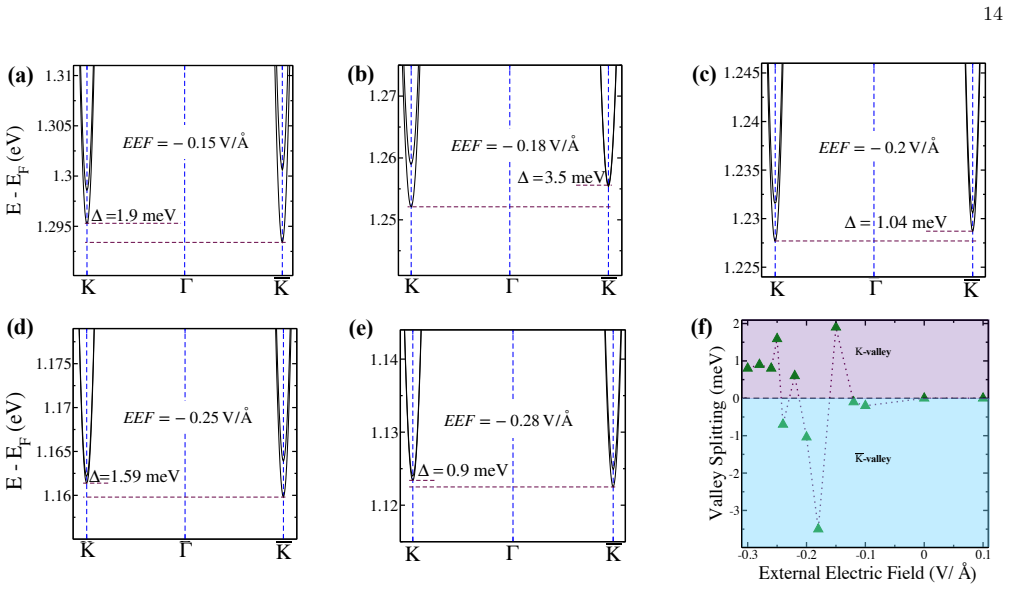
The central claim is that the deliberate lack of inversion symmetry at the MnPS3|WS2 interface turns an ordinary antiferromagnetic/semiconductor bilayer into a single platform where three spin-orbit phenomena coexist. In the valence band near Γ the heterostructure shows a Rashba-type helical spin texture (Rashba coefficient α_R ≈ 0.4); in the conduction band the K and K̄ valleys split by about 2.5 meV for one stacking geometry, reaching up to 3.5 meV under an electric field of −0.18 V/Å; and away from high-symmetry points the otherwise degenerate opposite-spin bands split with a six-nodal-line pattern characteristic of i-wave altermagnetism. These effects are traced to the C₃ point group and
Load-bearing premise
The calculation models the interface by compressing a 2×2 WS2 sheet by about 3.8% so it fits the MnPS3 lattice and calls that the zero-strain starting point; if the real interface instead relaxes into a Moiré pattern, the predicted gap, the few-meV splittings, and the six nodal lines could all change.
Editorial extensions
If this is right
- A single MnPS3|WS2 interface could provide altermagnetic, Rashba, and valley-selective spin-orbit functionality on one stack, removing the need to combine separate materials.
- An electric field can reversibly switch the band alignment between type-I and type-II and drive the valley splitting through values up to about 3.5 meV, including sign changes near −0.18 V/Å.
- In-plane biaxial strain tunes the gap, alignment, and Rashba splitting, with tensile strain strengthening the Rashba texture and strong compressive strain suppressing it.
- The altermagnetic spin splitting is reported to persist over the studied electric-field range, indicating that the magnetic order and its associated band splitting survive the tuning.
- The effective Hamiltonians imply finite, spin- and valley-dependent Berry curvature with opposite signs at K and K̄, so valley-contrasting transport and optical responses should be observable if the model is correct.
Reading between the lines
- Beyond the paper: the zero-strain reference already compresses a free-standing 2×2 WS2 sheet by about 3.8% to match the MnPS3 lattice; a physical Moiré stack may show different gap and splitting magnitudes, so the quantitative predictions deserve retesting in a larger supercell.
- Beyond the paper: if the altermagnetic and valley splittings share the same Mn-sublattice environment, reversing the electric-field polarity or switching the Néel vector could flip spin and valley contrasts together, offering a magnetoelectric memory readout.
- Beyond the paper: the predicted few-meV valley splitting should be visible as a circular-polarization difference in exciton photoluminescence; a null result there would localize the failure in the commensurate-cell model rather than in the coexistence idea.
- Beyond the paper: the fitted model parameters give an explicit map—Rashba coefficient and valley splitting versus field and strain—that could be tested independently by spin-resolved photoemission and Kerr rotation measurements.
Signed reviews
Editorial analysis
A structured set of objections, weighed in public.
Referee Report
Summary. The paper reports DFT+U calculations of MnPS3|WS2 van der Waals heterostructures in three stacking configurations, using a 2×2 WS2 supercell placed on the MnPS3 lattice. The main claims are: a direct band gap of about 1.65 eV, an altermagnetic spin splitting without spin-orbit coupling along K1→K2 with a sixfold 'i-wave' nodal structure, Rashba-like helical spin textures at Γ, a stacking-dependent conduction-band valley splitting of 2.5 meV in configuration I, and electric-field/strain tunability including type-I/II band-alignment transitions and a maximum valley splitting of 3.5 meV at EEF = −0.18 V/Å. Symmetry-adapted effective Hamiltonians are introduced for the altermagnetic Q-point, the Rashba Γ-point, and the K/K̄ valleys, and a Berry-curvature expression is derived and used for model outputs.
Significance. If the results hold, the paper would provide a single native vdW interface in which altermagnetic order, Rashba spin splitting, spin-valley locking, and valley polarization coexist and respond to external field and strain — a genuinely attractive prospect for spintronic and valleytronic applications. The work has concrete strengths: direct DFT calculations are reported for multiple stackings; the altermagnetic splitting without SOI is presented in the dispersion and isoenergetic plots (Figs. 5, 6); the Rashba spin textures are explicitly shown (Fig. 8); and the analytic two-band Berry-curvature derivation is given in Appendices A and B. The manuscript is nevertheless not yet in publishable form because at least one central claim is internally inconsistent and the simulation-cell strain state is not disclosed.
major comments (4)
- [Sec. III.A, Abstract, Sec. IV] The band alignment is stated to be type-II in Sec. III.A ('suggesting a direct band gap of ∼1.65 eV and type-II band alignment at the K and K̄ points'), while the Abstract and Sec. IV state type-I ('The band-edge states show type-I band alignment'). Section III.E and Fig. 14 also imply zero-field type-I. Since the electric-field/strain tuning of the type-I ↔ type-II transition is one of the paper's headline claims, the actual zero-field alignment must be established unambiguously and stated consistently throughout.
- [Sec. II, Sec. III.D] The simulation cell pins a 2×2 WS2 supercell to the MnPS3 lattice constant a = 6.067 Å, whereas the optimized 2×2 WS2 cell is 2×3.154 = 6.308 Å. The ε = 0 reference is therefore already under about 3.8% biaxial compression. This is nowhere stated. The altermagnetic symmetry analysis in Sec. III.B relies on global C3 and magnetic little co-group 2′; all reported numbers (1.65 eV gap, 2.5/3.5 meV valley splittings, α_R ≈ 0.4, six nodal lines) are properties of this particular coherently strained commensurate stack. The authors should explicitly discuss whether this model represents the physical Moiré-forming interface, and what near-field and symmetry-lowering effects may do to the claimed coexistence. This is load-bearing for the Abstract's promise of a physical multifunctional interface.
- [Secs. III.B.1, III.C.1–2] The effective Hamiltonians are central to the interpretation, but the altermagnetic coefficients λ and μ in Eqs. (2)–(3) are never quoted, so Fig. 6(c,d) cannot be reproduced or quantitatively connected to the DFT splitting. Similarly, the K/K̄ model parameters v_F, Δ, δ, λ_i, λ_u, λ_v are given in the Fig. 10 caption but no provenance (fitting procedure, error bars, or comparison with a direct DFT Berry-curvature calculation) is provided. The Berry curvature in Eq. (7)/Fig. 10 is thus model-derived from parameters fitted to the same DFT bands, not an independent DFT prediction. Please report all fitted parameters and, if the Berry-curvature claim is to be made for the material, compute it directly from the DFT wave functions or at least show that the model faithfully reproduces the DFT band structure and spin texture.
- [Sec. III.E, Fig. 15] The field-dependent valley splitting is described as investigated 'in the type-II stacking configuration,' which is not defined: is this stacking configuration II, or the type-II band-alignment regime? The distinction matters because the zero-field 2.5 meV valley splitting was found only in stacking configuration I (Fig. 9), whereas Fig. 15 shows large splittings (up to 3.5 meV) at negative EEF. Please specify which stacking and which band-alignment state is used for the field sweep, and reconcile this with the earlier statement that configurations II and III show no appreciable zero-field valley splitting.
minor comments (4)
- [Fig. 2 caption / Sec. III.A] The electrostatic potential is said to be 'illustrated in Fig. 2(d)' in the text, but the caption labels it as panel (g). Please correct the cross-reference.
- [Abstract/IV vs III.D] Related to the type-I/type-II contradiction: the sentence in Sec. III.D, 'the band alignment changes from type II to type I' under compressive strain, plus the Abstract's type-I claim, make it unclear what the zero-strain, zero-field alignment actually is. A single explicit definition and one consistent usage would remove the ambiguity.
- [Appendices A–B] Minor typographical issues exist (e.g., 'yeilds' in Appendix B). More substantively, the derivation would benefit from stating at the outset that H is restricted to a single spin/valley sector so that the 2×2 form is explicitly justified.
- [Sec. III.B] The statement that Eq. (2) 'preserves the magnetic point-group symmetry' while the second term is 'antisymmetric' is terse; a short group-theory table for the 2′ little co-group representations would help the reader verify the i-wave assignment.
Circularity Check
No significant circularity: the central coexistence claims are direct DFT results, and the fitted effective Hamiltonians are transparently used as explanatory models, not as independent predictions.
full rationale
The paper's central claims—the direct gap (~1.65 eV), valence-band Rashba splitting, 2.5 meV and 3.5 meV valley splittings, and the six nodal lines of i-wave altermagnetism—are all obtained from DFT band-structure calculations (Figs. 4–9, 15). The effective Hamiltonians are introduced after the DFT results as symmetry-constrained interpretations: Eq. (2) is said to 'reproduce' the DFT spin splitting, Eq. (4) has α_R explicitly 'determined by fitting' the DFT bands, and the K/K̄ model is introduced 'to elucidate the microscopic origin' of the spin-valley locking already seen in DFT. The Berry curvature of Fig. 10 is computed 'using the fitted parameters of the model Hamiltonian,' which is an interpretive repackaging rather than an independent prediction used to establish the abstract's main results. The self-citations (e.g., refs. 16, 23, 24, 46, 47) are contextual references for standard Rashba and altermagnetism formulations and do not carry a load-bearing uniqueness argument. The strain-reference issue (WS2 already compressed by ~3.8% at ε=0) is a modeling/representativeness concern that affects external validity, but it is not circular: no derived quantity is defined in terms of itself, and the calculations are not fitted to the conclusions they are used to support. Under the quoted-evidence standard, no specific reduction of a claimed result to its own input can be exhibited.
Assumptions & free parameters
free parameters (5)
- Hubbard U_eff on Mn 3d =
5 eV
- Rashba coefficient α_R (Eq. 4) =
≈ 0.4 (units not stated)
- K/K̄ model parameters (v_F, Δ, δ, λ_i, λ_u, λ_v) =
v_F=1.23×10^5 m/s; Δ=−0.075 eV; δ=0.07 meV; λ_i=0.072 meV; λ_u=0.06 meV; λ_v=0.072 meV
- Altermagnetic model coefficients λ and μ (Eqs. 2–3) =
not stated
- Built-in WS2 strain in the heterostructure cell =
≈ −3.8% (compressive)
assumptions (5)
- domain assumption GGA-PBE + Hubbard U (U_eff=5 eV) with DFT-D2 corrections gives the ground-state electronic structure of the heterostructure.
- domain assumption The relaxed heterostructure preserves the C3 point group and the magnetic little co-group 2′ at the Q-point.
- ad hoc to paper A 2×2 WS2 supercell coherently strained to the MnPS3 lattice faithfully represents the physical interface.
- domain assumption The low-energy physics at K/K̄ is described by the two-band massive Dirac Hamiltonian (Eq. 5) with the fitted parameters.
- standard math The i-wave altermagnetic Hamiltonian (Eqs. 2–3) contains the symmetry-allowed terms relevant around Q.
Cite this review
Pith. "Pith review of Valley polarization, Rashba interaction, and weak altermagnetism in inversion-asymmetric MnPS$_\text{3}|$WS$_\text{2}$ van der Waals heterostructures." pith.science (2026). https://pith.science/paper/FDASE7AO
@misc{pith2026260716454,
  author       = {Pith},
  title        = {Pith review of: Valley polarization, Rashba interaction, and weak altermagnetism in inversion-asymmetric MnPS$_\text3|$WS$_\text2$ van der Waals heterostructures},
  year         = {2026},
  howpublished = {\url{https://pith.science/paper/FDASE7AO}},
  note         = {Machine review of arXiv:2607.16454}
}
abstract
The deliberate breaking of inversion ($\mathcal{P}$) symmetry in antiferromagnets has recently emerged as an effective means to induce various features, such as the emergence of Berry curvature, spin-valley locking, magnetoelectric coupling, and the transition from conventional antiferromagnetism to altermagnetism. Conversely, in non-magnetic systems, inversion symmetry breaking in the presence of strong spin-orbit interaction (SOI) gives rise to momentum-dependent spin splitting via the Rashba effect, enabling tunable spin polarization through external electric fields. Motivated by recent advances in two-dimensional materials, we perform first-principles calculations based on density functional theory to investigate the van der Waals (vdW) heterostructure formed by a $\mathcal{P}$-symmetric MnPS$_3$ monolayer and a WS$_2$ monolayer. We demonstrate that the interface hosts a rich interplay of emergent phenomena, including an altermagnetic phase, Rashba spin splitting, spin-valley locking, and valley polarization. Our results demonstrate that the heterostructure exhibits semiconducting behavior with a direct band gap of approximately 1.65~eV and a type-I band alignment. Remarkably, the electronic structure and band alignment can be effectively tuned between type-I and type-II regimes via an external electric field and in-plane biaxial strain. Furthermore, field-induced modulation enables strong control over the altermagnetic phase and the valley splitting. These findings establish the proposed vdW heterostructure as a highly tunable platform with significant potential for spintronic and valleytronic applications.
Figures


Figures from the paper (8 more)


Reference graph
Works this paper leans on
-
[25]
Hayami, M
S. Hayami, M. Yatsushiro, Y. Yanagi, and H. Kusunose, Classification of atomic-scale multipoles under crystallo- graphic point groups and application to linear response tensors, Phys. Rev. B98, 165110 (2018)
2018
-
[1]
How- ever, once we move away from theK-point, a small but clear altermagnetic spin splitting appears along the path K1 →K 2 (see Fig
Effective two-band model Hamiltonian at theQ-point without SOI In the MnPS 3|WS2 heterostructure, the underlying magnetic symmetry keeps the bands spin-degenerate along certain directions in the Brillouin zone. How- ever, once we move away from theK-point, a small but clear altermagnetic spin splitting appears along the path K1 →K 2 (see Fig. 3(e) (inset)...
-
[2]
Since our DFT calculations show negligible MAE, an out-of-plane easy-axis orientation is adopted for the investigation of valley features present in the band dispersion
⃗k·⃗ pmodel Hamiltonian atK/ ¯Kpoint with SOI Spin-valley locking and valley polarization are some of the most useful features of 2D materials and het- erostructures, with a variety of interesting outcomes and envisaged applications. Since our DFT calculations show negligible MAE, an out-of-plane easy-axis orientation is adopted for the investigation of v...
2019
-
[3]
Effective two-band model Hamiltonian atΓpoint with SOI The MnPS 3|WS2 heterostructure exhibitsC 3 point group symmetry, lacking an inversion center. This ab- sence of inversion symmetry and SOI associated with W atoms, combined with a built-in electrostatic po- tential difference across the heterostructure, leads to momentum-dependent Rashba spin splittin...
-
[4]
Y. Gao, N. Ganguli, and P. J. Kelly, Itinerant ferromag- netism inp-doped monolayers of MoS 2, Phys. Rev. B99, 220406(R) (2019)
2019
-
[5]
A. K. Geim and I. V. Grigorieva, Van der Waals het- erostructures, Nature499, 419 (2013)
2013
-
[6]
Q. H. Wang, K. Kalantar-Zadeh, A. Kis, J. N. Coleman, and M. S. Strano, Electronics and optoelectronics of two- dimensional transition metal dichalcogenides, Nat. Nan- otech.7, 699 (2012)
2012
-
[7]
K. F. Mak, C. Lee, J. Hone, J. Shan, and T. F. Heinz, Atomically Thin MoS2: A New Direct-Gap Semiconduc- tor, Phys. Rev. Lett.105, 136805 (2010)
2010
Show all 59 references
-
[8]
Zhong, K
D. Zhong, K. L. Seyler, X. Linpeng, R. Cheng, N. Sivadas, B. Huang, E. Schmidgall, T. Taniguchi, K. Watanabe, M. A. McGuire, W. Yao, D. Xiao, K.- M. C. Fu, and X. Xu, Van der Waals engineering of fer- romagnetic semiconductor heterostructures for spin and valleytronics, Sci. A...
2017
-
[9]
Y. Gao, N. Ganguli, and P. J. Kelly, DFT study of itin- erant ferromagnetism inp-doped monolayers of MoS 2, Phys. Rev. B100, 235440 (2019)
2019
-
[10]
Xiao, G.-B
D. Xiao, G.-B. Liu, W. Feng, X. Xu, and W. Yao, Cou- pled Spin and Valley Physics in Monolayers of MoS2 and Other Group-VI Dichalcogenides, Phys. Rev. Lett.108, 196802 (2012)
2012
-
[11]
T. Cao, G. Wang, W. Han, H. Ye, C. Zhu, J. Shi, Q. Niu, P. Tan, E. Wang, B. Liu, and J. Feng, Valley-selective circular dichroism of monolayer molybdenum disulphide, Nat. Commun.3, 887 (2012)
2012
-
[12]
ˇZelezn´ y, P
J. ˇZelezn´ y, P. Wadley, K. Olejn ´ ık, A. Hoffmann, and H. Ohno, Spin transport and spin torque in antiferro- magnetic devices, Nat. Phys.14, 220 (2018)
2018
-
[13]
J. F. Sierra, J. Fabian, R. K. Kawakami, S. Roche, and S. O. Valenzuela, Van der Waals heterostructures for spintronics and opto-spintronics, Nat. Nanotech.16, 856 (2021)
2021
-
[14]
Jungwirth, X
T. Jungwirth, X. Marti, P. Wadley, and J. Wunderlich, Antiferromagnetic spintronics, Nat. Nanotech.11, 231 (2016)
2016
-
[15]
Baltz, A
V. Baltz, A. Manchon, M. Tsoi, T. Moriyama, T. Ono, and Y. Tserkovnyak, Antiferromagnetic spintronics, Rev. Mod. Phys.90, 015005 (2018)
2018
-
[16]
Ganguli, A
N. Ganguli, A. Singh, V. Kumar, and J. Chakraborty, Mapping Rashba and Dresselhaus spin-orbit interactions to inversion asymmetry in perovskite oxide heterostruc- tures, Phys. Rev. B111, 064413 (2025)
2025
-
[17]
S. Lei, J. Lin, Y. Jia, M. Gray, A. Topp, G. Farahi, S. Kle- menz, T. Gao, F. Rodolakis, J. L. McChesney, C. R. Ast, A. Yazdani, K. S. Burch, S. Wu, N. P. Ong, and L. M. Schoop, High mobility in a van der Waals layered anti- ferromagnetic metal, Sci. Adv.6, eaay6407 (2020)
2020
-
[18]
J. R. Schaibley, H. Yu, G. Clark, P. Rivera, J. S. Ross, K. L. Seyler, W. Yao, and X. Xu, Valleytronics in 2D materials, Nat. Rev. Mater.1, 16055 (2016)
2016
-
[19]
E. I. Rashba, Properties of semiconductors with an ex- tremum loop. 1. Cyclotron and combinational resonance in a magnetic field perpendicular to the plane of the loop, Sov. Phys. Solid State2, 1109 (1960)
1960
-
[20]
Z. Qiao, W. Ren, H. Chen, L. Bellaiche, Z. Zhang, A. H. MacDonald, and Q. Niu, Quantum Anomalous Hall Ef- fect in Graphene Proximity Coupled to an Antiferromag- netic Insulator, Phys. Rev. Lett.112, 116404 (2014)
2014
-
[21]
T. S. Ghiasi, A. A. Kaverzin, P. J. Blah, and B. J. van Wees, Charge-to-Spin Conversion by the Rashba- Edelstein Effect in Two-Dimensional van der Waals Het- erostructures up to Room Temperature, Nano Lett.19, 5959 (2019)
2019
-
[22]
J. O. Island, X. Cui, C. Lewandowski, J. Y. Khoo, E. M. Spanton, H. Zhou, D. Rhodes, J. C. Hone, T. Taniguchi, K. Watanabe, L. S. Levitov, M. P. Zale- tel, and A. F. Young, Spin-orbit-driven band inversion in bilayer graphene by the van der Waals proximity effect, Nature571, 85 (2019)
2019
-
[23]
Q. Tong, M. Chen, and W. Yao, Magnetic Proximity Ef- fect in a van der Waals Moir´ e Superlattice, Phys. Rev. Applied12, 024031 (2019)
2019
-
[24]
S. Rooj, S. Saxena, and N. Ganguli, Altermagnetism in the orthorhombicP nmastructure through group theory and DFT calculations, Phys. Rev. B111, 014434 (2025)
2025
-
[26]
Hayami, Y
S. Hayami, Y. Yanagi, and H. Kusunose, Bottom-up de- sign of spin-split and reshaped electronic band structures in antiferromagnets without spin-orbit coupling: Proce- dure on the basis of augmented multipoles, Phys. Rev. B 102, 144441 (2020)
2020
-
[27]
S. Rooj, J. Chakraborty, and N. Ganguli, Hexagonal MnTe with Antiferromagnetic Spin Splitting and Hidden Rashba - Dresselhaus Interaction for Antiferromagnetic Spintronics, Adv. Phys. Res.3, 2300050 (2024). 17
2024
-
[28]
K. S. Burch, D. Mandrus, and J.-G. Park, Magnetism in two-dimensional van der Waals materials, Nature563, 47 (2018)
2018
-
[29]
Wrzos, M
K. Wrzos, M. Birowska, and M. Rybak, Symmetry- Breaking Phenomena in MnPS 3/TMDC Heterostruc- tures: Nonrelativistic Spin Splitting, Altermagnetism and Spin-Valley Effects, J. Phys. Chem. C130, 6295 (2026)
2026
-
[30]
X. Li, T. Cao, Q. Niu, J. Shi, and J. Feng, Coupling the valley degree of freedom to antiferromagnetic order, Proc. Natl. Acad. Sci. U.S.A.110, 3738 (2013)
2013
-
[31]
H. Yan, X. Zhou, P. Qin, and Z. Liu, Review on spin-split antiferromagnetic spintronics, Appl. Phys. Lett.124, 030503 (2024)
2024
-
[32]
S. N. Neal, H.-s. Kim, K. A. Smith, A. V. Haglund, D. G. Mandrus, H. A. Bechtel, G. L. Carr, K. Haule, D. Vander- bilt, and J. L. Musfeldt, Near-field infrared spectroscopy of monolayer MnPS3, Phys. Rev. B100, 075428 (2019)
2019
-
[33]
Y. Gao, Z. Liu, D.-M. Sun, L. Huang, L.-P. Ma, L.-C. Yin, T. Ma, Z. Zhang, X.-L. Ma, L.-M. Peng, H.-M. Cheng, and W. Ren, Large-area synthesis of high-quality and uniform monolayer WS 2 on reusable Au foils, Nat. Commun.6, 8569 (2015)
2015
-
[34]
A. R. Wildes, H. M. Rønnow, B. Roessli, M. J. Har- ris, and K. W. Godfrey, Static and dynamic critical properties of the quasi-two-dimensional antiferromagnet MnPS3, Phys. Rev. B74, 094422 (2006)
2006
-
[35]
H. Qi, L. Wang, J. Sun, Y. Long, P. Hu, F. Liu, and X. He, Production Methods of Van der Waals Heterostructures Based on Transition Metal Dichalco- genides, Crystals8, 35 (2018)
2018
-
[36]
Kresse and D
G. Kresse and D. Joubert, From ultrasoft pseudopoten- tials to the projector augmented-wave method, Phys. Rev. B59, 1758 (1999)
1999
-
[37]
Z. Ni, H. Zhang, D. A. Hopper, A. V. Haglund, N. Huang, D. Jariwala, L. C. Bassett, D. G. Mandrus, E. J. Mele, C. L. Kane, and L. Wu, Direct imaging of antiferro- magnetic domains and anomalous layer-dependent mirror symmetry breaking in atomically thin mnps 3, Physical Review...
2021
-
[38]
H. Chu, C. J. Roh, J. O. Island, C. Li, S. Lee, J. Chen, J.-G. Park, A. F. Young, J. S. Lee, and D. Hsieh, Lin- ear magnetoelectric phase in ultrathin mnps 3 probed by optical second harmonic generation, Physical Review Letters124, 027601 (2020)
2020
-
[39]
Kresse and J
G. Kresse and J. Furthm¨ uller, Efficient iterative schemes for ab initio total-energy calculations using a plane-wave basis set, Phys. Rev. B54, 11169 (1996)
1996
-
[40]
P. E. Bl¨ ochl, O. Jepsen, and O. K. Andersen, Im- proved tetrahedron method for Brillouin-zone integra- tions, Phys. Rev. B49, 16223 (1994)
1994
-
[41]
P. E. Bl¨ ochl, Projector augmented-wave method, Phys. Rev. B50, 17953 (1994)
1994
-
[42]
J. P. Perdew, K. Burke, and M. Ernzerhof, Generalized Gradient Approximation Made Simple, Phys. Rev. Lett. 77, 3865 (1996)
1996
-
[43]
Grimme, Accurate description of van der Waals com- plexes by density functional theory including empirical corrections, J
S. Grimme, Accurate description of van der Waals com- plexes by density functional theory including empirical corrections, J. Comput. Chem.25, 1463 (2004)
2004
-
[44]
Cheong and F.-T
S.-W. Cheong and F.-T. Huang, Altermagnetism classi- fication, npj Quantum Mater.10, 38 (2025)
2025
-
[45]
S. L. Dudarev, G. A. Botton, S. Y. Savrasov, C. J. Humphreys, and A. P. Sutton, Electron-energy-loss spec- tra and the structural stability of nickel oxide: An LSDA+U study, Phys. Rev. B57, 1505 (1998)
1998
-
[46]
R. Brec, D. M. Schleich, G. Ouvrard, A. Louisy, and J. Rouxel, Physical properties of lithium inter- calation compounds of the layered transition-metal chalcogenophosphites, Inorg. Chem.18, 1814 (1979)
1979
-
[47]
M. A. U. Absor, H. Kotaka, F. Ishii, and M. Saito, Strain- controlled spin splitting in the conduction band of mono- layer WS2, Phys. Rev. B94, 115131 (2016)
2016
-
[48]
Wang and X
D. Wang and X. Zou, Tunable valley band and exciton splitting by interlayer orbital hybridization, npj Comput. Mater.8, 239 (2022)
2022
-
[49]
Frantzeskakis and M
E. Frantzeskakis and M. Grioni, Anisotropy effects on Rashba and topological insulator spin-polarized surface states: A unified phenomenological description, Phys. Rev. B84, 155453 (2011)
2011
-
[50]
Kumar and N
V. Kumar and N. Ganguli, Rashba-like spin-orbit inter- action and spin texture at the KTaO 3(001) surface from DFT calculations, Phys. Rev. B106, 125127 (2022)
2022
-
[51]
Chakraborty and N
J. Chakraborty and N. Ganguli, Perovskite oxide hetero- junction for Rashba-Dresselhaus assisted antiferromag- netic spintronics, Phys. Rev. B102, 214425 (2020)
2020
-
[52]
Q.-f. Yao, J. Cai, W.-y. Tong, S.-j. Gong, J.-q. Wang, X. Wan, C.-g. Duan, and J. H. Chu, Manipula- tion of the large Rashba spin splitting in polar two- dimensional transition-metal dichalcogenides, Phys. Rev. B95, 165401 (2017)
2017
-
[53]
Y. Xu, H. Liu, Y. Dai, B. Huang, and W. Wei, Spin-valley splitting and spontaneous valley polarization in antifer- romagnetic Mn 2P2X3Y3 monolayers, Appl. Phys. Lett. 122, 242404 (2023)
2023
-
[54]
T. Cai, S. A. Yang, X. Li, F. Zhang, J. Shi, W. Yao, and Q. Niu, Magnetic control of the valley degree of freedom of massive Dirac fermions with application to transition metal dichalcogenides, Phys. Rev. B88, 115140 (2013)
2013
-
[55]
W. Feng, Y. Yao, W. Zhu, J. Zhou, W. Yao, and D. Xiao, Intrinsic spin Hall effect in monolayers of group- VI dichalcogenides : A first-principles study, Phys. Rev. B86, 165108 (2012)
2012
-
[57]
Patel, U
S. Patel, U. Dey, N. P. Adhikari, and A. Taraphder, Elec- tric field and strain-induced band-gap engineering and manipulation of the Rashba spin splitting in Janus van der Waals heterostructures, Phys. Rev. B106, 035125 (2022)
2022
-
[58]
C. Xia, J. Du, M. Li, X. Li, X. Zhao, T. Wang, and J. Li, Effects of Electric Field on the Electronic Struc- tures of Broken-gap Phosphorene/SnX2 (X= S, Se) van der Waals Heterojunctions, Phys. Rev. Appl.10, 054064 (2018)
2018
-
[59]
B. H. Bransden and C. J. Joachain,Quantum mechanics, 2nd ed. (Prentice Hall, Harlow, England, 2000)
2000
-
[210]
We employ density functional theory (DFT) using the vaspcode [35, 36], which utilizes a plane wave basis set along with the projector augmented wave (PA W) method [37]
axes; mirror symmetry across the [001], [110], [100], and [010] planes; three-fold rotational symmetry both anticlockwise and clockwise about the [001] axis; six-fold anticlockwise and clockwise rotational symmetry with its inversion about the [001] axis; and the identity oper...
Reviewed August 1, 2026 · model on record in the stance chip above.
Discussion (0). Continue with ORCID to comment.