Verifiable and Collusion-Resistant Multi-Party Quantum Private Set Operations
Pith reviewed 2026-06-29 04:23 UTC · model grok-4.3
The pith
A quantum protocol uses sequential photon rotations to let multiple parties test intersection size against a threshold while keeping measurement meanings hidden from the third party.
A machine-rendered reading of the paper's core claim, the machinery that carries it, and where it could break.
Core claim
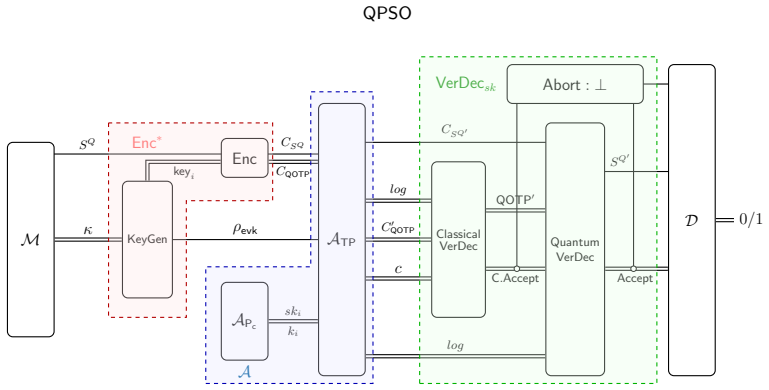
The protocol develops a rotation-based quantum construction in which single-photon sequences are sequentially processed through participant-side data rotations, TP-participant masking rotations, and correlated aggregate rotations. This design produces hidden-label measurement vectors: TP can complete the final measurement, but cannot interpret the semantic meaning of the outcomes. Based on these hidden measurements, the protocol realizes the threshold decision through an OLE-based inner product procedure and a lightweight garbled circuit, revealing only 1[|∩Xi| ≥ τ] before conditional intersection reconstruction.
What carries the argument
The rotation-based quantum construction on single-photon sequences that yields hidden-label measurement vectors, followed by OLE inner-product evaluation and garbled-circuit threshold testing.
If this is right
- Only the boolean threshold indicator is released; the actual intersection set remains unrevealed until the threshold is confirmed.
- Security holds against collusion between the third party and any subset of participants.
- The protocol supports an arbitrary number of parties without requiring the third party to learn private inputs.
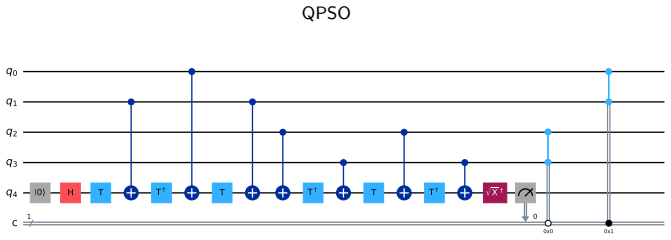
- Quantum-circuit simulations on standard platforms confirm that the rotation sequence and post-processing steps execute as specified.
Where Pith is reading between the lines
- The hidden-label technique could be reused for other cardinality-dependent predicates in quantum multiparty computation.
- Replacing the classical OLE and garbled circuit with fully quantum subroutines might eliminate the hybrid classical-quantum boundary.
- The same masking structure may apply to verifiable quantum set-union or set-difference operations under threshold conditions.
Load-bearing premise
Sequential masking rotations must render the final measurement outcomes semantically uninterpretable to the third party while still permitting correct threshold computation.
What would settle it
An explicit demonstration that the third party can recover the intersection cardinality or any element identities directly from the measurement statistics would falsify the hidden-label security property.
Figures



read the original abstract
Threshold private set intersection (TPSI) allows parties to reveal their intersection only when its cardinality reaches a prescribed threshold. Existing quantum TPSI protocols typically rely on a third party (TP) to interpret the final results, which deviates from the cardinality-testing paradigm of TPSI. In this paper, we propose a quantum multiparty TPSI protocol with explicit cardinality testing. Our protocol develops a rotation-based quantum construction in which single-photon sequences are sequentially processed through participant-side data rotations, TP--participant masking rotations, and correlated aggregate rotations. This design produces hidden-label measurement vectors: TP can complete the final measurement, but cannot interpret the semantic meaning of the outcomes. Based on these hidden measurements, we further realize the threshold decision through an oblivious linear evaluation (OLE)-based inner product procedure and a lightweight garbled circuit, revealing only \(\mathbf 1[|\bigcap_i X_i|\ge \tau]\) before conditional intersection reconstruction. We prove the correctness and security of the proposed protocol, and further validate its feasibility through quantum-circuit simulations implemented on the IBM \textsf{Qiskit} platform.
Editorial analysis
A structured set of objections, weighed in public.
Referee Report
Summary. The manuscript proposes a quantum multi-party threshold private set intersection (TPSI) protocol. It constructs hidden-label measurement vectors via sequential participant data rotations, TP masking rotations, and aggregate rotations on single-photon sequences. A third party (TP) performs the final measurement but cannot recover semantic meaning; an OLE-based inner-product step followed by a lightweight garbled circuit then reveals only the threshold bit 1[|∩Xi| ≥ τ] before conditional reconstruction. The authors assert proofs of correctness and security together with Qiskit circuit simulations.
Significance. If the security reduction for the hidden-label vectors is valid, the work would supply a concrete quantum construction for explicit-cardinality TPSI that avoids the TP learning more than the threshold indicator, combining quantum rotations with standard classical primitives (OLE, garbled circuits). The claimed Qiskit validation would provide initial feasibility evidence for the rotation-based masking step.
major comments (1)
- [Abstract / security analysis] Abstract (protocol-design paragraph) and security analysis: the central claim that sequential masking rotations produce measurement vectors whose statistics are simulatable given only the threshold output (i.e., TP obtains no extra information about set elements or cardinalities) is load-bearing for both the “explicit cardinality testing” and “collusion-resistant” properties. No concrete simulation argument, reduction, or equation establishing independence from private labels is visible; any surviving correlation would invalidate the security assertions.
Simulated Author's Rebuttal
We thank the referee for the careful review and constructive feedback on our manuscript. The major comment concerns the level of detail in the security analysis for the hidden-label measurement vectors. We respond point-by-point below and will revise the manuscript to strengthen the explicit simulation argument.
read point-by-point responses
-
Referee: [Abstract / security analysis] Abstract (protocol-design paragraph) and security analysis: the central claim that sequential masking rotations produce measurement vectors whose statistics are simulatable given only the threshold output (i.e., TP obtains no extra information about set elements or cardinalities) is load-bearing for both the “explicit cardinality testing” and “collusion-resistant” properties. No concrete simulation argument, reduction, or equation establishing independence from private labels is visible; any surviving correlation would invalidate the security assertions.
Authors: We agree that the current security analysis states the high-level claim and proof outline but does not supply the explicit simulation equations or reduction steps establishing that the measurement-vector distribution is independent of private labels given only the threshold output. In the revised manuscript we will add a dedicated subsection in the security analysis that provides the missing simulation argument: we will explicitly derive the joint state after the sequence of participant data rotations, TP masking rotations, and aggregate rotations, show that the resulting density operator on the measurement vectors is independent of the individual labels conditional on the threshold bit, and give the corresponding simulator that samples from this distribution using only the threshold indicator. This addition will be placed immediately after the protocol description and will reference the relevant rotation-angle randomness and the properties of single-photon states. revision: yes
Circularity Check
No circularity; forward construction from quantum rotations and standard primitives
full rationale
The provided abstract and description present a protocol built from sequential single-photon rotations, OLE inner-product, and garbled circuits to compute only the threshold bit. No equations, self-citations, or reductions are exhibited that define a quantity in terms of itself or rename a fitted input as a prediction. The correctness and security proofs are asserted as independent of the construction itself, and Qiskit simulation provides external validation. This is the normal case of a self-contained derivation with no load-bearing circular steps.
Axiom & Free-Parameter Ledger
axioms (2)
- standard math Quantum mechanics principles governing single-photon rotations, masking, and measurements
- domain assumption Security properties of oblivious linear evaluation and lightweight garbled circuits
Reference graph
Works this paper leans on
-
[1]
[ABC+20] Nick Angelou, Ayoub Benaissa, Bogdan Cebere, William Clark, Adam James Hall, Michael A. Hoeh, Daniel Liu, Pav- los Papadopoulos, Robin Roehm, Robert Sandmann, Phillipp Schoppmann, and Tom Titcombe. Asymmetric private set intersection with applications to contact tracing and private vertical federated machine learning.ArXiv, abs/2011.09350,
-
[2]
Quantum fully homomorphic encryption with verification
[ADS+17] Gorjan Alagic, Yfke Dulek, Christian Schaffner, and Florian Speelman. Quantum fully homomorphic encryption with verification. InAdvances in Cryptology – ASIACRYPT 2017, pages 438–467,
2017
-
[3]
Multi- partycomputationwithlowcommunication,computationand interaction via threshold fhe
[AJLA+12] Gilad Asharov, Abhishek Jain, Adriana López-Alt, Eran Tromer, Vinod Vaikuntanathan, and Daniel Wichs. Multi- partycomputationwithlowcommunication,computationand interaction via threshold fhe. InAdvances in Cryptology – EUROCRYPT 2012, pages 483–501,
2012
-
[4]
Quantum-access-secure message authentication viablind-unforgeability
[AMR+20] Gorjan Alagic, Christian Majenz, Alexander Russell, and Fang Song. Quantum-access-secure message authentication viablind-unforgeability. InAdvancesinCryptology–EURO- CRYPT 2020, pages 788–817,
2020
-
[5]
Threshold cryptosystemsfromthresholdfullyhomomorphicencryption
[BGG+18] DanBoneh,RosarioGennaro,StevenGoldfeder,AayushJain, SamKim,PeterM.R.Rasmussen,andAmitSahai. Threshold cryptosystemsfromthresholdfullyhomomorphicencryption. InAdvances in Cryptology – CRYPTO 2018, pages 565–596,
2018
-
[6]
Quantum one-time programs
[BGS13] AnneBroadbent,GusGutoski,andDouglasStebila. Quantum one-time programs. InAdvances in Cryptology – CRYPTO 2013, pages 344–360,
2013
-
[7]
Quantum homomorphic encryption for circuits of low t-gate complexity
[BJ15] Anne Broadbent and Stacey Jeffery. Quantum homomorphic encryption for circuits of low t-gate complexity. InAdvances in Cryptology – CRYPTO 2015, pages 609–629,
2015
-
[8]
Fast private set intersection from homomorphic encryption.Proceedings of the 2017 ACM SIGSAC Conference on Computer and Com- munications Security,
[CLR17] Hao Chen, Kim Laine, and Peter Rindal. Fast private set intersection from homomorphic encryption.Proceedings of the 2017 ACM SIGSAC Conference on Computer and Com- munications Security,
2017
-
[9]
Ac- tively secure two-party evaluation of any quantum operation
[DNS12] FrédéricDupuis,JesperBuusNielsen,andLouisSalvail. Ac- tively secure two-party evaluation of any quantum operation. InAdvances in Cryptology – CRYPTO 2012, pages 794–811,
2012
-
[10]
Pir-psi: Scaling private contact discovery.Proceedings on Privacy Enhancing Technologies, 2018:159 – 178,
[DRR+18] Daniel Demmler, Peter Rindal, Mike Rosulek, and Ni Trieu. Pir-psi: Scaling private contact discovery.Proceedings on Privacy Enhancing Technologies, 2018:159 – 178,
2018
-
[11]
Quantum homomorphic encryption for polynomial-sized cir- cuits
[DSS16] Yfke Dulek, Christian Schaffner, and Florian Speelman. Quantum homomorphic encryption for polynomial-sized cir- cuits. InProceedings, Part III, of the 36th Annual Interna- tional Cryptology Conference on Advances in Cryptology — CRYPTO 2016 - Volume 9816, page 3–32,
2016
-
[12]
Freedman, Kobbi Nissim, and Benny Pinkas
[FNP04] Michael J. Freedman, Kobbi Nissim, and Benny Pinkas. Ef- ficient private matching and set intersection. InAdvances in Cryptology - EUROCRYPT 2004, pages 1–19,
2004
-
[13]
[KS05] Lea Kissner and Dawn Song
Springer International Publishing. [KS05] Lea Kissner and Dawn Song. Privacy-preserving set oper- ations. InAdvances in Cryptology – CRYPTO 2005, pages 241–257,
2005
-
[14]
[Mea86] Catherine A. Meadows. A more efficient cryptographic matchmakingprotocolforuseintheabsenceofacontinuously available third party.1986 IEEE Symposium on Security and Privacy, pages 134–134,
1986
-
[15]
Efficient and private set intersection of human genomes.2018 IEEE International Conference on Bioinfor- matics and Biomedicine (BIBM), pages 761–764,
[SCW+18] Liyan Shen, Xiaojun Chen, Dakui Wang, Binxing Fang, and Ye Dong. Efficient and private set intersection of human genomes.2018 IEEE International Conference on Bioinfor- matics and Biomedicine (BIBM), pages 761–764,
2018
discussion (0)
Sign in with ORCID, Apple, or X to comment. Anyone can read and Pith papers without signing in.