REVIEW 4 major objections 5 minor 20 references
BeaverTalk: Oregon State University's IWSLT 2025 Simultaneous Speech Translation System
T0 review · 4 major / 5 minor · reviewed 2026-08-07 · deepseek-v4-flash
Pith's one-line read BeaverTalk, a cascade of VAD segmentation, Whisper ASR, and a LoRA-fine-tuned Gemma 3 12B translator, reports BLEU 24.64/27.83 on English→German and 34.07/37.23 on English→Chinese on the ACL 60/60 dev set, at StreamLAAL values from 1.84 s…
desk verdict A solid, honest shared-task system paper whose headline numbers are dev-set-tuned; useful as a reference configuration, not as an independent evaluation. read the letter →
The pith
A machine-rendered reading of the paper's core claim, the machinery that carries it, and where it could break.
The reading
What carries the argument
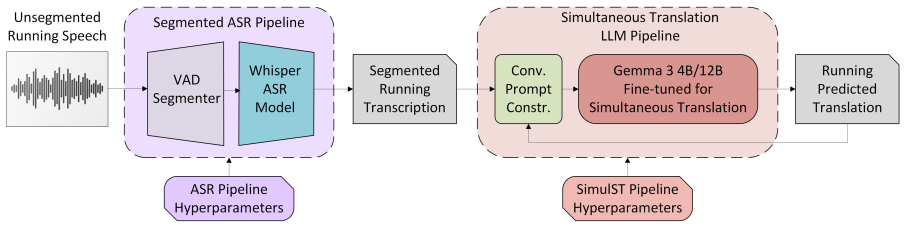
The load-bearing object is the conversational prompt: source chunks and partial translations interleaved under delimiter tokens, prefixed by the previous source sentence as a memory bank, and trained with the masked loss $L = \sum_{k=1}^{K}\sum_{i=s_k}^{e_k} \log p_\theta(t_i \mid s_{<i})$, which forces the model to predict the turn-ending token when evidence is insufficient and thereby embeds a learned latency policy into the translator. Around that prompt, the machinery is the segmented ASR front end—Silero VAD cutting on maximum unvoiced duration, voice probability threshold, and maximum segment duration, plus Whisper with a stable-transcription buffer that commits only repeated output and a context buffer that feeds the previous segment's transcript—which the paper tunes explicitly to reduce error propagation into the LLM.
What would settle it
Run the released 12B BeaverTalk pipeline on the IWSLT 2025 blind test set through the publicly released code: the central claim fails if English→German low-latency BLEU falls well under 24.64 or if StreamLAAL exceeds the 2 s regime cutoff (or 2.5 s for English→Chinese low latency). A second, sharper check is to re-tune the 12B model directly on the dev set and compare whether the 4B-derived VAD/ASR settings still win.
Extended reading notes
Core claim
The central claim is that the specific configuration of BeaverTalk—Silero VAD segmentation with tuned maximum unvoiced duration, voice probability threshold, and maximum segment duration; Whisper Large V2 ASR with a stable-transcription buffer and context buffer; and Gemma 3 12B fine-tuned via LoRA for conversational prompting with a single prior-sentence source memory bank—produces the reported quality–latency tradeoffs on the ACL 60/60 dev set. The authors further claim that the conversational loss, computed only on translation tokens and teaching the model to emit the end-of-turn delimiter when context is insufficient, makes the LLM learn part of the simultaneous decision policy jointly with translation. Scaling the translator from 4B to 12B parameters adds about 2 BLEU at roughly the same latency, and the front-end hyperparameters selected with the 4B model carry over to the 12B model without re-tuning.
Load-bearing premise
The load-bearing premise is that the ACL 60/60 dev set, used for both hyperparameter selection and the reported scores, represents the blind test audio, and that hyperparameters tuned with the 4B Gemma 3 remain optimal for the 12B model; if either fails, the headline numbers will not reproduce.
Editorial extensions
If this is right
- On English→German, the high-latency configuration gains 3.19 BLEU over the low-latency one (27.83 vs 24.64) within the 2–4 s StreamLAAL window, quantifying the task's quality–latency tradeoff.
- Scaling the translator from Gemma 3 4B to 12B yields roughly 2 BLEU at comparable StreamLAAL on both language pairs, evidence for the cascade's modularity.
- Because the VAD and ASR hyperparameters affect only transcription quality, the settings tuned on a 4B model transfer to the 12B model, letting teams tune on cheaper hardware.
- The conversational prompting loss teaches the model to emit the end-of-turn delimiter when evidence is insufficient, so a substantial part of the simultaneous policy is learned rather than hand-coded.
- On the noisy OpenSubtitles v2018 corpus, length filtering, punctuation removal, English-in-Chinese-target filtering, and CometKiwi scoring above 0.6 suffice to make fine-tuning work.
Reading between the lines
- The same cascade design should transfer to other language pairs and to longer or target-side memory banks without architectural change, though the paper does not test those variants.
- If the 4B-to-12B hyperparameter transfer holds generally, front-end tuning can be decoupled from translator scale, a practical cost saving for future simultaneous systems.
- The reported numbers are dev-set results; on the blind test set, acoustic conditions the dev set does not cover—noise, overlapping speech, code-switching—could move BLEU and StreamLAAL substantially.
- A direct prediction the paper does not run: improving ASR quality (a stronger Whisper variant or domain-adapted recognizer) should translate one-for-one into higher translation BLEU, since the cascade's bottleneck is error propagation.
Editorial analysis
A structured set of objections, weighed in public.
Referee Report
Summary. The paper describes BeaverTalk, a cascaded speech-to-text simultaneous translation system for IWSLT 2025. Audio is segmented by a Silero VAD, transcribed by Whisper Large V2, and translated by a fine-tuned Gemma 3 model (4B and 12B) using a conversational prompting strategy with a single-sentence source memory bank. The authors tune VAD parameters and the minimum chunk size on the ACL 60/60 development set using the 4B model, then report BLEU and StreamLAAL for both model sizes on the same development set for en→de and en→zh. The headline claimed results are BLEU 24.64/27.83 for en→de and 34.07/37.23 for en→zh in the low/high latency regimes.
Significance. If the reported results are taken at face value, BeaverTalk is a competitive cascaded simultaneous speech translation system, and the paper usefully documents a concrete recipe: SimAlign-based conversational prompt construction, a stable transcription buffer, and an explicit latency-quality hyperparameter search. The manuscript ships code, reports both 4B and 12B results, and gives enough implementation detail to reimplement the pipeline. The main limitations are that all reported metrics are development-set numbers obtained after selecting hyperparameters on that same set, with no blind-test numbers, no variance estimates, and no verification that 4B-selected decoding parameters transfer to the 12B model. These issues materially reduce the strength of the central claim as an independent estimate of system performance on fresh audio.
major comments (4)
- [§5.1–5.2, Tables 1–5] The headline BLEU and StreamLAAL values in Table 1 are measured on the ACL 60/60 development set, and the same set was used in §5.1 to select VPT, MSD, and MCS by maximizing BLEU. Section 2 says a blind test set is used for final evaluations, but no blind-test evaluation is reported. The numbers in the abstract and §5.2 are therefore development-set results after selection, not independent predictions; selection bias from multiple comparisons over 9 VPT/MSD combinations and 4 MCS values can inflate them. Please report the blind-test results, or if they are not available, clearly relabel all reported numbers as development-set results and soften the 'achieves' claims in the abstract and Section 5.2.
- [§5.1, Tables 4–5 and Figure 3] Minimum chunk size (MCS) is a decoding parameter of the translation LLM, yet it is selected using the 4B Gemma 3 model and then applied to the 12B model without any check. The justification in §5.1 that the VAD parameters are model-independent applies to MUD, VPT, and MSD, which determine ASR segments; it does not apply to MCS, which controls when the LLM is asked to close a translation with </s>. Since Eq. (1) explicitly trains the model's </s> emission as part of the policy, the optimal MCS could differ for the 12B model. Either run an MCS sweep with the 12B model on a subset of the development set or provide other evidence that the transfer holds before using the transferred MCS in Table 1.
- [§5.2, Table 1] The evaluation set has 60 sentences per language direction, and no confidence intervals or significance tests are provided. The claimed improvements from 4B to 12B range from +1.00 to +2.61 BLEU; after the grid search in §5.1, such differences could easily be within noise. Report bootstrap confidence intervals for BLEU and StreamLAAL, and specify how many sentences fall in each latency regime.
- [§2 and Table 1] The task description states that StreamLAAL is measured in seconds and gives low/high cutoffs of 0–2s and 2–4s, but Table 1 and the abstract report values such as 1837.86 and 3343.73 without units. If these are milliseconds, they fall within the stated regimes; if they are seconds, they exceed the cutoffs by orders of magnitude. State the unit explicitly wherever StreamLAAL is reported and make Section 2 consistent with the table values.
minor comments (5)
- [§5.1] The sentence 'Our final selected minimum chunk size for each latency regime is reported in Tables 2 and 3' should refer to Tables 4 and 5, which are the tables that actually list MCS values.
- [§3.2.1] The 'cutoff threshold' that limits the Whisper context buffer is never defined; please give its value or explain how it is chosen.
- [Figure 3] The figure caption does not state which model (4B or 12B) produced the plotted points, and the text does not describe the figure beyond listing chunk sizes; clarify this and reference the figure in the body.
- [Throughout] The spacing in 'V AD' is inconsistent (VAD appears elsewhere), and the metric is written both 'streamLAAL' and 'StreamLAAL'; unify both spellings.
- [Footnote 1] The GitHub URL in the footnote is typeset across a line break; ensure it is rendered as a single clickable URL.
Circularity Check
Headline BLEU/StreamLAAL are reported on the same ACL 60/60 dev set used to select inference hyperparameters, with no held-out or blind-test result, so the central performance claim is partly a fitted quantity rather than an independent estimate.
-
fitted input called prediction
[Section 5.1-5.2 (hyperparameter tuning and Table 1 results)]
"we selected inference hyperparameters using a 4B Gemma 3 model, which could run on a V100. ... We provide the quality and latency of our system in Table 1 on the ACL 60/60 dev set for the en→de and en→zh language pairs. ... we achieve a BLEU of 24.64 and 27.83 on the low and high latency regimes."
The same ACL 60/60 dev set is used both as the selection criterion and as the evaluation set: VPT, MSD, and MCS are chosen by maximizing BLEU/latency tradeoffs on that set, and then the headline BLEU/StreamLAAL numbers are reported on that same set. Choosing hyperparameters to optimize a metric on a dataset and then presenting the optimized metric on the same dataset does not yield an independent estimate; the reported numbers are the outcome of the search, not an out-of-sample result. Using the 4B model for the search and the 12B model for the final run does not remove the dependence because the selected hyperparameter values were chosen on the very set used for the final measurements, and no blind-test or held-out results are reported.
full rationale
There is no mathematical derivation chain in this systems paper, so no equation-level self-definitional circularity is present. The one substantive circularity concern is evaluation: Section 5.1 selects VPT/MSD/MCS by optimizing BLEU/latency on the ACL 60/60 dev set, and Section 5.2 reports the final BLEU/StreamLAAL on the same ACL 60/60 dev set without a blind-test result. This makes the central performance claim partly a fitted quantity, although the model weights themselves are trained on OpenSubtitles, so the effect is selection bias rather than full construction. Self-citations to the authors' prior Simul-LLM and simultaneous-masking work (Agostinelli et al. 2024; Raffel et al. 2024) are used as framework background, not as a load-bearing uniqueness or equivalence argument, and the paper provides its own code and experimental details. Accordingly, the circularity score is moderate.
Assumptions & free parameters
free parameters (6)
- MUD (maximum unvoiced duration) =
0.1 s
- VPT (voice probability threshold) =
0.5 (low), 0.3 (high) for en-de; 0.5 for en-zh
- MSD (maximum segment duration) =
0.5 s (low), 1.0 s (high) en-de; 0.5 s (low), 1.5 s (high) en-zh
- MCS (minimum chunk size) =
3 (low), 7 (high) en-de; 5 (low), 7 (high) en-zh
- CometKiwi filtering threshold =
0.6
- LoRA rank and alpha =
r=64, alpha=16
assumptions (5)
- domain assumption OpenSubtitles v2018, after the described cleaning, provides a training distribution that transfers to the IWSLT 2025 ACL 60/60 dev set.
- domain assumption A cascaded VAD and Whisper pipeline can produce transcriptions accurate enough that the translation LLM's errors dominate.
- ad hoc to paper Inference hyperparameters optimal for the 4B Gemma 3 model transfer to the 12B model.
- domain assumption BLEU at word level (en-de) and character level (en-zh) with sacreBLEU, and StreamLAAL as implemented, are valid measures of the reported quality and latency.
- domain assumption Gemma 3 12B fine-tuned with LoRA at the given rank retains sufficient translation quality and follows the conversational prompting format.
Cite this review
Pith. "Pith review of BeaverTalk: Oregon State University's IWSLT 2025 Simultaneous Speech Translation System." pith.science (2026). https://pith.science/paper/FEI35K3H
@misc{pith2026250524016,
  author       = {Pith},
  title        = {Pith review of: BeaverTalk: Oregon State University's IWSLT 2025 Simultaneous Speech Translation System},
  year         = {2026},
  howpublished = {\url{https://pith.science/paper/FEI35K3H}},
  note         = {Machine review of arXiv:2505.24016}
}
abstract
This paper discusses the construction, fine-tuning, and deployment of BeaverTalk, a cascaded system for speech-to-text translation as part of the IWSLT 2025 simultaneous translation task. The system architecture employs a VAD segmenter for breaking a speech stream into segments, Whisper Large V2 for automatic speech recognition (ASR), and Gemma 3 12B for simultaneous translation. Regarding the simultaneous translation LLM, it is fine-tuned via low-rank adaptors (LoRAs) for a conversational prompting strategy that leverages a single prior-sentence memory bank from the source language as context. The cascaded system participated in the English$\rightarrow$German and English$\rightarrow$Chinese language directions for both the low and high latency regimes. In particular, on the English$\rightarrow$German task, the system achieves a BLEU of 24.64 and 27.83 at a StreamLAAL of 1837.86 and 3343.73, respectively. Then, on the English$\rightarrow$Chinese task, the system achieves a BLEU of 34.07 and 37.23 at a StreamLAAL of 2216.99 and 3521.35, respectively.
Figures


Reference graph
Works this paper leans on
-
[1]
Idris Abdulmumin, Victor Agostinelli, Tanel Alumäe, Antonios Anastasopoulos, Ashwin, Luisa Bentivogli, Ondřej Bojar, Claudia Borg, Fethi Bougares, Roldano Cattoni, Mauro Cettolo, Lizhong Chen, William Chen, Raj Dabre, Yannick Estève, Marcello Federico, Marco Gaido, Dávid Javorský, Marek Kasztelnik, and 30 others. 2025. Findings of the iwslt 2025 evaluatio...
2025
-
[2]
Victor Agostinelli, Max Wild, Matthew Raffel, Kazi Fuad, and Lizhong Chen. 2024. https://doi.org/10.18653/v1/2024.acl-long.567 Simul- LLM : A framework for exploring high-quality simultaneous translation with large language models . In Proceedings of the 62nd Annual Meeting of the Association for Computational Linguistics (Volume 1: Long Papers), pages 10...
-
[3]
Alexis Conneau, Kartikay Khandelwal, Naman Goyal, Vishrav Chaudhary, Guillaume Wenzek, Francisco Guzm \' a n, Edouard Grave, Myle Ott, Luke Zettlemoyer, and Veselin Stoyanov. 2019. https://arxiv.org/abs/1911.02116 Unsupervised cross-lingual representation learning at scale . CoRR, abs/1911.02116
arXiv 2019
-
[4]
Tim Dettmers, Artidoro Pagnoni, Ari Holtzman, and Luke Zettlemoyer. 2023. Qlora: Efficient finetuning of quantized llms. Advances in neural information processing systems, 36:10088--10115
2023
-
[5]
Chris Dyer, Victor Chahuneau, and Noah A. Smith. 2013. https://aclanthology.org/N13-1073/ A simple, fast, and effective reparameterization of IBM model 2 . In Proceedings of the 2013 Conference of the North A merican Chapter of the Association for Computational Linguistics: Human Language Technologies , pages 644--648, Atlanta, Georgia. Association for Co...
2013
-
[6]
Hu, Yelong Shen, Phillip Wallis, Zeyuan Allen-Zhu, Yuanzhi Li, Shean Wang, Lu Wang, and Weizhu Chen
Edward J. Hu, Yelong Shen, Phillip Wallis, Zeyuan Allen-Zhu, Yuanzhi Li, Shean Wang, Lu Wang, and Weizhu Chen. 2021. https://arxiv.org/abs/2106.09685 Lora: Low-rank adaptation of large language models . Preprint, arXiv:2106.09685
arXiv 2021
-
[7]
Masoud Jalili Sabet, Philipp Dufter, Fran c ois Yvon, and Hinrich Sch \"u tze. 2020. https://doi.org/10.18653/v1/2020.findings-emnlp.147 S im A lign: High quality word alignments without parallel training data using static and contextualized embeddings . In Findings of the Association for Computational Linguistics: EMNLP 2020, pages 1627--1643, Online. As...
-
[8]
Pierre Lison, J \"o rg Tiedemann, and Milen Kouylekov. 2018. https://aclanthology.org/L18-1275/ O pen S ubtitles2018: Statistical rescoring of sentence alignments in large, noisy parallel corpora . In Proceedings of the Eleventh International Conference on Language Resources and Evaluation ( LREC 2018) , Miyazaki, Japan. European Language Resources Associ...
2018
Show all 20 references
-
[9]
Sara Papi, Marco Gaido, Matteo Negri, and Luisa Bentivogli. 2024. https://arxiv.org/abs/2406.06097 Streamatt: Direct streaming speech-to-text translation with attention-based audio history selection . Preprint, arXiv:2406.06097
2024 arXiv
-
[10]
Matt Post. 2018. A call for clarity in reporting bleu scores. arXiv preprint arXiv:1804.08771
2018 arXiv
- [11]
-
[12]
Matthew Raffel, Victor Agostinelli, and Lizhong Chen. 2024. https://doi.org/10.18653/v1/2024.emnlp-main.1017 Simultaneous masking, not prompting optimization: A paradigm shift in fine-tuning LLM s for simultaneous translation . In Proceedings of the 2024 Conference on Empirica...
2024 doi
-
[13]
Ricardo Rei, Marcos Treviso, Nuno M Guerreiro, Chrysoula Zerva, Ana C Farinha, Christine Maroti, Jos \'e GC De Souza, Taisiya Glushkova, Duarte M Alves, Alon Lavie, and 1 others. 2022. Cometkiwi: Ist-unbabel 2022 submission for the quality estimation shared task. arXiv preprin...
2022 arXiv
-
[14]
Gemma Team, Aishwarya Kamath, Johan Ferret, Shreya Pathak, Nino Vieillard, Ramona Merhej, Sarah Perrin, Tatiana Matejovicova, Alexandre Ramé, Morgane Rivière, Louis Rouillard, Thomas Mesnard, Geoffrey Cideron, Jean bastien Grill, Sabela Ramos, Edouard Yvinec, Michelle Casbon, ...
2025 arXiv
-
[15]
Silero Team. 2024. Silero vad: pre-trained enterprise-grade voice activity detector (vad), number detector and language classifier. https://github.com/snakers4/silero-vad
2024
-
[16]
Viet Anh Khoa Tran, David Thulke, Yingbo Gao, Christian Herold, and Hermann Ney. 2022. https://doi.org/10.18653/v1/2022.emnlp-main.297 Does joint training really help cascaded speech translation? In Proceedings of the 2022 Conference on Empirical Methods in Natural Language Pr...
2022 doi
-
[17]
Minghan Wang, Thuy-Trang Vu, Yuxia Wang, Ehsan Shareghi, and Gholamreza Haffari. 2024. https://arxiv.org/abs/2402.10552 Conversational simulmt: Efficient simultaneous translation with large language models . Preprint, arXiv:2402.10552
2024
-
[18]
Giulio Zhou, Tsz Kin Lam, Alexandra Birch, and Barry Haddow. 2024. Prosody in cascade and direct speech-to-text translation: a case study on korean wh-phrases. arXiv preprint arXiv:2402.00632
2024 arXiv
-
[19]
online" 'onlinestring :=
ENTRY address archivePrefix author booktitle chapter edition editor eid eprint eprinttype howpublished institution journal key month note number organization pages publisher school series title type volume year doi pubmed url lastchecked label extra.label sort.label short.list...
-
[20]
write newline
" write newline "" before.all 'output.state := FUNCTION n.dashify 't := "" t empty not t #1 #1 substring "-" = t #1 #2 substring "--" = not "--" * t #2 global.max substring 't := t #1 #1 substring "-" = "-" * t #2 global.max substring 't := while if t #1 #1 substring * t #2 gl...
Reviewed August 7, 2026 · model on record in the stance chip above.
Discussion (0). Sign in to comment.