Embedded Random Matrix Ensembles to Statistical Shell Model: Operation of q-normal forms
Pith reviewed 2026-06-30 02:22 UTC · model grok-4.3
The pith
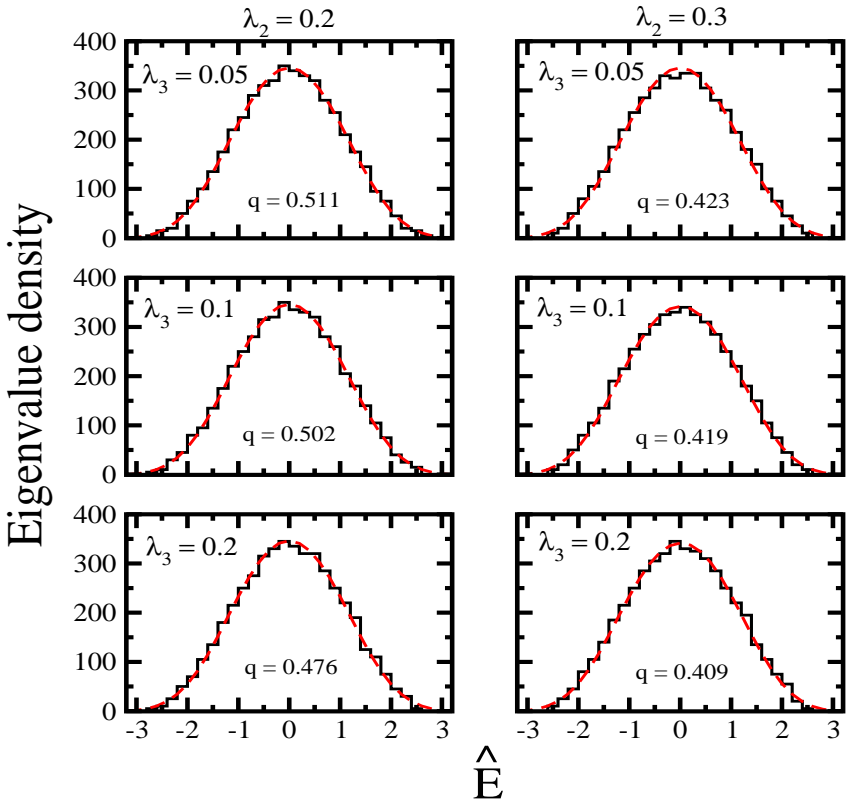
Embedded random matrix ensembles generate q-normal forms for nuclear level densities and transition strengths.
A machine-rendered reading of the paper's core claim, the machinery that carries it, and where it could break.
Core claim
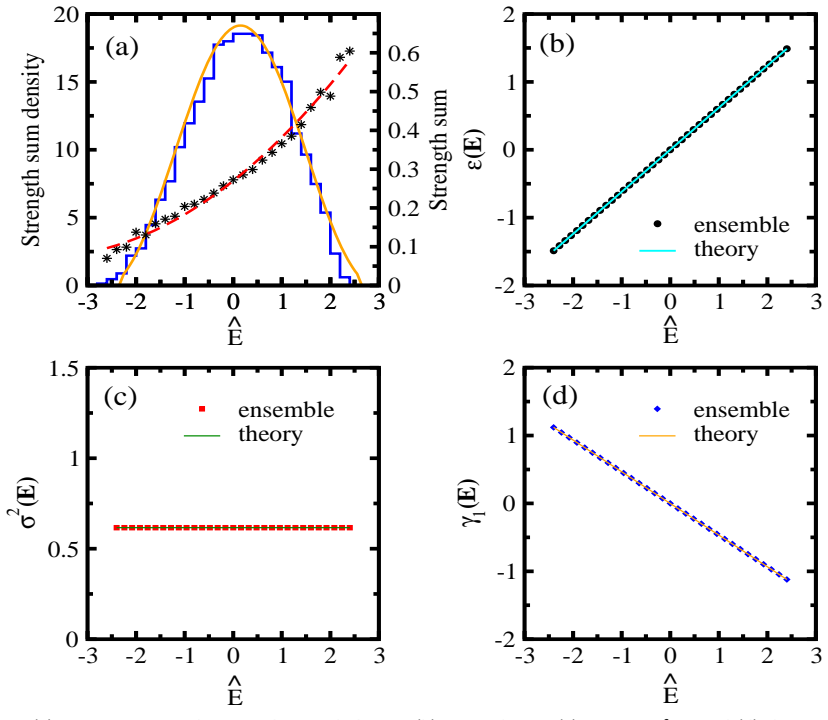
Embedded random matrix ensembles operating in nuclear shell model spaces generate q-normal form for the density of eigenvalues, bivariate q-normal form for transition strengths and conditional q-normal form for strength functions; these allow development of statistical shell model with q-normal forms, improving on previous Gaussian-based approaches when interactions are sufficiently strong.
What carries the argument
q-normal form (q=1 gives Gaussian, q=0 gives Wigner's semicircle) generated by embedded ensembles with two-body interactions in finite shell model spaces after partitioning by spherical configurations and J.
Load-bearing premise
With sufficiently strong two-body interactions the level densities take close to q-normal form and partitioning via spherical configurations and J is essential for the statistical spectroscopy to work.
What would settle it
A numerical diagonalization of a small embedded ensemble with strong random two-body interactions showing that the eigenvalue density cannot be fit by a q-normal for any q would falsify the central claim.
Figures
read the original abstract
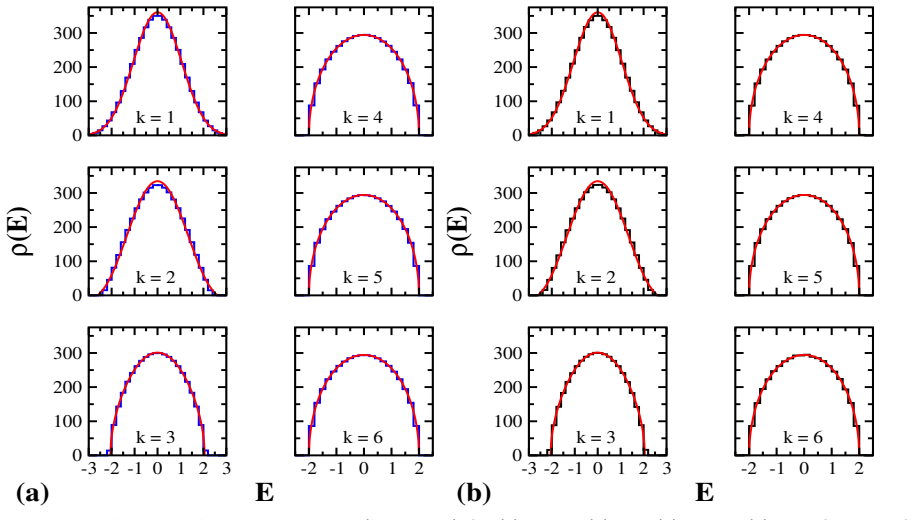
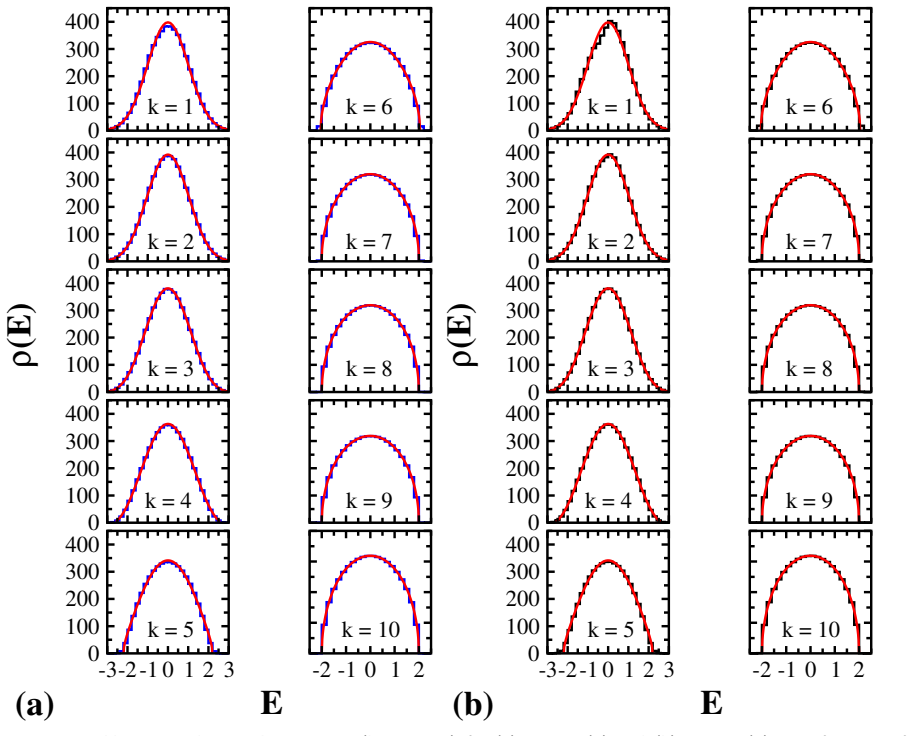
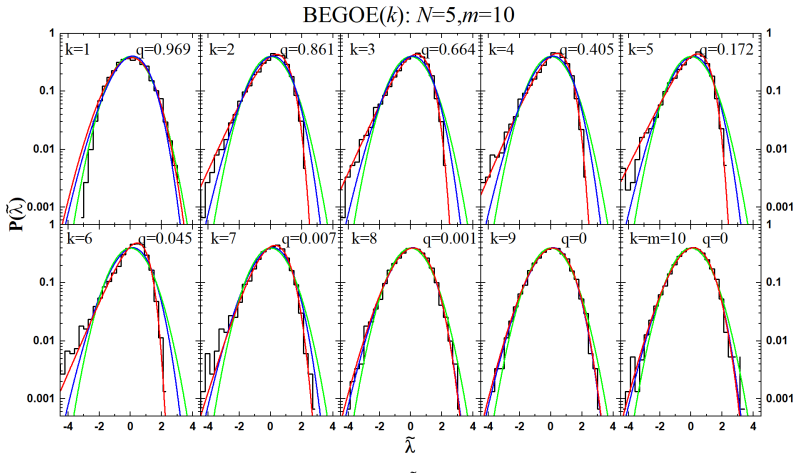
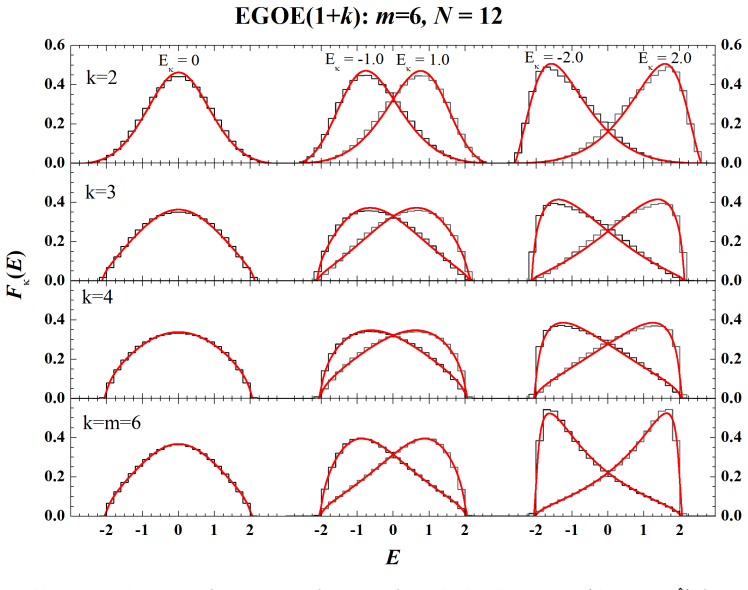
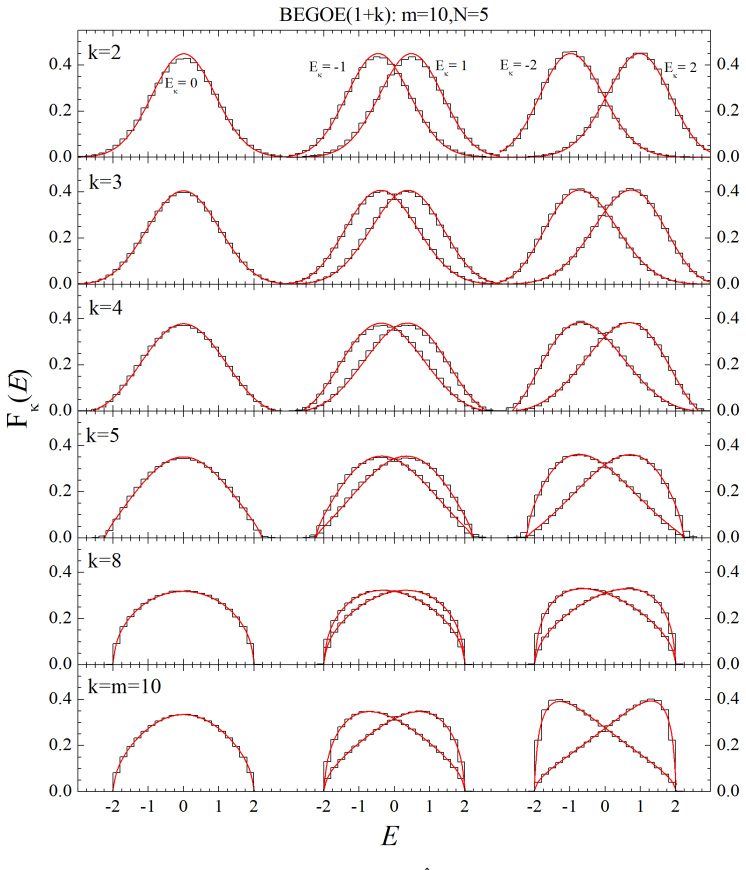
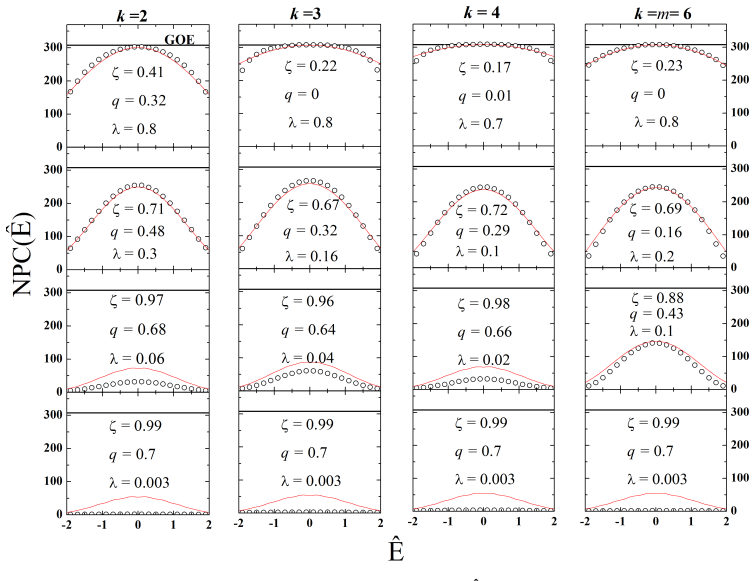
Embedded random matrix ensembles operating in nuclear shell model spaces, with nucleons occupying a finite set of single particle orbits and interacting via a two-body interaction, form the basis for statistical shell model. With sufficiently strong interaction, the level densities in shell model spaces take close to a Gaussian form and transition strength distributions close to a bivariate Gaussian form. In practice, partitioning via spherical configurations ($\tilde{m}$) and angular momentum $J$ (also isospin where appropriate) are essential. The resulting statistical spectroscopy or statistical shell model was applied successfully in the past in some studies of nuclear level densities, orbit occupancies, $\beta$-decay matrix elements and so on. Going beyond these, recently it is recognized that embedded ensembles, in a better approximation, generate in-fact $q$-normal form ($q=1$ gives Gaussian and $q=0$ Wigner's semi-circle) for density of eigenvalues, bivariate $q$-normal form for transition strengths and conditional $q$-normal form for strength functions. These then allow us to develop statistical shell model with $q$-normal forms. These new developments in embedded ensembles and statistical shell model are briefly reviewed in this paper. Also described, using some examples, is the role of the $q$ parameter in generating statistical properties of general quantum many-particle systems.
Editorial analysis
A structured set of objections, weighed in public.
Referee Report
Summary. The manuscript is a brief review of developments in embedded random matrix ensembles (ERMEs) operating in nuclear shell-model spaces with two-body interactions. It states that sufficiently strong interactions produce level densities close to q-normal form (with q=1 recovering the Gaussian and q=0 the semicircle), bivariate q-normal forms for transition strengths, and conditional q-normal forms for strength functions. These are positioned as improvements over prior Gaussian approximations in statistical shell model applications (level densities, occupancies, beta-decay matrix elements), with essential partitioning by spherical configurations (m̃) and angular momentum J. The review also discusses the role of the tunable q parameter in generating statistical properties of general quantum many-particle systems.
Significance. If the reviewed results hold, the work strengthens the statistical shell model by replacing Gaussian approximations with q-normal forms that better capture finite-space effects in many-body systems. The synthesis of ERME results with q-deformed distributions and the explicit role of q as an interpolating parameter constitute a useful consolidation for the field; the review format itself is a strength in providing context without claiming new derivations.
minor comments (2)
- [Abstract] Abstract: the phrasing 'it is recognized that embedded ensembles... generate in-fact q-normal form' would benefit from an explicit forward reference to the section(s) where the supporting ERME results or literature citations are summarized, to aid readers seeking the underlying evidence.
- The manuscript should clarify whether the q values are determined from ensemble moments or treated as free parameters in the reviewed applications; a short statement on this distinction would improve precision without altering the review character.
Simulated Author's Rebuttal
We thank the referee for the constructive summary and positive evaluation of the manuscript's significance as a consolidation of ERME results with q-deformed distributions. The recommendation for minor revision is noted. No specific major comments were listed in the report, so we provide no point-by-point responses below. We are prepared to address any editorial or minor suggestions during revision.
Circularity Check
Review paper summarizes prior results without new derivation chain
full rationale
The manuscript is explicitly a brief review of existing developments in embedded random matrix ensembles generating q-normal forms for level densities, transition strengths, and strength functions in nuclear shell model spaces. No new equations, derivations, or parameter-free predictions are presented in the provided text; q is described as a tunable interpolating parameter (q=1 Gaussian, q=0 semicircle) whose role is illustrated via examples from prior literature. No load-bearing steps reduce outputs to inputs by construction, no fitted quantities are relabeled as predictions, and no self-citation chains are invoked to justify uniqueness or forbid alternatives. The central claims rest on recognition of results from the broader embedded-ensemble literature rather than an internal derivation that could be circular.
Axiom & Free-Parameter Ledger
Reference graph
Works this paper leans on
-
[1]
French, Spectral distributions in nuclei, in Nuclear Structure, A
J.B. French, Spectral distributions in nuclei, in Nuclear Structure, A. Hossain, Harun-ar-Rashid and M.Islam (eds.) (North Holland, Amsterdam, 1967), p. 85
1967
-
[2]
French, E.C
J.B. French, E.C. Halbert, J.B. McGrory and S.S.M. Wong, Complex spectroscopy, Advances in Nuclear Physics, Vol.3, 193 (1969)
1969
-
[3]
Wong, Nuclear Statistical Spectroscopy (Oxford University Press, New York, 1986)
S.S.M. Wong, Nuclear Statistical Spectroscopy (Oxford University Press, New York, 1986)
1986
-
[4]
Kota and R.U
V.K.B. Kota and R.U. Haq, Spectral Distributions in Nuclei and Statistical Spectroscopy (World Scientific, Singapore, 2010)
2010
-
[5]
Dalton, S.M
B.J. Dalton, S.M. Grimes, J.P. Vary and S.A. Williams (eds.), Theory and Applications of Moment Methods in Many Fermion Systems (Plenum, New York, 1980)
1980
-
[6]
Ratcliff, Application of spectral distributions in nuclear Spectroscopy, Phys
K.F. Ratcliff, Application of spectral distributions in nuclear Spectroscopy, Phys. Rev. C3, 117 (1971)
1971
-
[7]
Chang, J.B
F.S. Chang, J.B. French and T.H. Thio, Distribution methods for nuclear energies, level densities and excitation strengths, Ann. Phys (N. Y.) 66, 137 (1971)
1971
-
[8]
French and S.S.M
J.P Draayer, J.B. French and S.S.M. Wong, Spectral distributions and statistical spectroscopy. 1. General theory, Ann. Phys. (N. Y)106, 472 (1977)
1977
-
[9]
Kota and R
V.K.B. Kota and R. Sahu, Statistical shell model for neutrinoless double𝛽-decay nuclear transition matrix elements: Results for76Ge, 82Se, 100Mo, 124Sn, 130Te and136Xe, Int. J. Mod. Phys. E35, 2550056 (2026)
2026
-
[10]
French, V.K.B
J.B. French, V.K.B. Kota, A. Pandey and S. Tomsovic, Statistical properties of many -particle spectra VI: Fluctuation bounds on N-N T- noninvariance, Ann. Phys. (N. Y.)181, 235 (1988)
1988
-
[11]
Mon and J.B
K.K. Mon and J.B. French, Statistical properties of many-particle spectra, Ann. Phys. (N.Y.)95, 90 (1975)
1975
-
[12]
Kota, Embedded random matrix ensembles for complexity and chaos in finite interacting particle systems, Physics Reports347, 223 (2001)
V.K.B. Kota, Embedded random matrix ensembles for complexity and chaos in finite interacting particle systems, Physics Reports347, 223 (2001)
2001
-
[13]
Brown, A
B.A. Brown, A. Etchegoyen and W. Rae. Computer code OXBASH: the Oxford University-Buenos Aires-MSU shell model code, Michigan State University Cyclotron Laboratory Report No. 524, 1985
1985
-
[14]
Zelevinsky, B.A
V. Zelevinsky, B.A. Brown, N. Frazier and M. Horoi, The nuclear shell model as a testing ground for many-body quantum chaos, Physics Reports276, 85 (1996)
1996
-
[15]
Lett.82, 2064 (1999)
M.Horoi,A.Volya,andV.Zelevinsky,ChaoticWaveFunctionsandExponentialConvergenceofLow-LyingEnergyEigenvalues,Phys.Rev. Lett.82, 2064 (1999)
2064
-
[16]
Horoi, M
M. Horoi, M. Ghita and V. Zelevinsky, Fixed spin and parity nuclear level density for restricted shell model configurations, Phys. Rev. C69, 041307(R) (2004)
2004
-
[17]
M.HoroiandV.Zelevinsky,ExactRemovaloftheCenter-of-MassSpuriousStatesfromLevelDensities,Phys.Rev.Lett.98,262503(2007)
2007
-
[18]
R. A. Senkov and M. Horoi, High-performance algorithm to calculate spin- and parity-dependent nuclear level densities, Phys. Rev. C82, 024304 (2010). V. K. B. Kota et al.:Preprint submitted to ElsevierPage 25 of 27
2010
-
[19]
R.A.Senkov,M.HoroiandV.G.Zelevinsky,Ahigh-performanceFortrancodetocalculatespin-andparity-dependentnuclearleveldensities, Computer Physics Communications184, 215 (2013)
2013
-
[20]
S.Karampagia,R.A.SenkovandV.Zelevinsky,Leveldensityofthesd-nucleiμStatisticalshell-modelpredictions,AtomicDataandNuclear Data Tables120, 1 (2018)
2018
-
[21]
Ghosh, B
Sangeeta, T. Ghosh, B. Maheshwari, G. Saxena and B.K. Agrawal, Astrophysical reaction rates with realistic nuclear level densities, Phys. Rev. C105, 044320 (2022)
2022
-
[22]
Zelevinsky and A
V. Zelevinsky and A. Volya, Mesoscopic Nuclear Physics: from Nucleus to Quantum Chaos and Quantum Signal Transmission (World Scientific, Singapore, 2023)
2023
-
[23]
V.K.B.KotaandN.D.Chavda,Embeddedrandommatrixensemblesfromnuclearstructureandtheirrecentapplications,Int.J.Mod.Phys.E 27, 1830001 (2018)
2018
-
[24]
French and S.S.M
J.B. French and S.S.M. Wong, Some random-matrix level and spacing distributions for fixed particle-rank interactions, Phys. Lett. B35, 5 (1971)
1971
-
[25]
Bohigas and J
O. Bohigas and J. Flores, Two-body random Hamiltonian and level density, Phys. Lett. B34, 261 (1971)
1971
-
[26]
Mehta, Random Matrices, 3rd edition (Elsevier B.V., The Netherlands, 2004)
M.L. Mehta, Random Matrices, 3rd edition (Elsevier B.V., The Netherlands, 2004)
2004
-
[27]
Brody, J
T.A. Brody, J. Flores, J.B. French, P.A. Mello, A. Pandey, and S.S.M. Wong, Random Matrix Physics: Spectrum and Strength Fluctuations, Rev. Mod. Phys.53, 385 (1981)
1981
-
[28]
Gomez, K
J.M.G. Gomez, K. Kar, V.K.B. Kota, R.A. Molina, A. Relano, and J. Retamosa, Many-Body Quantum Chaos: Recent Developments and Applications to Nuclei, Physics Reports499, 103 (2011)
2011
-
[29]
Borgonovi, F.M
F. Borgonovi, F.M. Izrailev, L.F. Santos and V. Zelevinsky, Quantum chaos and thermalization in isolated systems of interacting particles, Physics Reports626, 1 (2016)
2016
-
[30]
Kota, Embedded Random Matrix Ensembles in Quantum Physics (Springer, Heidelberg, 2014)
V.K.B. Kota, Embedded Random Matrix Ensembles in Quantum Physics (Springer, Heidelberg, 2014)
2014
-
[31]
Kota and N.D
V.K.B. Kota and N.D. Chavda, Random𝑘-body ensembles for chaos and thermalization in isolated systems, Entropy20, 541 (2018)
2018
-
[32]
Caurier, G
E. Caurier, G. Martinez-Pinedo, F. Nowacki, A. Poves, J. Retamosa and A. P. Zuker, Full0ℏ𝜔shell model calculation of the binding energies of the1𝑓 7∕2 nuclei, Phys. Rev. C59, 2033 (1999)
2033
- [33]
-
[34]
MananVyasandV.K.B.Kota,Quenchedmany-bodyquantumdynamicswith𝑘-bodyinteractionsusing𝑞-Hermitepolynomials,J.Stat.Mech.: Theory Exp.2019, 103103 (2019)
2019
-
[35]
Kota, Bivariate𝑞-normal distribution for transition matrix elements in quantum many-body systems, J
Manan Vyas and V.K.B. Kota, Bivariate𝑞-normal distribution for transition matrix elements in quantum many-body systems, J. Stat. Mech.: Theory Exp.2020, 0931001 (2020)
2020
-
[36]
V.K.B.KotaandMananVyas,Wavefunctionstructureinquantummany-fermionsystemswith𝑘-bodyinteractions:conditionalq-normalform of strength function, J. Stat. Mech.: Theory Exp.2021, 113103 (2021)
2021
-
[37]
V.K.B.KotaandMananVyas,Statisticalnuclearspectroscopywith𝑞-normalandbivariate𝑞-normaldistributionsand𝑞-Hermitepolynomials, Ann. Phys. (N.Y.)446, 169131 (2022)
2022
-
[38]
Ismail, D
M.E.H. Ismail, D. Stanton, G. Viennot, The combinatorics of𝑞-Hermite polynomials and the Askey-Wilson integral, European J. Combin.8, 379 (1987)
1987
-
[39]
P. J. Szablowski, Multidimensional𝑞-Normal and related distributions- Markov case, Electron. J. Probab15, 1296 (2010)
2010
-
[40]
46, 679 (2013)
P.J.Szablowski,Onthe𝑞-Hermitepolynomialsandtheirrelationshipwithsomeotherfamiliesoforthogonalpolynomials,DemonstratioMath. 46, 679 (2013)
2013
-
[41]
P. J. Szablowski, Moments of𝑞-normal and conditional𝑞-normal distribution, Stat. Probab. Lett.106, 65 (2015)
2015
-
[42]
García-García and J.J.M
A.M. García-García and J.J.M. Verbaarschot, Spectral and thermodynamic properties of the Sachdev-Ye-Kitaev model, Phys. Rev. D94, 126010 (2016)
2016
-
[43]
A.M.García-GarcíaandJ.J.M.Verbaarschot,AnalyticalspectraldensityoftheSachdev-Ye-KitaevmodelatfiniteN,Phys.Rev.D96,066012 (2017)
2017
-
[44]
A.M.García-García,Y.JiaandJ.J.M.Verbaarschot,UniversalityandThoulessenergyinthesupersymmetricSachdev-Ye-KitaevModel,Phys. Rev. D97106003 (2018)
2018
-
[45]
Jia and J
Y. Jia and J. J. M. Verbaarschot, Spectral fluctuations in the Sachdev-Ye-Kitaev mode, JHEP7, 193 (2020)
2020
-
[46]
Stuart and J.K
A. Stuart and J.K. Ord,Kendall’s Advanced Theory of Statistics : Distribution Theory(Oxford University Press, New York, 1987)
1987
-
[47]
Small and S
R.A. Small and S. Müller, Particle diagrams and statistics of many-body random potentials, Ann. Phys. (N.Y.)356, 269-298 (2015)
2015
-
[48]
(N.Y.)292, 67 (2001)
L.Benet,T.Rupp,andH.A.Weidenmüller,Spectralpropertiesofthe𝑘-bodyembeddedGaussianensemblesofrandommatrices,Ann.Phys. (N.Y.)292, 67 (2001)
2001
-
[49]
Benet and H.A
L. Benet and H.A. Weidenmüller, Review of the k-body embedded ensembles of Gaussian random matrices, J. Phys. A36, 3569 (2003)
2003
-
[50]
Kota, SU(N) Wigner-Racah algebra for the matrix of second moments of embedded Gaussian unitary ensemble of random matrices, J
V.K.B. Kota, SU(N) Wigner-Racah algebra for the matrix of second moments of embedded Gaussian unitary ensemble of random matrices, J. Math. Phys.46, 033514 (2005)
2005
-
[51]
Kota, Two-species𝑘-body embedded Gaussian unitary ensembles:𝑞-normal form of the eigenvalue density, J
Manan Vyas and V.K.B. Kota, Two-species𝑘-body embedded Gaussian unitary ensembles:𝑞-normal form of the eigenvalue density, J. Stat. Mech.: Theory Exp.2023, 093103 (2023)
2023
-
[52]
Kota and Manan Vyas, Random matrix theory for transition strength densities in finite quantum systems: Results from embedded unitary ensembles, Ann
V.K.B. Kota and Manan Vyas, Random matrix theory for transition strength densities in finite quantum systems: Results from embedded unitary ensembles, Ann. Phys. (N.Y.)359, 252 (2015)
2015
-
[53]
Rao and N.D
P. Rao and N.D. Chavda, Structure of wavefunction for interacting bosons in mean-field with random𝑘-body interactions, Phys. Lett. A399, 127302 (2021)
2021
-
[54]
P.RaoandN.D.Chavda,Thermalizationinmany-fermionquantumsystemswithone-plusrandom𝑘-bodyinteractions,J.Stat.Mech.:Theory Exp.2023, 033105 (2023)
2023
-
[55]
Dyson, Statistical theory of energy levels of complex systems III
F.J. Dyson, Statistical theory of energy levels of complex systems III. J. Math. Phys.3, 166 (1962). V. K. B. Kota et al.:Preprint submitted to ElsevierPage 26 of 27
1962
-
[56]
Kota, Bivariate moments of the two-point correlation function for embedded Gaussian unitary ensemble with𝑘-body interactions, Phys
V.K.B. Kota, Bivariate moments of the two-point correlation function for embedded Gaussian unitary ensemble with𝑘-body interactions, Phys. Rev. E107, 054128 (2023)
2023
-
[57]
French, P.A
J.B. French, P.A. Mello, and A. Pandey, Statistical properties of many-particle spectra II. Two-point correlations and fluctuations, Ann. Phys. (N.Y.)113, 277 (1978)
1978
-
[58]
Muñoz, E
L. Muñoz, E. Faleiro, R.A. Molina, A. Relaño, and J. Retamosa, Spectral statistics in non-interacting many-particle systems. Phys. Rev. E73, 036202 (2006)
2006
-
[59]
Prakash and A
R. Prakash and A. Pandey, Saturation of number variance in embedded random-matrix ensembles, Phys. Rev. E93, 052225 (2016)
2016
-
[60]
Maier, C
G. Maier, C. Echter, J.D. Urbina, C. Lewenkopf and K. Richter, Ensemble-averaged mean-field many-body level density: An indicator of integrable versus chaotic single-particle dynamics, Phys. Rev. E111, 054202 (2025)
2025
-
[61]
S. N. Majumdar and G. Schehr, Statistics of Extremes and Records in Random Sequences, (Oxford University Press, Oxford, 2024)
2024
-
[62]
E. J. Gumbel,Statistics of Extremes, (Columbia University Press, New York Chichester, West Sussex, 1958)
1958
-
[63]
Galambos,The Asymptotic Theory of Extreme Order Statistics, (Malabar, FL: Krieger, 1987)
J. Galambos,The Asymptotic Theory of Extreme Order Statistics, (Malabar, FL: Krieger, 1987)
1987
-
[64]
C. A. Tracy and H. Widom, Level-spacing distributions and the Airy kernel, Phys. Lett. B305, 115 (1993)
1993
-
[65]
C. A. Tracy and H. Widom, Level-spacing distributions and the Airy kernel, Comm. Math. Phys.159, 151 (1994)
1994
-
[66]
C. A. Tracy and H. Widom, On orthogonal and symplectic matrix ensembles, Comm. Math. Phys.177, 727 (1996)
1996
-
[67]
Palassini, Ground-state energy fluctuations in the Sherrington–Kirkpatrick model, J
M. Palassini, Ground-state energy fluctuations in the Sherrington–Kirkpatrick model, J. Stat. Mech.2008, P10005 (2008)
2008
-
[68]
E.Carro,L.BenetandI.P.Castillo,AsmoothtransitiontowardsaTracy–Widomdistributionforthelargesteigenvalueofinteracting𝑘-body fermionic embedded Gaussian ensembles, J. Stat. Mech.2023, 043201 (2023)
2023
-
[69]
Chavda, P
N.D. Chavda, P. Rao, V.K.B. Kota and Manan Vyas, Distribution of lowest eigenvalue in𝑘-body bosonic random matrix ensembles, Physica A677, 130874 (2025)
2025
-
[70]
R.MachleidtandF.Sammarruca,RecentadvancesinchiralEFTbasednuclearforcesandtheirapplications,ProgressinParticleandNuclear Physics137, 104117 (2024)
2024
-
[71]
E70, 016209 (2004)
D.Angom,S.GhoshandV.K.B.Kota,Strengthfunctions,entropiesanddualityinweaklytostronglyinteractingfermionsystems,Phys.Rev. E70, 016209 (2004)
2004
-
[72]
Chavda, V.K.B
N.D. Chavda, V.K.B. Kota, V. Potbhare, Thermalization in one- plus two-body ensembles for dense interacting boson systems, Phys. Lett. A 376, 2972 (2012)
2012
-
[73]
N. D. Chavda, V.K.B. Kota, Localization-delocalization transitions in bosonic random matrix ensembles, Ann. Phys. (Berlin)529, 1600287 (2017)
2017
-
[74]
Kota and R
V.K.B. Kota and R. Sahu, Structure of wavefunctions in (1+2)-body random matrix ensembles, Phys. Rev. E64, 016219 (2001)
2001
-
[75]
Double-scaled bosonic and fermionic embedded ensembles, complex SYK, and the dual Hilbert space
J. Tall and S. Tomsovic, Double-scaled bosonic and fermionic embedded ensembles, complex SYK, and the dual Hilbert space, arXiv:2604.14522 [hep-th] (2026). V. K. B. Kota et al.:Preprint submitted to ElsevierPage 27 of 27
work page internal anchor Pith review Pith/arXiv arXiv 2026
discussion (0)
Sign in with ORCID, Apple, or X to comment. Anyone can read and Pith papers without signing in.