REVIEW 4 major objections 3 minor 9 references
This paper establishes that the faster lithium diffusion in defect-rich MoNb12O33 comes from a change in which lithium sites fill first, not from faster hopping in any single channel. In the ordered block structure, lithium first occupies s
Reviewed by Pith at T0; open to challenge. T0 means a machine referee read the full paper against a public rubric. the ladder, T0–T4 →
T0 review · deepseek-v4-flash
2026-08-03 22:35 UTC pith:FG3L4MEX
load-bearing objection Strong experimental/computational pairing that plausibly explains defect-enhanced Li diffusion in MoNb12O33, with the main caveat that the Wadsley-defect models rely on a charge-compensation assumption the paper's own EXAFS/STEM do not support for the real MNO-800 sample. the 4 major comments →
Role of Wadsley Defects and Cation Disorder to Enhance MoNb12O33 Diffusion
The pith
A machine-rendered reading of the paper's core claim, the machinery that carries it, and where it could break.
Core claim
In the ordered T[3×4] block structure, lithium first fills the slow five-coordinate pocket sites and only populates the fast four-coordinate window sites (horizontal Wh and vertical Wv) late in lithiation. In models with either cation disorder (Mo displaced from tetrahedral sites into the block) or enlarged Wadsley-defect blocks (with charge balance restored by oxygen vacancies), the fast Wh and Wv sites become occupied at substantially lower lithium concentrations. Since per-site hopping barriers change only modestly, the main effect of both defect types is to reorder the sequence of site occupancy rather than to speed up any individual channel.
What carries the argument
The analysis rests on classifying lithium sites in Wadsley–Roth blocks into slow five-coordinate pocket sites and fast four-coordinate window sites (horizontal Wh and vertical Wv), then computing two things with a machine-learned interatomic potential trained to density functional theory: (1) per-site hopping barriers and diffusion coefficients, and (2) the ground-state sequence of lithium site occupancy at increasing lithiation via cluster expansion and Monte Carlo. Comparing pristine T[3×4], cation-disordered T[3×4], enlarged T[3×5], and mixed T[3×4–3×5] models isolates the two defect effects.
Load-bearing premise
The computational models of Wadsley defects keep Mo only in tetrahedral sites and restore charge balance with oxygen vacancies, but the experiments show Mo in the defect-rich sample is not uniformly tetrahedral; if the real defect-rich structure balances charge differently, the predicted early activation of fast lithium sites may not apply.
What would settle it
Measure the occupancy of fast window sites at low lithiation (e.g., x≈3–5) in MNO-800 using neutron diffraction or 7Li NMR; if fast Wh/Wv sites are not occupied early, the proposed mechanism is wrong. Alternatively, compute the defect-rich model with Mo placed in octahedral sites and no oxygen vacancies; if the fast sites no longer activate at low x, the conclusion is tied to the assumed charge-balance mode.
If this is right
- MNO-800's higher capacity at 0.1C (307 vs ~293 mAh/g) and its 200 mAh/g at 10C follow from faster solid-state diffusion, which ICI overpotential analysis identifies as the dominant rate-limiting step.
- The ~3x capacity-weighted diffusivity of MNO-800 is attributed to early activation of fast window sites; the measured D(x) curves converge at high lithiation, matching model predictions at ~75% Li.
- Wadsley defects and cation disorder are predicted to be independently beneficial, so a material containing both should retain the advantage of each.
- The mechanism provides a design principle: defects that lower the energy of fast window sites relative to slow pocket sites can accelerate rate capability across Wadsley–Roth anode materials.
Where Pith is reading between the lines
- A testable extension is to partially prelithiate the ordered MNO-900 to x≈3–5 before high-rate cycling: if the site-occupancy sequence is the controlling factor
- this could emulate the defect-rich early activation and recover some of MNO-800's rate performance.
- The computational separation of defect types rests on charge balancing enlarged blocks with oxygen vacancies
- but the paper's own EXAFS shows Mo in MNO-800 is not uniformly tetrahedral
- if the real defect-rich structure instead places Mo in octahedral sites
- the predicted early-activation effect would need to be re-evaluated for that charge-balance mode.
- The same site-occupancy-reordering mechanism may operate in other intercalation hosts with multiple lithium site types of differing mobility
- where defect engineering could be screened by computing only relative site energies rather than full diffusivities.
Editorial analysis
A structured set of objections, weighed in public.
Referee Report
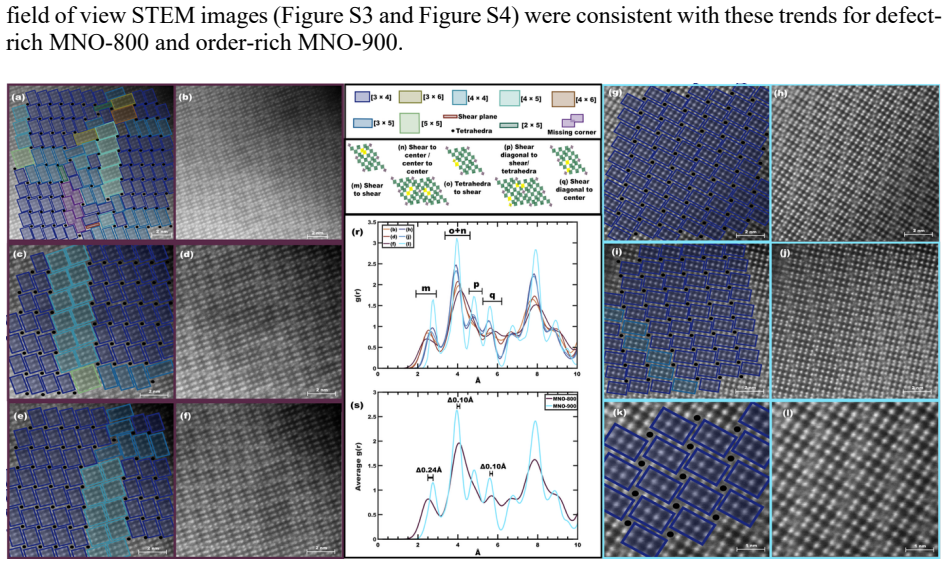
Summary. This manuscript reports a comparative study of two MoNb12O33 powders from a single sol-gel batch calcined at 800 °C and 900 °C. The defect-rich MNO-800 sample shows larger XRD microstrain, more Wadsley-type block-size variations and mixed T/E interfaces in STEM, higher and less well-defined Mo coordination in EXAFS, higher capacity and rate capability, ~3× larger capacity-weighted diffusivity from ICI, and lower volume expansion on lithiation. To explain the transport enhancement, the authors train a MACE-based MLIP on DFT and use NEB, cluster-expansion/Monte Carlo, and MD to study pristine T[3×4], cation-disordered T[3×4] variants, and enlarged-block T[3×5] and T[3×4-3×5] models with O vacancies. The computations predict that both cation disorder and Wadsley-type block enlargement cause the fast Wh/Wv window sites to become occupied at lower Li content than in the pristine model, matching the earlier onset of high diffusivity in MNO-800. The paper concludes that both defect types contribute independently to the enhanced performance.
Significance. The experimental dataset is rich and internally consistent: same-batch synthesis, multiple structural probes, operando WAXS, and a defensible ICI/SAXS diffusivity protocol. The computational work is mostly independent of the measured transport—no diffusion coefficient is fitted to experiment—and the MLIP is checked against DFT-NEB with ~10–15 meV MAE. If the mechanistic conclusion holds, the paper would provide a design principle for defect-enhanced WR anodes and would be of broad interest. However, the computational representation of the defect structures is the weakest link: the Wadsley-defect models are not the defect chemistry measured in MNO-800, and the cation-disorder conclusion rests on one selected motif rather than the SQS representative. These issues are load-bearing because the final attribution of the ~3× diffusivity enhancement to 'both defect types' depends on them.
major comments (4)
- [Results – Computational Analysis (Type-3 models, Fig. 5c,d)] The Wadsley-defect leg of the central claim is carried by T[3×5] and T[3×4-3×5] models with Mo only in tetrahedral sites and charge balance restored by O vacancies. This conflicts with the paper's own structural evidence for MNO-800: Mo K-edge EXAFS could not be fit to a model and indicates a markedly higher average Mo coordination than ~4.2; STEM-EDS maps Mo throughout [3×8] blocks and along shear planes. The Type-3 formulas also change the Mo:Nb ratio (1:15 and 2:27 vs 1:12). Because the O vacancy itself creates a 528 meV barrier and slows middle windows, the 'block size' effect on early window-site activation is entangled with the assumed charge-compensation mechanism. Please test enlarged-block models with Mo in octahedral/corner sites at the measured composition, or restrict the claim to O-vacancy-bearing block enlargements.
- [Results – Computational Analysis (Type-2 models, T[3×4-dis-5])] The cation-disorder mechanism is demonstrated with T[3×4-dis-1] (Mo at the block center), but the SQS model T[3×4-dis-5], described as representative of the disordered configuration, does not enhance diffusion relative to pristine T[3×4] and is not used in the site-occupation comparison. The paper should justify why dis-1 is the appropriate representation of disorder in MNO-800 (e.g., by matching the Mo-in-block distribution seen by STEM-EDS) or qualify the conclusion that cation disorder generally lowers the x threshold for activation of fast sites.
- [Conclusion and abstract] The abstract and conclusion attribute the improvement to 'both defect types,' but no model combines Wadsley block-size variation with cation disorder in a single simulation, and no model represents the actual integrated defect structure of MNO-800. The separate Type-2 and Type-3 results can show that each isolated motif is capable of shifting site occupancies; they do not establish that the effects are independent or additive in the real material. The manuscript itself notes after the STEM-EDS analysis that 'there remains ambiguity as to how each of these defects alters lithium diffusion.' A combined-defect calculation or an explicit discussion of interaction effects is needed before the concluding attribution can be accepted.
- [Methods – Molecular dynamics; Table 1] Table 1 is used to state that D is higher at 25% and 50% Li (order: dis-1 > 3×4-3×5 > 3×5 > pristine). These values are 300 K extrapolations from 2 ns MLIP-MD runs at 500–900 K, but no statistical uncertainty, trajectory convergence, or Arrhenius-fit quality is reported, and each concentration uses only three configurations. Please report error bars or confidence intervals so the ordering and factor differences in Table 1 can be evaluated.
minor comments (3)
- [Methods – Molecular dynamics / Results Table 1 paragraph] The text says concentration-dependent MD were 'performed at 300 K' while Methods states D at 300 K was extracted by Arrhenius extrapolation from 500–900 K. Please clarify which values are direct and which are extrapolated.
- [Fig. 4e] The three parabolic D(x) regions are described by widths and positions but no fitting procedure is given. State whether these are fits or guides and report the fit function/criteria.
- [General] Typos and notation: 'lowers' should be 'lower'; 'intensity of the peak reducing with annealing temperature' is ambiguous; non-integer oxygen stoichiometry in MoNb15O40.5 and Mo2Nb27O73.5 should be explicitly defined (per formula unit vs supercell).
Circularity Check
No significant circularity; central mechanism rests on DFT-trained MLIP plus independent ICI/electrochemistry; self-citations are methodological only.
full rationale
The central claim—that Wadsley defects and cation disorder independently advance Li occupation of fast Wh/Wv window sites to lower lithiation extents—is derived from CE/MC site-occupancy calculations using an MLIP trained on DFT geometries and energies, with MLIP-NEB validated against DFT-NEB (MAE 10.3/14.9 meV). No diffusion coefficient or site-occupation sequence is fitted to the experimental D(x) from ICI. The experimental 3X capacity-weighted diffusivity is measured from ICI and SAXS surface area, not inferred from the models. The paper's self-citations (refs 6, 13, 46, 51) concern nomenclature, a comparison metric, and prior applications of the ICI/parabola analysis; they are methodological precedents rather than load-bearing proofs, and the ICI method traces to an external source. The O-vacancy charge-compensation in the Type-3 Wadsley-defect models is an acknowledged modeling assumption that may not match MNO-800's measured Mo coordination, but this is a correctness/transferability limitation, not a circular reduction: the model's output is not defined in terms of the experimental result it explains.
Axiom & Free-Parameter Ledger
free parameters (1)
- Hubbard U for Mo =
4.38 eV
axioms (5)
- domain assumption PBE+U with U(Mo)=4.38 eV gives reliable formation and Li-migration energetics for MoNb12O33.
- domain assumption The MACE MLIP fine-tuned from MACE-MP0 reproduces DFT barriers well enough (MAE 10.3/14.9 meV on NEB paths) for MD diffusivities.
- domain assumption Li diffusivity follows Arrhenius behavior from 500-900 K down to 300 K.
- domain assumption CE/MC at 2000 K finds ground-state Li site occupations that determine room-temperature occupation order.
- ad hoc to paper Wadsley-defect models T[3x5] and T[3x4-3x5] with Mo only in tetrahedral sites and compensating O vacancies are representative of defect-rich MNO-800.
invented entities (1)
-
Oxygen vacancies in enlarged Wadsley blocks
no independent evidence
read the original abstract
Wadsley-Roth (WR) niobates have emerged as high-rate anode materials that can combine rapid ionic diffusion with good electronic conductivity. WR compounds have been defect-enhanced by limited annealing, however, such materials often contain multiple types of defects. In particular, both Wadsley defects (variable block size) and transition metal disorder have the potential to modify transport rates, however the corresponding effects are not well understood mechanistically. Here, MoNb12O33 (MNO) was calcined at two different temperatures to compare a defect-rich condition (MNO-800) with a proximal order-rich condition (MNO-900) as assessed through XRD, XANES, EXAFS, and STEM characterizations. Galvanostatically cycled lithium half cells of MNO-800 exhibited additional capacity (307 mAh/g at 0.1C, 4.66% higher) and improved high-rate capacity of 200 mAhg-1 at 10C. ICI-based overpotential analysis identified solid state diffusion as the dominant rate limiting process where MNO-800 correspondingly exhibited ~3X faster capacity-weighted diffusivity. A machine-learning interatomic potential was trained to density functional theory and then applied with molecular dynamics (MLIP-MD) to examine the possible roles of Wadsley defects and transition metal disorder. For both defect-types, Li was found to populate and activate fast diffusion paths from window sites at lower extents of lithiation as compared to the order-rich model.
Figures


Reference graph
Works this paper leans on
-
[1]
# !$# !"#$%& %!!&#%'!!()# &
XRD and Rietveld refinement results for (a) MNO-800 and (b) MNO-900 samples (excluded sample holder peak at ~22.5). (c) Nb K edge and (d) Mo K edge radial distribution function of FT EXAFS oscillations, all phase-corrected. Kinetically limited crystallization is well known to result in transient (non-equilibrium) defect-rich states. The early 1970’s studi...
1970
-
[2]
carbon black,
Diffusion coefficient (in m2s-1) at different concentrations of Li for the considered structural models. Li Concentrations Pristine T[3×4] T[3×4-dis-1] T[3×5] T[3×4-3×5] 25% 2.00x10⁻¹² 3.07x10⁻¹⁰ 3.08x10⁻¹¹ 3.26x10⁻¹¹ 50% 3.12x10⁻¹³ 3.01x10⁻¹¹ 1.30x10⁻¹¹ 1.57x10⁻¹¹ 75% 3.17x10⁻¹² 5.93x10⁻¹³ 2.40x10⁻¹² 8.95x10⁻¹² The faster diffusion is confirmed with MD s...
2032
-
[4]
Ganesha Operating Manual
(61) Joensen, K. Ganesha Operating Manual. https://smif.pratt.duke.edu/capabilities/55527 (accessed 2025-06-17). (62) NIST X-Ray Form Factor, Atten. Scatt. Tables Form Page. https://physics.nist.gov/PhysRefData/FFast/html/form.html (accessed 2025-06-17). (63) Scattering Length Density Calculator. https://www.ncnr.nist.gov/resources/sldcalc.html (accessed ...
2025
-
[516]
(43) Xiang, W.; Chen, M.; Zhou, X.; Chen, J.; Huang, H.; Sun, Z.; Lu, Y.; Zhang, G.; Wen, X.; Li, W
https://doi.org/10.1038/ncomms1527. (43) Xiang, W.; Chen, M.; Zhou, X.; Chen, J.; Huang, H.; Sun, Z.; Lu, Y.; Zhang, G.; Wen, X.; Li, W. Highly Enforced Rate Capability of a Graphite Anode via Interphase Chemistry Tailoring Based on an Electrolyte Additive. J. Phys. Chem. Lett. 2022, 13 (23), 5151–5159. https://doi.org/10.1021/acs.jpclett.2c01183. (44) Ch...
-
[592]
https://doi.org/10.1038/s41467-019-08490-w. (31) Driscoll, E. H.; Green, A.; Fortes, D.; Howard, C.; Driscoll, L. L.; Kendrick, E.; Greaves, C.; Slater, P. R. A High-Power 4 × 4: Crystallographic and Electrochemical Insights into a Novel Wadsley–Roth Anode Nb9Ti1.5W1.5O30. Chem. Commun. 2024, 60 (73), 10001–10004. https://doi.org/10.1039/D4CC02844A. (32) ...
-
[2024]
(52) Zunger, A.; Wei, S.-H.; Ferreira, L
https://doi.org/10.1039/D4TA06041E. (52) Zunger, A.; Wei, S.-H.; Ferreira, L. G.; Bernard, J. E. Special Quasirandom Structures. Phys. Rev. Lett. 1990, 65 (3), 353–356. https://doi.org/10.1103/PhysRevLett.65.353. (53) van de Walle, A.; Tiwary, P.; de Jong, M.; Olmsted, D. L.; Asta, M.; Dick, A.; Shin, D.; Wang, Y.; Chen, L.-Q.; Liu, Z.-K. Efficient Stocha...
arXiv 1990
-
[2025]
https://doi.org/10.48550/arXiv.2401.00096. (75) Waters, M. J.; Rondinelli, J. M. Energy Contour Exploration with Potentiostatic Kinematics. J. Phys. Condens. Matter 2021, 33 (44), 445901. https://doi.org/10.1088/1361-648X/ac1af0. (76) Sanchez, J. M.; Ducastelle, F.; Gratias, D. Generalized Cluster Description of Multicomponent Systems. Phys. Stat. Mech. I...
-
[2289]
(45) Geng, Z.; Thiringer, T.; Lacey, M
https://doi.org/10.1038/s41467-023-37989-6. (45) Geng, Z.; Thiringer, T.; Lacey, M. J. Intermittent Current Interruption Method for Commercial Lithium-Ion Batteries Aging Characterization. IEEE Trans. Transp. Electrification 2022, 8 (2), 2985–2995. https://doi.org/10.1109/TTE.2021.3125418. (46) Kumar, M.; Muhit, M. A. A.; Sturgill, C.; Karimitari, N.; Bar...
arXiv 2022
-
[6507]
https://doi.org/10.1038/s41467-025-61646-9. (34) Iijima, S. Direct Observation of Lattice Defects in H -Nb 2 O 5 by High Resolution Electron Microscopy. Acta Crystallogr. Sect. A 1973, 29 (1), 18–24. https://doi.org/10.1107/S0567739473000045. (35) Anderson, J. S. On Infinitely Adaptive Structures. J. Chem. Soc. Dalton Trans. 1973, No. 10, 1107–1115. https...
discussion (0)
Sign in with ORCID, Apple, or X to comment. Anyone can read and Pith papers without signing in.