REVIEW 3 major objections 6 minor 34 references
DeepF-fNet: a physics-informed neural network for vibration isolation optimization
T0 review · 3 major / 6 minor · reviewed 2026-08-10 · deepseek-v4-flash
Pith's one-line read DeepF-fNet, a dual-network physics-informed surrogate, estimates locally resonant metamaterial parameters that place a vibration bandgap at a user-specified target frequency in real time.
desk verdict A plausible incremental extension of neural inverse operators to variable-frequency vibration isolation, but the headline speed claim and the SICE4 correction step need serious scrutiny before the paper's conclusions can be trusted. read the letter →
The pith
A machine-rendered reading of the paper's core claim, the machinery that carries it, and where it could break.
The reading
What carries the argument
The load-bearing object is the SICE4 prediction-correction update on dispersion curves: a shift by $\Delta$ and a rescaling by Gamma that convert a stored spectrum into an approximate target spectrum without solving the direct eigenvalue problem. This is paired with DeepF-fNet's dual CNN architecture, where the IEPS inverts spectra into structural parameters and the WES enforces physical plausibility by evaluating the wave-equation residual and boundary-condition residual on the predicted mode shapes, making the inverse mapping respect the underlying physics.
What would settle it
A direct check: take the parameters predicted by SICE4 for a target frequency, run a fresh finite-element simulation of that unit cell, and compare the simulated dispersion curves with the corrected spectrum that was fed to the network. If the first bandgap of the simulated cell does not center near the target frequency for a substantial fraction of the tested targets, the shift-and-rescale assumption fails.
Extended reading notes
Core claim
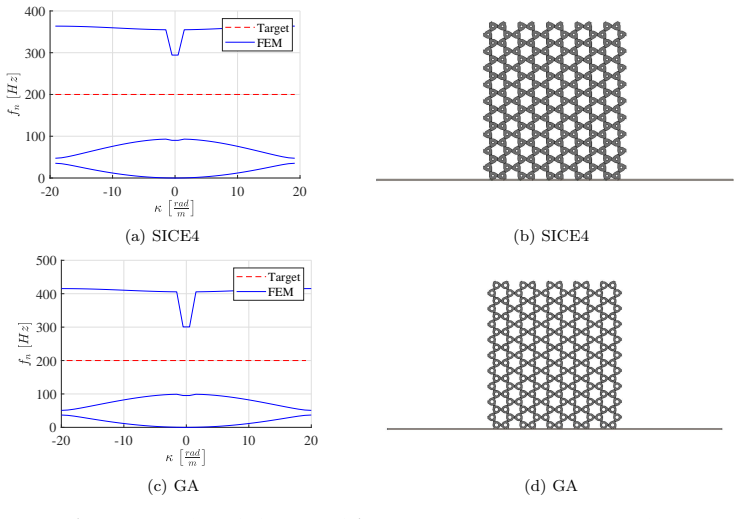
DeepF-fNet is a dual convolutional network: the inverse eigenvalue problem solver (IEPS) maps a set of dispersion curves to the three unit-cell parameters r, L, and s, while the wave equation solver (WES) takes the discretized geometry defined by those parameters and predicts mode shapes. Training combines a data loss with two physics-informed terms, the harmonic wave-equation residual and the boundary-condition residual, so the inverse mapping is constrained by the governing elastodynamics. The SICE4 deployment algorithm selects from the training dataset the spectrum whose first bandgap is closest to the user's target frequency, shifts all curves except the first by the difference $\Delta$, rescales the first curve by Gamma = min(second curve)/max(first curve), and feeds the corrected spectrum to the IEPS. The paper reports that for a 200 Hz target this pipeline returns parameters essentially equivalent to those found by a genetic algorithm, with a first bandgap centered near the target, while consuming about 0.0157 s of CPU time versus 7690 s for the GA.
Load-bearing premise
The SICE4 correction step assumes that shifting a stored dispersion curve by $\Delta$ and rescaling its first branch by Gamma produces an input spectrum that behaves like a real metamaterial spectrum for the network; if that artificial spectrum lies outside the training distribution, the predicted parameters can be wrong even though the network itself is accurate on genuine spectra.
Editorial extensions
If this is right
- A trained DeepF-fNet under SICE4 can estimate optimal unit-cell parameters for a time-varying target frequency at control-loop rates; the simulated 2 s, 150 Hz test signal tracks a 250-750-500 Hz sequence.
- For a single 200 Hz target, SICE4 produces essentially the same first bandgap as a genetic algorithm while using about 500,000 times less CPU time, because training is performed offline.
- The physics-informed losses allow the inverse mapping to be trained from a relatively small dataset of 2000 finite-element samples and to remain accurate within the parameter range covered by that dataset.
- The first, lowest bandgap is predicted accurately even though higher eigenfrequencies exhibit spectral bias, so the method is directly usable for low-frequency single-bandgap isolation, while multi-bandgap targets need further development.
- The framework positions semi-active vibration isolators as a practical replacement for fully active control systems in applications like automotive noise, vibration, and harshness, where rapid retuning is essential.
Reading between the lines
- The shift-and-rescale correction in SICE4 is effectively an affine augmentation of the training manifold; a natural testable extension is to check whether corrected spectra lie close to genuine finite-element spectra in the IEPS latent space, and if not, to add a small number of physically realizable spectra near the target-bandgap manifold to close the distribution shift.
- Because the method succeeds on the first bandgap, it likely transfers to other periodic structures, such as phononic plates or beams with attached resonators, whose bandgap formation is dominated by the lowest dispersion branches; the same SICE4 logic could be reused if the input spectra are normalized consistently.
- The reported 500,000x speedup is a single-case comparison against one genetic algorithm implementation without parallelization or warm starting; the practical gain in deployment will be smaller once sensor readout, actuation, and safety margins are included, though the core advantage of offline training with online feed-forward inference remains.
- The spectral bias at higher eigenfrequencies suggests that multi-bandgap targets will require a higher-fidelity operator, such as a Fourier neural operator, as the authors propose; a focused study on bandgaps above the first would test whether the correction step preserves accuracy there.
Editorial analysis
A structured set of objections, weighed in public.
Referee Report
Summary. The paper introduces DeepF-fNet, a dual-CNN neural network that maps dispersion curves of a locally resonant metamaterial unit cell to the geometric parameters (r, L, s), and SICE4, a prediction-correction algorithm that transforms a stored dispersion curve to approximate a user-specified target bandgap frequency before querying the network. The intended application is real-time semi-active vibration isolation. The case study trains on 2000 finite-element-computed dispersion spectra, validates the inverse solver (IEPS) by feeding predicted parameters back to the FE solver and comparing the resulting dispersion curves, and compares SICE4 against a genetic algorithm (GA) for a single 200 Hz target. The authors report a speed advantage of up to 5e5 times and comparable first-bandgap accuracy.
Significance. The paper contains a credible validation of the first-bandgap prediction: predicted parameters are re-run through the FE solver and shown to reproduce the target bandgap, which rules out simple overfitting to training labels. The SICE4 heuristic of selecting the nearest stored spectrum and then applying a shift/scale correction is a practical idea for inverse eigenvalue problems in this setting. If the off-manifold generalization of SICE4 were demonstrated across a range of target frequencies, the framework would be a valuable tool for fast structural optimization. However, the current evidence supports only a narrow, single-frequency claim; the broad real-time claims in the abstract and conclusions are not yet backed by the experiments.
major comments (3)
- [Section 2.1, Algorithm 1 lines 6-10] The correction step constructs an input spectrum by shifting all branches n>1 by Δ and rescaling branch 1 by Γ = min(new DC_{n=2})/max(DC_{n=1}[ib]). This synthetic spectrum is not a physically realizable dispersion curve of any (r,L,s) triple, because eigenfrequency branches do not transform in this way under geometric changes. The IEPS was trained exclusively on FE-generated spectra from valid parameter triples (Section 3.2), so the corrected input lies on a different manifold. The paper's only FE verification of the full SICE4 pipeline is a single 200 Hz target compared with a single GA run (Table 7, Fig. 10). The time-series simulation in Fig. 9 outputs parameters for 300 targets between 250 and 750 Hz but does not re-run the FE solver to confirm that the resulting bandgaps actually bracket those targets. To support the central claim of real-time optimal parameter estimation over a user-defined frequency range, the authors should FE-verify a representative sample of target frequencies, or otherwise quantify the network's error on artificial SICE4 inputs versus genuine FE spectra.
- [Section 3.3, Table 7] The speed comparison is asymmetric. The SICE4 inference time of 0.0157 s excludes the offline cost of generating the 2000-sample FE dataset and training both networks, whereas the reported GA time of 7690 s is the full optimization time. Offline costs can legitimately be amortized in real-time deployment, but the 'up to 500,000 times faster' statement in the abstract and Section 4 should be presented as an inference-time comparison. Moreover, the GA settings (population size, number of generations, objective function definition) are not specified, so the 7690 s figure cannot be assessed or reproduced.
- [Section 2.2, Table 5] The PDE loss weight is 10^-14 and the BC loss weight is 10^-12 for both networks, while the data loss weights are 10^8 and 10^12. With these settings the physics terms contribute negligibly to the total loss, so the framework is effectively a purely data-driven surrogate. The paper's claim that 'incorporating physical laws into training reduces data requirements and improves accuracy' (Section 4) is therefore not supported by the experiments. The authors should either show an ablation with meaningful physics weights, or revise the characterization of the method as physics-informed.
minor comments (6)
- [Section 3.1] 'Its width (along the y-axis) was optimized' appears to be a typo; the width is along the x-axis according to Eq. (4c) and Fig. 3a.
- [Section 3.1, Eq. (6)] The Floquet-Bloch condition is written for a vector w0 but the surrounding text refers to a scalar displacement; please make the notation consistent.
- [Section 2.2] The paper describes DeepF-fNet as based on DeepONets, but the architecture in Table 3 is a standard CNN without a branch/trunk structure. Clarify the connection to DeepONets or avoid the term.
- [Section 3.3, Fig. 5(e)] The compliance conditions are said to be 'violated for some combinations of parameters,' but it is not specified how these violations are treated during training or what 'empirically observed' means quantitatively; please clarify.
- [Algorithm 1] The notation DC, f_bg, and ib is not fully defined; in particular, the index ib runs over dataset samples while n indexes branches. Please define all variables explicitly.
- [Section 3.3, Table 7] The GA comparison uses a single run and a single target frequency; please report the GA's population size, generation count, and the objective function, and ideally repeat with several random seeds to provide error bars.
Circularity Check
No circularity: the inverse network is validated against external FE recomputation; SICE4's synthetic-spectrum concern is a generalization issue, not a circular derivation.
full rationale
I walked the claimed derivation chain. The central claim is that SICE4/DeepF-fNet maps a user-specified target frequency to optimal unit-cell parameters. This is an empirical surrogate-inversion claim, not a derivation, and the paper's own evaluations are external to the training labels. The IEPS is trained on FE-generated spectra with labels (r, L, s), and the reported validation recomputes dispersion curves from the predicted parameters using the COMSOL FE solver (Fig. 6 and Tab. 6), which is an independent check of the surrogate. The SICE4 correction step (Algorithm 1, lines 6-10) constructs an input spectrum by shifting and rescaling a database spectrum, and the IEPS then predicts parameters; this is a heuristic input transformation, not a fitted parameter renamed as a prediction. The full-pipeline 200 Hz case is verified by FE recomputation and compared against a genetic algorithm (Tab. 7 and Fig. 10), again an external baseline. No equation in the paper uses the target frequency as a fitted constant, and no output is equivalent to an input by construction. The paper also explicitly discloses limitations: spectral bias at higher eigenfrequencies, dataset-size constraints, and the need for future experimental validation. The skeptic's concerns about out-of-distribution synthetic spectra, the single-frequency FE check, and the very low PDE/BC loss weights are genuine validity and generalization risks, but they are not circularity: there is no self-citation chain, no uniqueness theorem imported from the authors, no ansatz smuggled in via citation, and no fitted parameter predicted as a new result. I therefore find no significant circularity.
Assumptions & free parameters
free parameters (4)
- Loss function weights =
w_data_IEPS=10^8; w_data_WES=10^12; w_PDE=10^-14; w_BC=10^-12
- Network hyperparameters =
Learning rates 1e-3 and 1e-2; dropout 0.5; norm clip 1; batch size 40; 40 epochs; CNN filter sizes and layer counts
- Eigenfrequency count and wave-number count =
N=10, K=40
- Random parameter sampling bounds =
r, L, s in [0.04 mm, 4 mm]
assumptions (6)
- standard math Floquet-Bloch theorem applies to the periodic LRM unit cell and reduces the analysis to the first Brillouin zone.
- domain assumption The 2D plane-strain extruded model captures the 3D behavior of the metamaterial.
- domain assumption The effective material properties of the chiral honeycomb in Equation 5 are valid.
- domain assumption The COMSOL eigenfrequency study with a Finer physics-controlled mesh and ARPACK solver provides converged ground-truth dispersion curves.
- ad hoc to paper Choosing the training spectrum whose first-bandgap center is closest to the target frequency, then shifting and rescaling it, is a sufficient initialization for finding optimal parameters.
- ad hoc to paper A neural network trained on physically realizable FE spectra will generalize to the artificially shifted and rescaled spectra produced by SICE4.
Cite this review
Pith. "Pith review of DeepF-fNet: a physics-informed neural network for vibration isolation optimization." pith.science (2026). https://pith.science/paper/FGQG45V6
@misc{pith2026241221132,
  author       = {Pith},
  title        = {Pith review of: DeepF-fNet: a physics-informed neural network for vibration isolation optimization},
  year         = {2026},
  howpublished = {\url{https://pith.science/paper/FGQG45V6}},
  note         = {Machine review of arXiv:2412.21132}
}
read the original abstract
Structural optimization is essential for designing safe, efficient, and durable components with minimal material usage. Traditional methods for vibration control often rely on active systems to mitigate unpredictable vibrations, which may lead to resonance and potential structural failure. However, these methods face significant challenges when addressing the nonlinear inverse eigenvalue problems required for optimizing structures subjected to a wide range of frequencies. As a result, no existing approach has effectively addressed the need for real-time vibration suppression within this context, particularly in high-performance environments such as automotive noise, vibration and harshness, where computational efficiency is crucial. This study introduces DeepF-fNet, a novel neural network framework designed to replace traditional active systems in vibration-based structural optimization. Leveraging DeepONets within the context of physics-informed neural networks, DeepF-fNet integrates both data and the governing physical laws. This enables rapid identification of optimal parameters to suppress critical vibrations at specific frequencies, offering a more efficient and real-time alternative to conventional methods. The proposed framework is validated through a case study involving a locally resonant metamaterial used to isolate structures from user-defined frequency ranges. The results demonstrate that DeepF-fNet outperforms traditional genetic algorithms in terms of computational speed while achieving comparable results, making it a promising tool for vibration-sensitive applications. By replacing active systems with machine learning techniques, DeepF-fNet paves the way for more efficient and cost-effective structural optimization in real-world scenarios.
Figures


Figures from the paper (7 more)


Reference graph
Works this paper leans on
-
[1]
K. Bia/suppress las, Comparison of passive and active reduction of vibrations of mechanical systems, Journal of Achievements in Materials and Man u- facturing Engineering 18 (08 2006)
work page 2006
-
[2]
P. GARDONIO, S. ELLIOTT, Passive and active isolation of struct ural vibration transmission Journal of Sound and Vibration 237 (3) (2000) 483–511. doi:https://doi.org/10.1006/jsvi.2000.3064. URL https://www.sciencedirect.com/science/article/pii/S0022460X00930645
-
[3]
Y. Liu, T. Waters, M. Brennan, A comparison of semi-active damping control strategies for vibration Journal of Sound and Vibration 280 (1) (2005) 21–39. doi:https://doi.org/10.1016/j.jsv.2003.11.048. URL https://www.sciencedirect.com/science/article/pii/S0022460X04000252
-
[4]
D. Karnopp, M. J. Crosby, R. Harwood, Vibration control using semi- active force generators (1974)
work page 1974
- [5]
-
[6]
M. T. Chu, Inverse eigenvalue problems, SIAM Review 40 (1) (1998) 1–39. arXiv:https://doi.org/10.1137/S0036144596303984, doi:10.1137/S0036144596303984. URL https://doi.org/10.1137/S0036144596303984 24
-
[7]
G. M. Gladwell, Inverse Problems in Vibration, 2nd Edition, Kluwer Academic Publishers, New York, Boston, Dordrecht, London, Mos cow, 2004
work page 2004
- [8]
Show all 34 references
-
[9]
Zargham, T
S. Zargham, T. Ward, R. Ramli, Topology optimization: a review for structural designs under vibra tion problems, Structural and Multidisciplinary Optimization 53 (2016) 1157–1177. doi:https://doi.org/10.1007/s00158-015-1370-5 . URL https://link.springer.com/article/10.1007/s00...
2016 doi
-
[10]
Abdeljaber, O
O. Abdeljaber, O. Avci, D. J. Inman, Optimization of chiral lattice based metastructures for broadban d vibration suppression using Journal of Sound and Vibration 369 (2016) 50–62. doi:https://doi.org/10.1016/j.jsv.2015.11.048. URL https://www.sciencedirect.com/science/article...
2016 doi
-
[11]
Madeira, H
J. Madeira, H. Pina, H. Rodrigues, Plate eigenfrequency opti- mization with genetic algorithms and random keys, Vol. 88, 2008. doi:10.4203/ccp.88.73
2008 doi
-
[12]
Hornik, M
K. Hornik, M. Stinchcombe, H. White, Multilayer feedforward networks are universal approximators, Neural Networks 2 (5) (1989) 359–366. doi:https://doi.org/10.1016/0893-6080(89)90020-8. URL https://www.sciencedirect.com/science/article/pii/0893608089900208
1989
-
[13]
Raissi, P
M. Raissi, P. Perdikaris, G. Karniadakis, Physics-informed neural networks: A deep learning framework fo r solving forward and inverse Journal of Computational Physics 378 (2019) 686–707. doi:https://doi.org/10.1016/j.jcp.2018.10.045. URL https://www.sciencedirect.com/science/...
2019 doi
-
[14]
Haghighat, M
E. Haghighat, M. Raissi, A. Moure, H. Gomez, R. Juanes, A physics-informed deep learning framework for inversion and surr ogate modeling in solid mec Computer Methods in Applied Mechanics and Engineering 379 (2021) 25 113741. doi:https://doi.org/10.1016/j.cma.2021.113741. URL ...
2021
-
[15]
A. D. Jagtap, Z. Mao, N. Adams, G. E. Karniadakis, Physics-informed neural networks for inverse problems in supers onic flows, Journal of Computational Physics 466 (2022) 111402. doi:https://doi.org/10.1016/j.jcp.2022.111402. URL https://www.sciencedirect.com/science/article/pi...
2022
-
[16]
S. Hu, M. Liu, S. Zhang, S. Dong, R. Zheng, Physics-informed neural network combined with characteristic-b ased split for solving forward Neurocomputing 573 (2024) 127240. doi:https://doi.org/10.1016/j.neucom.2024.127240 URL https://www.sciencedirect.com/science/article/pii/S0...
2024
-
[17]
L. Lu, P. Jin, G. Pang, Z. Zhang, G. E. Karniadakis, Learning nonlinear operators via deeponet based on the universal approximation theorem of op Nature Machine Intelligence 3 (3) (2021) 218–229. doi:10.1038/s42256-021-00302-5 . URL http://dx.doi.org/10.1038/s42256-021-00302-5
2021 doi
-
[18]
J. He, S. Koric, D. Abueidda, A. Najafi, I. Jasiuk, Geom-deeponet: A point-cloud-based deep operator network fo r field predictions on 3d parameterized Computer Methods in Applied Mechanics and Engineering 429 (2024) 117130. doi:https://doi.org/10.1016/j.cma.2024.117130. URL htt...
2024
-
[19]
Molinaro, Y
R. Molinaro, Y. Yang, B. Engquist, S. Mishra, Neural inverse operators for solving pde inverse problems (2023) . arXiv:2301.11167. URL https://arxiv.org/abs/2301.11167
2023 arXiv
-
[20]
Soleimanian, G
S. Soleimanian, G. Petrone, F. Franco, S. De Rosa, P. Ko/suppress lakowski, Semi-active vibro-acoustic control of vehicle transmission system s using a metal rubber-based Applied Acoustics 217 (2024) 109861. doi:https://doi.org/10.1016/j.apacoust.2024.109861. URL https://www.s...
2024
-
[21]
URL http://www.comsol.com/products/multiphysics/ 26
COMSOL-Inc., Comsol multiphysics ® v 6.1 (2024). URL http://www.comsol.com/products/multiphysics/ 26
2024
-
[22]
D. P. Kingma, J. Ba, Adam: A method for stochastic optimization (2017). arXiv:1412.6980. URL https://arxiv.org/abs/1412.6980
2017 arXiv
-
[23]
Abadi, A
M. Abadi, A. Agarwal, P. Barham, E. Brevdo, Z. Chen, C. Citro, G. S. Corrado, A. Davis, J. Dean, M. Devin, S. Ghemawat, I. Good- fellow, A. Harp, G. Irving, M. Isard, Y. Jia, R. Jozefowicz, L. Kaise r, M. Kudlur, J. Levenberg, D. Man´ e, R. Monga, S. Moore, D. Mur- ray, C. Ola...
2015
-
[24]
S. Ioffe, C. Szegedy, Batch normalization: Accelerating deep n etwork training by reducing internal (2015). arXiv:1502.03167. URL https://arxiv.org/abs/1502.03167
2015 arXiv
-
[25]
Pascanu, T
R. Pascanu, T. Mikolov, Y. Bengio, Understanding the exploding gradient problem, ArXiv abs/1211.506 3 (2012). URL https://api.semanticscholar.org/CorpusID:16074905
2012
-
[26]
Jung, H.-G
J. Jung, H.-G. Kim, S. Goo, K.-J. Chang, S. Wang, Realisation of a locally resonant metamaterial on the automobile pane l structure to reduce noise Mechanical Systems and Signal Processing 122 (2019) 206–231. doi:https://doi.org/10.1016/j.ymssp.2018.11.050. URL https://www.sci...
2019 doi
-
[27]
X. Yu, J. Zhou, H. Liang, Z. Jiang, L. Wu, Mechanical metamaterials associated with stiffness, rigidity and com pressibility: A brief review Progress in Materials Science 94 (2018) 114–173. doi:https://doi.org/10.1016/j.pmatsci.2017.12.003. URL https://www.sciencedirect.com/sci...
2018 doi
-
[28]
Baravelli, M
E. Baravelli, M. Ruzzene, Internally resonating lattices for ban dgap generation and low-frequency Journal of Sound and Vibration 332 (25) (2013) 6562–6579. doi:https://doi.org/10.1016/j.jsv.2013.08.014. URL https://www.sciencedirect.com/science/article/pii/S0022460X13006792 27
2013 doi
-
[29]
Mousanezhad, B
D. Mousanezhad, B. Haghpanah, R. Ghosh, A. M. Hamouda, H. Nayeb-Hashemi, A. Vaziri, Elastic properties of chiral, anti-chiral, and hierarchical honeycom bs: A simple energy-based approac Theoretical and Applied Mechanics Letters 6 (2) (2016) 81–96. doi:https://doi.org/10.1016/...
2016 doi
-
[30]
C. C. Claeys, K. Vergote, P. Sas, W. Desmet, On the potential of tuned resonators to obtain low-frequency vib rational stop bands in periodic Journal of Sound and Vibration 332 (6) (2013) 1418–1436. doi:https://doi.org/10.1016/j.jsv.2012.09.047. URL https://www.sciencedirect.c...
2013 doi
-
[31]
Collet, M
M. Collet, M. Ouisse, M. Ruzzene, M. Ichchou, Floquet–bloch decomposition for the computation of dispersion of t wo-dimensional periodic, damp International Journal of Solids and Structures 48 (20) (2011) 2837–2848. doi:https://doi.org/10.1016/j.ijsolstr.2011.06.002. URL https...
2011 doi
-
[32]
Sayin, genetic-algorithm-matlab (2012)
A. Sayin, genetic-algorithm-matlab (2012). URL https://github.com/alpsayin/genetic-algorithm-matlab?tab=readme-ov-file
2012
-
[33]
Z. Li, D. Huang, B. Liu, A. Anandkumar, Fourier neural operator with learned deformations for pdes on ge neral geometries, Journal of Machine Learning Research 24 (388) (2023) 18593–18 618. doi:https://doi.org/10.5555/3648699.3649087. URL https://arxiv.org/abs/2207.05209
2023
-
[34]
DeepF-ONet_Architecture.png
Z. Li, N. Kovachki, K. Azizzadenesheli, B. Liu, K. Bhattacharya, A. Stuart, A. Anandkumar, Fourier neural operator for parametric partial differential equa tions (2021). arXiv:2010.08895. URL https://arxiv.org/abs/2010.08895 28 This figure "DeepF-ONet_Architecture.png" is avail...
2021 arXiv
Reviewed August 10, 2026 · model on record in the stance chip above.
Discussion (0). Continue with ORCID to comment.