REVIEW 3 major objections 5 minor 58 references
A Statistical Framework for Model Selection in LSTM Networks
T0 review · 3 major / 5 minor · reviewed 2026-08-07 · deepseek-v4-flash
Pith's one-line read The paper claims that a BIC-driven, likelihood-based selection procedure can recover the true LSTM hidden size and input variables with high probability, and that adaptive Gauss-Hermite quadrature or variational inference both make this…
desk verdict A well-intended patchwork of standard model selection tools for LSTMs, sunk by a factorized marginal likelihood that discards the recurrent dependence it claims to model. read the letter →
The pith
A machine-rendered reading of the paper's core claim, the machinery that carries it, and where it could break.
The reading
What carries the argument
The carrying object is the temporal information criterion $BIC_T = -2\log p(y_{1:T}\mid x_{1:T};\hat\theta) + \log(T)\,df$, with $df$ the effective number of free parameters after shrinkage. Because the marginal likelihood over hidden states is intractable, the framework computes it approximately: variational inference maximizes an ELBO with a reparameterized Gaussian posterior, while adaptive Gauss-Hermite quadrature centers nodes at the per-time-step posterior mode and scales them by the local Hessian. Algorithm 3 then multiplies the per-time-step approximate marginals to get the total. The selection loop scores candidate hidden sizes and input subsets by this criterion and picks the minimum.
What would settle it
Take a small LSTM with known parameters, generate one long sequence, and compute the paper's Algorithm 3 marginal likelihood as $\prod_t p(y_t\mid x_t)$. Then compute the joint marginal likelihood with a method that respects the hidden-state recursion, such as a particle filter or a joint quadrature over $h_{1:T}$. If the two estimates agree closely and yield the same BIC ranking across candidate hidden sizes, the framework is verified; if the rankings diverge on realistic sample sizes, the central claim is falsified.
Extended reading notes
Core claim
The central claim is that model selection for LSTM networks can be made statistical rather than heuristic. Treating the hidden states as latent variables, the paper defines temporal information criteria, notably $BIC_T = -2\ell(\hat\theta) + \log(T)\,df$, and approximates the marginal likelihood $p(y_{1:T}\mid x_{1:T})$ by variational inference or by adaptive Gauss-Hermite quadrature. In simulation studies with known LSTM generators, selecting the model with lowest BIC recovers the true hidden-unit count and the true relevant inputs with high probability, up to 99% full-model recovery at $n=1000$ under AGHQ, and clearly outperforms stepwise linear-model selection when the data are nonlinear or interaction-rich. The paper presents this as evidence that BIC-style criteria can balance parsimony and predictive performance for sequential neural models.
Load-bearing premise
The load-bearing premise is that the total likelihood can be treated as a product of per-time-step likelihoods, even though an LSTM's hidden states are causally dependent across time; if that approximation is substantially wrong, the BIC scores and the architectures they select are not trustworthy.
Editorial extensions
If this is right
- At sample size $n=1000$, the AGHQ+BIC pipeline recovers the full true LSTM model, inputs and hidden units, in 99% of simulation replicates, with VI+BIC close behind at 96%.
- BIC selection keeps false discovery rates low and parameter counts near the true model, outperforming AIC and out-of-sample RMSE as an architecture-selection rule in the simulations.
- The LSTM framework's advantage over stepwise linear selection grows when the data contain interactions and nonlinearity; at $T=1000$ it recovers correct covariates 82% of the time versus 41% for stepwise BIC.
- AGHQ buys more accurate model recovery, especially in small samples, at higher computation cost, while VI remains competitive and scalable for larger problems.
Reading between the lines
- Inference: Algorithm 3's product factorization $p(y_{1:T}\mid x_{1:T})=\prod_t p(y_t\mid x_t)$ is inconsistent with the causal LSTM hidden-state recursion, so the BIC values it produces are approximations whose error is unquantified; replacing the product with a joint sequential Monte Carlo estimate would be a direct robustness test.
- Inference: The simulations provide empirical evidence of selection consistency, but no theorem; a formal consistency proof for BIC under dependent hidden states would determine whether the 96–99% recovery rates persist outside the simulated regimes.
- Inference: The $\hat\tau$ effect sizes in the biomedical tables are average predictive associations, not causal effects; the same selection machinery could be paired with explicit causal targets, such as treatment effects, to avoid overinterpreting them.
Editorial analysis
A structured set of objections, weighed in public.
Referee Report
Summary. The paper proposes a statistical model selection framework for LSTM networks, combining gate-wise and hidden-state shrinkage penalties with AIC/BIC criteria. It develops two estimation strategies, variational inference and adaptive Gauss-Hermite quadrature, and embeds them in a stepwise procedure for selecting hidden size and input variables. Simulation studies claim that the framework recovers the true LSTM architecture with high probability and outperforms stepwise linear model selection; the method is also applied to several biomedical time series datasets.
Significance. If the proposed framework were valid, it would offer a useful alternative to heuristic grid-search-based LSTM selection by grounding architecture choice in penalized likelihood and information criteria. The paper is commendable for including a public implementation and for attempting a formal treatment of marginal likelihoods for recurrent architectures. However, the central computational device used to define the BIC is not the marginal likelihood of the LSTM defined in the paper, and the simulations are not sufficiently specified to be audited. As a result, the current empirical evidence does not support the main claim of reliable LSTM model selection.
major comments (3)
- [Section 5, Algorithm 3, Step 8; Section 2.2, Eq. (4)] The algorithm computes p(y_{1:T} | x_{1:T}) as the product over t of p(y_t | x_t), where each p(y_t | x_t) is obtained from a separate per-time-step integral over h_t. This is not the marginal likelihood in Eq. (4), because the joint density in Eq. (3) contains the transition term p(h_t | h_{t-1}, x_t; θ), which couples hidden states across time. The product formula corresponds to a model with temporally independent hidden states. Since every BIC value in Tables 1, 2, 3, and 5 is derived from this factorized criterion, the reported recovery probabilities and model rankings are not evidence for the proposed LSTM model selection framework.
- [Section 3.3 and Algorithm 2, Step 5] The effective degrees of freedom are estimated as the number of nonzero parameters of the fitted model. Because the sparsity pattern is itself selected from the same data, df is a data-dependent random quantity, and the resulting criterion is not the classical Schwarz BIC. The paper provides no justification for this post-selection complexity measure or for its consistency in the LSTM setting; without such justification, the BIC comparisons in the simulations are circular rather than principled model selection.
- [Sections 6.1-6.3] The simulation studies omit essential implementation details: the true LSTM weight values and the noise variance in Simulation 1, the optimizer and learning rate, the values or selection procedure for λ, λ_hidden, α1-α3, β, dropout probability p, and the number of quadrature points K. In addition, n is not defined clearly as the number of sequences or something else, and the candidate set of all 2^13 input subsets combined with 1000 replicates is not matched with any computational accounting. These omissions make Tables 1-3 impossible to reproduce or audit.
minor comments (5)
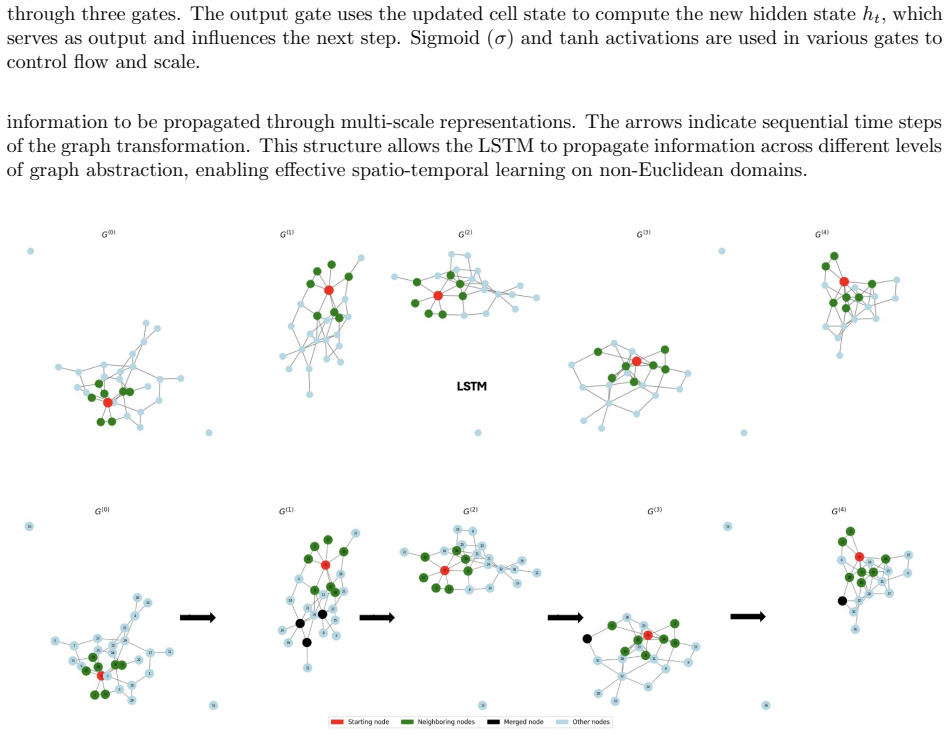
- [Section 2.1, Figure 2] The graph-evolution example in Figure 2 appears unrelated to the LSTM model selection pipeline and is not integrated into the statistical framework; it should be removed or clearly motivated.
- [Section 3.2, Eq. (10)] The gate penalty is written twice in the same subsection, once with the bias term α3||b_g||1 and once without it; please clarify which objective is actually used in the algorithms.
- [Section 6.2] The abbreviation 'AGQH' appears in the text; the correct abbreviation introduced earlier is 'AGHQ'.
- [References] The reference 'McInerney and Burke' appears as both 2022 and 2024 for what seems to be the same article; please consolidate and cite consistently.
- [Algorithm 2, Step 4] The step says 'Fit the model to obtain maximum likelihood estimate', but the paper uses penalized variational inference or AGHQ; please specify whether θ̂ is the penalized estimate and whether the likelihood in the criterion is penalized or unpenalized.
Circularity Check
No significant circularity; the main weakness is an incorrect marginal-likelihood factorization, which is a correctness issue rather than a circular derivation.
full rationale
The paper's central claim is an empirical recovery result: synthetic data are generated from a known LSTM model, candidate models are scored by the paper's BIC-style criterion, and recovery probabilities are reported. This is a conventional self-consistency benchmark: the data-generating mechanism is external to the selection criterion, so recovering the true model is not forced by definition. The paper contains no self-citations; the methodological references (e.g., Jin and Andersson 2020, Stringer 2021, McInerney and Burke 2022) are external. The strongest concern is Algorithm 3, Step 8, which replaces the marginal likelihood of Eq. (4) with a product of per-time-step marginals; this is a mathematically invalid approximation for LSTM hidden states that are causally dependent. However, this is an error in likelihood computation, not a definitional equivalence or a fitted parameter renamed as a prediction. Likewise, using the number of nonzero fitted parameters as df in Algorithm 2 makes the BIC penalty depend on the fitted model, but it is a heuristic and does not reduce by construction to the selection outcome. Therefore no load-bearing circularity is present, and the circularity score is 0.
Assumptions & free parameters
free parameters (5)
- Regularization weight lambda (and lambda_hidden) =
not reported
- Gate shrinkage weights alpha1, alpha2, alpha3 =
not reported
- Hidden-state shrinkage weight beta =
not reported
- Dropout probability p =
0.1, 0.2, 0.3 in Table 5
- Number of quadrature points K =
not reported
assumptions (4)
- standard math AIC and BIC remain valid model selection criteria when the likelihood and effective degrees of freedom are evaluated at a penalized estimate.
- ad hoc to paper LSTM hidden states can be modeled as random latent variables with a posterior distribution p(h1:T | y1:T, x1:T; theta).
- ad hoc to paper The joint sequence likelihood factorizes across time steps after integrating out hidden states.
- ad hoc to paper Effective degrees of freedom for an LSTM equal the number of nonzero parameters after L1 shrinkage.
invented entities (1)
-
Stochastic LSTM latent states
Cite this review
Pith. "Pith review of A Statistical Framework for Model Selection in LSTM Networks." pith.science (2026). https://pith.science/paper/FGR7RGD5
@misc{pith2026250606840,
  author       = {Pith},
  title        = {Pith review of: A Statistical Framework for Model Selection in LSTM Networks},
  year         = {2026},
  howpublished = {\url{https://pith.science/paper/FGR7RGD5}},
  note         = {Machine review of arXiv:2506.06840}
}
read the original abstract
Long Short-Term Memory (LSTM) neural network models have become the cornerstone for sequential data modeling in numerous applications, ranging from natural language processing to time series forecasting. Despite their success, the problem of model selection, including hyperparameter tuning, architecture specification, and regularization choice remains largely heuristic and computationally expensive. In this paper, we propose a unified statistical framework for systematic model selection in LSTM networks. Our framework extends classical model selection ideas, such as information criteria and shrinkage estimation, to sequential neural networks. We define penalized likelihoods adapted to temporal structures, propose a generalized threshold approach for hidden state dynamics, and provide efficient estimation strategies using variational Bayes and approximate marginal likelihood methods. Several biomedical data centric examples demonstrate the flexibility and improved performance of the proposed framework.
Figures


Figures from the paper (2 more)


Reference graph
Works this paper leans on
-
[1]
Akaike, H. (1974). A new look at the statistical model identification. IEEE Transactions on Automatic Control , 19(6):716--723
1974
-
[2]
Andrysiak, T. (2016). Machine learning techniques applied to data analysis and anomaly detection in ecg signals. Applied Artificial Intelligence , 30(6):610--634
work page 2016
-
[3]
Augustyniak, M. (2014). Maximum likelihood estimation of the markov-switching garch model. Computational Statistics & Data Analysis , 76:61--75
work page 2014
-
[4]
Baek, Y. and Kim, H. Y. (2018). Modaugnet: A new forecasting framework for stock market index value with an overfitting prevention lstm module and a prediction lstm module. Expert Systems with Applications , 113:457--480
work page 2018
-
[5]
Bickel, P. J., Li, B., Tsybakov, A. B., van de Geer, S. A., Yu, B., Vald \'e s, T., Rivero, C., Fan, J., and van der Vaart, A. (2006). Regularization in statistics. Test , 15:271--344
work page 2006
-
[6]
Bischl, B., Binder, M., Lang, M., Pielok, T., Richter, J., Coors, S., Thomas, J., Ullmann, T., Becker, M., Boulesteix, A.-L., et al. (2023). Hyperparameter optimization: Foundations, algorithms, best practices, and open challenges. Wiley Interdisciplinary Reviews: Data Mining and Knowledge Discovery , 13(2):e1484
work page 2023
-
[7]
Cao, J., Li, Z., and Li, J. (2019). Financial time series forecasting model based on ceemdan and lstm. Physica A: Statistical mechanics and its applications , 519:127--139
work page 2019
-
[8]
Capliez, E., Ienco, D., Gaetano, R., Baghdadi, N., and Salah, A. H. (2023). Temporal-domain adaptation for satellite image time-series land-cover mapping with adversarial learning and spatially aware self-training. IEEE Journal of Selected Topics in Applied Earth Observations and Remote Sensing , 16:3645--3675
work page 2023
Show all 58 references
-
[9]
and Ghosh, J
Chakrabarti, A. and Ghosh, J. K. (2011). Aic, bic and recent advances in model selection. Philosophy of statistics , pages 583--605
2011
-
[10]
Chantry, M., Christensen, H., Dueben, P., and Palmer, T. (2021). Opportunities and challenges for machine learning in weather and climate modelling: hard, medium and soft ai. Philosophical Transactions of the Royal Society A , 379(2194):20200083
2021
-
[11]
and Harel, O
Chaurasia, A. and Harel, O. (2013). Model selection rates of information based criteria
2013
-
[12]
T., Martin, R
Connor, J. T., Martin, R. D., and Atlas, L. E. (1994). Recurrent neural networks and robust time series prediction. IEEE transactions on neural networks , 5(2):240--254
1994
-
[13]
De Mulder, W., Bethard, S., and Moens, M.-F. (2015). A survey on the application of recurrent neural networks to statistical language modeling. Computer Speech & Language , 30(1):61--98
2015
-
[14]
Do g an, E. (2020). Analysis of the relationship between lstm network traffic flow prediction performance and statistical characteristics of standard and nonstandard data. Journal of Forecasting , 39(8):1213--1228
2020
-
[15]
Efron, B. (2012). Large-scale inference: empirical Bayes methods for estimation, testing, and prediction , volume 1. Cambridge University Press
2012
-
[16]
Evgeniou, T., Poggio, T., Pontil, M., and Verri, A. (2002). Regularization and statistical learning theory for data analysis. Computational Statistics & Data Analysis , 38(4):421--432
2002
-
[17]
and Krauss, C
Fischer, T. and Krauss, C. (2018). Deep learning with long short-term memory networks for financial market predictions. European Journal of Operational Research , 270(2):654--669
2018
-
[18]
Forkan, A. R. M. and Khalil, I. (2017). A clinical decision-making mechanism for context-aware and patient-specific remote monitoring systems using the correlations of multiple vital signs. Computer methods and programs in biomedicine , 139:1--16
2017
-
[19]
Fortunato, M., Blundell, C., and Vinyals, O. (2017). Bayesian recurrent neural networks. arXiv preprint arXiv:1704.02798
2017 arXiv
-
[20]
and Ghahramani, Z
Gal, Y. and Ghahramani, Z. (2016). A theoretically grounded application of dropout in recurrent neural networks. In Advances in Neural Information Processing Systems , volume 29
2016
-
[21]
K., Koutn \' k, J., Steunebrink, B
Greff, K., Srivastava, R. K., Koutn \' k, J., Steunebrink, B. R., and Schmidhuber, J. (2016). Lstm: A search space odyssey. IEEE transactions on neural networks and learning systems , 28(10):2222--2232
2016
-
[22]
K., Koutník, J., Steunebrink, B
Greff, K., Srivastava, R. K., Koutník, J., Steunebrink, B. R., and Schmidhuber, J. (2017). Lstm: A search space odyssey. IEEE Transactions on Neural Networks and Learning Systems , 28(10):2222--2232
2017
-
[23]
Hastie, T., Tibshirani, R., Friedman, J., et al. (2009). The elements of statistical learning
2009
-
[24]
Hornik, K., Stinchcombe, M., and White, H. (1989). Multilayer feedforward networks are universal approximators. Neural Networks , 2(5):359--366
1989
-
[25]
and Andersson, B
Jin, S. and Andersson, B. (2020). A note on the accuracy of adaptive gauss--hermite quadrature. Biometrika , 107(3):737--744
2020
-
[26]
Khurana, U., Samulowitz, H., and Turaga, D. (2018). Feature engineering for predictive modeling using reinforcement learning. In Proceedings of the AAAI Conference on Artificial Intelligence , volume 32
2018
-
[27]
and White, H
Kuan, C.-M. and White, H. (1994). Artificial neural networks: An econometric perspective. Econometric reviews , 13(1):1--91
1994
-
[28]
S., and Solla, S
LeCun, Y., Denker, J. S., and Solla, S. A. (1990). Optimal brain damage. Advances in Neural Information Processing Systems , 2:598--605
1990
-
[29]
and Theodorou, E
Liu, G.-H. and Theodorou, E. A. (2019). Deep learning theory review: An optimal control and dynamical systems perspective. arXiv preprint arXiv:1908.10920
2019 arXiv
-
[30]
and Burke, K
McInerney, A. and Burke, K. (2022). A statistical modelling approach to feedforward neural network model selection. Statistical Modelling , page 1471082X241258261
2022
-
[31]
and Burke, K
McInerney, A. and Burke, K. (2024). A statistical modelling approach to feedforward neural network model selection. Statistical Modelling
2024
-
[32]
C., Ter \"a svirta, T., and Rech, G
Medeiros, M. C., Ter \"a svirta, T., and Rech, G. (2006). Building neural network models for time series: a statistical approach. Journal of Forecasting , 25(1):49--75
2006
-
[33]
Miller, A. (2002). Subset selection in regression. Chapman & Hall/CRC
2002
-
[34]
A., Sheng, O
Morid, M. A., Sheng, O. R. L., and Dunbar, J. (2023). Time series prediction using deep learning methods in healthcare. ACM Transactions on Management Information Systems , 14(1):1--29
2023
-
[35]
and Cameron, N
Moshiri, S. and Cameron, N. (2000). Neural network versus econometric models in forecasting inflation. Journal of forecasting , 19(3):201--217
2000
-
[36]
Muralitharan, K., Sakthivel, R., and Vishnuvarthan, R. (2018). Neural network based optimization approach for energy demand prediction in smart grid. Neurocomputing , 273:199--208
2018
-
[37]
M., and Smyth, P
Nalisnick, E., Hern \'a ndez-Lobato, J. M., and Smyth, P. (2019). Dropout as a structured shrinkage prior. In International Conference on Machine Learning , pages 4712--4722. PMLR
2019
-
[38]
Nguyen, S., Nguyen, D., Nguyen, K., Than, K., Bui, H., and Ho, N. (2021). Structured dropout variational inference for bayesian neural networks. Advances in Neural Information Processing Systems , 34:15188--15202
2021
-
[39]
P., Dash, D., and Kumar, N
Ray, P. P., Dash, D., and Kumar, N. (2020). Sensors for internet of medical things: State-of-the-art, security and privacy issues, challenges and future directions. Computer Communications , 160:111--131
2020
-
[40]
Ripley, B. D. (1993). Statistical aspects of neural networks. Networks and Chaos: Statistical and Probabilistic Aspects , pages 40--123
1993
-
[41]
Schmidhuber, J. (2022). Annotated history of modern ai and deep learning. arXiv preprint arXiv:2212.11279
2022
-
[42]
Schwarz, G. (1978). Estimating the dimension of a model. The Annals of Statistics , 6(2):461--464
1978
-
[43]
Sherstinsky, A. (2020). Fundamentals of recurrent neural network (rnn) and long short-term memory (lstm) network. Physica D: Nonlinear Phenomena , 404:132306
2020
-
[44]
and Quinn, A
S m \' dl, V. and Quinn, A. (2006). The variational Bayes method in signal processing . Springer Science & Business Media
2006
-
[45]
Song, J., Guo, Y., Gao, L., Li, X., Hanjalic, A., and Shen, H. T. (2018). From deterministic to generative: Multimodal stochastic rnns for video captioning. IEEE transactions on neural networks and learning systems , 30(10):3047--3058
2018
-
[46]
Stringer, A. (2021). Implementing approximate bayesian inference using adaptive quadrature: the aghq package. arXiv preprint arXiv:2101.04468
2021 arXiv
-
[47]
Su, Y., Zhao, Y., Niu, C., Liu, R., Sun, W., and Pei, D. (2019). Robust anomaly detection for multivariate time series through stochastic recurrent neural network. In Proceedings of the 25th ACM SIGKDD international conference on knowledge discovery & data mining , pages 2828--2837
2019
-
[48]
Sun, Y., Song, Q., and Liang, F. (2022). Learning sparse deep neural networks with a spike-and-slab prior. Statistics & Probability Letters , 180:109246
2022
-
[49]
Sundermeyer, M., Ney, H., and Schl \"u ter, R. (2015). From feedforward to recurrent lstm neural networks for language modeling. IEEE/ACM Transactions on Audio, Speech, and Language Processing , 23(3):517--529
2015
-
[50]
Tibshirani, R. (1996). Regression shrinkage and selection via the lasso. Journal of the Royal Statistical Society: Series B (Methodological) , 58(1):267--288
1996
-
[51]
J., and Kohn, R
Tran, M.-N., Nguyen, N., Nott, D. J., and Kohn, R. (2020). Bayesian deep net glm and glmm. Journal of Computational and Graphical Statistics , 29(1):97--113
2020
-
[52]
J., and Kohn, R
Tran, M.-N., Nott, D. J., and Kohn, R. (2017). Variational bayes with intractable likelihood. Journal of Computational and Graphical Statistics , 26(4):873--882
2017
-
[53]
Wang, K., Zhao, Y., Xiong, Q., Fan, M., Sun, G., Ma, L., and Liu, T. (2016). Research on healthy anomaly detection model based on deep learning from multiple time-series physiological signals. Scientific Programming , 2016(1):5642856
2016
-
[54]
White, H. (1989). Learning in artificial neural networks: A statistical perspective. Neural Computation , 1(4):425--464
1989
-
[55]
Wu, L., Li, J., Wang, Y., Meng, Q., Qin, T., Chen, W., Zhang, M., Liu, T.-Y., et al. (2021). R-drop: Regularized dropout for neural networks. Advances in neural information processing systems , 34:10890--10905
2021
-
[56]
Yang, L., Xu, M., Guo, Y., Deng, X., Gao, F., and Guan, Z. (2021). Hierarchical bayesian lstm for head trajectory prediction on omnidirectional images. IEEE Transactions on Pattern Analysis and Machine Intelligence , 44(11):7563--7580
2021
-
[57]
Yu, Y., Si, X., Hu, C., and Zhang, J. (2019). A review of recurrent neural networks: Lstm cells and network architectures. Neural computation , 31(7):1235--1270
2019
-
[58]
C., and Liu, J
Zhao, Z., Chen, W., Wu, X., Chen, P. C., and Liu, J. (2017). Lstm network: a deep learning approach for short-term traffic forecast. IET intelligent transport systems , 11(2):68--75
2017
Reviewed August 7, 2026 · model on record in the stance chip above.
Discussion (0). Sign in to comment.