Resonant Networks of Spin-Orbit Coupling in Ellipsoid-Ellipsoid Binary Asteroid Systems
Pith reviewed 2026-06-30 19:44 UTC · model grok-4.3
The pith
Nonlinear coupling between primary and secondary synchronous resonances produces a secondary resonance structure in binary asteroid systems.
A machine-rendered reading of the paper's core claim, the machinery that carries it, and where it could break.
Core claim
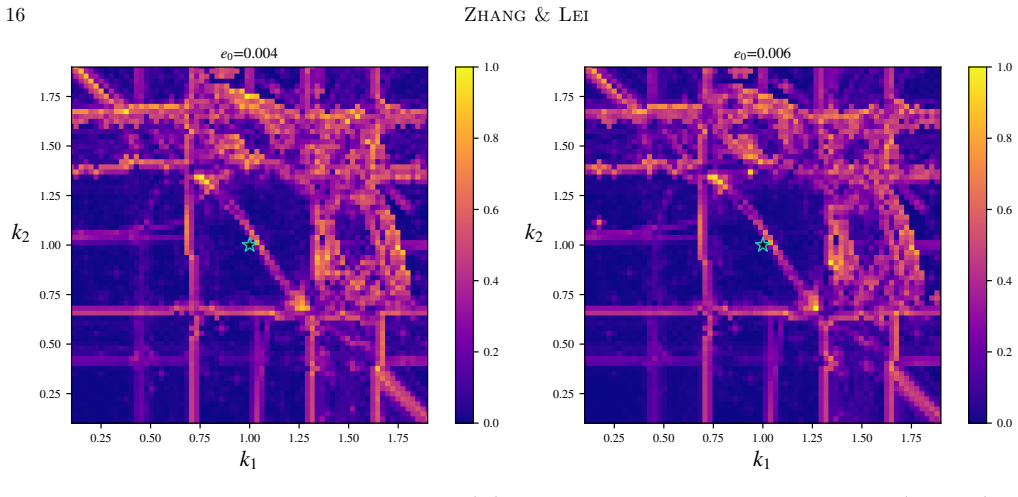
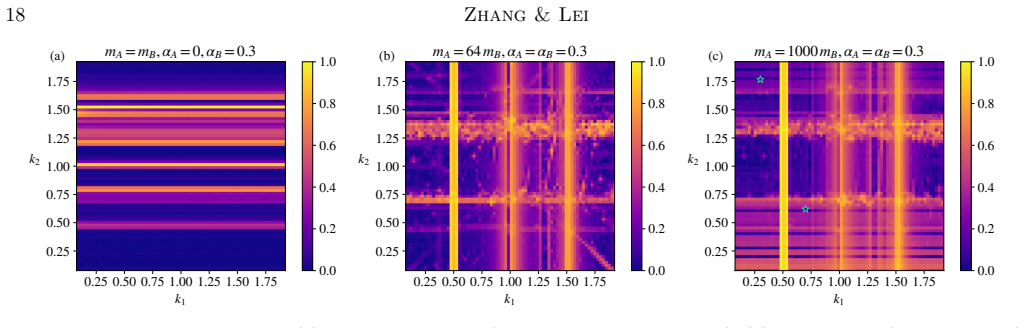
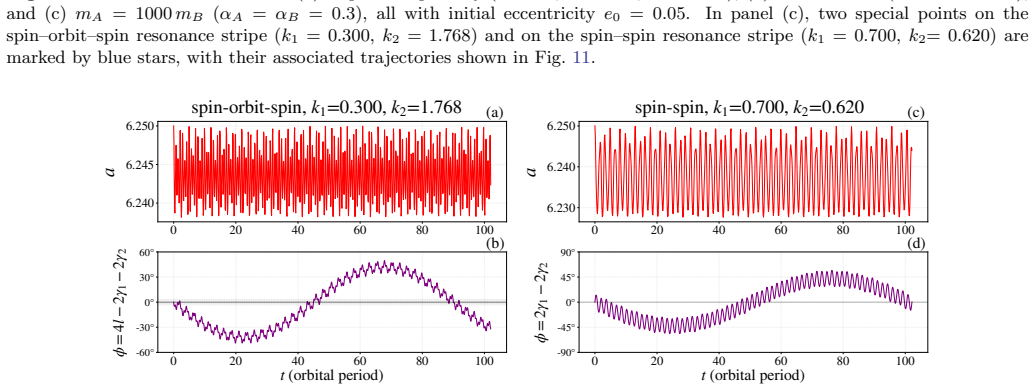
We develop a global Hamiltonian framework based on elliptic expansions of the spin-orbit coupling model, enabling the numerical construction of comprehensive resonant networks. Concentrating on a representative synchronous region that encompasses synchronous spin-orbit, spin-spin, spin-orbit-spin, and doubly synchronous resonances, we study the dynamical boundaries of different resonant modes in a systematical manner. Crucially, we identify a secondary resonance structure arising from the strong nonlinear coupling between the synchronous resonances of the primary and secondary asteroids. Ultimately, this study provides a reliable parameter-space atlas, which is helpful for predicting the lon
What carries the argument
The global Hamiltonian framework based on elliptic expansions of the spin-orbit coupling model, which constructs resonant networks and reveals boundaries among coexisting modes in the synchronous region.
If this is right
- Dynamical boundaries of synchronous spin-orbit, spin-spin, spin-orbit-spin, and doubly synchronous resonances can be mapped systematically.
- Mutual interactions among resonant modes become accessible through the resonant network construction.
- Long-term evolutionary pathways of binary asteroid systems follow from the parameter-space atlas.
- The domains of influence of different resonant modes are delimited within the synchronous region.
Where Pith is reading between the lines
- The same coupling mechanism could appear in other multi-resonance regimes such as triple asteroid systems.
- Observed spin states of known binary asteroids could be checked against the atlas for consistency with the secondary resonance.
- Relaxing the ellipsoidal assumption in targeted cases would test whether the secondary structure persists.
Load-bearing premise
The elliptic expansions of the spin-orbit coupling model remain valid and sufficient to capture the mutual interactions inside the chosen synchronous region without requiring higher-order terms or non-ellipsoidal shape corrections.
What would settle it
Numerical integration of the unexpanded equations of motion for a specific ellipsoid-ellipsoid binary system that shows no secondary resonance structure inside the modeled synchronous region would falsify the central claim.
Figures
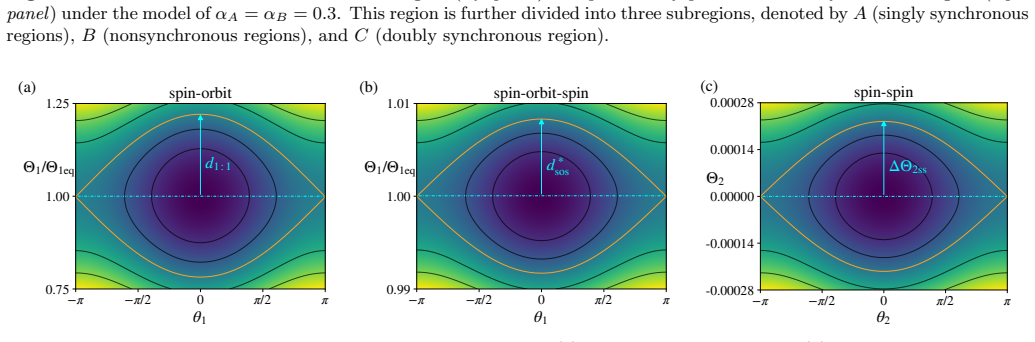
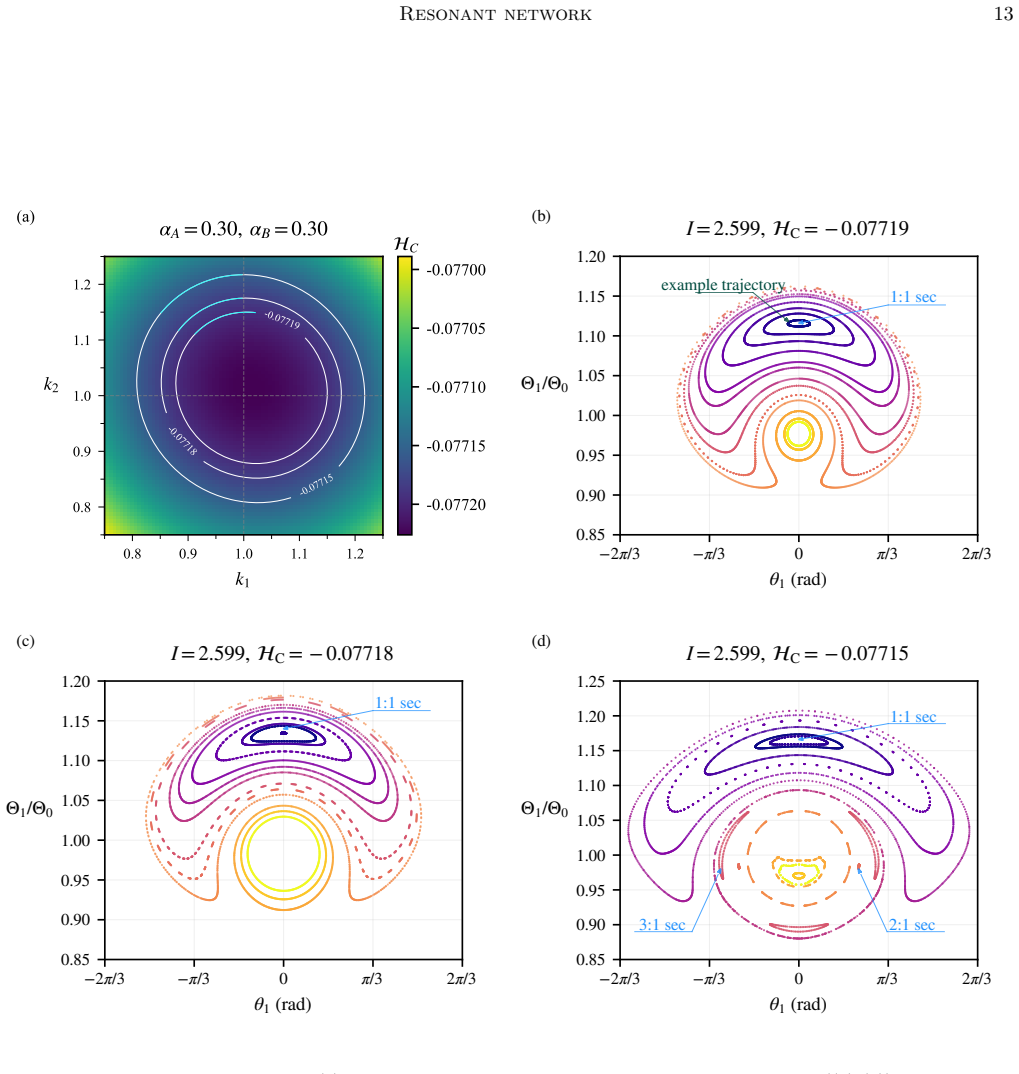
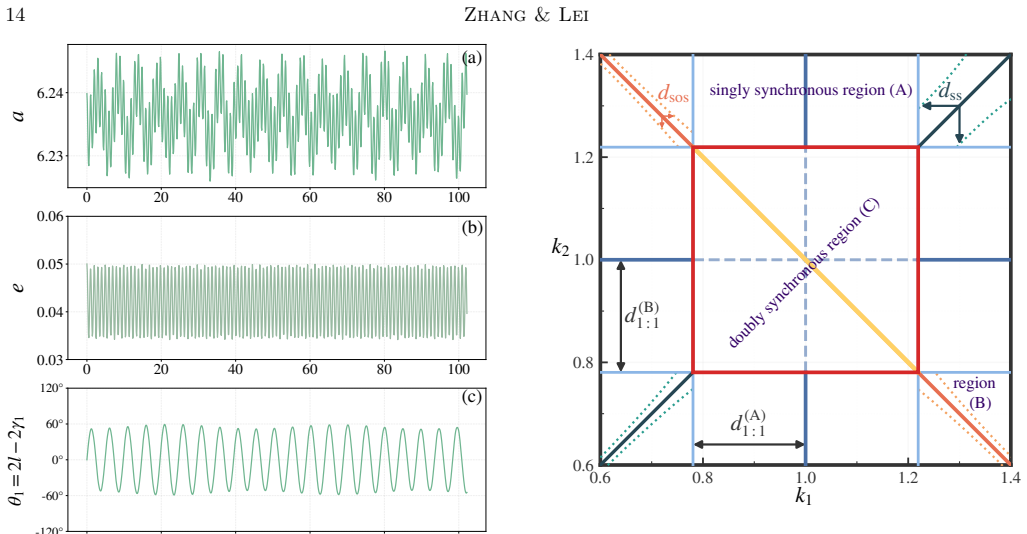
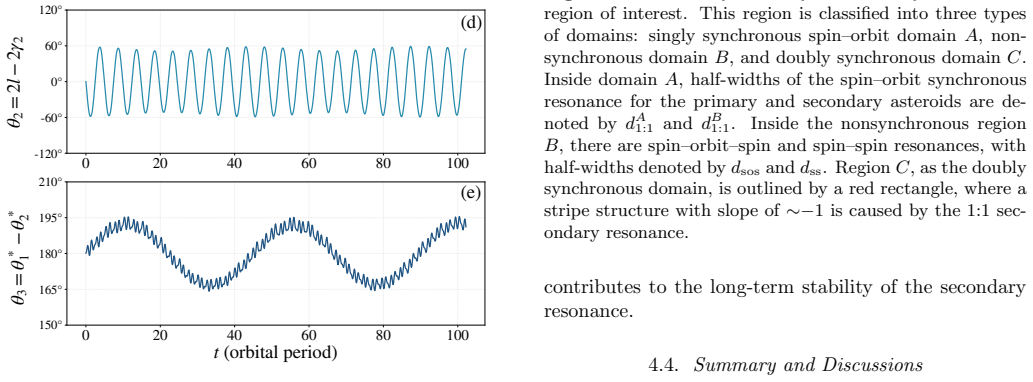
read the original abstract
The dynamical evolution of binary asteroid systems is deeply influenced by spin-orbit resonances. However, their domains of influence and mutual interactions remain elusive, in particular in the space where multiple resonant modes coexist. In such regimes, the standard single-resonance approach is intrinsically limited and fails to capture the true coupled dynamics. To overcome this, we develop a global Hamiltonian framework based on elliptic expansions of the spin-orbit coupling model, enabling the numerical construction of comprehensive resonant networks. Concentrating on a representative synchronous region that encompasses synchronous spin-orbit, spin-spin, spin-orbit-spin, and doubly synchronous resonances, we study the dynamical boundaries of different resonant modes in a systematical manner. Crucially, we identify a secondary resonance structure arising from the strong nonlinear coupling between the synchronous resonances of the primary and secondary asteroids. Ultimately, this study provides a reliable parameter-space atlas, which is helpful for predicting the long-term evolutionary pathways of binary asteroid systems.
Editorial analysis
A structured set of objections, weighed in public.
Referee Report
Summary. The manuscript develops a global Hamiltonian framework based on elliptic expansions of the spin-orbit coupling model for ellipsoid-ellipsoid binary asteroid systems. It numerically constructs resonant networks within a representative synchronous region that includes synchronous spin-orbit, spin-spin, spin-orbit-spin, and doubly synchronous resonances. The central result is the identification of a secondary resonance structure arising from strong nonlinear coupling between the synchronous resonances of the primary and secondary bodies, with the goal of providing a parameter-space atlas for long-term evolutionary pathways.
Significance. If the numerical construction is reliable, the framework addresses a genuine limitation of single-resonance approximations in multi-resonant regimes and could supply a practical atlas for binary-asteroid dynamics. The reported secondary resonance would constitute a concrete, falsifiable prediction about coupled spin-orbit behavior if the underlying expansions are shown to be adequate.
major comments (2)
- [Methods / resonant-network construction] The truncation order of the elliptic expansions used to construct the global Hamiltonian is never stated (see the description of the numerical procedure in the methods and the resonant-network figures). Because the secondary resonance is attributed to nonlinear coupling captured by these expansions, an unstated truncation order leaves open the possibility that higher-order eccentricity terms or non-ellipsoidal corrections could shift or eliminate the reported structure.
- [Results / secondary resonance identification] No validation against known limiting cases (e.g., the decoupled spin-orbit problem or the circular-orbit limit) and no error bars or convergence tests on the numerically located resonant boundaries are supplied. The central claim that a secondary resonance exists inside the chosen synchronous region therefore rests on an unverified numerical procedure whose accuracy cannot be assessed from the presented material.
minor comments (1)
- [Notation] Notation for the resonant angles and the elliptic-expansion coefficients should be defined once in a dedicated table or appendix rather than introduced piecemeal.
Simulated Author's Rebuttal
We thank the referee for the careful reading and constructive comments on our manuscript. The points raised highlight important aspects of reproducibility and validation that we will address in revision. We respond to each major comment below.
read point-by-point responses
-
Referee: [Methods / resonant-network construction] The truncation order of the elliptic expansions used to construct the global Hamiltonian is never stated (see the description of the numerical procedure in the methods and the resonant-network figures). Because the secondary resonance is attributed to nonlinear coupling captured by these expansions, an unstated truncation order leaves open the possibility that higher-order eccentricity terms or non-ellipsoidal corrections could shift or eliminate the reported structure.
Authors: We agree that the truncation order must be stated explicitly. The elliptic expansions in the global Hamiltonian were truncated at fourth order in eccentricity (with higher-order terms retained only for the leading resonant arguments), but this detail was omitted from the methods description. In the revised manuscript we will add a clear statement of the truncation order, justify its sufficiency for the eccentricity range of interest (e < 0.3), and note the expected magnitude of omitted terms. revision: yes
-
Referee: [Results / secondary resonance identification] No validation against known limiting cases (e.g., the decoupled spin-orbit problem or the circular-orbit limit) and no error bars or convergence tests on the numerically located resonant boundaries are supplied. The central claim that a secondary resonance exists inside the chosen synchronous region therefore rests on an unverified numerical procedure whose accuracy cannot be assessed from the presented material.
Authors: We acknowledge that the manuscript lacks explicit validation and convergence diagnostics. We will add a dedicated methods subsection that (i) recovers the standard decoupled spin-orbit resonance widths in the limit of vanishing mutual gravitational torque, (ii) reproduces the circular-orbit synchronous resonance locations, and (iii) presents convergence tests obtained by increasing the expansion order from 2 to 6 and by refining the numerical grid. Error estimates on the resonant boundaries will be included in the revised figures. revision: yes
Circularity Check
No significant circularity; derivation is self-contained modeling and numerical exploration
full rationale
The paper constructs a global Hamiltonian from elliptic expansions of the spin-orbit coupling model, then numerically maps resonant networks and identifies a secondary resonance as an output of that construction. No quoted steps reduce by definition or construction to fitted inputs, self-citations, or ansatzes; the framework is presented as derived from the standard spin-orbit model without load-bearing reliance on prior author work or parameter fitting that forces the reported structure. The central claim therefore remains independent of its inputs.
Axiom & Free-Parameter Ledger
axioms (1)
- domain assumption Elliptic expansions of the spin-orbit coupling model are adequate to capture the coupled dynamics inside the synchronous region.
Reference graph
Works this paper leans on
-
[1]
1994, CeMDA, 60, 331, doi: https://doi.org/10.1007/BF00691901 Callegari Jr, N
Balmino, G. 1994, CeMDA, 60, 331, doi: https://doi.org/10.1007/BF00691901 Callegari Jr, N. 2024, Commun. Nonlinear Sci. Numer. Simul., 138, 108224, doi: https://doi.org/10.1016/j.cnsns.2024.108224
-
[2]
1990a, ZAMP, 41, 453, doi: https://doi.org/10.1007/BF00945951 —
Celletti, A. 1990a, ZAMP, 41, 453, doi: https://doi.org/10.1007/BF00945951 —. 1990b, ZAMP, 41, 174, doi: https://doi.org/10.1007/BF00945107
-
[3]
2000, CeMDA, 76, 229, doi: https://doi.org/10.1023/A:1008341317257 Resonant network 19 —
Celletti, A., & Chierchia, L. 2000, CeMDA, 76, 229, doi: https://doi.org/10.1023/A:1008341317257 Resonant network 19 —. 2008, CeMDA, 101, 159, doi: https://doi.org/10.1007/s10569-008-9142-9
-
[4]
Celletti, A., Gimeno, J., & Misquero, M. 2022, J. Nonlinear Sci., 32, 88, doi: https://doi.org/10.1007/s00332-022-09840-7
-
[5]
2023, CeMDA, 135, 31, doi: https://doi.org/10.1007/s10569-023-10143-6 de Oliveira, V
Daquin, J., & Charalambous, C. 2023, CeMDA, 135, 31, doi: https://doi.org/10.1007/s10569-023-10143-6 de Oliveira, V. M. 2025, Commun. Nonlinear Sci. Numer. Simul., 150, 109024, doi: https://doi.org/10.1016/j.cnsns.2025.109024
-
[6]
2007, Icar., 187, 482, doi: https://doi.org/10.1016/j.icarus.2006.10.030
Descamps, P., Marchis, F., Michalowski, T., et al. 2007, Icar., 187, 482, doi: https://doi.org/10.1016/j.icarus.2006.10.030
-
[7]
Flynn, A. E., & Saha, P. 2005, AJ, 130, 295, doi: https://doi.org/10.1086/430410
-
[8]
2016, MNRAS, 459, 1327, doi: https://doi.org/10.1093/mnras/stw752
Gkolias, I., Celletti, A., Efthymiopoulos, C., & Pucacco, G. 2016, MNRAS, 459, 1327, doi: https://doi.org/10.1093/mnras/stw752
-
[9]
Gkolias, I., Efthymiopoulos, C., Celletti, A., et al. 2019, Commun. Nonlinear Sci. Numer. Simul., 77, 181, doi: https://doi.org/10.1016/j.cnsns.2019.04.015
-
[10]
Goldreich, P., & Peale, S. J. 1966, AJ, 71, 425, doi: https://doi.org/10.1086/109947
-
[11]
1966, PASJ, 18, 287, doi: https://doi.org/10.1093/pasj/18.4.287
Hori, G.-I. 1966, PASJ, 18, 287, doi: https://doi.org/10.1093/pasj/18.4.287
-
[12]
Hou, X., Scheeres, D. J., & Xin, X. 2017, CeMDA, 127, 369, doi: https://doi.org/10.1007/s10569-016-9731-y
-
[13]
2017, AJ, 154, 257, doi: https://doi.org/10.3847/1538-3881/aa96ab
Hou, X.-Y., & Xin, X.-S. 2017, AJ, 154, 257, doi: https://doi.org/10.3847/1538-3881/aa96ab
-
[14]
Hughes, S. 1981, Celest. Mech., 25, 101, doi: https://doi.org/10.1007/BF01301812
-
[15]
2015, Nonlinear Dyn., 81, 2031, doi: https://doi.org/10.1007/s11071-015-2123-0 —
Jafari-Nadoushan, M., & Assadian, N. 2015, Nonlinear Dyn., 81, 2031, doi: https://doi.org/10.1007/s11071-015-2123-0 —. 2023, MNRAS, 520, 3514, doi: https://doi.org/10.1093/mnras/stac3624
-
[16]
2024a, CeMDA, 136, 37, doi: https://doi.org/10.1007/s10569-024-10211-5 —
Lei, H. 2024a, CeMDA, 136, 37, doi: https://doi.org/10.1007/s10569-024-10211-5 —. 2024b, AJ, 168, 146, doi: https://doi.org/10.3847/1538-3881/ad6988 —. 2024c, Perturbation Methods and Theory (Nanjing, China: Nanjing University Press) —. 2024d, AJ, 167, 121, doi: https://doi.org/10.3847/1538-3881/ad21ff Lemaˆ ıtre, A., D’Hoedt, S., & Rambaux, N. 2006, CeMD...
-
[17]
Margot, J.-L., Nolan, M. C., Benner, L. A. M., et al. 2002, Science, 296, 1445, doi: https://doi.org/10.1126/science.1072094
-
[18]
Jacobson, S. 2015, in Asteroids IV, ed. P. Michel, F. E. DeMeo, & W. F. Bottke (Tucson, Arizona: University of Arizona Press), 355–374, doi: https: //doi.org/10.2458/azu uapress 9780816532131-ch019
work page doi:10.2458/azu 2015
-
[19]
2002, Modern Celestial Mechanics: Aspects of Solar System Dynamics (London: Taylor & Francis)
Morbidelli, A. 2002, Modern Celestial Mechanics: Aspects of Solar System Dynamics (London: Taylor & Francis)
2002
-
[20]
D., & Dermott, S
Murray, C. D., & Dermott, S. F. 1999, Solar System Dynamics (Cambridge: Cambridge University Press)
1999
-
[21]
Naidu, S. P., & Margot, J.-L. 2015, AJ, 149, 80, doi: https://doi.org/10.1088/0004-6256/149/2/80
-
[22]
1965, Nature, 206, 1240, doi: https://doi.org/10.1038/2061240b0
Peale, S., & Gold, T. 1965, Nature, 206, 1240, doi: https://doi.org/10.1038/2061240b0
-
[23]
Peale, S. J. 1969, AJ, 74, 483, doi: https://doi.org/10.1086/110825
-
[24]
2025, Astrodynamics, 9, 289, doi: https://doi.org/10.1007/s42064-024-0237-1
Rizza, A., Giordano, C., & Topputo, F. 2025, Astrodynamics, 9, 289, doi: https://doi.org/10.1007/s42064-024-0237-1
-
[25]
Scheeres, D. J., Fahnestock, E. G., Ostro, S. J., et al. 2006, Science, 314, 1280, doi: https://doi.org/10.1126/science.1133599
-
[26]
2021, ApJ, 913, 31, doi: https://doi.org/10.3847/1538-4357/abf248
Seligman, D., & Batygin, K. 2021, ApJ, 913, 31, doi: https://doi.org/10.3847/1538-4357/abf248
-
[27]
2020, MNRAS, 493, 171, doi: https://doi.org/10.1093/mnras/staa133
Wang, H.-S., & Hou, X.-Y. 2020, MNRAS, 493, 171, doi: https://doi.org/10.1093/mnras/staa133
-
[28]
2024, Astrodynamics, 8, 417, doi: https://doi.org/10.1007/s42064-024-0202-z
Wen, T., Zeng, X., Li, Z., & Yu, Y. 2024, Astrodynamics, 8, 417, doi: https://doi.org/10.1007/s42064-024-0202-z
-
[29]
2004, AJ, 128, 484, doi: https://doi.org/10.1086/421360
Wisdom, J. 2004, AJ, 128, 484, doi: https://doi.org/10.1086/421360
-
[30]
Wisdom, J., Peale, S. J., & Mignard, F. 1984, Icar., 58, 137, doi: https://doi.org/10.1016/0019-1035(84)90032-0
discussion (0)
Sign in with ORCID, Apple, or X to comment. Anyone can read and Pith papers without signing in.