REVIEW 2 major objections 2 minor 13 references
SVD-Surgeon: Optimal Singular-Value Surgery for Large Language Model Compression
T0 review · 2 major / 2 minor · reviewed 2026-06-26 · grok-4.3
Pith's one-line read SVD-Surgeon computes closed-form second-order updates to retained singular values to compensate for those removed during LLM compression.
desk verdict SVD-Surgeon moves the OBS closed-form update into the singular-value basis and layers it on SVD-LLM, but the second-order approximation is never checked against actual loss change. read the letter →
The pith
A machine-rendered reading of the paper's core claim, the machinery that carries it, and where it could break.
The reading
What carries the argument
The singular-value adaptation of the Optimal Brain Surgeon framework, which supplies both the closed-form update rule for retained values and the saliency scores used for pruning decisions.
What would settle it
A direct comparison, on a held-out validation set, between the loss change predicted by the second-order formula after SVD-Surgeon updates and the loss actually observed after the same singular values are removed.
Extended reading notes
Core claim
Treating singular values as parameters inside the OBS framework produces a closed-form compensation update for the retained singular values that accounts for second-order effects in the model loss, together with a saliency criterion for choosing which values to prune; the resulting procedure layers directly onto any existing SVD factorization and requires no retraining.
Load-bearing premise
The second-order Taylor expansion of the loss around the current singular values is accurate enough to produce useful compensation updates and pruning decisions.
Editorial extensions
If this is right
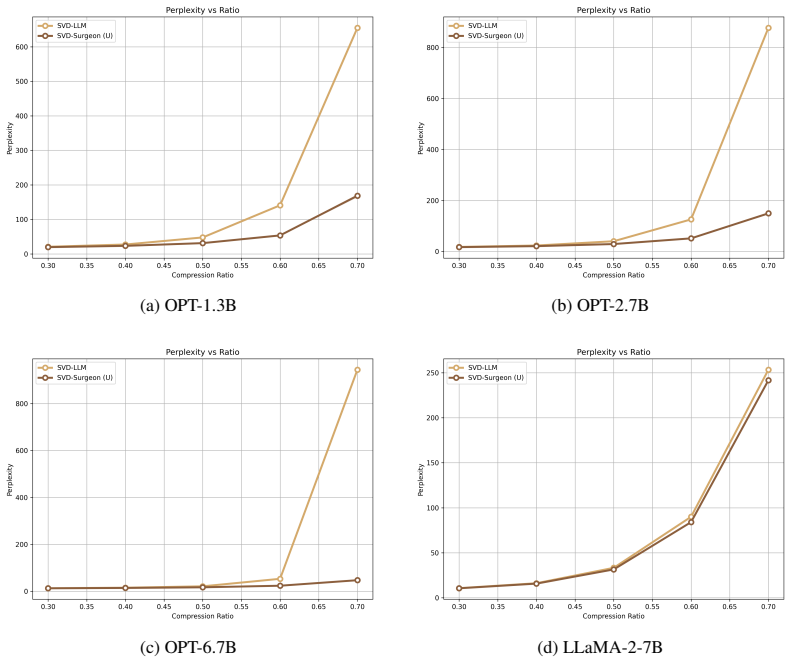
- The method improves the perplexity-compression curve when applied to SVD-LLM on OPT models.
- The same improvement appears on LLaMA 2-7B.
- No retraining is required after the updates are applied.
- The procedure works on top of any pre-existing SVD factorization without additional approximation steps.
Reading between the lines
- The same second-order compensation idea could be tested on other matrix-factorization bases used for model compression.
- If the second-order term remains reliable at larger scales, the technique might reduce reliance on post-compression fine-tuning stages.
- Extending the saliency score to decide entire layers or blocks rather than individual singular values would be a direct next measurement.
Editorial analysis
A structured set of objections, weighed in public.
Referee Report
Summary. The paper introduces SVD-Surgeon, a training-free post-processing method for SVD-based LLM compression. It adapts the Optimal Brain Surgeon framework to the singular-value basis by treating singular values as parameters, deriving closed-form compensatory updates to retained singular values and a saliency metric from a second-order Taylor expansion of the loss; the method is layered on top of existing SVD compressors such as SVD-LLM and is shown to improve the perplexity-compression trade-off on the OPT family and LLaMA 2-7B.
Significance. If the second-order approximation remains accurate for finite singular-value removals, the approach would supply a principled, parameter-free way to refine any SVD factorization without retraining, potentially tightening the efficiency frontier for training-free LLM compression.
major comments (2)
- [Method] Method section (derivation of the update rule): the central claim that the second-order Taylor expansion yields useful compensatory updates and saliency scores after singular-value truncation is load-bearing, yet the manuscript provides no quantitative check of the approximation error (e.g., predicted vs. actual loss change) on the OPT or LLaMA models evaluated.
- [§4] §4 (experimental setup): the reported perplexity gains are obtained by applying SVD-Surgeon on top of SVD-LLM factorizations, but no ablation isolates the contribution of the second-order update versus the saliency-based selection alone, leaving open whether the OBS-style compensation is responsible for the observed improvement.
minor comments (2)
- [Method] Notation for the Hessian approximation with respect to singular values is introduced without an explicit statement of whether off-diagonal blocks between layers are retained or dropped.
- [Figures] Figure captions should state the exact compression ratios and base SVD-LLM settings used for each curve.
Simulated Author's Rebuttal
We thank the referee for the thoughtful comments on our manuscript. The two major points identify important gaps in validation and experimental design. We address each below and will revise the manuscript accordingly.
read point-by-point responses
-
Referee: [Method] Method section (derivation of the update rule): the central claim that the second-order Taylor expansion yields useful compensatory updates and saliency scores after singular-value truncation is load-bearing, yet the manuscript provides no quantitative check of the approximation error (e.g., predicted vs. actual loss change) on the OPT or LLaMA models evaluated.
Authors: We agree that a direct quantitative check of the second-order approximation error is necessary to support the central claim. In the revised manuscript we will add a new subsection (or appendix) that reports, for the evaluated OPT and LLaMA-2 models, the predicted loss change from the Taylor expansion versus the actual loss change measured after applying the closed-form updates. This will be computed on the same calibration data used in the original experiments. revision: yes
-
Referee: [§4] §4 (experimental setup): the reported perplexity gains are obtained by applying SVD-Surgeon on top of SVD-LLM factorizations, but no ablation isolates the contribution of the second-order update versus the saliency-based selection alone, leaving open whether the OBS-style compensation is responsible for the observed improvement.
Authors: We acknowledge that the current experiments do not isolate the effect of the compensatory updates from the saliency-based pruning. In the revision we will add an ablation that applies the same SVD-LLM factorizations but replaces the OBS-style updates with a simple re-scaling (or no update) while keeping the saliency selection fixed, thereby quantifying the incremental benefit of the second-order compensation. revision: yes
Circularity Check
No circularity: direct transfer of external OBS math to SVD basis
full rationale
The derivation applies the pre-existing Optimal Brain Surgeon closed-form solution (second-order Taylor expansion for parameter updates and saliency) to singular values treated as parameters. This is an algebraic re-expression in the SVD coordinate system rather than a redefinition of the target perplexity metric or a fitted input renamed as prediction. No load-bearing self-citation, uniqueness theorem, or ansatz from the authors' prior work is invoked; the paper states it layers on existing SVD factorizations without retraining. The central claim of improved trade-off therefore rests on the external OBS framework and empirical verification rather than reducing to its own inputs by construction.
Assumptions & free parameters
Cite this review
Pith. "Pith review of SVD-Surgeon: Optimal Singular-Value Surgery for Large Language Model Compression." pith.science (2026). https://pith.science/paper/FI4YCRNC
@misc{pith2026260623568,
  author       = {Pith},
  title        = {Pith review of: SVD-Surgeon: Optimal Singular-Value Surgery for Large Language Model Compression},
  year         = {2026},
  howpublished = {\url{https://pith.science/paper/FI4YCRNC}},
  note         = {Machine review of arXiv:2606.23568}
}
read the original abstract
Large language models (LLMs) achieve remarkable performance across a wide range of tasks, but their deployment is constrained by substantial memory and compute requirements. Low-rank compression via singular value decomposition (SVD) is an effective remedy, but existing methods focus on how to factorize and which components to keep. We introduce SVD-Surgeon, a training-free method that brings the Optimal Brain Surgeon (OBS) framework to the singular-value basis. Treating each singular value as a parameter, it computes a closed-form update of the retained singular values that compensates, to second order in the model loss, for those removed by truncation. The same analysis yields a saliency for choosing which values to prune. As it operates directly on the singular-value factorization, SVD-Surgeon can be layered on top of existing SVD compressors. Applied to SVD-LLM, a leading SVD-based method, it improves the perplexity-compression trade-off on the OPT family and LLaMA 2-7B without any retraining.
Figures


Reference graph
Works this paper leans on
-
[1]
Drone: Data-aware low- rank compression for large nlp models.Advances in neural information processing systems, 34:29321–29334, 2021
Patrick Chen, Hsiang-Fu Yu, Inderjit Dhillon, and Cho-Jui Hsieh. Drone: Data-aware low- rank compression for large nlp models.Advances in neural information processing systems, 34:29321–29334, 2021
2021
-
[2]
Optimal brain compression: A framework for accurate post- training quantization and pruning.Advances in Neural Information Processing Systems, 35:4475– 4488, 2022
Elias Frantar and Dan Alistarh. Optimal brain compression: A framework for accurate post- training quantization and pruning.Advances in Neural Information Processing Systems, 35:4475– 4488, 2022
2022
-
[3]
Sparsegpt: Massive language models can be accurately pruned in one-shot
Elias Frantar and Dan Alistarh. Sparsegpt: Massive language models can be accurately pruned in one-shot. InInternational conference on machine learning, pages 10323–10337. PMLR, 2023
2023
-
[4]
Optq: Accurate quantization for generative pre-trained transformers
Elias Frantar, Saleh Ashkboos, Torsten Hoefler, and Dan Alistarh. Optq: Accurate quantization for generative pre-trained transformers. InThe Eleventh International Conference on Learning Representations
-
[5]
Second order derivatives for network pruning: Optimal brain surgeon.Advances in neural information processing systems, 5, 1992
Babak Hassibi and David Stork. Second order derivatives for network pruning: Optimal brain surgeon.Advances in neural information processing systems, 5, 1992
1992
-
[6]
Yen-Chang Hsu, Ting Hua, Sungen Chang, Qian Lou, Yilin Shen, and Hongxia Jin. Language model compression with weighted low-rank factorization.arXiv preprint arXiv:2207.00112, 2022
-
[7]
The optimal bert surgeon: Scalable and accurate second-order pruning for large language models
Eldar Kurtic, Daniel Campos, Tuan Nguyen, Elias Frantar, Mark Kurtz, Benjamin Fineran, Michael Goin, and Dan Alistarh. The optimal bert surgeon: Scalable and accurate second-order pruning for large language models. InProceedings of the 2022 conference on empirical methods in natural language processing, pages 4163–4181, 2022
2022
-
[8]
Optimal brain damage
Yann LeCun, John Denker, and Sara Solla. Optimal brain damage. In D. Touretzky, editor, Advances in Neural Information Processing Systems, volume 2. Morgan-Kaufmann, 1989
1989
Show all 13 references
-
[9]
Optimal brain decomposition for accurate llm low-rank approximation.arXiv preprint arXiv:2604.00821, 2026
Yuhang Li, Donghyun Lee, Ruokai Yin, and Priyadarshini Panda. Optimal brain decomposition for accurate llm low-rank approximation.arXiv preprint arXiv:2604.00821, 2026
2026
-
[10]
Optimizing neural networks with kronecker-factored approx- imate curvature
James Martens and Roger Grosse. Optimizing neural networks with kronecker-factored approx- imate curvature. InInternational conference on machine learning, pages 2408–2417. PMLR, 2015
2015
-
[11]
The llm surgeon
Tycho van der Ouderaa, Markus Nagel, Mart Van Baalen, and Tijmen Blankevoort. The llm surgeon. InInternational Conference on Learning Representations, volume 2024, pages 13245–13255, 2024
2024
-
[12]
Svd-llm: Truncation-aware singular value decomposition for large language model compression
Xin Wang, Yu Zheng, Zhongwei Wan, and Mi Zhang. Svd-llm: Truncation-aware singular value decomposition for large language model compression. InThe Thirteenth International Conference on Learning Representations
-
[13]
Asvd: Activation-aware singular value decomposition for compressing large language models
Zhihang Yuan, Yuzhang Shang, Yue Song, Dawei Yang, Qiang Wu, Yan Yan, and Guangyu Sun. Asvd: Activation-aware singular value decomposition for compressing large language models. arXiv preprint arXiv:2312.05821, 2023. 9 A Hyperparameter Settings Tables 3 and 4 list, respectivel...
2023 arXiv
Reviewed June 26, 2026 · model on record in the stance chip above.
Discussion (0). Sign in to comment.