REVIEW 4 major objections 5 minor 84 references
Milliarcsecond astrometric oscillations in active galactic nuclei as a precursor of multi-messenger gravitational wave events
T0 review · 4 major / 5 minor · reviewed 2026-08-06 · deepseek-v4-flash
Pith's one-line read This paper argues that the 7.9-year astrometric oscillation of the quasar J0204+1514 is the orbital signature of a supermassive black hole binary whose gravitational-wave-driven inspiral will culminate in a merger on a timescale of about…
desk verdict A careful, well-hedged SMBHB candidate study with a robust DEC period, a marginal RA signal, and an explicitly unproven binary link; it merits refereeing but needs a red-noise reanalysis. read the letter →
The pith
A machine-rendered reading of the paper's core claim, the machinery that carries it, and where it could break.
The reading
What carries the argument
The load-bearing mechanism is a two-step mapping from astrometry to gravitational waves. First, a generalized Lomb–Scargle periodogram and a cross-spectrum analysis extract a common $7.9$ year harmonic from the right-ascension and declination time series of absolute VLBI positions; the declination signal is highly significant while the right-ascension signal is weaker. Second, a toy model assumes a circular orbit of a low-mass secondary ($q\ll1$) around a non-rotating primary, so Kepler's third law converts the observed period into a separation $a$, and the quadrupole formula for gravitational-wave energy loss converts that separation into an inspiral timescale $t_{gw}\simeq(5r_g/8cq)(a/r_g)^4$. The single observational input is the period; everything else follows from assumed masses, mass ratio, redshift, and the requirement that the secondary reaches the gravitational-wave regime within a cosmological time.
What would settle it
Continued VLBI monitoring of J0204+1514 over at least two more periods that fails to reproduce the 7.9-year harmonic in both coordinates, or that shows the wobble amplitude and phase tracking individual jet-component ejections or flux-density flares instead of a stable Keplerian ellipse, would falsify the binary interpretation and with it the derived separation and merger timescale.
Extended reading notes
Core claim
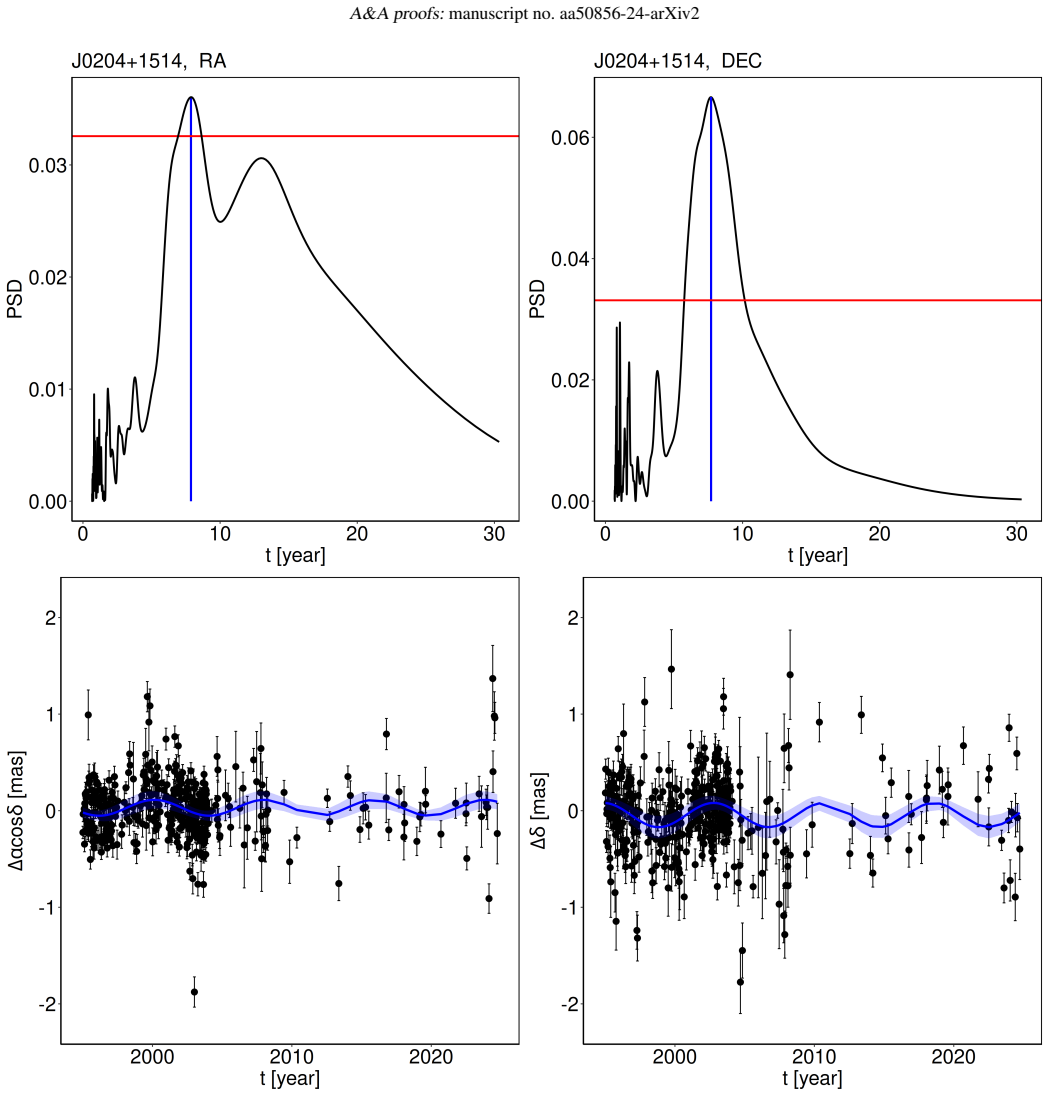
The central claim is that J0204+1514 shows a coherent harmonic astrometric oscillation of sub-milliarcsecond amplitude with period $T\simeq7.9$ yr in both celestial coordinates, and that the most plausible cause is Keplerian orbital motion of a secondary black hole around a more massive primary. Treating the secondary as a test mass in a circular orbit, Kepler's third law gives a separation $a\simeq8.9\times10^{-3}$ pc $\simeq89\,r_g$ for a $10^9\,M_\odot$ primary at redshift $z=0.834$. Comparing the gravitational-wave energy-loss timescale with the accretion-disc interaction timescale in the toy model, the authors find that gravitational-wave emission already dominates the orbital evolution, with $t_{gw}\simeq1.2\times10^6\,(M_9/q_{-2})$ yr. The paper does not claim conclusive proof: it explicitly notes that the jet-centroid explanation would require a separate study and that another reason for the astrometric behaviour cannot be ruled out, but it argues that the binary interpretation is very plausible and that the multi-messenger link between radio astrometry and gravitational waves is the essential point, independent of the specific numbers.
Load-bearing premise
The load-bearing premise is that the 7.9-year astrometric oscillation of J0204+1514 is produced by orbital motion in a binary black hole system, rather than by changes in the jet's brightness distribution or by systematic errors in absolute VLBI astrometry.
Editorial extensions
If this is right
- J0204+1514 would become one of the closest-separation supermassive black hole binary candidates known, with $a\simeq8.9\times10^{-3}$ pc $\simeq89\,r_g$, already in the gravitational-wave-dominated inspiral phase.
- The predicted merger timescale $t_{gw}\simeq1.2\times10^6\,(M_9/q_{-2})$ yr makes the system a concrete multi-messenger target: a gravitational-wave source expected to form within a cosmologically short time.
- The same toy model applied to any other astrometrically oscillating source turns one measured period into estimates of separation, inspiral time, and gravitational-wave detectability, so systematic VLBI astrometry can build a census of pre-merger binaries.
- The paper's quantitative constraints specify what parameter space future space-based gravitational-wave interferometers must reach to detect individual systems like this one, and how many similar binaries would be needed to explain the pulsar-timing-array background.
- Future space-borne VLBI with microarcsecond resolution could directly image the milli-parsec separation of such binaries, converting astrometric candidates into resolved dual nuclei and completing the electromagnetic side of the multi-messenger event.
Reading between the lines
- If the observed periodicity reflects jet or accretion modulation rather than the orbital period itself, the GRMHD results cited in the paper imply the true orbital period could differ by a factor of 0.7–1.0, shifting the inferred separation by the corresponding two-thirds power; multi-cycle jet-structure monitoring could test this.
- Applying the same periodogram-to-toy-model pipeline to the dozens of quasi-periodic VLBI sources already catalogued in the literature would yield a population-level estimate of milli-parsec binaries and their gravitational-wave background contribution without assuming galaxy merger rates.
- A decisive observational separation of the two explanations would be multi-frequency, phase-referenced imaging of J0204+1514 against a stable background source: persistence of the 7.9-year harmonic in the core position relative to the reference would strongly support the binary interpretation, while correlation of the wobble with flaring or structural changes would favor a jet origin.
- If this interpretation is typical, the same absolute-VLBI data that define the celestial reference frame could be mined systematically for other periodic wobbles, turning a by-product of geodetic monitoring into a discovery channel for gravitational-wave precursor sources.
Editorial analysis
A structured set of objections, weighed in public.
Referee Report
Summary. The paper reports the detection of a quasi-periodic astrometric oscillation with a period of about 7.9 years in the VLBI position time series of the quasar J0204+1514, and interprets the oscillation as orbital motion in a supermassive black hole binary (SMBHB). Using this period as the sole observed input, the authors construct a 'toy model' that yields a binary separation a ≈ 8.9e-3 pc (about 89 r_g for a 10^9 M_sun primary, Eq. 14) and a gravitational-wave-driven merger timescale t_gw ≈ 1.2e6 (M9/q_-2) yr (Eq. 21). They also discuss detectability by LISA and the contribution to the PTA GW background, and provide a re-assessed redshift z=1.42 for the previously studied source J2102+6015 in an appendix. The authors explicitly acknowledge that the jet-centroid variability is an alternative explanation that is not ruled out, and that the binary interpretation is an assumption.
Significance. If the periodicity and its binary interpretation are robust, the paper would add a new SMBHB candidate at sub-parsec separation with a remarkably short orbital period, and it would demonstrate a practical multi-messenger link between VLBI astrometry and future gravitational-wave observations. The toy-model derivation is transparent and uses standard Keplerian and quadrupole formulas, and the paper is honest about the assumption-laden nature of the interpretation. However, the significance hinges on two load-bearing points that are not fully established: (1) the statistical reality of the 7.9-yr periodicity against realistic red noise, and (2) the causal association between the astrometric oscillation and binary orbital motion. The paper's own text repeatedly states that these links are not proven. As a candidate-identification and forward-looking framework paper, it has value; as a detection of an SMBHB, the current evidence is not yet sufficient. The main contribution is the quantitative framework for connecting astrometric oscillations to GW predictions, which is useful regardless of the specific source.
major comments (4)
- [§2.2.2] The claimed significance of the 7.9-yr peak uses bootstrap resampling and the Baluev (2008) analytic FAP, both of which assume independent noise. VLBI astrometric time series are widely known to contain time-correlated errors (atmospheric/ionospheric delays, unmodeled source structure), and J0204+1514 itself is a core-jet source with components moving at up to 15.9c (§2.1). With dense monitoring spanning only about 1.9 cycles of the 7.9-yr period, a red-noise process could produce a similar low-frequency peak. The quoted DEC FAP of 2.4e-13 is therefore not a realistic measure of the detection confidence unless a red-noise null is constructed. Please re-evaluate the significance with simulated time series that have the same cadence, error bars, and a power-law or ARMA-like noise spectrum constrained by the data, and report the FAP of the observed peak under that null.
- [§3 and §6] The causal link between the observed oscillation and orbital motion in a binary is the load-bearing assumption of the paper. The authors state in §3 that the jet-centroid explanation 'requires a separate study' and in §6 that they 'cannot rule out another reason for the apparent astrometric behaviour.' Since Eqs. (13)-(21) in §4 feed only the observed period into the toy model, if the oscillation is produced by jet component motion or by systematics, all derived SMBHB parameters and GW predictions lose their applicability to this source. The paper should either provide a positive observational test—for example, a check that the RA and DEC amplitudes and phases in Table 1 are consistent with a projected elliptical Keplerian orbit, or a comparison with long-term VLBI imaging of jet components—or explicitly label the Section 4 results as purely illustrative and not as evidence for a binary in J0204+1514.
- [§2.2 and Table 1] No uncertainty is given for the period of 7.9 yr, and different methods yield different values: 7.8 yr from the cross-spectrum (Fig. 2) and 8.05 yr in DEC only from Makarov et al. (2024), as cited in §3. Because the period is the single observational input to the toy model, the derived separation a=8.9×10^-3 pc and timescale t_gw=1.2×10^6 (M9/q_-2) yr in Eqs. (14) and (21) have no quoted uncertainty. Please quantify the period uncertainty (e.g., from bootstrap or a covariance-based method), assess whether the 7.8 yr and 8.05 yr values are consistent with 7.9 yr within that uncertainty, and propagate the period error into the derived quantities in Section 4.
- [§4.3, Eq. (21)] The sentence following Eq. (21) states that 'we can predict that, in approximately one million years, this object is likely to become a source of detectable gravitational radiation.' This is only true for the fiducial values M9=1 and q_-2=1, which are not measured for J0204+1514. Since t_gw scales as M9/q_-2, different mass assumptions change the timescale by orders of magnitude. Please either present this as a scaling relation with the fiducial values stated explicitly, or provide observational constraints on M and q for this source. Otherwise, the statement may be interpreted as a source-specific prediction rather than an illustrative example.
minor comments (5)
- [Throughout] The source designation is inconsistent: the text and figure captions use both J0204+1415 and J0204+1514. Please use one name consistently.
- [Eq. (18)] The sentence 'This variation in r corresponds to the timescale...' refers to a variable r that is not defined in Eq. (18); the equation is written in terms of a. Also, the notation r_g appears both as 'r_g' and 'rg' in Eqs. (14)-(21); please unify the notation.
- [§2.2.1] The trend order (quadratic for RA, cubic for DEC) is selected using significance tests on the same data that are later used for the periodogram. The quoted FAPs do not account for this model-selection step. Please state this caveat, or use an information criterion to justify the chosen trend order.
- [Appendix A] The re-assessed redshift z=1.42 for J2102+6015 is based on a single emission line and is acknowledged to be non-unique. The abstract uses the phrase 'ad hoc result'; in the main text it may be helpful to add 'tentative' to avoid overstatement.
- [Fig. 1 caption] The caption says 'nearly 30 years' for the GLS spectra, while the text mentions about 15 years of dense IVS monitoring until 2009. Please clarify the time span covered by the data used in the periodograms and in the model fits, and how the sparse post-2009 data are weighted.
Circularity Check
No circularity: the derived SMBHB separation and GW timescale are standard Kepler/quadrupole consequences of the observed period, with no fitted parameter renamed as a prediction.
full rationale
The paper's derivation chain is: detect a 7.9 yr GLS peak in VLBI astrometry of J0204+1514 (Sec. 2.2, Table 1), validate it by cross-spectrum at 7.8 yr and by an independent 8.05 yr DEC detection (Makarov et al. 2024), then assume, with explicit caveats, that the oscillation reflects SMBHB orbital motion (Secs. 3 and 4). The toy model feeds just the observed period T, together with assumed M9=1, q=0.01, and z=0.834, into Kepler's third law (Eq. 13) to obtain separation a ≈ 8.9e-3 pc (Eq. 14), and into the standard quadrupole formula (Eqs. 16-19) to obtain t_gw ≈ 1.2e6 yr (Eq. 21). No output quantity is fitted back to the astrometric data, so the 'prediction' is an algebraic consequence of the input period rather than a disguised fit. The self-citations (Titov et al. 2023; Gurvits et al. 2023) concern J2102+6015 and do not enter the J0204 parameter estimates; the Appendix A redshift re-estimate is a separate spectral re-interpretation and is not load-bearing for the GW derivation. The admitted limitations (Sec. 3: the jet-centroid explanation 'requires a separate study'; Sec. 6 item 1: the authors 'cannot rule out another reason for the apparent astrometric behaviour') are evidence-strength caveats about the binary assumption, not circular reductions. Similarly, the weak RA significance (FAP_bootstrap = 0.06) and the possible red-noise contamination of the periodogram are statistical robustness concerns, not derivation-circularity concerns. Overall, the chain is self-contained with respect to its stated assumptions.
Assumptions & free parameters
free parameters (4)
- Observed astrometric period T =
7.9 yr (GLS; 7.8 yr cross-spectrum)
- Primary black hole mass M (normalized to M9 = 1) =
10^9 M_sun (chosen)
- Mass ratio q (normalized to q_-2 = 1) =
q = 0.01 (chosen)
- Accretion rate Mdot (normalized to Mdot_1 = 1 M_sun/yr) =
1 M_sun/yr (chosen)
assumptions (5)
- domain assumption The observed astrometric period equals the binary orbital period to within a factor of about 0.7 to 1.0.
- domain assumption The binary orbit is circular and the mass ratio is small, so the secondary moves as a test particle around a Schwarzschild primary.
- domain assumption The 'last parsec problem' is solved: dynamical friction brings the secondary close enough in less than a Hubble time.
- standard math Standard Kepler and quadrupole gravitational-wave formulas apply.
- domain assumption The source redshift z = 0.834 for J0204+1514 is adopted from the literature.
Cite this review
Pith. "Pith review of Milliarcsecond astrometric oscillations in active galactic nuclei as a precursor of multi-messenger gravitational wave events." pith.science (2026). https://pith.science/paper/FIBCZFWF
@misc{pith2026250702146,
  author       = {Pith},
  title        = {Pith review of: Milliarcsecond astrometric oscillations in active galactic nuclei as a precursor of multi-messenger gravitational wave events},
  year         = {2026},
  howpublished = {\url{https://pith.science/paper/FIBCZFWF}},
  note         = {Machine review of arXiv:2507.02146}
}
read the original abstract
The existence of supermassive black hole binaries (SMBHBs) is predicted by various cosmological and evolutionary scenarios for active galactic nuclei. These objects are considered as contributors into the gravitational wave (GW) background and emitters of discrete GW bursts. Yet, SMBHBs remain a rather elusive class of extragalactic objects. Previously we have identified the quasar J2102+6015 as potential SMBHB system based on its oscillating astrometric pattern. We analysed the available VLBI astrometry data and identified another case of astrometric oscillations in the source J0204+1514. We assume these oscillations as manifestations of orbital motion in a binary systems. We estimated parameters of the suspected SMBHB in this source and applied basic theoretical models for projecting its evolution toward coalescence. We also develop a toy model of SMBHB consistent with the discovered astrometric oscillations and give quantitative predictions of GW emission of such the source using the case of J0204+1514 as an example. As an ad hoc result, we also provide a re-assessed estimate of the redshift of J2102+6015, z=1.42. A toy model of the object containing SMBHB with parameters consistent with the observed astrometric oscillations of the source J0204+1514 enabled us to consider GW emission as the cause of the system's orbital evolution. Astrometric VLBI monitoring has an appreciable potential for future detections of SMBHBs as multi-messenger targets for both electromagnetic (in radio domain) and gravitational wave astronomy. To outline the contours of a future physical model connecting SMBHB with detectable GW manifestations, we apply the toy model to the source J0204+1514. We also provide justification for aiming future space-borne VLBI missions toward direct imaging of SMBHBs as a synergistic contribution into future multi-messenger studies involving prospective GW facilities.
Figures

Reference graph
Works this paper leans on
-
[1]
P., Abbott, R., Abbott, T
Abbott, B. P., Abbott, R., Abbott, T. D., et al. 2016, Phys. Rev. Lett., 116, 061102
2016
-
[2]
M., et al
Agazie, G., Anumarlapudi, A., Archibald, A. M., et al. 2023, ApJ, 956, L3
2023
-
[3]
L., & Wiesemeyer, H
Agudo, I., Thum, C., Gómez, J. L., & Wiesemeyer, H. 2014, A&A, 566, A59
2014
-
[4]
2018, Radio Science, 53, 1211 Andrés-Carcasona, M., Iovino, A
An, T., Mohan, P., & Frey, S. 2018, Radio Science, 53, 1211 Andrés-Carcasona, M., Iovino, A. J., Vaskonen, V ., et al. 2024, Phys. Rev. D, 110, 023040 Astropy Collaboration, Price-Whelan, A. M., Sip˝ocz, B. M., et al. 2018, AJ, 156, 123 Astropy Collaboration, Robitaille, T. P., Tollerud, E. J., et al. 2013, A&A, 558, A33
2018
-
[5]
2025, Living Reviews in Relativity, 28, 4
Ayzenberg, D., Blackburn, L., Brito, R., et al. 2025, Living Reviews in Relativity, 28, 4
2025
-
[6]
Baluev, R. V . 2008, MNRAS, 385, 1279
work page 2008
-
[7]
Baluev, R. V . 2014, Astrophysics, 57, 434
work page 2014
-
[8]
Bansal, K., Taylor, G. B., Peck, A. B., Zavala, R. T., & Romani, R. W. 2017, ApJ, 843, 14
work page 2017
Show all 84 references
-
[9]
C., Blandford, R
Begelman, M. C., Blandford, R. D., & Rees, M. J. 1980, Nature, 287, 307
1980
-
[10]
S., & Dotti, M
Boschini, M., Gerosa, D., Salafia, O. S., & Dotti, M. 2024, A&A, 686, A245
2024
-
[11]
B., Kardashev, N
Braginsky, V . B., Kardashev, N. S., Polnarev, A. G., & Novikov, I. D. 1990, Nuovo Cimento B Serie, 105, 1141
1990
-
[12]
2018, MNRAS, 478, 3199 Article number, page 11 of 13 A&A proofs:manuscript no
Britzen, S., Fendt, C., Witzel, G., et al. 2018, MNRAS, 478, 3199 Article number, page 11 of 13 A&A proofs:manuscript no. aa50856-24-arXiv2
2018
-
[13]
2023, ApJ, 951, 106
Britzen, S., Zajaˇcek, M., Gopal-Krishna, et al. 2023, ApJ, 951, 106
2023
-
[14]
2025, ApJ, 979, L48
Cao, X., Chen, Y .-M., Shi, Y ., et al. 2025, ApJ, 979, L48
2025
-
[15]
1990, AJ, 99, 1309
Charlot, P. 1990, AJ, 99, 1309
1990
-
[16]
S., Gordon, D., et al
Charlot, P., Jacobs, C. S., Gordon, D., et al. 2020, A&A, 644, A159
2020
-
[17]
& Wright, E
Chen, X. & Wright, E. L. 2009, ApJ, 694, 222
2009
-
[18]
2022, ApJ, 925, 162
Chen, Y .-C., Hwang, H.-C., Shen, Y ., et al. 2022, ApJ, 925, 162
2022
-
[19]
2023, ApJ, 958, 29
Chen, Y .-C., Liu, X., Lazio, J., et al. 2023, ApJ, 958, 29
2023
-
[20]
& Jiang, Y
Chen, Z.-H. & Jiang, Y . 2024, A&A, 689, A35
2024
-
[21]
2014, Space Sci
Colpi, M. 2014, Space Sci. Rev., 183, 189
2014
-
[22]
2023, Laser Interferometer Space Antenna
Colpi, M., Dnzmann, K., Hewitson, M., & LISA Science and ESA Study Teams. 2023, Laser Interferometer Space Antenna. Definition Study Report, Tech. rep., ESA, ESA-SCI-DIR-RP-002 de la Parra, P. V ., Kiehlmann, S., Mróz, P., et al. 2025, ApJ, 987, 191 De Paolis, F., Ingrosso, G....
2023
-
[23]
J., Gopakumar, A., et al
Dey, L., Valtonen, M. J., Gopakumar, A., et al. 2018, ApJ, 866, 11
2018
-
[24]
B., Wiik, K., et al
Dodson, R., Fomalont, E. B., Wiik, K., et al. 2008, ApJS, 175, 314 D’Orazio, D. J., Charisi, M., Derdzinski, A., et al. 2024, in Black Holes in the Era of Gravitational-Wave Astronomy, ed. M. Arca Sedda, E. Bortolas, & M. Spera (Elsevier), 379–478, (updated version: arXiv:2310.16896)
2008 arXiv
-
[25]
1979, The Annals of Statistics, 7, 1 EHT
Efron, B. 1979, The Annals of Statistics, 7, 1 EHT. 2019, Astrophysical Journal Letters, 875, L1 EHT. 2022, Astrophysical Journal Letters, 930, L12
1979
-
[26]
2024, arXiv e-prints, arXiv:2410.24224 Escrivà, A., Kuhnel, F., & Tada, Y
Ellis, J., Fairbairn, M., Urrutia, J., & Vaskonen, V . 2024, arXiv e-prints, arXiv:2410.24224 Escrivà, A., Kuhnel, F., & Tada, Y . 2024, in: Listening to the dark Universe: black holes in the era of gravitational-wave astronomy (Elsevier), 261–377, eds.: M. Arca Sedda, E. Bort...
2024
-
[27]
Z., Notari, A., Pujolàs, O., & Rompineve, F
Ferreira, R. Z., Notari, A., Pujolàs, O., & Rompineve, F. 2024, J. Cosmology Astropart. Phys., 2024, 020
2024
-
[28]
L., Gordon, D., Jacobs, C
Fey, A. L., Gordon, D., Jacobs, C. S., et al. 2015, AJ, 150, 58
2015
-
[29]
2024, A&A Rev., 32, 3
Genzel, R., Eisenhauer, F., & Gillessen, S. 2024, A&A Rev., 32, 3
2024
-
[30]
2024, A&A, 691, L5 Gómez, J
Goldoni, P., Boisson, C., Pita, S., et al. 2024, A&A, 691, L5 Gómez, J. L., Traianou, E., Krichbaum, T. P., et al. 2022, ApJ, 924, 122
2024
-
[31]
2024, arXiv e-prints, arXiv:2409.03627
Goncharov, B., Sardana, S., Sesana, A., et al. 2024, arXiv e-prints, arXiv:2409.03627
2024
-
[32]
C., Chen, Y .-C., Oguri, M., et al
Gross, A. C., Chen, Y .-C., Oguri, M., et al. 2024, arXiv [arXiv:2409.16363], ApJ, submitted
2024 arXiv
-
[33]
I., Frey, S., Krezinger, M., et al
Gurvits, L. I., Frey, S., Krezinger, M., et al. 2023, in The Multimessenger Chakra of Blazar Jets, ed. I. Liodakis, M. F. Aller, H. Krawczynski, A. Lähteenmäki, & T. J. Pearson, V ol. Proc. IAUS #375, 86–90
2023
-
[34]
I., Paragi, Z., Amils, R
Gurvits, L. I., Paragi, Z., Amils, R. I., et al. 2022, Acta Astron., 196, 314
2022
-
[35]
I., Paragi, Z., Casasola, V ., et al
Gurvits, L. I., Paragi, Z., Casasola, V ., et al. 2021, Exp. Astronomy, 51, 559
2021
-
[36]
2020, ApJ, 888, 73
Hwang, H.-C., Shen, Y ., Zakamska, N., & Liu, X. 2020, ApJ, 888, 73
2020
-
[37]
B., Papaloizou, J
Ivanov, P. B., Papaloizou, J. C. B., Paardekooper, S. J., & Polnarev, A. G. 2015, A&A, 576, A29
2015
-
[38]
B., Papaloizou, J
Ivanov, P. B., Papaloizou, J. C. B., & Polnarev, A. G. 1999, MNRAS, 307, 79
1999
-
[39]
B., Polnarev, A
Ivanov, P. B., Polnarev, A. G., & Saha, P. 2005, MNRAS, 358, 1361
2005
-
[40]
Ivanov, P. B. & Zhuravlev, V . V . 2024, MNRAS, 528, 337
2024
-
[41]
D., Akiyama, K., Baturin, R., et al
Johnson, M. D., Akiyama, K., Baturin, R., et al. 2024, in Society of Photo- Optical Instrumentation Engineers (SPIE) Conference Series, V ol. 13092, Space Telescopes and Instrumentation 2024: Optical, Infrared, and Millime- ter Wave, ed. L. E. Coyle, S. Matsuura, & M. D. Perri...
2024
-
[42]
M., Ghosh, T., & Salter, C
Jones, K. M., Ghosh, T., & Salter, C. J. 2018, AJ, 155, 254
2018
-
[43]
& Chelouche, D
Kollatschny, W. & Chelouche, D. 2024, A&A, 690, L2
2024
-
[44]
J., Treister, E., Kakkad, D., et al
Koss, M. J., Treister, E., Kakkad, D., et al. 2023, ApJ, 942, L24
2023
-
[45]
2024, Phys
Kou, X.-X., Fragione, G., & Mandic, V . 2024, Phys. Rev. D, 109, 123036
2024
-
[46]
Y ., Kardashev, N
Kovalev, Y . Y ., Kardashev, N. S., Sokolovsky, K. V ., et al. 2020, Advances in Space Research, 65, 705
2020
-
[47]
2022, ApJ, 940, 163
Kun, E., Jaroschewski, I., Ghorbanietemad, A., et al. 2022, ApJ, 940, 163
2022
-
[48]
B., et al
Kun, E., Jaroschewski, I., Tjus, J. B., et al. 2024, ApJ, 963, L16
2024
-
[49]
2024, MNRAS, 535, 3732
Kuznetsov, S. 2024, MNRAS, 535, 3732
2024
-
[50]
Landau, L. D. & Lifshitz, E. M. 1975, The classical theory of fields, 4th rev. English edn., Course of theoretical physics (Oxford: Pergamon Press)
1975
-
[51]
Lidov, M. L. 1962, Planet. Space Sci., 9, 719
1962
-
[52]
L., Aller, M
Lister, M. L., Aller, M. F., Aller, H. D., et al. 2013, AJ, 146, 120
2013
-
[53]
Lomb, N. R. 1976, Ap&SS, 39, 447
1976
-
[54]
V ., Lambert, S., Cigan, P., DiLullo, C., & Gordon, D
Makarov, V . V ., Lambert, S., Cigan, P., DiLullo, C., & Gordon, D. 2024, PASP, 136, 054503
2024
-
[55]
2025, arXiv e-prints, arXiv:2504.12375
Manikantan, V ., Paschalidis, V ., & Bozzola, G. 2025, arXiv e-prints, arXiv:2504.12375
2025 arXiv
-
[56]
2024, MNRAS, 531, 4444
Marcoccia, P., Nardini, G., & Pieroni, M. 2024, MNRAS, 531, 4444
2024
-
[57]
2024, ApJ, 965, L4
Matsuoka, Y ., Izumi, T., Onoue, M., et al. 2024, ApJ, 965, L4
2024
-
[58]
2016, ARA&A, 54, 441 O’Neill, S., Kiehlmann, S., Readhead, A
Naoz, S. 2016, ARA&A, 54, 441 O’Neill, S., Kiehlmann, S., Readhead, A. C. S., et al. 2022, ApJ, 926, L35
2016
-
[59]
A., Titov, O
Osetrova, A. A., Titov, O. A., & Melnikov, A. E. 2024, Astronomy Letters, 50, 657
2024
-
[60]
N., Helfand, D
Owen, F. N., Helfand, D. J., & Spangler, S. R. 1981, ApJ, 250, L55
1981
-
[61]
& Loeb, A
Padmanabhan, H. & Loeb, A. 2024, A&A, 684, L15
2024
-
[62]
R., Tombesi, F., Suková, P., et al
Pasham, D. R., Tombesi, F., Suková, P., et al. 2024, Science Advances, 10, eadj8898
2024
-
[63]
Piner, B. G. & Kingham, K. A. 1998, ApJ, 507, 706
1998
-
[64]
G., Nakama, T., & Yokoyama, J
Polnarev, A. G., Nakama, T., & Yokoyama, J. 2012, J. Cosmology Astropart. Phys., 2012, 027
2012
-
[65]
Polnarev, A. G. & Rees, M. J. 1994, A&A, 283, 301
1994
-
[66]
Priestley, M. B. 1981, Spectral Analysis and Time Series (Academic Press)
1981
-
[67]
A., Fragione, G., Rasio, F
Purohit, R. A., Fragione, G., Rasio, F. A., Petter, G. C., & Hickox, R. C. 2024, AJ, 167, 191
2024
-
[68]
B., Zavala, R
Rodriguez, C., Taylor, G. B., Zavala, R. T., et al. 2006, ApJ, 646, 49
2006
-
[69]
2024, ApJ, 975, 265
Saeedzadeh, V ., Babul, A., Mukherjee, S., et al. 2024, ApJ, 975, 265
2024
-
[70]
2024, Phys
Sato-Polito, G., Zaldarriaga, M., & Quataert, E. 2024, Phys. Rev. D, 110, 063020
2024
-
[71]
2025, arXiv e-prints, arXiv:2501.09786
Sato-Polito, G., Zaldarriaga, M., & Quataert, E. 2025, arXiv e-prints, arXiv:2501.09786
2025 arXiv
-
[72]
Scargle, J. D. 1982, ApJ, 263, 835
1982
-
[73]
W., Michelson, P
Sowards-Emmerd, D., Romani, R. W., Michelson, P. F., & Ulvestad, J. S. 2004, ApJ, 609, 564
2004
-
[74]
2025, Phys
Spadaro, A., Buscicchio, R., Izquierdo–Villalba, D., et al. 2025, Phys. Rev. D, 111, 023004
2025
-
[75]
2003, Science, 300, 1263
Sudou, H., Iguchi, S., Murata, Y ., & Taniguchi, Y . 2003, Science, 300, 1263
2003
-
[76]
W., Scharwächter, J., Peck, A., & Taylor, G
Surti, T., Romani, R. W., Scharwächter, J., Peck, A., & Taylor, G. B. 2024, ApJ, 960, 110
2024
-
[77]
& Seifina, E
Titarchuk, L. & Seifina, E. 2024, Frontiers in Astronomy and Space Sciences, 11, 1368633
2024
-
[78]
2022, MNRAS, 512, 874
Titov, O., Frey, S., Melnikov, A., et al. 2022, MNRAS, 512, 874
2022
-
[79]
2023, AJ, 165, 69 Trindade Falcão, A., Turner, T
Titov, O., Frey, S., Melnikov, A., et al. 2023, AJ, 165, 69 Trindade Falcão, A., Turner, T. J., Kraemer, S. B., et al. 2024, ApJ, 972, 185
2023
-
[80]
VanderPlas, J. T. 2018, ApJS, 236, 16 Véron-Cetty, M. P. & Véron, P. 2006, A&A, 455, 773 V oggel, K. T., Seth, A. C., Baumgardt, H., et al. 2022, A&A, 658, A152
2018
-
[81]
Winkler, M. W. & Freese, K. 2025, Phys. Rev. D, 111, 083509
2025
-
[82]
H., Anderson, J
Xu, M. H., Anderson, J. M., Heinkelmann, R., et al. 2019, ApJS, 242, 5
2019
-
[83]
2024, ApJ, 969, 36
Xu, W., Cui, L., Liu, X., et al. 2024, ApJ, 969, 36
2024
-
[84]
2024, ApJ, 961, 20 Article number, page 12 of 13 L.I
Zhao, S.-S., Jiang, W., Lu, R.-S., Huang, L., & Shen, Z. 2024, ApJ, 961, 20 Article number, page 12 of 13 L.I. Gurvits et al.: Milliarcsecond oscillations and multi-messenger studies Appendix A: On the redshift of the source J2102+6015 Our attention to possible astrometric osc...
2023
Reviewed August 6, 2026 · model on record in the stance chip above.
Discussion (0). Sign in to comment.