REVIEW 3 major objections 5 minor 25 references
Quickly Tuning Foundation Models for Image Segmentation
T0 review · 3 major / 5 minor · reviewed 2026-08-05 · deepseek-v4-flash
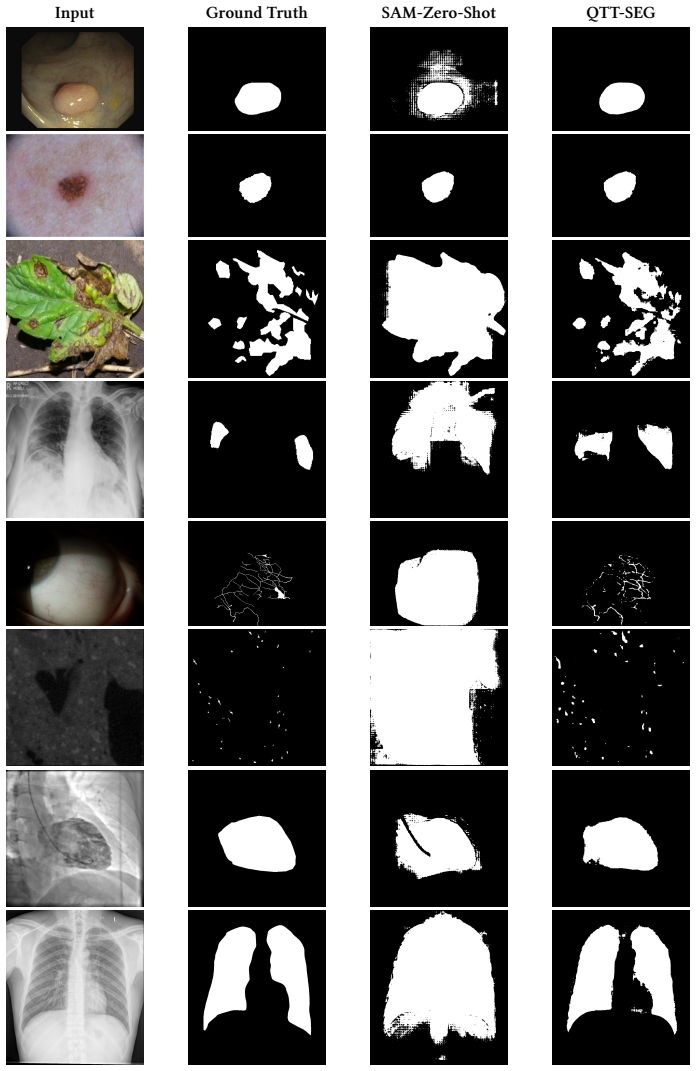
Pith's one-line read QTT-SEG uses meta-learned performance and cost predictors to fine-tune SAM for image segmentation, and the paper reports that this automated tuning consistently beats SAM's zero-shot performance across 13 datasets, reaching 97.3% of its fin
desk verdict The AutoGluon comparison is compromised by oracle bounding-box prompts from ground-truth masks, so the headline numbers are not apples-to-apples; the meta-learning extension itself is a credible engineering contribution that deserves referee attention once the evaluation protocol is fixed. read the letter →
The pith
A machine-rendered reading of the paper's core claim, the machinery that carries it, and where it could break.
The reading
What carries the argument
The carrier of the argument is the pair of meta-learned predictors inside Quick-Tune: a probabilistic performance predictor (a deep-kernel Gaussian process) and a cost predictor (an MLP), trained on learning curves and wall-clock costs from 2,000 configuration–dataset pairs. Together they implement Multi-fidelity Expected Improvement, an acquisition function that scores a candidate configuration by predicted accuracy per unit of predicted training time, letting the optimizer compare thousands of configurations without fine-tuning each one fully. The search space it navigates is defined by LoRA application, rank, and dropout; AdamW learning rate; binary flips and rotations; BCE+Dice loss; and
What would settle it
Run QTT-SEG on a segmentation dataset drawn from a domain absent from the 13 benchmark datasets (e.g., satellite imagery, histopathology, or aerial crops) and compare its selected configurations against random sampling from the same 200-million-configuration search space under equal time budgets. If mean IoU does not exceed random search, the meta-learned predictors are not transferring. A cheaper internal test: disable the meta-learned predictors and replace the acquisition function with random sampling on the current 8 binary datasets; if the average-IoU gain over zero-shot collapses, the re
Extended reading notes
Core claim
QTT-SEG extends the Quick-Tune hyperparameter optimizer to semantic segmentation. In a pre-training phase it samples 2,000 configuration–dataset pairs across eight binary and five multiclass datasets, fine-tunes each for 10 epochs, and records per-epoch IoU and training cost. Those traces train a deep-kernel Gaussian process performance predictor and an MLP cost predictor, keyed to four dataset meta-features (number of classes, number of channels, number of samples, default resolution). At deployment on a new dataset, the predictors score configurations from a search space of over 200 million combinations — LoRA rank and placement, learning rate, augmentation, loss, and scheduler choices — a
Load-bearing premise
The meta-learned performance and cost predictors, trained only on the 13 curated segmentation datasets and four numeric meta-features, transfer to any new segmentation dataset; otherwise QTT-SEG reduces to random configuration sampling and loses its core automation advantage.
Editorial extensions
If this is right
- A new segmentation dataset can be handled by running QTT-SEG for one to three minutes on a single GPU, with no manual expert tuning; the predictor replaces the usual trial-and-error search.
- SAM fine-tuning under tight budgets becomes a practical recipe for medical imaging and other specialized domains where the zero-shot model alone is insufficient.
- The same meta-learned predictor mechanism transfers from classification and language fine-tuning to segmentation, supporting the view that Quick-Tune is a task-agnostic AutoML layer for foundation models.
- On multiclass datasets the average gain over zero-shot is 85.28% at 180 seconds, so the method is not limited to binary foreground/background problems.
Reading between the lines
- Beyond the paper: if transfer holds outside the 13 benchmark datasets, the obvious next step is replacing the SAM-specific search space with a module for other foundation backbones; the predictor stack is backbone-agnostic as long as traces can be generated.
- Beyond the paper: the four dataset meta-features are very coarse; augmenting them with cheap dataset descriptors such as mask statistics or embedding statistics would likely sharpen transfer and could close the two binary datasets where AutoGluon wins.
- Beyond the paper: the paper's held-out evaluation excludes the target dataset's traces but samples target datasets from the same benchmark pool, so the cleanest test of the transfer claim is a deployment study on a genuinely external domain; until then the evidence shows transfer within this curated family.
Editorial analysis
A structured set of objections, weighed in public.
Referee Report
Summary. The paper proposes QTT-SEG, an AutoML/meta-learning system for rapidly fine-tuning the Segment Anything Model (SAM) for image segmentation under tight time budgets (60–180 s). It extends Quick-Tune by pre-training performance and cost predictors on dataset meta-features and learning curves, then uses these predictors to guide Bayesian optimization over a search space of LoRA, augmentation, optimizer, and learning-rate scheduler choices. The method is evaluated on 8 binary and 5 multiclass segmentation datasets, with leave-one-dataset-out meta-training, and is compared against zero-shot SAM and AutoGluon Multimodal. The authors report consistent improvements over zero-shot SAM and superior average performance over AutoGluon on most binary tasks.
Significance. If the central claims are valid, this is a useful contribution: it demonstrates a meta-learning-driven AutoML pipeline for SAM adaptation that works within minutes on a single GPU, with a leave-one-dataset-out evaluation protocol and open-source code. The paper also highlights a practically important problem—fast, automated adaptation of foundation models to specialized domains. The empirical protocol is largely reproducible in spirit, and the 13-dataset evaluation is a reasonable start. However, the comparison against AutoGluon is currently undermined by an asymmetric evaluation protocol in which SAM-based methods receive ground-truth box prompts, and the generalization claim is stronger than the evidence from a same-pool leave-one-out evaluation. These issues must be resolved before the headline performance claims can be accepted.
major comments (3)
- [§3, Experimental Setup] The paper states: 'We prompt SAM with bounding boxes extracted from ground truth masks, adding random perturbations to simulate noisy prompts.' This protocol applies to all SAM runs, including the zero-shot baseline and QTT-SEG, while AutoGluon Multimodal receives only images. The comparison in Table 1 is therefore not a like-for-like AutoML comparison: QTT-SEG and zero-shot SAM are given oracle box information at inference, whereas AutoGluon must predict masks unconditionally. The claim that QTT-SEG 'surpasses AutoGluon Multimodal' on 6 of 8 binary datasets is not supported as a fair comparison, and the real-world automation claim is overstated because a deployed system would not have ground-truth boxes. Please either evaluate all methods with the same automatic prompt/box proposal mechanism (e.g., SAM's automatic mask generator or a detector-based box proposal), or clearly separate 'bo
- [§4, Experimental Setup] The leave-one-dataset-out meta-training is conducted within a pool of 13 curated datasets, and the meta-features are only four scalar statistics (num classes, num channels, num samples, default resolution). The phrase 'hence enabling generalization to unseen data' is therefore stronger than the evidence. The held-out datasets come from the same benchmark family as the meta-training data, so the transfer claim is not tested on a genuinely external or differently distributed dataset. Please either add an external dataset experiment, or explicitly scope the claim to 'unseen datasets from the same benchmark distribution' and discuss the limitations of the current meta-feature set for broader transfer.
- [§5, Submission Checklist] The checklist states 'Did you describe the limitations of your work? [Yes]' and 'Did you run ablation studies... [Yes]', but the manuscript contains no limitations section and no ablation study reporting the contribution of the meta-learned predictors, cost model, or search-space components. This is a reporting inconsistency that should be corrected. If the authors consider the checklist responses to be aspirational, they should revise them; if limitations and ablations exist, they should be included in the paper.
minor comments (5)
- [Table 1/2] The table formatting is hard to read: values such as '0.4950.006' should use an explicit subscript or separator, and the column headers under each time budget ('AG QTT-SEG') are ambiguous. Please clarify which columns correspond to which method.
- [§4, Results] The claim that QTT-SEG 'consistently outperforms zero-shot baselines across all datasets' would be stronger with a significance test or confidence intervals across the five seeds. The current standard deviations are reported but no statistical comparison is provided; the checklist item for significance is marked 'N/A', which seems inconsistent with such a claim.
- [§1/Abstract] The code link in the full text appears as 'Link' rather than the actual URL. Please include the complete URL.
- [Appendix A] The text references 'Table Table 3' and elsewhere 'Table Table 2'; these should be corrected to 'Table 3' and 'Table 2'.
- [§4, Experimental Setup] The description of the time budget and configuration count (128 configurations) is clear, but the relationship between the 2,000 meta-training configuration–dataset pairs and the 128 configurations used per target dataset is not fully specified. Please clarify whether the 128 is per seed and how the time budget is allocated across epochs and configurations.
Circularity Check
No significant circularity: the meta-learning evaluation is a genuine leave-one-out prediction, and no claim reduces to its input by construction.
full rationale
I walked the paper's claimed derivation chain. QTT-SEG is an empirical AutoML system, not a theorem derivation. The core mechanism is that performance/cost predictors are pre-trained on configuration--dataset traces, then used to select configurations for a held-out dataset. Section 4 states: 'For each run, we exclude the target dataset's learning curves from metadata, ensuring the predictors are trained only on other datasets.' That is a fair leave-one-out protocol, and the reported IoU numbers are measured after tuning, not read off the predictor. No equation defines the reported IoU as the predictor's own output; no fitted parameter is renamed as a prediction. The search-space and predictor steps are external to the evaluated metric. Self-citations to Quick-Tune (Arango et al., 2023) and its language-domain extension (Strangmann et al., 2024) are normal prior-work citations and are not used to forbid alternatives or to justify the empirical results; the experimental comparison carries the claims. Two non-circularity concerns are worth flagging: (1) Section 3 says 'We prompt SAM with bounding boxes extracted from ground truth masks, adding random perturbations to simulate noisy prompts.' Because this protocol applies to SAM zero-shot and QTT-SEG but not to AutoGluon MultiModal, the 'surpasses AutoGluon' claim is an evaluation-validity threat, not a circular-derivation threat. (2) The checklist answers 'Did you describe the limitations of your work? [Yes]' but no limitations section appears in the manuscript; this is a reporting/omission issue, not circularity. Neither issue makes the derivation equivalent to its inputs, so the circularity score is 0.
Assumptions & free parameters
free parameters (3)
- Configuration search space choices =
e.g., LoRA rank {4,8,16}, learning rate over 27 grid values, scheduler choice
- Meta-features (Num Classes, Num Channels, Num Samples, Default Resolution) =
value depends on each dataset at run time
- Number of epochs for meta-training (10) =
10 epochs
assumptions (3)
- domain assumption SAM (SAM 2) is a strong zero-shot segmentation model that can be fine-tuned with LoRA
- domain assumption Performance is measured by IoU.
- domain assumption The 13 curated datasets form a learnable meta-distribution.
Cite this review
Pith. "Pith review of Quickly Tuning Foundation Models for Image Segmentation." pith.science (2026). https://pith.science/paper/FIWRFV4X
@misc{pith2026250817283,
  author       = {Pith},
  title        = {Pith review of: Quickly Tuning Foundation Models for Image Segmentation},
  year         = {2026},
  howpublished = {\url{https://pith.science/paper/FIWRFV4X}},
  note         = {Machine review of arXiv:2508.17283}
}
read the original abstract
Foundation models like SAM (Segment Anything Model) exhibit strong zero-shot image segmentation performance, but often fall short on domain-specific tasks. Fine-tuning these models typically requires significant manual effort and domain expertise. In this work, we introduce QTT-SEG, a meta-learning-driven approach for automating and accelerating the fine-tuning of SAM for image segmentation. Built on the Quick-Tune hyperparameter optimization framework, QTT-SEG predicts high-performing configurations using meta-learned cost and performance models, efficiently navigating a search space of over 200 million possibilities. We evaluate QTT-SEG on eight binary and five multiclass segmentation datasets under tight time constraints. Our results show that QTT-SEG consistently improves upon SAM's zero-shot performance and surpasses AutoGluon Multimodal, a strong AutoML baseline, on most binary tasks within three minutes. On multiclass datasets, QTT-SEG delivers consistent gains as well. These findings highlight the promise of meta-learning in automating model adaptation for specialized segmentation tasks. Code available at: https://github.com/ds-brx/QTT-SEG/
Figures


Figures from the paper (2 more)

Reference graph
Works this paper leans on
-
[1]
Quick-Tune: Quickly Learning Which Pretrained Model to Finetune and How
Arango, S. P., Ferreira, F., Kadra, A., Hutter, F., and Grabocka, J. (2023). Quick-tune: Quickly learning which pretrained model to finetune and how. arXiv preprint arXiv:2306.03828
work page Pith review arXiv 2023
-
[2]
Degerli, A., Kiranyaz, S., Chowdhury, M. E., and Gabbouj, M. (2022). Osegnet: Operational segmentation network for covid-19 detection using chest x-ray images. In 2022 IEEE International Conference on Image Processing (ICIP) , pages 2306--2310. IEEE
work page 2022
-
[3]
J., Shen, Y., Wallis, P., Allen-Zhu, Z., Li, Y., Wang, S., Wang, L., Chen, W., et al
Hu, E. J., Shen, Y., Wallis, P., Allen-Zhu, Z., Li, Y., Wang, S., Wang, L., Chen, W., et al. (2022). Lora: Low-rank adaptation of large language models. ICLR , 1(2):3
work page 2022
-
[4]
u cke, J., and Schmidt-Thieme, L. (2015). Beyond manual tuning of hyperparameters. KI-K \
Hutter, F., L \"u cke, J., and Schmidt-Thieme, L. (2015). Beyond manual tuning of hyperparameters. KI-K \"u nstliche Intelligenz , 29:329--337
work page 2015
-
[5]
Jin, H., Song, Q., and Hu, X. (2019). Auto-keras: An efficient neural architecture search system. In Proceedings of the 25th ACM SIGKDD international conference on knowledge discovery & data mining , pages 1946--1956
work page 2019
-
[6]
Kato, S., Mitsuoka, H., and Hotta, K. (2024). Generalized sam: Efficient fine-tuning of sam for variable input image sizes. arXiv preprint arXiv:2408.12406
work page Pith review arXiv 2024
-
[7]
Kingma, D. P. and Ba, J. (2014). Adam: A method for stochastic optimization. arXiv preprint arXiv:1412.6980
arXiv 2014
-
[8]
Loshchilov, I. and Hutter, F. (2016). Sgdr: Stochastic gradient descent with warm restarts. arXiv preprint arXiv:1608.03983
arXiv 2016
Show all 25 references
-
[9]
Mallik, N., Bergman, E., Hvarfner, C., Stoll, D., Janowski, M., Lindauer, M., Nardi, L., and Hutter, F. (2023). Priorband: Practical hyperparameter optimization in the age of deep learning. In Thirty-seventh Conference on Neural Information Processing Systems (NeurIPS 2023)
2023
-
[10]
O., Maskeli \=u nas, R., and Dama s evi c ius, R
Ogundokun, R. O., Maskeli \=u nas, R., and Dama s evi c ius, R. (2022). Human posture detection using image augmentation and hyperparameter-optimized transfer learning algorithms. Applied Sciences , 12(19):10156
2022
-
[11]
\"O zt \"u rk, E., Ferreira, F., Jomaa, H., Schmidt-Thieme, L., Grabocka, J., and Hutter, F. (2022). Zero-shot automl with pretrained models. In International Conference on Machine Learning , pages 17138--17155. PMLR
2022
-
[12]
Paszke, A. (2019). Pytorch: An imperative style, high-performance deep learning library. arXiv preprint arXiv:1912.01703
2019 arXiv
-
[13]
Peng, Z., Xu, Z., Zeng, Z., Yang, X., and Shen, W. (2024). Sam-parser: fine-tuning sam efficiently by parameter space reconstruction. In Proceedings of the Thirty-Eighth AAAI Conference on Artificial Intelligence and Thirty-Sixth Conference on Innovative Applications of Artifi...
2024
-
[14]
Quinton, F., Presles, B., Leclerc, S., Nodari, G., Lopez, O., Chevallier, O., Pellegrinelli, J., Vrigneaud, J.-M., Popoff, R., Meriaudeau, F., et al. (2024). Navigating the nuances: comparative analysis and hyperparameter optimisation of neural architectures on contrast-enhanc...
2024
-
[15]
P., Kadra, A., Grabocka, J., and Hutter, F
Rapant, I., Purucker, L., Ferreira, F., Arango, S. P., Kadra, A., Grabocka, J., and Hutter, F. (2024). Quick-tune-tool: A practical tool and its user guide for automatically finetuning pretrained models. In AutoML Conference 2024 (Workshop Track)
2024
-
[16]
Ravi, N., Gabeur, V., Hu, Y.-T., Hu, R., Ryali, C., Ma, T., Khedr, H., R \"a dle, R., Rolland, C., Gustafson, L., et al. (2024). Sam 2: Segment anything in images and videos. arXiv preprint arXiv:2408.00714
2024 arXiv
-
[17]
N., Hutter, F., and M \"u ller, A
Sharma, A., van Rijn, J. N., Hutter, F., and M \"u ller, A. (2019). Hyperparameter importance for image classification by residual neural networks. In Discovery Science: 22nd International Conference, DS 2019, Split, Croatia, October 28--30, 2019, Proceedings 22 , pages 112--1...
2019
-
[18]
Smith, L. N. and Topin, N. (2019). Super-convergence: Very fast training of neural networks using large learning rates. In Artificial intelligence and machine learning for multi-domain operations applications , volume 11006, pages 369--386. SPIE
2019
-
[19]
K., Rapant, I., Ferreira, F., and Hutter, F
Strangmann, T., Purucker, L., Franke, J. K., Rapant, I., Ferreira, F., and Hutter, F. (2024). Transfer learning for finetuning large language models. In Adaptive Foundation Models: Evolving AI for Personalized and Efficient Learning
2024
-
[20]
H., Li, W., Vercauteren, T., Ourselin, S., and Jorge Cardoso, M
Sudre, C. H., Li, W., Vercauteren, T., Ourselin, S., and Jorge Cardoso, M. (2017). Generalised dice overlap as a deep learning loss function for highly unbalanced segmentations. In Deep Learning in Medical Image Analysis and Multimodal Learning for Clinical Decision Support: T...
2017
-
[21]
Tang, Z., Fang, H., Zhou, S., Yang, T., Zhong, Z., Hu, T., Kirchhoff, K., and Karypis, G. (2024). Autogluon-multimodal (automm): Supercharging multimodal automl with foundation models. arXiv preprint arXiv:2404.16233
2024 arXiv
-
[22]
Wagner, F. (2023). Fiber segmentation dataset
2023
-
[23]
Wistuba, M., Kadra, A., and Grabocka, J. (2022). Supervising the multi-fidelity race of hyperparameter configurations. Advances in Neural Information Processing Systems , 35:13470--13484
2022
-
[24]
Xie, B., Tang, H., Duan, B., Cai, D., and Yan, Y. (2024). Masksam: Towards auto-prompt sam with mask classification for medical image segmentation. arXiv preprint arXiv:2403.14103
2024 arXiv
-
[25]
Zimmer, L., Lindauer, M., and Hutter, F. (2021). Auto-pytorch: Multi-fidelity metalearning for efficient and robust autodl. IEEE transactions on pattern analysis and machine intelligence , 43(9):3079--3090
2021
Reviewed August 5, 2026 · model on record in the stance chip above.
Discussion (0). Sign in to comment.