A semi-analytic model of the bouncing barrier for protoplanetary dust aggregates
Pith reviewed 2026-06-26 04:12 UTC · model grok-4.3
The pith
A semi-analytic model shows larger dust aggregates bounce more readily because larger contact regions are likelier to contain weak bonds.
A machine-rendered reading of the paper's core claim, the machinery that carries it, and where it could break.
Core claim
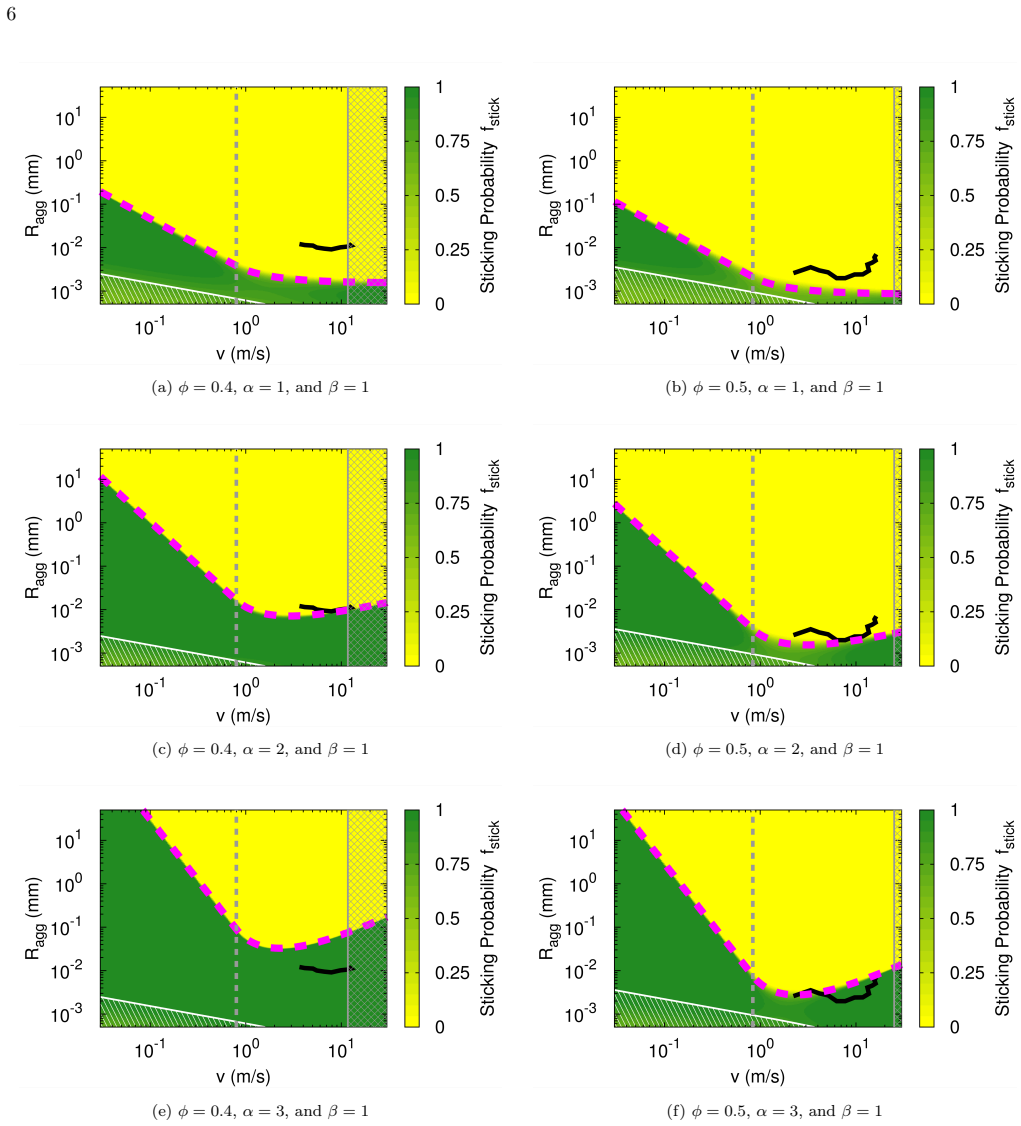
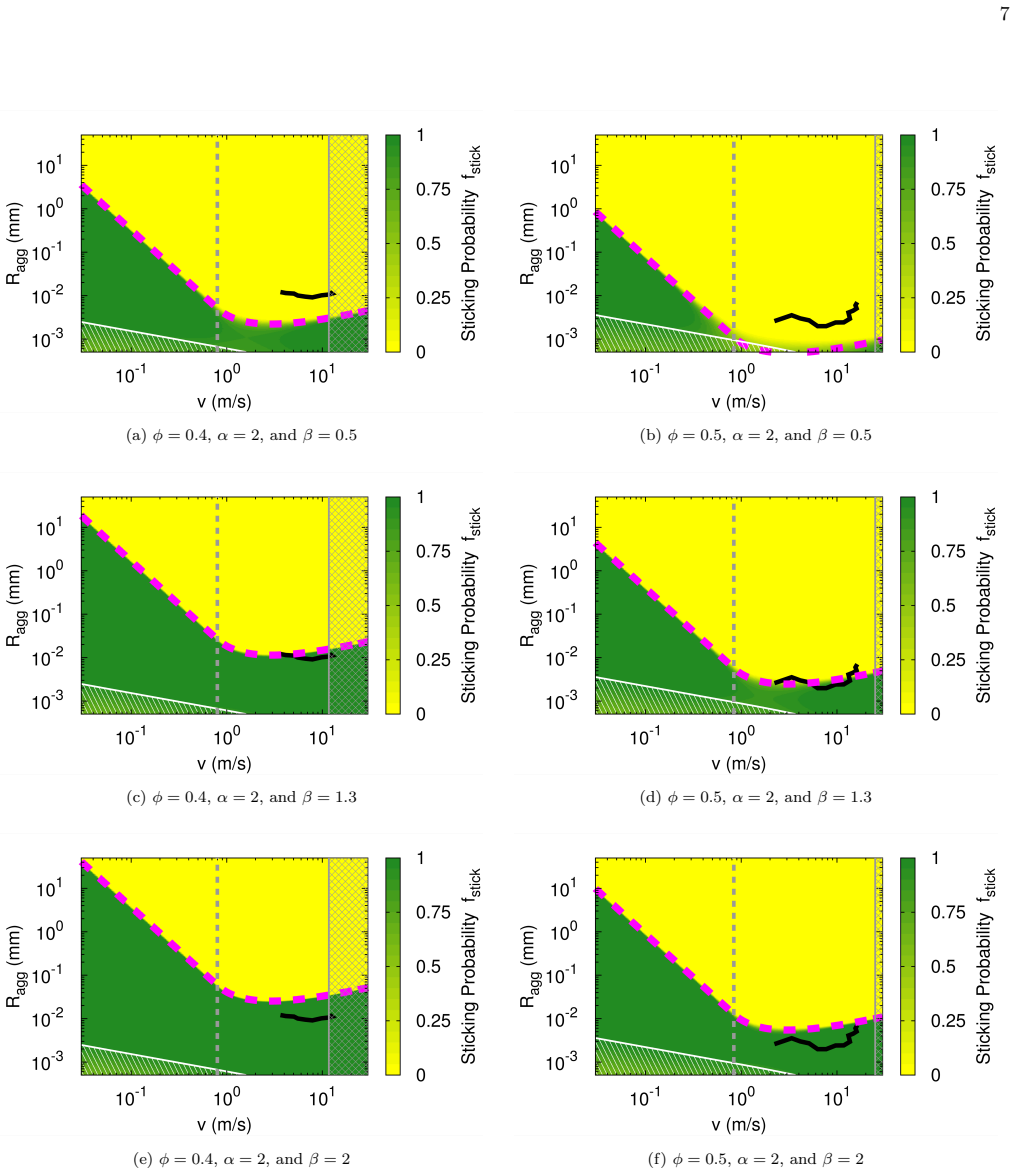
The model treats the separation phase as fracture of a stochastic network of interparticle bonds evaluated with weakest-link statistics; this single assumption produces the result that larger aggregates bounce more readily, reproduces the simulated sticking-bouncing boundary, and places the predicted barrier through the size-velocity range inferred from ALMA observations of protoplanetary disks.
What carries the argument
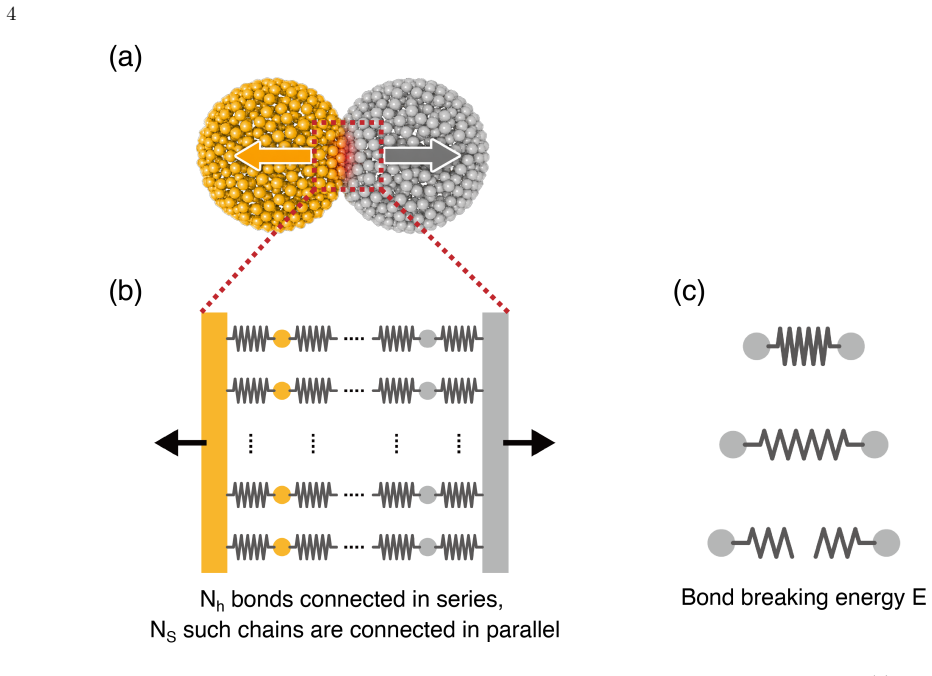
Separation phase treated as fracture of a stochastic network of interparticle bonds whose fracture energy is evaluated using weakest-link statistics.
If this is right
- Bouncing probability rises with aggregate size because contact area grows and weak bonds become more probable.
- Once calibrated to simulations the model can be inserted into global disk-evolution calculations.
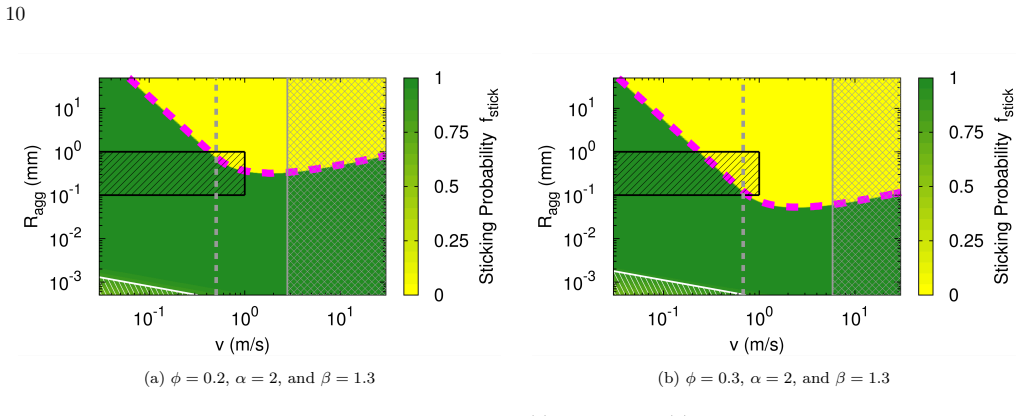
- For the filling factors inferred from ALMA the bouncing barrier lies inside the observed size-velocity window.
- The framework supplies an explicit functional form for the sticking probability as a function of size, velocity and porosity.
Where Pith is reading between the lines
- If the weakest-link picture holds, modest changes in material strength or bond-number distribution would shift the barrier location and could be tested with targeted simulations.
- The same machinery could be applied to the transition between bouncing and fragmentation by adding an energy threshold for bond breaking.
- Embedding the size-dependent sticking function into coagulation codes would give a concrete prediction for the maximum aggregate size reachable before growth stalls.
Load-bearing premise
The separation phase can be treated as fracture of a stochastic network of interparticle bonds whose fracture energy follows weakest-link statistics.
What would settle it
A set of distinct-element simulations or laboratory collisions that measures sticking probability versus aggregate size at fixed velocity and finds no increase in bouncing probability with size.
Figures
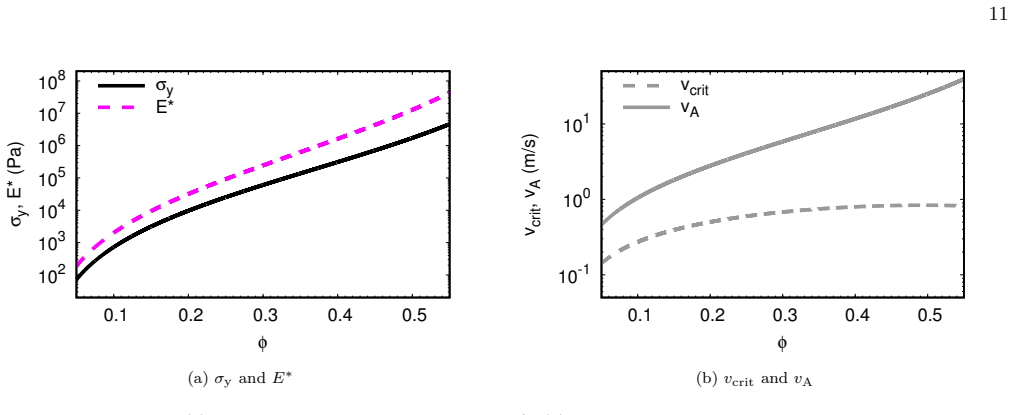
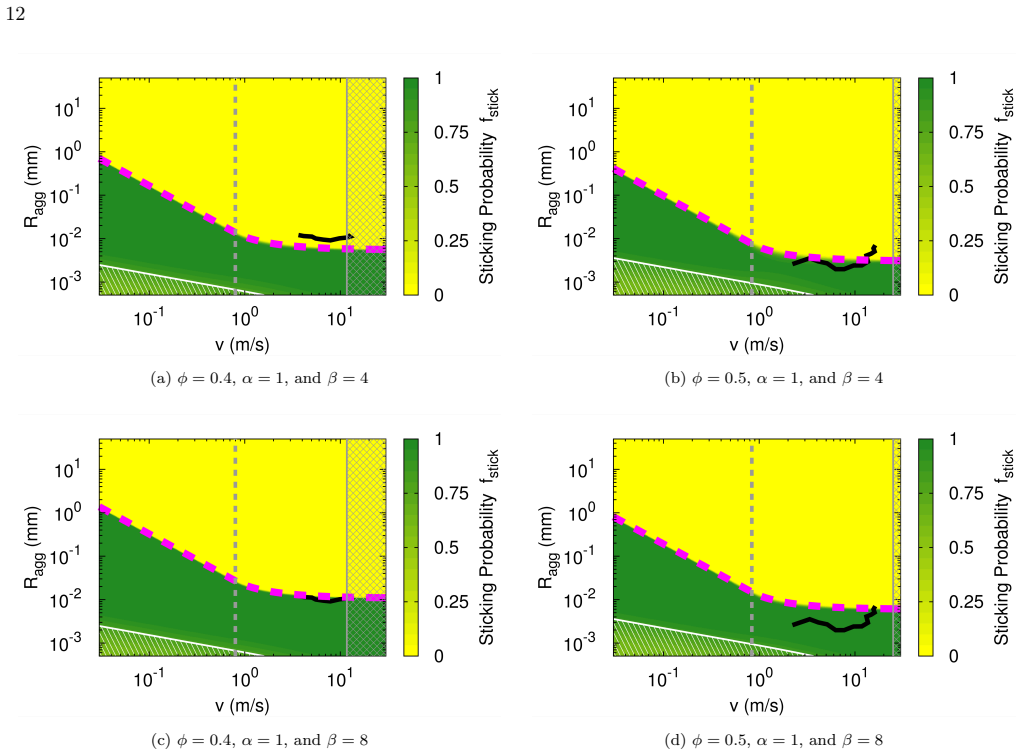
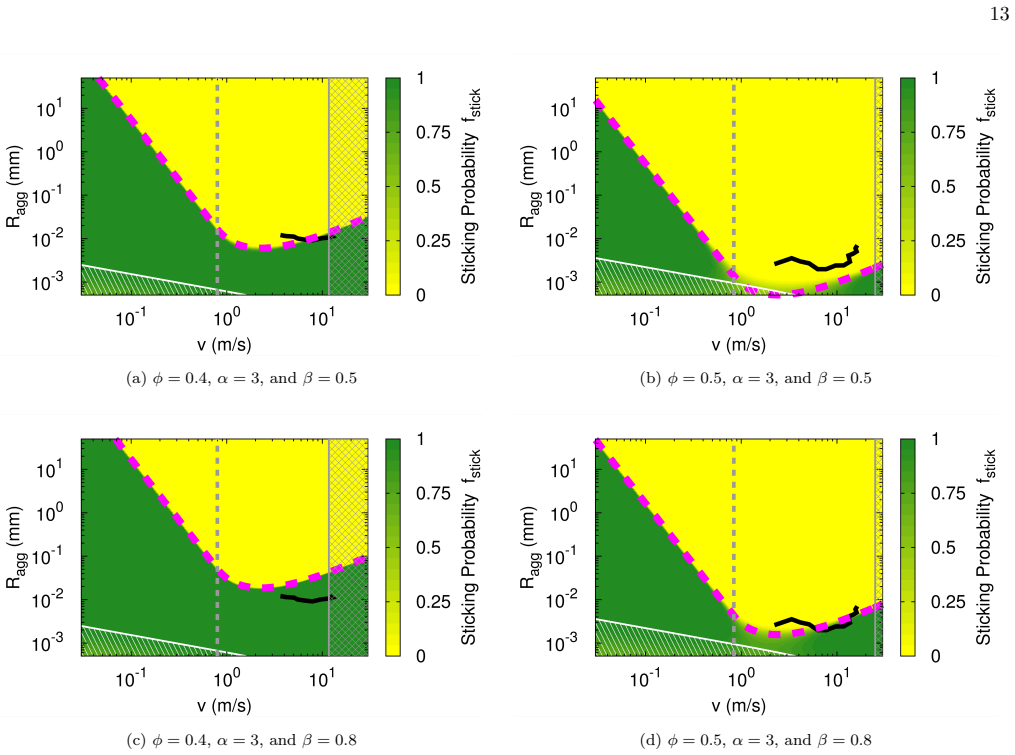
read the original abstract
Collisional bouncing limits the growth of dust aggregates in protoplanetary disks, but its dependence on aggregate size, collision velocity, and filling factor remains poorly understood. Here we develop a semi-analytic model for the sticking probability of colliding dust aggregates. We divide each aggregate collision into two phases: a compression phase and a separation phase. The compression phase is described with an elastoplastic contact model, which determines the maximum contact radius and repulsive energy after compression. The separation phase is treated as fracture of a stochastic network of interparticle bonds, whose fracture energy is evaluated using weakest-link statistics. The model naturally predicts that larger aggregates bounce more readily because larger contact regions are more likely to contain weak bonds. Comparison with distinct element method simulations shows that the model reproduces the simulated sticking--bouncing boundary. Furthermore, applying the calibrated model to moderately porous aggregates inferred from ALMA observations of protoplanetary disks, we find that the predicted bouncing barrier passes through the observationally inferred size--velocity range. Thus, our semi-analytic model provides a useful framework for predicting the collisional evolution of protoplanetary dust aggregates.
Editorial analysis
A structured set of objections, weighed in public.
Referee Report
Summary. The paper develops a semi-analytic model for the sticking probability of colliding dust aggregates in protoplanetary disks. Collisions are split into a compression phase modeled with an elastoplastic contact model (determining maximum contact radius and repulsive energy) and a separation phase modeled as fracture of a stochastic interparticle bond network whose energy is computed via weakest-link statistics. The model is calibrated to distinct-element-method (DEM) simulations, after which it is reported to reproduce the simulated sticking-bouncing boundary; the calibrated model is then applied to moderately porous aggregates inferred from ALMA observations, where the predicted bouncing barrier is stated to pass through the observationally inferred size-velocity range.
Significance. If the reproduction of the DEM boundary and the ALMA alignment hold under quantitative scrutiny, the model supplies a computationally inexpensive framework that isolates the statistical origin of the size dependence of the bouncing barrier. This could be incorporated into dust-evolution codes and would constitute a concrete bridge between microphysical simulations and disk observations.
major comments (3)
- [Abstract and §4] Abstract and §4 (comparison with DEM simulations): the claim that the model 'reproduces the simulated sticking-bouncing boundary' is presented without any quantitative metric (RMS deviation, fraction of correctly classified collisions, or goodness-of-fit statistic). Because the central claim rests on this reproduction after calibration of the free parameters, the absence of such metrics is load-bearing for assessing whether the agreement is robust or merely qualitative.
- [§5] §5 (application to ALMA aggregates): the model is calibrated to DEM data and then applied to produce the 'predicted' bouncing barrier that is compared with observations. The manuscript should explicitly quantify how the calibration choices propagate into the final size-velocity locus and whether the agreement remains within the observational uncertainties once those choices are varied.
- [§3.2] §3.2 (separation phase): the fracture energy is evaluated with weakest-link statistics on a stochastic bond network. The manuscript must state the assumed bond-strength distribution (e.g., Weibull parameters) and demonstrate that the reported size dependence is insensitive to reasonable variations in that distribution; otherwise the mechanism that generates the size dependence remains under-constrained.
minor comments (2)
- Figure captions and axis labels should explicitly indicate whether the plotted curves are for the calibrated or uncalibrated model.
- [Abstract] The abstract states that the model 'naturally predicts' larger aggregates bounce more readily, yet the quantitative boundary requires calibration; this distinction should be drawn more clearly in the abstract.
Simulated Author's Rebuttal
We thank the referee for the constructive comments that help strengthen the presentation of our results. We address each major comment below and indicate the revisions made to the manuscript.
read point-by-point responses
-
Referee: [Abstract and §4] Abstract and §4 (comparison with DEM simulations): the claim that the model 'reproduces the simulated sticking-bouncing boundary' is presented without any quantitative metric (RMS deviation, fraction of correctly classified collisions, or goodness-of-fit statistic). Because the central claim rests on this reproduction after calibration of the free parameters, the absence of such metrics is load-bearing for assessing whether the agreement is robust or merely qualitative.
Authors: We agree that quantitative metrics are required to substantiate the reproduction claim. In the revised manuscript we have added the root-mean-square deviation of the model boundary from the DEM data points together with the fraction of collisions correctly classified as sticking or bouncing. These statistics are now reported in §4 and confirm that the agreement is quantitative. revision: yes
-
Referee: [§5] §5 (application to ALMA aggregates): the model is calibrated to DEM data and then applied to produce the 'predicted' bouncing barrier that is compared with observations. The manuscript should explicitly quantify how the calibration choices propagate into the final size-velocity locus and whether the agreement remains within the observational uncertainties once those choices are varied.
Authors: We agree that propagation of calibration uncertainty should be quantified. The revised §5 now includes a sensitivity analysis in which the principal calibration parameters are varied within the ranges permitted by the DEM fits; the resulting uncertainty bands on the bouncing-barrier locus are shown to remain consistent with the ALMA-inferred size-velocity range. revision: yes
-
Referee: [§3.2] §3.2 (separation phase): the fracture energy is evaluated with weakest-link statistics on a stochastic bond network. The manuscript must state the assumed bond-strength distribution (e.g., Weibull parameters) and demonstrate that the reported size dependence is insensitive to reasonable variations in that distribution; otherwise the mechanism that generates the size dependence remains under-constrained.
Authors: We have now stated explicitly in §3.2 that bond strengths follow a Weibull distribution with shape parameter 3.5 and scale parameter fixed by the DEM calibration. A new panel in the supplementary figure demonstrates that the size dependence of the fracture energy (and therefore the location of the bouncing barrier) changes only quantitatively for shape parameters between 2 and 5, preserving the qualitative scaling. revision: yes
Circularity Check
No significant circularity identified
full rationale
The derivation begins with an independent physical split into compression (elastoplastic contact model) and separation (weakest-link fracture of stochastic bonds) phases, neither of which is defined in terms of the target sticking-bouncing boundary. The model is then compared to external DEM simulations for validation after parameter calibration; this is standard benchmarking against independent data rather than a fitted quantity renamed as a prediction. Application of the calibrated model to separate ALMA observational constraints produces a forward prediction for an independent dataset. No self-citation, ansatz smuggling, or self-definitional reduction appears in the provided text. The central result is therefore self-contained against external benchmarks.
Axiom & Free-Parameter Ledger
free parameters (1)
- calibration parameters for elastoplastic and fracture components
axioms (1)
- domain assumption The separation phase can be modeled as fracture of a stochastic network of interparticle bonds using weakest-link statistics.
Reference graph
Works this paper leans on
-
[1]
Size Dependence of the Bouncing Barrier in Protoplanetary Dust Growth. , keywords =. doi:10.3847/2041-8213/acdb5f , archivePrefix =. 2306.04070 , primaryClass =
-
[2]
Granular Matter , keywords =
On the elastoplastic behavior in collisional compression of spherical dust aggregates. Granular Matter , keywords =
-
[3]
Investigating the Bouncing Barrier with Collision Simulations of Compressed Dust Aggregates. , keywords =. doi:10.3847/1538-4357/adbf04 , archivePrefix =. 2502.03107 , primaryClass =
-
[4]
Modeling the Contact Surfaces Formed by Pebble Collisions: Application to Formation of Comet 67P/Churyumov─Gerasimenko. , keywords =. doi:10.3847/1538-4357/ae1fd8 , archivePrefix =. 2511.09835 , primaryClass =
-
[5]
Andrews , title = "
J.P. Andrews , title = ". The London, Edinburgh, and Dublin Philosophical Magazine and Journal of Science , volume =. 1930 , publisher =
1930
-
[6]
1896 , publisher=
Miscellaneous papers. 1896 , publisher=
-
[7]
Formulating Compressive Strength of Dust Aggregates from Low to High Volume Filling Factors with Numerical Simulations. , keywords =. doi:10.3847/1538-4357/acdf43 , archivePrefix =. 2306.09259 , primaryClass =
-
[8]
Thermal conductivity and coordination number of compressed dust aggregates
Thermal conductivity and coordination number of compressed dust aggregates. , keywords =. doi:10.1016/j.icarus.2019.01.022 , archivePrefix =. 1901.09700 , primaryClass =
work page internal anchor Pith review Pith/arXiv arXiv doi:10.1016/j.icarus.2019.01.022 2019
-
[9]
Mechanical Properties of Dust, Pebbles, and Planetesimals Based on Johnson─Kendall─Roberts, Griffith, and Weibull Theories. , keywords =. doi:10.3847/1538-4357/ae0c18 , adsurl =
-
[10]
Numerical Simulation of Dust Aggregate Collisions. I. Compression and Disruption of Two-Dimensional Aggregates. , keywords =. doi:10.1086/514332 , adsurl =
-
[11]
Support for fragile porous dust in a gravitationally self-regulated disk around IM Lup. Nature Astronomy , keywords =. doi:10.1038/s41550-024-02308-6 , archivePrefix =. 2406.07427 , primaryClass =
-
[12]
Proceedings of the Royal Society of London Series A , year = 1971, volume =
Surface Energy and the Contact of Elastic Solids. Proceedings of the Royal Society of London Series A , year = 1971, volume =
1971
-
[13]
Rapid Coagulation of Porous Dust Aggregates outside the Snow Line: A Pathway to Successful Icy Planetesimal Formation. , keywords =. doi:10.1088/0004-637X/752/2/106 , archivePrefix =. 1204.5035 , primaryClass =
work page internal anchor Pith review Pith/arXiv arXiv doi:10.1088/0004-637x/752/2/106
-
[14]
Rapid Formation of Gas-giant Planets via Collisional Coagulation from Dust Grains to Planetary Cores. , keywords =. doi:10.3847/1538-4357/ac289c , archivePrefix =. 2110.00919 , primaryClass =
-
[15]
, year = 2008, month = sep, volume =
The growth mechanisms of macroscopic bodies in protoplanetary disks. , year = 2008, month = sep, volume =. doi:10.1146/annurev.astro.46.060407.145152 , adsurl =
-
[16]
The multifaceted planetesimal formation process
The Multifaceted Planetesimal Formation Process. Protostars and Planets VI , year = 2014, editor =. doi:10.2458/azu_uapress_9780816531240-ch024 , archivePrefix =. 1402.1344 , primaryClass =
work page internal anchor Pith review Pith/arXiv arXiv doi:10.2458/azu_uapress_9780816531240-ch024 2014
-
[17]
Dust Growth and Evolution in Protoplanetary Disks. , keywords =. doi:10.1146/annurev-astro-071221-052705 , archivePrefix =. 2312.13287 , primaryClass =
-
[18]
The outcome of protoplanetary dust growth: pebbles, boulders, or planetesimals? II. Introducing the bouncing barrier. , keywords =. doi:10.1051/0004-6361/200912976 , archivePrefix =. 1001.0488 , primaryClass =
work page internal anchor Pith review Pith/arXiv arXiv doi:10.1051/0004-6361/200912976
-
[19]
The bouncing barrier revisited: Impact on key planet formation processes and observational signatures. , keywords =. doi:10.1051/0004-6361/202347716 , archivePrefix =. 2312.06000 , primaryClass =
-
[20]
Bouncing Behavior of Microscopic Dust Aggregates
Bouncing behavior of microscopic dust aggregates. , keywords =. doi:10.1051/0004-6361/201220946 , archivePrefix =. 1301.3629 , primaryClass =
work page internal anchor Pith review Pith/arXiv arXiv doi:10.1051/0004-6361/201220946
-
[21]
The Rebound Condition of Dust Aggregates Revealed by Numerical Simulation of Their Collisions. , keywords =. doi:10.1088/0004-637X/737/1/36 , adsurl =
-
[22]
The Physics of Protoplanetesimal Dust Agglomerates. II. Low-Velocity Collision Properties. , keywords =. doi:10.1086/525841 , archivePrefix =. 0711.2148 , primaryClass =
work page internal anchor Pith review Pith/arXiv arXiv doi:10.1086/525841
-
[23]
The outcome of protoplanetary dust growth: pebbles, boulders, or planetesimals?. I. Mapping the zoo of laboratory collision experiments. , keywords =. doi:10.1051/0004-6361/200912852 , archivePrefix =. 0910.4251 , primaryClass =
work page internal anchor Pith review Pith/arXiv arXiv doi:10.1051/0004-6361/200912852
-
[24]
A Statistical Theory of the Strength of Materials. Ingeni
-
[25]
The tensile strength of dust aggregates consisting of small elastic grains: constraints on the size of condensates in protoplanetary discs. , keywords =. doi:10.1093/mnras/staa1641 , archivePrefix =. 2006.05107 , primaryClass =
-
[26]
Unveiling Dust Aggregate Structure in Protoplanetary Disks by Millimeter-wave Scattering Polarization. , keywords =. doi:10.3847/1538-4357/ab45f0 , archivePrefix =. 1907.00189 , primaryClass =
-
[27]
Free collisions in a microgravity many-particle experiment. III. The collision behavior of sub-millimeter-sized dust aggregates. , keywords =. doi:10.1016/j.icarus.2013.02.034 , archivePrefix =. 1302.5532 , primaryClass =
work page internal anchor Pith review Pith/arXiv arXiv doi:10.1016/j.icarus.2013.02.034 2013
-
[28]
Collisions between sintered icy aggregates
Collisions between Sintered Icy Aggregates. , keywords =. doi:10.3847/1538-4357/aa6fad , archivePrefix =. 1705.04778 , primaryClass =
work page internal anchor Pith review Pith/arXiv arXiv doi:10.3847/1538-4357/aa6fad
-
[29]
Erosion and the limits to planetesimal growth
Erosion and the limits to planetesimal growth. , keywords =. doi:10.1051/0004-6361/201425222 , archivePrefix =. 1412.3593 , primaryClass =
work page internal anchor Pith review Pith/arXiv arXiv doi:10.1051/0004-6361/201425222
-
[30]
1986 , publisher=
Theory of Elasticity (Third Edition). 1986 , publisher=
1986
-
[31]
Collisional properties of cm-sized high-porosity ice and dust aggregates and their applications to early planet formation. , keywords =. doi:10.1093/mnras/stab3348 , archivePrefix =. 2111.09141 , primaryClass =
-
[32]
Multi-frequency analysis of the ALMA and VLA high resolution continuum observations of the substructured disc around CI Tau: Preference for submillimetre-sized low-porosity amorphous carbon grains. , keywords =. doi:10.1051/0004-6361/202452986 , archivePrefix =. 2507.08797 , primaryClass =
-
[33]
Dust Scattering Albedo at Millimeter Wavelengths in the TW Hya Disk. , keywords =. doi:10.3847/1538-4357/ad9f31 , archivePrefix =. 2412.10731 , primaryClass =
discussion (0)
Sign in with ORCID, Apple, or X to comment. Anyone can read and Pith papers without signing in.