REVIEW 3 major objections 6 minor 58 references
Jet shape modification in a transport calculation
T0 review · 3 major / 6 minor · reviewed 2026-08-16 · deepseek-v4-flash
Pith's one-line read A unified transport model with elastic scattering plus medium-induced gluon emission reproduces the measured suppression and full radial jet-shape ratio in central Pb-Pb collisions at 5.02 TeV.
desk verdict First radiative+elastic jet transport in string-melting AMPT with a clean physics claim and honest caveats—just missing a pT,cut sensitivity scan before I'd buy the central conclusion. read the letter →
The pith
A machine-rendered reading of the paper's core claim, the machinery that carries it, and where it could break.
The reading
What carries the argument
The engine is the AMPT multiphase transport model with string melting, extended for jet quenching by allowing hard jet shower partons to undergo medium-induced inelastic splittings alongside the existing elastic parton cascade. Jets are embedded as full PYTHIA-generated parton showers, and jet-medium interactions are described by a Debye-screened elastic cross section plus a higher-twist gluon radiation spectrum whose sampling follows the LBT methodology. The inelastic rate is tied to the elastic broadening through the jet transport coefficient q-hat, and emitted gluons only re-interact after a formation time and if their transverse momentum exceeds 2 GeV; bulk medium partons scatter only elastically. This machinery allows the lost energy and momentum to flow from the jet into the medium through discrete scatterings, producing the medium response that dominates the jet shape at large radial distances.
What would settle it
Repeat the same simulation with the transverse-momentum threshold varied from about 1 to 3 GeV and check whether the jet-shape ratio at radial distances greater than 0.5 changes by more than the experimental uncertainty; if it does, the claim that gradual gluon degradation is essential to the full profile is not robust.
Extended reading notes
Core claim
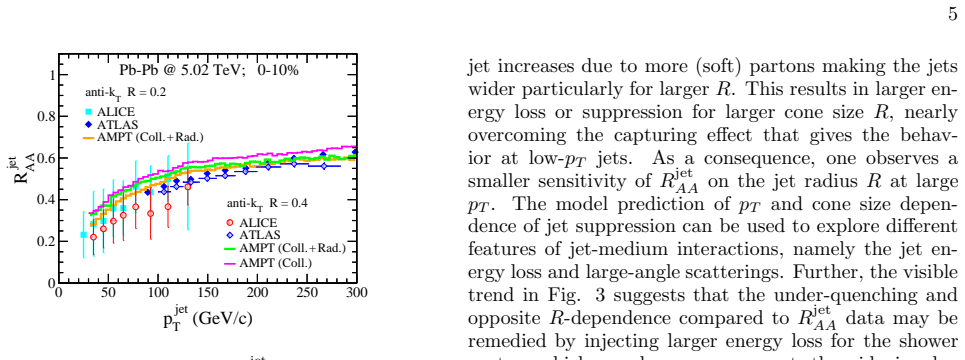
The paper claims that a single kinetic-transport framework, in which a full jet shower and the quark-gluon plasma are evolved together and exchange energy and momentum through both elastic scatterings and medium-induced gluon radiation, describes the measured jet observables in central Pb-Pb collisions at 5.02 TeV. Concretely, the jet nuclear modification factor is reproduced within statistical uncertainties for cone radii R=0.2 and 0.4, and the jet-shape ratio matches experimental data from the core out to radial distance one. The authors find that pure collisional energy loss produces too much particle population at large radial distances, while gradual energy degradation via gluon emission makes the jet narrower and is essential to describe the entire range of the ratio. The result is presented as the first unified kinetic-based treatment of jet and medium evolution with a dynamically evolving partonic background, as opposed to models that assume instantaneous thermalization of the lost energy.
Load-bearing premise
The calculation rests on a fixed 2 GeV transverse-momentum threshold that separates partons allowed to radiate gluons from bulk medium partons that only scatter elastically, and the paper does not test whether changing that threshold changes the conclusions.
Editorial extensions
If this is right
- If the central claim holds, jet-shape measurements at large radial distance directly probe the partition of lost jet energy into radiative versus collisional channels, not just total suppression.
- The model's under-quenching of low-pT jets for larger cone radius implies more energy loss is needed at the high-virtuality stage, motivating the addition of a detailed in-medium high-virtuality evolution to the same framework.
- The strong sensitivity of the jet-shape ratio to the medium's parton density means the observable can discriminate between different bulk-medium evolution scenarios.
- Pure collisional transport predicts a characteristic dip-and-rise jet-shape ratio, so a precise measurement in the intermediate radial region can flag whether a model is missing the radiative channel.
- The framework sets the stage for exploring different radiative energy-loss formalisms within a kinetically consistent medium, rather than assuming instantaneous thermalization.
Reading between the lines
- Editorial: the 2 GeV transverse-momentum threshold that separates radiative jet partons from elastically scattering bulk partons is the least constrained parameter in the model; a systematic scan of this threshold would map the radiative-versus-elastic competition and should be reported before applying the framework to fine jet substructure.
- Editorial: because the lost energy is not instantaneously thermalized in this approach, the jet-shape ratio's large-angle tail is probably sensitive to the medium's relaxation time; comparisons with calculations that assume instantaneous thermalization would isolate this memory effect.
- Editorial: the same framework could naturally be extended to jet-substructure observables such as girth or angularities, where the radiative and elastic contributions enter in different combinations and would provide sharper tests of the mechanism identified here.
Signed reviews
Editorial analysis
A structured set of objections, weighed in public.
Referee Report
Summary. The manuscript extends the AMPT parton transport model to include, in addition to elastic scatterings, medium-induced gluon radiation for jet shower partons, using the higher-twist spectrum of Eq. (3) with qhat computed from the same elastic cross section that governs the collisional channel. The model is applied to (0-10)% central Pb-Pb collisions at 5.02 TeV, and predictions are presented for the time dependence of single-gluon energy loss (Fig. 1), jet pT loss as a function of cone size (Fig. 2), inclusive jet R_AA (Fig. 3), the jet shape rho(Delta r) (Fig. 4), and the jet-shape ratio rho_PbPb/rho_pp (Fig. 5). The central claim is that gradual degradation of jet energy through repeated gluon emissions is essential to describe the full range of the measured jet-shape ratio, whereas a pure collisional calculation injects too much pT broadening and overpopulates large angular distances. The model achieves reasonable quantitative agreement with the CMS jet-shape data up to Delta r = 1, while the inclusive jet R_AA is somewhat under-quenched at low pT and for the larger cone radius.
Significance. If the central claim holds, the paper provides a genuinely unified kinetic framework for jet and bulk evolution, with the notable strength that alpha_s and the Debye mass are fixed by prior AMPT bulk calibration to multiplicity and flow, and qhat is not tuned to jet data but derived from the elastic cross section. The controlled switch between collisional-only and collisional-plus-radiative channels in Fig. 5 is a valuable diagnostic, and the decomposition of the jet shape into fragmentation, semi-hard radiated gluons, and medium-excitation contributions in Fig. 4 is informative. The model also makes falsifiable predictions for the pT and cone-size dependence of jet suppression. However, the central conclusion rests on the unexamined threshold pT,cut = 2 GeV that regulates the radiative cascade, so the significance can only be fully realized after a sensitivity analysis is provided.
major comments (3)
- [Sec. II, after Eq. (3)] The threshold pT,cut = 2 GeV determines whether a radiated gluon can undergo further inelastic splittings, and therefore controls both the number of cascade generations and the population of semi-hard partons that subsequently diffuse elastically to large angles. The central claim that gradual radiative degradation is essential to describe the jet-shape ratio (abstract and Sec. III, Fig. 5) is thus regulated by a parameter for which no sensitivity study is presented. I request a scan of pT,cut (for example 1, 3, and 4 GeV, or values tied to mu or to the jet radius R) with the jet-shape ratio and R_AA shown, together with a statement of how pT,cut relates to the zmin = mu/E_j cutoff in Eq. (3) and to the hadron track cut pT > 0.7 GeV.
- [Sec. III, Fig. 5] The comparison between the pure-collisional (dashed blue) and collisional-plus-radiative (solid red) curves is the primary evidence for the central claim. Because the radiative channel is switched on together with the pT,cut criterion, the difference between the two curves could be influenced by pT,cut as much as by the presence of radiation itself. At minimum, one additional radiative run with a different pT,cut is needed to separate these effects; without it, the statement that gluon emissions are 'essential' remains conditional on the threshold choice.
- [Sec. III, Fig. 3] The model visibly underpredicts the measured jet suppression, with the largest deviations for pjet_T < 150 GeV and for the larger cone radius R = 0.4, in line with the authors' own acknowledgment in the text. Since the abstract and Sec. III claim 'reasonable quantitative agreement' with inclusive jet suppression, the disagreement should be quantified (for instance as a chi-square per degree of freedom or an average relative deviation) and its implications for the jet-shape analysis discussed, particularly whether the missing suppression points to high-virtuality energy loss that could also affect the small-Delta r region of the jet-shape ratio.
minor comments (6)
- [Author affiliation] There is a spacing typo in the affiliation: 'Ind ia' should read 'India'.
- [Throughout] The notation for the jet nuclear modification factor appears in several forms (Rjet_AA, R^jet_AA, RAA^jet); please use a single consistently typeset symbol.
- [Fig. 2 caption] The dashed curves are labeled 'w/o medium' but the caption should specify that this means without jet-induced medium response, not without the underlying medium itself, to avoid confusion with the collisional-only case in Fig. 3.
- [Eq. (10) and Fig. 4] The text should clarify that Eq. (10) sums charged tracks with pT > 0.7 GeV while the R_AA calculation in Eq. (8) includes all hadrons; the current wording 'all the hadrons' in Fig. 2 is ambiguous.
- [References] Reference [43] has an incomplete page number '01491'; it should be '014910' or the full article number as published.
- [Sec. IV] In the concluding paragraph, 'the significant differences' and 'their significance' are used in close proximity with slightly different meanings; rewording would improve readability.
Circularity Check
No circularity: the jet-shape predictions are driven by a transport framework whose parameters are fixed by independent bulk calibration, not by the jet observables being predicted.
full rationale
The derivation chain for the jet-shape predictions is self-contained. The key inputs, alpha_s = 0.333 and the Debye mass mu = 3.226 fm^-1, are fixed by prior AMPT calibration to hadron multiplicity and flow harmonics, not by jet data: "The string-melting AMPT with these parameter values agrees very well with hadron multiplicity and flow harmonics data at LHC energies." The jet transport coefficient is not fitted to jet observables; it is computed from the same elastic cross section through Eq. (4), qhat_j = integral dq_perp^2 (d sigma_el / d q_perp^2) q_perp^2, and the medium-induced gluon spectrum in Eq. (3) is imported from the standard higher-twist formalism with an explicit kinematic cutoff z_min = mu/E_j. No parameter is adjusted to reproduce the jet shape ratio or R_AA; the central comparison between collisional-only and collisional-plus-radiative scenarios is a within-model variation, not an inversion of the data. The pT,cut = 2 GeV threshold separating jet-shower partons from bulk partons is a modeling choice rather than a quantity derived from the jet shape, and the absence of a sensitivity scan over pT,cut is a legitimate robustness concern, but it is not circularity because no equation in the paper forces the predicted jet shape to equal this input. Self-citations to the AMPT model and prior work by the authors provide the underlying transport code and bulk calibration, which are external to the target jet-shape prediction and are independently established; they are not used to import the jet-shape result itself. The paper also explicitly reports where the model under-predicts R_AA, further indicating that the jet observables are not manufactured to match data. I therefore find no step where a prediction reduces by construction to a fitted parameter, a self-citation chain, or a definitional identity.
Assumptions & free parameters
free parameters (4)
- Strong coupling constant alpha_s =
0.333
- Debye screening mass mu =
3.226 fm^-1
- pT,cut for secondary inelastic radiation =
2 GeV
- Minimum emitted gluon energy fraction z_min =
mu/E_j
assumptions (5)
- domain assumption The higher-twist medium-induced gluon spectrum of Eq. (3), taken from Refs. [48,49], applies to jet partons in the AMPT kinetic medium with qhat computed from the elastic cross section.
- domain assumption High-virtuality shower partons do not interact with the medium before their formation time tau_form = sum over parent splitting times (Eq. (1)).
- domain assumption The DGLAP vacuum splitting kernels describe in-medium branchings.
- domain assumption The string-melting AMPT model provides a valid description of the bulk QGP evolution.
- domain assumption The Debye-screened leading-order elastic cross section Eq. (2) is the correct two-body rate for all parton-parton scatterings.
Cite this review
Pith. "Pith review of Jet shape modification in a transport calculation." pith.science (2026). https://pith.science/paper/FKKRX32F
@misc{pith2026250502436,
  author       = {Pith},
  title        = {Pith review of: Jet shape modification in a transport calculation},
  year         = {2026},
  howpublished = {\url{https://pith.science/paper/FKKRX32F}},
  note         = {Machine review of arXiv:2505.02436}
}
abstract
A precise quantification of the medium-modification of the high transverse momenta jets in relativistic heavy ion collisions rely on consistent modelling of elastic and inelastic energy loss suffered by the jet and the concurrent underlying medium evolution. We have developed a unified framework for jet and bulk medium evolution within a multiphase transport approach where the jets and medium share energy and momentum via multiple elastic scatterings and medium-induced gluon radiation during the parton transport. The formulation enables realistic predictions of jet based observables extended to a large radius of the jet cone in central Pb-Pb collisions at 5.02 TeV. The model provides reasonable quantitative agreement with the experimental data from inclusive jet suppression and the full jet shape function up to large radial distances induced by both the collisional and radiative jet energy loss and migration of the lost $p_T$ in the medium. We find that gradual degradation of jet energy through gluon emissions alters the energy-momentum evolution in the jet, essential to describe the entire range of jet shape ratio relative to proton-proton collisions. Pure collisional energy loss injects appreciable $p_T$ broadening and migration of the medium partons, resulting in an enhanced population at large angular distances in the jet-shape ratio.
Figures


Reference graph
Works this paper leans on
-
[1]
5 mb for gluon-gluon scatterings. The string-melting AMPT with these parameter values agrees very well with hadron multiplicity and flow harmonics data at LHC energies. It should be noted that energy deposition in the QGP medium from elastic scatterings with energetic partons can also lead to jet-induced medium flow and medium excitations producing soft had...
- [2]
-
[3]
50. This can be traced to (i) a smaller and more real- istic minijet production in HIJING 2.0 initial conditions as discussed in Sec. 2 and (ii) the more dramatic effects due to time-delayed development of parton shower dur- ing the high-virtuality stage. Both of these initial state aspects lead to relatively reduced energy-momentum ex- change with the med...
- [4]
-
[5]
5 mb and collisional plus radiative energy loss for σ el gg = 1
for (0-10)% central Pb-Pb collisions is compared with th e string melting AMPT results for collisions energy loss only for gg elastic scattering cross section σ el gg = 1. 5 mb and collisional plus radiative energy loss for σ el gg = 1. 5 and 5.0 mb. The result from the default AMPT model (without string melting) at σ el gg = 1. 5 mb is shown in solid bla...
- [6]
- [7]
-
[8]
A. M. Sirunyan et al. [CMS], JHEP 05 (2018) 006
work page 2018
Show all 58 references
-
[9]
Aaboud et al
M. Aaboud et al. [ATLAS], Phys. Lett. B 790 (2019) 108
2019
-
[10]
Aad et al
G. Aad et al. [ATLAS], Phys. Rev. Lett. 131 (2023) no.17, 172301
2023
-
[11]
Acharya et al
S. Acharya et al. [ALICE], Phys. Rev. C 101 (2020) 034911
2020
-
[12]
Acharya et al
S. Acharya et al. [ALICE], Phys. Lett. B 849 (2024) 138412
2024
-
[13]
Abelev et al
B. Abelev et al. [ALICE], JHEP 03 (2014) 013
2014
-
[14]
Aad et al
G. Aad et al. [ATLAS], Phys. Rev. Lett. 105 (2010) 252303
2010
-
[15]
Mehtar-Tani, J
Y. Mehtar-Tani, J. G. Milhano and K. Tywoniuk, Int. J. Mod. Phys. A 28 (2013) 1340013
2013
-
[16]
Majumder and M
A. Majumder and M. Van Leeuwen, Prog. Part. Nucl. Phys. 66 (2011) 41-92
2011
-
[17]
Cunqueiro and A
L. Cunqueiro and A. M. Sickles, Prog. Part. Nucl. Phys. 124 (2022) 103940
2022
-
[18]
Majumder, Phys
A. Majumder, Phys. Rev. C 88 (2013) 014909
2013
-
[19]
Cao and A
S. Cao and A. Majumder, Phys. Rev. C 101 (2020) 024903
2020
-
[20]
Pal and S
S. Pal and S. Pratt, Phys. Lett. B 574 (2003) 21
2003
-
[21]
Tachibana and T
Y. Tachibana and T. Hirano, Phys. Rev. C 93 (2016) 054907
2016
-
[22]
Z. Yang, W. Chen, Y. He, W. Ke, L. Pang and X. N. Wang, Phys. Rev. Lett. 127 (2021) 082301
2021
-
[23]
Z. Yang, T. Luo, W. Chen, L. G. Pang and X. N. Wang, Phys. Rev. Lett. 130 (2023) 052301
2023
-
[24]
Schenke, C
B. Schenke, C. Gale and S. Jeon, Phys. Rev. C 80, 054913 (2009) 054913
2009
-
[25]
K. C. Zapp, Eur. Phys. J. C 74 (2014) 2762
2014
-
[26]
J. Xu, A. Buz-atti and M. Gyulassy, JHEP 08 (2014) 063
2014
-
[27]
Y. He, T. Luo, X. N. Wang and Y. Zhu, Phys. Rev. C 91 (2015) 054908 [erratum: Phys. Rev. C 97 (2018) 019902]
2015
-
[28]
S. Cao, T. Luo, G. Y. Qin and X. N. Wang, Phys. Rev. C 94 (2016) 014909
2016
-
[29]
Tachibana, N
Y. Tachibana, N. B. Chang and G. Y. Qin, Phys. Rev. C 95 (2017) 044909
2017
-
[30]
Jeon and G
S. Jeon and G. D. Moore, Phys. Rev. C 71 (2005) 034901
2005
-
[31]
Turbide, C
S. Turbide, C. Gale, S. Jeon and G. D. Moore, Phys. Rev. C 72 (2005) 014906
2005
-
[32]
S. Cao, A. Majumder, R. Modarresi-Yazdi, I. Soudi and Y. Tachibana, Int. J. Mod. Phys. E 33 (2024) 2430002
2024
-
[33]
Gyulassy, P
M. Gyulassy, P. Levai and I. Vitev, Nucl. Phys. B 594 (2001) 371-419
2001
-
[34]
Djordjevic and M
M. Djordjevic and M. Gyulassy, Nucl. Phys. A 733 (2004) 265-298
2004
-
[35]
Tachibana, C
Y. Tachibana, C. Shen and A. Majumder, Phys. Rev. C 106 (2022) L021902
2022
- [36]
-
[37]
Pablos, Phys
D. Pablos, Phys. Rev. Lett. 124 (2020) 052301
2020
-
[38]
Casalderrey-Solana, D
J. Casalderrey-Solana, D. Gulhan, G. Milhano, D. Pablo s and K. Rajagopal, JHEP 03 (2017) 135
2017
-
[39]
Xu and C
Z. Xu and C. Greiner, Phys. Rev. C 76 (2007) 024911
2007
-
[40]
A. Luo, Y. X. Mao, G. Y. Qin, E. K. Wang and H. Z. Zhang, Eur. Phys. J. C 82 (2022) 156
2022
-
[41]
Z. W. Lin, C. M. Ko, B. A. Li, B. Zhang and S. Pal, Phys. Rev. C 72 (2005) 064901
2005
-
[42]
R. S. Bhalerao, J. Y. Ollitrault and S. Pal, Phys. Lett. B 742 (2015) 94
2015
-
[43]
R. S. Bhalerao, J. Y. Ollitrault, S. Pal and D. Teaney, Phys. Rev. Lett. 114 (2015) 152301
2015
-
[44]
R. S. Bhalerao, J. Y. Ollitrault and S. Pal, Phys. Rev. C 88 (2013) 024909
2013
-
[45]
Acharya et al
S. Acharya et al. [ALICE], Phys. Rev. C 97 (2018) 024906
2018
-
[46]
W. T. Deng, X. N. Wang and R. Xu, Phys. Rev. C 83 (2011) 01491
2011
-
[47]
Pal and M
S. Pal and M. Bleicher, Phys. Lett. B 709 (2012) 82
2012
-
[48]
Sj¨ ostrand, S
T. Sj¨ ostrand, S. Ask, J. R. Christiansen, R. Corke, N. De- sai, P. Ilten, S. Mrenna, S. Prestel, C. O. Rasmussen and P. Z. Skands, Comput. Phys. Commun. 191 (2015) 159- 177
2015
-
[49]
Zhang, Y
M. Zhang, Y. He, S. Cao and L. Yi, Chin. Phys. C 47 (2023) 024106
2023
-
[50]
Modarresi-Yazdi, S
R. Modarresi-Yazdi, S. Shi, C. Gale and S. Jeon, [arXiv:2407.19966 [hep-ph]]
-
[51]
X. f. Guo and X. N. Wang, Phys. Rev. Lett. 85 (2000) 3591
2000
-
[52]
Majumder, Phys
A. Majumder, Phys. Rev. D 85 (2012) 014023
2012
-
[53]
K. M. Burke et al. [JET], Phys. Rev. C 90 (2014) 014909
2014
-
[54]
Cacciari, G
M. Cacciari, G. P. Salam and G. Soyez, Eur. Phys. J. C 72 (2012) 1896
2012
-
[55]
Armesto, B
N. Armesto, B. Cole, C. Gale, W. A. Horowitz, P. Jacobs, S. Jeon, M. van Leeuwen, A. Majumder, B. Muller and G. Y. Qin, et al. Phys. Rev. C 86 (2012) 064904
2012
-
[56]
Mehtar-Tani, S
Y. Mehtar-Tani, S. Schlichting and I. Soudi, JHEP 05 (2023) 091
2023
-
[57]
Brewer, A
J. Brewer, A. Sadofyev and W. van der Schee, Phys. Lett. B 820 (2021) 136492
2021
-
[58]
Mehtar-Tani, D
Y. Mehtar-Tani, D. Pablos and K. Tywoniuk, Phys. Rev. D 110 (2024) 014009
2024
Reviewed August 16, 2026 · model on record in the stance chip above.
Discussion (0). Continue with ORCID to comment.