REVIEW 3 major objections 6 minor 2 references
L$^3$: Large Lookup Layers
T0 review · 3 major / 6 minor · reviewed 2026-08-03 · deepseek-v4-flash
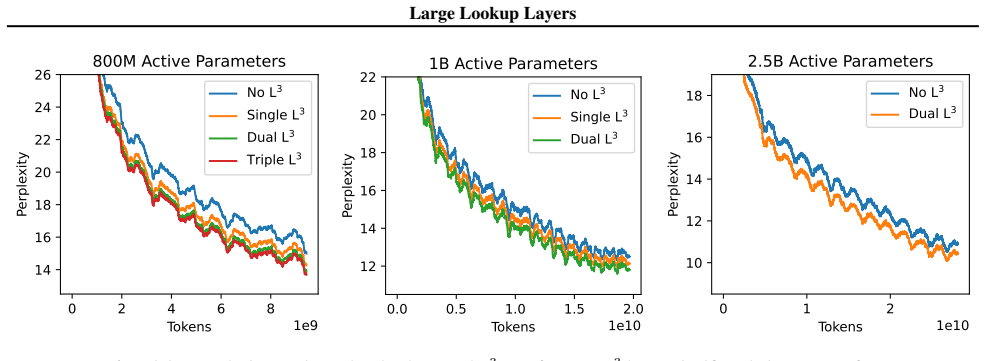
Pith's one-line read Large Lookup Layers (L3), which cache per-token embeddings inside transformer layers, beat dense models and Mixture-of-Experts models at equal active parameters and FLOPs.
desk verdict A promising new static-routing sparse layer with solid dense-vs-L3 evidence, but the headline claim against MoEs rests on baselines that look undertuned. read the letter →
The pith
A machine-rendered reading of the paper's core claim, the machinery that carries it, and where it could break.
The reading
What carries the argument
The central object is the Large Lookup Layer (L3), a transformer layer parameterized by per-token-ID key matrices K_t and value matrices V_t, an up-projection, and a mixing matrix. The forward pass computes softmax(K_t x) to attend over the token's allowed embeddings, aggregates the corresponding values, projects them up, and mixes the result with the residual stream. The embedding allocation—how many embeddings each token gets, chosen by a variant of the LZW compression algorithm that favors frequent suffixes and caps at k per token—is the main quality-versus-speed knob. The static routing property is what gives L3 its systems advantage: active parameters are known at token generation time,
What would settle it
Train the same-size MoE baselines with a thorough hyperparameter sweep and a standard token budget (e.g., 5–10x more tokens than used here) and compare final perplexity on a held-out language modeling corpus; if an MoE then matches or beats the L3 model at equal FLOPs and sparsity, the paper's central claim fails. Alternatively, retrain the L3 model with a uniform per-token embedding allocation and check whether it still beats the dense baseline: if it does not, the LZW allocation is the true source of the gain.
Extended reading notes
Core claim
The paper's central claim is that static, token-based routing can deliver the modeling benefits of dynamic expert routing without its systems costs. An L3 layer holds key and value embeddings for each token ID; given a token, the hidden state scores that token's allowed embeddings via attention, aggregates the corresponding values, projects them up, and mixes the result into the residual stream. Because the set of active embeddings is known as soon as the token ID is generated, the layer's parameters can be fetched from CPU during earlier computation, and training can be organized as block-diagonal attention over sorted token batches. The authors train transformers at 800M, 1.5B, and 2.6B ac
Load-bearing premise
The load-bearing premise is that the Mixture-of-Experts baselines are configured and tuned representatively, since the central claim that L3 strongly outperforms iso-sparse MoEs relies on those baselines; a secondary premise is that the LZW allocation, fit to a 1GB slice of the training corpus, transfers to the evaluation distribution.
Editorial extensions
If this is right
- Sparse scaling can come from static lookup layers instead of dynamic routers, eliminating auxiliary routing losses and load-balancing instability.
- L3 layers effectively cache frequent token-sequence information, letting the model skip decoder computation; tuned-lens KL drops at L3 layers support this interpretation.
- Inference can keep most parameters on CPU: the paper reports that with L3 placed after four decoder layers, offload latency is fully masked at batch size 1.
- Since L3 targets different per-layer sparsity rates and modeling behavior than MoEs, the paper proposes them as a complementary axis that could be combined with MoEs.
- Weight tying between the key and value embeddings preserves quality while roughly halving data transfer and improving effective sparsity.
Reading between the lines
- If the static-routing result holds at larger scales, L3 could be a cheap way to add capacity to existing dense or MoE models without increasing inference FLOPs, since total parameters can be large while active parameters stay tiny.
- The LZW allocation suggests deeper ties between lossless compression and neural architecture; one could learn the allocation end-to-end or adapt it per domain, potentially improving the gap further.
- Because routing depends only on token ID, L3 is a natural fit for low-memory or edge deployment: a model with tens of billions of parameters could run on a single GPU by keeping lookup tables on CPU.
- The paper's observation that the first L3 layer behaves more like a lookup while the second aggregates more suggests a testable hypothesis: stacking multiple L3 layers may yield diminishing returns or require different allocations per depth.
Editorial analysis
A structured set of objections, weighed in public.
Referee Report
Summary. The paper proposes L3, a sparse layer that generalizes the tokenizer embedding table into decoder layers. For each token ID, an L3 layer stores a set of key/value embeddings, and the hidden state attends to the active embeddings for that token. Because routing is static and token-based, active parameters are known before the layer executes, enabling block-diagonal attention-style kernels, CPU offloading, and prefetching. An LZW-based allocation algorithm (Algorithm 1) assigns embedding budgets to tokens according to corpus statistics. The authors pretrain Llama-style transformers with 800M/1.5B/2.6B active parameters and report that adding L3 layers improves perplexity and downstream accuracy relative to dense models and to iso-sparse top-k MoE baselines. They also present ablations of layer count, allocation, layer placement, and weight tying, plus a tuned-lens analysis.
Significance. If the empirical claims hold, L3 is a genuinely new axis of sparsity that is substantially more systems-friendly than MoEs: static routing removes the need for load-balancing losses, allows prefetching, and enables offloading with minimal overhead. The dense-vs-L3 evidence is internally consistent and unusually well ablated (Figs. 6, 7C/L/R, 9; Table 1), and the tuned-lens KL drops at L3 positions are a nice mechanistic corroboration. The LZW allocation idea is original, and the ablation against uniform allocation supports its importance. The paper includes pseudocode and a PyTorch implementation in the appendix, aiding reproducibility. The main weakness is the MoE comparison, which rests on a single configuration per sparsity level and is not yet sufficient to support the abstract's headline claim that L3 'strongly outperforms ... iso-sparse MoEs.'
major comments (3)
- [§4.1, Table 5, Fig. 8] The MoE comparison is not yet sufficient to support the abstract's claim that L3 'strongly outperforms ... iso-sparse MoEs.' Each sparsity level uses a single MoE configuration, with no seeds, error bars, or sensitivity analysis for the load-balancing weight (0.01), router z-loss (0.001), expert count (15–44), or active experts (4–6). The 1.5B '1 L3 MoE equiv' model underperforms the dense baseline after 20B tokens, which is atypical for standard top-k MoEs at this scale and suggests tuning/configuration issues rather than a fundamental limitation. The paper states it follows OLMoE recommendations, but Table 5 does not use the OLMoE-1B-7B configuration (64 experts, 8 active). Table 5 also omits total parameters, so iso-sparsity cannot be verified. Please strengthen the baselines (e.g., a known-good configuration plus a small sweep) or soften the MoE claim.
- [§4.1, Tables 3–4, A.4] The label 'iso-FLOP' is not exact. For the 1.5B and 2.6B classes, the L3 models keep the same decoder depth and hidden/intermediate sizes as the dense baselines and add L3 layers; using the FLOP counts in A.4 this is roughly +1–2.5% FLOPs rather than equal. Only the 800M class drops one decoder layer when adding L3. Also, 'active params/token' in Table 1 rounds the L3 active matrices into the same value as the dense model; exact counts would make the comparison transparent. This does not invalidate the dense-vs-L3 result, but the comparison should be stated accurately.
- [§A.3.2, Table 1] Downstream evaluations report raw 'accuracy' rather than 'acc_norm'. For ARC-E, HellaSwag, PIQA, and WinoGrande, acc_norm is the standard LM-Eval metric and avoids length/verbosity bias. Several reported gains are small (e.g., PIQA 71.22→71.71 and WinoGrande 57.30→58.80 for the 2.6B model), so the downstream claim should be verified with acc_norm or with a justification for raw accuracy.
minor comments (6)
- [General] Typos include 'Futhermore' (§4.1), 'a setof' (§3), and 'ae three example generations' (§A.5).
- [§A.4] The W_mix FLOPs formula appears dimensionally wrong: the code has W_mix = Linear(d_up + h, h), so FLOPs should be 2*h*(d_up + h), not 2*d_emb*(d_emb + d_up). Also, d_out is introduced in §3 but unused in A.4.
- [Algorithm 1] The notation 'Count AC = 1^|τ|' is ambiguous. Also state explicitly that the loop terminates because the chosen v satisfies v < k·|τ|; otherwise the cap could prevent reaching the target allocation.
- [Table 5/Fig. 8] Give exact sparsity ratios and total parameters for the MoE baselines so that 'iso-sparse' can be checked from the table.
- [§3.1] The phrase 'information-theoretic' is a stretch for a frequency-based LZW heuristic without an optimality or code-length argument. Suggest softening to 'compression-inspired.'
- [§A.5] The third example generation is from a prompt in the training set; this demonstrates memorization of a training passage rather than open-ended generalization. Label it as such.
Circularity Check
No significant circularity: L3's central empirical claims rest on direct measurements, not on fitted predictions or self-citation chains.
full rationale
The paper's derivation chain is: define the L3 layer, choose embedding allocations via Algorithm 1, train dense/L3/MoE models under iso-FLOP conditions, and directly measure perplexity and downstream accuracy. No load-bearing step reduces to its own inputs. The LZW allocation is computed from token frequencies in a corpus slice and is not fit to the evaluation metric; the ablation against uniform allocation is a direct comparison. The dense power-law fit P=aN^b+c is used descriptively to express scaling and is not used to generate the L3 perplexity numbers, which are measured. The MoE comparison is empirical, and any concern about baseline tuning or representativeness is a correctness risk, not circularity. The paper's self-citations appear only in related-work discussions of quantization and sparsity and are not load-bearing for the L3 claims. No quoted reduction of the form 'prediction equals fitted input by construction' or 'choice forced by a self-cited uniqueness theorem' can be exhibited. Therefore the appropriate finding is no circularity.
Assumptions & free parameters
free parameters (6)
- total embedding budget v =
710000
- per-token embedding cap k =
512
- L3 layer placement =
after decoder layers 4 and 16 (2.6B); layer 4 for 800M/1.5B single-layer runs
- LZW allocation training corpus =
1GB slice of FineWeb-Edu
- dense power-law (a, b, c) =
fit to 3 dense models
- MoE expert counts and active experts =
22/4, 44/4, 15/6, 20/4 depending on config
assumptions (5)
- domain assumption Suffix-set selection for embedding allocation is effectively dual to lossless text compression, so LZW is a valid allocation route.
- domain assumption Active-parameter count is the fair quality-normalization axis for cross-architecture comparison.
- domain assumption The OLMoE-style recipe (softmax router + load-balancing loss + router z-loss) yields competitive MoE baselines at 10-30B tokens.
- ad hoc to paper Tuned-lens sharp KL drops indicate information caching by L3 layers.
- domain assumption Static routing makes parameter prefetch fully maskable by pre-L3 compute (hardware behavior).
Cite this review
Pith. "Pith review of L$^3$: Large Lookup Layers." pith.science (2026). https://pith.science/paper/FKRBCYH4
@misc{pith2026260121461,
  author       = {Pith},
  title        = {Pith review of: L$^3$: Large Lookup Layers},
  year         = {2026},
  howpublished = {\url{https://pith.science/paper/FKRBCYH4}},
  note         = {Machine review of arXiv:2601.21461}
}
abstract
Modern sparse language models typically achieve sparsity through Mixture-of-Experts (MoE) layers, which dynamically route tokens to dense MLP "experts." However, dynamic hard routing has a number of drawbacks, such as potentially poor hardware efficiency and needing auxiliary losses for stable training. In contrast, the tokenizer embedding table, which is natively sparse, largely avoids these issues by selecting a single embedding per token at the cost of not having contextual information. In this work, we introduce the Large Lookup Layer (L$^3$), which generalizes embedding tables to model decoder layers as a means of further scaling sparsity. L$^3$ layers use static token-based routing to aggregate a set of learned embeddings per token in a context-dependent way, allowing the model to efficiently balance memory and compute by caching information in embeddings. L$^3$ has two main components: (1) a systems-friendly architecture that allows for fast training and CPU-offloaded inference with no overhead, and (2) an information-theoretic embedding allocation algorithm that effectively balances speed and quality. We empirically test L$^3$ by training transformers with up to 2.6B active parameters and find that L$^3$ strongly outperforms both dense models and iso-sparse MoEs in both language modeling and downstream tasks.
Figures


Figures from the paper (7 more)




Reference graph
Works this paper leans on
-
[2020]
train” split of the “Sample-350BT
as a basis. We use the Llama RMS Norm with ϵ= 10 −5, and the RoPE scaling and θ configuration from Llama 3.2 1B. We train models with the AdamW optimizer (Loshchilov & Hutter, 2019) with the default PyTorch ϵ= 10 −8 and a cosine schedule learning rate (Loshchilov & Hutter, 2017). We use the PyTorch implementations of FSDP sharding with BF16 mixed precisio...
2019
-
[2024]
Tseng, A., Sun, Q., Hou, D., and Sa, C
URL https://openreview.net/forum? id=9BrydUVcoe. Tseng, A., Sun, Q., Hou, D., and Sa, C. D. Qtip: Quanti- zation with trellises and incoherence processing, 2025a. URLhttps://arxiv.org/abs/2406.11235. Tseng, A., Sun, Z., and Sa, C. D. Model-preserving adaptive rounding, 2025b. URL https://arxiv.org/abs/ 2505.22988. Tseng, A., Yu, T., and Park, Y . Training...
arXiv 2024
Reviewed August 3, 2026 · model on record in the stance chip above.
Discussion (0). Continue with ORCID to comment.