REVIEW 3 major objections 5 minor 1 cited by
Optical Black-hole Analog Created by Topological Phase Transition with a Long-lived Horizon
T0 review · 3 major / 5 minor · reviewed 2026-08-14 · deepseek-v4-flash
Pith's one-line read A gradual tilt change of Dirac cones in a photonic lattice creates a stationary optical event horizon whose tunneling photons emit Hawking radiation at 0.14 mK.
desk verdict Concrete optical black-hole design with solid band-structure support, but the headline Hawking temperature rests on an unexplained conversion factor and should be treated as an unverified estimate. read the letter →
The pith
A machine-rendered reading of the paper's core claim, the machinery that carries it, and where it could break.
The reading
What carries the argument
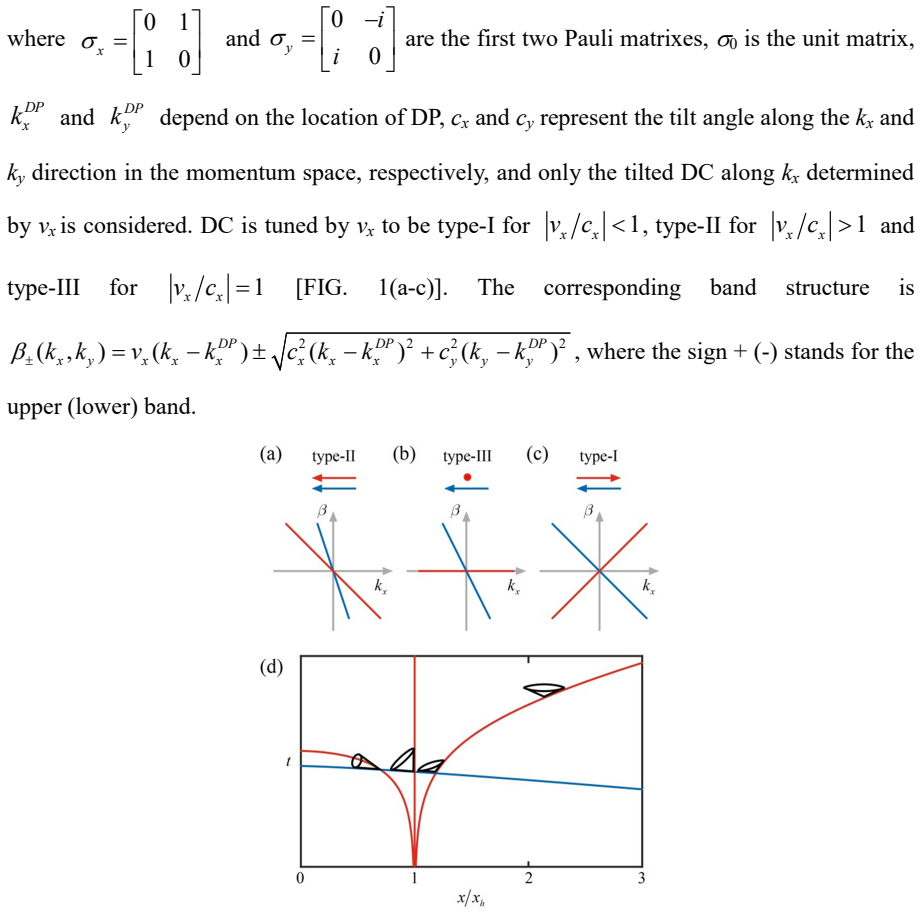
The load-bearing object is the tilted Dirac cone described by a two-band Hamiltonian with tilt parameters $c_x$, $c_y$ and an anisotropic velocity $v_x$. The type-III condition $v_x = c_x$ is the horizon condition: it is where the counter-propagating mode's group velocity goes to zero and the Painlevé-Gullstrand line element develops a one-way light cone. The machinery is completed by the semiclassical tunneling formula, which turns the gradient of the dragging velocity at the horizon into a Hawking temperature and a Planck spectrum, and by the graphyne-like photonic lattice whose tunable intra-chain hopping makes the tilt vary continuously in space.
What would settle it
Fabricate the proposed inhomogeneous graphyne-like lattice, excite the type-II region near the horizon, and measure the emitted spectrum on the type-I side. A thermal Planck spectrum at 0.14 mK, with the log-ratio of positive- and negative-norm amplitudes linear in frequency at the predicted slope, would support the claim; any nonthermal output, or a spectrum whose temperature does not track the index gradient, would refute it. A numerical version using full-wave simulation of the graded interface is equally decisive.
Extended reading notes
Core claim
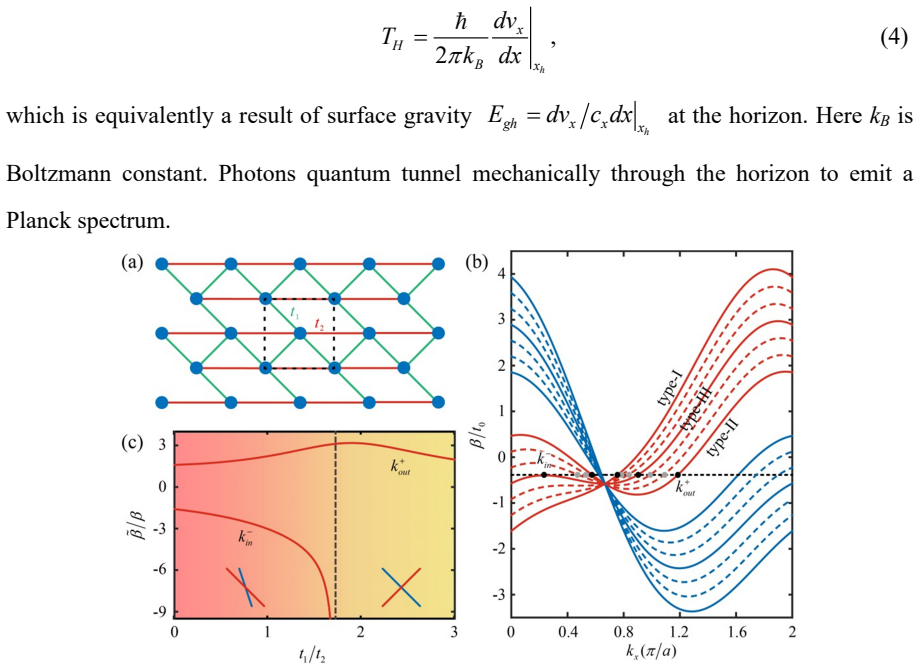
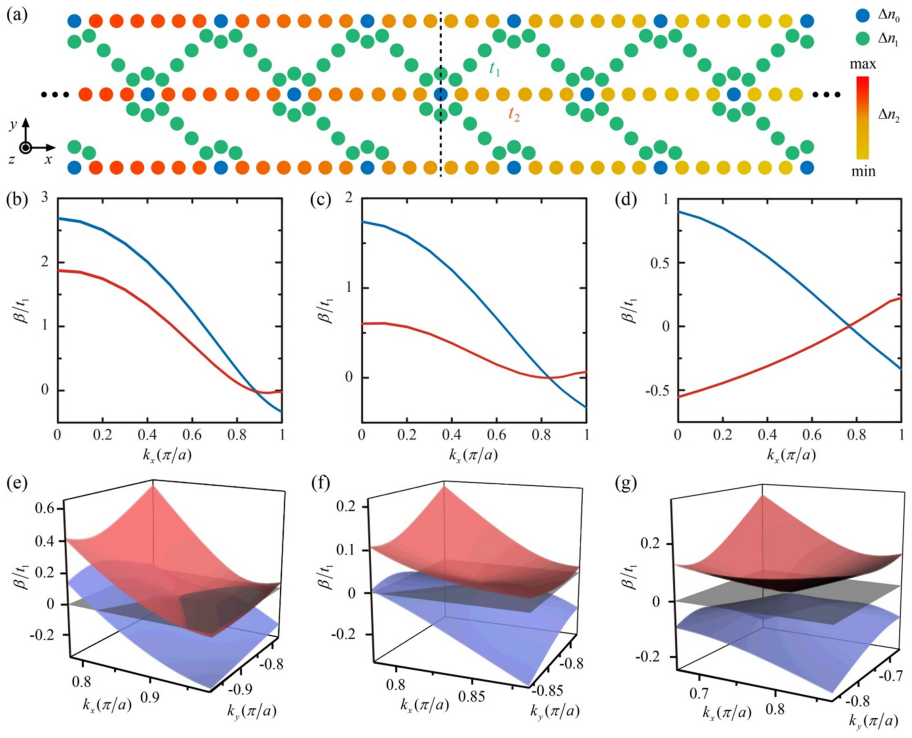
The central claim is that the low-energy Hamiltonian of a tilted Dirac cone in two dimensions, written with emergent tetrad fields, is equivalent to a scalar field propagating in a Painlevé-Gullstrand spacetime, so a spatial transition from type-II to type-I tilt plays the role of a black-hole spacetime. At the interface the tilt equals the cone speed, the counter-propagating mode's group velocity vanishes, and that point is the event horizon; on the type-II side the dragging velocity exceeds the cone speed and modes are trapped. The paper computes Hawking radiation as semiclassical tunneling through this horizon, obtaining a temperature set by the gradient of the dragging velocity at the horizon and a Planck emission spectrum. It then realizes the transition in a graphyne-like photonic lattice by grading the refractive index of a coupling chain, verifies type-I, type-II, and type-III Dirac points in finite-element band calculations, and reports a Hawking temperature of approximately 0.14 mK for the designed parameters.
Load-bearing premise
The quantitative prediction of 0.14 mK depends on treating the propagation direction along the waveguides as a time coordinate and converting the diffraction slopes $c_x$ and $v_x$ into real velocities with a multiplicative group-velocity factor; if that conversion is wrong, the temperature and spectrum are unsupported. The argument also assumes the finite-width graded interface behaves like an ideal, sharp type-III horizon.
Editorial extensions
If this is right
- The same equations apply to other photonic platforms, so a similar graded-index photonic crystal should produce the same Hawking-like radiation at higher temperatures, possibly above 1 K.
- Reversing the index gradient creates a white-hole analog, and placing black and white horizons back-to-back would form a black-hole laser.
- Because the horizon sits at topologically protected Dirac points, the analog horizon should survive moderate fabrication disorder, giving a stationary, long-lived configuration rather than a transient one.
- Fluorescent molecules embedded near the type-II region should show enhanced spontaneous emission, since the type-II isofrequency surface has a large density of states, making the predicted thermal spectrum experimentally measurable.
Reading between the lines
- Beyond the paper, the same graded-tilt lattice could be used to test other curved-spacetime phenomena, such as mode mixing or effective gravitational lensing, because the Painlevé-Gullstrand metric is fixed by the local tilt gradient.
- The paper assumes an ideal sharp horizon; a real device has a graded interface of finite width, which will likely introduce gray-body factors. A testable extension is to compute or measure the reflection coefficient as a function of interface width and check that the spectrum remains thermal with a reduced emissivity.
- A clean experimental check of the mechanism is to double the refractive-index gradient and verify that the measured Hawking temperature doubles, since the temperature is predicted to scale with the drag-velocity gradient at the horizon.
- Stimulated, rather than spontaneous, emission could confirm the prediction sooner: injecting a coherent probe on one side and measuring the amplified output and the log-ratio slope should reveal the Hawking temperature without needing single-photon detection.
Editorial analysis
A structured set of objections, weighed in public.
Referee Report
Summary. The paper proposes an optical black-hole analogue based on a spatially graded topological phase transition between type-II and type-I Dirac cones in a graphyne-like photonic waveguide lattice. The authors map the low-energy tight-binding Hamiltonian to a Painlevé–Gullstrand metric, argue that the type-III condition at the transition interface forms a stationary event horizon, and derive a Hawking temperature from a WKB tunneling calculation. They support the existence of the three cone types with COMSOL band-structure calculations for specific waveguide parameters and propose a laboratory design with a Hawking temperature of 0.14 mK and a long-lived horizon.
Significance. If the central quantitative conversion issue were resolved, this would be a useful contribution: it combines topologically protected Dirac cones, a stationary horizon configuration, and concrete fabrication parameters in a single proposal. The paper is explicit about falsifiable design elements, such as the specific waveguide diameters and refractive-index contrasts that produce type-II, type-III, and type-I cones, and it shows a predicted linear relation between the log-amplitude ratio and quasi-frequency. However, the headline number 0.14 mK is not yet reproducible from the manuscript, so the significance is conditional on the authors supplying the missing derivation.
major comments (3)
- [Final paragraph before Summary (Hawking-temperature correction)] The conversion from diffraction-angle slopes to a real-time Hawking temperature is stated in one sentence without derivation. The manuscript says, 'In fact, c_x(y) and v_x are not real group velocities but diffraction angles... However, we need to correct Hawking temperature by multiplying the group velocity along the waveguide array.' Equation (4) uses d v_x/dx, but if v_x is a dimensionless diffraction angle, this quantity has units of inverse length and must be multiplied by a velocity to yield a temperature. The manuscript does not specify the correction factor, how it is computed from the band structure, or at which point it is evaluated. Because the central quantitative result, T_H = 0.14 mK, depends entirely on this one paragraph, the predicted temperature and the associated Planck spectrum are not reproducible or checkable from the manuscript as written.
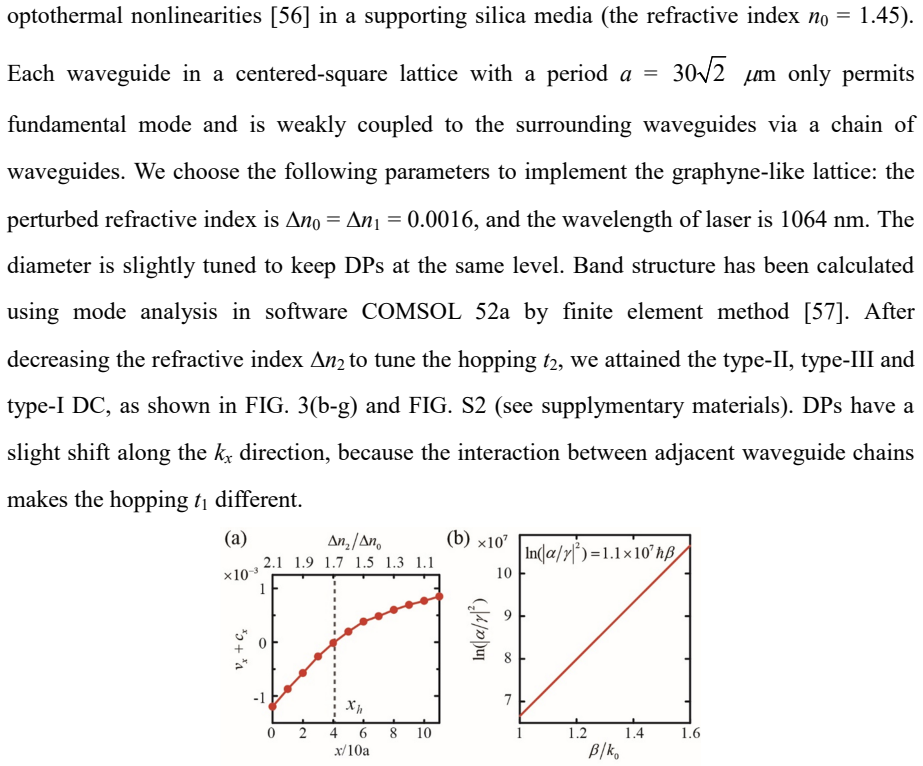
- [Inhomogeneous graphyne-like PL and Fig. 4] The claim of a 'long-lived horizon' is not backed by tolerance or finite-width analysis. In the proposed device, the type-III condition v_x = c_x is achieved only at a single point or over a finite-width graded chain of waveguides, and the refractive-index gradient Δn2(x) is discrete rather than continuous. The paper does not estimate how the surface gravity, tunneling probability, or horizon lifetime depend on the width of the transition region or on fabrication tolerances for the waveguide diameters and index contrasts. Since a long-lived stationary horizon is presented as a key advantage over previous analogs, this omission is load-bearing for that claim.
- [Section 3, Eqs. (1)–(3) and the laboratory mapping] The mapping from the tight-binding band structure to the metric is asserted but not fully specified. In particular, the relation between the hopping parameters t1, t2 and the effective velocities c_x, v_x is given only through derivatives of h(k) and h'(k); the manuscript does not show how the spatially varying t2(x) produces the required v_x(x) profile, nor how the discrete chain realizes the continuum gradient assumed in Eq. (4). A derivation of the effective v_x(x) from the designed Δn2(x) would make the 0.14 mK estimate independently computable.
minor comments (5)
- [Throughout] There are numerous typographical and typesetting errors (e.g., 'Bugoliubov' for Bogoliubov, 'supplymentary' for supplementary, and garbled equation renderings). A clean typeset version is needed.
- [Eq. (2)] The Einstein summation convention and the definition of the tetrad fields e^a_μ are not spelled out, making the metric derivation in Eq. (3) hard to follow for readers not already familiar with the formalism.
- [Text before Fig. 4] The explicit functional form of the refractive-index gradient Δn2(x) is not stated cleanly; the text says only 'Δn2(x) ∝ ...' in garbled form. A precise formula with all constants would improve reproducibility.
- [Sec. 2 (definitions of c_x and v_x)] Because the final temperature correction depends on the distinction between diffraction angles and real group velocities, the manuscript should define c_x and v_x as partial derivatives of the propagation constant β with respect to k_x and state their units early in the paper.
- [Supplementary materials] References to FIG. S1 and S2 and to 'supplementary materials' should be verified; if these are not included with the arXiv submission, the manuscript should either include them or remove the references.
Circularity Check
No circularity: the 0.14 mK Hawking temperature is a forward calculation from the designed gradient; the unexplained diffraction-angle-to-time conversion is an omitted derivation, not a circular step.
full rationale
Walking the derivation: Eq. (1) is the low-energy Weyl Hamiltonian with a tunable tilt v_x, and Eq. (3) is the standard Painlevé–Gullstrand metric obtained from the emergent tetrads, with the horizon condition v_x = c_x read off from the metric rather than imposed as the conclusion. Eq. (4) gives T_H = (ħ/2π k_B)(dv_x/dx)|_h from the WKB tunneling action, with the derivative evaluated at the type-III point. In the photonic implementation, the refractive-index gradient Δn_2(x) is a design input; the band calculation yields v_x(x), and T_H = 0.14 mK follows from Eq. (4). This is a forward design calculation, not a fitted parameter relabeled as a prediction. The paper states that c_x and v_x are diffraction angles and that 'we need to correct Hawking temperature by multiplying the group velocity along the waveguide array,' but it does not give the correction formula or the numerical group velocity. That is an omitted unit-conversion derivation and a correctness risk, not a circular reduction: no equation defining the output exclusively in terms of itself or of a fitted target is present. Self-citations ([33]–[37], [43], [44]) provide context and the graphyne-like lattice platform, but the metric and tunneling derivation are performed in this paper and do not reduce to those citations. No load-bearing self-citation chain or definitional equivalence is exhibited, so the circularity score is 0.
Assumptions & free parameters
free parameters (4)
- Surface-gravity gradient dv_x/dx at horizon =
set by Δn2(x) gradient, giving T_H ≈ 0.14 mK
- Refractive-index contrasts Δn0, Δn1, Δn2 =
Δn0 = Δn1 = 0.0016; Δn2 = 2Δn0, 1.69Δn0, Δn0 for type-II/III/I
- Waveguide diameters d =
3.768, 4, 4.479 μm for type-II/III/I
- Lattice period a =
30√2 μm
assumptions (5)
- domain assumption Tight-binding / coupled-mode equation (Eq. 5) governs light evolution with propagation distance z as time.
- standard math Low-energy Hamiltonian near the Dirac point is the tilted Weyl Hamiltonian of Eq. (1).
- domain assumption The inverse metric is built from tetrads via g^{μν} = e_a^μ e_b^ν η^{ab} with η = diag(-1,1,1).
- standard math WKB tunneling and the Parikh-Wilczek formula give T_H = ħ |dv_x/dx|/(2π k_B).
- standard math Bogoliubov coefficients relate outgoing and incoming modes to give a Planck spectrum (Eq. 6).
Cite this review
Pith. "Pith review of Optical Black-hole Analog Created by Topological Phase Transition with a Long-lived Horizon." pith.science (2026). https://pith.science/paper/FLUUQMSP
@misc{pith2026190805049,
  author       = {Pith},
  title        = {Pith review of: Optical Black-hole Analog Created by Topological Phase Transition with a Long-lived Horizon},
  year         = {2026},
  howpublished = {\url{https://pith.science/paper/FLUUQMSP}},
  note         = {Machine review of arXiv:1908.05049}
}
read the original abstract
Hawking radiation, a manifestation of quantum field theory in curved spacetime, has stimulated extensive theoretical and experimental studies of various black-hole (BH) analogs. However, an undisputed confirmation of Hawking radiation remains elusive. One challenge is BH analog structures with long-lived horizons are difficult to achieve. Here, we theoretically demonstrate a new type of optical BH analog based on light cone evolution associated with topological phase transition of Dirac cones. The transition from a type-II to type-I Dirac/Weyl cone creates an analogous curved spacetime that crosses a type-III Dirac/Weyl cone, which affords a stationary configuration of long-lived event horizon. Photons tunneling through the horizon emit a spectrum of Hawking radiation. As an example, we design a laboratory version in an inhomogeneous two-dimensional graphyne-like topological photonic lattice with a Hawking temperature of 0.14 mK. Understanding Hawking-like radiation in this unique topological BH is not only of fundamental interest in its own right but may also provide new hints to gravitational physics.
Figures
Figures from the paper (1 more)
Forward citations
Cited by 1 Pith paper
-
Smart Holes: Analogue black holes with the right temperature and entropy
The entropy of a tilted Dirac cone material, integrated across a spatially varying tilt, grows linearly with temperature behind the analogue horizon and can be mapped to BTZ black hole entropy.
Reference graph
Works this paper leans on
-
[1]
Hawking S W 1974 Black hole explosions? Nature 248 30 - 1
work page 1974
-
[2]
Unruh W G 1981 Experimental Black - Hole Evaporation? Phys. Rev. Lett. 46 1351 - 3
work page 1981
-
[3]
Schutzhold R and Unruh W G 2002 Gravity wave analogues of black holes Phys. Rev. D 66 044019
work page 2002
-
[4]
Rousseaux G, Mathis C, Maïssa P , Philbin T G and Leonhardt U 2008 Observation of negative - frequency waves in a water tank: a classical analogue to the Hawking effect? New J. Phys. 10 053015
work page 2008
-
[5]
Weinfurtner S, Tedford E W, Penrice M C, Unruh W G and Lawrence G A 2011 Measurement of stimulated Hawking emission in an analogue system Phys. Rev. Lett. 106 021302
work page 2011
-
[6]
Garay L J, Anglin J R, Cirac J I and Zoller P 2000 Sonic analog of gravitational black holes in bose - einstein condensates Phys. Rev. Lett. 85 4643 - 7
work page 2000
-
[7]
Steinhauer J 2014 Observation of self - amplifying Hawking radiation in an analogue black - hole laser Nat. Phys. 10 864 - 9
work page 2014
-
[8]
Steinhauer J 2016 Observation o f quantum Hawking radiation and its entanglement in an analogue black hole Nat. Phys. 12 959 - 65
work page 2016
Show all 69 references
-
[9]
Jacobson T and Volovik G 1998 Event horizons and ergoregions in 3 He Phys. Rev. D 58 064021
1998
-
[10]
Giovanazzi S 2005 Hawking radiation in sonic black holes Ph ys. Rev. Lett. 94 061302
2005
-
[11]
Horstmann B, Reznik B, Fagnocchi S and Cirac J I 2010 Hawking radiation from an acoustic black hole on an ion ring Phys. Rev. Lett. 104 250403
2010
-
[12]
Solnyshkov D D, Flayac H and Malpuech G 2011 Black holes and wormholes in spin or polariton condensates Phys. Rev. B 84 233405
2011
-
[13]
Nguyen H S, Gerace D, Carusotto I, Sanvitto D, Galopin E, Lemaitre A, Sagnes I, Bloch J and Amo A 2015 Acoustic black hole in a stationary hydrodynamic flow of microcavity polaritons Phys. Rev. Lett. 114 036402
2015
-
[14]
Roldan - Molina A, Nunez A S and Duine R A 2017 Magnonic Black Holes Phys. Rev. Lett. 118 061301
2017
-
[15]
Leonhardt U and Piwnicki P 2000 Relativistic effects of light in moving media with extremely low group velocity Phys. Rev. Lett. 84 822 - 5
2000
-
[16]
Schutzhold R and Unruh W G 2005 Hawking radiation in an electromagnetic waveguide? Phys. Rev. Lett. 95 031301
2005
-
[17]
Philbin T G, Kuklewicz C, Robertson S, Hill S, Konig F and Leonhardt U 2008 Fiber - optical analog of the event horizon Science 319 1367 - 70
2008
-
[18]
Belgiorno F, Cacciatori S L, Clerici M, Gorini V, Ortenzi G, Rizzi L, Rubino E, Sala V G and Faccio D 2010 Hawking radiation from ultrashort laser pulse filaments Phys. Rev. Lett. 105 203901
2010
-
[19]
Elazar M, Fleurov V and Bar - Ad S 2012 All - optical event horizon in an optical analog of a Laval nozzle Phys. Rev. A 86 063821
2012
-
[20]
Drori J, Rosenberg Y , Bermudez D, Silberberg Y and Leonhardt U 2019 Observation of Stimulated Hawking Radiation in an Optical Analogue Phys. Rev. Lett. 122 010404
2019
-
[21]
Michel F and Parentani R 2014 Probing the thermal character of analogue Hawking radiation for shallow water waves? Phys. Rev. D 90 044033
2014
-
[22]
Euvé L - P , Michel F, Parentani R and Rousseaux G 2015 Wave blocking and partial transmission in subcritical flows over an obst acle Phys. Rev. D 91 024020
2015
-
[23]
Wang Y - H, Jacobson T , Edwards M and Clark C W 2017 Mechanism of stimulated Hawking radiation in a laboratory Bose - Einstein condensate Phys. Rev. A 96 023616
2017
-
[24]
Wang Y - H, Jacobson T , Edwards M and Clark C 2017 Induced dens ity correlations in a sonic black hole condensate SciPost Phys. 3 022
2017
-
[25]
Parola A, Tettamanti M and Cacciatori S L 2017 Analogue Hawking radiation in an exactly solvable model of BEC EPL 119 50002
2017
-
[26]
Leonhardt U 2018 Questioning the Recent Observation of Quantum Hawking Radiation Ann. Phys. (Berl.) 530 1700114
2018
-
[27]
Hawking radiation from ultrashort laser pulse filaments
Schutzhold R and Unruh W G 2011 Comment on "Hawking radiation from ultrashort laser pulse filaments" Phys. Rev. Lett. 107 149401; author reply 2
2011
-
[28]
Barceló C 2018 Analogue black - hole horizo ns Nat. Phys. 1
2018
-
[29]
Vocke D, Maitland C, Prain A, Wilson K E, Biancalana F, Wright E M, Marino F and Faccio D 2018 Rotating black hole geometries in a two - dimensional photon superfluid Optica 5 1099 - 103
2018
-
[30]
Photonics 8 821 - 9
Lu L, Joannopoulos J D and Soljaclc M 2014 Top ological photonics Nat. Photonics 8 821 - 9
2014
-
[31]
Photonics 11 763 - 73
Khanikaev A B and Shvets G 2017 Two - dimensional topological photonics Nat. Photonics 11 763 - 73
2017
-
[33]
104 645 - 8
Volovik G E 2016 Black hole and hawking radiation by type - II Weyl fermions JETP Lett. 104 645 - 8
2016
-
[34]
Low Temp
Volovik G E and Zhang K 2017 Lifshitz Transitions, Type - II Dirac and Weyl Fermions, Event Horizon an d All That J. Low Temp. Phys. 189 276 - 99
2017
-
[35]
Guan S, Yu Z - M, Liu Y , Liu G - B, Dong L, Lu Y , Yao Y and Yang S A 2017 Artificial gravity field, astrophysical analogues, and topological phase transitions in strained topological semimetals npj Quantum Mater. 2 23
2017
-
[36]
Huang H, Jin K - H and Liu F 2018 Black - hole horizon in the Dirac semimetal Zn 2 In 2 S 5 Phys. Rev. B 98 121110
2018
-
[37]
Liu H, Sun J - T , Huang H, Liu F and Meng S 2018 Fermionic analogue of black hole radiation with a super high Hawking temperature arX iv:1809.00479
2018 arXiv
-
[38]
Liu Z, Liu F and Wu Y - S 2014 Exotic electronic states in the world of flat bands: From theory to material Chin. Phys. B 23 077308
2014
-
[39]
Liu Z, Wang Z - F, Mei J - W, Wu Y - S and Liu F 2013 Flat Chern band in a two - dimensional organometallic f ramework Phys. Rev. Lett. 110 106804
2013
-
[40]
13 2842 - 5
Wang Z, Su N and Liu F 2013 Prediction of a two - dimensional organic topological insulator Nano Lett. 13 2842 - 5
2013
-
[41]
Express 24 8877 - 85
Zong Y , Xia S, Tang L, Song D, Hu Y , Pei Y , Su J, Li Y and Chen Z 2016 Observation of localized fl at - band states in Kagome photonic lattices Opt. Express 24 8877 - 85
2016
-
[42]
Leykam D, Andreanov A and Flach S 2018 Artificial flat band systems: from lattice models to experiments Adv. Phys. 3 1473052
2018
-
[43]
Zhang L Z, Wang Z F, Wang Z M, Du S X, Gao H J and Liu F 2015 Highly Anisotropic Dirac Fermions in Square Graphynes J. Phys. Chem. Lett. 6 2959 - 62
2015
-
[44]
Pyrialakos G G, Nye N S, Kantartzis N V and Christodoulides D N 2017 Emergence of Type - II Dirac Points i n Graphynelike Photonic Lattices Phys. Rev. Lett. 119 113901
2017
-
[45]
Painlevé P 1921 La mécanique classique et la théorie de la relativité C. R. Acad. Sci. (Paris) 173 677 - 80
1921
-
[46]
Gullstrand A 1922 Allgemeine Losung des statischen Einkorperproblems in der Ein steinschen Gravitationstheorie Ark. Mat. Astron. Fys. 16
1922
-
[47]
Huhtala P and Volovik G 2002 Fermionic microstates within the Painlevé - Gullstrand black hole J. Exp. Theor. Phys. 94 853 - 61
2002
-
[48]
Volovik G E 2003 The universe in a helium droplet (Oxford: Oxford University Press)
2003
-
[49]
Parikh M K and Wilczek F 2000 Hawking radiation As tunneling Phys. Rev. Lett. 85 5042 - 5
2000
-
[50]
Majhi B R and Samanta S 2010 Hawking radiation due to photon and gravitino tunneling Ann. Phys. (N. Y.) 325 2410 - 24
2010
-
[51]
Banerjee R and Maj hi B R 2009 Hawking black body spectrum from tunneling mechanism Phys. Lett. B 675 243 - 5
2009
-
[52]
Unruh W G 1995 Sonic analogue of black holes and the effects of high frequencies on black hole evaporation Phys. Rev. D 51 2827 - 38
1995
-
[53]
Jacobson T 1996 On the ori gin of the outgoing black hole modes Phys. Rev. D 53 7082
1996
-
[54]
Robertson S J 2012 The theory of Hawking radiation in laboratory analogues J. Phys. B: At. Mol. Opt. Phys. 45 163001
2012
-
[55]
Szameit A and Nolte S 2010 Discrete optics in femtosecond - laser - written photonic structures J. Phys. B: At. Mol. Opt. Phys. 43 163001
2010
-
[56]
Shabahang S, Nye N S, Markos C, Christodoulides D N and Abouraddy A F 2017 Reconfigurable opto - thermal graded - index waveguiding in bulk chalcogenide glasses Opt. Lett. 42 1919 - 22
2017
-
[57]
Jin J - M 2014 The finite element method in electromagnetics (New York: Wiley)
2014
-
[58]
Lu L, Wang Z, Ye D, Ran L, Fu L, Joannopoulos J D and Soljačić M 2015 Experimental observation of Weyl points Science 349 622 - 4
2015
-
[59]
Lin J Y , Hu N C, Chen Y J, Lee C H and Zhang X 2017 Line nodes, Dirac points, and Lifshitz transition in two - dimensional nonsymmorphic photonic crystals Phys. Rev. B 96 075438
2017
-
[60]
Guo Q, Yang B, Xia L, Gao W, Liu H, Chen J, Xiang Y and Zhang S 2017 Three Dimensional Photonic Dirac Points in Metamate rials Phys. Rev. Lett. 119 213901
2017
-
[61]
Yang B, Guo Q, Tremain B, Liu R, Barr L E, Yan Q, Gao W, Liu H, Xiang Y , Chen J, Fang C, Hibbins A, Lu L and Zhang S 2018 Ideal Weyl points and helicoid surface states in artificial photonic crystal structures Science 359 1013 - 6
2018
-
[62]
Hu C, Li Z, Tong R, Wu X, Xia Z, Wang L, Li S, Huang Y , Wang S, Hou B, Chan C T and Wen W 2018 Type - II Dirac Photons at Metasurfaces Phys. Rev. Lett. 121 024301
2018
-
[63]
Jin D, Christensen T , Soljacic M, Fang N X, Lu L and Zhang X 2017 Infrare d Topological Plasmons in Graphene Phys. Rev. Lett. 118 245301
2017
-
[64]
Pan D, Yu R, Xu H and Garcia de Abajo F J 2017 Topologically protected Dirac plasmons in a graphene superlattice Nat. Commun. 8 1243
2017
-
[65]
Photonics 7 902 - 6
Sheng C, Liu H, Wang Y , Zhu S N and Genov D A 2013 Trapping light by mimicking gravitational lensing Nat. Photonics 7 902 - 6
2013
-
[66]
Sheng C, Bekenstein R, Liu H, Zhu S and Segev M 2016 Wavefront shaping through emulated curved space in waveguide settings Nat. Commun. 7 10747
2016
-
[67]
Zhong F, Li J, Liu H and Zhu S 2018 Controlling Surface Plasmons Through Covariant Transformation of the Spin - Dependent Geometric Phase Between Curved Metamaterials Phys. Rev. Lett. 120 243901
2018
-
[68]
Xiao M, Chen W - J, He W - Y and Chan C T 2015 Synthetic gauge flux and Weyl points in acoustic systems Nat. Phys. 11 920
2015
-
[69]
Yang Z and Zhang B 2016 Acoustic type - II Weyl nodes from stacking dimerized chains Phys. Rev. Lett. 117 224301
2016
-
[70]
Corley S and Jacobson T 1999 Black hole lasers Phys. Rev. D 59 124011
1999
Reviewed August 14, 2026 · model on record in the stance chip above.
Discussion (0). Continue with ORCID to comment.