REVIEW 3 major objections 3 minor 41 references
Thermal conductance of one dimensional disordered harmonic chains
T0 review · 3 major / 3 minor · reviewed 2026-08-14 · deepseek-v4-flash
Pith's one-line read One-dimensional disordered harmonic chains transport heat as G∝L^{-β}; strong heavy-tailed disorder with impedance mismatch gives β=1 (Fourier's law).
desk verdict A useful scaling framework for 1D disordered heat transport, but the headline Fourier-law claim for strong power-law disorder rests on an untested resonance-area assumption that needs a direct numerical check. read the letter →
The pith
A machine-rendered reading of the paper's core claim, the machinery that carries it, and where it could break.
The reading
What carries the argument
The cutoff frequency ω_L, defined by the equality ξ(ω_L)=L, is the central object: it separates delocalized transmitting phonons from localized insulating ones. The argument uses the Landauer formula for phonons and replaces the full transmission coefficient by a step function below ω_L for k≈1 (yielding G∝ω_L) or by Lorentzian peaks of equal area for k≪1 and k≫1 (yielding G∝∫$_0^{{ω_L}}$ρ(ω)dω). The equal-area property for weak coupling is imported from an earlier work of the same group; for strong coupling it is derived in the supplementary material from first-order perturbation theory about a clean chain with fixed boundaries, where the end amplitudes of low-frequency modes scale as |v_1|,|v_N|∼ω/(k√N).
What would settle it
For a chain with power-law disorder ϵ=0.5 and coupling k=0.01, compute the transmission peaks below ω_L and measure the area γ of each peak as a function of its center frequency ω. If γ∝ω^δ with δ≠0, the scaling becomes G∝$L^{{-(s+1+δ)/α}}$, contradicting the paper's claimed β=1 for strong disorder.
Extended reading notes
Core claim
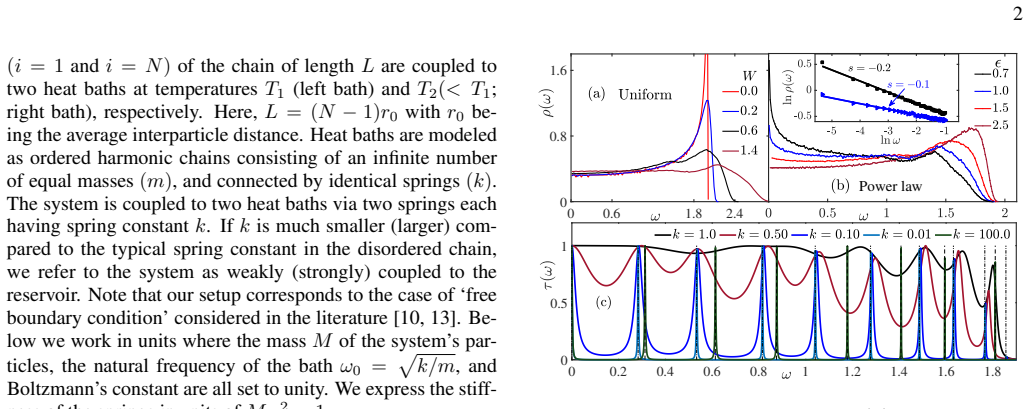
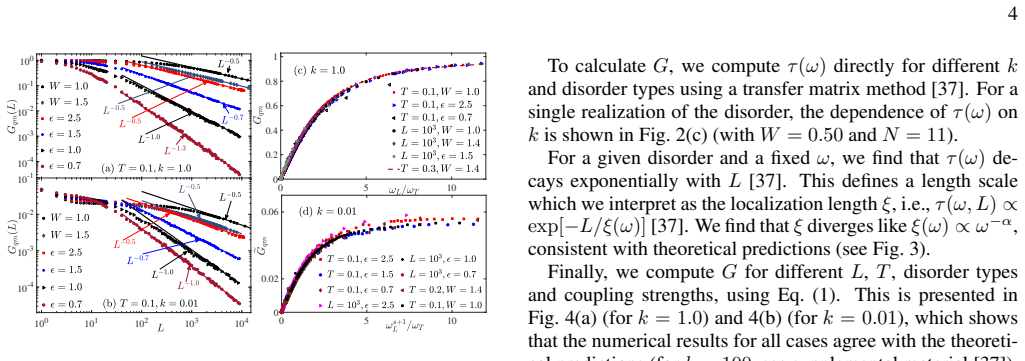
For frequencies ω below a cutoff ω_L defined by ξ(ω_L)=L, phonons are delocalized and carry heat; above it they are localized and do not. Taking the transmission to be roughly one for ω<ω_L in the impedance-matched case k≈1, the Landauer integral gives G∝ω_L/ω_T, hence β=1/α because ω_L∝$L^{{-1/α}}$. In the strong-impedance-mismatch case k≪1 or k≫1, transmission consists of well-resolved Lorentzians centered on the chain's eigenfrequencies, and the integrated area of each resonance is frequency-independent (derived for strong coupling from the boundary-amplitude scaling |v_1|,|v_N|∼ω/(k√N)). The conductance then reduces to counting modes below ω_L, G∝∫$_0^{{ω_L}}$ dω ρ(ω)∝$ω_L^{{s+1}}$∝$L^{{-(s+1)/α}}$. The paper demonstrates numerically that for uniform disorder s=0, α=2, giving β=1/2; for power-law disorder with 1<ϵ≤2, α=ϵ, giving β=1/ϵ; and for ϵ≤1, s=(ϵ-1)/(ϵ+1) and α=2ϵ/(1+ϵ), whose combination yields s+1=α and therefore β=1, normal heat conduction.
Load-bearing premise
The derivation assumes that every transmission resonance below the cutoff ω_L contributes a frequency-independent integrated area to the conductance; if the resonance area varies with frequency, the mode-counting step G∝∫ρ(ω)dω and all derived exponents, including Fourier's β=1, collapse.
Editorial extensions
If this is right
- Uniform mass or spring disorder gives G∝L^{-1/2} for all bath couplings, confirming and extending earlier free-boundary results.
- Power-law disorder with 1<ϵ≤2 gives an anomalous exponent β=1/ϵ, tunable by the disorder strength.
- Strong heavy-tailed disorder (ϵ≤1) together with strong impedance mismatch (k≪1 or k≫1) satisfies Fourier's law, G∝L^{-1}.
- All disorder and temperature data collapse onto one universal curve when the conductance is plotted against ω_L/ω_T for k≈1 or against ω_L^{s+1}/ω_T for k≪1 and k≫1.
- At fixed length L, the conductance saturates at the quantum of thermal conductance for T≪ℏω_L and then decays as T^{-1} for T≫ℏω_L.
Reading between the lines
- A direct corollary, not stated in the paper, is that any disorder model whose exponents satisfy s+1=α will show Fourier-like β=1 even without impedance mismatch; strong heavy-tailed disorder is the paper's concrete realization.
- The universal variable ω_L^{s+1}/ω_T suggests a practical experimental way to extract both α and s from a single conductance-versus-temperature curve, avoiding separate localization-length measurements.
- The derivation's Lorentzian-area assumption could be tested directly by computing the area of each transmission peak below ω_L; if the area acquires a frequency dependence δ, the exponent becomes β=(s+1+δ)/α rather than (s+1)/α.
Signed reviews
Editorial analysis
A structured set of objections, weighed in public.
Referee Report
Summary. This manuscript studies steady-state heat transport through one-dimensional disordered harmonic chains connected to ordered harmonic reservoirs. The authors start from the Landauer formula and combine scaling laws for the localization length ξ(ω) and the density of states ρ(ω) to derive the scaling of the thermal conductance with the chain length L. For near impedance matching (k≈1) they approximate τ(ω)=1 below a disorder cut-off ω_L defined by ξ(ω_L)=L, obtaining G∝L^{−1/α}; for strong impedance mismatch (k≪1 or k≫1) they treat transmission as non-overlapping Lorentzians with frequency-independent area, obtaining G∝L^{−(s+1)/α}. The paper then uses published and partially re-derived results for uniform and power-law disorder: ρ(ω)∼Dω^s and ξ(ω)∼ω^{−α}. The combination (s+1)/α=1 for power-law disorder with ε≤1 gives a Fourier-law prediction G∝L^{−1}. The results are collected in Table I, and numerics for τ, ρ, ξ, and G are presented, along with a claimed universal collapse in terms of ω_L/ω_T (k≈1) and ω_L^{s+1}/ω_T (impedance mismatch).
Significance. Proving the existence of a concrete parameter regime where Fourier's law holds in a one-dimensional disordered harmonic chain is of considerable interest, given the long history of anomalous transport in low-dimensional systems. If the central claim is correct, the paper also offers a compact unifying scaling variable and predictions that can be tested in numerical simulations. The analytical structure is transparent, and the numerical work for the uniform-disorder and ε>1 power-law cases corroborates the predicted exponents. A particular strength of the paper is that the asymptotic exponents are not obtained by fitting; they are derived from independent scaling inputs and then compared with numerics. My reservations concern the untested assumptions in the ε≤1 strong-disorder, strong-impedance-mismatch regime, which is exactly the case used to claim Fourier's law.
major comments (3)
- [Supplemental Material, Sec. II and Eq. (S.24); main text Eqs. (4)-(5)] The derivation of the strong-coupling Lorentzian area (Eq. (S.15)), with |v1|,|vN|∼ω/(k√N) from Eq. (S.24), assumes that the low-frequency modes of the disordered chain are close to ordered-chain sinusoidal modes. For power-law disorder with ε<1, where ρ(ω) diverges at zero frequency and soft springs are abundant, this assumption is not self-evident; rare soft springs near the boundaries could change the exponent in |v1|∼ω^p/N^q. If p≠1, the Lorentzian area scales as γ∼ω^{2p−2}, and Eq. (5) becomes G∝ω_L^{s+2p−1}, destroying the exact cancellation that yields β=1. The numerical evidence cited for Eq. (S.24), namely Figs. S.2 and S.3, is for uniform disorder only (W=0.5 and W=1.95), and no frequency-dependence check of the resonance area or of v1(ω) is provided for the ε<1 power-law case. I ask the authors to either prove Eq. (S.24) for power-law disorder or supply a dedicated numerical test in this regime.
- [Main text, Eqs. (4)-(5) and Table I] For weak coupling k≪1, the frequency independence of the individual Lorentzian areas is imported from Ref. [21] without a derivation for the power-law disorder model. The soft-spring dominance in the ε<1 regime is precisely the case in which the delocalized-mode structure underlying Ref. [21] is most questionable. The authors should state the precise conditions under which the Ref. [21] result carries over, or verify numerically that Σ(ω) is flat for ε<1. Until this is supplied, the Fourier-law row of Table I rests on an untested premise.
- [Fig. 2(b) and the paragraph near Fig. 2] The paper reports an unexplained weak divergence of ρ(ω) at ε=1 in a regime where theory predicts s=0. Since ε=1 lies on the boundary of the strong-disorder row used for the β=1 prediction, this discrepancy should be addressed explicitly, for example by a finite-size scaling study or by sharpening the regime boundaries. If the divergence persists in the thermodynamic limit, the exponent s used in Eq. (5) at ε=1 is not the correct input to the central derivation.
minor comments (3)
- [Supplemental Material, Sec. I] There is a typo: 'condactuance' should be 'conductance'; similarly, footnote [38] reads 'infinte' for 'infinite'. The manuscript would benefit from a careful proofread.
- [Main text, Eq. (2)] The prefactor in Eq. (2) is easy to misread because g_q=π²T/(3h) already contains T and h; please state explicitly that the expression is written in natural units k_B=1 and ħ=1 for the thermal frequency, so that the prefactor 3/π² is unambiguous.
- [Fig. 4 caption] The caption introduces G̃qm=(s+1)Gqm/D, but the symbols G̃qm and D are not defined in the main text before the figure; please define them in the main text near Eq. (5) so that the collapse shown in panels (c) and (d) is self-contained.
Circularity Check
No significant circularity: the scaling exponents follow from independently stated and numerically verified DOS/localization laws; only minor reliance on the authors' earlier weak-coupling result.
full rationale
The derivation chain is not circular. The conductance exponents are obtained by combining the quoted scaling laws rho(omega) = D omega^s and xi(omega) proportional to omega^{-alpha} with the Landauer integral and the cutoff definition xi(omega_L) = L. For k close to 1, the step tau(omega)=1 below omega_L is an explicit approximation checked in Fig. 2(c), and Eq. (3) follows by integration, giving beta = 1/alpha. For k much less than 1 and k much greater than 1, the only nontrivial input is the claim that each transmission Lorentzian has a frequency-independent area. For strong coupling this is derived in the supplementary material from first-order perturbation theory, and for weak coupling it is imported from the authors' earlier published work [21]. That citation is not equivalent to the present target result: it is a parameter-free published derivation, and the same Fourier-law conclusion is independently rederived for k much greater than 1 in this paper. The power-law DOS and localization-length exponents come from an external source [33] and are verified numerically in Figs. 2-3. The collapse variable omega_L/omega_T or omega_L^{s+1}/omega_T is derived from the same scaling relations rather than fitted to the collapse; the per-disorder constant D affects only vertical normalization and not the scaling exponents. The acknowledged unexplained divergence at epsilon = 1 and the assumed ordered-chain dispersion for epsilon < 1 modes are correctness risks, not circular reductions. Thus no central prediction reduces to its inputs by construction.
Assumptions & free parameters
free parameters (1)
- D =
not reported numerically
assumptions (4)
- domain assumption Localization length scaling ξ(ω)∝ω^{-α} with α=2 for uniform disorder, α=ϵ for 1<ϵ≤2, and α=2ϵ/(1+ϵ) for ϵ≤1.
- domain assumption Density of states scaling ρ(ω)∝ω^s with s=0 for uniform disorder and for ϵ>1, and s=(ϵ-1)/(1+ϵ) for ϵ≤1.
- ad hoc to paper For k≈1, the transmission coefficient is τ(ω)=1 for all ω≤ω_L and zero otherwise.
- domain assumption Each transmission resonance below ω_L is a Lorentzian whose integrated area is independent of frequency for delocalized modes.
Cite this review
Pith. "Pith review of Thermal conductance of one dimensional disordered harmonic chains." pith.science (2026). https://pith.science/paper/FLWCWPDZ
@misc{pith2026190804314,
  author       = {Pith},
  title        = {Pith review of: Thermal conductance of one dimensional disordered harmonic chains},
  year         = {2026},
  howpublished = {\url{https://pith.science/paper/FLWCWPDZ}},
  note         = {Machine review of arXiv:1908.04314}
}
read the original abstract
We study heat conduction mediated by longitudinal phonons in one dimensional disordered harmonic chains. Using scaling properties of the phonon density of states and localization in disordered systems, we find non-trivial scaling of the thermal conductance with the system size. Our findings are corroborated by extensive numerical analysis. We show that a system with strong disorder, characterized by a `heavy-tailed' probability distribution, and with large impedance mismatch between the bath and the system satisfies Fourier's law. We identify a dimensionless scaling parameter, related to the temperature scale and the localization length of the phonons, through which the thermal conductance for different models of disorder and different temperatures follows a universal behavior.
Figures


Figures from the paper (1 more)
Reference graph
Works this paper leans on
-
[21]
I. F. Herrera-Gonz´alez, F. M. Izrailev, and L. Tessieri, Eur. phys. Lett. 110, 64001 (2015)
work page 2015
- [1]
-
[2]
Thermal conductance of one dimensional disordered harmonic chains
For this particular model, it was also shown that normal scaling (i.e. β = 1) can be observed only under spe- cific choices of the thermal bath [10]. It was also argued, un- der free boundary conditions, that one-dimensional harmonic chains with spatially correlated disorder may exhibit normal heat conduction asymptotically [20]. ∗ Deceased System (disorde...
work page Pith review arXiv 1908
-
[3]
J. Cividini, A. Kundu, A. Miron, and D. Mukamel, Journal of Statistical Mechanics: Theory and Experiment 2017, 013203 (2017)
work page 2017
-
[4]
Xu, Theoretical and Applied Mechanics Letters 6, 113 (2016)
Z. Xu, Theoretical and Applied Mechanics Letters 6, 113 (2016)
work page 2016
- [5]
-
[6]
F. Bonetto, J. L. Lebowitz, and L. Rey-Bellet, F ouriers law: A challenge for theorists (Imperial College Press, London, 2000). 5
work page 2000
- [7]
Show all 41 references
-
[8]
Monasterio, T
C. Monasterio, T. Prosen, and G. Casati, Eur. phys. Lett. 72, 520 (2005)
2005
-
[9]
Narayan and S
O. Narayan and S. Ramaswamy, Phys. Rev. Lett. 89, 200601 (2002)
2002
-
[10]
Mai and O
T. Mai and O. Narayan, Phys. Rev. E 73, 061202 (2006)
2006
-
[11]
Dhar, Phys
A. Dhar, Phys. Rev. Lett. 86, 5882 (2001)
2001
-
[12]
Moghaddasi Fereidani and D
R. Moghaddasi Fereidani and D. Segal, J. Chem. Phys. 150, 024105 (2019)
2019
-
[13]
Casher and J
A. Casher and J. L. Lebowitz, Journal of Mathematical Physics 12, 1701 (1971)
1971
-
[14]
R. J. Rubin and W. L. Greer, Journal of Mathematical Physics 12, 1686 (1971)
1971
-
[15]
Casati, J
G. Casati, J. Ford, F. Vivaldi, and W. M. Visscher, Phys. Rev. Lett. 52, 1861 (1984)
1984
-
[16]
Lepri, R
S. Lepri, R. Livi, and A. Politi, Physics Reports 377, 1 (2003)
2003
-
[17]
P. I. Hurtado and P. L. Garrido, Scientific Reports 6, 38823 (2016)
2016
-
[18]
C. W. Chang, D. Okawa, H. Garcia, A. Majumdar, and A. Zettl, Phys. Rev. Lett. 101, 075903 (2008)
2008
-
[19]
N. Yang, G. Zhang, and B. Li, Nano Today 5, 85 (2010)
2010
-
[20]
X. Xu, L. F. C. Pereira, Y . Wang, J. Wu, K. Zhang, X. Zhao, S. Bae, C. Tinh Bui, R. Xie, J. T. L. Thong, et al., Nature Com- munications 5, 3689 (2014)
2014
-
[22]
A. Amir, Y . Oreg, and Y . Imry, Eur. Phys. Lett. 124, 16001 (2018)
2018
-
[23]
Dhar and J
A. Dhar and J. L. Lebowitz, Phys. Rev. Lett. 100, 134301 (2008)
2008
-
[24]
B. Hu, B. Li, and H. Zhao, Phys. Rev. E 57, 2992 (1998)
1998
-
[25]
Roy and A
D. Roy and A. Dhar, Phys. Rev. E 78, 051112 (2008)
2008
-
[26]
J. D. Bodyfelt, M. C. Zheng, R. Fleischmann, and T. Kottos, Phys. Rev. E 87, 020101 (2013)
2013
-
[27]
M. Y . Azbel, Phys. Rev. B28, 4106 (1983)
1983
-
[28]
Ishii, Progress of Theoretical Physics Supplement 53, 77 (1973)
K. Ishii, Progress of Theoretical Physics Supplement 53, 77 (1973)
1973
-
[29]
Note that K is bounded from above and the power law tail is at low values ofK
-
[30]
A. Amir, J. J. Krich, V . Vitelli, Y . Oreg, and Y . Imry, Phys. Rev. X 3, 021017 (2013)
2013
-
[31]
A. Amir, Y . Oreg, and Y . Imry, Phys. Rev. Lett. 105, 070601 (2010)
2010
-
[32]
Ashcroft and N
N. Ashcroft and N. Mermin, Solid State Physics (Saunders Col- lege, Philadelphia, 1976)
1976
-
[33]
Alexander, J
S. Alexander, J. Bernasconi, W. R. Schneider, and R. Orbach, Rev. Mod. Phys. 53, 175 (1981)
1981
-
[34]
T. A. L. Ziman, Phys. Rev. Lett. 49, 337 (1982)
1982
-
[35]
L. G. C. Rego and G. Kirczenow, Phys. Rev. Lett. 81, 232 (1998)
1998
-
[36]
J. B. Pendry, Journal of Physics A: Mathematical and General 16, 2161 (1983)
1983
-
[37]
In our model we always haveM = 1 for the masses comprising the disordered system. For a fixed disorder strength, when we varyk to study the effect of coupling strength, we also vary m with it to maintain the natural frequency of the ordered chain as ω0 = √ k m = 1
-
[38]
See Supplemental Material for more details
-
[39]
Thus, in this limit, the mean temperature of the baths is effectively infinte (T ≫ ℏω) and becomes irrele- vant [21]
For large L, only low frequency modes (ω→ 0) contribute to the heat transport. Thus, in this limit, the mean temperature of the baths is effectively infinte (T ≫ ℏω) and becomes irrele- vant [21]
-
[40]
J. J. Sakurai, Modern quantum mechanics; rev. ed. (Addison- Wesley, Reading, MA, 1994)
1994
-
[41]
degenerate bands
P. Markos and C. M. Soukoulis, eds., Wave Propagation: From Electrons to Photonic Crystals and Left-Handed Mate- rials (Princeton University Press, 2008). 6 SUPPLEMENTAL MA TERIAL FOR ‘THERMAL CONDUCTANCE FOR ONE DIMENSIONAL DISORDERED HARMONIC CHAINS’ I. ANALYTICAL PREDICTION...
2008
Reviewed August 14, 2026 · model on record in the stance chip above.
Discussion (0). Continue with ORCID to comment.