REVIEW 4 major objections 5 minor 45 references
LCDS: A Logic-Controlled Discharge Summary Generation System Supporting Source Attribution and Expert Review
T0 review · 4 major / 5 minor · reviewed 2026-08-06 · deepseek-v4-flash
Pith's one-line read LCDS, a logic-controlled discharge summary generator, ties every generated sentence to a source record in the original EMR and reports that a fine-tuned 6B model using it beats GPT-4o with chain-of-thought prompting on accuracy…
desk verdict Useful system paper whose headline numbers are not yet trustworthy because the paper never says the 150 evaluation EMRs are disjoint from the 500 used to build the mapping table and fine-tune the model. read the letter →
The pith
A machine-rendered reading of the paper's core claim, the machinery that carries it, and where it could break.
The reading
What carries the argument
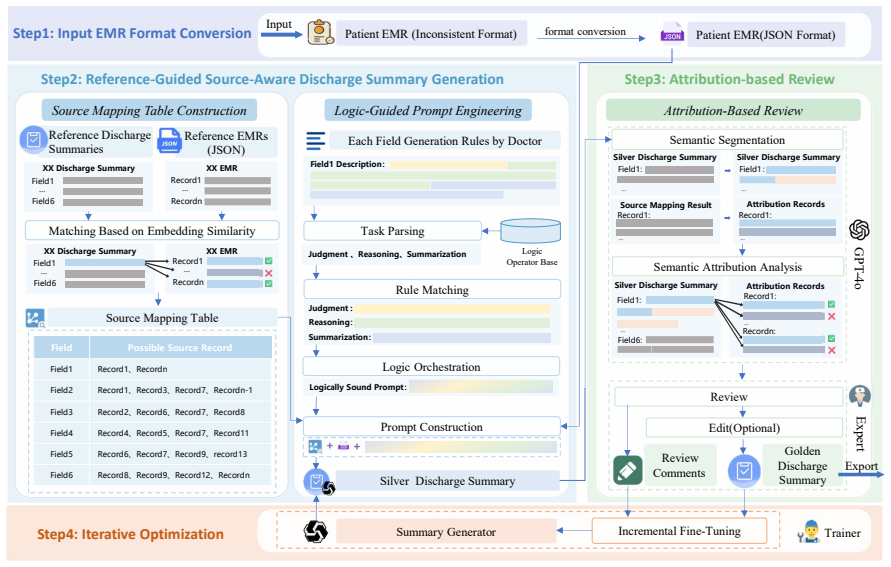
The central object is the source mapping table, which for each of six discharge summary fields lists the EMR records most likely to contain the needed information. It is built by BM25 similarity: physician-written summaries are segmented into sentences or short fields, matched against all EMR fields, and candidates above a 0.8 score are kept; each candidate's priority is its frequency as a valid source across 500 record–summary pairs, so inference starts from the most reliable field and falls back down the list. This table narrows the generator's input, and the other main mechanism is a logic-guided prompt constructor based on five rule types, extraction, summarization, judgment, inference, and knowledge, assembled by GPT-4o into field-specific prompts. A final mechanism assigns unique identifiers to original-record sentences and has GPT-4o return those identifiers as attributions for each generated sentence, enabling the expert review interface.
What would settle it
An independent re-evaluation could compare patient identifiers or record hashes between the 500 mapping-construction EMRs and the 150 evaluation EMRs; any overlap would call the reported scores into question, and a strictly disjoint held-out set would settle the matter. A second check is an ablation that replaces the source mapping table with random field selection while keeping the same prompts and fine-tuned model; if EMRLLM with LCDS still beats GPT-4o with chain-of-thought by a similar margin, the source mapping is not the mechanism carrying the result.
Extended reading notes
Core claim
On the paper's own terms, the central discovery is that a generation pipeline built around a source mapping table, logic-guided prompts, and sentence-level attribution lets a fine-tuned 6B model produce discharge summaries that experts rate higher than those from GPT-4o with chain-of-thought prompting. The reported numbers are ROUGE-L 77.60, LLM-as-a-Judge 75.26, and human score 79.45 for EMRLLM with LCDS, compared with 24.01, 24.68, and 31.41 for GPT-4o with chain-of-thought on the same 150 EMRs from 15 departments. The authors interpret this as evidence that content localization reduces hallucinations and that attribution makes expert verification practical.
Load-bearing premise
The load-bearing premise is that the 150 EMRs used for evaluation are disjoint from the 500 EMRs that built the source mapping table; the paper does not state this overlap status, and its own Limitations section notes that reliance on one dataset may limit generalization. If the same records appear in both sets, the high ROUGE-L and human scores could reflect memorized source priorities, not a model that generalizes to new patients.
Editorial extensions
If this is right
- A fine-tuned 6B model inside LCDS beats a much larger general model with chain-of-thought prompting by all three reported measures, so model size is not the main driver of quality in this task.
- Constraining the input to source fields ranked above a similarity threshold bounds what the generator can write about, which directly reduces opportunities for unsupported statements.
- Sentence-level attribution makes every generated claim reviewable against the original EMR, giving physicians a concrete audit trail rather than a black-box summary.
- Expert edits and comments accumulate into an incremental fine-tuning set, so the generator improves over time without starting from scratch.
- Department-specific logic rules let one system serve 15 clinical departments while keeping field structures and medication advice locally relevant.
Reading between the lines
- A natural next experiment, not reported in the paper, is an ablation that removes the source mapping table, the logic-guided prompts, and the attribution step one at a time to reveal which component drives the reported gap between EMRLLM with LCDS and GPT-4o with chain-of-thought.
- If the priority table transfers across departments, it could act as a reusable retrieval prior for other clinical summarization tasks; that reuse is implied by the system's modular design but not tested here.
- Because attribution relies on GPT-4o's judgments, the system's auditability is only as strong as that attribution step; measuring attribution precision separately from generation quality would complement the reported overall scores.
Editorial analysis
A structured set of objections, weighed in public.
Referee Report
Summary. This paper presents LCDS, a pipeline for automated discharge summary generation from electronic medical records. The system converts heterogeneous EMR documents into unified JSON, constructs a DS-EMR source mapping table using BM25 similarity between 500 physician-authored discharge summaries and their source records, applies logic-guided prompts (extraction, summarization, judgment, inference, knowledge) generated with GPT-4o, and provides sentence-level source attribution to support expert review and incremental fine-tuning of ChatGLM3-6B (named EMRLLM). The evaluation on 150 EMRs reports that EMRLLM with LCDS achieves ROUGE-L 77.60, LLM-as-a-Judge 75.26, and human score 79.45, outperforming GPT-4o with chain-of-thought prompting and GPT-4o with LCDS. The central claims are that LCDS improves accuracy, coherence, and clinical applicability, reduces hallucinations, and improves content traceability.
Significance. If the quantitative results are reproducible and generalizable, LCDS would be a practically valuable system: it combines content localization, logic-controlled generation, and an interactive attribution interface for expert review, and it is accompanied by a public GitHub repository and demo video. The idea of constructing a source mapping table from existing physician-authored summaries and then using it to constrain generation scope is a credible approach to reducing hallucinations from long-form EMRs. However, the current evaluation is not sufficient to support the headline claims. The dataset split between mapping construction and evaluation is not stated, no statistical reliability measures are reported, and the paper does not directly measure hallucination or attribution accuracy. The significance is therefore conditional on a substantially strengthened evaluation.
major comments (4)
- [§4.2, §5 (Dataset split)] Section 4.2 states that the source mapping table is constructed from 500 EMRs with physician-authored discharge summaries, while Section 5 evaluates on 150 EMRs selected '10 from each of 15 departments' but never states that the 150 are disjoint from the 500. Because both sets are drawn from the same 15 departments, any overlap would allow the BM25-derived mapping priorities and the fine-tuned EMRLLM to have been optimized on the very gold summaries used as references in Table 1, making the reported ROUGE-L 77.60 and human score 79.45 evidence of memorization rather than generalization. The authors must specify the split, report patient-level deduplication, and re-evaluate on a strictly held-out subset.
- [§5, Table 1 (Statistical reliability)] Table 1 reports single point estimates with no error bars, confidence intervals, significance tests, or per-department variance, and the human evaluation description does not state the number of expert raters, their specialties, blinding, or inter-rater agreement. The 53.59-point ROUGE-L gap between GPT-4o with COT (24.01) and EMRLLM with LCDS (77.60) is unusually large for abstractive summarization, but without variance or statistical testing one cannot judge whether any of the differences are reliable. Please report standard errors or confidence intervals, significance tests, and the full human-evaluation protocol.
- [§1, §5, Appendix C (Hallucination and traceability metrics)] The abstract and conclusion claim that LCDS 'significantly reduc[es] hallucinations' and improves content traceability, but Table 1 and the evaluation rubrics do not contain a direct hallucination or attribution metric. ROUGE-L measures lexical overlap, while the LLM-as-a-Judge dimensions and the human rubric in Appendix C address accuracy, completeness, standardization, and practicality but never require raters to verify the source of each generated sentence or count fabricated content. To support the paper's central claims, the authors should add direct measurements, such as clinician-annotated hallucination/factuality error rates and attribution precision/recall against the source mapping table.
- [§5, Baselines (Ablation)] The current comparison cannot separate the contribution of the LCDS pipeline from that of fine-tuning: EMRLLM with LCDS is compared against GPT-4o with COT and GPT-4o with LCDS, but no EMRLLM-without-LCDS condition is reported. Since EMRLLM is fine-tuned on a medical instruction dataset, the large improvement over GPT-4o with COT could be due to the fine-tuned base model rather than to logic-controlled prompting or source mapping. Adding an EMRLLM baseline without LCDS, and ideally a GPT-4o variant with the same source mapping but without logic rules, would isolate the contributions.
minor comments (5)
- [§1] The phrase 'propose A LCDS' should be corrected to 'propose a logic-controlled discharge summary generation system' or 'an LCDS system'.
- [§5] The 'Baseline Methods' paragraph lists EMRLLM with LCDS as one of three baseline methods, but EMRLLM with LCDS is the proposed system; relabeling the comparison conditions would avoid confusion.
- [§3.3, §4.4] Figure 2 identifies GPT-4o as the semantic attribution component, while §4.1 says the summary generator is ChatGLM3-6B/EMRLLM; please clarify the roles of GPT-4o and EMRLLM in the pipeline.
- [§4.2] The description of priority assignment using the example with patients A, B, and C would be clearer with a small table or pseudocode showing how BM25 scores and frequencies map to final source-field priorities.
- [Table 1 caption] The caption should state the number of EMRs per condition, the number of human raters, and whether the same LLM judge prompt was used for all three methods.
Circularity Check
Evaluation set may overlap with the EMRs used to build the source mapping table and fine-tune EMRLLM; if so, Table 1's headline scores reflect memorization, not generalization.
-
fitted input called prediction
[Section 4.2 (Source Mapping Table Construction), Section 5 (Evaluation), and Limitations]
"We collect 500 EMRs from 15 departments, each containing a physician-authored DS. These DSs serve as ground truth for localizing information from the corresponding source documents. ... We collect 150 EMRs, selecting 10 from each of 15 departments. ... our approach primarily relies on a specific dataset for training and evaluation"
The paper never states that the 150 evaluation EMRs are disjoint from the 500 EMRs used to build the source mapping table and to fine-tune EMRLLM. The Limitations section explicitly says the approach 'relies on a specific dataset for training and evaluation', implying the same data may serve both purposes. The source mapping table is constructed by using the physician-authored DSs as ground truth to locate source records; during generation, the system extracts content in order of priority learned from these DSs. If the evaluation EMRs are among the 500, then the reference DSs used for ROUGE-L and human scoring have directly shaped the mapping priorities and the fine-tuned model.
full rationale
The central claim is that LCDS outperforms baselines on discharge summary generation. The only load-bearing circularity risk arises from the undisclosed overlap between the 150 evaluation EMRs and the 500 EMRs that drive the source mapping table and fine-tuning. The paper provides no train/eval split, and the Limitations section suggests a shared dataset. If the sets overlap, the experimental results reduce to memorization rather than generalization, and the 'prediction' is effectively the fitted input. No other circular patterns appear: there are no self-citations, no imported uniqueness theorems, and the logic rules and attribution mechanisms are externally defined. However, the missing disjointness statement is severe enough to compromise the validity of every reported score, so the circularity score reflects this partial reduction-by-construction.
Assumptions & free parameters
free parameters (2)
- BM25 similarity threshold =
0.8
- Source-field priority statistics =
ratios from 500 EMRs, e.g., 2/3 and 1/3
assumptions (6)
- domain assumption BM25 similarity scores above 0.8 identify valid source fields for each discharge summary segment.
- domain assumption The 500 physician-authored discharge summaries used to build the source mapping table are correct ground truth for source localization.
- domain assumption The 150 evaluation EMRs are independent of the 500 EMRs used to construct the source mapping table.
- domain assumption GPT-4o's sentence-level attribution to unique EMR sentence identifiers is accurate enough for expert review.
- domain assumption LLM-as-a-Judge scores from DeepSeek-R1 correlate with clinical quality.
- domain assumption LoRA fine-tuning of ChatGLM3-6B on the instruction dataset produces a model that generalizes beyond the training distribution.
Cite this review
Pith. "Pith review of LCDS: A Logic-Controlled Discharge Summary Generation System Supporting Source Attribution and Expert Review." pith.science (2026). https://pith.science/paper/FMNFMRH5
@misc{pith2026250705319,
  author       = {Pith},
  title        = {Pith review of: LCDS: A Logic-Controlled Discharge Summary Generation System Supporting Source Attribution and Expert Review},
  year         = {2026},
  howpublished = {\url{https://pith.science/paper/FMNFMRH5}},
  note         = {Machine review of arXiv:2507.05319}
}
read the original abstract
Despite the remarkable performance of Large Language Models (LLMs) in automated discharge summary generation, they still suffer from hallucination issues, such as generating inaccurate content or fabricating information without valid sources. In addition, electronic medical records (EMRs) typically consist of long-form data, making it challenging for LLMs to attribute the generated content to the sources. To address these challenges, we propose LCDS, a Logic-Controlled Discharge Summary generation system. LCDS constructs a source mapping table by calculating textual similarity between EMRs and discharge summaries to constrain the scope of summarized content. Moreover, LCDS incorporates a comprehensive set of logical rules, enabling it to generate more reliable silver discharge summaries tailored to different clinical fields. Furthermore, LCDS supports source attribution for generated content, allowing experts to efficiently review, provide feedback, and rectify errors. The resulting golden discharge summaries are subsequently recorded for incremental fine-tuning of LLMs. Our project and demo video are in the GitHub repository https://github.com/ycycyc02/LCDS.
Figures

Reference graph
Works this paper leans on
-
[1]
Griffin Adams, Jason Zucker, and Noémie Elhadad. 2024. Speer: Sentence-level planning of long clinical summaries via embedded entity retrieval. arXiv:2401.02369
work page Pith review arXiv 2024
-
[2]
Akari Asai, Zeqiu Wu, Yizhong Wang, Avirup Sil, and Hannaneh Hajishirzi. 2023. Self-rag: Learning to retrieve, generate, and critique through self-reflection. In The Twelfth International Conference on Learning Representations
2023
-
[3]
Shuyang Cao and Lu Wang. 2024. Verifiable generation with subsentence-level fine-grained citations. arXiv preprint arXiv:2406.06125
arXiv 2024
-
[4]
Yung-Sung Chuang, Benjamin Cohen-Wang, Shannon Zejiang Shen, Zhaofeng Wu, Hu Xu, Xi Victoria Lin, James Glass, Shang-Wen Li, and Wen-tau Yih. 2025. Selfcite: Self-supervised alignment for context attribution in large language models. arXiv preprint arXiv:2502.09604
arXiv 2025
-
[5]
Reece Alexander James Clough, William Anthony Sparkes, Oliver Thomas Clough, Joshua Thomas Sykes, Alexander Thomas Steventon, and Kate King. 2024. Transforming healthcare documentation: harnessing the potential of ai to generate discharge summaries. BJGP open, 8(1):BJGPO.2023.0116
-
[6]
Benjamin Cohen-Wang, Harshay Shah, Kristian Georgiev, and Aleksander Madry. 2024. Contextcite: Attributing model generation to context. Advances in Neural Information Processing Systems, 37:95764--95807
work page 2024
-
[7]
Daniel Dubinski, Sae-Yeon Won, Svorad Trnovec, Bedjan Behmanesh, Peter Baumgarten, Nazife Dinc, Juergen Konczalla, Alvin Chan, Joshua D. Bernstock, Thomas M. Freiman, and Florian Gessler. 2024. Leveraging artificial intelligence in neurosurgery-unveiling chatgpt for neurosurgical discharge summaries and operative reports. Acta Neurochirurgica, 166(1):38
work page 2024
-
[8]
Constanza Fierro, Reinald Kim Amplayo, Fantine Huot, Nicola De Cao, Joshua Maynez, Shashi Narayan, and Mirella Lapata. 2024. Learning to plan and generate text with citations. arXiv preprint arXiv:2404.03381
arXiv 2024
Show all 45 references
-
[9]
Team GLM, Aohan Zeng, Bin Xu, Bowen Wang, Chenhui Zhang, Da Yin, Diego Rojas, Guanyu Feng, Hanlin Zhao, Hanyu Lai, Hao Yu, Hongning Wang, Jiadai Sun, Jiajie Zhang, Jiale Cheng, Jiayi Gui, Jie Tang, Jing Zhang, Juanzi Li, Lei Zhao, Lindong Wu, Lucen Zhong, Mingdao Liu, Minlie H...
2024 arXiv
-
[10]
Jiawei Gu, Xuhui Jiang, Zhichao Shi, Hexiang Tan, Xuehao Zhai, Chengjin Xu, Wei Li, Yinghan Shen, Shengjie Ma, Honghao Liu, et al. 2024. A survey on llm-as-a-judge. arXiv preprint arXiv:2411.15594
2024 arXiv
-
[11]
Daya Guo, Dejian Yang, Haowei Zhang, Junxiao Song, Ruoyu Zhang, Runxin Xu, Qihao Zhu, Shirong Ma, Peiyi Wang, Xiao Bi, et al. 2025. Deepseek-r1: Incentivizing reasoning capability in llms via reinforcement learning. arXiv preprint arXiv:2501.12948
2025 arXiv
-
[12]
Vince C Hartman, Sanika S Bapat, Mark G Weiner, Babak B Navi, Evan T Sholle, and Thomas R Campion Jr. 2023. A method to automate the discharge summary hospital course for neurology patients. Journal of the American Medical Informatics Association, 30(12):1995--2003
2023
-
[13]
Lucas Torroba Hennigen, Shannon Shen, Aniruddha Nrusimha, Bernhard Gapp, David Sontag, and Yoon Kim. 2023. Towards verifiable text generation with symbolic references. arXiv preprint arXiv:2311.09188
2023 arXiv
-
[14]
Aaron Hurst, Adam Lerer, Adam P Goucher, Adam Perelman, Aditya Ramesh, Aidan Clark, AJ Ostrow, Akila Welihinda, Alan Hayes, Alec Radford, et al. 2024. Gpt-4o system card. arXiv preprint arXiv:2410.21276
2024 arXiv
-
[15]
Ziwei Ji, Nayeon Lee, Rita Frieske, Tiezheng Yu, Dan Su, Yan Xu, Etsuko Ishii, Ye Jin Bang, Andrea Madotto, and Pascale Fung. 2023. Survey of hallucination in natural language generation. ACM computing surveys, 55(12):1--38
2023
-
[16]
Krishna K, Khosla S, Bigham J, and Lipton ZC. 2021. Generating soap notes from doctor-patient conversations using modular summarization techniques. Association for Computational Linguistics, pages 4958--4972
2021
-
[17]
Hanjae Kim, Hee Min Jin, Yoon Bin Jung, and Seng Chan You. 2024. Patient-friendly discharge summaries in korea based on chatgpt: Software development and validation. Journal of Korean Medical Science, 39(16):e148
2024
-
[18]
Sunil Kripalani, Amy T Jackson, Jeffrey L Schnipper, and Eric A Coleman. 2007. Promoting effective transitions of care at hospital discharge: a review of key issues for hospitalists. Journal of hospital medicine: an official publication of the Society of Hospital Medicine, 2(5...
2007
-
[19]
Leslie A Lenert, Farrant H Sakaguchi, and Charlene R Weir. 2014. Rethinking the discharge summary: a focus on handoff communication. Academic Medicine, 89(3):393--398
2014
-
[20]
Jordan YZ Li, Tuck Y Yong, Paul Hakendorf, David Ben-Tovim, and Campbell H Thompson. 2013. Timeliness in discharge summary dissemination is associated with patients’ clinical outcomes. Journal of evaluation in clinical practice, 19(1):76--79
2013
-
[21]
Chin-Yew Lin. 2004. Rouge: A package for automatic evaluation of summaries. In Text summarization branches out, pages 74--81
2004
-
[22]
Fenglin Liu, Bang Yang, Chenyu You, Xian Wu, Shen Ge, Zhangdaihong Liu, Xu Sun, Yang Yang, and David Clifton. 2022. Retrieve, reason, and refine: Generating accurate and faithful patient instructions. Advances in Neural Information Processing Systems, 35:18864--18877
2022
-
[23]
discharge me!
Mengxian Lyu, Cheng Peng, Daniel Paredes, Ziyi Chen, Aokun Chen, Jiang Bian, and Yonghui Wu. 2024. Uf-hobi at" discharge me!": A hybrid solution for discharge summary generation through prompt-based tuning of gatortrongpt models. arXiv preprint arXiv:2407.15359
2024 arXiv
-
[24]
Joshua Maynez, Shashi Narayan, Bernd Bohnet, and Ryan McDonald. 2020. On faithfulness and factuality in abstractive summarization. arXiv preprint arXiv:2005.00661
2020 arXiv
-
[25]
Lesley C Rink, Tolu O Oyesanya, Kathryn C Adair, Janice C Humphreys, Susan G Silva, and John Bryan Sexton. 2023. Stressors among healthcare workers: a summative content analysis. Global qualitative nursing research, 10:23333936231161127
2023
-
[26]
Stephen Robertson, Hugo Zaragoza, et al. 2009. The probabilistic relevance framework: Bm25 and beyond. Foundations and Trends in Information Retrieval , 3(4):333--389
2009
-
[27]
Han-Chin Shing, Chaitanya Shivade, Nima Pourdamghani, Feng Nan, Philip Resnik, Douglas Oard, and Parminder Bhatia. 2021. Towards clinical encounter summarization: Learning to compose discharge summaries from prior notes. arXiv preprint arXiv:2104.13498
2021 arXiv
-
[28]
Aviv Slobodkin, Eran Hirsch, Arie Cattan, Tal Schuster, and Ido Dagan. 2024. Attribute first, then generate: Locally-attributable grounded text generation. arXiv preprint arXiv:2403.17104
2024 arXiv
-
[29]
Dave Van Veen, Cara Van Uden, Louis Blankemeier, Jean-Benoit Delbrouck, Asad Aali, Christian Bluethgen, Anuj Pareek, Malgorzata Polacin, Eduardo Pontes Reis, Anna Seehofnerov \'a , et al. 2024. Adapted large language models can outperform medical experts in clinical text summa...
2024
-
[30]
Hartman VC, Bapat SS, Weiner MG, and et al. 2023. https://doi.org/10.1093/jamia/ocad177 A method to automate the discharge summary hospital course for neurology patients . Journal of the American Medical Informatics Association, 12:12
2023 doi
-
[31]
Carl Van Walraven, Ratika Seth, Peter C Austin, and Andreas Laupacis. 2002. Effect of discharge summary availability during post-discharge visits on hospital readmission. Journal of general internal medicine, 17:186--192
2002
-
[32]
Haochun Wang, Chi Liu, Nuwa Xi, Zewen Qiang, Sendong Zhao, Bing Qin, and Ting Liu. 2023. https://arxiv.org/abs/2304.06975 Huatuo: Tuning llama model with chinese medical knowledge . Preprint, arXiv:2304.06975
2023 arXiv
-
[33]
Jason Wei, Xuezhi Wang, Dale Schuurmans, Maarten Bosma, Fei Xia, Ed Chi, Quoc V Le, Denny Zhou, et al. 2022. Chain-of-thought prompting elicits reasoning in large language models. Advances in neural information processing systems, 35:24824--24837
2022
-
[34]
Christopher Y. K. Williams, Jaskaran Bains, Tianyu Tang, Kishan Patel, Alexa N. Lucas, Fiona Chen, Brenda Y. Miao, Atul J. Butte, and Aaron E. Kornblith. 2024. Evaluating large language models for drafting emergency department discharge summaries. medRxiv: The Preprint Server ...
2024
-
[35]
discharge me!
Haotian Wu, Paul Boulenger, Antonin Faure, Berta C \'e spedes, Farouk Boukil, Nastasia Morel, Zeming Chen, and Antoine Bosselut. 2024. Epfl-make at “discharge me!”: An llm system for automatically generating discharge summaries of clinical electronic health record. In Proceedi...
2024
-
[36]
Ying Xiong, Buzhou Tang, Qingcai Chen, Xiaolong Wang, and Jun Yan. 2019. A study on automatic generation of chinese discharge summary. In 2019 IEEE International Conference on Bioinformatics and Biomedicine (BIBM), pages 1681--1687. IEEE
2019
-
[37]
discharge me!
Justin Xu, Zhihong Chen, Andrew Johnston, Louis Blankemeier, Maya Varma, Jason Hom, William J Collins, Ankit Modi, Robert Lloyd, Benjamin Hopkins, et al. 2024. Overview of the first shared task on clinical text generation: Rrg24 and" discharge me!". In BioNLP@ ACL
2024
-
[38]
Xi Ye, Ruoxi Sun, Sercan \"O Arik, and Tomas Pfister. 2023. Effective large language model adaptation for improved grounding and citation generation. arXiv preprint arXiv:2311.09533
2023 arXiv
-
[39]
Hongbo Zhang, Junying Chen, Feng Jiang, Fei Yu, Zhihong Chen, Jianquan Li, Guiming Chen, Xiangbo Wu, Zhiyi Zhang, Qingying Xiao, et al. 2023 a . Huatuogpt, towards taming language model to be a doctor. arXiv preprint arXiv:2305.15075
2023 arXiv
-
[40]
Jingyu Zhang, Marc Marone, Tianjian Li, Benjamin Van Durme, and Daniel Khashabi. 2024. Verifiable by design: Aligning language models to quote from pre-training data. arXiv preprint arXiv:2404.03862
2024 arXiv
-
[41]
Nan Zhang, Yusen Zhang, Wu Guo, Prasenjit Mitra, and Rui Zhang. 2023 b . Famesumm: investigating and improving faithfulness of medical summarization. arXiv preprint arXiv:2311.02271
2023 arXiv
-
[42]
Xinlu Zhang, Chenxin Tian, Xianjun Yang, Lichang Chen, Zekun Li, and Linda Ruth Petzold. 2023 c . Alpacare: Instruction-tuned large language models for medical application. arXiv preprint arXiv:2310.14558
2023 arXiv
-
[43]
Manning, and Curtis Langlotz
Yuhao Zhang, Derek Merck, Emily Tsai, Christopher D. Manning, and Curtis Langlotz. 2020. Optimizing the factual correctness of a summary: A study of summarizing radiology reports. Proceedings of the 58th Annual Meeting of the Association for Computational Linguistics, pages 51...
2020
-
[44]
online" 'onlinestring :=
ENTRY address archivePrefix author booktitle chapter edition editor eid eprint eprinttype howpublished institution journal key month note number organization pages publisher school series title type volume year doi pubmed url lastchecked label extra.label sort.label short.list...
-
[45]
write newline
" write newline "" before.all 'output.state := FUNCTION n.dashify 't := "" t empty not t #1 #1 substring "-" = t #1 #2 substring "--" = not "--" * t #2 global.max substring 't := t #1 #1 substring "-" = "-" * t #2 global.max substring 't := while if t #1 #1 substring * t #2 gl...
Reviewed August 6, 2026 · model on record in the stance chip above.
Discussion (0). Sign in to comment.