REVIEW 4 major objections 4 minor 24 references
Hamming Sentence Embeddings for Information Retrieval
T0 review · 4 major / 4 minor · reviewed 2026-08-14 · deepseek-v4-flash
Pith's one-line read An autoencoder can compress sentence embeddings to binary codes that match full-precision vectors on semantic similarity, at memory reductions up to 256:1.
desk verdict Solid empirical study of binary compression for sentence embeddings; the STS claim mostly holds, but the absence of repeated-run statistics and the unexamined train/test binarization gap keep it below the bar for a strong accept. read the letter →
The pith
A machine-rendered reading of the paper's core claim, the machinery that carries it, and where it could break.
The reading
What carries the argument
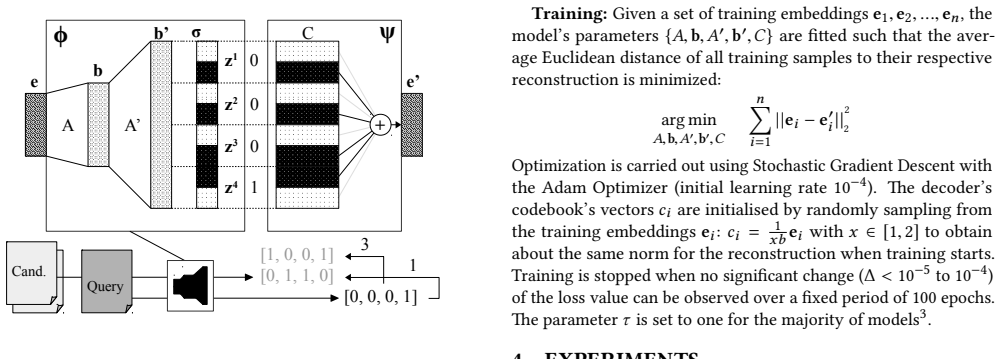
The load-bearing mechanism is the encoder–decoder compressor with a binary bottleneck. The encoder maps each embedding to b two-way softmax choices (via the Gumbel softmax trick), so the latent code is b bits after thresholding; the decoder reconstructs the input as a linear combination of codebook vectors selected by those bits, C·x. Training minimizes the average squared Euclidean distance between original and reconstructed embeddings, so the bits are forced to preserve the input geometry. At inference, thresholded bits compared by Hamming distance act as a proxy for that geometry, while the decorrelation of redundant input dimensions is the paper's proposed explanation for why the proxy works so well.
What would settle it
A direct check: on the same STS test sets, compare the learned 512-bit codes against random 512-bit projections and against the median-threshold baseline; if either matches the learned codes' Spearman correlation, the autoencoder's learned geometry is not the source of the gain.
Extended reading notes
Core claim
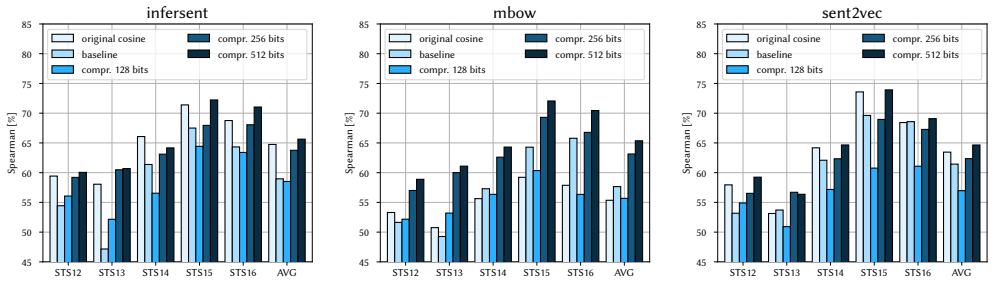
The discovery is that a neural autoencoder trained purely to minimize Euclidean reconstruction error over sentence embeddings produces binary bottleneck codes whose Hamming distances preserve semantic similarity almost as well as—and in some configurations better than—the original real-valued embeddings. This holds across three different upstream embedding types and across the STS 2012–2016 benchmarks, with the largest gains for averaged GloVe bag-of-words vectors. The same compressed codes also cut memory by up to 256:1 (for example, 4096-dimensional InferSent vectors drop from 163 GB to 640 MB for ten million items). On topic-oriented k-NN classification the compressed codes do not match the original cosine-similarity retrieval, so the paper frames the finding as specific to sentence-level semantic similarity rather than retrieval in general.
Load-bearing premise
The whole result rests on the bet that training the compressor to shrink the ordinary Euclidean distance between an embedding and its reconstruction also keeps the semantic-similarity ordering intact after the vectors are turned into bits; the paper shows this holds for sentence similarity but the topic-classification results show it is not universally true.
Editorial extensions
If this is right
- On the STS 2012–2016 benchmarks, systems can drop 4096-dimensional InferSent vectors to 512-bit codes — a 256:1 memory cut — while keeping semantic similarity ranking within the same range as the original floats.
- The largest gains from compression appear for averaged GloVe bag-of-words embeddings, so cheap embeddings become more competitive with supervised sentence encoders after binarization.
- Because a compressor trained on 100,000 Wikipedia sentences already reaches competitive STS scores, deploying the method does not require access to task-specific training data.
- Hamming-distance comparison over bits is cheaper in memory and compute than cosine similarity over floats, so the same ranking quality becomes available on low-memory or embedded devices.
- For topic-oriented k-NN classification the compressed codes trail the original embeddings, so the claim's scope is semantic similarity, not all retrieval tasks.
Reading between the lines
- Inference: the fact that the compressor never sees similarity labels suggests L2 reconstruction geometry is already aligned with human semantic similarity on sentence-level tasks; a direct test would be to add a ranking-aware loss and see whether STS scores increase or stay flat.
- Inference: the strong decorrelation result implies part of the gain may come from suppressing redundant dimensions rather than from the bit encoding itself; one could test this by pruning the most correlated dimensions from the original float vectors and measuring STS correlation against the compressed codes.
- Inference: the two-way softmax bottleneck is equivalent to learning one binary codebook per dimension, which resembles product quantization; connecting it to multi-index hashing could give a principled way to choose bit count per embedding family.
- Inference: if the pattern holds for other dense representations, any future sentence encoder could be retrofitted with this compressor as a post-processing step, letting retrieval systems swap precision for memory without retraining upstream models.
Signed reviews
Editorial analysis
A structured set of objections, weighed in public.
Referee Report
Summary. The paper proposes a neural encoder-decoder compressor that maps real-valued sentence embeddings (InferSent, Sent2Vec, GloVe-BoW) into low-dimensional binary Hamming codes. The encoder uses a Gumbel-softmax bottleneck with p=2 classes per bit, and the decoder reconstructs the original embedding as a linear combination of codebook vectors, with training minimizing Euclidean reconstruction error. At inference, the binary codes are compared with Hamming distance. Experiments on STS 2012-2016 report Spearman correlations comparable to or better than the original embeddings at compression ratios up to 256:1, while k-NN topic classification results are mixed. The paper also reports that the compressor decorrelates input dimensions and that training on Wikipedia sentences generalizes to the STS tasks.
Significance. If the central empirical claim holds, the paper provides a practically useful recipe for reducing the memory and computation cost of sentence embeddings in semantic similarity retrieval: for example, 4096-dimensional InferSent vectors are reduced to 512 bits while retaining competitive STS performance. The work is strengthened by its honest scope: the authors explicitly acknowledge that topic-oriented k-NN results are mixed and that the transfer is task-dependent. The release of source code and experimental results is a further positive. However, the empirical support for the central claim is weakened by the absence of confidence intervals or significance tests, by a partially documented hyperparameter choice (p=2), and by a baseline binarization that is not matched in bit budget. These issues are load-bearing because the observed differences between compressed and original embeddings are often only a few Spearman points.
major comments (4)
- [Section 4.1, Figure 2] The central claim that compressed Hamming embeddings are comparable to or better than the original embeddings is supported only by single-run Spearman values with no confidence intervals, significance tests, or multiple random seeds. Since differences of one to three percentage points separate the methods in several STS years, the claim cannot be distinguished from noise as reported. Please report means and standard deviations over multiple training runs (or at least bootstrap confidence intervals over the test pairs) and, where possible, a paired significance test for the comparisons that drive the abstract's claim.
- [Section 3 and Section 4.4] The model is trained on continuous Gumbel-softmax outputs with temperature tau and random Gumbel noise, but inference uses hard thresholding at 0.5 with the noise set to zero. This train-inference mismatch is not analyzed, and the paper provides no evidence that minimizing L2 reconstruction error transfers to preserving semantic ordering in Hamming space. The paper's own k-NN results (Figure 4) show that the transfer is not generally valid. To make the central claim load-bearing, please add an explicit evaluation of the thresholded codes against the continuous bottleneck outputs (e.g., same bit budget, same evaluation) and discuss where the Hamming ranking breaks down.
- [Section 4.1, baseline binarization] The 'baseline binarization' thresholds each dimension of the original embedding at its median, so for InferSent (4096 dimensions) the baseline is a 4096-bit code while the compressed models use 128, 256, or 512 bits. This is not a like-for-like comparison at the same bit budget, so the reported advantages of the learned compressor could partly reflect the difficulty of using a much longer binary code rather than the learned compression itself. Please add a binarization baseline with the same target bit count, for example a random projection or PCA projection followed by median thresholding, so that the contribution of the learned encoder-decoder is isolated.
- [Section 3, p=2] The paper states that p=2 is 'found to work best' but does not report the search procedure, the range of values tried, or whether the selection was made on validation data or on the STS test sets. If p or other hyperparameters (tau, learning rate, early stopping) were selected using the same test sets that are later reported, the results are optimistically biased. Please specify the validation protocol used for all hyperparameter choices.
minor comments (4)
- [Section 4.1, text referring to Figure 1] The sentence 'Also, Figure 1 shows that our model generalizes well...' should refer to Figure 3 (the training-set-size plot), not Figure 1 (the architecture diagram).
- [Figure 3] Figure 3 lacks a legend and axis labels that identify the embedding type, bit size, and evaluation dataset; without these, the claim that Wikipedia training outperforms target-domain training cannot be verified from the figure alone.
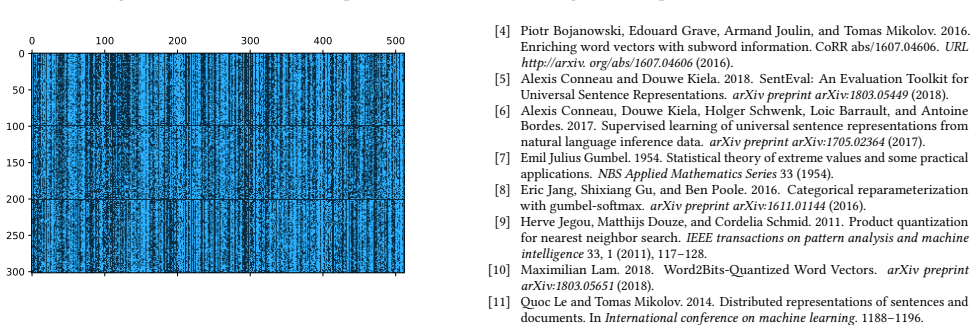
- [Section 4.3, Table 1] The correlation analysis in Table 1 is computed on the Wikipedia-1m training corpus; it is descriptive of the training data and should not be presented as an explanation of test-set STS performance without a direct link to the similarity task.
- [Abstract and Introduction] The term 'hamming' should be capitalized as 'Hamming' in the abstract and title. In addition, the related-work claim that no attempt to hash sentence embeddings has been evaluated so far is too strong given the existing literature on document-level semantic hashing; please soften it.
Circularity Check
No significant circularity: the central STS evaluation is held-out and not forced by the training objective or any fitted parameter.
full rationale
The paper's central claim is empirical: a compressor trained to minimize Euclidean reconstruction error (Section 3) yields Hamming codes that score comparably to uncompressed embeddings on STS benchmarks. The evaluation uses held-out STS test sets (SentEval STS 2012-2016) against ground-truth similarity annotations, so the result is not a restatement of the training objective or of any fitted parameter. The one tuned choice, p=2 ('which we found to work best'), is a hyperparameter selection, not a fitted prediction target. The correlation analysis in Table 1 is descriptive of the trained representation on the Wikipedia corpus and is not used to produce the STS numbers. No load-bearing self-citation appears: the compressor is based on external work (Shu & Nakayama, Tissier et al.), and the paper does not invoke any uniqueness theorem or own prior result to force its conclusions. The acknowledged limitation that k-NN topic classification results are mixed, and the unverified assumption that L2 reconstruction fidelity transfers to Hamming-order semantic similarity, are correctness and robustness concerns rather than circularity. Therefore no step reduces to its inputs by construction.
Assumptions & free parameters
free parameters (5)
- p (softmax classes per bit) =
2
- Gumbel temperature tau =
1 (majority), annealed to 0.75 for some
- Initial learning rate =
1e-4
- Early stopping threshold =
loss change < 1e-5 to 1e-4 over 100 epochs
- Codebook initialization scale x =
random in [1,2]
assumptions (5)
- standard math Gumbel-softmax provides a differentiable sample from a categorical distribution.
- domain assumption Pretrained sentence embeddings capture semantics in their geometry.
- domain assumption Minimizing L2 reconstruction error preserves semantic similarity after binarization.
- domain assumption Hamming distance on binary codes is a valid similarity measure for retrieval.
- domain assumption Wikipedia sentences are a suitable training source that generalizes to STS tasks.
Cite this review
Pith. "Pith review of Hamming Sentence Embeddings for Information Retrieval." pith.science (2026). https://pith.science/paper/FMSND5MR
@misc{pith2026190805541,
  author       = {Pith},
  title        = {Pith review of: Hamming Sentence Embeddings for Information Retrieval},
  year         = {2026},
  howpublished = {\url{https://pith.science/paper/FMSND5MR}},
  note         = {Machine review of arXiv:1908.05541}
}
read the original abstract
In retrieval applications, binary hashes are known to offer significant improvements in terms of both memory and speed. We investigate the compression of sentence embeddings using a neural encoder-decoder architecture, which is trained by minimizing reconstruction error. Instead of employing the original real-valued embeddings, we use latent representations in Hamming space produced by the encoder for similarity calculations. In quantitative experiments on several benchmarks for semantic similarity tasks, we show that our compressed hamming embeddings yield a comparable performance to uncompressed embeddings (Sent2Vec, InferSent, Glove-BoW), at compression ratios of up to 256:1. We further demonstrate that our model strongly decorrelates input features, and that the compressor generalizes well when pre-trained on Wikipedia sentences. We publish the source code on Github and all experimental results.
Figures

Figures from the paper (2 more)

Reference graph
Works this paper leans on
-
[1]
Sanjeev Arora, Yingyu Liang, and Tengyu Ma. 2016. A simple but tough-to-beat baseline for sentence embeddings. (2016)
work page 2016
-
[2]
Artem Babenko and Victor Lempitsky. 2014. Additive quantization for extreme vector compression. In Proceedings of the IEEE Conference on Computer Vision and Pa/t_tern Recognition. 931–938
work page 2014
-
[3]
John Blitzer, Mark Dredze, and Fernando Pereira. 2007. Biographies, bollywood, boom-boxes and blenders: Domain adaptation for sentiment classi/f_ication. In ACL ’07. 440–447
work page 2007
-
[4]
Piotr Bojanowski, Edouard Grave, Armand Joulin, and Tomas Mikolov. 2016. Enriching word vectors with subword information. CoRR abs/1607.04606. URL h/t_tp://arxiv. org/abs/1607.04606(2016)
arXiv 2016
-
[5]
Alexis Conneau and Douwe Kiela. 2018. SentEval: An Evaluation Toolkit for Universal Sentence Representations. arXiv preprint arXiv:1803.05449 (2018)
arXiv 2018
-
[6]
Alexis Conneau, Douwe Kiela, Holger Schwenk, Loic Barrault, and Antoine Bordes. 2017. Supervised learning of universal sentence representations from natural language inference data. arXiv preprint arXiv:1705.02364 (2017)
arXiv 2017
-
[7]
Emil Julius Gumbel. 1954. Statistical theory of extreme values and some practical applications. NBS Applied Mathematics Series 33 (1954)
1954
-
[8]
Eric Jang, Shixiang Gu, and Ben Poole. 2016. Categorical reparameterization with gumbel-so/f_tmax.arXiv preprint arXiv:1611.01144 (2016)
arXiv 2016
Show all 24 references
-
[9]
Herve Jegou, Ma/t_thijs Douze, and Cordelia Schmid. 2011. Product quantization for nearest neighbor search. IEEE transactions on pa/t_tern analysis and machine intelligence 33, 1 (2011), 117–128
2011
-
[10]
Maximilian Lam. 2018. Word2Bits-/Q_uantized Word Vectors. arXiv preprint arXiv:1803.05651 (2018)
2018 arXiv
-
[11]
/Q_uoc Le and Tomas Mikolov. 2014. Distributed representations of sentences and documents. In International conference on machine learning . 1188–1196
2014
-
[12]
Lajanugen Logeswaran and Honglak Lee. 2018. An efficient framework for learning sentence representations. arXiv preprint arXiv:1803.02893 (2018)
2018 arXiv
-
[13]
Chris J Maddison, Andriy Mnih, and Yee Whye Teh. 2016. /T_he concrete distri- bution: A continuous relaxation of discrete random variables. arXiv preprint arXiv:1611.00712 (2016)
2016 arXiv
-
[14]
Tomas Mikolov, Kai Chen, Greg Corrado, and Jeffrey Dean. 2013. Efficient estimation of word representations in vector space. arXiv preprint arXiv:1301.3781 (2013)
2013 arXiv
-
[15]
Mohammad Norouzi, Ali Punjani, and David J Fleet. 2014. Fast exact search in hamming space with multi-index hashing. IEEE transactions on pa/t_tern analysis and machine intelligence 36, 6 (2014), 1107–1119
2014
-
[16]
Ma/t_teo Pagliardini, Prakhar Gupta, and Martin Jaggi. 2017. Unsupervised learn- ing of sentence embeddings using compositional n-gram features. arXiv preprint arXiv:1703.02507 (2017)
2017 arXiv
-
[17]
Jeffrey Pennington, Richard Socher, and Christopher Manning. 2014. Glove: Global vectors for word representation. In Proceedings of the 2014 conference on empirical methods in natural language processing (EMNLP) . 1532–1543
2014
-
[18]
Ruslan Salakhutdinov and Geoffrey Hinton. 2009. Semantic hashing. International Journal of Approximate Reasoning 50, 7 (2009), 969–978
2009
-
[19]
Raphael Shu and Hideki Nakayama. 2017. Compressing Word Embeddings via Deep Compositional Code Learning. arXiv preprint arXiv:1711.01068 (2017)
2017 arXiv
-
[20]
Julien Tissier, Amaury Habrard, and Christophe Gravier. 2018. Near-lossless Binarization of Word Embeddings. arXiv preprint arXiv:1803.09065 (2018)
2018 arXiv
-
[21]
Volkan Tunali. 2010. Data Mining Research, Classic3 and Classic4 DataSets. Retrieved 2019-01-14 from h/t_tp://www.dataminingresearch.com/index.php/2010/ 09/classic3-classic4-datasets/
2010
-
[22]
John Wieting, Mohit Bansal, Kevin Gimpel, and Karen Livescu. 2015. Towards universal paraphrastic sentence embeddings. arXiv preprint arXiv:1511.08198 (2015)
2015 arXiv
-
[23]
Xiang Zhang and Yann LeCun. 2015. Text Understanding from Scratch. CoRR abs/1502.01710 (2015). arXiv:1502.01710 h/t_tp://arxiv.org/abs/1502.01710
2015 arXiv
-
[24]
Yukun Zhu, Ryan Kiros, Rich Zemel, Ruslan Salakhutdinov, Raquel Urtasun, Antonio Torralba, and Sanja Fidler. 2015. Aligning books and movies: Towards story-like visual explanations by watching movies and reading books. In Pro- ceedings of the IEEE international conference on c...
2015
Reviewed August 14, 2026 · model on record in the stance chip above.
Discussion (0). Continue with ORCID to comment.