A Levitated-Magnet Vector Force Sensor for Spin-Dependent Exotic Interactions
Pith reviewed 2026-07-01 01:36 UTC · model grok-4.3
The pith
A magnetically levitated ferromagnet can probe spin-dependent exotic electron-electron interactions at distances below one centimeter.
A machine-rendered reading of the paper's core claim, the machinery that carries it, and where it could break.
Core claim
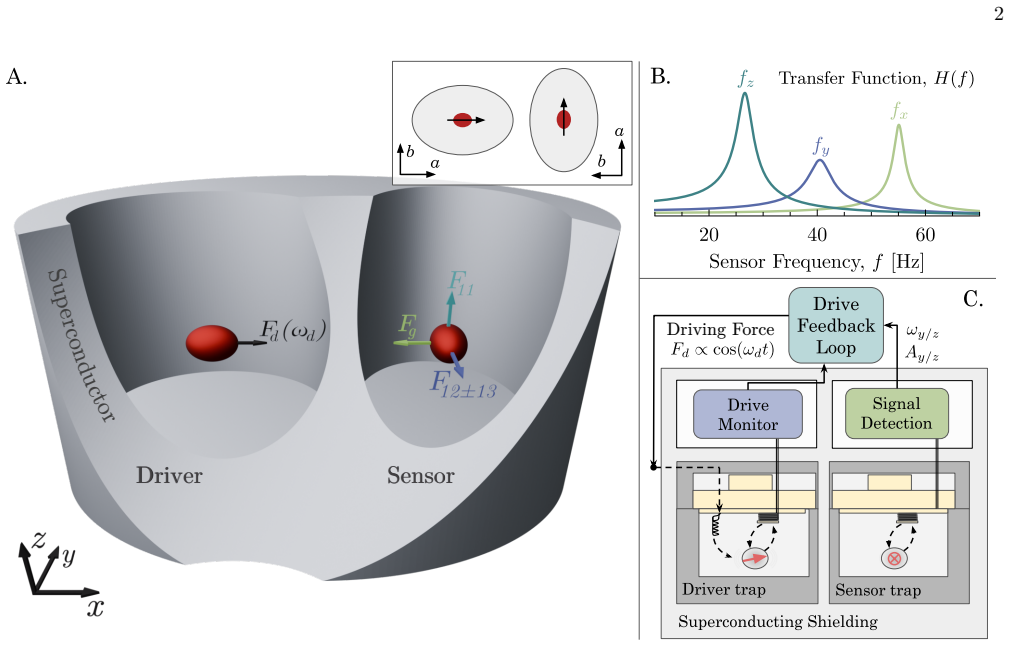
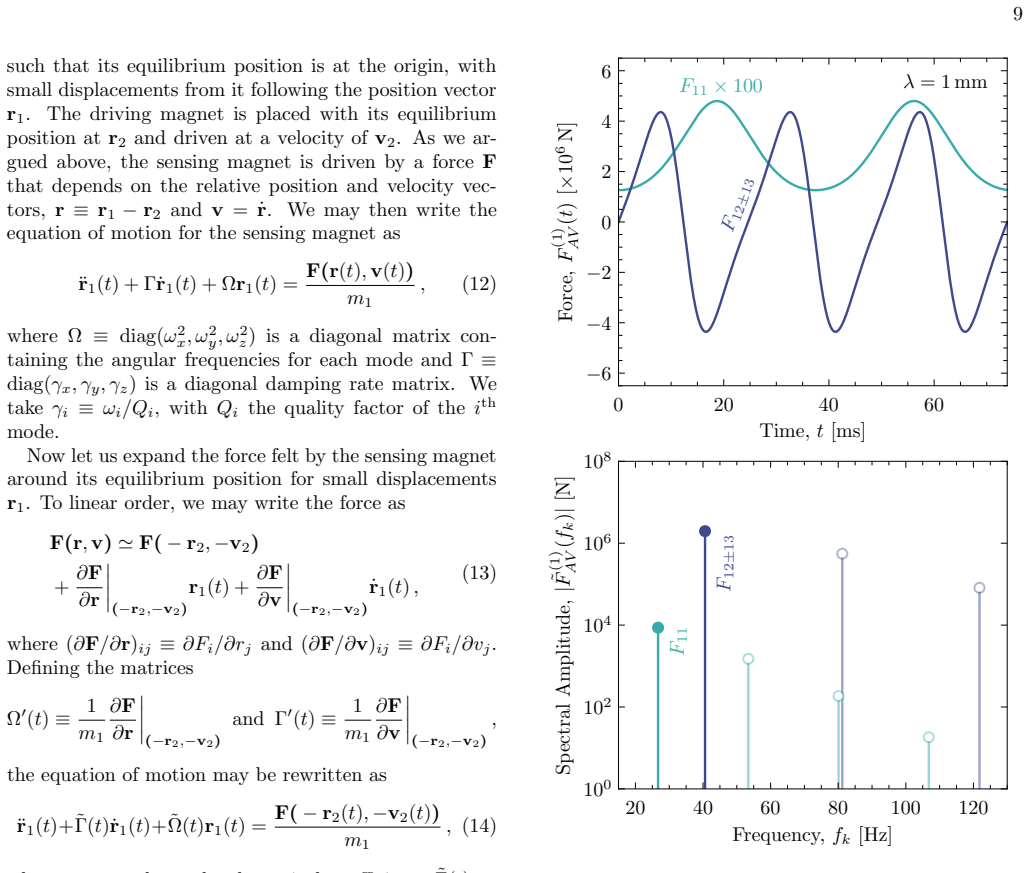
A defining feature of spin-dependent exotic interactions is that they can generate forces with distinct directional signatures set by the relative spin configuration of the interacting bodies. The sensor resolves these signatures by mapping forces along different axes onto distinct translational modes with different resonance frequencies, thereby separating interaction channels within the same coupling class. As a representative example, parity-violating axial-vector--vector interactions mediated by a spin-1 Z' boson between a sensing and a driving levitated ferromagnet can be probed for the pure electron-electron coupling g_A^e g_V^e in the range λ ≲ 1 cm using matched-filter likelihood ana
What carries the argument
magnetically levitated ferromagnetic vector force sensor that maps forces along different axes onto distinct translational modes with different resonance frequencies
Load-bearing premise
The assumption that the resonance frequencies of the distinct translational modes allow clean separation of the axial-vector-vector interaction channels without significant crosstalk or loss of sensitivity.
What would settle it
An experiment demonstrating that the translational modes of the levitated ferromagnets exhibit significant crosstalk between force channels or fail to achieve the required sensitivity for the projected coupling reach.
Figures
read the original abstract
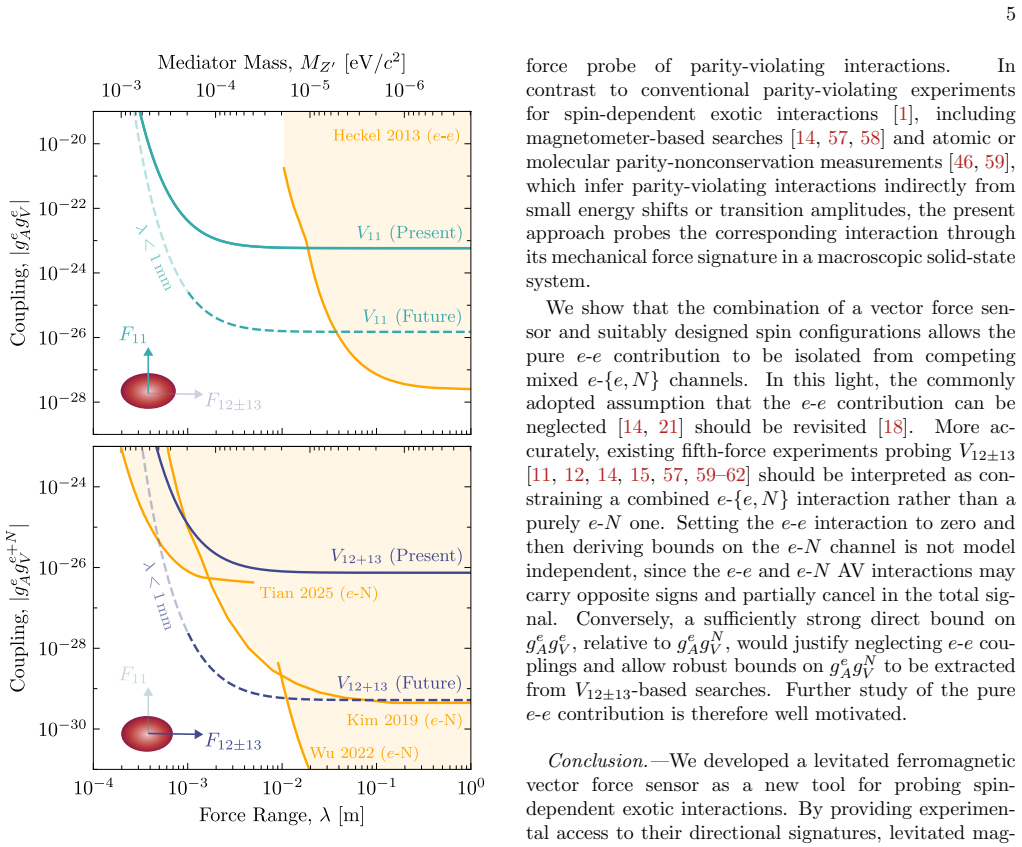
We present a magnetically levitated ferromagnetic vector force sensor that enables selective searches for spin-dependent exotic interactions mediated by beyond-Standard-Model bosons. A defining feature of spin-dependent exotic interactions is that they can generate forces with distinct directional signatures set by the relative spin configuration of the interacting bodies. We show that our sensor resolves these signatures by mapping forces along different axes onto distinct translational modes with different resonance frequencies, thereby separating interaction channels within the same coupling class. As a representative example, we study parity-violating axial-vector--vector interactions mediated by a spin-1 $Z'$ boson between a sensing and a driving levitated ferromagnet. Using a matched-filter likelihood analysis, we show that a setup based on an already demonstrated experiment can probe the pure electron--electron coupling $g_A^e g_V^e$ in the previously inaccessible force range $\lambda \lesssim 1\,\mathrm{cm}$, corresponding to mediator masses $M_{Z'} \gtrsim 10^{-5}\,\mathrm{eV}/c^2$. Our results establish levitated ferromagnets as a promising platform for millimeter-scale searches for spin-dependent fifth forces and for resolving the multiple effective potentials associated with a given coupling class.
Editorial analysis
A structured set of objections, weighed in public.
Referee Report
Summary. The manuscript proposes a magnetically levitated ferromagnetic vector force sensor for searches of spin-dependent exotic interactions. It claims that forces from axial-vector--vector couplings (mediated by a spin-1 Z' boson) produce distinct directional signatures that map onto separate translational modes of the levitated magnets, which have different resonance frequencies; a matched-filter likelihood analysis on an already-demonstrated experimental configuration then projects sensitivity to the pure electron-electron coupling g_A^e g_V^e in the previously inaccessible range λ ≲ 1 cm (M_Z' ≳ 10^{-5} eV/c²).
Significance. If the mode-separation premise holds with quantified crosstalk bounds, the work would establish levitated ferromagnets as a platform capable of resolving multiple effective potentials within a single coupling class at millimeter scales, extending fifth-force searches into a new regime without requiring new hardware beyond existing demonstrations.
major comments (1)
- [Abstract / mode-mapping description] Abstract and the section describing the mapping of forces onto translational modes: the assertion that distinct resonance frequencies enable clean separation of axial-vector--vector channels (and subsequent unambiguous attribution in the matched-filter analysis) is not accompanied by a quantitative bound on crosstalk from finite frequency separation, trap anharmonicity, or small misalignments. If off-diagonal coupling exceeds a few percent, the projected reach below λ = 1 cm cannot be substantiated.
Simulated Author's Rebuttal
We thank the referee for their careful review and constructive comment regarding the need for quantitative crosstalk bounds. We address the point below.
read point-by-point responses
-
Referee: [Abstract / mode-mapping description] Abstract and the section describing the mapping of forces onto translational modes: the assertion that distinct resonance frequencies enable clean separation of axial-vector--vector channels (and subsequent unambiguous attribution in the matched-filter analysis) is not accompanied by a quantitative bound on crosstalk from finite frequency separation, trap anharmonicity, or small misalignments. If off-diagonal coupling exceeds a few percent, the projected reach below λ = 1 cm cannot be substantiated.
Authors: We agree that the manuscript would be strengthened by explicit quantitative bounds on crosstalk. The original text relies on the distinct resonance frequencies of the translational modes (as demonstrated in the referenced experimental platform) to separate the axial-vector--vector channels but does not include a dedicated calculation of off-diagonal coupling from finite frequency separation, anharmonicity, or misalignments. In the revised manuscript we will add a new subsection that: (i) computes the frequency separation using the trap parameters from the existing demonstration, (ii) estimates anharmonic contributions via the known potential expansion, (iii) bounds misalignment effects at the level of typical experimental alignment precision, and (iv) shows that the resulting off-diagonal matrix elements remain below ~2% across the force range of interest. This will directly support the matched-filter projections for λ ≲ 1 cm. revision: yes
Circularity Check
No circularity; projection uses external demonstrated experiment and standard analysis
full rationale
The paper presents a sensitivity projection for a levitated-magnet sensor based on an already-demonstrated experiment, mapping forces to distinct translational modes and applying a matched-filter likelihood analysis. No step reduces by construction to a fitted input, self-definition, or self-citation chain; the mode-separation premise is an explicit assumption about the apparatus rather than an output derived from the target result. The derivation chain remains self-contained against external benchmarks and does not rename known results or smuggle ansatzes via citation.
Axiom & Free-Parameter Ledger
axioms (2)
- domain assumption Levitated ferromagnets produce distinct translational modes with different resonance frequencies that map one-to-one onto force directions.
- domain assumption The matched-filter likelihood analysis can extract the interaction signal from the sensor output without unaccounted systematics.
Reference graph
Works this paper leans on
-
[1]
Spin-dependent exotic interactions,
L. Cong, W. Ji, P. Fadeev, F. Ficek, M. Jiang, V. V. Flambaum, H. Guan, D. F. Jackson Kimball, M. G. Ko- zlov, Y. V. Stadnik, and D. Budker, “Spin-dependent exotic interactions,” Rev. Mod. Phys.97, 025005 (2025)
2025
-
[2]
Search for new physics with atoms and molecules,
M. S. Safronova, D. Budker, D. DeMille, D. F. J. Kimball, A. Derevianko, and C. W. Clark, “Search for new physics with atoms and molecules,” Rev. Mod. Phys.90, 025008 (2018)
2018
-
[3]
Origin of the matter- antimatter asymmetry,
M. Dine and A. Kusenko, “Origin of the matter- antimatter asymmetry,” Rev. Mod. Phys.76, 1 (2003)
2003
-
[4]
Dark matter candidates from particle physics and methods of detection,
J. L. Feng, “Dark matter candidates from particle physics and methods of detection,” Annual Review of Astronomy and Astrophysics48, 495 (2010)
2010
-
[5]
Cos- mological relaxation of the electroweak scale,
P. W. Graham, D. E. Kaplan, and S. Rajendran, “Cos- mological relaxation of the electroweak scale,” Phys. Rev. Lett.115, 221801 (2015)
2015
-
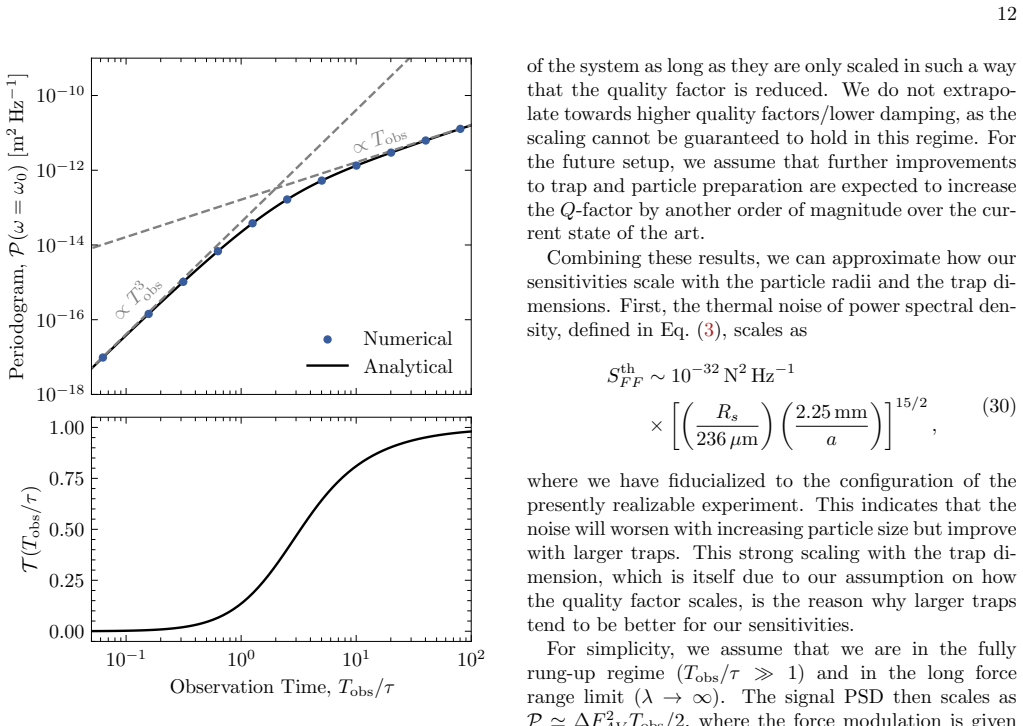
[6]
Review of particle physics,
S. Navaset al.(Particle Data Group), “Review of particle physics,” Phys. Rev. D110, 030001 (2024)
2024
-
[7]
New macroscopic forces?
J. E. Moody and F. Wilczek, “New macroscopic forces?” Phys. Rev. D30, 130 (1984)
1984
-
[8]
Spin-dependent macro- scopic forces from new particle exchange,
B. A. Dobrescu and I. Mocioiu, “Spin-dependent macro- scopic forces from new particle exchange,” J. High Energy Phys.2006, 005 (2006)
2006
-
[9]
Constraints on new vector boson mediated electron-nucleus interactions from spectroscopy data of polar diatomic molecules,
K. Gaul, L. Cong, and D. Budker, “Constraints on new vector boson mediated electron-nucleus interactions from spectroscopy data of polar diatomic molecules,” Phys. Rev. Lett.136, 181805 (2026)
2026
-
[10]
Constraint on an exotic parity-odd spin- and velocity-dependent interaction with atom in- terferometer,
Y.-B. Shu, T. Zhang, L.-L. Chen, Q. Luo, X.-B. Deng, W.-J. Xu, X.-C. Duan, X.-T. Fang, L.-S. Cao, Z.-K. Hu, and M.-K. Zhou, “Constraint on an exotic parity-odd spin- and velocity-dependent interaction with atom in- terferometer,” Phys. Rev. Lett.133, 213401 (2024)
2024
-
[11]
Ex- perimental constraint on an exotic parity-odd spin- and velocity-dependent interaction with a single electron spin quantum sensor,
M. Jiao, M. Guo, X. Rong, Y.-F. Cai, and J. Du, “Ex- perimental constraint on an exotic parity-odd spin- and velocity-dependent interaction with a single electron spin quantum sensor,” Phys. Rev. Lett.127, 010501 (2021)
2021
-
[12]
Constraints on velocity and spin dependent exotic in- teraction at the millimeter scale with a diamagnetic- levitated force sensor,
K. Tian, Y. Sheng, R. Li, L. Wang, P. Yin, S. Lin, D. Long, C.-K. Duan, X. Kong, P. Huang, and J. Du, “Constraints on velocity and spin dependent exotic in- teraction at the millimeter scale with a diamagnetic- levitated force sensor,” Phys. Rev. Lett.134, 111001 (2025)
2025
-
[13]
New experimental limits on exotic spin- spin-velocity-dependent interactions by using smco 5 spin sources,
W. Ji, Y. Chen, C. Fu, M. Ding, J. Fang, Z. Xiao, K. Wei, and H. Yan, “New experimental limits on exotic spin- spin-velocity-dependent interactions by using smco 5 spin sources,” Phys. Rev. Lett.121, 261803 (2018)
2018
-
[14]
Experimental limit on an exotic parity-odd spin- and velocity-dependent interaction using an optically polar- ized vapor,
Y. J. Kim, P.-H. Chu, I. Savukov, and S. Newman, “Experimental limit on an exotic parity-odd spin- and velocity-dependent interaction using an optically polar- ized vapor,” Nat Commun10, 2245 (2019)
2019
-
[15]
Preferred- frame andcp-violation tests with polarized electrons,
B. R. Heckel, E. G. Adelberger, C. E. Cramer, T. S. Cook, S. Schlamminger, and U. Schmidt, “Preferred- frame andcp-violation tests with polarized electrons,” Phys. Rev. D78, 092006 (2008)
2008
-
[16]
Precision physics of simple atoms and constraints on a light boson with ultraweak cou- pling,
S. G. Karshenboim, “Precision physics of simple atoms and constraints on a light boson with ultraweak cou- pling,” Phys. Rev. Lett.104, 220406 (2010)
2010
-
[17]
Improved constraints on exotic electron-proton interactions in hy- drogen,
L. Cong, F. Ficek, P. Fadeev, and D. Budker, “Improved constraints on exotic electron-proton interactions in hy- drogen,” Phys. Rev. A112, 052824 (2025)
2025
-
[18]
New limit on possible long-range parity-odd interactions of the neutron from neutron-spin rotation in liquid 4He,
H. Yan and W. M. Snow, “New limit on possible long-range parity-odd interactions of the neutron from neutron-spin rotation in liquid 4He,” Phys. Rev. Lett. 110, 082003 (2013)
2013
-
[19]
Revisiting spin- dependent forces mediated by new bosons: Potentials in the coordinate-space representation for macroscopic- and atomic-scale experiments,
P. Fadeev, Y. V. Stadnik, F. Ficek, M. G. Kozlov, V. V. Flambaum, and D. Budker, “Revisiting spin- dependent forces mediated by new bosons: Potentials in the coordinate-space representation for macroscopic- and atomic-scale experiments,” Phys. Rev. A99, 022113 (2019)
2019
-
[20]
Exotic-interaction searches on small scales via near-threshold enhancement,
R. Kang and X. Rong, “Exotic-interaction searches on small scales via near-threshold enhancement,” (2025), arXiv:2511.21073
-
[21]
Search for exotic spin- dependent interactions with a spin-based amplifier,
H. Su, Y. Wang, M. Jiang, W. Ji, P. Fadeev, D. Hu, X. Peng, and D. Budker, “Search for exotic spin- dependent interactions with a spin-based amplifier,” Sci- ence Advances7, eabi9535 (2021)
2021
-
[22]
Quantum magnetomechanics: Ultrahigh-q-levitated mechanical os- cillators,
M. Cirio, G. K. Brennen, and J. Twamley, “Quantum magnetomechanics: Ultrahigh-q-levitated mechanical os- cillators,” Phys. Rev. Lett.109, 147206 (2012)
2012
-
[23]
Quantum magnetomechanics with lev- itating superconducting microspheres,
O. Romero-Isart, L. Clemente, C. Navau, A. Sanchez, and J. I. Cirac, “Quantum magnetomechanics with lev- itating superconducting microspheres,” Phys. Rev. Lett. 109, 147205 (2012)
2012
-
[24]
Levitodynamics: Levitation and control of microscopic objects in vac- uum,
C. Gonzalez-Ballestero, M. Aspelmeyer, L. Novotny, R. Quidant, and O. Romero-Isart, “Levitodynamics: Levitation and control of microscopic objects in vac- uum,” Science374, eabg3027 (2021)
2021
-
[25]
Acceleration sensing with magnetically lev- itated oscillators above a superconductor,
C. Timberlake, G. Gasbarri, A. Vinante, A. Setter, and H. Ulbricht, “Acceleration sensing with magnetically lev- itated oscillators above a superconductor,” Appl. Phys. Lett.115, 224101 (2019)
2019
-
[26]
J. Hofer, “High-q magnetic levitation and control of superconducting microspheres at millikelvin tempera- tures,” Phys. Rev. Lett.131(2023), 10.1103/Phys- RevLett.131.043603
-
[27]
Superconducting microsphere mag- netically levitated in an anharmonic potential with inte- grated magnetic readout,
M. Gutierrez Latorre, G. Higgins, A. Paradkar, T. Bauch, and W. Wieczorek, “Superconducting microsphere mag- netically levitated in an anharmonic potential with inte- grated magnetic readout,” Phys. Rev. Appl.19, 054047 (2023)
2023
-
[28]
Levitated sensor for magnetometry in ambient environment,
W. Ji, C. Xu, G. Qu, and D. Budker, “Levitated sensor for magnetometry in ambient environment,” https://arxiv.org/abs/2504.21524v1 (2025)
-
[29]
Ultralow mechanical damping with meissner-levitated ferromagnetic microparticles,
A. Vinante, P. Falferi, G. Gasbarri, A. Setter, C. Tim- berlake, and H. Ulbricht, “Ultralow mechanical damping with meissner-levitated ferromagnetic microparticles,” Phys. Rev. Appl.13, 064027 (2020)
2020
-
[30]
Measuring gravity with milligram levi- tated masses,
T. M. Fuchs, D. G. Uitenbroek, J. Plugge, N. van Hal- teren, J.-P. van Soest, A. Vinante, H. Ulbricht, and T. H. 7 Oosterkamp, “Measuring gravity with milligram levi- tated masses,” Science Advances10, eadk2949 (2024)
2024
-
[31]
Ferromagnetic broadband sensing of axionlike dark matter
C. Peng, D. Budker, Y. Gao, X. Li, J. Liu, W. Ji, J. Shu, Z. Tang, and L. Wang, “Ferromagnetic broadband sens- ing of axionlike dark matter,” (2026), arXiv:2606.22814
work page internal anchor Pith review Pith/arXiv arXiv 2026
-
[32]
Superconducting levitated detector of gravitational waves,
D. Carney, G. Higgins, G. Marocco, and M. Wentzel, “Superconducting levitated detector of gravitational waves,” Phys. Rev. Lett.134, 181402 (2025)
2025
-
[33]
Maglev for dark mat- ter: Dark-photon and axion dark matter sensing with levitated superconductors,
G. Higgins, S. Kalia, and Z. Liu, “Maglev for dark mat- ter: Dark-photon and axion dark matter sensing with levitated superconductors,” Phys. Rev. D109, 055024 (2024)
2024
-
[34]
Surpassing the en- ergy resolution limit with ferromagnetic torque sensors,
A. Vinante, C. Timberlake, D. Budker, D. F. J. Kimball, A. O. Sushkov, and H. Ulbricht, “Surpassing the en- ergy resolution limit with ferromagnetic torque sensors,” Phys. Rev. Lett.127, 070801 (2021)
2021
-
[35]
Levitated milligram- scale ferromagnetic magnetometer at room tempera- ture,
Y. Sheng, Y. Leng, K. Tian, R. Li, Y. Chen, D. Long, S. Chen, X. He, and P. Yin, “Levitated milligram- scale ferromagnetic magnetometer at room tempera- ture,” Phys. Rev. Appl.25, 024090 (2026)
2026
-
[36]
Magnetic levitation as a new probe of non- newtonian gravity,
D. W. P. Amaral, T. M. Fuchs, H. Ulbricht, and C. D. Tunnell, “Magnetic levitation as a new probe of non- newtonian gravity,” Phys. Rev. D113, L021101 (2026)
2026
-
[37]
First search for ultralight dark mat- ter using a magnetically levitated particle,
D. W. P. Amaral, D. G. Uitenbroek, T. H. Oosterkamp, and C. D. Tunnell, “First search for ultralight dark mat- ter using a magnetically levitated particle,” Phys. Rev. Lett.134, 251001 (2025)
2025
-
[38]
Towards the direct detection of compos- ite ultraheavy dark matter in quantum sensor arrays,
D. W. P. Amaral, E. Cai, A. J. Long, J. Qin, and C. D. Tunnell, “Towards the direct detection of compos- ite ultraheavy dark matter in quantum sensor arrays,” https://arxiv.org/abs/2512.10124v1 (2025)
-
[39]
Mechanical sensors for ultraheavy dark matter searches via long-range forces,
J. Qin, D. W. P. Amaral, S. A. Bhave, E. Cai, D. Carney, R. F. Lang, S. Li, A. M. Marino, G. Marocco, C. Mar- vinney, J. R. Newton, J. M. Taylor, and C. Tunnell, “Mechanical sensors for ultraheavy dark matter searches via long-range forces,” Phys. Rev. D112, 072003 (2025)
2025
-
[40]
Dy- namics of a ferromagnetic particle levitated over a super- conductor,
T. Wang, S. Lourette, S. R. O’Kelley, M. Kayci, Y. Band, D. F. J. Kimball, A. O. Sushkov, and D. Budker, “Dy- namics of a ferromagnetic particle levitated over a super- conductor,” Phys. Rev. Applied11, 044041 (2019)
2019
-
[41]
Search for ultralight axion dark matter with a levitated ferromagnetic torsional oscilla- tor,
C. Li, Y. Huang, S. Yang, Y. Ren, Y. Zhang, P. Yin, P. Huang, and F. Xue, “Search for ultralight axion dark matter with a levitated ferromagnetic torsional oscilla- tor,” (2026), arXiv:2601.04576
-
[42]
Ultralight Dark Matter Detection with a Ferromagnet Lattice
D. Yang, X. Yang, C. Sun, and J. Zhang, “Ultra- light dark matter detection with a ferromagnet lattice,” (2026), arXiv:2602.17291
work page internal anchor Pith review Pith/arXiv arXiv 2026
-
[43]
Gravity probe spin: Prospects for measuring general-relativistic precession of intrinsic spin using a ferromagnetic gyro- scope,
P. Fadeev, T. Wang, Y. B. Band, D. Budker, P. W. Gra- ham, A. O. Sushkov, and D. F. J. Kimball, “Gravity probe spin: Prospects for measuring general-relativistic precession of intrinsic spin using a ferromagnetic gyro- scope,” Phys. Rev. D103, 044056 (2021)
2021
-
[44]
Ultralight dark matter detection with lev- itated ferromagnets,
S. Kalia, D. Budker, D. F. J. Kimball, W. Ji, Z. Liu, A. O. Sushkov, C. Timberlake, H. Ulbricht, A. Vinante, and T. Wang, “Ultralight dark matter detection with lev- itated ferromagnets,” Phys. Rev. D110, 115029 (2024)
2024
-
[45]
Ultra-light dark matter,
E. G. M. Ferreira, “Ultra-light dark matter,” Astron As- trophys Rev29, 7 (2021)
2021
-
[46]
Isotopic variation of parity violation in atomic ytterbium,
D. Antypas, A. Fabricant, J. E. Stalnaker, K. Tsigutkin, V. V. Flambaum, and D. Budker, “Isotopic variation of parity violation in atomic ytterbium,” Nat. Phys.15, 120 (2019)
2019
-
[47]
Long-range parity-nonconserving electron-nucleon in- teraction,
V. A. Dzuba, V. V. Flambaum, and P. Munro-Laylim, “Long-range parity-nonconserving electron-nucleon in- teraction,” Phys. Rev. A106, 012817 (2022)
2022
-
[48]
Experimental test of parity conservation in beta decay,
C. S. Wu, E. Ambler, R. W. Hayward, D. D. Hoppes, and R. P. Hudson, “Experimental test of parity conservation in beta decay,” Phys. Rev.105, 1413 (1957)
1957
-
[49]
Limits on exotic long-range spin-spin interactions of electrons,
B. R. Heckel, W. A. Terrano, and E. G. Adelberger, “Limits on exotic long-range spin-spin interactions of electrons,” Phys. Rev. Lett.111, 151802 (2013)
2013
-
[50]
Using the earth as a polarized electron source to search for long-range spin-spin interactions,
L. Hunter, J. Gordon, S. Peck, D. Ang, and J.-F. Lin, “Using the earth as a polarized electron source to search for long-range spin-spin interactions,” Science339, 928 (2013)
2013
-
[51]
Supplemental material for “a levitated-magnet vector force sensor for spin- dependent exotic interactions
See Supplemental Material, “Supplemental material for “a levitated-magnet vector force sensor for spin- dependent exotic interactions”, including our force com- putations, likelihood analysis, and future setups.”
-
[52]
Superconducting penetration depth of lead,
R. F. Gasparovic and W. L. McLean, “Superconducting penetration depth of lead,” Phys. Rev. B2, 2519 (1970)
1970
-
[53]
Magnetic shielding and exotic spin-dependent interactions,
D. F. Jackson Kimball, J. Dudley, Y. Li, S. Thulasi, S. Pustelny, D. Budker, and M. Zolotorev, “Magnetic shielding and exotic spin-dependent interactions,” Phys. Rev. D94, 082005 (2016)
2016
-
[54]
Ex- traction of signals from noise,
L. A. Wainstein, V. D. Zubakov, and A. A. Mullin, “Ex- traction of signals from noise,” inAmerican Journal of Physics, Vol. 31 (1963) pp. 68–68
1963
-
[55]
Asymptotic formulae for likelihood-based tests of new physics,
G. Cowan, K. Cranmer, E. Gross, and O. Vitells, “Asymptotic formulae for likelihood-based tests of new physics,” Eur. Phys. J. C71, 1554 (2011)
2011
-
[56]
Experimental limits on exotic spin and ve- locity dependent interactions using rotationally modu- lated source masses and an atomic-magnetometer array,
K. Y. Wu, S. Y. Chen, G. A. Sun, S. M. Peng, M. Peng, and H. Yan, “Experimental limits on exotic spin and ve- locity dependent interactions using rotationally modu- lated source masses and an atomic-magnetometer array,” Phys. Rev. Lett.129, 051802 (2022)
2022
-
[57]
Searching for exotic spin-dependent interactions using rotationally modulated source masses and an atomic magnetometer array,
K. Y. Wu, S. Y. Chen, J. Gong, M. Peng, and H. Yan, “Searching for exotic spin-dependent interactions using rotationally modulated source masses and an atomic magnetometer array,” Phys. Rev. D105, 055020 (2022)
2022
-
[58]
Search for exotic parity-violation interactions with quantum spin amplifiers,
Y. Wang, Y. Huang, C. Guo, M. Jiang, X. Kang, H. Su, Y. Qin, W. Ji, D. Hu, X. Peng, and D. Budker, “Search for exotic parity-violation interactions with quantum spin amplifiers,” Science Advances9, eade0353 (2023)
2023
-
[59]
Probing low-mass vector bosons with parity noncon- servation and nuclear anapole moment measurements in atoms and molecules,
V. A. Dzuba, V. V. Flambaum, and Y. V. Stadnik, “Probing low-mass vector bosons with parity noncon- servation and nuclear anapole moment measurements in atoms and molecules,” Phys. Rev. Lett.119, 223201 (2017)
2017
-
[60]
New constraints on exotic spin-dependent interactions with an ensemble- nv-diamond magnetometer,
H. Liang, M. Jiao, Y. Huang, P. Yu, X. Ye, Y. Wang, Y. Xie, Y.-F. Cai, X. Rong, and J. Du, “New constraints on exotic spin-dependent interactions with an ensemble- nv-diamond magnetometer,” Nat. Sci. Rev.10, nwac262 (2023)
2023
-
[61]
Using earth to search for long-range spin-velocity interactions,
N. B. Clayburn and L. R. Hunter, “Using earth to search for long-range spin-velocity interactions,” Phys. Rev. D 108, L051701 (2023)
2023
-
[62]
Search for a parity- violating long-range spin-dependent interaction,
X. Heng, Z. Xu, X. Huang, D. Gong, G. Tian, W. Ji, J. Fang, D. Budker, and K. Wei, “Search for a parity- violating long-range spin-dependent interaction,” Pro- ceedings of the National Academy of Sciences122, e2512538122 (2025)
2025
-
[63]
On the distribution of the likelihood ratio,
H. Chernoff, “On the distribution of the likelihood ratio,” The Annals of Mathematical Statistics25, 573 (1954)
1954
-
[64]
Magnetic dipole trapping potential between infinite superconducting plates,
F. J. Headley, “Magnetic dipole trapping potential between infinite superconducting plates,” (2025), arXiv:2504.18852. 8 Supplemental Material: A Levitated-Magnet Vector Force Sensor for Spin-Dependent Exotic-Interactions Dorian W. P. Amaral, Lei Cong, Tim M. Fuchs, Hendrik Ulbricht, and Dmitry Budker A. Forces from Potentials Consider a coordinate system...
-
[65]
and the dimensionless scaling factor T(x)≡ 1− 1−e −x x 2 (27) is the growth factor we introduced in Eq. (4). In the lim- iting regime that the observation time is much shorter than the damping time, the resonator is still ringing up and its displacement amplitude grows linearly with time. Conversely, for much larger observation times, the res- onance peak...
discussion (0)
Sign in with ORCID, Apple, or X to comment. Anyone can read and Pith papers without signing in.