REVIEW 3 major objections 5 minor 4 cited by
DMRG Approach to Optimizing Two-Dimensional Tensor Networks
T0 review · 3 major / 5 minor · reviewed 2026-08-14 · deepseek-v4-flash
Pith's one-line read This paper shows that DMRG, the algorithm that made one-dimensional tensor networks practical, carries over to two-dimensional PEPS by canonizing one column at a time and solving a regular eigenvalue problem for each local tensor.
desk verdict The paper delivers a working DMRG-style PEPS optimizer, but the approximate column canonization (fidelity >0.99) weakens the variational guarantee; the numerics are good enough to warrant a serious referee. read the letter →
The pith
A machine-rendered reading of the paper's core claim, the machinery that carries it, and where it could break.
The reading
What carries the argument
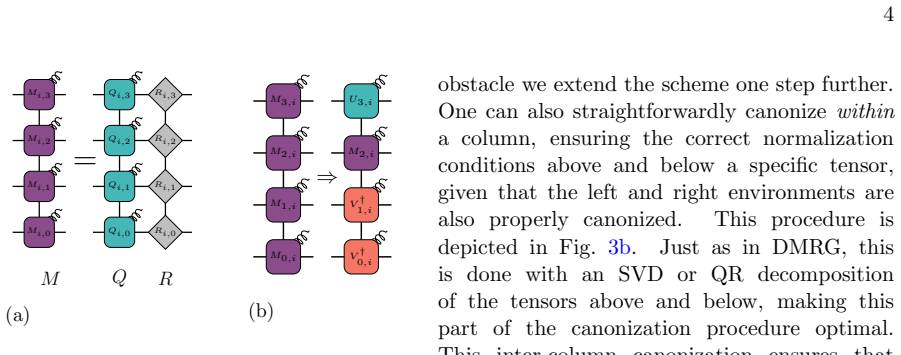
The central object is an approximate column canonization for PEPS. A column $M$ of the tensor network is decomposed into $Q R$, where $Q$ obeys the exact canonical condition and $R$ is an MPO-like remainder folded into the next column. The decomposition is found by iterating polar decompositions of environment tensors until the fidelity $\mathrm{Tr}[M^\dagger Q R]/\mathrm{Tr}[M^\dagger M]$ exceeds $0.99$. A second, intra-column canonization using SVD or QR makes the environments above and below the active tensor orthonormal, so the effective normalization matrix becomes the identity. This machinery converts the generalized eigenvalue problem for a PEPS update into a regular eigenvalue problem, which iterative solvers like Davidson can handle quickly and stably, allowing large tensor updates without losing numerical control.
What would settle it
Run the same Heisenberg calculation on a larger or more frustrated lattice while recording, for every column, the canonization fidelity $\mathrm{Tr}[M^\dagger Q R]/\mathrm{Tr}[M^\dagger M]$ and the energy after every sweep; if any optimized column has fidelity below $0.99$ or if the energy rises persistently instead of converging within about ten sweeps, the regular-eigenvalue form of the algorithm is not delivering the claimed stable convergence.
Extended reading notes
Core claim
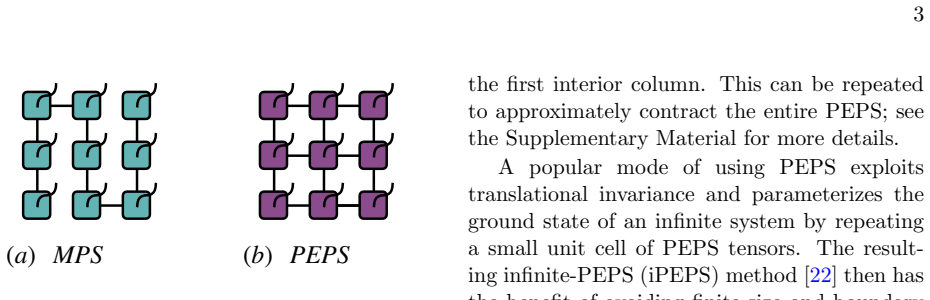
The central claim is that there is no obstacle in principle to a PEPS optimization with all of DMRG's technical machinery. Working on finite PEPS with open boundary conditions, the authors canonize the network one column at a time: each optimized column $M$ is factored into a unitary column $Q$, which carries the physical indices and stays in the network, and a non-unitary remainder $R$, which is multiplied into the neighboring column. A second, intra-column canonization then imposes orthogonality above and below the tensor being updated. With these two canonization steps, the normalization matrix $\hat N$ for the environment becomes the identity to good approximation, so the local energy minimization becomes a regular eigenvalue problem $\hat H v = \lambda v$ solved by a Davidson iteration, exactly as in MPS-DMRG. On the square-lattice spin-$1/2$ Heisenberg model, the resulting algorithm converges in roughly ten sweeps, reproduces nearest-neighbor correlators at accuracy comparable to state-of-the-art infinite-PEPS methods, and shows residual errors controlled by the bond dimension $D$.
Load-bearing premise
The whole method rests on the approximate column canonization being accurate enough, fidelity above $0.99$ in practice, that replacing a PEPS column by its unitary factor $Q$ times the remainder $R$ only distorts the Hamiltonian slightly; if that approximation fails, the regular eigenvalue solve can minimize a distorted energy and the variational guarantee is lost.
Editorial extensions
If this is right
- Finite PEPS ground states can be optimized with all three DMRG advantages: an orthonormal background from canonization, a regular eigenvalue problem at each site, and large tensor updates without losing stability.
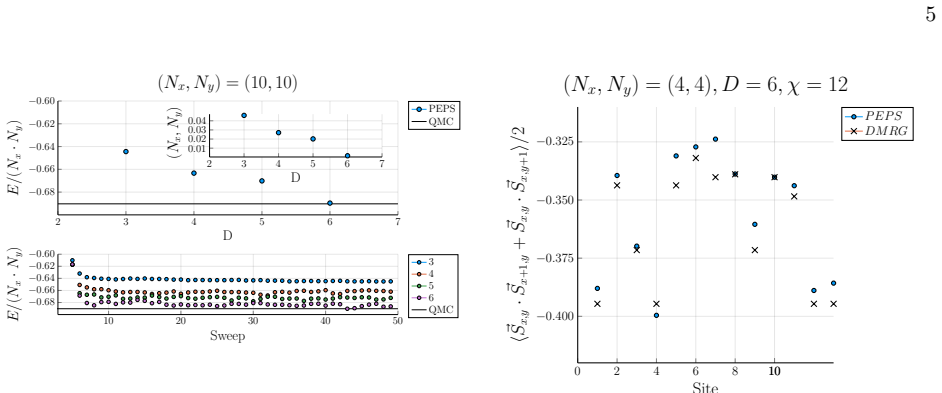
- For the square-lattice Heisenberg model up to $10 \times 10$, the PEPS-DMRG energy converges to within about $10^{-2}$ of the converged value within roughly ten sweeps, with the remaining error controlled by the bond dimension $D$.
- Unlike MPS-DMRG on ladders, where the required bond dimension grows exponentially with the ladder width, PEPS-DMRG uses a modest bond dimension independent of system size for fixed accuracy.
- Nearest-neighbor spin-spin correlators from PEPS-DMRG match essentially exact MPS-DMRG results to an accuracy comparable to state-of-the-art iPEPS calculations at similar bond dimension.
- The algorithm's runtime is dominated by tensor contractions and MPO-MPO multiplications, identifying concrete targets for performance optimization in future implementations.
Reading between the lines
- If canonization fidelity can be pushed reliably above $0.99$, the occasional energy increases the paper reports should disappear, and the convergence in sweeps might approach the exponential rate that DMRG achieves for gapped one-dimensional systems.
- A two-site variant that dynamically grows the bond dimension, which the paper names as future work, would remove the need to guess $D$ in advance and should also be better at escaping local minima; the one-site version presented here freezes the bond dimension throughout.
- Because the algorithm works on finite open-boundary systems, it could be paired with finite-size scaling to extract bulk quantities; the paper does not report such extrapolated values, but its boundary-pinned Heisenberg data would support that analysis.
- A head-to-head comparison of this finite PEPS-DMRG method with translation-invariant iPEPS on the same bulk observable would settle whether the finite-size, DMRG-style approach can compete with infinite-system optimization; the paper flags this comparison as an open question.
Editorial analysis
A structured set of objections, weighed in public.
Referee Report
Summary. The manuscript presents a finite-PEPS ground-state optimization algorithm that directly adapts the one-site DMRG workflow. After optimizing a column, the column is approximately canonized into a unitary column Q and an MPO remainder R; R is absorbed into the neighboring column, and additional within-column canonization is used so that each local tensor update is formulated as a regular eigenvalue problem solved with Davidson. Sweeps over all columns are repeated until convergence. The method is tested on the square-lattice spin-1/2 Heisenberg model with open boundaries for L = 4, 6, 8, 10, reporting energies versus PEPS bond dimension D and versus sweep number, compared with QMC energies, and nearest-neighbor spin-spin correlators compared with MPS-DMRG. The authors claim that the three features that make MPS-DMRG powerful---enforcing a canonical/orthonormal basis, solving regular eigenvalue problems with iterative solvers, and making large stable updates---are realized for PEPS.
Significance. If the method is validated, it would provide a competitive variational finite-PEPS approach that inherits the favorable convergence and stability properties of DMRG, and it would be a useful tool for finite-size two-dimensional systems. The paper's strengths are the clean benchmark setting (Heisenberg model compared with essentially exact QMC and MPS-DMRG references), the clear outline of the algorithmic pipeline, and the availability of an ITensor-based implementation. However, the approximate column canonization lies at the heart of the method, and the manuscript does not supply enough numerical control over this approximation to establish that the regular eigenvalue solve optimizes the true PEPS energy. With additional convergence data the central claim would be credible; as written it is promising but not fully demonstrated.
major comments (3)
- [Canonization of PEPS (Fig. 3)] The local update is a regular eigenvalue problem H v = lambda v only for the canonized, approximate wavefunction: the text states that 'the product of Q times R generally differs from the original, input column by a small amount' and that the stopping criterion is a fidelity Tr[M^dag Q R]/Tr[M^dag M] of only > 0.99. Because R is folded into the neighboring column, the effective Hamiltonian solved at each step differs from the Hamiltonian in the true PEPS basis, so DMRG's variational guarantee and the claimed property of 'representing the Hamiltonian within an orthonormal basis during the entire calculation' are not inherited. The paper also attributes 'occasional increases in energy' to this same approximation, which directly weakens the claim of large, stable updates. Please report the actual canonization fidelity achieved per sweep rather than only the >0.99 threshold, show convergence of the final energy as the allowed canonization error is reduced, and provide evidence that the energy is controlled by the approximation error. Without this, the central mechanism claimed in the abstract and introduction is not established.
- [Application to the Heisenberg Model (Fig. 4 and Fig. 5)] No environment bond dimension chi is reported for the energy-versus-D curves in Fig. 4, and Fig. 5 uses chi = 12 without a convergence study. The approximate boundary-MPS contraction is an independent source of bias, so the agreement with QMC in Fig. 4 could depend on chi as well as D. Please provide energies versus chi for at least the largest D shown and for each system size, or otherwise demonstrate that the reported numbers are converged in chi.
- [Canonization of PEPS and Supplemental Material] The reproducibility and verification of the canonization step depend on details placed in the Supplementary Material: the full canonization algorithm, the MPO-MPS contraction procedure, and the intra-column canonization. As written, the main text does not specify the internal bond dimensions of Q and R used in the canonization, the number of canonization passes, or the contraction parameters, so the reader cannot assess whether the reported 'small amount' of canonization error is typical or contingent. Please include these parameters in the main text or in a clearly labeled table, and report the actually achieved fidelity for the calculations shown in Figs. 4 and 5.
minor comments (5)
- [Projected Entangled Pair States] The section heading reads 'Projected Pair Entangled States'; this should be 'Projected Entangled Pair States'.
- [Introduction] The phrase 'A promising ways to break through this scaling issue' is grammatically incorrect and should be 'A promising way'.
- [Application to the Heisenberg Model (Fig. 5)] The correlator comparison is shown only for L = 4; please state whether similar accuracy holds for L = 6, 8, 10, or clarify that the correlator benchmark was only performed for the smallest system.
- [Application to the Heisenberg Model] The number of initial simple-update sweeps is not specified, although the text says the optimization starts with 'simple update sweeps of the system for only the first several sweeps.' Please state this number and any associated parameters, since it is part of the optimization protocol.
- [Fig. 4] The bottom subfigure appears to contain several curves with labels 3, 4, 5, 6, but the text says the lower plot is for D = 6; please clarify which curves correspond to which bond dimension, including the QMC reference.
Circularity Check
No circularity found: the PEPS energy is minimized directly and external QMC/MPS-DMRG results serve only as benchmarks, not as fitted inputs.
full rationale
The paper's central claim is that the three features of DMRG—canonical/orthonormal basis, regular eigenvalue solves, and large stable updates—can be adapted to finite PEPS. The algorithm optimizes the PEPS energy directly: local tensors are updated by a Davidson eigensolver on a regular eigenvalue problem after an approximate column canonization, and the resulting energies and correlators are compared with quantum Monte Carlo and MPS-DMRG results. No parameter is fitted to those benchmark data; D, chi, and the fidelity threshold are numerical convergence parameters, not fitted constants. The approximate nature of the canonization is explicitly admitted by the paper ('the product of Q times R generally differs from the original, input column by a small amount') and is cited as the cause of 'occasional increases in energy'; this is a numerical approximation that weakens the exact variational guarantee, but it is not a circular step because the local solve is an optimization for the approximate state, not a restatement of the output in terms of its inputs. The self-citations present (e.g., the Stoudenmire and White review and the ITensor library) are background or implementation references and are not load-bearing for the derivation. The paper is therefore self-contained against external benchmarks, and no prediction reduces by construction to its inputs.
Assumptions & free parameters
free parameters (6)
- PEPS bond dimension D =
2 to 7 (10x10 results)
- environment bond dimension chi =
12 (correlator figure); not reported for energy figure
- number of DMRG sweeps =
50
- canonization fidelity threshold =
> 0.99
- number of initial simple-update sweeps =
not specified ('first several sweeps')
- random initialization seed =
not specified
assumptions (5)
- domain assumption A PEPS with modest bond dimension (D up to about 20) can accurately represent ground states of 2D spin lattices with accuracy that does not degrade with system size.
- domain assumption The boundary MPS-MPO contraction method yields sufficiently accurate expectation values and local environments for the PEPS sizes and bond dimensions studied.
- ad hoc to paper After approximate column canonization with fidelity > 0.99, the normalization matrix is close enough to the identity that the regular eigenvalue problem H v = lambda v optimizes the original PEPS energy.
- standard math The unitary factor from a polar decomposition of the environment tensor has maximal overlap with that environment (proved by Refs. [31-33]).
- domain assumption The staggered pinning field on boundary spins does not significantly perturb the bulk ground-state energy or correlations of the Heisenberg model.
Cite this review
Pith. "Pith review of DMRG Approach to Optimizing Two-Dimensional Tensor Networks." pith.science (2026). https://pith.science/paper/FO6D4B2V
@misc{pith2026190808833,
  author       = {Pith},
  title        = {Pith review of: DMRG Approach to Optimizing Two-Dimensional Tensor Networks},
  year         = {2026},
  howpublished = {\url{https://pith.science/paper/FO6D4B2V}},
  note         = {Machine review of arXiv:1908.08833}
}
read the original abstract
Tensor network algorithms have been remarkably successful solving a variety of problems in quantum many-body physics. However, algorithms to optimize two-dimensional tensor networks known as PEPS lack many of the aspects that make the seminal density matrix renormalization group (DMRG) algorithm so powerful for optimizing one-dimensional tensor networks known as matrix product states. We implement a framework for optimizing two-dimensional PEPS tensor networks which includes all of steps that make DMRG so successful for optimizing one-dimension tensor networks. We present results for several 2D spin models and discuss possible extensions and applications.
Figures

Figures from the paper (1 more)
Forward citations
Cited by 4 Pith papers
-
Diagonal Isometric Form for Tensor Network States in Two Dimensions
A new isometric form for 2D tensor network states uses auxiliary tensors on a 45-degree rotated lattice, enabling a local Yang-Baxter move and a TEBD algorithm that captures area-law ground states and short-time dynamics.
-
Pauli propagation enables fast classical simulation of strongly correlated quantum systems
A classical algorithm combining sparse Pauli dynamics with a variational double bracket flow estimates ground-state energies of Heisenberg and Hubbard models with sub-1% error vs DMRG, with large speedups on some 2D systems.
-
Advantages of density in tensor network geometries for gradient based training
Densely connected tensor network geometries train to lower infidelity than sparse ones on random quantum states, and a new leaf-contraction trick reduces memory while improving training.
-
Accurate simulation for finite projected entangled pair states in two dimensions
A variational Monte Carlo scheme for finite PEPS, with a sequential spin-pair update, accurately simulates 32x32 Heisenberg and 24x24 frustrated J1-J2 lattices.
Reference graph
Works this paper leans on
-
[1]
S. R. White, Phys. Rev. Lett. 69, 2863 (1992)
1992
- [2]
-
[3]
S. R. White, Phys. Rev. B 72, 180403 (2005)
2005
-
[4]
Schollw¨ ock, Rev
U. Schollw¨ ock, Rev. Mod. Phys.77, 259 (2005)
2005
-
[5]
I. P. McCulloch, arXiv preprint arXiv:0804.2509 (2008)
arXiv 2008
- [6]
-
[7]
J. Dukelsky, M. A. Mart´ ın-Delgado, T. Nishino, and G. Sierra, EPL (Europhysics Letters) 43, 457 (1998)
work page 1998
-
[8]
Schollw¨ ock, Annals of Physics 326, 96 (2011)
U. Schollw¨ ock, Annals of Physics 326, 96 (2011)
2011
Show all 39 references
-
[9]
Or´ us, Annals of Physics349, 117 (2014)
R. Or´ us, Annals of Physics349, 117 (2014)
2014
-
[10]
Stoudenmire and S
E. Stoudenmire and S. R. White, Annual Re- view of Condensed Matter Physics 3, 111 (2012)
2012
-
[11]
J. P. F. LeBlanc, A. E. Antipov, F. Becca, I. W. Bulik, G. K.-L. Chan, C.-M. Chung, Y. Deng, M. Ferrero, T. M. Henderson, C. A. Jim´ enez- Hoyos, E. Kozik, X.-W. Liu, A. J. Millis, N. V. Prokof’ev, M. Qin, G. E. Scuseria, H. Shi, B. V. Svistunov, L. F. Tocchio, I. S. Tupitsyn,...
2015
- [12]
-
[13]
Wu, S.-S
H.-Q. Wu, S.-S. Gong, and D. N. Sheng, Phys. Rev. B 99, 085141 (2019)
2019
-
[14]
Kurashige, G
Y. Kurashige, G. K.-L. Chan, and T. Yanai, Nat Chem 5, 660 (2013)
2013
-
[15]
A. J. Daley, C. Kollath, U. Schollw¨ ock, and G. Vidal, Journal of Statistical Mechanics: The- ory and Experiment 2004, P04005 (2004)
2004
-
[16]
S. R. White and A. E. Feiguin, Phys. Rev. Lett. 93, 076401 (2004)
2004
-
[17]
Verstraete, J
F. Verstraete, J. J. Garc´ ıa-Ripoll, and J. I. Cirac, Phys. Rev. Lett. 93, 207204 (2004)
2004
-
[18]
Zwolak and G
M. Zwolak and G. Vidal, Phys. Rev. Lett. 93, 207205 (2004)
2004
-
[19]
A. E. Feiguin and S. R. White, Phys. Rev. B 72, 220401 (2005)
2005
-
[20]
S. R. White, Phys. Rev. Lett. 102, 190601 (2009)
2009
- [21]
-
[22]
Jordan, R
J. Jordan, R. Or´ us, G. Vidal, F. Verstraete, and J. I. Cirac, Phys. Rev. Lett. 101, 250602 (2008)
2008
-
[23]
Vanderstraeten, J
L. Vanderstraeten, J. Haegeman, P. Corboz, and F. Verstraete, Phys. Rev. B 94, 155123 (2016)
2016
-
[24]
Corboz, Phys
P. Corboz, Phys. Rev. B 94, 035133 (2016)
2016
-
[25]
M. P. Zaletel and F. Pollmann, Phys. Rev. Lett. 124, 037201 (2020)
2020
-
[26]
Haghshenas, M
R. Haghshenas, M. J. O’Rourke, and G. K.-L. Chan, Phys. Rev. B 100, 054404 (2019)
2019
-
[27]
S. Yan, D. A. Huse, and S. R. White, Science 332, 1173 (2011)
2011
-
[28]
Depenbrock, I
S. Depenbrock, I. P. McCulloch, and 7 U. Schollw¨ ock, Phys. Rev. Lett. 109, 067201 (2012)
2012
-
[29]
S. S. Jahromi, R. Or´ us, M. Kargarian, and A. Langari, Phys. Rev. B 97, 115161 (2018)
2018
- [30]
-
[31]
Evenbly, Phys
G. Evenbly, Phys. Rev. B 95, 045117 (2017)
2017
- [32]
-
[33]
P. H. Sch¨ onemann, Psychometrika31, 1 (1966)
1966
-
[34]
Bauer, G
B. Bauer, G. Vidal, and M. Troyer, Journal of Statistical Mechanics: Theory and Experiment 2009, P09006 (2009)
2009
-
[35]
Rader and A
M. Rader and A. M. L¨ auchli, Phys. Rev. X 8, 031030 (2018)
2018
-
[36]
Lubasch, J
M. Lubasch, J. I. Cirac, and M.-C. Ba˜ nuls, Phys. Rev. B 90, 064425 (2014)
2014
-
[37]
Z.-C. Gu, M. Levin, and X.-G. Wen, Phys. Rev. B 78, 205116 (2008)
2008
-
[38]
ITensor Library (Julia version 0.1),
“ITensor Library (Julia version 0.1),” (2020), https://github.com/ITensor/ITensors.jl
2020
-
[39]
ITensorsGPU.jl (version 0.1),
“ITensorsGPU.jl (version 0.1),” (2020), https://github.com/ITensor/ITensorsGPU.jl
2020
Reviewed August 14, 2026 · model on record in the stance chip above.
Discussion (0). Continue with ORCID to comment.