Intrinsic handedness in O1-O4a black-hole mergers: probing orbital precession, remnant retention in dense environments and cosmological mirror asymmetry
Pith reviewed 2026-06-27 00:11 UTC · model grok-4.3
The pith
Black-hole merger handedness analysis of 91 events indicates precessing dynamics in 92% and at most 8% remnant retention in clusters.
A machine-rendered reading of the paper's core claim, the machinery that carries it, and where it could break.
Core claim
Precessing binary black-holes produce an imbalance of right- and left-handed gravitational waves. Using the quantity V_GW to measure this handedness in 91 observed mergers, 92% of events favor non-vanishing values indicating precessing dynamics. The relation to remnant recoil constrains at most 8% to remain bound in clusters. The distribution is consistent with symmetry under V_GW to -V_GW, with average -1.9^{+6.1}_{-6.6} x 10^{-3}.
What carries the argument
V_GW, the observer-independent gravitational analogue of the optical Stokes parameter that quantifies the intrinsic handedness of the emitted radiation.
If this is right
- Orbital precession is predominant in the population of binary black-hole mergers.
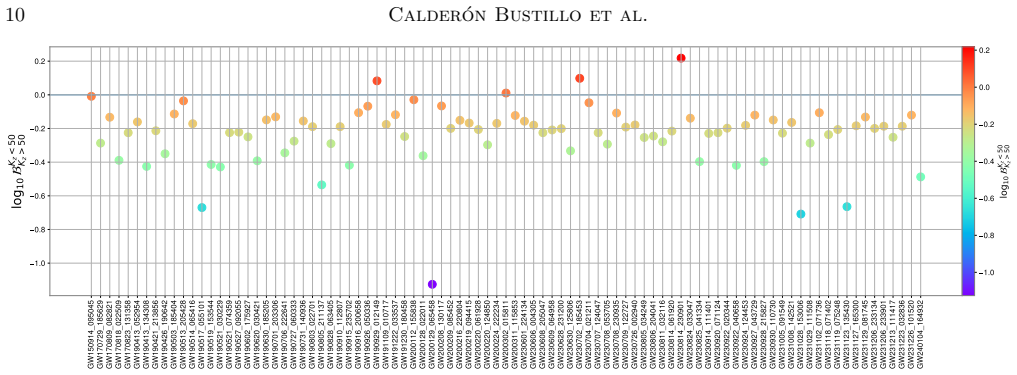
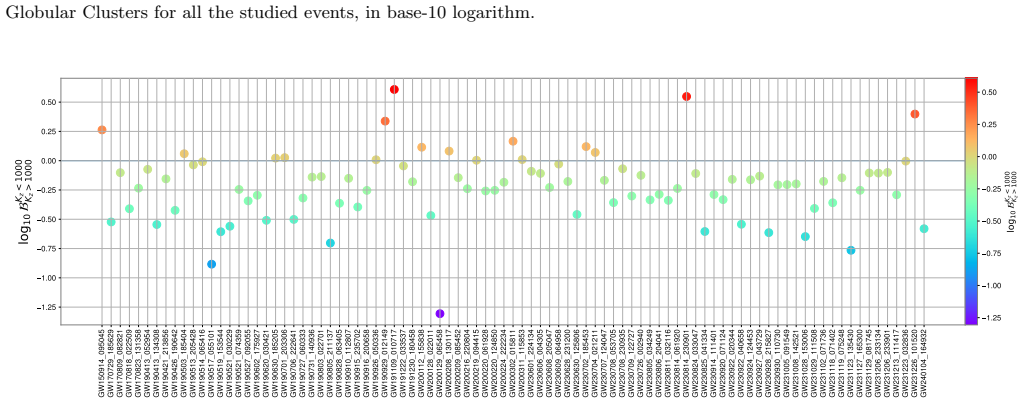
- At most 8% of merger remnants could remain bound to globular or nuclear star clusters for hierarchical mergers.
- The cosmological distribution of black-hole mergers shows no preferred handedness, consistent with statistical isotropy.
- The addition of O4a data reduces uncertainties in the average handedness by about 40%.
Where Pith is reading between the lines
- Future observations could use this handedness measure to distinguish between different black-hole formation channels.
- Improved measurements might test for violations of mirror symmetry on cosmological scales.
- This approach links local dynamics to global cosmological properties through a single observable.
Load-bearing premise
The recently established relation between V_GW and the remnant black hole recoil holds accurately enough for the observed events.
What would settle it
Observing a retention fraction significantly higher than 8% in cluster environments or detecting a statistically significant non-zero average V_GW.
Figures
read the original abstract
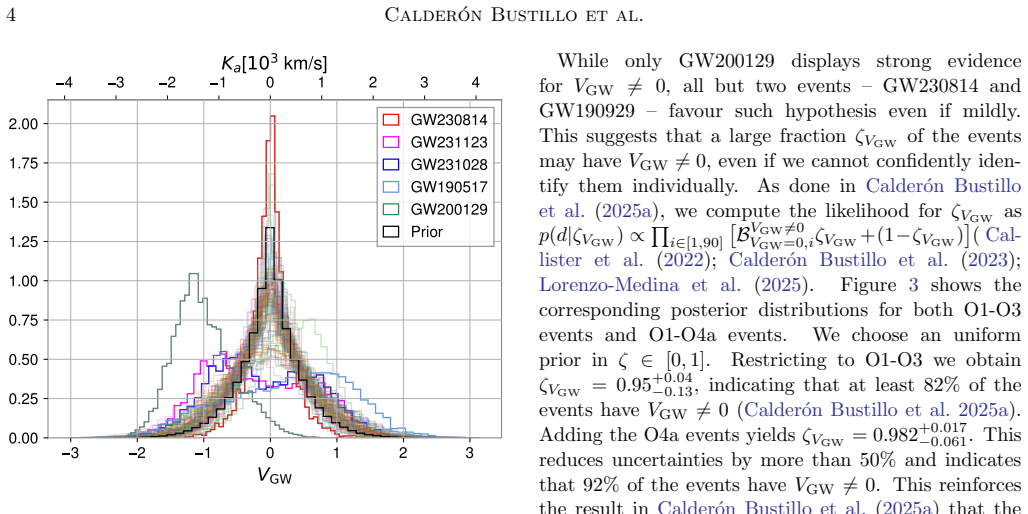
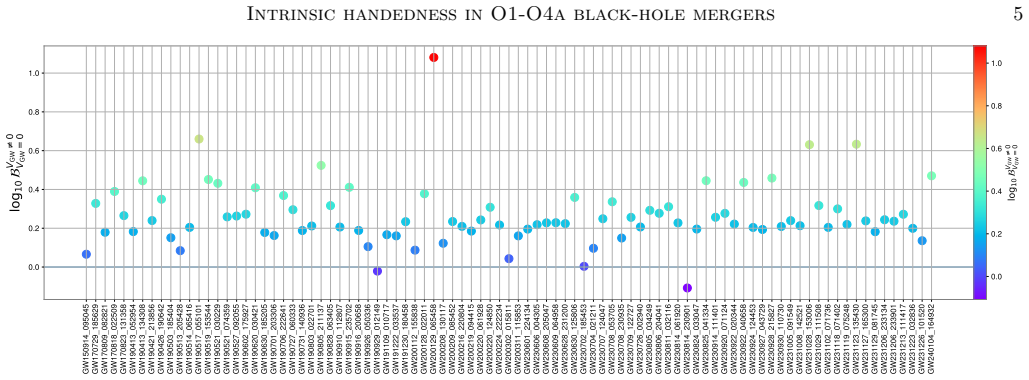
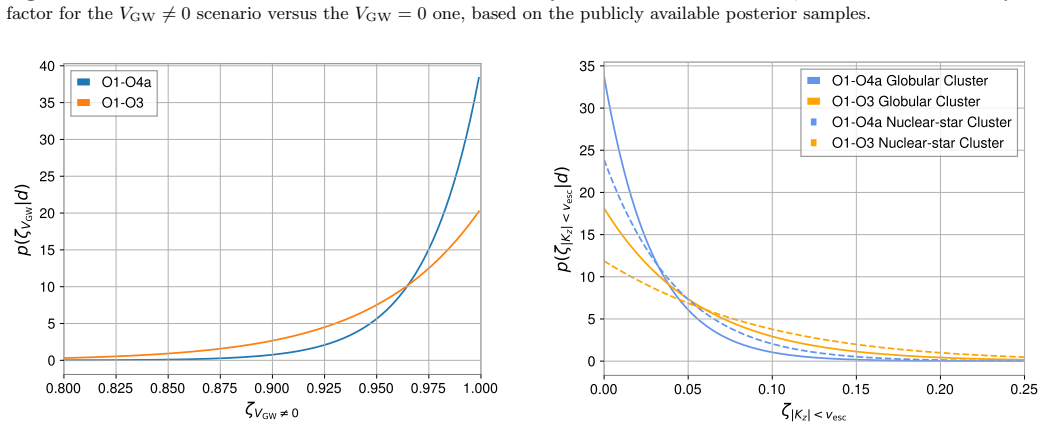
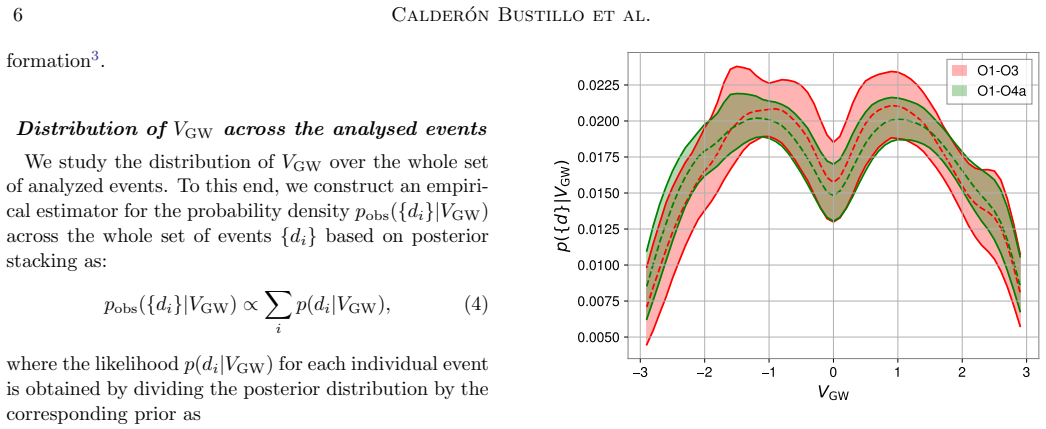
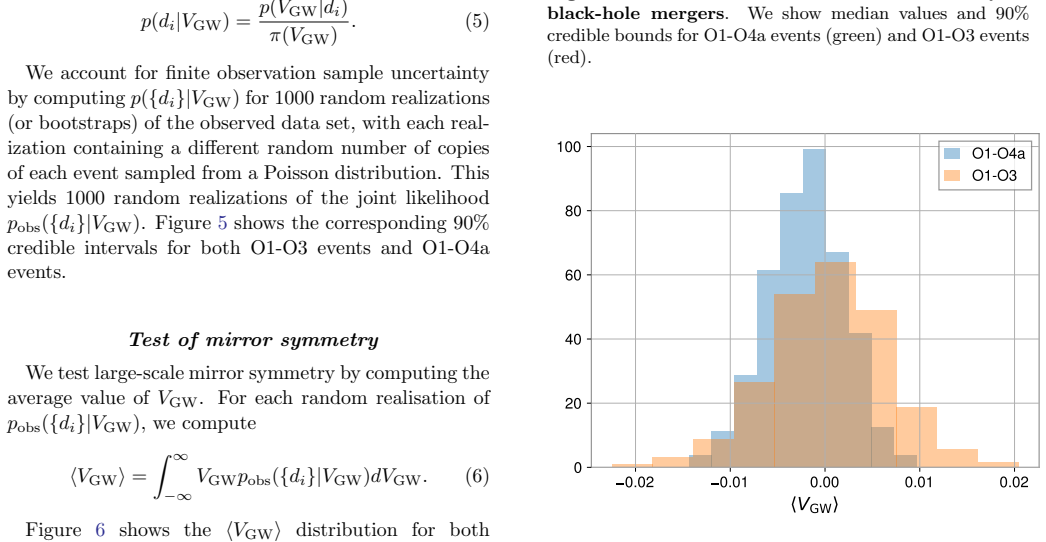
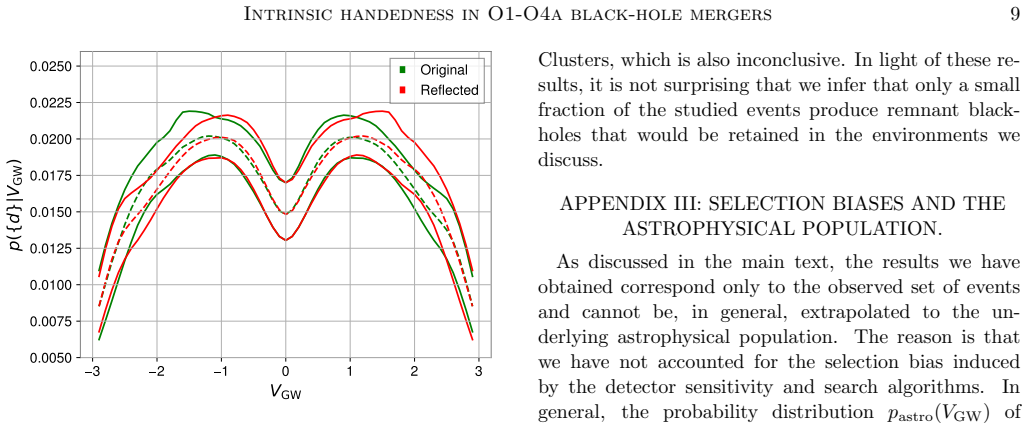
Precessing binary black-holes generically produce an imbalance of right- and left- handed gravitational waves, reflecting the breaking of mirror symmetry by the merger dynamics. We study this phenomenon using the observer-independent quantity $V_{\rm GW}$, a gravitational analogue of the optical Stokes parameter that quantifies the intrinsic handedness of the emitted radiation. Using 91 LIGO-Virgo-KAGRA black-hole mergers from the O1-O4a observing runs, we find that $92\%$ of the analyzed events favour non-vanishing $V_{\rm GW}$, indicating a predominance of precessing dynamics across the events. Through a recently established relation between $V_{\rm GW}$ and the remnant black hole recoil, we further constrain the retention of merger remnants in dense stellar environments, finding that at most $8\%$ could remain gravitationally bound to globular or nuclear star clusters and subsequently participate in hierarchical merger channels. We finally investigate the cosmological distribution of black-hole merger handedness. The observed $V_{\rm GW}$ distribution is consistent with symmetry under $V_{\rm GW}\rightarrow -V_{\rm GW}$, and yields an average value $\langle V_{\rm GW}\rangle=-1.9^{+6.1}_{-6.6}\times10^{-3}$ ($90\%$ credibility), consistent with the absence of a preferred handedness and with expectations from large-scale statistical isotropy. In particular, the inclusion of O4a events reduces uncertainties in $\langle V_{\rm GW} \rangle$ by $\sim 40\%$ with respect to O1-O3 events. These results establish black-hole merger handedness as a unified probe of orbital precession, remnant recoil, hierarchical formation, and cosmological mirror symmetry.
Editorial analysis
A structured set of objections, weighed in public.
Referee Report
Summary. The manuscript analyzes 91 LIGO-Virgo-KAGRA black-hole merger events from O1-O4a using the observer-independent quantity V_GW to quantify intrinsic handedness of the emitted gravitational waves. It reports that 92% of events favor non-vanishing V_GW (indicating precessing dynamics), derives an upper limit of at most 8% on remnant retention in dense environments via a V_GW-recoil relation, and finds the distribution consistent with mirror symmetry with ⟨V_GW⟩ = -1.9^{+6.1}_{-6.6}×10^{-3} (90% credibility), with O4a data reducing uncertainties by ~40%.
Significance. If the V_GW-recoil relation holds with sufficient accuracy across the relevant parameter space of the observed events, the work provides a unified statistical probe linking orbital precession signatures, remnant retention fractions in clusters, and tests of large-scale isotropy using existing gravitational-wave catalogs. The direct handedness measurements on a sizable event sample add empirical constraints on binary dynamics.
major comments (1)
- [Retention analysis section] The retention upper limit of at most 8% (abstract and retention analysis section) is obtained by mapping the measured V_GW distribution through the recently established V_GW–recoil relation. This mapping is load-bearing for the bound; the manuscript does not quantify the relation's accuracy, scatter, or additional systematic uncertainties when applied to the specific mass-ratio, spin, and inclination posteriors of the 91 events, so any offset would scale directly into the reported fraction.
minor comments (2)
- [Abstract] The abstract refers to 'a recently established relation' between V_GW and remnant recoil without an explicit citation; the reference should be provided at first mention.
- The determination of the 92% fraction favoring non-vanishing V_GW would benefit from a brief statement of the exact statistical criterion or threshold applied to the individual event posteriors.
Simulated Author's Rebuttal
We thank the referee for their constructive review and for highlighting the importance of the V_GW-recoil mapping in the retention analysis. We address the single major comment below and commit to revisions that strengthen the presentation of uncertainties.
read point-by-point responses
-
Referee: The retention upper limit of at most 8% (abstract and retention analysis section) is obtained by mapping the measured V_GW distribution through the recently established V_GW–recoil relation. This mapping is load-bearing for the bound; the manuscript does not quantify the relation's accuracy, scatter, or additional systematic uncertainties when applied to the specific mass-ratio, spin, and inclination posteriors of the 91 events, so any offset would scale directly into the reported fraction.
Authors: We agree that the V_GW-recoil relation is central to deriving the retention bound and that explicit quantification of its accuracy, scatter, and systematics for the specific event posteriors is warranted. The relation originates from a prior study that validated it over mass ratios, spins, and inclinations overlapping with the LIGO catalog; however, the current manuscript does not propagate its reported uncertainties. In the revised version we will add a dedicated paragraph (and supplementary figure) that (i) samples the relation’s published scatter across the 91 events’ posterior medians, (ii) assesses inclination-dependent residuals, and (iii) recomputes the retention fraction with these uncertainties folded in, thereby converting the present 8 % upper limit into a more conservative interval that explicitly reflects mapping systematics. revision: yes
Circularity Check
V_GW distribution from external LIGO data; retention bound applies prior relation without internal reduction
full rationale
The paper's primary results (92% non-vanishing V_GW fraction, ⟨V_GW⟩ consistent with zero) are direct statistical measurements performed on the 91 external LIGO-Virgo-KAGRA events. The retention upper limit (≤8%) applies a mapping from a previously established V_GW-recoil relation; this step does not reduce any reported quantity to a parameter fitted inside the present analysis or to a self-definition. No equations in the paper equate the measured V_GW statistics to the retention fraction by construction. The cited relation is treated as external input rather than derived here, satisfying the condition for independent support when the underlying simulations are externally falsifiable. This yields only a minor self-citation that is not load-bearing for the central claims.
Axiom & Free-Parameter Ledger
axioms (2)
- domain assumption The V_GW quantity accurately captures intrinsic handedness arising from precessing binary dynamics.
- domain assumption The relation between V_GW and remnant recoil velocity applies to the LIGO events analyzed here.
Reference graph
Works this paper leans on
-
[1]
Aasi, J., et al. 2015, Class. Quant. Grav., 32, 074001, 10.1088/0264-9381/32/7/074001
-
[2]
Abac, et al. 2025 a , GWTC-4.0: Updating the Gravitational-Wave Transient Catalog with Observations from the First Part of the Fourth LIGO-Virgo-KAGRA Observing Run. arXiv:2508.18082
Pith/arXiv arXiv 2025
-
[4]
G., et al., 2025b, @doi [The Astrophysical Journal Letters] 10.3847/2041-8213/ae0c9c , 993, L25
Abac, A. G., et al. 2025 b , The Astrophysical Journal Letters, 993, L25, 10.3847/2041-8213/ae0c9c
-
[5]
2026 a , GWTC-4.0: Tests of General Relativity
---. 2026 a , GWTC-4.0: Tests of General Relativity. I. Overview and General Tests. arXiv:2603.19019
Pith/arXiv arXiv 2026
-
[7]
2026 c , GWTC-4.0: Tests of General Relativity
---. 2026 c , GWTC-4.0: Tests of General Relativity. III. Tests of the Remnants. arXiv:2603.19020
Pith/arXiv arXiv 2026
-
[8]
---. 2026 d , Phys. Rev. Lett., 136, 041403, 10.1103/6c61-fm1n
-
[9]
Abbott, et al. 2020 a , Physical Review Letters, 125, 10.1103/PhysRevLett.125.101102
-
[10]
Observation of Gravitational Waves from a Binary Black Hole Merger
Abbott, B. P., et al. 2016, Phys. Rev. Lett., 116, 061102, 10.1103/PhysRevLett.116.061102
-
[11]
---. 2017 a , Nature, 551, 85, 10.1038/nature24471
-
[12]
2017 b , Classical and Quantum Gravity, 34, 044001, 10.1088/1361-6382/aa51f4
---. 2017 b , Classical and Quantum Gravity, 34, 044001, 10.1088/1361-6382/aa51f4
-
[13]
doi:10.1103/physrevx.9.031040 , url =
---. 2019 a , Phys. Rev. X, 9, 031040, 10.1103/PhysRevX.9.031040
-
[14]
---. 2019 b , Phys. Rev. D, 100, 104036, 10.1103/PhysRevD.100.104036
-
[15]
2020 b , Physical Review D, 102, 10.1103/physrevd.102.043015
Abbott, R., et al. 2020 b , Physical Review D, 102, 10.1103/physrevd.102.043015
-
[16]
2021 a , Physical Review X, 11, 021053
Abbott, R., Abbott, T., Abraham, S., et al. 2021 a , Physical Review X, 11, 021053
2021
-
[17]
2021 b , SoftwareX , 13, 100658, 10.1016/j.softx.2021.100658
Abbott, R., et al. 2021 b , SoftwareX , 13, 100658, 10.1016/j.softx.2021.100658
-
[18]
---. 2023 a , Physical Review X, 13, 10.1103/physrevx.13.041039
-
[19]
---. 2023 b , Physical Review X, 13, 10.1103/physrevx.13.011048
-
[20]
2025, Physical Review D, 112, 10.1103/physrevd.112.084080
---. 2025, Physical Review D, 112, 10.1103/physrevd.112.084080
-
[21]
Advanced Virgo: a second-generation interferometric gravitational wave detector
Acernese, F., et al. 2015, Class. Quant. Grav., 32, 024001, 10.1088/0264-9381/32/2/024001
-
[22]
2020, Publications of the Astronomical Society of Australia, 37, 10.1017/pasa.2020.39
Ackley, K., et al. 2020, Publications of the Astronomical Society of Australia, 37, 10.1017/pasa.2020.39
-
[23]
2019, Nature Astron., 3, 35, 10.1038/s41550-018-0658-y
Akutsu, T., et al. 2019, Nature Astron., 3, 35, 10.1038/s41550-018-0658-y
-
[24]
2005, Phys.Rev., D71, 062001, 10.1103/PhysRevD.71.062001
Allen, B. 2005, Phys.Rev., D71, 062001, 10.1103/PhysRevD.71.062001
-
[25]
Antonini, F., & Rasio, F. A. 2016, The Astrophysical Journal, 831, 187, 10.3847/0004-637x/831/2/187
-
[26]
Boh\'e, A., et al. 2017, Phys. Rev., D95, 044028, 10.1103/PhysRevD.95.044028
-
[27]
Boyle, M., Hemberger, D., Iozzo, D. A. B., et al. 2019, Classical and Quantum Gravity, 36, 195006, 10.1088/1361-6382/ab34e2
-
[28]
A., Hannam, M., Husa, S., & Sperhake, U
Br\"ugmann, B., Gonz\'alez, J. A., Hannam, M., Husa, S., & Sperhake, U. 2008, Phys. Rev. D, 77, 124047, 10.1103/PhysRevD.77.124047
-
[29]
Bustillo, J. C., del Rio, A., Leong, S. H. W., & Sanchis-Gual, N. 2025, International Journal of Modern Physics D, 34, 2544004, 10.1142/S0218271825440043
-
[30]
Bustillo, J. C., Lasky, P. D., & Thrane, E. 2021 a , Physical Review D, 103, 10.1103/physrevd.103.024041
-
[31]
C., Sanchis-Gual, N., Torres-Forné, A., & Font, J
Bustillo, J. C., Sanchis-Gual, N., Torres-Forné, A., & Font, J. A. 2021 b , Physical Review Letters, 126, 10.1103/physrevlett.126.201101
-
[32]
Calder \'o n Bustillo, J., Husa, S., Sintes, A. M., & P \"u rrer, M. 2016, Phys. Rev., D93, 084019, 10.1103/PhysRevD.93.084019
-
[33]
Calder \'o n Bustillo, J., Laguna, P., & Shoemaker, D. 2017, Phys. Rev., D95, 104038, 10.1103/PhysRevD.95.104038
-
[34]
Calderón Bustillo, J., del Rio, A., Sanchis-Gual, N., Chandra, K., & Leong, S. H. 2025 a , Physical Review Letters, 134, 10.1103/physrevlett.134.031402
-
[36]
2025 c , Nature Astronomy, 9, 1530–1540, 10.1038/s41550-025-02632-5
---. 2025 c , Nature Astronomy, 9, 1530–1540, 10.1038/s41550-025-02632-5
-
[37]
Calderón Bustillo, J., Sanchis-Gual, N., Leong, S. H., et al. 2023, Physical Review D, 108, 10.1103/physrevd.108.123020
-
[38]
Callister, T. A., Miller, S. J., Chatziioannou, K., & Farr, W. M. 2022, The Astrophysical Journal Letters, 937, L13, 10.3847/2041-8213/ac847e
-
[39]
2007 a , The Astrophysical Journal, 659, L5, 10.1086/516712
Campanelli, M., Lousto, C., Zlochower, Y., & Merritt, D. 2007 a , The Astrophysical Journal, 659, L5, 10.1086/516712
-
[40]
O., Zlochower, Y., & Merritt, D
Campanelli, M., Lousto, C. O., Zlochower, Y., & Merritt, D. 2007 b , Phys. Rev. Lett., 98, 231102, 10.1103/PhysRevLett.98.231102
-
[41]
2014, Phys.Rev., D89, 102003, 10.1103/PhysRevD.89.102003
Capano, C., Pan, Y., & Buonanno, A. 2014, Phys.Rev., D89, 102003, 10.1103/PhysRevD.89.102003
-
[42]
D., Cabero, M., Westerweck, J., et al
Capano, C. D., Cabero, M., Westerweck, J., et al. 2023, Physical Review Letters, 131, 10.1103/physrevlett.131.221402
-
[43]
Chandra, K., Bustillo, J. C., Pai, A., & Harry, I. 2022, Physical Review D, 106, 10.1103/physrevd.106.123003
-
[44]
Chandra, K., & Calder \'o n Bustillo, J. 2025. 2509.17315
arXiv 2025
-
[45]
Chandra, K., Gamba, R., & Chiaramello, D. 2025. 2512.04593
arXiv 2025
-
[46]
Chandra, K., Gayathri, V., Bustillo, J. C., & Pai, A. 2020, Physical Review D, 102, 10.1103/physrevd.102.044035
-
[47]
Chiaramello, D., Cibrario, N., Lange, J., et al. 2025. 2511.19593
arXiv 2025
-
[48]
Collaboration, T. L. S., the Virgo Collaboration, & the KAGRA Collaboration. 2023, Open data from the third observing run of LIGO, Virgo, KAGRA and GEO. arXiv:2302.03676
Pith/arXiv arXiv 2023
-
[49]
---. 2026 a , GWTC-5.0: Observations from the Second Part of the Fourth LIGO-Virgo-KAGRA Observing Run and Updates to the Gravitational-Wave Transient Catalog. arXiv:2605.27225
Pith/arXiv arXiv 2026
-
[50]
2026 b , GWTC-5.0: Population Properties of Merging Compact Binaries
---. 2026 b , GWTC-5.0: Population Properties of Merging Compact Binaries. arXiv:2605.27226
Pith/arXiv arXiv 2026
-
[51]
---. 2026 c , GWTC-5.0: Constraints on the Cosmic Expansion Rate and Modified Gravitational-wave Propagation. arXiv:2605.27227
Pith/arXiv arXiv 2026
-
[52]
2014 a , Class.Quant.Grav., 31, 015016, 10.1088/0264-9381/31/1/015016
Dal Canton, T., Bhagwat, S., Dhurandhar, S., & Lundgren, A. 2014 a , Class.Quant.Grav., 31, 015016, 10.1088/0264-9381/31/1/015016
-
[53]
Dal Canton, T., Nitz, A. H., Lundgren, A. P., et al. 2014 b , Phys.Rev., D90, 082004, 10.1103/PhysRevD.90.082004
-
[54]
S., Dent, T., Tápai, M., et al
Davies, G. S., Dent, T., Tápai, M., et al. 2020, Physical Review D, 102, 10.1103/physrevd.102.022004
-
[55]
2021, Physical Review D, 104, 10.1103/physrevd.104.065012
del Rio, A. 2021, Physical Review D, 104, 10.1103/physrevd.104.065012
-
[56]
2020, Physical Review Letters, 124, 10.1103/physrevlett.124.211301
del Rio, A., Sanchis-Gual, N., Mewes, V., et al. 2020, Physical Review Letters, 124, 10.1103/physrevlett.124.211301
-
[57]
Dickey, J. M. 1971, Annals of Mathematical Statistics, 42, 204. http://www.jstor.org/stable/2958475
arXiv 1971
-
[58]
2025, Are the Circular Polarizations of Observed Gravitational-Waves Even-Handed? arXiv:2508.17103
Emtsova, E., & Birnholtz, O. 2025, Are the Circular Polarizations of Observed Gravitational-Waves Even-Handed? arXiv:2508.17103
arXiv 2025
-
[59]
Essick, R., Farr, W. M., Fishbach, M., Holz, D. E., & Katsavounidis, E. 2023, Physical Review D, 107, 10.1103/physrevd.107.043016
-
[60]
2026, Physical Review D, 113, 10.1103/pjbd-pjxn
Estellés, H., Buonanno, A., Enficiaud, R., Foo, C., & Pompili, L. 2026, Physical Review D, 113, 10.1103/pjbd-pjxn
-
[61]
2023, Classical and Quantum Gravity, 40, 195018, 10.1088/1361-6382/acf26c
Fernandes, T., Vieira, S., Onofre, A., et al. 2023, Classical and Quantum Gravity, 40, 195018, 10.1088/1361-6382/acf26c
-
[62]
Fragione, G., & Silk, J. 2020, Monthly Notices of the Royal Astronomical Society, 498, 4591–4604, 10.1093/mnras/staa2629
-
[63]
2022, Nature Astronomy, 6, 344, 10.1038/s41550-021-01568-w
Gayathri, V., Healy, J., Lange, J., et al. 2022, Nature Astronomy, 6, 344, 10.1038/s41550-021-01568-w
-
[64]
2021, Nature Astronomy, 5, 749–760, 10.1038/s41550-021-01398-w
Gerosa, D., & Fishbach, M. 2021, Nature Astronomy, 5, 749–760, 10.1038/s41550-021-01398-w
-
[65]
2020, Physical Review Letters, 125, 10.1103/physrevlett.125.101103
Gerosa, D., Vitale, S., & Berti, E. 2020, Physical Review Letters, 125, 10.1103/physrevlett.125.101103
-
[66]
Ghosh, S., Kolitsidou, P., & Hannam, M. 2024, Phys. Rev. D, 109, 024061, 10.1103/PhysRevD.109.024061
-
[67]
A., Sperhake, U., Bruegmann, B., Hannam, M., & Husa, S
Gonzalez, J. A., Sperhake, U., Bruegmann, B., Hannam, M., & Husa, S. 2007, Phys. Rev. Lett., 98, 091101, 10.1103/PhysRevLett.98.091101
-
[68]
2025, Physical Review D, 112, 10.1103/vpyp-nvfp
Gupte, N., Ramos-Buades, A., Buonanno, A., et al. 2025, Physical Review D, 112, 10.1103/vpyp-nvfp
-
[69]
Hannam, M., Hoy, C., Thompson, J. E., et al. 2022, Nature, 10.1038/s41586-022-05212-z
-
[70]
Harry, I., Privitera, S., Boh \'e , A., & Buonanno, A. 2016, Phys. Rev., D94, 024012, 10.1103/PhysRevD.94.024012
-
[71]
Heger, A., Fryer, C. L., Woosley, S. E., Langer, N., & Hartmann, D. H. 2003, Astrophys. J., 591, 288, 10.1086/375341
-
[72]
Classical and Quantum Gravity , abstract =
Hild, S., et al. 2010, 10.1088/0264-9381/28/9/094013
-
[73]
M., & Varma, V
Isi, M., Farr, W. M., & Varma, V. 2023, The directional isotropy of LIGO-Virgo binaries
2023
-
[74]
Isi, M., Giesler, M., Farr, W. M., Scheel, M. A., & Teukolsky, S. A. 2019, Physical Review Letters, 123, 10.1103/physrevlett.123.111102
-
[75]
Islam, T. 2026, Inference of recoil kicks from binary black hole mergers up to GWTC--4 and their astrophysical implications. arXiv:2604.04546
Pith/arXiv arXiv 2026
-
[76]
2023, NRSurCat-1, Zenodo, 10.5281/ZENODO.8115310
Islam, T., Vajpeyi, A., Feroz Shaik , et al. 2023, NRSurCat-1, Zenodo, 10.5281/ZENODO.8115310
-
[77]
Islam, T., Vajpeyi, A., Shaik, F. H., et al. 2025, Physical Review D, 112, 10.1103/48ck-2fff
-
[78]
Kolitsidou, P., Thompson, J. E., & Hannam, M. 2024, Impact of anti-symmetric contributions to signal multipoles in the measurement of black-hole spins. 2402.00813
arXiv 2024
-
[79]
Leong, S. H., Tomé, A. F., Bustillo, J. C., del Río, A., & Sanchis-Gual, N. 2025, Physical Review D, 112, 10.1103/1nnp-w5w4
-
[80]
2026, GWTC-4.0: Parameter estimation data release, Zenodo, 10.5281/ZENODO.16053483
LIGO Scientific Collaboration and Virgo Collaboration and KAGRA Collaboration . 2026, GWTC-4.0: Parameter estimation data release, Zenodo, 10.5281/ZENODO.16053483
-
[81]
2026, Remnant recoil and host environments of GWTC-4.0 binary black-hole mergers
Llobera-Querol, J., Hamilton, E., Singh, N., et al. 2026, Remnant recoil and host environments of GWTC-4.0 binary black-hole mergers. arXiv:2604.05492
Pith/arXiv arXiv 2026
-
[82]
Lorenzo-Medina, A., Bustillo, J. C., & Leong, S. H. 2025, Physical Review D, 112, 10.1103/lqqf-y7l8
-
[83]
Lousto, C. O., & Zlochower, Y. 2011, Phys. Rev. Lett., 107, 231102, 10.1103/PhysRevLett.107.231102
discussion (0)
Sign in with ORCID, Apple, or X to comment. Anyone can read and Pith papers without signing in.