REVIEW 4 major objections 5 minor 83 references
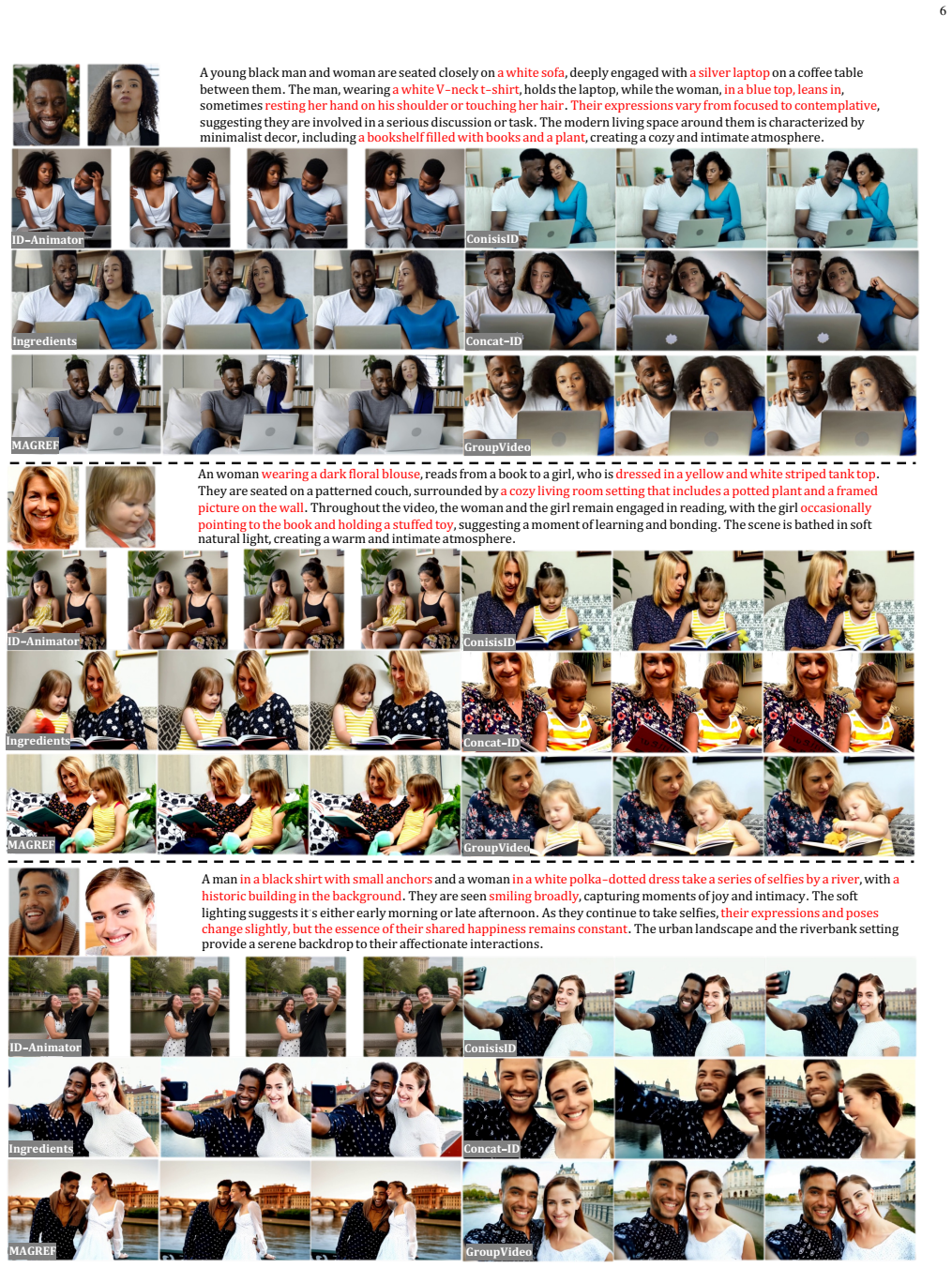
GroupVideo uses multimodal identity alignment and ID localization to generate videos with multiple consistent characters and natural motion.
Reviewed by Pith at T0; open to challenge. T0 means a machine referee read the full paper against a public rubric. the ladder, T0–T4 →
T0 review · deepseek-v4-flash
2026-08-01 08:39 UTC pith:FOI5CDOK
load-bearing objection A promising architecture and a potentially valuable dataset, but the paper's central quantitative claim is undercut by an unexplained discrepancy between its own tables. the 4 major comments →
GroupVideo: Multi-Identity Customized Text-to-Video Generation
The pith
A machine-rendered reading of the paper's core claim, the machinery that carries it, and where it could break.
Core claim
GroupVideo claims that identity blending and the 'copy-paste' artifact in multi-ID video generation can be eliminated by treating each reference face as an independent conditioning signal in both visual and semantic spaces, then routing the resulting identity embeddings through learned localization masks. The visual branch concatenates per-face VAE tokens with the noise latent along channels, while the semantic branch fuses face embeddings into text embeddings via a semantic perceiver. The ID localization module computes a soft mask over spatiotemporal positions for each identity and gates cross-attention, preventing identities from overlapping. The paper reports the best text alignment and
What carries the argument
Three mechanisms: (1) visual identity alignment, which concatenates each reference face's VAE tokens with noise latents along the channel axis; (2) semantic identity alignment, which derives per-face identity embeddings and fuses them into text embeddings via a semantic perceiver; (3) the ID localization module, which computes a soft mask for each identity from DiT hidden states and identity embeddings and uses it to gate masked cross-attention. A progressive two-stage training, with a bounding-box loss in the first stage and a mask-regularization loss in the second, stabilizes optimization and speeds convergence.
Load-bearing premise
The method relies on face masks and identity embeddings that are correct and separable, and on a training set of 2-3-person clips that represents arbitrary multi-person scenes; if those are biased, the localization module may fail for dynamic or atypical prompts.
What would settle it
Generate prompts where two identities swap positions or one turns away for several frames and inspect the predicted localization masks frame by frame; if the masks blend or swap identities, the claimed routing fails.
If this is right
- Multi-identity video generation can be done without per-prompt fine-tuning or predefined spatial masks, using an offline-trained diffusion transformer.
- The ID localization module supports an arbitrary number of identities, including three or more, by assigning each to its own spatiotemporal region.
- The curated 20,000-video dataset with face masks and captions provides a resource for training and evaluating multi-identity video generation.
Where Pith is reading between the lines
- If the method scales, identity-conditioned generation could move from single-character avatars to controllable multi-character scenes; a testable extension is to combine learned masks with user-provided boxes for explicit layout control.
- The dataset's filter for 2-3 clearly visible faces may be a hidden factor; an extension is to test on out-of-distribution prompts with crowded or partially occluded scenes.
Editorial analysis
A structured set of objections, weighed in public.
Referee Report
Summary. The paper proposes GroupVideo, a multi-identity customized text-to-video generation framework built on a Video Diffusion Transformer (CogVideoX-5B). It introduces two main components: multimodal identity alignment (visual identity alignment concatenating face-derived latent tokens with noise latents, and semantic alignment via a Q-Former + semantic perceiver that fuses identity embeddings with text embeddings) and an ID localization module that predicts spatial masks to route identity embeddings through masked cross-attention. Training is progressive: stage I optimizes alignment modules with a bounding-box loss, and stage II fine-tunes the localization module with a mask-regularization loss. The authors also curate a 20,000-video multi-person dataset and report quantitative, qualitative, user-study, and efficiency comparisons against existing single-ID and multi-ID methods. The central claim is that GroupVideo outperforms prior methods in multi-character identity consistency and motion naturalness.
Significance. If the empirical claims were stable and reproducible, GroupVideo would be a meaningful contribution to multi-identity video customization: it addresses a real limitation of single-ID frameworks, introduces a scalable identity-alignment design, and provides a curated multi-person video dataset that could support future work. The two-stage training with explicit face-region losses and the lightweight ID localization module are reasonable engineering choices, and the computational overhead analysis (Tab. VI) is a useful addition. However, the paper's own numbers are internally inconsistent, and the text misreads its own table, so the central 'outperforms' claim is not currently supported by a reliable evaluation basis.
major comments (4)
- [Section IV-C, Tables II and IV] The full GroupVideo model is reported with inconsistent numbers in the main comparison and the ablation table. In Tab. II, GroupVideo has FaceSim 0.636, CLIPScore 32.035, FID 147.228; in Tab. IV, the same 'GroupVideo' row reports FaceSim 0.733, CLIPScore 31.95, FID 136.94. These are large discrepancies (~0.1 FaceSim, ~10 FID). No explanation is given (different test subsets, different seeds, or different checkpoints). Since the paper's central claim is that GroupVideo outperforms existing methods, the evaluation must be based on a single, clearly defined protocol. As written, a reader cannot tell which numbers represent the official comparison, and the 'outperforms' claim has no stable evidentiary basis.
- [Section IV-C, text near Table II] The text states: 'Although Ingredients and ConsisID achieve higher scores in face similarity due to their copy-paste phenomena...' Tab. II shows ConsisID FaceSim = 0.634, which is below GroupVideo's 0.636; only Ingredients (0.644) is higher. This is a direct misreading of the paper's own results. This is not a minor wording issue: it affects the interpretation of whether GroupVideo actually leads on identity fidelity among DiT-based baselines. The comparison sentence should be corrected and the quantitative claims aligned with the table.
- [Section IV-A and IV-B (dataset, test set, and evaluation protocol)] The evaluation protocol has several unaddressed confounds. First, the test set is only 50 face images and 40 prompts (500 cases), with no error bars or significance tests; FaceSim differences of 0.002 (e.g., 0.636 vs 0.634) are within likely noise. Second, baselines use different backbone models: ID-Animator uses AnimateDiff, ConsisID/Ingredients/Concat-ID use CogVideoX, and MAGREF uses Wan-2.1. Differences may therefore reflect base-model capacity rather than the proposed modules. Third, the curated 20k dataset is filtered to exactly 2–3 discernible characters with high face visibility (steps 4–6), but no distributional analysis is provided, and despite Tab. I claiming 'Open Accessibility', no dataset release link is given. If the dataset is biased toward static, interaction-light indoor scenes, the claimed generalization to dynamic or atypical prompts (Fig. 7) may be limited. Please pr
- [Section IV-C, Table III (user study)] The text says GroupVideo 'achieves the highest ratings across nearly all evaluation dimensions,' but Tab. III shows GroupVideo's Identity Similarity is 6.54, lower than Ingredients' 6.75. The following sentence ('Although Ingredients achieves a higher user score in FaceSim') also misnames the dimension: Tab. III has no FaceSim column; the dimension is 'Identity Similarity.' Since identity consistency is one of the two headline claims, a user-study result where the main multi-ID competitor scores higher on identity is important and should be discussed transparently, not obscured by wording.
minor comments (5)
- [Author block] The author block contains a typo: 'Graduate Student Membder' should be 'Member'.
- [Fig. 2 and Fig. 5 captions] Fig. 2 caption spells 'Ingradients' instead of 'Ingredients'; Fig. 5 caption spells 'ConisisID' instead of 'ConsisID'.
- [Section II-B and Tab. VI] Typographical issues: 'adavancements' should be 'advancements' in Section II-B; 'semantic perciever' appears in Tab. VI and should be 'semantic perceiver'; 'Consis-ID' should be 'ConsisID' for consistency in Section IV-C.
- [Table I and Table II formatting] Tab. I row for GroupVideo is missing spaces ('GroupVideoFace&Body1080×1920'); Tab. II has a missing space in the Ingredients row ('0.64430.220'). Please format tables consistently.
- [Conclusion] The conclusion describes GroupVideo as a 'zero-shot framework,' but the method requires offline training on a large curated dataset. If the intended meaning is 'no test-time fine-tuning,' please define it explicitly to avoid confusion with zero-shot generation in the strict sense.
Circularity Check
No significant circularity: external losses and metrics anchor the claims; self-citations are background-only. Table inconsistencies are correctness risks, not circularity.
full rationale
All training objectives are externally anchored. Stage I uses the standard diffusion MSE (Eq. 2) and a bounding-box-weighted variant (Eq. 6), where boxes are supplied by external YOLO face detection; Stage II uses a mask-regularization loss (Eq. 7) where the ground-truth masks come from external SAM-2 segmentation, described as stored ground truth for the bounding box constraint and the mask regularization loss. No equation defines a predicted quantity in terms of a fitted constant that is later called a prediction. The localization masks (Eqs. 4-5) are supervised by, not defined by, those annotations. The central empirical claim is assessed with external metrics (FaceSim, CLIPScore, FID, VBench, user study), none of which coincide with the ArcFace-based conditioning. Self-citations by the first author appear only in literature enumeration and are not load-bearing. The noted numerical mismatches between Tab. II and Tab. IV (FaceSim 0.636 vs 0.733, FID 147.228 vs 136.94) and the text misreading of ConsisID's FaceSim are evidentiary/reporting concerns, not constructional circularity. The curated test set is the same for all baselines, so the comparison is not statistically forced by construction. The derivation chain is therefore self-contained relative to its external data and metrics.
Axiom & Free-Parameter Ledger
free parameters (2)
- alpha (bounding-box loss probability) =
0.5
- lambda (mask regularization weight) =
0.1
axioms (4)
- domain assumption CogVideoX-5B provides a sufficiently strong text-to-video DiT prior that can absorb additional identity conditioning without catastrophic forgetting.
- domain assumption ArcFace identity embeddings remain discriminative across pose, expression, lighting, and video appearance.
- domain assumption YOLO face boxes and SAM-2 face masks are accurate enough to serve as ground truth for the bounding-box and mask losses.
- ad hoc to paper The curated 20k-video dataset plus 400k internal samples covers the target distribution of multi-identity interactions.
read the original abstract
Current identity customized video generation methodologies are predominantly limited to single-identity scenarios, as the lack of explicit identity separation mechanisms often leads to identity confusion in multi-identity settings. Existing multi-identity approaches, which directly extend single-identity frameworks by concatenating face images as input conditions, frequently result in unnatural facial expressions and motions, manifesting as the "copy-paste" phenomenon. To overcome these limitations, we introduce GroupVideo, a novel framework that leverages multiple individual photographs to generate identitycustomized video. Built upon Video Diffusion Transformers, GroupVideo incorporates multimodal identity alignment: visual alignment jointly encodes multiple face images to provide robust identity references, while semantic alignment introduces a semantic perceiver to enhance the naturalness of motions. An ID localization module with spatial guidance is introduced to address identity blending and enhance identity fidelity, along with bounding box constraints and mask regularization loss, to focus on facial regions and improve training efficiency. In response to the shortage of multi-ID video datasets, we have curated a comprehensive high-quality dataset of 20,000 videos, thereby establishing a crucial resource to advance future research in multi-ID video generation. Extensive experiments demonstrate that GroupVideo outperforms existing methods in generating multi-character videos with consistent identities and natural motions.
Figures




Reference graph
Works this paper leans on
-
[1]
N. Ruiz, Y . Li, V . Jampani, Y . Pritch, M. Rubinstein and K. Aberman, ”DreamBooth: Fine Tuning Text-to-Image Diffusion Models for Subject- Driven Generation,” 2023 IEEE/CVF Conference on Computer Vision and Pattern Recognition (CVPR), Vancouver, BC, Canada, 2023, pp. 22500- 22510
2023
-
[2]
Rinon Gal, Yuval Alaluf, Yuval Atzmon, Or Patashnik, Amit H Bermano, Gal Chechik, and Daniel CohenOr. An image is worth one word: Per- sonalizing text-to-image generation using textual inversion, 2022, arXiv preprint arXiv:2208.01618
Pith/arXiv arXiv 2022
-
[3]
S. Yuan et al., ”Identity-Preserving Text-To-Video Generation by Fre- quency Decomposition,” 2025 IEEE/CVF Conference on Computer Vi- sion and Pattern Recognition (CVPR), Nashville, TN, USA, 2025, pp. 12978-12988
2025
-
[4]
He, X.; Liu, Q.; Qian, S.; Wang, X.; Hu, T.; Cao, K.; Yan, K.; and Zhang, J., Id-animator: Zero-shot identity-preserving human video generation, 2024, arXiv preprint arXiv:2404.15275
Pith/arXiv arXiv 2024
-
[5]
Wei, J.; Yan, S.; Lin, W.; Liu, B.; Chen, R.; and Guo, M, EchoVideo: Identity-Preserving Human Video Generation by Multimodal Feature Fusion, 2025, arXiv preprint arXiv:2501.13452
Pith/arXiv arXiv 2025
-
[6]
Zhang, Y .; Liu, Y .; Xia, B.; Peng, B.; Yan, Z.; Lo, E.; and Jia, J., Magic Mirror: ID-Preserved Video Generation in Video Diffusion Transformers, 2025, arXiv preprint arXiv:2501.03931
arXiv 2025
-
[7]
Fei, Z.; Li, D.; Qiu, D.; Yu, C.; and Fan, M. Ingredients: Blending Custom Photos with Video Diffusion Transformers, 2025, arXiv preprint arXiv:2501.01790
Pith/arXiv arXiv 2025
-
[8]
Peebles and S
W. Peebles and S. Xie, ”Scalable Diffusion Models with Transformers,” 2023 IEEE/CVF International Conference on Computer Vision (ICCV), Paris, France, 2023, pp. 4172-4182
2023
-
[9]
Generative adversarial networks
Goodfellow, I.; Pouget-Abadie, J.; Mirza, M.; Xu, B.; Warde-Farley, D.; Ozair, S.; Courville, A.; and Bengio, Y . Generative adversarial networks. Communications of the ACM, 63(11), 2020, pp. 139–144
2020
-
[10]
Karras, S
T. Karras, S. Laine and T. Aila, ”A Style-Based Generator Architecture for Generative Adversarial Networks,” in IEEE Transactions on Pattern Analysis and Machine Intelligence, vol. 43, no. 12, 2021, pp. 4217-4228
2021
-
[11]
J. Liu, W. Wang, S. Chen, X. Zhu and J. Liu, ”Sounding Video Genera- tor: A Unified Framework for Text-Guided Sounding Video Generation,” in IEEE Transactions on Multimedia, vol. 26, pp. 141-153, 2024
2024
-
[12]
K ¨oksal, K
A. K ¨oksal, K. E. Ak, Y . Sun, D. Rajan and J. H. Lim, ”Controllable Video Generation With Text-Based Instructions,” in IEEE Transactions on Multimedia, vol. 26, pp. 190-201, 2024
2024
-
[13]
Taming transformers for high- resolution image synthesis
Esser, P.; Rombach, R.; and Ommer, B. Taming transformers for high- resolution image synthesis. In Proceedings of the IEEE/CVF conference on computer vision and pattern recognition, 2021, pp. 12873–12883
2021
-
[14]
Y .; Luong, T.; Baid, G.; Wang, Z.; Vasude- van, V .; Ku, A.; Yang, Y .; Ayan, B
Yu, J.; Xu, Y .; Koh, J. Y .; Luong, T.; Baid, G.; Wang, Z.; Vasude- van, V .; Ku, A.; Yang, Y .; Ayan, B. K.; et al. Scaling autoregressive models for content-rich text-to-image generation, 2022, arXiv preprint arXiv:2206.10789, 2(3): 5
Pith/arXiv arXiv 2022
-
[15]
Rombach, A
R. Rombach, A. Blattmann, D. Lorenz, P. Esser and B. Ommer, ”High-Resolution Image Synthesis with Latent Diffusion Models,” 2022 IEEE/CVF Conference on Computer Vision and Pattern Recognition (CVPR), New Orleans, LA, USA, 2022, pp. 10674-10685
2022
-
[16]
L.; Ghasemipour, K.; Gontijo Lopes, R.; Karagol Ayan, B.; Salimans, T.; et al
Saharia, C.; Chan, W.; Saxena, S.; Li, L.; Whang, J.; Denton, E. L.; Ghasemipour, K.; Gontijo Lopes, R.; Karagol Ayan, B.; Salimans, T.; et al. Photorealistic text-to-image diffusion models with deep language understanding. Advances in neural information processing systems, 2022, pp. 36479–36494
2022
-
[17]
Podell, D.; English, Z.; Lacey, K.; Blattmann, A.; Dockhorn, T.; M ¨uller, J.; Penna, J.; and Rombach, R. Sdxl: Improving latent diffusion models for high-resolution image synthesis, 2023, arXiv preprint arXiv:2307.01952
Pith/arXiv arXiv 2023
-
[18]
Unialignment: Semantic alignment for unified image generation, understanding, manipulation and perception
Song X, Wang L, Wang W, et al. Unialignment: Semantic alignment for unified image generation, understanding, manipulation and perception. Proceedings of the AAAI Conference on Artificial Intelligence, 2026, pp. 9116-9126
2026
-
[19]
Song X, Wang L, Wang W, et al. 3SGen: Unified Subject, Style, and Structure-Driven Image Generation with Adaptive Task-specific Memory, 2025, arXiv preprint arXiv:2512.19271
arXiv 2025
-
[20]
Fine-Grained Text-to-Image Synthesis with Semantic Refinement
Song X, Sun J, Zhang Y , et al. Fine-Grained Text-to-Image Synthesis with Semantic Refinement. ICASSP 2026-2026 IEEE International Con- ference on Acoustics, Speech and Signal Processing (ICASSP), 2026, pp. 8637-8641
2026
-
[21]
Y . Hu, C. Luo and Z. Chen, ”A Benchmark for Controllable Text-Image- to-Video Generation,” in IEEE Transactions on Multimedia, vol. 26, pp. 1706-1719, 2024. 12
2024
-
[22]
M. Zhao, W. Wang, T. Chen, R. Zhang and R. Li, ”TA2V: Text-Audio Guided Video Generation,” in IEEE Transactions on Multimedia, vol. 26, pp. 7250-7264, 2024
2024
-
[23]
Video generation models as world simulators
Brooks, T.; Peebles, B.; Holmes, C.; DePue, W.; Guo, Y .; Jing, L.; Schnurr, D.; Taylor, J.; Luhman, T.; Luhman, E.; Ng, C.; Wang, R.; and Ramesh, A. Video generation models as world simulators. 2024
2024
-
[24]
Latte: Latent diffusion transformer for video generation, 2024, arXiv preprint arXiv:2401.03048
Ma, X.; Wang, Y .; Jia, G.; Chen, X.; Liu, Z.; Li, Y .-F.; Chen, C.; and Qiao, Y . Latte: Latent diffusion transformer for video generation, 2024, arXiv preprint arXiv:2401.03048
Pith/arXiv arXiv 2024
-
[25]
Open-sora plan: Open-source large video generation model
Lin, B.; Ge, Y .; Cheng, X.; Li, Z.; Zhu, B.; Wang, S.; He, X.; Ye, Y .; Yuan, S.; Chen, L.; et al. Open-sora plan: Open-source large video generation model. 2024, arXiv preprint arXiv:2412.00131
Pith/arXiv arXiv 2024
-
[26]
Open-sora: Democratizing efficient video production for all
Zheng, Z.; Peng, X.; Yang, T.; Shen, C.; Li, S.; Liu, H.; Zhou, Y .; Li, T.; and You, Y . Open-sora: Democratizing efficient video production for all. 2024, arXiv preprint arXiv:2412.20404
Pith/arXiv arXiv 2024
-
[27]
Yang, Z.; Teng, J.; Zheng, W.; Ding, M.; Huang, S.; Xu, J.; Yang, Y .; Hong, W.; Zhang, X.; Feng, G.; et al. Cogvideox: Text-to-video diffusion models with an expert transformer, 2024, arXiv preprint arXiv:2408.06072
Pith/arXiv arXiv 2024
-
[28]
Hunyuanvideo: A systematic framework for large video generative models
Kong, W.; Tian, Q.; Zhang, Z.; Min, R.; Dai, Z.; Zhou, J.; Xiong, J.; Li, X.; Wu, B.; Zhang, J.; et al. Hunyuanvideo: A systematic framework for large video generative models. 2024, arXiv preprint arXiv:2412.03603
Pith/arXiv arXiv 2024
-
[29]
Lin H, Wang T, Ge Y , et al. Toklip: Marry visual tokens to clip for multimodal comprehension and generation, 2026, arXiv preprint arXiv:2505.05422
Pith/arXiv arXiv 2026
-
[30]
Li, Z., Lin, H., Xiao, Y ., Li, Z., Song, X, et al. IV-CoT: Implicit Visual Chain-of-Thought for Structure-Aware Text-to-Image Generation, 2026, arXiv preprint arXiv:2606.24849
Pith/arXiv arXiv 2026
-
[31]
Concept-Guided Tokenization: Closing the Gap Between Reconstruction and Generation, 2026
Yunqiao Yang and Haokun Lin and Guanzhong Wu and Ying Wei. Concept-Guided Tokenization: Closing the Gap Between Reconstruction and Generation, 2026
2026
-
[32]
Shaping a Stabilized Video by Mitigating Unintended Changes for Concept-Augmented Video Editing
Guo, Mingce and He, Jingxuan and Tang, Shengeng and Wang, Zhangye and Cheng, Lechao. Shaping a Stabilized Video by Mitigating Unintended Changes for Concept-Augmented Video Editing. 2024. arXiv preprint arXiv:2410.12526
Pith/arXiv arXiv 2024
-
[33]
N. Ruiz et al., ”HyperDreamBooth: HyperNetworks for Fast Personaliza- tion of Text-to-Image Models,” 2024 IEEE/CVF Conference on Computer Vision and Pattern Recognition (CVPR), Seattle, W A, USA, 2024, pp. 6527-6536
2024
-
[34]
J.; Shen, Y .; Wallis, P.; Allen-Zhu, Z.; Li, Y .; Wang, S.; Wang, L.; and Chen, W
Hu, E. J.; Shen, Y .; Wallis, P.; Allen-Zhu, Z.; Li, Y .; Wang, S.; Wang, L.; and Chen, W. Lora: Low-rank adaptation of large language models. 2021, arXiv preprint arXiv:2106.09685
Pith/arXiv arXiv 2021
-
[35]
Zhang, T
H. Zhang, T. Wu and Y . Wei, ”Multi-View User Preference Modeling for Personalized Text-to-Image Generation,” in IEEE Transactions on Multimedia, vol. 27, pp. 3082-3091, 2025
2025
-
[36]
Y . Xu, X. Xu, H. Gao and F. Xiao, ”SGDM: An Adaptive Style-Guided Diffusion Model for Personalized Text to Image Generation,” in IEEE Transactions on Multimedia, vol. 26, pp. 9804-9813, 2024
2024
-
[37]
Instantid: Zero-shot identity-preserving generation in seconds
Wang, Q.; Bai, X.; Wang, H.; Qin, Z.; Chen, A.; Li, H.; Tang, X.; and Hu, Y . Instantid: Zero-shot identity-preserving generation in seconds. 2024, arXiv preprint arXiv:2401.07519
Pith/arXiv arXiv 2024
-
[38]
Ip-adapter: Text compatible image prompt adapter for text-to-image diffusion models
Ye, H.; Zhang, J.; Liu, S.; Han, X.; and Yang, W. Ip-adapter: Text compatible image prompt adapter for text-to-image diffusion models. 2023, arXiv preprint arXiv:2308.06721
Pith/arXiv arXiv 2023
-
[39]
PuLID: Pure and Lightning ID Customization via Contrastive Alignment
Guo, Z.; Wu, Y .; Chen, Z.; Chen, L.; and He, Q. PuLID: Pure and Lightning ID Customization via Contrastive Alignment. 2024, arXiv preprint arXiv:2404.16022
Pith/arXiv arXiv 2024
-
[40]
Blip-diffusion: Pre-trained subject represen- tation for controllable text-to-image generation and editing
Li, D.; Li, J.; and Hoi, S. Blip-diffusion: Pre-trained subject represen- tation for controllable text-to-image generation and editing. Advances in Neural Information Processing Systems, 2024, pp. 36
2024
-
[41]
Z. Li, M. Cao, X. Wang, Z. Qi, M. -M. Cheng and Y . Shan, ”Pho- toMaker: Customizing Realistic Human Photos via Stacked ID Embed- ding,” 2024 IEEE/CVF Conference on Computer Vision and Pattern Recognition (CVPR), Seattle, W A, USA, 2024, pp. 8640-8650
2024
-
[42]
Dreamidentity: Enhanced editability for efficient face-identity preserved image generation
Chen, Z.; Fang, S.; Liu, W.; He, Q.; Huang, M.; and Mao, Z. Dreamidentity: Enhanced editability for efficient face-identity preserved image generation. In Proceedings of the AAAI Conference on Artificial Intelligence, volume 38, 2024, pp. 1281–1289
2024
-
[43]
H.; Chechik, G.; and Cohen- Or, D
Gal, R.; Arar, M.; Atzmon, Y .; Bermano, A. H.; Chechik, G.; and Cohen- Or, D. 2023. Encoder-based domain tuning for fast personalization of text- to-image models. ACM Transactions on Graphics (TOG), 42(4): 1–13
2023
-
[44]
X-portrait: Expressive portrait animation with hierarchical motion attention
Xie, Y .; Xu, H.; Song, G.; Wang, C.; Shi, Y .; and Luo, L. X-portrait: Expressive portrait animation with hierarchical motion attention. In ACM SIGGRAPH 2024 Conference Papers, 2024, pp. 1–11
2024
-
[45]
H. Li, ”Animate Anyone: Consistent and Controllable Image-to-Video Synthesis for Character Animation,” 2024 IEEE/CVF Conference on Computer Vision and Pattern Recognition (CVPR), Seattle, W A, USA, 2024, pp. 8153-8163
2024
-
[46]
PoseGen: In-Context LoRA Finetuning for Pose-Controllable Long Human Video Generation
He, Jingxuan and Su, Busheng and Wong, Finn. PoseGen: In-Context LoRA Finetuning for Pose-Controllable Long Human Video Generation
-
[47]
Animatediff: Animate your personalized text- to-image diffusion models without specific tuning
Guo, Y .; Yang, C.; Rao, A.; Liang, Z.; Wang, Y .; Qiao, Y .; Agrawala, M.; Lin, D.; and Dai, B. Animatediff: Animate your personalized text- to-image diffusion models without specific tuning. 2023, arXiv preprint arXiv:2307.04725
Pith/arXiv arXiv 2023
-
[48]
I2vgen-xl: High-quality image-to-video synthesis via cascaded diffusion models
Zhang, S.; Wang, J.; Zhang, Y .; Zhao, K.; Yuan, H.; Qin, Z.; Wang, X.; Zhao, D.; and Zhou, J. I2vgen-xl: High-quality image-to-video synthesis via cascaded diffusion models. 2023, arXiv preprint arXiv:2311.04145
Pith/arXiv arXiv 2023
-
[49]
Dynamicrafter: Animating open-domain images with video diffusion priors
Xing, J.; Xia, M.; Zhang, Y .; Chen, H.; Yu, W.; Liu, H.; Liu, G.; Wang, X.; Shan, Y .; and Wong, T.-T. Dynamicrafter: Animating open-domain images with video diffusion priors. In European Conference on Computer Vision, 2024, pp. 399–417
2024
-
[50]
Ma, Z.; Zhou, D.; Yeh, C.-H.; Wang, X.-S.; Li, X.; Yang, H.; Dong, Z.; Keutzer, K.; and Feng, J. 2024b. Magic-me: Identity-specific video customized diffusion. arXiv preprint arXiv:2402.09368
-
[51]
Chefer, H.; Zada, S.; Paiss, R.; Ephrat, A.; Tov, O.; Rubinstein, M.; Wolf, L.; Dekel, T.; Michaeli, T.; and Mosseri, I. 2024. Still-moving: Customized video generation without customized video data. ACM Transactions on Graphics (TOG), 43(6): 1–11
2024
-
[52]
Y . Wei et al., ”Dream Video: Composing Your Dream Videos with Cus- tomized Subject and Motion,” 2024 IEEE/CVF Conference on Computer Vision and Pattern Recognition (CVPR), Seattle, W A, USA, 2024, pp. 6537-6549
2024
-
[53]
Jiang et al., ”VideoBooth: Diffusion-based Video Generation with Image Prompts,” 2024 IEEE/CVF Conference on Computer Vision and Pattern Recognition (CVPR), Seattle, W A, USA, pp
Y . Jiang et al., ”VideoBooth: Diffusion-based Video Generation with Image Prompts,” 2024 IEEE/CVF Conference on Computer Vision and Pattern Recognition (CVPR), Seattle, W A, USA, pp. 6689-6700, 2024
2024
-
[54]
Multi- concept customization of text-to-image diffusion
Kumari, N.; Zhang, B.; Zhang, R.; Shechtman, E.; and Zhu, J.-Y . Multi- concept customization of text-to-image diffusion. In Proceedings of the IEEE/CVF Conference on Computer Vision and Pattern Recognition, pp. 1931–1941, 2023
1931
-
[55]
Cones 2: Customizable image synthesis with multiple subjects
Liu, Z.; Zhang, Y .; Shen, Y .; Zheng, K.; Zhu, K.; Feng, R.; Liu, Y .; Zhao, D.; Zhou, J.; and Cao, Y . Cones 2: Customizable image synthesis with multiple subjects. In Proceedings of the 37th International Conference on Neural Information Processing Systems, pp. 57500–57519, 2023
2023
-
[56]
H. Chen et al., ”VideoDreamer: Customized Multi-Subject Text-to-Video Generation With Disen-Mix Finetuning on Language-Video Foundation Models,” in IEEE Transactions on Multimedia, vol. 27, pp. 2875-2885, 2025
2025
-
[57]
Jiang, Q
Y . Jiang, Q. Liu, D. Chen, L. Yuan and Y . Fu, ”AnimeDiff: Customized Image Generation of Anime Characters Using Diffusion Model,” in IEEE Transactions on Multimedia, vol. 26, pp. 10559-10572, 2024
2024
-
[58]
InstantFam- ily: Masked Attention for Zero-shot Multi-ID Image Generation
Kim, C.; Lee, J.; Joung, S.; Kim, B.; and Baek, Y .-M. InstantFam- ily: Masked Attention for Zero-shot Multi-ID Image Generation. arXiv preprint arXiv:2404.19427, 2024
Pith/arXiv arXiv 2024
-
[59]
Z.; Shi, Y .; Chen, Y .; Fan, Z.; Xiao, W.; Zhao, R.; Chang, S.; Wu, W.; et al
Gu, Y .; Wang, X.; Wu, J. Z.; Shi, Y .; Chen, Y .; Fan, Z.; Xiao, W.; Zhao, R.; Chang, S.; Wu, W.; et al. Mix-of-show: Decentralized low-rank adaptation for multi-concept customization of diffusion models. Advances in Neural Information Processing Systems, pp. 36, 2024
2024
-
[60]
T.; Durand, F.; and Han, S
Xiao, G.; Yin, T.; Freeman, W. T.; Durand, F.; and Han, S. Fastcomposer: Tuning-free multi-subject image generation with localized attention. In- ternational Journal of Computer Vision, pp. 1–20, 2024
2024
-
[61]
Wang et al., ”StableIdentity: Inserting Anybody into Anywhere at First Sight,” in IEEE Transactions on Multimedia, 2025
Q. Wang et al., ”StableIdentity: Inserting Anybody into Anywhere at First Sight,” in IEEE Transactions on Multimedia, 2025
2025
-
[62]
Moa: Mixture-of-attention for subject-context disentanglement in person- alized image generation
Wang, K.-C.; Ostashev, D.; Fang, Y .; Tulyakov, S.; and Aberman, K. Moa: Mixture-of-attention for subject-context disentanglement in person- alized image generation. In SIGGRAPH Asia 2024 Conference Papers, 2024, pp. 1–12
2024
-
[63]
He J, Geng Y , Bo L. Uniportrait: A unified framework for identity- preserving single-and multi-human image personalization[J]. 2024, arXiv preprint arXiv:2408.05939
Pith/arXiv arXiv 2024
-
[64]
Raffel, C.; Shazeer, N.; Roberts, A.; Lee, K.; Narang, S.; Matena, M.; Zhou, Y .; Li, W.; and Liu, P. J. Exploring the limits of transfer learning with a unified text-to-text transformer. Journal of machine learning research, 2019, 21(140): 1–67
2019
-
[65]
Prompt disentanglement via language guidance and representation alignment for domain generalization
Cheng, De; Xu, Zhipeng; Jiang, Xinyang; Li, Dongsheng; Wang, Nannan and Gao, Xinbo. Prompt disentanglement via language guidance and representation alignment for domain generalization. IEEE Transactions on Pattern Analysis and Machine Intelligence, 2026, pp. 1-18
2026
-
[66]
Isolating Interference Factors for Robust Cloth-Changing Person Re-Identification
Cheng, De; Li, Yubo; Fang, Chaowei; Zhang, Shizhou; Wang, Nannan and Gao, Xinbo. Isolating Interference Factors for Robust Cloth-Changing Person Re-Identification. IEEE Transactions on Pattern Analysis and Machine Intelligence, 2026, pp. 1-18. 13
2026
-
[67]
Semantic-Aligned Learning with Collaborative Refinement for Unsupervised VI-ReID
Cheng, De; He, Lingfeng; Wang, Nannan; Zhang, Dingwen and Gao, Xinbo. Semantic-Aligned Learning with Collaborative Refinement for Unsupervised VI-ReID. International Journal of Computer Vision, 2025, pp.5992-6014
2025
-
[68]
Arcface: Additive an- gular margin loss for deep face recognition
Deng, J.; Guo, J.; Xue, N.; and Zafeiriou, S. Arcface: Additive an- gular margin loss for deep face recognition. In Proceedings of the IEEE/CVF conference on computer vision and pattern recognition, 2019, pp. 4690–4699
2019
-
[69]
Blip-2: Bootstrapping language- image pre-training with frozen image encoders and large language models
Li, J.; Li, D.; Savarese, S.; and Hoi, S. Blip-2: Bootstrapping language- image pre-training with frozen image encoders and large language models. In International conference on machine learning, 2023, pp. 19730–19742
2023
-
[70]
C.; Cai, W.; and Wu, W
Yu, J.; Zhu, H.; Jiang, L.; Loy, C. C.; Cai, W.; and Wu, W. CelebV- Text: A Large-Scale Facial Text-Video Dataset. In Proceedings of the IEEE/CVF conference on computer vision and pattern recognition, 2023
2023
-
[71]
Bai, J.; Bai, S.; Yang, S.; Wang, S.; Tan, S.; Wang, P.; Lin, J.; Zhou, C.; and Zhou, J. 2023. Qwen-VL: A Versatile Vision-Language Model for Understanding, Localization, Text Reading, and Beyond. arXiv:2308.12966
Pith/arXiv arXiv 2023
-
[72]
You only look once: Unified, real-time object detection
Redmon, Joseph and Divvala, Santosh and Girshick, Ross and Farhadi, Ali. You only look once: Unified, real-time object detection. In Proceed- ings of the IEEE conference on computer vision and pattern recognition, 2016, pp: 779-788
2016
-
[73]
Ravi, Nikhila and Gabeur, Valentin and Hu, Yuan-Ting and Hu, Rong- hang and Ryali, Chaitanya and Ma, Tengyu and Khedr, Haitham and R¨adle, Roman and Rolland, Chloe and Gustafson, Laura and others
-
[74]
Wang, W.; Lv, Q.; Yu, W.; Hong, W.; Qi, J.; Wang, Y .; Ji, J.; Yang, Z.; Zhao, L.; Song, X.; et al. 2023. Cogvlm: Visual expert for pretrained language models. arXiv preprint arXiv:2311.03079
Pith/arXiv arXiv 2023
-
[75]
Zhong, Yong and Yang, Zhuoyi and Teng, Jiayan and Gu, Xiaotao and Li, Chongxuan. 2025. Concat-ID: Towards Universal Identity-Preserving Video Synthesis. arXiv preprint arXiv:2503.14151
Pith/arXiv arXiv 2025
-
[76]
Deng, Yufan and Guo, Xun and Yin, Yuanyang and Fang, Jacob Zhiyuan and Yang, Yiding and Wang, Yizhi and Yuan, Shenghai and Wang, Angtian and Liu, Bo and Huang, Haibin and others. 2025. MAGREF: Masked Guidance for Any-Reference Video Generation. arXiv preprint arXiv:2505.23742
arXiv 2025
-
[77]
Facenet: A unified embedding for face recognition and clustering
Schroff, F.; Kalenichenko, D.; and Philbin, J. Facenet: A unified embedding for face recognition and clustering. In Proceedings of the IEEE conference on computer vision and pattern recognition, 2015, pp. 815–823
2015
-
[78]
Hessel, J.; Holtzman, A.; Forbes, M.; Bras, R. L.; and Choi, Y . 2021. Clipscore: A reference-free evaluation metric for image captioning. arXiv preprint arXiv:2104.08718
Pith/arXiv arXiv 2021
-
[79]
Gans trained by a two time-scale update rule converge to a local nash equilibrium
Heusel, M.; Ramsauer, H.; Unterthiner, T.; Nessler, B.; and Hochreiter, S. Gans trained by a two time-scale update rule converge to a local nash equilibrium. Advances in neural information processing systems, 2017, pp. 30
2017
-
[80]
Vbench: Comprehensive benchmark suite for video generative models
Huang, Z.; He, Y .; Yu, J.; Zhang, F.; Si, C.; Jiang, Y .; Zhang, Y .; Wu, T.; Jin, Q.; Chanpaisit, N.; et al. Vbench: Comprehensive benchmark suite for video generative models. In Proceedings of the IEEE/CVF Conference on Computer Vision and Pattern Recognition, 2024, pp. 21807–21818
2024
discussion (0)
Sign in with ORCID, Apple, or X to comment. Anyone can read and Pith papers without signing in.