REVIEW 3 major objections 4 minor 37 references
MirrorCraft pairs each Minecraft world with rule-modified copies to isolate how agents adapt to hidden rule changes, reporting that hidden changes can help as well as hurt and that reasoning-trace agents adapt best but still stall on deep t
Reviewed by Pith at T0; open to challenge. T0 means a machine referee read the full paper against a public rubric. the ladder, T0–T4 →
T0 review · deepseek-v4-flash
2026-08-03 11:23 UTC pith:FPPS6UOI
load-bearing objection A genuinely useful paired-world benchmark whose headline ReAct-vs-XENON comparison is hostage to the 50/75-action budget; the paper's own horizon study reverses the ranking. the 3 major comments →
MirrorCraft: Paired Evaluation under Hidden Rule Changes in Minecraft
The pith
A machine-rendered reading of the paper's core claim, the machinery that carries it, and where it could break.
Core claim
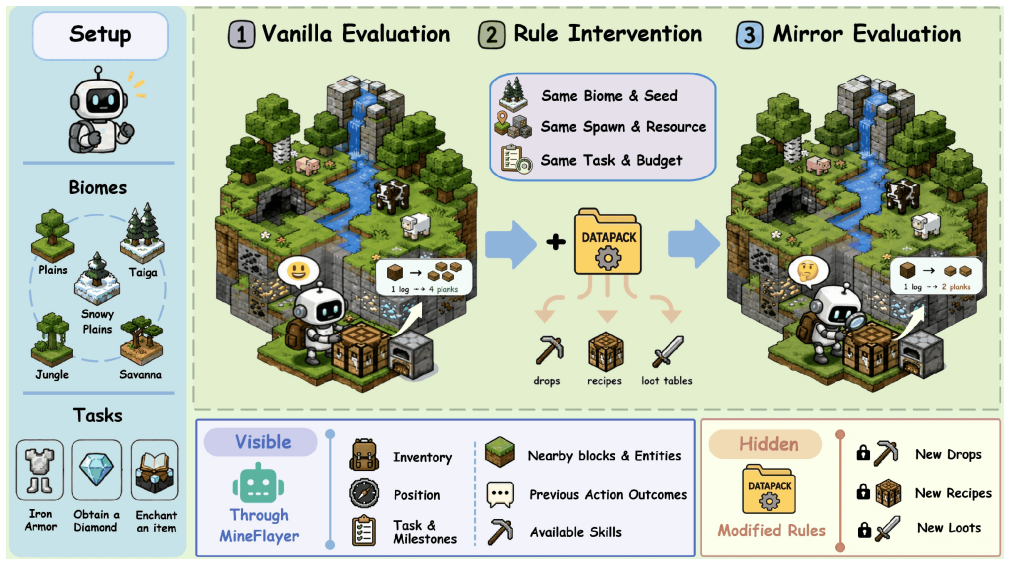
The central discovery is that the paired-copy design makes rule intervention measurable in an open-world game. For every Vanilla world under standard mechanics, MirrorCraft creates six paired Mirror worlds by copying its save and loading a datapack that changes selected recipes, drops, or processing routes, while terrain, spawn, placed resources, task, interfaces, and action budget stay fixed. Because only the rules differ, the paper attributes outcome differences to the intervention plus the agent's response. The pooled Rule Intervention Effect is positive overall, but individual suites range from strongly negative to positive, showing hidden rule changes do not form a uniformly harder test
What carries the argument
The core mechanism is the paired world copy: each Mirror world is initialized from the same save as its Vanilla world and differs only by a server-side datapack that modifies selected gameplay rules. This pairing keeps terrain, spawn, resource placement, task, interfaces, and action budget matched, so any difference in outcome can be attributed to the rule change and the agent's response. The paper operationalizes this with two Rule Intervention Effects—RIE for score and RIE for success rate—defined as the pooled difference between the paired Vanilla mean and the Mirror mean for the same world, model, task, configuration, and action budget. The paired identity carries the argument: it conver
Load-bearing premise
The fixed action budgets (50 or 75 semantic actions) are assumed adequate for the modified solution routes in every Mirror world, yet the reachability tests do not verify equal route lengths, so a rule that lengthens the route can exhaust the budget before the agent has a chance to adapt.
What would settle it
A concrete test would compute the verified shortest route length in semantic actions from spawn to each objective under every rule suite. If any suite's required route exceeds the action budget used in the main study, the RIE and success-rate gaps for that suite could be budget artifacts; rerunning those suites with route-length–matched budgets would show whether the reported configuration ordering changes.
If this is right
- If paired world copies are adopted, open-world agent benchmarks can separate rule adaptation from performance under familiar mechanics, rather than treating high fixed-mechanics scores as evidence of general competence.
- Evaluations of agents under changed rules should report both absolute Mirror performance and paired RIE, because a small RIE does not imply strong Mirror performance and vice versa.
- Hidden rule changes are not uniformly harder; suites that add useful byproducts can improve average outcomes, so 'changed rules' is not a single difficulty axis but a family of interventions with different signs and magnitudes.
- Providing the exact modified rules helps on average but does not ensure completion, implying that long-horizon progress depends on more than knowing the rule text—budget, route structure, and planning errors still bind.
- Action budgets are confounding: extending the horizon from 100 to 200 actions sharply improves the Mirror success of the slowest revision-based configuration, suggesting that some failures in the main study reflect budget exhaustion rather than inability to adapt.
Where Pith is reading between the lines
- A natural extension is to randomize individual rule edits within a suite, which would let future work attribute outcome differences to specific recipe or drop changes rather than to a bundled intervention.
- The paired-copy operation generalizes beyond Minecraft: any simulator with deterministic save states could adopt this 'rule surgery' protocol to measure adaptation in a controlled way.
- One should be cautious about interpreting IRR and RL as measures of causal adaptation; they are trajectory summaries, and a follow-up could check whether actions immediately repeated after a changed outcome actually increase progress.
- The single strongest untested implication is whether budget should be normalized by verified route length; the paper's reachability tests do not require equal route lengths, so a rule that lengthens a route can produce RIE differences that are partly an artifact of the fixed action budget.
Editorial analysis
A structured set of objections, weighed in public.
Referee Report
Summary. The paper introduces MirrorCraft, a paired Minecraft benchmark for evaluating LLM-based agents under hidden rule changes. Each Vanilla world is copied into six Mirror worlds that load different datapacks (M01–M06) modifying recipes, drops, or processing routes while preserving terrain, spawn, resources, task, interface, and action budget. Three progression tasks (Iron Armor, Diamond, Enchantment) are scored with server-verified milestones and success rate, and the Rule Intervention Effect (RIE) measures paired Vanilla−Mirror performance differences. A main study of 8,640 episodes across two models and six agent configurations finds that ReAct achieves the highest pooled Mirror Score without rule descriptions, and that disclosing exact rules yields modest gains but does not ensure completion, especially on Enchantment. The paper also reports IRR/RL behavioral diagnostics and a horizon study that shows ranking changes at longer action budgets.
Significance. If the claims hold, MirrorCraft makes a solid contribution: it offers a controlled, reproducible protocol for evaluating adaptation to changed mechanics, with deterministic construction checks, matched world copies, and server-verified milestones. The inclusion of paired Vanilla/Mirror worlds and the separation of Mirror performance from RIE are methodologically useful. The paper ships detailed supplementary tables, a construction pipeline with compile/load/route tests, and honest horizon-study data. These strengths are real and distinguish the work from earlier fixed-mechanics benchmarks. However, the headline comparative claim about ReAct is sensitive to the chosen action budgets, and the reported means lack uncertainty quantification, so the empirical ranking should be interpreted with care.
major comments (3)
- [§Results (Table 3) and §Integrity and Reachability Controls] Main-study budgets are 50/75 semantic actions, yet the reachability tests explicitly 'do not require equal route lengths, which may change under an intervention while the action budget remains fixed.' Table 3 shows this is not a theoretical caveat: at 200 actions, Gemini XENON's Mirror SR is 86.8% versus ReAct's 73.9%, and XENON gains 49.4 percentage points from 100 to 200 actions while ReAct gains only 9.5. The fixed budgets truncate slow knowledge-revision agents, so the headline 'ReAct achieves the highest pooled Mirror Score' is budget-dependent and may be an artifact of the cap. The paper should re-run the main study with longer budgets or explicitly reposition the claim as budget-specific, and elevate the horizon study to a central result.
- [§Eqs. (3)–(4) and §Limitations] RIE subtracts paired Mirror from Vanilla under the same fixed budget, so a rule change that lengthens the required route is scored as a performance drop even if the agent adapts perfectly. The paper acknowledges that RIE 'does not separately identify changes in route length,' but the pooled suite-level RIE values (e.g., M01 +13.5 Score, +23.5 SR in Table 4) are then described as 'declines from Vanilla.' Because the budget binds in Enchantment (most configurations exhaust all 75 actions), RIE conflates budget exhaustion with rule-change difficulty. Reporting per-suite route-length estimates or an action-budget contrast would make the measure interpretable.
- [§Table 2 and §Results] Every reported cell is a mean over three episodes, with no confidence intervals, standard deviations, or significance tests. The central comparative claim that ReAct achieves the highest pooled Mirror Score rests on a 2.45-point gap over Reflexion (86.8 vs. 84.35 pooled). Without per-cell variance or episode-level data, it is impossible to assess whether this ordering is stable. The paper should provide episode-level data, bootstrapped confidence intervals, or at least per-cell standard deviations for pooled Scores, SRs, and RIE values.
minor comments (4)
- [Table 3 text] The horizon study description says '25 Vanilla worlds (five per biome) and 60 Mirror worlds from 10 source worlds,' which differs from the main study's 10 Vanilla worlds. The sampling for the horizon study should be clarified.
- [Abstract / Table 2] 'Six agent configurations' is ambiguous because Table 2 also lists ReAct w/rules as a separate row. Consider wording like 'six configurations without rule descriptions, plus one disclosure condition.'
- [§Progression Tasks and Scoring] The milestone weights w_t(c) are only shown in Figure 3 of the supplementary material; the main text should give at least the final-milestone value of 100 and state the intermediate weights or reference the figure explicitly.
- [§Experimental Setup] The cost/actions columns in Table 2 are described as averaged over paired Mirror episodes, but the table also displays Vanilla rows. Clarify whether Vanilla actions/costs are included or whether the columns refer only to Mirror episodes.
Circularity Check
No significant circularity: MirrorCraft is a measurement instrument, not a derivation; RIE is a direct paired difference and no fitted parameter is reported as a prediction.
full rationale
MirrorCraft does not claim to derive agent behavior from a model or to predict outcomes from fitted constants. The Rule Intervention Effect (RIE) is defined directly as the paired Vanilla-minus-Mirror difference (Eqs. 3–4) and is computed from server-verified milestones, so it is a measurement rather than a construction. The rule suites are compiled by a deterministic pipeline with loading, outcome, and reachability checks; the LLM judge screens manifests for relevance and solvability but is explicitly not used to evaluate agent episodes or determine success. Agent configurations are external baselines (ReAct, Reflexion, Voyager, XENON, ADAM) evaluated under a common interface, not quantities used to define the benchmark. The main validity concern—fixed action budgets and unequal route lengths under rule changes—is an acknowledged limitation, not a circular reduction: the paper states that the reachability tests 'do not require equal route lengths' and the horizon study (Table 3) empirically shows that rankings change at 200 actions. That is a protocol-sensitivity caveat about the headline claim, not an identity between the input and the result. There is no self-citation chain, uniqueness theorem, or ansatz-smuggled-in-via-citation that makes the central claim true by construction. The derivation/measurement chain is self-contained, and the reported results are genuinely empirical.
Axiom & Free-Parameter Ledger
free parameters (4)
- Action budgets per task =
50 (Iron Armor, Diamond), 75 (Enchantment)
- Milestone score weights =
Final milestone = 100; intermediate weights per Figure 3
- Repetition count per condition =
3 (main study); 4 in horizon study; 2 for GPT-5.6
- Equal task weighting in pooled results =
1/3 per task
axioms (4)
- domain assumption Minecraft 1.19 datapack mechanisms (recipes, loot tables, advancements) behave as declared and are loaded consistently in every Mirror world.
- domain assumption The six rule suites are treated as a representative set of rule changes.
- domain assumption Agents cannot access hidden rule information from the interface or their pretraining priors.
- domain assumption Server-verified advancement milestones are a faithful ground truth for task progress.
read the original abstract
With the prosperity of the large language models (LLMs), it has become an interesting topic: how do LLM-based agents work in Minecraft? Unfortunately, most existing benchmarks evaluate them under fixed game mechanics. High performance in these settings does not show whether an agent can continue making progress when familiar recipes, drops, and other rules change. In this paper, we introduce MirrorCraft, a paired benchmark for evaluating agents under hidden rule changes in Minecraft. Each Mirror world is a copy of its paired Vanilla world, with selected server-side rules modified by the corresponding datapack. Terrain, spawn, resource placement, objective, interface, and action budget remain matched within every Vanilla-Mirror pair. MirrorCraft includes five controlled biomes, six rule suites, three progression objectives, two model families, and six agent configurations under a shared Mineflayer interface. We evaluate task progress with deterministic advancement milestones and success rate and use the Rule Intervention Effect (RIE) to measure the performance change between matched Vanilla and Mirror worlds. The experiments show that hidden rule changes have strongly different effects across suites. Among the configurations evaluated without rule descriptions, ReAct achieves the highest pooled Mirror score. Providing the exact rules yields modest gains in average progress and completion across all three objectives. MirrorCraft extends Minecraft evaluation beyond fixed mechanics and provides a controlled setting for studying how agents use gameplay outcomes when the rules of the current world differ from familiar ones.
Figures


Reference graph
Works this paper leans on
-
[1]
2026 , howpublished =
2026
-
[2]
and Houghton, Brandon and Topin, Nicholay and Wang, Phillip and Codel, Cayden and Veloso, Manuela and Salakhutdinov, Ruslan , booktitle =
Guss, William H. and Houghton, Brandon and Topin, Nicholay and Wang, Phillip and Codel, Cayden and Veloso, Manuela and Salakhutdinov, Ruslan , booktitle =
-
[3]
Fan, Linxi and Wang, Guanzhi and Jiang, Yunfan and Mandlekar, Ajay and Yang, Yuncong and Zhu, Haoyi and Tang, Andrew and Huang, De-An and Zhu, Yuke and Anandkumar, Anima , booktitle =
-
[4]
2025 , url =
Zheng, Xinyue and Lin, Haowei and He, Kaichen and Wang, Zihao and Fu, Qiang and Fu, Haobo and Zheng, Zilong and Liang, Yitao , booktitle =. 2025 , url =
2025
-
[5]
2026 , url =
Wang, Zihao and Li, Muyao and He, Kaichen and Wang, Xiangyu and Mu, Zhancun and Liu, Minghao and Liu, Anji and Liang, Yitao , booktitle =. 2026 , url =
2026
-
[6]
2024 , url =
Wu, Yue and Tang, Xuan and Mitchell, Tom and Li, Yuanzhi , booktitle =. 2024 , url =
2024
-
[7]
International Conference on Learning Representations , year =
Benchmarking the Spectrum of Agent Capabilities , author =. International Conference on Learning Representations , year =
-
[8]
2023 , note =
Voyager: An Open-Ended Embodied Agent with Large Language Models , author =. 2023 , note =
2023
-
[9]
Describe, Explain, Plan and Select: Interactive Planning with
Wang, Zihao and Cai, Shaofei and Chen, Guanzhou and Liu, Anji and Ma, Xiaojian and Liang, Yitao , booktitle =. Describe, Explain, Plan and Select: Interactive Planning with
-
[10]
Ghost in the
Zhu, Xizhou and Chen, Yuntao and Tian, Hao and Tao, Chenxin and Su, Weijie and Yang, Chenyu and Huang, Gao and Li, Bin and Lu, Lewei and Wang, Xiaogang and Qiao, Yu and Zhang, Zhaoxiang and Dai, Jifeng , year =. Ghost in the
-
[11]
Odyssey: Empowering
Liu, Shunyu and Li, Yaoru and Zhang, Kongcheng and Cui, Zhenyu and Fang, Wenkai and Zheng, Yuxuan and Zheng, Tongya and Song, Mingli , booktitle =. Odyssey: Empowering. 2025 , doi =
2025
-
[12]
From Entity-Centric to Goal-Oriented Graphs: Enhancing
Leung, Jonathan and Wang, Yongjie and Shen, Zhiqi , journal =. From Entity-Centric to Goal-Oriented Graphs: Enhancing. 2026 , doi =
2026
-
[13]
2025 , doi =
Wang, Zihao and Cai, Shaofei and Liu, Anji and Jin, Yonggang and Hou, Jinbing and Zhang, Bowei and Lin, Haowei and He, Zhaofeng and Zheng, Zilong and Yang, Yaodong and Ma, Xiaojian and Liang, Yitao , journal =. 2025 , doi =
2025
-
[14]
Advances in Neural Information Processing Systems , year =
Optimus-1: Hybrid Multimodal Memory Empowered Agents Excel in Long-Horizon Tasks , author =. Advances in Neural Information Processing Systems , year =
-
[15]
2025 , doi =
Li, Muyao and Wang, Zihao and He, Kaichen and Ma, Xiaojian and Liang, Yitao , booktitle =. 2025 , doi =
2025
-
[16]
MrSteve: Instruction-Following Agents in
Park, Junyeong and Cho, Junmo and Ahn, Sungjin , booktitle =. MrSteve: Instruction-Following Agents in. 2025 , note =
2025
-
[17]
and Cao, Yuan , booktitle =
Yao, Shunyu and Zhao, Jeffrey and Yu, Dian and Du, Nan and Shafran, Izhak and Narasimhan, Karthik R. and Cao, Yuan , booktitle =. 2023 , note =
2023
-
[18]
Advances in Neural Information Processing Systems , year =
Reflexion: Language Agents with Verbal Reinforcement Learning , author =. Advances in Neural Information Processing Systems , year =
-
[19]
2025 , note =
Yu, Shu and Lu, Chaochao , booktitle =. 2025 , note =
2025
-
[20]
Experience-Based Knowledge Correction for Robust Planning in
Lee, Seungjoon and Kim, Suhwan and Oh, Minhyeon and Yoon, Youngsik and Ok, Jungseul , booktitle =. Experience-Based Knowledge Correction for Robust Planning in. 2026 , note =
2026
-
[21]
Advances in Neural Information Processing Systems, Datasets and Benchmarks Track , year =
Mars: Situated Inductive Reasoning in an Open-World Environment , author =. Advances in Neural Information Processing Systems, Datasets and Benchmarks Track , year =
-
[22]
2021 , url =
Goel, Shivam and Tatiya, Gyan and Scheutz, Matthias and Sinapov, Jivko , booktitle =. 2021 , url =
2021
-
[23]
Transactions on Machine Learning Research , year =
NovelCraft: A Dataset for Novelty Detection and Discovery in Open Worlds , author =. Transactions on Machine Learning Research , year =
-
[24]
Plancraft: An Evaluation Dataset for Planning with
Dagan, Gautier and Keller, Frank and Lascarides, Alex , booktitle =. Plancraft: An Evaluation Dataset for Planning with. 2025 , note =
2025
-
[25]
ICLR 2026 Workshop on Recursive Self-Improvement , year =
Can Current Language Models Close the Discovery to Application Loop? , author =. ICLR 2026 Workshop on Recursive Self-Improvement , year =
2026
-
[26]
MineExplorer: Evaluating Open-World Exploration of
Ju, Tianjie and Sun, Yueqing and Wu, Zheng and Zhang, Wei and Huo, Yaqi and Su, Xi and Gu, Qi and Cai, Xunliang and Liu, Gongshen and Zhang, Zhuosheng , year =. MineExplorer: Evaluating Open-World Exploration of
-
[27]
MineAnyBuild: Benchmarking Spatial Planning for Open-World
Wei, Ziming and Lin, Bingqian and Jiao, Zijian and Nie, Yunshuang and Ma, Liang and Liu, Yuecheng and Zhuang, Yuzheng and Liang, Xiaodan , booktitle =. MineAnyBuild: Benchmarking Spatial Planning for Open-World. 2025 , note =
2025
-
[28]
2025 , url =
Zhou, Siyu and Zhou, Tianyi and Yang, Yijun and Long, Guodong and Ye, Deheng and Jiang, Jing and Zhang, Chengqi , booktitle =. 2025 , url =
2025
-
[29]
Proceedings of the 23rd International Conference on Autonomous Agents and Multiagent Systems , year =
NovelGym: A Flexible Ecosystem for Hybrid Planning and Learning Agents Designed for Open Worlds , author =. Proceedings of the 23rd International Conference on Autonomous Agents and Multiagent Systems , year =
-
[30]
Thibault Le Sellier de Chezelles and Maxime Gasse and Alexandre Lacoste and Massimo Caccia and Alexandre Drouin and L. The. Transactions on Machine Learning Research , issn =. 2025 , url =
2025
-
[31]
AgentBoard: An Analytical Evaluation Board of Multi-turn
Ma, Chang and Zhang, Junlei and Zhu, Zhihao and Yang, Cheng and Yang, Yujiu and Jin, Yaohui and Lan, Zhenzhong and Kong, Lingpeng and He, Junxian , booktitle =. AgentBoard: An Analytical Evaluation Board of Multi-turn. 2024 , doi =
2024
-
[32]
2025 , url =
Rawles, Chris and Clinckemaillie, Sarah and Chang, Yifan and Waltz, Jonathan and Lau, Gabrielle and Fair, Marybeth and Li, Alice and Bishop, William and Li, Wei and Campbell-Ajala, Folawiyo and Toyama, Daniel and Berry, Robert and Tyamagundlu, Divya and Lillicrap, Timothy and Riva, Oriana , booktitle =. 2025 , url =
2025
-
[33]
Ouyang, Mingyu and Hu, Siyuan and Lin, Kevin Qinghong and Ng, Hwee Tou and Shou, Mike Zheng , year =. 2604.07429 , archivePrefix =
-
[34]
2026 , eprint=
The World Won't Stay Still: Programmable Evolution for Agent Benchmarks , author=. 2026 , eprint=
2026
-
[35]
Tutorial: Installing a Data Pack , year=
-
[36]
Tutorial: Custom World Generation , year=
-
[37]
Gemini 3.1 Flash-Lite , year =
discussion (0)
Sign in with ORCID, Apple, or X to comment. Anyone can read and Pith papers without signing in.