REVIEW 4 major objections 5 minor 1 cited by
QFFT, Question-Free Fine-Tuning for Adaptive Reasoning
T0 review · 4 major / 5 minor · reviewed 2026-08-15 · deepseek-v4-flash
Pith's one-line read Removing the input question from fine-tuning lets a model keep its concise answers and switch to long, reflective reasoning only when needed, matching full fine-tuning accuracy while using about half the tokens.
desk verdict Question-free fine-tuning on long CoT responses cuts tokens ~50% at roughly matched accuracy—the core claim is solid; the adaptive switching story is plausible but under-tested, and RAK needs tightening. read the letter →
The pith
A machine-rendered reading of the paper's core claim, the machinery that carries it, and where it could break.
The reading
What carries the argument
The machinery is the question-free objective over the response sequence alone, $L_{\mathrm{QFFT}} = -\frac{1}{|R|}\sum_{t\in R}\log P_\theta(R_t | R_{<t})$. This is the whole method; it can be implemented by deleting the question from a standard SFT template. The paper identifies two equivalences that carry the argument: QFFT is SFT with null questions, so no concrete $Q \to R$ association is learned, and it is a form of continued pre-training on reasoning traces, so the model's existing abilities are extended rather than replaced. A second load-bearing piece is the transfer assumption that reflection learned for Long CoT contexts, written $P_\theta(B_r | U_L)$, also applies in Short CoT contexts, written $P_\theta(B_r | U_S)$, so the model spontaneously starts reflecting when its quick answer hits an error. The RAK score, a chance-corrected agreement statistic between whether a question is hard for the reference Short CoT model and whether the evaluated model chooses Long CoT, is the metric used to demonstrate that the switching actually tracks difficulty.
What would settle it
Run the Appendix B.5 continuation test on the QFFT-trained model itself, not on a different distilled model: feed it correct and erroneous Short CoT prefixes and compare how often reflection keywords appear. If the rates are equal, or if the QFFT model's hard-question accuracy on AIME24 and AIME25 falls materially below the SFT model's, the transfer assumption fails. A simpler check: classify the QFFT model's responses by whether the first reflective keyword follows a wrong step; if reflection is not concentrated after errors, the adaptive-switching claim is contradicted.
Extended reading notes
Core claim
The central claim is that the overthinking seen in long-reasoning models is not a property of the long reasoning style itself but of the supervised mapping from questions to long responses. Standard Long CoT SFT teaches the model $P_\theta(R | Q)$ for a long reflective response $R$, and this override makes the model produce long answers even for simple questions. QFFT instead optimizes $L_{\mathrm{QFFT}} = -\frac{1}{|R|}\sum_{t \in R}\log P_\theta(R_t | R_{<t})$, a standard causal language modeling objective over the response tokens only, with the question removed. The paper argues that this removes the $Q \to R$ mapping, so the model's default Short CoT behavior survives, while the response-only training still installs Long CoT reflective patterns. At inference the model is claimed to start with a concise answer and switch into Long CoT when it detects an error or uncertainty, a behavior the paper calls adaptive reasoning. The empirical claim is that QFFT matches SFT accuracy on six math benchmarks, reduces average response length by more than 50%, raises a proposed Reasoning Adaptability Kappa (RAK) score, and beats SFT in noisy, out-of-domain, and low-resource settings.
Load-bearing premise
The argument hinges on the claim that reflective behavior learned inside long, deliberate reasoning chains will transfer to the model's own quick, concise answers, so that when a quick answer contains an error the model spontaneously switches into checking and correcting mode; if that transfer is weak, accuracy on hard questions would drop below SFT.
Editorial extensions
If this is right
- A model can learn a long, reflective reasoning style from responses alone, so question-answer pairing is not required to transfer reasoning behavior.
- Token cost adapts to difficulty: on simple datasets like GSM8K response length falls by roughly three-quarters, while on AIME the reduction is smaller, consistent with the model keeping long reasoning where it is needed.
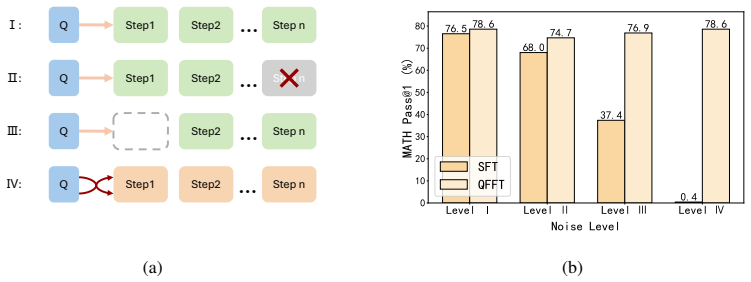
- Because no question-to-response mapping is learned, corrupted or mismatched training responses do much less damage; QFFT holds accuracy under noise levels that make SFT collapse.
- Out-of-domain generalization and hallucination behavior are preserved or improved relative to SFT, since the base model's knowledge and instruction-following are not overwritten by a new question-to-response mapping.
- QFFT composes with length-reduction methods such as DPO and SimPO, further cutting the tokens spent on long reasoning portions without large accuracy loss.
Reading between the lines
- A natural next test is whether the same question-free recipe can inject other behavioral patterns—tool-calling, code formatting, cautious verification—into a model without erasing its default style; the paper gestures at this idea in its closing section but does not test it.
- If the noise-robustness claim generalizes, QFFT could let practitioners use raw, uncurated reasoning traces from logs as training signal, since the method does not depend on question-answer alignment; this is an extension, not something the paper demonstrates beyond its synthetic noise levels.
- The adaptive-switching explanation predicts that QFFT's advantage over SFT should shrink as question difficulty rises and grow as data quality falls; this is a testable pattern across future benchmarks.
- Because QFFT preserves the base model's knowledge, it may be a safer starting point than SFT for continual learning in specialized domains, where later training should add skills without forgetting earlier ones.
Signed reviews
Editorial analysis
A structured set of objections, weighed in public.
Referee Report
Summary. The paper proposes Question-Free Fine-Tuning (QFFT), which removes the input question from the training data and fine-tunes a base model on Long CoT responses alone. The central claim is that this preserves the model's default Short CoT patterns while teaching it reflective Long CoT behaviors, so the resulting model adaptively uses short reasoning for simple questions and switches to long reasoning when it detects errors or uncertainty. Experiments on Qwen2.5-7B/32B and Phi-4-mini backbones over three distillation datasets and six math benchmarks report accuracy comparable to standard SFT while reducing average token length by more than 50%. Additional experiments report advantages for QFFT over SFT in noisy, out-of-domain, and low-resource settings, and the authors introduce a new metric, Reasoning Adaptability Cohen's Kappa (RAK), to quantify adaptive reasoning. The method is simple, the code is released, and the empirical pattern of token reduction with roughly matched accuracy is consistent across several configurations.
Significance. If the findings hold, the main contribution is conceptually interesting and practically useful: it suggests that a reasoning style can be injected from answer text alone, without learning question-to-response mappings, thereby avoiding the override of an existing concise style. The paper ships reproducible experiments across multiple backbones, distillation datasets, and benchmarks, and the question-free training recipe is simple enough to be broadly adopted. However, the evidence for the central adaptive-switching mechanism is incomplete: the transfer assumption in Section 3.4 is load-bearing but is only tested on a different model in Appendix B.5, and the RAK metric used to measure adaptive reasoning lacks an operational definition of Short vs Long CoT. The reported accuracy differences on the hardest benchmarks are small and mostly negative, yet no error bars or significance tests are provided. The noisy-data advantage is partly a design artifact because QFFT is never exposed to the mismatched question-answer pairs. These issues are fixable, but they currently leave the strongest claims not fully secured.
major comments (4)
- [§3.4, Appendix B.5] Assumption 2, that reflective behavior learned as P_theta(Br | U_L) in Long CoT contexts transfers to Short CoT contexts as P_theta(Br | U_S), is the mechanism that explains why QFFT can match SFT on hard questions. The only direct evidence is a continuation experiment on DeepSeek-R1-Distill-Qwen-7B, not on any QFFT-trained model. Showing that an already-long-CoT model reflects more often after erroneous prefixes does not show that a model trained question-free on Long CoT responses has acquired the same conditional trigger and can apply it inside its own Short CoT generation. The case study in Figure 3 and the GPT-4o classification in Figure 4 do not include a control comparison with error-free Short CoT prefixes or a measure of the pre-switch error rate. Please probe the QFFT models themselves, e.g., by feeding matched correct and erroneous Short CoT prefixes and measuring the switch-to-Long-CoT rate, or by comparing the QFFT model's own error-triggered switching against the SFT baseline on the same questions. Without this, the 'comparable on hard questions' part of the central claim is not secured, especially since the AIME25 and AIME24 differences in Tables 2 and 6 are mostly negative.
- [§2.2, Tables 2 and 6] RAK is the central evidence for the adaptive-reasoning claim, but the paper never specifies an operational rule for classifying a generated response as Short CoT versus Long CoT. Section 5.1 uses the first occurrence of 'wait' as a boundary, but it is not stated that the RAK computation in Tables 2 and 6 uses this rule, a length threshold, or an external classifier. Without a reproducible classification rule and some reliability check, RAK values such as 47.7 versus 3.5 on MATH cannot be interpreted as measuring adaptability rather than whatever the classifier happens to capture. Please specify the exact classification procedure used to compute RAK, report the classifier's agreement with human judgment, and make the annotation code available.
- [§4.1, Tables 2 and 6] The central claim that QFFT achieves performance comparable to SFT rests on 16-sample averages with no error bars, confidence intervals, or significance tests. The differences on the hardest benchmarks are small and mostly negative, e.g., AIME25 accuracy for 32B S1.1 is 48.6 for SFT versus 46.8 for QFFT (-1.8), and AIME24 accuracy for 32B LIMO is 56.7 versus 54.6 (-2.1). Given these magnitudes, the word 'comparable' is not statistically supported. Please report variance, confidence intervals, or pairwise significance tests for the main accuracy and token comparisons, at least for the headline tables.
- [§6.1, Figure 6] The Level IV noise comparison is confounded by design. In the QFFT format the question is removed, so a dataset in which each question is paired with another question's answer is not noisy for QFFT at all; only the SFT model is exposed to the mismatched question-answer pairs. The result that QFFT maintains 78.6% accuracy at Level IV is therefore partly a consequence of the method's question-free formulation rather than evidence of robustness to noisy data in the usual sense. Please add a control in which QFFT is trained on internally corrupted responses (e.g., truncated or wrong-answer responses while the question remains absent), or a condition with a present but uninformative question, or soften the robustness claim accordingly.
minor comments (5)
- [§3.2, Eq. (2)] The notation with the struck-through Q in Equation (2) is not defined; please clarify that it denotes removal of the question and check the typesetting of the conditioning context.
- [§2.3, Figure 2b] The x-axis labeled 'Ratio of Data with Question (%)' includes 0% and 100% but the text describes a logarithmic scale; a log scale cannot include 0%. Please use a broken axis or a consistent scale.
- [Tables 3 and 9] The header 'A VG' appears to be a typo for 'Average', and the tables are hard to read because column separators are missing. Please reformat them.
- [§5.2] The subsets 'MATHSystem 1' and 'MATHSystem 2' are used without definition; please define them explicitly as the Short-CoT and Long-CoT response subsets described in the surrounding text.
- [Footnote 4] Footnote 4 says the reason for the remaining Long CoT patterns will be discussed in Section 4, but the relevant discussion appears in Section 5.1; please fix the cross-reference.
Circularity Check
Central accuracy and token claims are externally benchmarked and independent; one secondary noise experiment is self-definitional because QFFT removes the very question that Level IV corrupts.
-
self definitional
[Section 6.1 (Noisy Scenarios), Level IV definition and Figure 6b, Key Observation 4]
"Level IV: Irrelevant Answers This level creates completely mismatched question-answer pairs, where each question is paired with an answer from another question. ... In contrast, QFFT exhibits remarkable robustness, maintaining 78.6% performance even under extreme noise conditions at Level IV, matching its Level I performance."
QFFT is defined by removing the question during training (Eq. 2), so a 'mismatched question-answer pair' is, for QFFT, just another Long CoT response. The Level IV training set is therefore identical to the Level I training set up to permutation, and the reported 78.6% at Level IV equals Level I by construction. Presenting this equality as evidence of noise robustness reduces the claim to the method's definition rather than an empirical discovery. The comparison with SFT remains valid, but Level IV provides no independent support for QFFT's robustness to response-content corruption (Levels II and III).
full rationale
The paper's central results (Table 2: accuracy and average token length on GSM8K, MATH, AIME25, plus appendix benchmarks) are measured against external benchmarks and are not defined in terms of the QFFT method, so the main 'comparable to SFT with more than 50% token reduction' claim is not circular. RAK is a custom metric aligned with the paper's own Definition 1, but it is used as a descriptive lens rather than as proof, and it can discriminate between models (SFT RAK scores are near 0-9 while QFFT scores are 27-48); no fitted parameter is hidden in it. Assumption 2, the transfer of reflective behavior P_theta(Br | U_L) to Short CoT contexts P_theta(Br | U_S), is an unproven transfer premise; Appendix B.5 tests DeepSeek-R1-Distill-Qwen-7B rather than a QFFT-trained model, so it is a missing-support/correctness risk, not a circularity. The one by-construction element is the Level IV noisy-data experiment: because QFFT discards the question, 'irrelevant answer' pairs are indistinguishable from normal responses, making Level IV performance identical to Level I by design. This affects only the noisy-data application claim and does not infect the main benchmark results, so the overall circularity is low.
Assumptions & free parameters
free parameters (1)
- AES weights =
alpha=0.1, beta=0.1, gamma=1.0
assumptions (3)
- domain assumption Assumption 1
- domain assumption Assumption 2
- domain assumption Override hypothesis
invented entities (1)
-
Reasoning Adaptability Cohen's Kappa (RAK)
Cite this review
Pith. "Pith review of QFFT, Question-Free Fine-Tuning for Adaptive Reasoning." pith.science (2026). https://pith.science/paper/FPWUYUQY
@misc{pith2026250612860,
  author       = {Pith},
  title        = {Pith review of: QFFT, Question-Free Fine-Tuning for Adaptive Reasoning},
  year         = {2026},
  howpublished = {\url{https://pith.science/paper/FPWUYUQY}},
  note         = {Machine review of arXiv:2506.12860}
}
read the original abstract
Recent advancements in Long Chain-of-Thought (CoT) reasoning models have improved performance on complex tasks, but they suffer from overthinking, which generates redundant reasoning steps, especially for simple questions. This paper revisits the reasoning patterns of Long and Short CoT models, observing that the Short CoT patterns offer concise reasoning efficiently, while the Long CoT patterns excel in challenging scenarios where the Short CoT patterns struggle. To enable models to leverage both patterns, we propose Question-Free Fine-Tuning (QFFT), a fine-tuning approach that removes the input question during training and learns exclusively from Long CoT responses. This approach enables the model to adaptively employ both reasoning patterns: it prioritizes the Short CoT patterns and activates the Long CoT patterns only when necessary. Experiments on various mathematical datasets demonstrate that QFFT reduces average response length by more than 50\%, while achieving performance comparable to Supervised Fine-Tuning (SFT). Additionally, QFFT exhibits superior performance compared to SFT in noisy, out-of-domain, and low-resource scenarios.
Figures


Figures from the paper (8 more)




Forward citations
Cited by 1 Pith paper
-
Towards Concise and Adaptive Thinking in Large Reasoning Models: A Survey
A comprehensive review that categorizes methods for shortening and adaptively triggering chain-of-thought reasoning in large language models.
Reference graph
Works this paper leans on
-
[1]
Openai o1 system card.arXiv preprint arXiv:2412.16720, 2024
Aaron Jaech, Adam Kalai, Adam Lerer, Adam Richardson, Ahmed El-Kishky, Aiden Low, Alec Helyar, Aleksander Madry, Alex Beutel, Alex Carney, et al. Openai o1 system card.arXiv preprint arXiv:2412.16720, 2024
arXiv 2024
-
[2]
Daya Guo, Dejian Yang, Haowei Zhang, Junxiao Song, Ruoyu Zhang, Runxin Xu, Qihao Zhu, Shirong Ma, Peiyi Wang, Xiao Bi, et al. Deepseek-r1: Incentivizing reasoning capability in llms via reinforcement learning.arXiv preprint arXiv:2501.12948, 2025
arXiv 2025
-
[3]
Reasoning with large language models, a survey.arXiv preprint arXiv:2407.11511, 2024
Aske Plaat, Annie Wong, Suzan Verberne, Joost Broekens, Niki van Stein, and Thomas Back. Reasoning with large language models, a survey.arXiv preprint arXiv:2407.11511, 2024
arXiv 2024
-
[4]
Dayu Yang, Tianyang Liu, Daoan Zhang, Antoine Simoulin, Xiaoyi Liu, Yuwei Cao, Zhaopu Teng, Xin Qian, Grey Yang, Jiebo Luo, et al. Code to think, think to code: A survey on code-enhanced reasoning and reasoning-driven code intelligence in llms.arXiv preprint arXiv:2502.19411, 2025
arXiv 2025
-
[5]
Competitive programming with large reasoning models.arXiv preprint arXiv:2502.06807, 2025
Ahmed El-Kishky, Alexander Wei, Andre Saraiva, Borys Minaiev, Daniel Selsam, David Dohan, Francis Song, Hunter Lightman, Ignasi Clavera, Jakub Pachocki, et al. Competitive programming with large reasoning models.arXiv preprint arXiv:2502.06807, 2025
arXiv 2025
-
[6]
Dacheng Li, Shiyi Cao, Tyler Griggs, Shu Liu, Xiangxi Mo, Eric Tang, Sumanth Hegde, Kourosh Hakhamaneshi, Shishir G Patil, Matei Zaharia, et al. Llms can easily learn to reason from demonstrations structure, not content, is what matters!arXiv preprint arXiv:2502.07374, 2025
arXiv 2025
-
[7]
Menghao Huo, Kuan Lu, Qiang Zhu, and Zhenrui Chen. Enhancing customer contact effi- ciency with graph neural networks in credit card fraud detection workflow.arXiv preprint arXiv:2504.02275, 2025
arXiv 2025
-
[8]
Sky-t1: Fully open-source reasoning model with o1-preview performance in 450 budget
NovaSky Team. Sky-t1: Fully open-source reasoning model with o1-preview performance in 450 budget. https://novasky-ai.github.io/posts/sky-t1, 2025. Accessed: 2025-01-09
work page 2025
Show all 49 references
-
[9]
s1: Simple test-time scaling.arXiv preprint arXiv:2501.19393, 2025
Niklas Muennighoff, Zitong Yang, Weijia Shi, Xiang Lisa Li, Li Fei-Fei, Hannaneh Hajishirzi, Luke Zettlemoyer, Percy Liang, Emmanuel Candès, and Tatsunori Hashimoto. s1: Simple test-time scaling.arXiv preprint arXiv:2501.19393, 2025. 14
2025 arXiv
-
[10]
Limo: Less is more for reasoning.arXiv preprint arXiv:2502.03387, 2025
Yixin Ye, Zhen Huang, Yang Xiao, Ethan Chern, Shijie Xia, and Pengfei Liu. Limo: Less is more for reasoning.arXiv preprint arXiv:2502.03387, 2025
2025 arXiv
-
[11]
Do not think that much for 2+ 3=? on the overthinking of o1-like llms.arXiv preprint arXiv:2412.21187, 2024
Xingyu Chen, Jiahao Xu, Tian Liang, Zhiwei He, Jianhui Pang, Dian Yu, Linfeng Song, Qiuzhi Liu, Mengfei Zhou, Zhuosheng Zhang, et al. Do not think that much for 2+ 3=? on the overthinking of o1-like llms.arXiv preprint arXiv:2412.21187, 2024
2024 arXiv
-
[12]
Thoughts are all over the place: On the underthinking of o1-like llms.arXiv preprint arXiv:2501.18585, 2025
Yue Wang, Qiuzhi Liu, Jiahao Xu, Tian Liang, Xingyu Chen, Zhiwei He, Linfeng Song, Dian Yu, Juntao Li, Zhuosheng Zhang, et al. Thoughts are all over the place: On the underthinking of o1-like llms.arXiv preprint arXiv:2501.18585, 2025
2025 arXiv
-
[13]
Kimi Team, Angang Du, Bofei Gao, Bowei Xing, Changjiu Jiang, Cheng Chen, Cheng Li, Chenjun Xiao, Chenzhuang Du, Chonghua Liao, et al. Kimi k1. 5: Scaling reinforcement learning with llms.arXiv preprint arXiv:2501.12599, 2025
2025 arXiv
-
[14]
O1-pruner: Length-harmonizing fine-tuning for o1-like reasoning pruning.arXiv preprint arXiv:2501.12570, 2025
Haotian Luo, Li Shen, Haiying He, Yibo Wang, Shiwei Liu, Wei Li, Naiqiang Tan, Xiaochun Cao, and Dacheng Tao. O1-pruner: Length-harmonizing fine-tuning for o1-like reasoning pruning.arXiv preprint arXiv:2501.12570, 2025
2025 arXiv
-
[15]
L1: Controlling how long a reasoning model thinks with reinforcement learning.arXiv preprint arXiv:2503.04697, 2025
Pranjal Aggarwal and Sean Welleck. L1: Controlling how long a reasoning model thinks with reinforcement learning.arXiv preprint arXiv:2503.04697, 2025
2025 arXiv
-
[16]
Cot-valve: Length-compressible chain-of-thought tuning.arXiv preprint arXiv:2502.09601, 2025
Xinyin Ma, Guangnian Wan, Runpeng Yu, Gongfan Fang, and Xinchao Wang. Cot-valve: Length-compressible chain-of-thought tuning.arXiv preprint arXiv:2502.09601, 2025
2025 arXiv
-
[17]
Tokenskip: Controllable chain-of-thought compression in llms.arXiv preprint arXiv:2502.12067, 2025
Heming Xia, Yongqi Li, Chak Tou Leong, Wenjie Wang, and Wenjie Li. Tokenskip: Controllable chain-of-thought compression in llms.arXiv preprint arXiv:2502.12067, 2025
2025
-
[18]
Understanding catastrophic forgetting in language models via implicit inference
Suhas Kotha, Jacob Mitchell Springer, and Aditi Raghunathan. Understanding catastrophic forgetting in language models via implicit inference. InThe Twelfth International Conference on Learning Representations, 2024
2024
-
[19]
Towards large reasoning models: A survey of reinforced reasoning with large language models.arXiv preprint arXiv:2501.09686, 2025
Fengli Xu, Qianyue Hao, Zefang Zong, Jingwei Wang, Yunke Zhang, Jingyi Wang, Xiaochong Lan, Jiahui Gong, Tianjian Ouyang, Fanjin Meng, et al. Towards large reasoning models: A survey of reinforced reasoning with large language models.arXiv preprint arXiv:2501.09686, 2025
2025 arXiv
-
[20]
Towards widening the distillation bottleneck for reasoning models.arXiv preprint arXiv:2503.01461, 2025
Huifeng Yin, Yu Zhao, Minghao Wu, Xuanfan Ni, Bo Zeng, Hao Wang, Tianqi Shi, Liangying Shao, Chenyang Lyu, Longyue Wang, et al. Towards widening the distillation bottleneck for reasoning models.arXiv preprint arXiv:2503.01461, 2025
2025 arXiv
-
[21]
Note on cohen’s kappa.Psychological reports, 65(1):223–226, 1989
Tarald O Kvålseth. Note on cohen’s kappa.Psychological reports, 65(1):223–226, 1989
1989
-
[22]
Let’s verify step by step.arXiv preprint arXiv:2305.20050, 2023
Hunter Lightman, Vineet Kosaraju, Yura Burda, Harri Edwards, Bowen Baker, Teddy Lee, Jan Leike, John Schulman, Ilya Sutskever, and Karl Cobbe. Let’s verify step by step.arXiv preprint arXiv:2305.20050, 2023
2023 arXiv
-
[23]
Demystifying long chain-of-thought reasoning in llms.arXiv preprint arXiv:2502.03373, 2025
Edward Yeo, Yuxuan Tong, Morry Niu, Graham Neubig, and Xiang Yue. Demystifying long chain-of-thought reasoning in llms.arXiv preprint arXiv:2502.03373, 2025
2025 arXiv
-
[24]
Data engineering for scaling language models to 128k context, 2024
Yao Fu, Rameswar Panda, Xinyao Niu, Xiang Yue, Hannaneh Hajishirzi, Yoon Kim, and Hao Peng. Data engineering for scaling language models to 128k context, 2024
2024
-
[25]
Huang, Jie Fu, Xiang Yue, and Wenhu Chen
Alex Zhuang, Ge Zhang, Tianyu Zheng, Xinrun Du, Junjie Wang, Weiming Ren, Stephen W. Huang, Jie Fu, Xiang Yue, and Wenhu Chen. Structlm: Towards building generalist models for structured knowledge grounding, 2024
2024
-
[26]
A survey of transfer learning.Journal of Big data, 3:1–40, 2016
Karl Weiss, Taghi M Khoshgoftaar, and DingDing Wang. A survey of transfer learning.Journal of Big data, 3:1–40, 2016
2016
-
[27]
A comprehensive survey on transfer learning.Proceedings of the IEEE, 109(1):43–76, 2020
Fuzhen Zhuang, Zhiyuan Qi, Keyu Duan, Dongbo Xi, Yongchun Zhu, Hengshu Zhu, Hui Xiong, and Qing He. A comprehensive survey on transfer learning.Proceedings of the IEEE, 109(1):43–76, 2020. 15
2020
-
[28]
An Yang, Baosong Yang, Beichen Zhang, Binyuan Hui, Bo Zheng, Bowen Yu, Chengyuan Li, Dayiheng Liu, Fei Huang, Haoran Wei, et al. Qwen2. 5 technical report.arXiv preprint arXiv:2412.15115, 2024
2024 arXiv
-
[29]
Llamafactory: Unified efficient fine-tuning of 100+ language models
Yaowei Zheng, Richong Zhang, Junhao Zhang, Yanhan Ye, and Zheyan Luo. Llamafactory: Unified efficient fine-tuning of 100+ language models. InProceedings of the 62nd Annual Meeting of the Association for Computational Linguistics (Volume 3: System Demonstrations), pages 400–410, 2024
2024
-
[30]
Training verifiers to solve math word problems.arXiv preprint arXiv:2110.14168, 2021
Karl Cobbe, Vineet Kosaraju, Mohammad Bavarian, Mark Chen, Heewoo Jun, Lukasz Kaiser, Matthias Plappert, Jerry Tworek, Jacob Hilton, Reiichiro Nakano, Christopher Hesse, and John Schulman. Training verifiers to solve math word problems.arXiv preprint arXiv:2110.14168, 2021
-
[31]
Solving quantitative reasoning problems with language models.Advances in Neural Information Processing Systems, 35:3843–3857, 2022
Aitor Lewkowycz, Anders Andreassen, David Dohan, Ethan Dyer, Henryk Michalewski, Vinay Ramasesh, Ambrose Slone, Cem Anil, Imanol Schlag, Theo Gutman-Solo, et al. Solving quantitative reasoning problems with language models.Advances in Neural Information Processing Systems, 35:...
2022
-
[32]
Gpqa: A graduate-level google-proof q&a benchmark
David Rein, Betty Li Hou, Asa Cooper Stickland, Jackson Petty, Richard Yuanzhe Pang, Julien Dirani, Julian Michael, and Samuel R Bowman. Gpqa: A graduate-level google-proof q&a benchmark. InFirst Conference on Language Modeling, 2024
2024
-
[33]
Mmlu-pro: A more robust and challenging multi-task language understanding benchmark
Yubo Wang, Xueguang Ma, Ge Zhang, Yuansheng Ni, Abhranil Chandra, Shiguang Guo, Weiming Ren, Aaran Arulraj, Xuan He, Ziyan Jiang, et al. Mmlu-pro: A more robust and challenging multi-task language understanding benchmark. InThe Thirty-eight Conference on Neural Information Pro...
2024
-
[34]
Cognitive behaviors that enable self-improving reasoners, or, four habits of highly effective stars.arXiv preprint arXiv:2503.01307, 2025
Kanishk Gandhi, Ayush Chakravarthy, Anikait Singh, Nathan Lile, and Noah D Goodman. Cognitive behaviors that enable self-improving reasoners, or, four habits of highly effective stars.arXiv preprint arXiv:2503.01307, 2025
2025 arXiv
-
[35]
Minicheck: Efficient fact-checking of llms on grounding documents
Liyan Tang, Philippe Laban, and Greg Durrett. Minicheck: Efficient fact-checking of llms on grounding documents. InProceedings of the 2024 Conference on Empirical Methods in Natural Language Processing, pages 8818–8847, 2024
2024
-
[36]
Why rare diseases are an important medical and social issue.The Lancet, 371(9629):2039–2041, 2008
Arrigo Schieppati, Jan-Inge Henter, Erica Daina, and Anita Aperia. Why rare diseases are an important medical and social issue.The Lancet, 371(9629):2039–2041, 2008
2008
-
[37]
Significance of the rare event in geology.AAPG Bulletin, 51(11):2197–2206, 1967
Peter E Gretener. Significance of the rare event in geology.AAPG Bulletin, 51(11):2197–2206, 1967
1967
-
[38]
Qwq-32b: Embracing the power of reinforcement learning, March 2025
Qwen Team. Qwq-32b: Embracing the power of reinforcement learning, March 2025
2025
-
[39]
From system 1 to system 2: A survey of reasoning large language models.arXiv preprint arXiv:2502.17419, 2025
Zhong-Zhi Li, Duzhen Zhang, Ming-Liang Zhang, Jiaxin Zhang, Zengyan Liu, Yuxuan Yao, Haotian Xu, Junhao Zheng, Pei-Jie Wang, Xiuyi Chen, et al. From system 1 to system 2: A survey of reasoning large language models.arXiv preprint arXiv:2502.17419, 2025
2025 arXiv
-
[40]
Reasoning on a spectrum: Aligning llms to system 1 and system 2 thinking.arXiv preprint arXiv:2502.12470, 2025
Alireza S Ziabari, Nona Ghazizadeh, Zhivar Sourati, Farzan Karimi-Malekabadi, Payam Piray, and Morteza Dehghani. Reasoning on a spectrum: Aligning llms to system 1 and system 2 thinking.arXiv preprint arXiv:2502.12470, 2025
2025
-
[41]
Towards system 2 reasoning in llms: Learning how to think with meta chain-of-though.arXiv preprint arXiv:2501.04682, 2025
Violet Xiang, Charlie Snell, Kanishk Gandhi, Alon Albalak, Anikait Singh, Chase Blagden, Duy Phung, Rafael Rafailov, Nathan Lile, Dakota Mahan, et al. Towards system 2 reasoning in llms: Learning how to think with meta chain-of-though.arXiv preprint arXiv:2501.04682, 2025
2025 arXiv
-
[42]
Open r1: A fully open reproduction of deepseek-r1, January 2025
Hugging Face. Open r1: A fully open reproduction of deepseek-r1, January 2025
2025
-
[43]
Aimo-2 winning solution: Building state-of-the-art math- ematical reasoning models with openmathreasoning dataset.arXiv preprint arXiv:2504.16891, 2025
Ivan Moshkov, Darragh Hanley, Ivan Sorokin, Shubham Toshniwal, Christof Henkel, Benedikt Schifferer, Wei Du, and Igor Gitman. Aimo-2 winning solution: Building state-of-the-art math- ematical reasoning models with openmathreasoning dataset.arXiv preprint arXiv:2504.16891, 2025. 16
2025 arXiv
-
[44]
Unlocking efficient long-to-short llm reasoning with model merging.arXiv preprint arXiv:2503.20641, 2025
Han Wu, Yuxuan Yao, Shuqi Liu, Zehua Liu, Xiaojin Fu, Xiongwei Han, Xing Li, Hui-Ling Zhen, Tao Zhong, and Mingxuan Yuan. Unlocking efficient long-to-short llm reasoning with model merging.arXiv preprint arXiv:2503.20641, 2025
2025 arXiv
-
[45]
Chain of draft: Thinking faster by writing less.arXiv preprint arXiv:2502.18600, 2025
Silei Xu, Wenhao Xie, Lingxiao Zhao, and Pengcheng He. Chain of draft: Thinking faster by writing less.arXiv preprint arXiv:2502.18600, 2025
2025 arXiv
-
[46]
Concise thoughts: Impact of output length on llm reasoning and cost.arXiv preprint arXiv:2407.19825, 2024
Sania Nayab, Giulio Rossolini, Marco Simoni, Andrea Saracino, Giorgio Buttazzo, Nicolamaria Manes, and Fabrizio Giacomelli. Concise thoughts: Impact of output length on llm reasoning and cost.arXiv preprint arXiv:2407.19825, 2024
2024 arXiv
-
[47]
Token-budget-aware llm reasoning.arXiv preprint arXiv:2412.18547, 2024
Tingxu Han, Zhenting Wang, Chunrong Fang, Shiyu Zhao, Shiqing Ma, and Zhenyu Chen. Token-budget-aware llm reasoning.arXiv preprint arXiv:2412.18547, 2024
2024 arXiv
-
[48]
Longrecipe: Recipe for efficient long context generalization in large language models, 2024
Zhiyuan Hu, Yuliang Liu, Jinman Zhao, Suyuchen Wang, Yan Wang, Wei Shen, Qing Gu, Anh Tuan Luu, See-Kiong Ng, Zhiwei Jiang, and Bryan Hooi. Longrecipe: Recipe for efficient long context generalization in large language models, 2024
2024
-
[49]
let me double-check
Chujie Zheng, Zhenru Zhang, Beichen Zhang, Runji Lin, Keming Lu, Bowen Yu, Dayiheng Liu, Jingren Zhou, and Junyang Lin. Processbench: Identifying process errors in mathematical reasoning. InThe 63rd Annual Meeting of the Association for Computational Linguistics, 2025. 17 A Ex...
2025
Reviewed August 15, 2026 · model on record in the stance chip above.
Discussion (0). Continue with ORCID to comment.