REVIEW 3 major objections 5 minor 2 cited by
People who frequently use ChatGPT for writing tasks are accurate and robust detectors of AI-generated text
T0 review · 3 major / 5 minor · reviewed 2026-08-10 · deepseek-v4-flash
Pith's one-line read Frequent LLM users detect AI-generated articles with near-perfect accuracy.
desk verdict A solid, well-documented study of a small screened expert panel that detects AI text near-perfectly, but the title's population-level claim about frequent ChatGPT users is not supported by the selection design; worth serious refereeing after reframing. read the letter →
The pith
A machine-rendered reading of the paper's core claim, the machinery that carries it, and where it could break.
The reading
What carries the argument
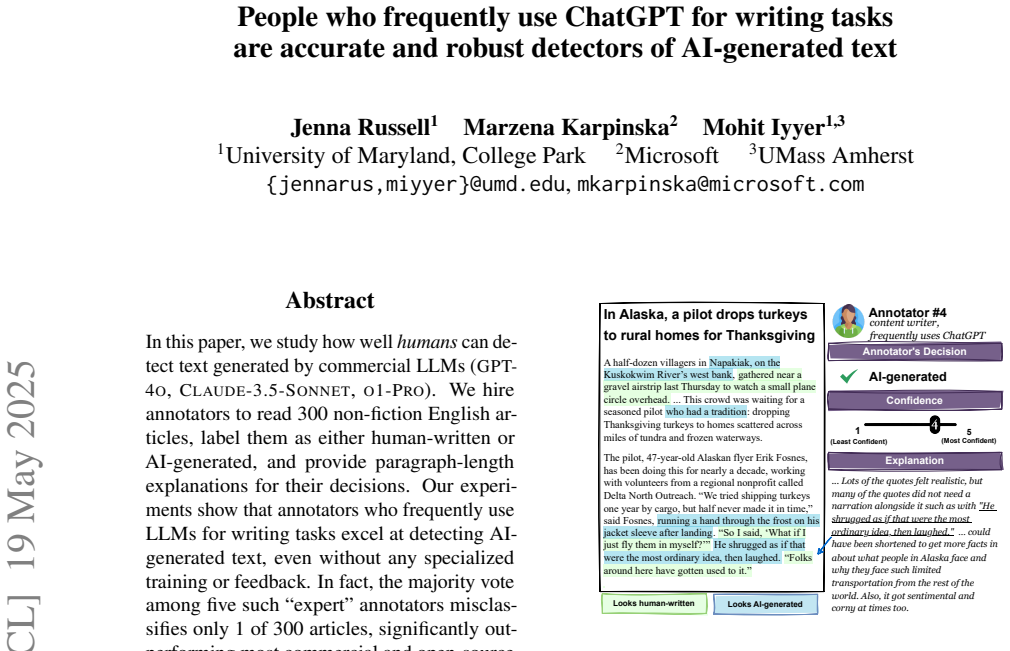
The central machinery is the expert majority vote: five annotators recruited for frequent LLM use in writing tasks each independently label articles, highlight clue spans, rate confidence, and write explanations; their majority vote is the system that achieves 99.3% true-positive and 0% false-positive on 300 articles. The detection guide compiled from expert explanations also drives the paper's humanization attack and its prompt-based detector, making the annotators' clue taxonomy the load-bearing component that carries both the human and automated results.
What would settle it
Test the same five experts on a corpus of AI articles generated in the wild (varied prompts, user requests, other genres, or non-English text) and with humanization methods not built from the experts' own clues; if their majority vote accuracy drops substantially below the reported 99.3%, the claim that expert writers are robust detectors of AI-generated text would be falsified.
Extended reading notes
Core claim
On the paper's own terms, the central discovery is that expertise with LLMs for writing transfers to detection: five annotators who routinely edit, copywrite, or proofread with ChatGPT identify AI-generated nonfiction articles at near-perfect accuracy using vocabulary, sentence-structure, and originality cues, and their aggregate majority vote is robust to adversarial paraphrasing and humanization. The paper further finds that these experts outperform every tested automatic detector except the commercial Pangram system, which they match, and that their free-form explanations reveal clues—overused "AI vocabulary", formulaic structures, overly tidy conclusions—that are accessible to humans but hard for detectors to score.
Load-bearing premise
The near-perfect expert accuracy assumes that the AI-generated articles used in the study—produced by prompting with only the title, subtitle, length, and publication name—are representative of the AI-generated text people actually encounter, and that the paired human articles contain no AI edits.
Editorial extensions
If this is right
- A small panel of LLM-experienced writers can serve as a practical detection workforce in settings where false accusations are costly and an explanation is required.
- Prompt-based humanization built from expert clues degrades most automatic detectors but leaves expert majority-vote accuracy at 100% on the tested articles, so current humanization tools do not yet erase the signatures experts rely on.
- Individual expert performance varies (one annotator's true-positive rate falls to 0% on humanized articles), so relying on a single human reader is risky; the paper's near-perfect result depends on aggregating diverse clue preferences.
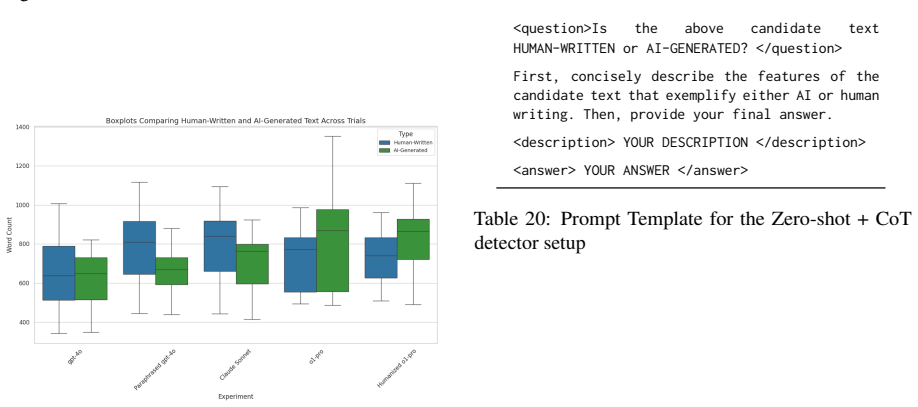
- The paper's prompt-based detector using an expert guidebook is competitive on easy configurations but fails on humanized text, indicating that simply giving an LLM the guide does not reproduce expert robustness.
Reading between the lines
- A natural extension the paper does not test: combining expert human adjudication with automatic scorers in a human-in-the-loop pipeline, where experts handle borderline or high-stakes cases while machines do the bulk screening.
- Because all AI articles were generated with a single prompt template using the human article's title, subtitle, and publication, the measured expert accuracy may partly reflect prompt-induced artifacts; a test on articles produced by real users with varied prompts could yield lower accuracy.
- The reported cost ($4.9K for 1,790 annotations) and throughput (8-12 articles per hour per annotator) imply that expert panels are economical only for low-volume, high-stakes detection, not for content moderation at scale; the paper acknowledges the scale limit but does not quantify it in deployment terms.
Signed reviews
Editorial analysis
A structured set of objections, weighed in public.
Referee Report
Summary. The paper reports a human annotation study in which five 'expert' annotators, recruited for frequent LLM use and editing/writing backgrounds, label 300 human-authored and LLM-generated non-fiction English article pairs across five experiments. The authors report that a majority vote of these five experts misclassifies only 1 of 300 articles (99.3% TPR, 0% FPR), outperforming most tested automatic detectors and matching the commercial Pangram model, including under paraphrasing and a prompt-based humanization attack. The paper also analyzes the experts' free-text explanations, extracts a taxonomy of detection clues, and tests whether LLMs prompted with a guidebook built from those explanations can mimic the experts. The authors release the annotated dataset and code.
Significance. If interpreted as a statement about screened, high-performing human annotators, the result is significant: it provides a concrete benchmark showing that a small ensemble of human experts can match the best commercial detector on this article corpus while also offering explanations, and it documents which textual clues survive paraphrasing and humanization. The dataset and code release are valuable assets, and the comparison across GPT-4o, Claude, and o1-pro with and without evasion tactics is more thorough than most prior human-detection studies. However, the title and abstract claim a population-level conclusion about frequent LLM users, and that claim is not supported by the recruitment protocol, which selected annotators based on performance on the very task and article distribution later reported as the headline result.
major comments (3)
- [§A.1, §2.1] The recruitment of expert annotators in §A.1 creates an outcome-based selection artifact for Experiment 1. The four additional experts were required to score at least 4/5 on a 5-question sample drawn from the Experiment 1 article set and then at least 90% on the remaining 60 Experiment 1 articles; the fifth expert (Annotator 1) was the original pilot annotator who already performed almost perfectly on that same batch. Consequently, the perfect majority-vote result in §2.1 is partly guaranteed by construction and cannot support the abstract's claim that 'annotators who frequently use LLMs for writing tasks excel at detecting AI-generated text.' The paper should either reframe the central claim as being about screened experts who pass a performance qualification, or add an unscreened cohort of frequent LLM users evaluated on a held-out article set. Experiments 2–5 do provide independent evidence for the robustness of the five selected experts on new article sets, but they do not rehabilitate the population-level title claim.
- [§2, Table 8, §B.2] The generalization claim that experts are 'robust detectors of AI-generated text' is anchored to a narrow generation template. All AI articles, including humanized ones, are produced from a prompt that supplies the title, subtitle, publication, section, and desired length, and instructs the model to 'Include quotations from relevant experts and make sure the article is concise and easily understandable to a lay audience.' This common prompt likely induces systematic structural and lexical fingerprints (e.g., expert quotes placed at the end of paragraphs, uniform exposition style) that the experts learn to exploit. The paper therefore demonstrates robustness across three model families and two evasion tactics within one genre and one generation template, but it does not establish robustness to the broader distribution of real-world AI text, which may be written with different prompts, lengths, domains, or post-editing. The limitations section acknowledges domain restriction and possible AI edits in the human articles, but it does not address the prompt-template confound; a paragraph acknowledging this and softening the title-level generalization would be needed.
- [§2.4, Table 2] The headline robustness result depends heavily on the majority-vote aggregation, and the paper should be more explicit that this is an ensemble property rather than a property of typical individual experts. Annotator 3, for example, achieves a TPR of only 16.7% on o1-pro and 0% on humanized o1-pro articles, while Annotator 2's FPR reaches 30% on Claude articles. The paper does acknowledge individual variation in §3 and §D.3, but the abstract's phrasing 'five such expert annotators' could mislead readers into thinking each expert is highly robust. The practical recommendation to hire 'expert human annotators' should state clearly that a majority-vote panel of at least five screened experts is the unit that delivers the reported 99.3% TPR, and that individual performance varies substantially across generators.
minor comments (5)
- [§2.1, Table 1] There are numeric inconsistencies between the text and Table 1: the text reports an average FPR of 52.5% for nonexperts, but Table 1 lists 51.7%; the text reports an average FPR of 3.3% for experts, but Table 1 lists 4.0%. Please reconcile these values.
- [Introduction, §2 (Annotator details)] The paper states in the introduction that 'we collect 1790 annotations on 300 unique articles' but later reports '1740 annotations from 9 annotators.' With 5 experts × 300 articles and 4 nonexperts × 60 articles, the total is 1740; the 1790 figure appears to be a typo and should be corrected.
- [Table 2] The 'OVERALL' columns in Table 2 should specify whether the TPR/FPR values are macro-averaged across the five experiments or computed over the pooled 150 AI and 150 human articles. The current presentation makes this ambiguous, which matters because experiments differ in difficulty (e.g., o1-pro humanized has much lower automatic-detector TPR).
- [§3, §D.3] The sentence 'This diversity explains why an ensemble of expert annotators performs so well and it also suggests room for training so that all experts are at least aware of most distinguishing features. implies additional training can improve individual experts.' contains a grammatical break ('features. implies') and should be rewritten.
- [§B.2, Table 9/Table 10] The captions for the paraphrase prompts refer to 'Experiment 2 Paraphras-ing' but paraphrasing is used in Experiment 3; please correct the cross-reference.
Circularity Check
Expert annotators were screened on the same 60 articles used as Experiment 1, so the headline Experiment 1 accuracy is partly an inclusion criterion rather than a measurement; Experiments 2–5 remain independent.
-
self definitional
[Appendix A.1 (Finding Expert Annotators), applied to §2.1 and Table 2 GPT-4O column]
"Only one annotator from the original experiment met these requirements. We recruited 10 more native English speakers on Upwork to take a 5 question sample of the original article task ... Those who got at least 4 out of 5 correct (80%) given the rest of the 60 articles, and annotators who got at least 90% correct (54/60) were considered to be experts and recruited for the rest of the labeling rounds."
The expert panel is defined by scoring at least 90% on the very 60-article batch that §2.1 then reports as the discovery that experts are accurate ('The majority vote out of these five annotators correctly determined authorship of all 60 articles'; Table 2, 100% TPR). Experiment 1's accuracy is therefore an entry requirement restated as a result: the study identifies a screened high-performing subset of frequent LLM users, not an unscreened population effect. The aggregate 99.3% headline also includes this screened 60-item batch, which is why the paper's population-level claim is partly circular; the title overstates what Experiment 1 can establish.
full rationale
The central circularity is selection on the dependent variable. In §A.1, annotators are hired only if they reach 80% on a 5-question sample from the Experiment 1 task and then ≥90% on the remaining Experiment 1 articles; hence the near-perfect Experiment 1 scores (and part of the 99.3% overall majority-vote figure) are artifacts of the inclusion rule rather than independent evidence about frequent ChatGPT users generally. I do not count Experiments 2–5 as circular: those article sets were generated with different models and evasion tactics after selection, so they provide genuine evidence that the five chosen experts generalize across generators and attacks within this article template. The Experiment 5 humanizer being built from the experts' own clue guidebook is a strong, tailored stress test rather than a circularity, though it limits generalization to other humanization methods. I also see no load-bearing self-citation: references to PostMark, Karpinska et al., and other prior work by the authors are methodological, not premises that force the detection results. Overall, the paper's robustness claim is substantially supported by the independent experiments, but the title and abstract claim about the population of frequent LLM users is partly an artifact of screening, giving a moderate circularity score.
Assumptions & free parameters
free parameters (1)
- Expert qualification threshold =
>=90% (54/60) and 4/5 on 5-question screen
assumptions (4)
- domain assumption Human-written articles from eight US publications are genuinely human-written and representative of human non-fiction.
- domain assumption AI articles generated from title, subtitle, publication, and length with fixed prompts are representative of AI-generated text in the wild.
- domain assumption Annotator self-reports of LLM usage frequency are accurate.
- domain assumption Within-subjects paired design controls for topic and content so that authorship is the main varying factor.
Cite this review
Pith. "Pith review of People who frequently use ChatGPT for writing tasks are accurate and robust detectors of AI-generated text." pith.science (2026). https://pith.science/paper/FPYV3X44
@misc{pith2026250115654,
  author       = {Pith},
  title        = {Pith review of: People who frequently use ChatGPT for writing tasks are accurate and robust detectors of AI-generated text},
  year         = {2026},
  howpublished = {\url{https://pith.science/paper/FPYV3X44}},
  note         = {Machine review of arXiv:2501.15654}
}
read the original abstract
In this paper, we study how well humans can detect text generated by commercial LLMs (GPT-4o, Claude, o1). We hire annotators to read 300 non-fiction English articles, label them as either human-written or AI-generated, and provide paragraph-length explanations for their decisions. Our experiments show that annotators who frequently use LLMs for writing tasks excel at detecting AI-generated text, even without any specialized training or feedback. In fact, the majority vote among five such "expert" annotators misclassifies only 1 of 300 articles, significantly outperforming most commercial and open-source detectors we evaluated even in the presence of evasion tactics like paraphrasing and humanization. Qualitative analysis of the experts' free-form explanations shows that while they rely heavily on specific lexical clues ('AI vocabulary'), they also pick up on more complex phenomena within the text (e.g., formality, originality, clarity) that are challenging to assess for automatic detectors. We release our annotated dataset and code to spur future research into both human and automated detection of AI-generated text.
Figures


Figures from the paper (11 more)




Forward citations
Cited by 2 Pith papers
-
Domain Regeneration: How well do LLMs match syntactic properties of text domains?
LLM regenerations of Wikipedia, news, and ELI5 text show shifted means, lower variance, and reduced long tails on syntactic complexity metrics relative to human text.
-
Human-LLM Coevolution: Evidence from Academic Writing
After ChatGPT-style words were publicly flagged in early 2024, their frequency in arXiv abstracts dropped, while other common LLM-favored words kept rising, suggesting authors are adapting their writing to avoid detection.
Reference graph
Works this paper leans on
-
[1]
Generate, then Humanize: Firstly, we tried to replicate what we believe most students or novice LLM users would do to humanize their AI-generated text. We asked O1-P RO to first generate an article using the prompt tem- plate depicted in Table 8, then instructed the model to make it sound more human. Quali- tative analysis from the first author found this...
-
[2]
Step-by-Step: To add a fine-grained ap- proach to the humanization efforts, we next tried a step-by-step approach to humanization. We generated a base article, then iteratively prompted the model to humanize the article, focusing on a different element at each step. For example, we first asked it to make the ar- ticle more creative, then alter the tone. F...
-
[3]
In Findings of the Association for Computational Linguistics: EMNLP 2020, pages 1307–1323, Online
Evaluating models’ local decision boundaries via contrast sets. In Findings of the Association for Computational Linguistics: EMNLP 2020, pages 1307–1323, Online. Association for Computational Linguistics. Sebastian Gehrmann, Hendrik Strobelt, and Alexander Rush. 2019. GLTR: Statistical Detection and Visual- ization of Generated Text. In Proceedings of th...
work page 2020
-
[5]
The perils of using Mechanical Turk to evalu- ate open-ended text generation. In Proceedings of the 2021 Conference on Empirical Methods in Natural Language Processing, pages 1265–1285, Online and Punta Cana, Dominican Republic. Association for Computational Linguistics. Marzena Karpinska, Nishant Raj, Katherine Thai, Yix- iao Song, Ankita Gupta, and Mohi...
arXiv 2021
-
[6]
Embracing AI in Education: Understanding the Surge in Large Language Model Use by Sec- ondary Students. arXiv preprint. ArXiv:2411.18708 [cs] version: 1. A Human Evaluation In this section of the appendix we provide addi- tional details about our experts the data collection pipeline. Annotators: The annotations for the experiment 1 were done by 5 annotato...
arXiv 2017
-
[9]
AI Humanizer Recom- mendations?
Two-step Humanization: Next, we tried tak- ing a 2-step approach to humanization. We gave the humanizing LLM the AI detection guide found in Table 11, and asked the LLM to make a list of everything identifiable as AI- generated in the article, and suggested edits. Then, giving the LLM the list of suggested edits, we prompted the LLM to edit the article to...
work page 2024
-
[10]
The **category** it falls under (e.g., Vocabulary, Grammar, etc.)
-
[11]
The **label** (AI-generated or Human-written) the annotator associates with that clue
Show all 12 references
-
[12]
The article mentioned the word ‘crucial’ and used a lot of unusual synonyms
The exact **quote** from the annotator’s explanation that shows this clue. Below is a list of categories and **example** indicators the annotator might reference. **Note:** These examples do **not** cover all possibilities. If a comment fits two categories, choose the best one...
2024
-
[2020]
arXiv preprint
Language Models are Few-Shot Learners. arXiv preprint. ArXiv:2005.14165 [cs]. Tuhin Chakrabarty, Philippe Laban, Divyansh Agar- wal, Smaranda Muresan, and Chien-Sheng Wu. 2024. Art or artifice? large language models and the false promise of creativity. In Proceedings of the 20...
2005 arXiv
-
[2021]
All that‘s ‘human’ is not gold: Evaluating human evaluation of generated text. In Proceedings of the 59th Annual Meeting of the Association for Computational Linguistics and the 11th International Joint Conference on Natural Language Processing (Volume 1: Long Papers), pages 7...
2021 arXiv
-
[2024]
AI vs Humans
Spotting LLMs with binoculars: Zero-shot detection of machine-generated text. In Proceedings of the 41st International Conference on Machine Learning, volume 235 of Proceedings of Machine Learning Research, pages 17519–17537. PMLR. Xiaomeng Hu, Pin-Yu Chen, and Tsung-Yi Ho. 20...
2023 arXiv
Reviewed August 10, 2026 · model on record in the stance chip above.
Discussion (0). Continue with ORCID to comment.