Quantum Routers: A Switching-Fabric Framework for Quantum-Native Forwarding
Pith reviewed 2026-06-27 00:56 UTC · model grok-4.3
The pith
Quantum routers forward all requested entanglement links at constant depth using graph-state fabrics.
A machine-rendered reading of the paper's core claim, the machinery that carries it, and where it could break.
Core claim
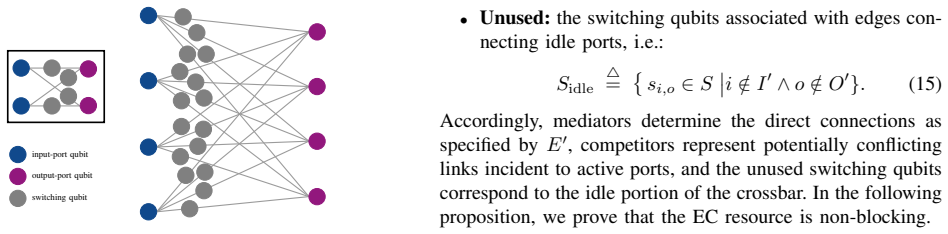
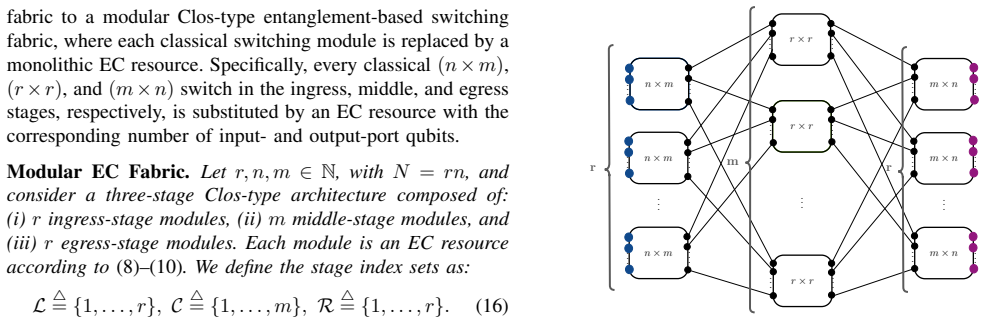
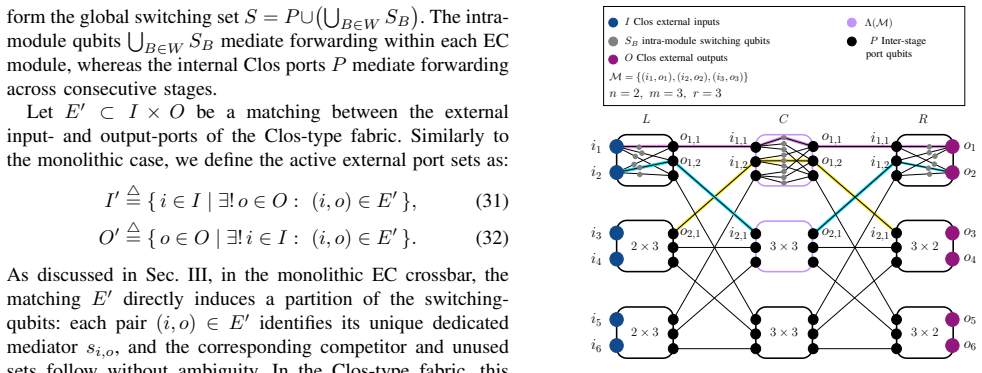
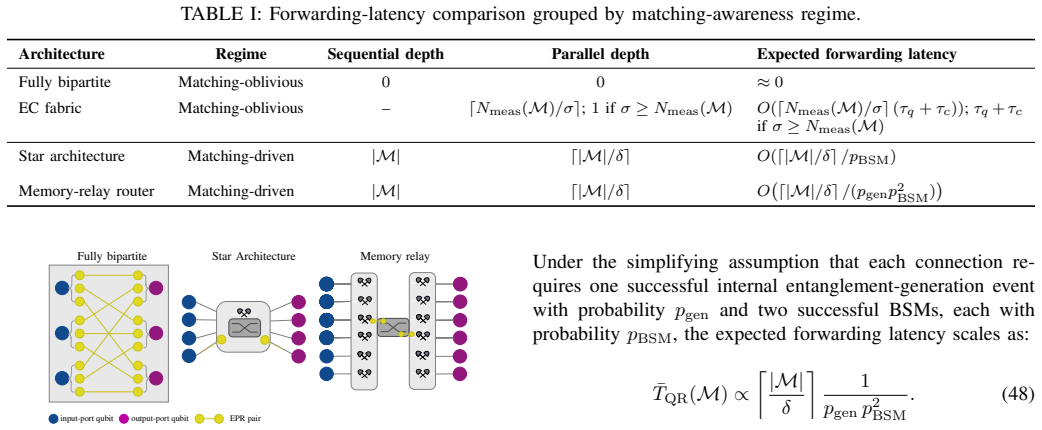
An entanglement-based switching fabric uses a graph state as the forwarding resource and realizes requested input-output entanglement links through local Pauli measurements. Under the edge-controlled design principle, both monolithic crossbar and modular Clos-type instances achieve non-blocking operation; when measurement parallelism is available, forwarding depth stays constant regardless of how many connections are requested, in contrast to matching-driven EPR fabrics whose latency scales directly with connection count.
What carries the argument
The edge-controlled (EC) design principle, which structures the graph state so that local Pauli measurements on its vertices can produce any requested set of input-output entanglement links without additional resources or blocking.
If this is right
- All requested input-output entanglement links are realized without blocking.
- Forwarding depth remains constant when sufficient measurement parallelism is available.
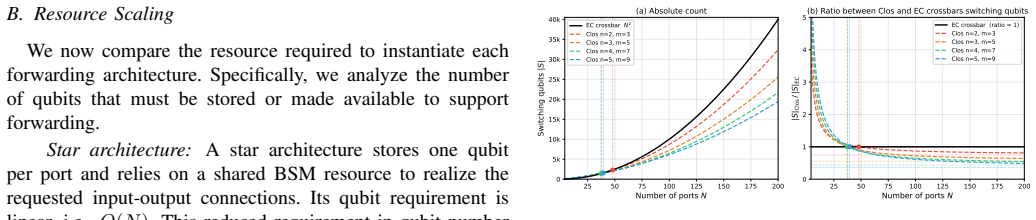
- A modular Clos-type EC fabric uses fewer resources than a monolithic EC crossbar beyond a crossover scale.
- Resource requirements for both fabrics are characterized as functions of port count and connection requests.
Where Pith is reading between the lines
- Constant-depth forwarding could remove a scaling barrier for dense quantum networks.
- Router designs may shift emphasis toward preparing large graph states rather than generating many dynamic EPR pairs.
- The distinction between matching-oblivious and matching-driven forwarding suggests new performance metrics for comparing quantum switching proposals.
Load-bearing premise
Ideal local Pauli measurements performed on a suitably prepared graph state can produce any set of requested entanglement connections without errors or extra resources.
What would settle it
An experiment or simulation in which realizing multiple simultaneous requested connections on an EC graph state either requires extra entanglement beyond the initial state or produces errors that block some links.
Figures


read the original abstract
Forwarding in quantum networks cannot be realized by directly transposing classical switching fabrics, since the no-cloning theorem and the quantum measurement postulate constrain the direct relay of quantum information while ruling out copy-based buffering and inspection. In this paper, we propose a switching-fabric framework for quantum routers based on multipartite entanglement. Specifically, we formalize the notion of an entanglement-based switching fabric, in which a graph state acts as the forwarding resource and entanglement forwarding is realized through local Pauli measurements. We translate the classical notions of blocking and non-blocking operation into structural conditions for entanglement-based fabrics, by deriving the \textit{edge-controlled (EC) design principle} for non-blocking operation. We instantiate this principle through a monolithic \textit{EC crossbar} and a modular Clos-type EC fabric, for which we characterize resource scaling and identify the regime where the modular design becomes more resource-efficient than the monolithic one. Finally, a forwarding-latency analysis establishes a fundamental distinction between matching-oblivious and matching-driven forwarding: the proposed EC fabrics realize all requested input-output entanglement links with constant forwarding depth under sufficient measurement parallelism, whereas matching-driven EPR-based fabrics exhibit latency that scales with the number of requested connections. The proposed framework provides a hardware-agnostic foundation for quantum-router switching fabrics.
Editorial analysis
A structured set of objections, weighed in public.
Referee Report
Summary. The paper proposes a switching-fabric framework for quantum routers based on multipartite entanglement. Graph states act as the forwarding resource, with entanglement forwarding realized via local Pauli measurements. Classical blocking/non-blocking notions are translated into structural conditions yielding the edge-controlled (EC) design principle. This is instantiated in a monolithic EC crossbar and a modular Clos-type EC fabric; resource scaling is characterized and the regime where the modular design is more efficient is identified. A latency analysis claims that EC fabrics achieve constant forwarding depth (under sufficient measurement parallelism) for arbitrary requested I/O entanglement links, in contrast to latency that scales with the number of connections in matching-driven EPR-based fabrics. The framework is presented as hardware-agnostic.
Significance. If the EC principle and the associated measurement mapping are rigorously established, the work supplies a formal, entanglement-native alternative to classical or EPR-based router designs and identifies concrete resource trade-offs between monolithic and modular fabrics. The explicit distinction between matching-oblivious constant-depth forwarding and scaling latency is a potentially useful conceptual separation. No machine-checked proofs or reproducible code are supplied, but the structural translation of non-blocking conditions into graph-state terms is a clear contribution if the central mapping holds.
major comments (2)
- [Abstract and EC design principle derivation] Abstract and the section deriving the EC design principle: the claim that local Pauli measurements on a suitably prepared graph state realize arbitrary requested I/O entanglement links without residual errors or supplementary entanglement resources is the load-bearing assumption for the constant-depth result, yet the manuscript supplies no explicit stabilizer mapping, inductive argument, or small-instance verification that the required entanglement connections are obtained for every request pattern.
- [Forwarding-latency analysis] Forwarding-latency analysis section: the assertion that EC fabrics achieve constant forwarding depth while matching-driven EPR fabrics scale with the number of connections rests on the unverified premise that the EC structural conditions suffice for error-free realization of any connection set solely by measurements; if this premise fails for some patterns, the claimed fundamental distinction collapses.
minor comments (2)
- [Formalization of entanglement-based fabric] Notation for the graph-state stabilizers and the precise definition of 'edge-controlled' operation should be introduced with an equation or small example before the general claims.
- [Resource scaling characterization] The resource-scaling comparison between monolithic and modular fabrics would benefit from an explicit table or plot showing the crossover point as a function of port count.
Simulated Author's Rebuttal
We thank the referee for the careful reading and for highlighting the need for greater explicitness in the central mapping. We respond to each major comment below.
read point-by-point responses
-
Referee: [Abstract and EC design principle derivation] Abstract and the section deriving the EC design principle: the claim that local Pauli measurements on a suitably prepared graph state realize arbitrary requested I/O entanglement links without residual errors or supplementary entanglement resources is the load-bearing assumption for the constant-depth result, yet the manuscript supplies no explicit stabilizer mapping, inductive argument, or small-instance verification that the required entanglement connections are obtained for every request pattern.
Authors: The derivation in Section 3 translates classical non-blocking conditions into graph-state stabilizer requirements via the edge-controlled (EC) principle, showing that any admissible I/O request set can be realized by local Pauli measurements on the pre-shared graph state. We acknowledge that the manuscript presents the general structural argument without an explicit per-pattern stabilizer table or small-instance verification. In the revision we will add a new subsection containing (i) explicit stabilizer mappings for 2 imes2 and 3 imes3 EC crossbars under all admissible request patterns and (ii) a concise inductive outline for the general case. These additions will make the load-bearing claim fully verifiable while preserving the original derivation. revision: yes
-
Referee: [Forwarding-latency analysis] Forwarding-latency analysis section: the assertion that EC fabrics achieve constant forwarding depth while matching-driven EPR fabrics scale with the number of connections rests on the unverified premise that the EC structural conditions suffice for error-free realization of any connection set solely by measurements; if this premise fails for some patterns, the claimed fundamental distinction collapses.
Authors: The latency comparison in Section 5 is predicated on the EC principle derived in Section 3. Once the explicit stabilizer mappings and small-instance checks are supplied (as committed above), the premise that every admissible request set is realized error-free by parallel local measurements will be directly substantiated. The constant-depth claim then follows from the fact that the measurement schedule is independent of the specific matching; we will add a forward reference from the latency section to the new verification subsection to make this dependence explicit. revision: yes
Circularity Check
No significant circularity; derivation presented as following from standard quantum constraints and classical translations without self-referential reductions or fitted predictions.
full rationale
The abstract and provided context formalize an entanglement-based switching fabric using graph states and local Pauli measurements, then translate classical non-blocking conditions into an EC design principle instantiated in crossbar and Clos fabrics. No equations, fitted parameters, or self-citations are exhibited that would reduce any claim (such as constant forwarding depth) to a definition or input by construction. The constant-depth distinction versus EPR fabrics is asserted from the measurement-based forwarding definition and structural conditions, but without visible self-definitional loops, renamings, or load-bearing self-citations in the given text. This matches the default expectation of a self-contained framework derived from external quantum postulates rather than internal circular steps.
Axiom & Free-Parameter Ledger
axioms (1)
- domain assumption No-cloning theorem and quantum measurement postulate prevent direct relay, copy-based buffering, or inspection of quantum information.
invented entities (1)
-
Edge-controlled (EC) design principle
no independent evidence
Reference graph
Works this paper leans on
-
[1]
Entanglement- based crossbar for quantum routers,
J. Illiano, C. De Risi, M. Caleffi, and A. S. Cacciapuoti, “Entanglement- based crossbar for quantum routers,”proc. of IEEE ICC, 2026. Avail- able: https://doi.org/10.5281/zenodo.18673229
-
[2]
Quantum internet architecture: un- locking quantum-native routing via quantum addressing,
M. Caleffi and A. S. Cacciapuoti, “Quantum internet architecture: un- locking quantum-native routing via quantum addressing,”IEEE TCOM, p. 3577–3599, 2026. Invited Paper
2026
-
[3]
A quantum internet protocol suite beyond layering,
A. S. Cacciapuoti and M. Caleffi, “A quantum internet protocol suite beyond layering,”IEEE TNSE, pp. 9170–9187, 2026. Invited Paper
2026
-
[4]
Quantum-Native Architectural Tenets and Philosophy for the Quantum Internet,
A. S. Cacciapuoti, M. Caleffi, J. Illiano, C. D. Risi, A. Abane, and J. Chung, “Quantum-Native Architectural Tenets and Philosophy for the Quantum Internet,” Internet-Draft draft-cacciapuoti-qirg-quantum- native-architecture-01, IETF, Apr. 2026. Work in Progress
2026
-
[5]
Entanglement routing in quantum networks: A comprehensive survey,
A. Abane, M. Cubeddu, V . S. Mai, and A. Battou, “Entanglement routing in quantum networks: A comprehensive survey,”IEEE TQE, 2025
2025
-
[6]
Optimal architectures for long distance quantum communication,
S. Muralidharanet al., “Optimal architectures for long distance quantum communication,”Scientific reports, vol. 6, no. 1, pp. 1–10, 2016
2016
-
[7]
All-photonic quantum repeaters,
K. Azuma, K. Tamaki, and H.-K. Lo, “All-photonic quantum repeaters,” Nature communications, vol. 6, no. 1, pp. 1–7, 2015
2015
-
[8]
Architecture and protocols for all-photonic quantum repeaters,
N. Benchasattabuse, M. Hajdušek, and R. Van Meter, “Architecture and protocols for all-photonic quantum repeaters,” inIEEE QCE, 2024
2024
-
[9]
Quantum circuit switching with one-way repeaters in star networks,
Álvaro G. Iñesta, H. Choi, D. Englund, and S. Wehner, “Quantum circuit switching with one-way repeaters in star networks,” 2024
2024
-
[10]
Linear-optical programmable quantum router,
K. Lemr and A. ˇCernoch, “Linear-optical programmable quantum router,”Optics Communications, vol. 300, pp. 282–285, 2013
2013
-
[11]
Quantum routing for emerging quantum networks,
W. Shi and R. Malaney, “Quantum routing for emerging quantum networks,”IEEE Network, 2023
2023
-
[12]
Quantum switch scheduling for information qubits,
P. Promponas, V . Valls, and L. Tassiulas, “Quantum switch scheduling for information qubits,”SIGMETRICS Perform. Eval. Rev., 2023
2023
-
[13]
An architecture for control of entanglement generation switches in quantum networks,
S. Gauthier, G. Vardoyan, and S. Wehner, “An architecture for control of entanglement generation switches in quantum networks,”IEEE TQE, vol. 4, no. 01, pp. 1–17, 2023
2023
-
[14]
Quantum switches for gottesman-kitaev-preskill qubit- based all-photonic quantum networks,
M. Azariet al., “Quantum switches for gottesman-kitaev-preskill qubit- based all-photonic quantum networks,”IEEE TQE, 2024
2024
-
[15]
A optical quantum router based on ghz states,
J. Kuang, “A optical quantum router based on ghz states,” inIEEE 3rd ITNEC, pp. 2540–2544, IEEE, 2019
2019
-
[16]
Quantum switches for single-photon routing and entanglement generation in waveguide-based networks,
J. Cumbrado and R. Puebla, “Quantum switches for single-photon routing and entanglement generation in waveguide-based networks,” arXiv preprint arXiv:2503.10276, 2025
arXiv 2025
-
[17]
A resource- driven framework for configurable entanglement in quantum networks,
F. Mazza, C. Pellitteri, A. S. Cacciapuoti, and M. Caleffi, “A resource- driven framework for configurable entanglement in quantum networks,” arXiv preprint arXiv:2605.15029, 2026
Pith/arXiv arXiv 2026
-
[18]
Intra-qlan connectivity via graph states: Beyond the physical topology,
F. Mazza, M. Caleffi, and A. S. Cacciapuoti, “Intra-qlan connectivity via graph states: Beyond the physical topology,”IEEE TNSE, 2025
2025
-
[19]
Universal nested quantum switch,
J. Miguel-Ramiro, M. F. Mor-Ruiz, and W. Dür, “Universal nested quantum switch,”arXiv preprint arXiv:2603.00236, 2026
arXiv 2026
-
[20]
Optimized quantum net- works,
J. Miguel-Ramiro, A. Pirker, and W. Dür, “Optimized quantum net- works,”Quantum, vol. 7, p. 919, 2023
2023
-
[21]
J. Freund, A. Pirker, and W. Dür, “A flexible quantum data bus,”arXiv preprint arXiv:2404.06578, 2024
arXiv 2024
-
[22]
Entanglement- based artificial topology: Neighboring remote network nodes,
S.-Y . Chen, J. Illiano, A. S. Cacciapuoti, and M. Caleffi, “Entanglement- based artificial topology: Neighboring remote network nodes,”IEEE OJ- COMS, vol. 6, pp. 2220–2238, 2025
2025
-
[23]
Quantum lan: On-demand network topology via two-colorable graph states,
F. Mazza, M. Caleffi, and A. S. Cacciapuoti, “Quantum lan: On-demand network topology via two-colorable graph states,” inQCNC, IEEE, 2024
2024
-
[24]
Entanglement in graph states and its applications,
M. Heinet al., “Entanglement in graph states and its applications,”arXiv preprint quant-ph/0602096, 2006
Pith/arXiv arXiv 2006
-
[25]
Multiparty entanglement in graph states,
M. Hein, J. Eisert, and H. J. Briegel, “Multiparty entanglement in graph states,”Physical Review A, vol. 69, no. 6, p. 062311, 2004
2004
-
[26]
A study of non-blocking switching networks,
C. Clos, “A study of non-blocking switching networks,”Bell System Technical Journal, vol. 32, no. 2, pp. 406–424, 1953
1953
-
[27]
Algebraic and topological properties of connecting networks,
V . Beneš, “Algebraic and topological properties of connecting networks,” Bell System Technical Journal, vol. 41, no. 4, pp. 1249–1274, 1962
1962
-
[28]
On nonblocking properties of the beneš network,
P. Kolman, “On nonblocking properties of the beneš network,” in European Symposium on Algorithms, pp. 259–270, Springer, 1998
1998
-
[29]
On the efficient extraction of entangled resources,
S.-Y . Chen, A. S. Cacciapuoti, and M. Caleffi, “On the efficient extraction of entangled resources,”IEEE TCOM, 2026
2026
-
[30]
Quantum circuit switching with one-way repeaters in star networks,
Á. G. Iñesta, H. Choi, D. Englund, and S. Wehner, “Quantum circuit switching with one-way repeaters in star networks,” inIEEE QCE, 2024
2024
-
[31]
A quantum router architecture for high-fidelity entangle- ment flows in quantum networks,
Y . Leeet al., “A quantum router architecture for high-fidelity entangle- ment flows in quantum networks,”npj Quantum Information, 2022
2022
-
[32]
Maximum efficiency of a linear- optical bell-state analyzer,
J. Calsamiglia and N. Lütkenhaus, “Maximum efficiency of a linear- optical bell-state analyzer,”Applied Physics B, 2001
2001
-
[33]
Bell-state measurement exceeding 50% success probability with linear optics,
M. J. Bayerbach, S. E. D’Aurelio, P. Van Loock, and S. Barz, “Bell-state measurement exceeding 50% success probability with linear optics,” Science Advances, vol. 9, no. 32, p. eadf4080, 2023
2023
-
[34]
A one-way quantum computer,
R. Raussendorf and H. Briegel, “A one-way quantum computer,”Phys. Rev. Lett., vol. 86, pp. 5188–91, 06 2001
2001
-
[35]
Deterministic generation of a cluster state of entangled photons,
I. Schwartzet al., “Deterministic generation of a cluster state of entangled photons,”Science, vol. 354, no. 6311, pp. 434–437, 2016
2016
-
[36]
Deterministic generation of multidimensional photonic cluster states with a single quantum emitter,
O. Rubies-Bigordaet al., “Deterministic generation of multidimensional photonic cluster states with a single quantum emitter,”Physical Review Letters, vol. 134, no. 5, p. 053601, 2025
2025
discussion (0)
Sign in with ORCID, Apple, or X to comment. Anyone can read and Pith papers without signing in.