The structure of a melt: The case of liquid bismuth
Pith reviewed 2026-06-30 14:41 UTC · model grok-4.3
The pith
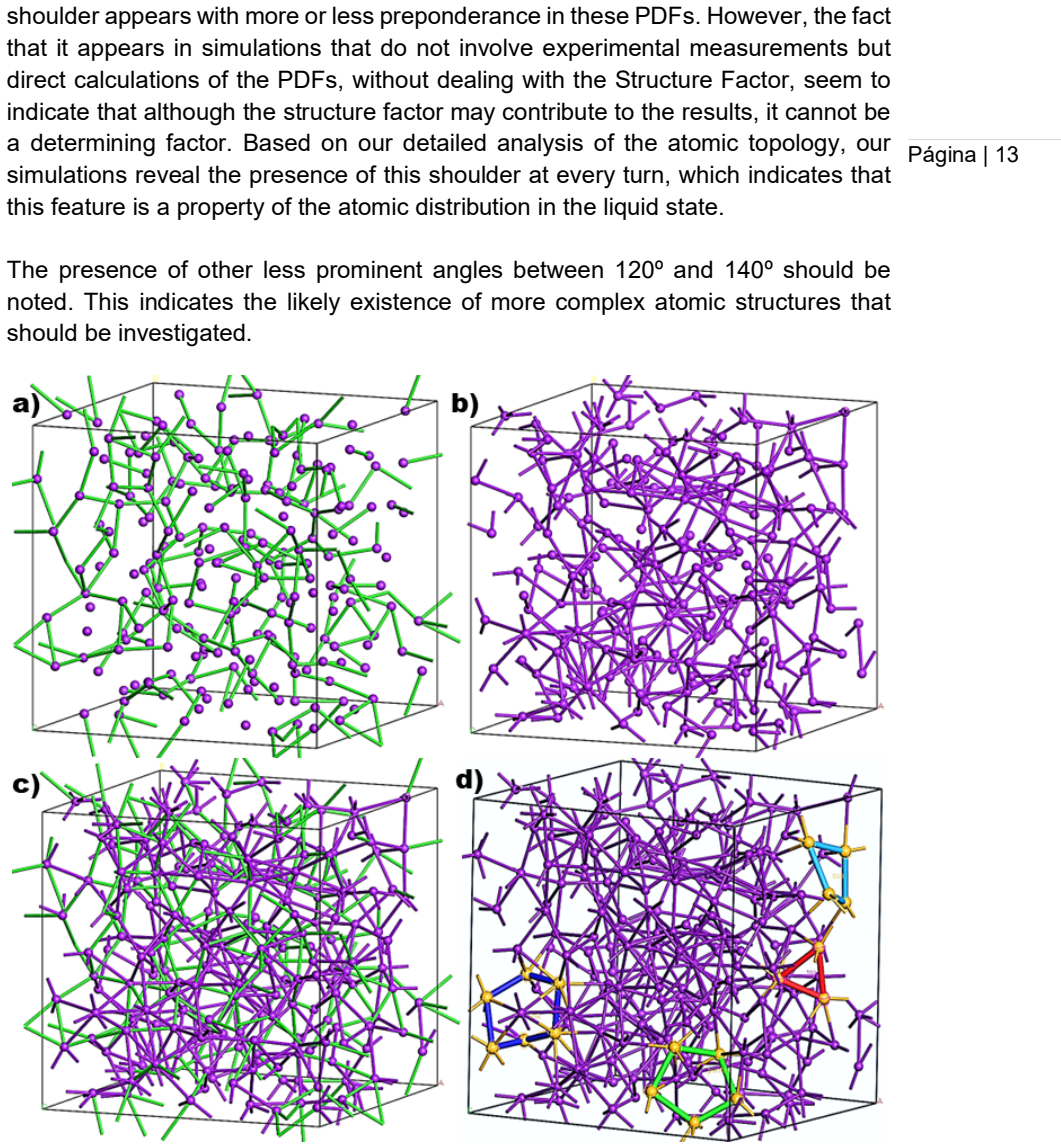
Liquid bismuth at 573 K contains deformed triangles and squares shown by distinct peaks in its plane angle distributions.
A machine-rendered reading of the paper's core claim, the machinery that carries it, and where it could break.
Core claim
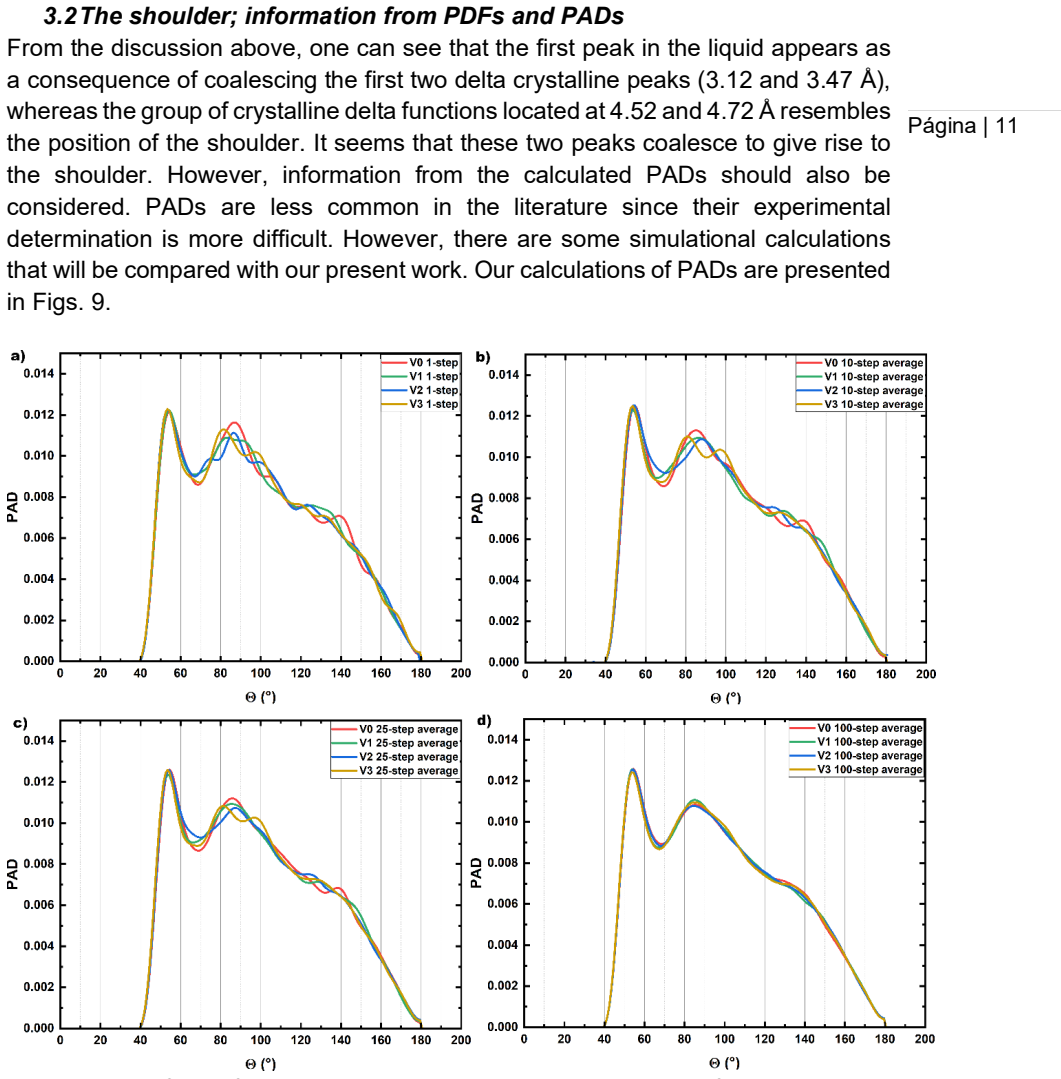
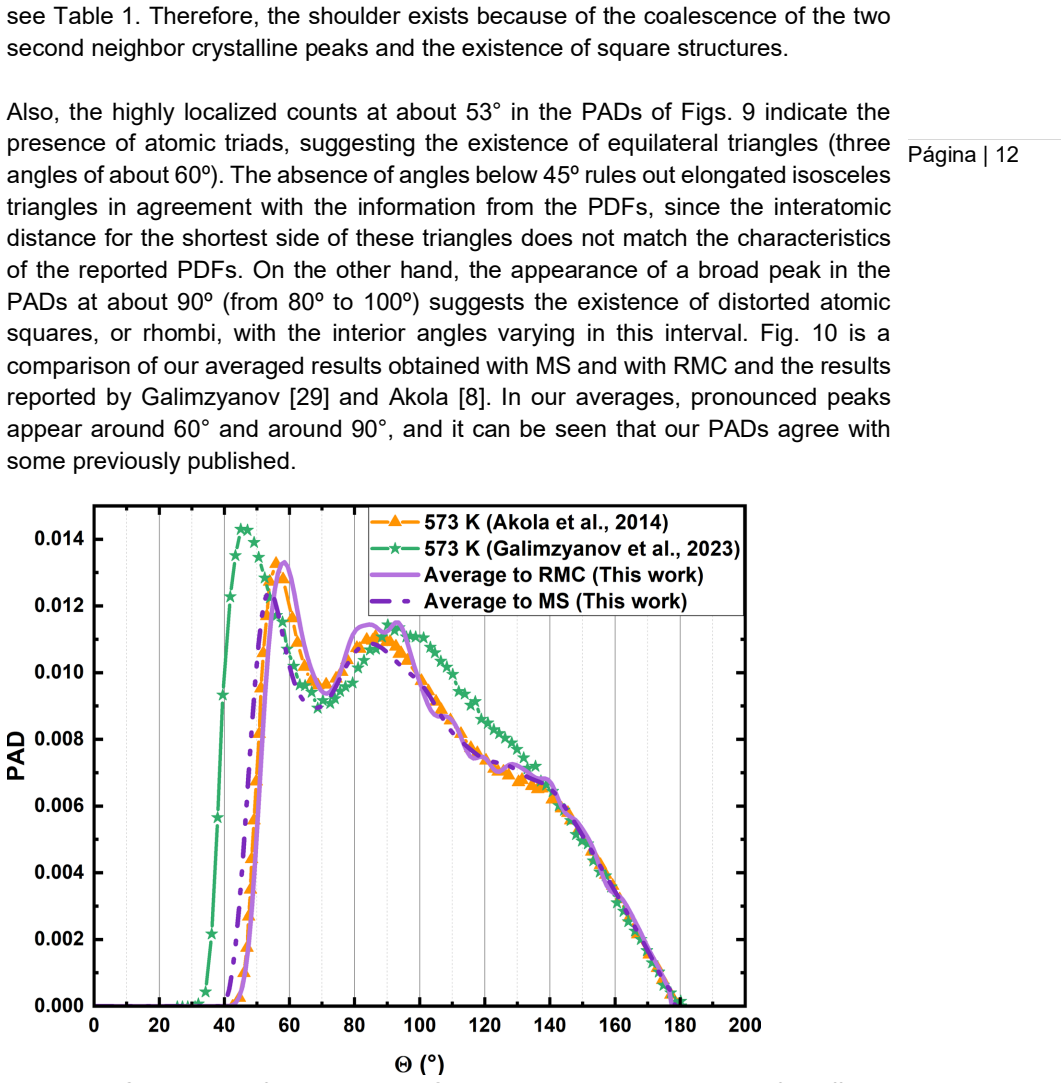
Averaging the last 100 molecular dynamics steps at 573 K and performing reverse Monte Carlo on four independent runs produces atomic configurations whose plane angle distributions exhibit prominent peaks at 53° and 85° (MD) and at 58° and 90° (RMC). These peaks are interpreted as signatures of deformed triangles and squares, while the pair distribution function shoulder at 4.6 Å is connected to distances inside those squares and to crystalline neighbor shells. Less abundant higher-order structures are also noted.
What carries the argument
Plane angle distributions (PADs) extracted from molecular dynamics trajectories and reverse Monte Carlo configurations, used to identify preferred angles that correspond to triangular and square atomic arrangements.
Load-bearing premise
The 216-atom supercell size together with the Materials Studio potentials and the choice to average only the final 100 steps produce a representative liquid structure whose angle peaks can be read directly as geometric motifs.
What would settle it
A larger supercell simulation or an ab initio calculation at the same temperature that yields PAD peaks at substantially different angles or no distinct peaks at all would falsify the interpretation of deformed triangles and squares as dominant motifs.
Figures
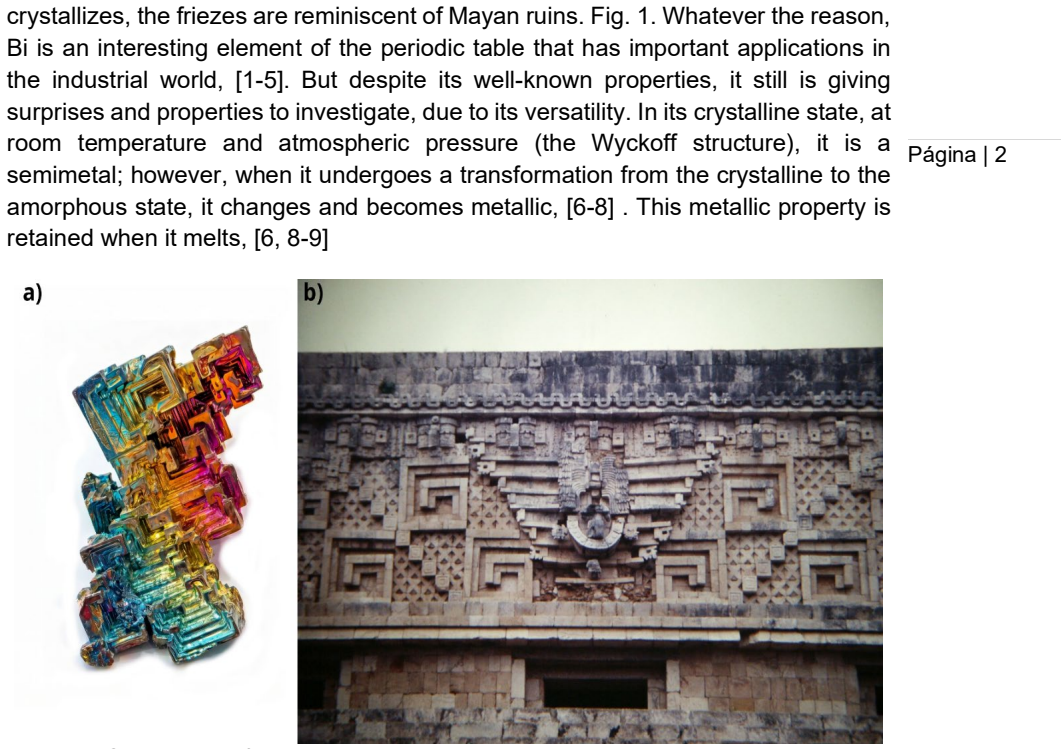
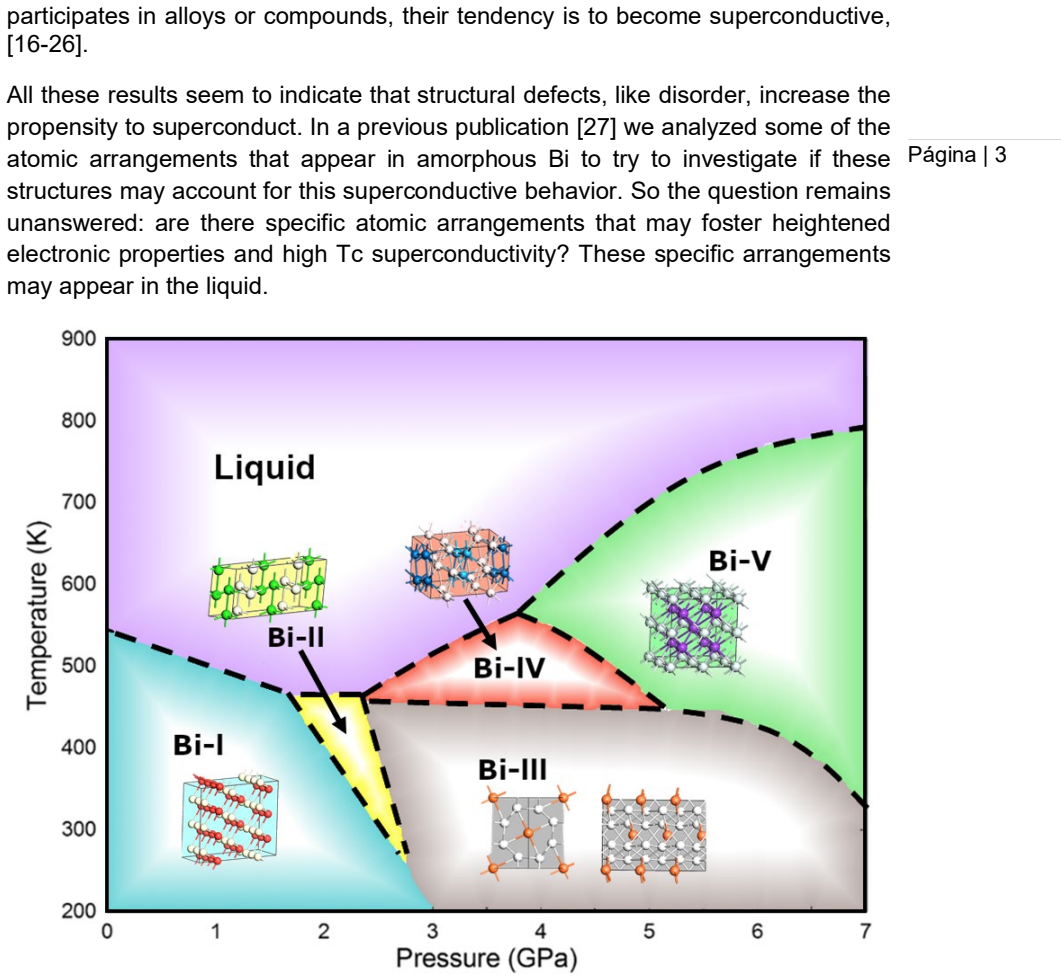
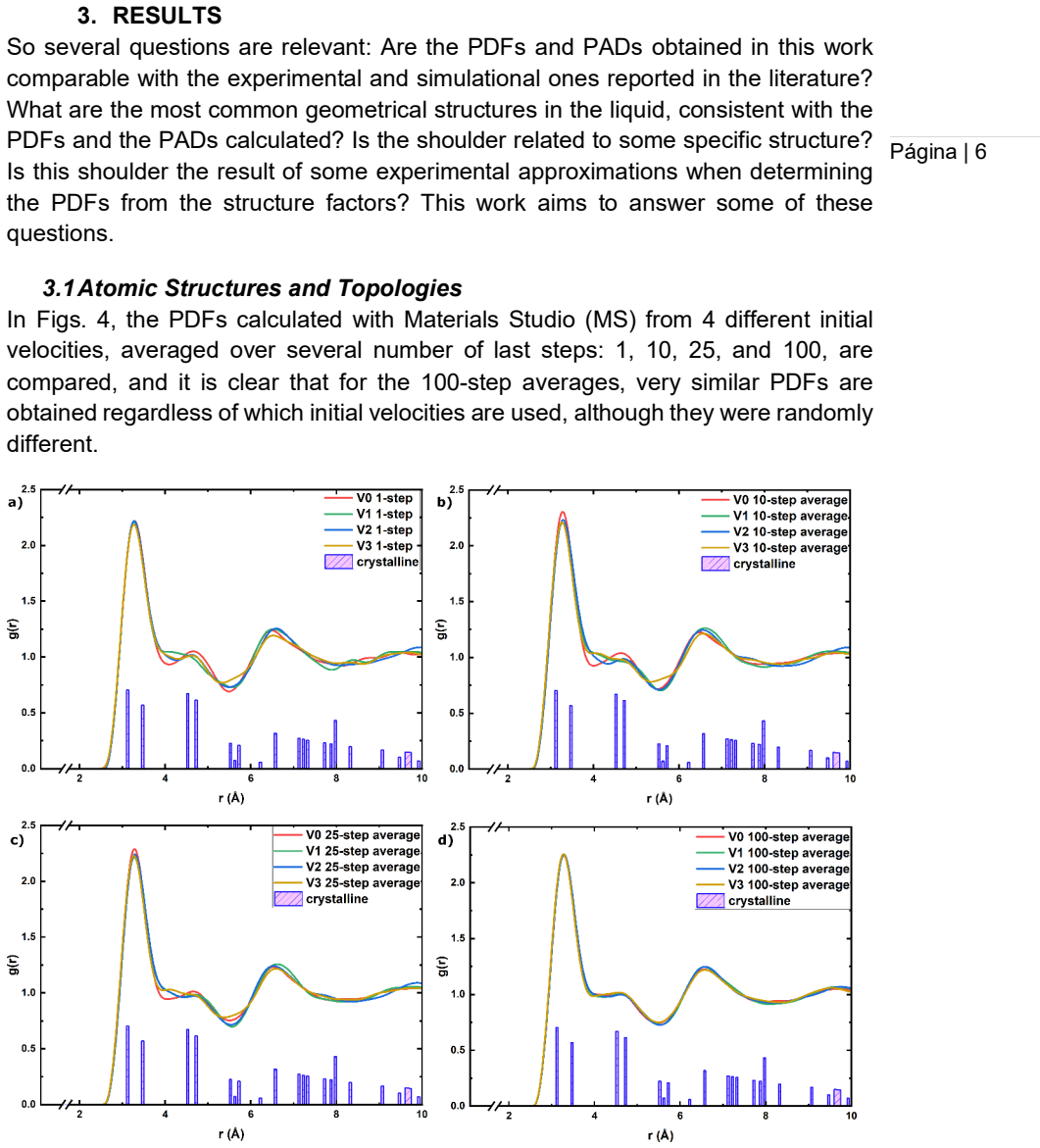
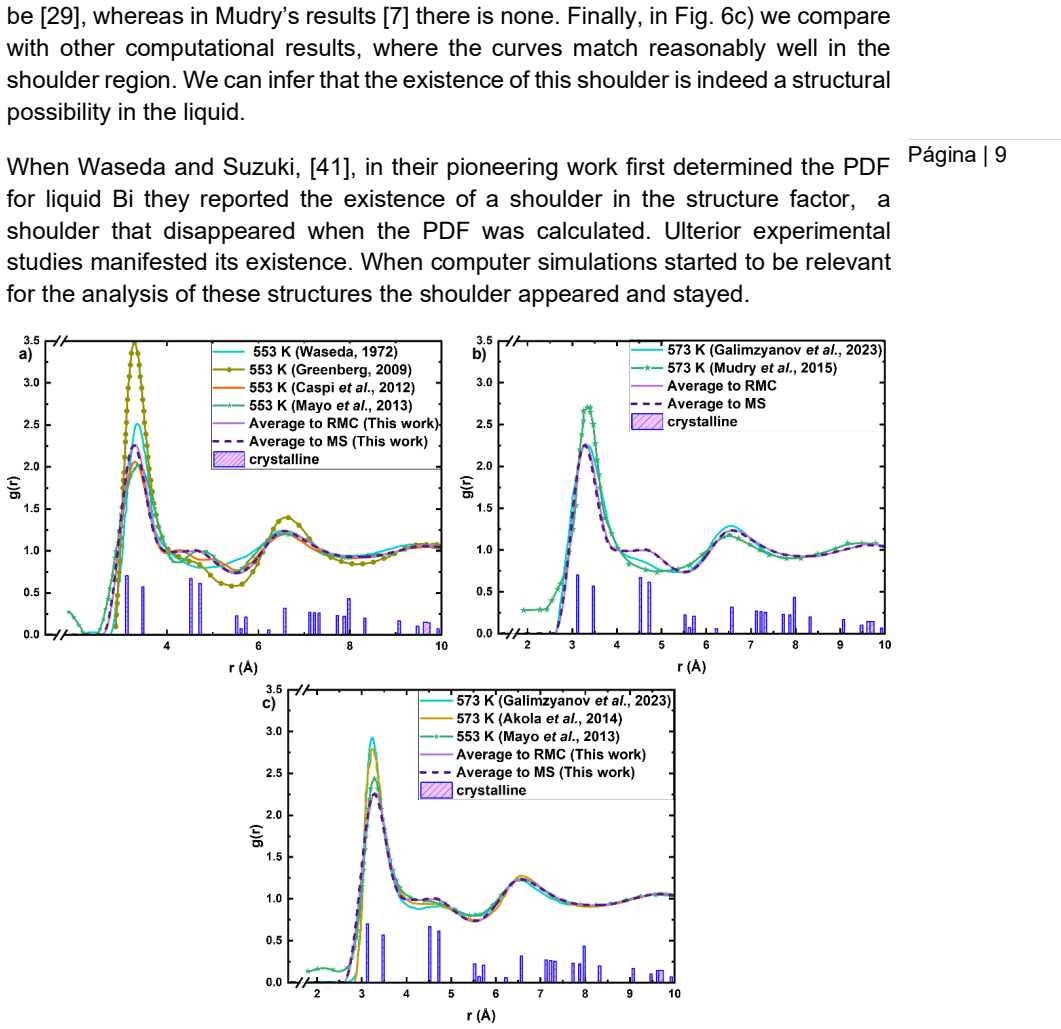
read the original abstract
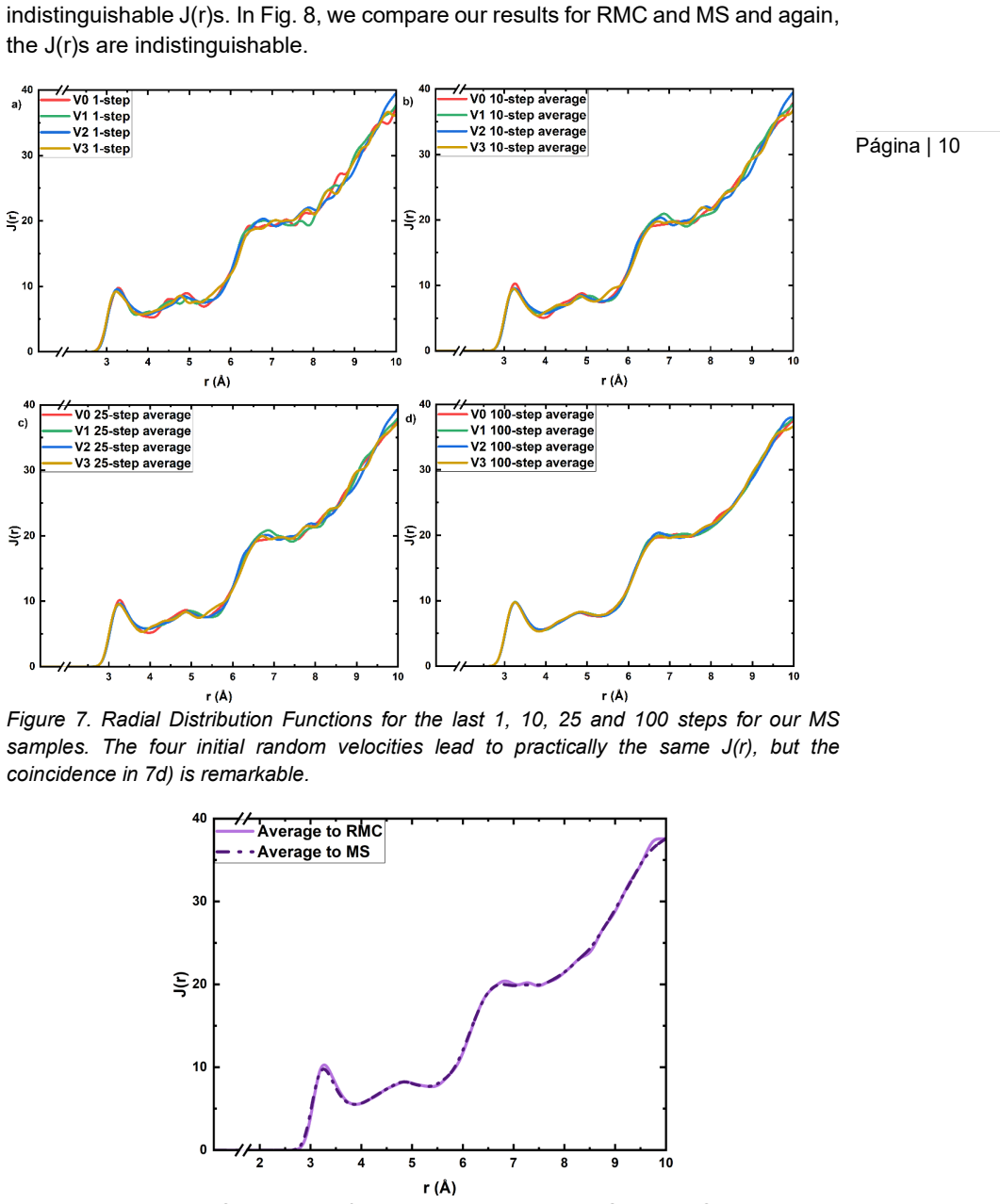
Molecular Dynamics (MD) is performed on supercells of 216 atoms of bismuth, going from 300 K to 573 K in 100 steps and maintaining it in the liquid state, at 573 K, during 500 steps using the Materials Studio (MS) suite of codes. The Pair Distribution Functions (PDFs) and the Plane Angle Distributions (PADs) of the last 1, 10, 25 and 100 steps of the MD have been obtained. Averaging the last 100 steps, as representative of the liquid, Reverse Monte Carlo (RMC) was applied to obtain 4 atomic structures, one for each set of initial random velocities. Then, a detailed structural study of liquid bismuth at 573 K was undertaken; PDFs and PADs are calculated and reported. Two noticeable peaks appear for the PDFs, at 3.25 and 6.55 {\AA}, along with a pseudo peak (shoulder) at 4.6 {\AA}. This shoulder (after the first peak) of the PDFs is found to be related to the third and fourth neighbor peaks of the crystalline Wyckoff structure and also to the diagonal distances in deformed squares in the liquid structure. For completeness J(r)s are also reported. Two prominent peaks in the MS PADs are observed: 53{\deg} and 85{\deg}; and two for the RMC PADs: 58{\deg} and 90{\deg}, suggesting the existence of deformed triangles and squares. Less abundant are higher-order geometrical structures.
Editorial analysis
A structured set of objections, weighed in public.
Referee Report
Summary. The manuscript performs MD simulations on 216-atom Bi supercells with Materials Studio potentials, heating from 300 K to 573 K in 100 steps then holding at 573 K for 500 steps. PDFs and PADs are extracted from the final 1/10/25/100 steps; the last 100 steps are averaged and used as input for RMC modeling with four independent initial-velocity sets. Reported results include PDF peaks at 3.25 Å and 6.55 Å plus a shoulder at 4.6 Å (linked to third/fourth crystalline neighbors and square diagonals) and PAD peaks at 53°/85° (MD) and 58°/90° (RMC), interpreted as signatures of deformed triangles and squares with rarer higher-order motifs.
Significance. If the sampled configurations are representative, the work supplies concrete numerical angle distributions for liquid bismuth that could inform models of its local geometry and melting behavior. The combination of direct MD output with multiple RMC realizations offers a modest cross-check on the structural motifs.
major comments (2)
- [Abstract / Methods] Abstract and methods description: the MD protocol (100-step heat-up followed by only 500 steps at 573 K on a 216-atom cell, averaging the final 100 steps) provides no timestep, no equilibration diagnostics (energy/pressure convergence, mean-square displacement), and no potential validation against experimental PDFs or other Bi potentials. This short trajectory and small cell size are load-bearing for the central geometric claim, as incomplete equilibration or periodic artifacts could produce the reported PAD peaks at 53°/85° and 58°/90° rather than intrinsic liquid motifs.
- [Results] Results section on PDFs and PADs: no error bars or statistical uncertainties are reported on the averaged PDFs or PAD histograms, and no quantitative comparison is made to experimental scattering data or independent simulations of liquid Bi. Without these, the assignment of the 4.6 Å shoulder to deformed-square diagonals and the PAD peaks to triangles/squares cannot be assessed for robustness against modeling choices.
minor comments (2)
- [Abstract] Abstract contains unrendered LaTeX markup ({\deg}, {\AA}) that should be corrected for readability.
- [Methods] Clarify how the four RMC structures (one per initial-velocity set) were combined or compared when reporting the final PADs; the text states '4 atomic structures' but does not specify the averaging procedure.
Simulated Author's Rebuttal
We thank the referee for the constructive comments on our manuscript. We address each major point below and indicate where revisions will be made. The simulation protocol is indeed brief and the cell small, which we will acknowledge more explicitly as a limitation while defending the consistency of the reported motifs across MD and RMC.
read point-by-point responses
-
Referee: [Abstract / Methods] Abstract and methods description: the MD protocol (100-step heat-up followed by only 500 steps at 573 K on a 216-atom cell, averaging the final 100 steps) provides no timestep, no equilibration diagnostics (energy/pressure convergence, mean-square displacement), and no potential validation against experimental PDFs or other Bi potentials. This short trajectory and small cell size are load-bearing for the central geometric claim, as incomplete equilibration or periodic artifacts could produce the reported PAD peaks at 53°/85° and 58°/90° rather than intrinsic liquid motifs.
Authors: We agree the protocol description is incomplete. The Materials Studio implementation used a 1 fs timestep; we will add this value and a short statement on the heating schedule. No explicit convergence plots or MSD data were generated in the original runs, and the potential was used as supplied without separate validation against experimental PDFs. We will revise the methods to state these limitations explicitly and note that the 216-atom cell and 500-step production run are modest. However, the structural features (PDF peaks at 3.25 Å / 6.55 Å and PAD peaks near 53–58° / 85–90°) appear consistently in the final 100 MD steps and across four independent RMC realizations started from different velocities, which provides an internal cross-check against gross non-equilibrium artifacts. revision: partial
-
Referee: [Results] Results section on PDFs and PADs: no error bars or statistical uncertainties are reported on the averaged PDFs or PAD histograms, and no quantitative comparison is made to experimental scattering data or independent simulations of liquid Bi. Without these, the assignment of the 4.6 Å shoulder to deformed-square diagonals and the PAD peaks to triangles/squares cannot be assessed for robustness against modeling choices.
Authors: We accept that error bars are missing. In revision we will compute and display standard deviations on the PDF and PAD histograms using the four independent RMC models plus the MD trajectory segments. Quantitative comparison to experiment was outside the scope of the present work, which instead emphasizes geometric motif identification from the simulated configurations; we will nevertheless add a qualitative overlay of the computed PDF against published experimental data for liquid Bi near 573 K and cite the relevant scattering studies. The shoulder at 4.6 Å and the PAD peaks are assigned on the basis of direct distance and angle matching to crystalline neighbors and regular polygons, but we agree that without uncertainties the robustness is harder to judge. revision: yes
Circularity Check
No circularity: direct simulation outputs with no self-referential reduction
full rationale
The paper performs MD on 216-atom Bi supercells using Materials Studio potentials, averages the final 100 steps at 573 K to obtain PDFs and PADs, then applies RMC to generate structures and recomputes the same distributions. The reported PAD peaks (53°/85° in MD, 58°/90° in RMC) and PDF features are presented as direct numerical outputs interpreted as evidence for deformed triangles and squares. No equations, fitted parameters renamed as predictions, self-citations providing uniqueness theorems, or ansatzes smuggled via prior work appear in the derivation chain. The results are not forced by construction from the inputs; they are independent computational measurements whose validity rests on equilibration and potential quality rather than definitional loops.
Axiom & Free-Parameter Ledger
free parameters (2)
- supercell atom count
- MD step counts
axioms (2)
- domain assumption Materials Studio interatomic potentials for bismuth reproduce realistic liquid structure at 573 K.
- domain assumption Averaging the final 100 MD steps yields a statistically representative liquid configuration.
Reference graph
Works this paper leans on
-
[1]
Liquid metals: fundamentals and applications in chemistry,
T. Daeneke et al., “Liquid metals: fundamentals and applications in chemistry,” Chem. Soc. Rev., vol. 47, no. 11, pp. 4073–4111, Jun. 2018, doi: 10.1039/C7CS00043J
-
[2]
Bismuth-based liquid metals: advances, applications, and prospects,
X. Zhang, J. Liu, and Z. Deng, “Bismuth-based liquid metals: advances, applications, and prospects,” Mater. Horiz., 2024, doi: 10.1039/D3MH01722B
-
[3]
C. Qin et al., “Phase Interface Regulating on Amorphous/Crystalline Bismuth Catalyst for Boosted Electrocatalytic CO 2 Reduction to Formate,” ACS Appl. Mater. Interfaces, vol. 15, no. 40, pp. 47016–47024, Oct. 2023, doi: 10.1021/acsami.3c10011
-
[4]
J. Pan et al., “Mechanically Robust Bismuth-Embedded Carbon Microspheres for Ultrafast Charging and Ultrastable Sodium-Ion Batteries,” J. Am. Chem. Soc., vol. 147, no. 4, pp. 3047–3061, Jan. 2025, doi: 10.1021/jacs.4c09824. Página | 17
-
[5]
A Bismuth Metal–Organic Framework as a Contrast Agent for X-ray Computed Tomography,
L. Robison et al., “A Bismuth Metal–Organic Framework as a Contrast Agent for X-ray Computed Tomography,” ACS Appl. Bio Mater., vol. 2, no. 3, pp. 1197–1203, Mar. 2019, doi: 10.1021/acsabm.8b00778
-
[6]
V. Plechystyy, I. Shtablavyi, S. Winczewski, K. Rybacki, S. Mudry, and J. Rybicki, “Short-range order structure and free volume distribution in liquid bismuth: X-ray diffraction and computer simulations studies,” Philosophical Magazine, vol. 100, no. 17, pp. 2165–2182, Sep. 2020, doi: 10.1080/14786435.2020.1756500
-
[7]
Structure and thermal expansion of liquid bismuth,
S. Mudry, I. Shtablavyi, U. Liudkevych, and S. Winczewski, “Structure and thermal expansion of liquid bismuth,” Materials Science-Poland, vol. 33, no. 4, pp. 767–773, Dec. 2015, doi: 10.1515/msp-2015-0100
-
[8]
Structure and dynamics in liquid bismuth and Bi n clusters: A density functional study,
J. Akola, N. Atodiresei, J. Kalikka, J. Larrucea, and R. O. Jones, “Structure and dynamics in liquid bismuth and Bi n clusters: A density functional study,” J. Chem. Phys., vol. 141, no. 19, Nov. 2014, doi: 10.1063/1.4901525
-
[9]
J. Hafner and W. Jank, “Structural and electronic properties of the liquid polyvalent elements. IV. the pentavalent semimetals and trends across the periodic table,” Phys. Rev. B, vol. 45, no. 6, pp. 2739–2749, 1992, doi: 10.1103/PhysRevB.45.2739
-
[10]
Phase Diagrams of Arsenic, Antimony, and Bismuth at Pressures up to 70 kbars,
W. Klement, A. Jayaraman, and G. C. Kennedy, “Phase Diagrams of Arsenic, Antimony, and Bismuth at Pressures up to 70 kbars,” Physical Review, vol. 131, no. 2, pp. 632–637, Jul. 1963, doi: 10.1103/PhysRev.131.632
-
[11]
J. H. Chen, H. Iwasaki, and T. Ktkegawa, “Crystal structure of the high pressure phases of bismuth bi iii and bi iii′ by high energy synchrotron x-ray diffraction,” High Press. Res., vol. 15, no. 3, pp. 143–158, Jan. 1996, doi: 10.1080/08957959608240468
-
[12]
Possible superconductivity in the Bismuth IV solid phase under pressure,
A. A. Valladares, I. Rodríguez, D. Hinojosa-Romero, A. Valladares, and R. M. Valladares, “Possible superconductivity in the Bismuth IV solid phase under pressure,” Sci. Rep., vol. 8, no. 1, pp. 1–7, 2018, doi: 10.1038/s41598-018-24150-3
-
[13]
Supraleitung und elektrischer Widerstand neuartiger Zinn- Wismut-Legierungen,
W. Buckel and R. Hilsch, “Supraleitung und elektrischer Widerstand neuartiger Zinn- Wismut-Legierungen,” Zeitschrift f �r Physik, vol. 146, no. 1, pp. 27–38, Feb. 1956, doi: 10.1007/BF01326000
-
[14]
W. Buckel and R. Hilsch, “Einflu� der Kondensation bei tiefen Temperaturen auf den elektrischen Widerstand und die Supraleitung f�r verschiedene Metalle,” Zeitschrift f�r Physik, vol. 138, no. 2, pp. 109–120, Apr. 1954, doi: 10.1007/BF01337903
-
[15]
Evidence for bulk superconductivity in pure bismuth single crystals at ambient pressure,
O. Prakash, A. Kumar, A. Thamizhavel, and S. Ramakrishnan, “Evidence for bulk superconductivity in pure bismuth single crystals at ambient pressure,” Science (1979)., vol. 355, no. 6320, pp. 52–55, 2017, doi: 10.1126/science.aaf8227
-
[16]
Ab initio Study of the Amorphous Cu-Bi System,
D. Hinojosa-Romero, I. Rodriguez, A. Valladares, R. M. Valladares, and A. A. Valladares, “Ab initio Study of the Amorphous Cu-Bi System,” MRS Adv., vol. 4, no. 2, pp. 81–86, Jan. 2019, doi: 10.1557/adv.2019.83
-
[17]
Multiphase superconductivity in PdBi2,
L. Powell et al., “Multiphase superconductivity in PdBi2,” Nat. Commun., vol. 16, no. 1, p. 291, Jan. 2025, doi: 10.1038/s41467-024-54867-x
-
[18]
Type-II superconductivity at 9K in Pb–Bi alloy,
N. K. Karn et al., “Type-II superconductivity at 9K in Pb–Bi alloy,” Solid State Commun., vol. 391, p. 115639, Nov. 2024, doi: 10.1016/j.ssc.2024.115639. Página | 18
-
[19]
Superconductivity in Novel BiS 2 -Based Layered Superconductor LaO 1- x F x BiS 2,
Y. Mizuguchi et al., “Superconductivity in Novel BiS 2 -Based Layered Superconductor LaO 1- x F x BiS 2,” J. Physical Soc. Japan, vol. 81, no. 11, p. 114725, Nov. 2012, doi: 10.1143/JPSJ.81.114725
-
[20]
Superconductivity on a Bi Square Net in LiBi,
K. Górnicka et al., “Superconductivity on a Bi Square Net in LiBi,” Chemistry of Materials, vol. 32, no. 7, pp. 3150–3159, Apr. 2020, doi: 10.1021/acs.chemmater.0c00179
-
[21]
Prediction of superconductivity and topological aspects in single-layer βBiPd,
P.-F. Liu et al., “Prediction of superconductivity and topological aspects in single-layer βBiPd,” Phys. Rev. B, vol. 102, no. 15, p. 155406, Oct. 2020, doi: 10.1103/PhysRevB.102.155406
-
[22]
Correlating the charge-transfer gap to the maximum transition temperature in Bi 2 Sr 2 Ca n-1 Cu n O 2n+4+d
Z. Wang et al., “Correlating the charge-transfer gap to the maximum transition temperature in Bi 2 Sr 2 Ca n-1 Cu n O 2n+4+d.” [Online]. Available: https://www.science.org
-
[23]
Superconductivity Induced by Oxygen Doping in Y 2 O 2 Bi,
X. Cheng, E. E. Gordon, M. Whangbo, and S. Deng, “Superconductivity Induced by Oxygen Doping in Y 2 O 2 Bi,” Angewandte Chemie, vol. 129, no. 34, pp. 10257–10260, Aug. 2017, doi: 10.1002/ange.201701427
-
[24]
L., Cococcioni M., Dabo I., et al., J
J. Barzola-Quiquia, C. Lauinger, M. Zoraghi, M. Stiller, S. Sharma, and P. Häussler, “Superconductivity in the amorphous phase of topological insulator Bi x Sb 100– x alloys,” Supercond. Sci. Technol., vol. 30, no. 1, p. 015013, Jan. 2017, doi: 10.1088/0953- 2048/30/1/015013
-
[25]
J. Park et al., “Superconducting phase diagram in BixNi1-x thin films: The effects of Bi stoichiometry on superconductivity,” Phys. Rev. Mater., vol. 8, no. 7, p. 074805, Jul. 2024, doi: 10.1103/PhysRevMaterials.8.074805
-
[26]
Superconductivity of the Bi–Sn Eutectic Alloy,
M. V. Likholetova, E. V. Charnaya, E. V. Shevchenko, and Yu. A. Kumzerov, “Superconductivity of the Bi–Sn Eutectic Alloy,” Physics of the Solid State, vol. 63, no. 2, pp. 232–236, Feb. 2021, doi: 10.1134/S1063783421020153
-
[27]
Superconductivity in Bismuth. A New Look at an Old Problem,
Z. Mata-Pinzón, A. A. Valladares, R. M. Valladares, and A. Valladares, “Superconductivity in Bismuth. A New Look at an Old Problem,” PLoS One, vol. 11, no. 1, p. e0147645, Jan. 2016, doi: 10.1371/journal.pone.0147645
-
[28]
I. Rodríguez, D. Hinojosa-Romero, A. Valladares, R. M. Valladares, and A. A. Valladares, “A facile approach to calculating superconducting transition temperatures in the bismuth solid phases,” Sci. Rep., vol. 9, no. 1, pp. 1–14, 2019, doi: 10.1038/s41598-019-41401-z
-
[29]
B. N. Galimzyanov, A. A. Tsygankov, A. V. Suslov, V. I. Lad’yanov, and A. V. Mokshin, “Quasi- Stable Structures in Equilibrium Dense Bismuth Melt: Experimental and First Principles Theoretical Studies,” Scr. Mater., vol. 235, no. June, p. 115618, Jun. 2023, doi: 10.1016/j.scriptamat.2023.115618
-
[30]
Determination of the structure of liquids: an asymptotic approach,
M. Mayo, E. Yahel, Y. Greenberg, E. N. Caspi, B. Beuneu, and G. Makov, “Determination of the structure of liquids: an asymptotic approach,” J. Appl. Crystallogr., vol. 46, no. 6, pp. 1582–1591, Dec. 2013, doi: 10.1107/S002188981302431X
-
[31]
On the Structure of Liquid Bismuth,
U. Dahlborg and M. Davidovi, “On the Structure of Liquid Bismuth,” Phys. Chem. Liquids, vol. 15, no. 4, pp. 243–252, Mar. 1986, doi: 10.1080/00319108608078486
-
[32]
What is the structure of liquid Bismuth?,
E. N. Caspi, Y. Greenberg, E. Yahel, B. Beuneu, and G. Makov, “What is the structure of liquid Bismuth?,” J. Phys. Conf. Ser., vol. 340, 2012, doi: 10.1088/1742-6596/340/1/012079. Página | 19
-
[33]
DMol, a standard tool for density functional calculations: Review and advances,
B. Delley, “DMol, a standard tool for density functional calculations: Review and advances,” Theoretical and Computational Chemistry, vol. 2, no. C, pp. 221–254, Jan. 1995, doi: 10.1016/S1380-7323(05)80037-8
-
[34]
BIOVIA Materials Studio, Release,
Dassault Systèmes BIOVIA, “BIOVIA Materials Studio, Release,” 2015, Dassault Systèmes, San Diego: 2020
2015
-
[35]
Canonical dynamics: Equilibrium phase-space distributions,
W. G. Hoover, “Canonical dynamics: Equilibrium phase-space distributions,” Phys. Rev. A (Coll. Park)., vol. 31, no. 3, pp. 1695–1697, Mar. 1985, doi: 10.1103/PhysRevA.31.1695
-
[36]
S. H. Vosko, L. Wilk, and M. Nusair, “Accurate spin-dependent electron liquid correlation energies for local spin density calculations: a critical analysis,” Can. J. Phys., vol. 58, no. 8, pp. 1200–1211, Aug. 1980, doi: 10.1139/p80-159
-
[37]
VallaClan: Computational MAterials Sience Code and Analysis Repository
I. Rodríguez-Aguirre, D. Hinojosa-Romero, A. Valladares, R. M. Valladares, and Valladares Ariel A., “VallaClan: Computational MAterials Sience Code and Analysis Repository.” Accessed: May 19, 2026. [Online]. Available: https://github.com/Isurwars/Vallaclan
2026
-
[38]
RMCProfile: reverse Monte Carlo for polycrystalline materials,
M. G. Tucker, D. A. Keen, M. T. Dove, A. L. Goodwin, and Q. Hui, “RMCProfile: reverse Monte Carlo for polycrystalline materials,” Journal of Physics: Condensed Matter, vol. 19, no. 33, p. 335218, Aug. 2007, doi: 10.1088/0953-8984/19/33/335218
-
[39]
Y. Zhang, M. Eremenko, V. Krayzman, M. G. Tucker, and I. Levin, “New capabilities for enhancement of RMCProfile : instrumental profiles with arbitrary peak shapes for structural refinements using the reverse Monte Carlo method,” J. Appl. Crystallogr., vol. 53, no. 6, pp. 1509–1518, Dec. 2020, doi: 10.1107/S1600576720013254
-
[40]
Correlation: An Analysis Tool for Liquids and for Amorphous Solids,
I. Rodríguez, R. Valladares, A. Valladares, D. Hinojosa-Romero, U. Santiago, and A. Valladares, “Correlation: An Analysis Tool for Liquids and for Amorphous Solids,” J. Open Source Softw., vol. 6, no. 65, p. 2976, Sep. 2021, doi: 10.21105/joss.02976
-
[41]
Structure factor and atomic distribution in liquid metals by X-ray diffraction,
Y. Waseda and K. Suzuki, “Structure factor and atomic distribution in liquid metals by X-ray diffraction,” physica status solidi (b), vol. 49, no. 1, pp. 339–347, Jan. 1972, doi: 10.1002/pssb.2220490132
-
[42]
Evidence for a temperature-driven structural transformation in liquid bismuth,
Y. Greenberg et al., “Evidence for a temperature-driven structural transformation in liquid bismuth,” Epl, vol. 86, no. 3, 2009, doi: 10.1209/0295-5075/86/36004
discussion (0)
Sign in with ORCID, Apple, or X to comment. Anyone can read and Pith papers without signing in.