REVIEW 2 major objections 5 minor 28 references
A disciplined workflow of benchmark construction, cross-model evaluation, and low-cost adapter fine-tuning makes sub-3B open-weight language models viable as local experts for structured niche workloads.
Reviewed by Pith at T0; open to challenge. T0 means a machine referee read the full paper against a public rubric. the ladder, T0–T4 →
T0 review · deepseek-v4-flash
2026-08-02 14:51 UTC pith:FRKR2KXC
load-bearing objection A solid, clearly-scoped small-model benchmark study whose PEFT claims rest on a single 108-item split; worth refereeing, but only after artifact release and multi-seed evidence. the 2 major comments →
Democratizing AI with Small Language Models: Structured Benchmarking and Parameter-Efficient Fine-Tuning for Local Deployment
The pith
A machine-rendered reading of the paper's core claim, the machinery that carries it, and where it could break.
Core claim
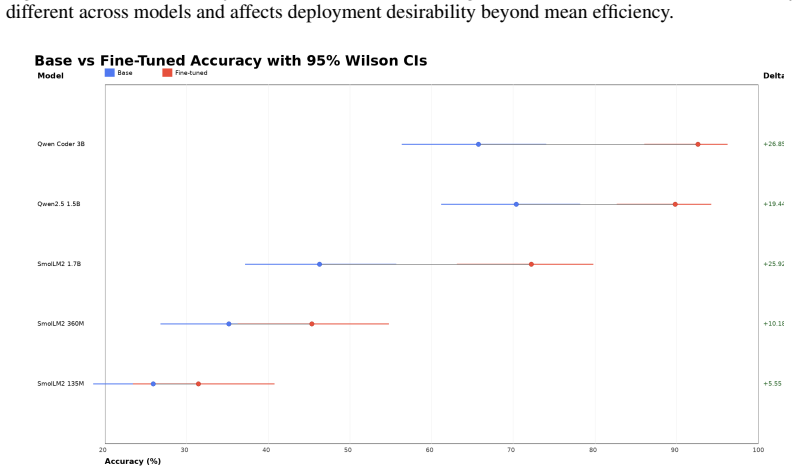
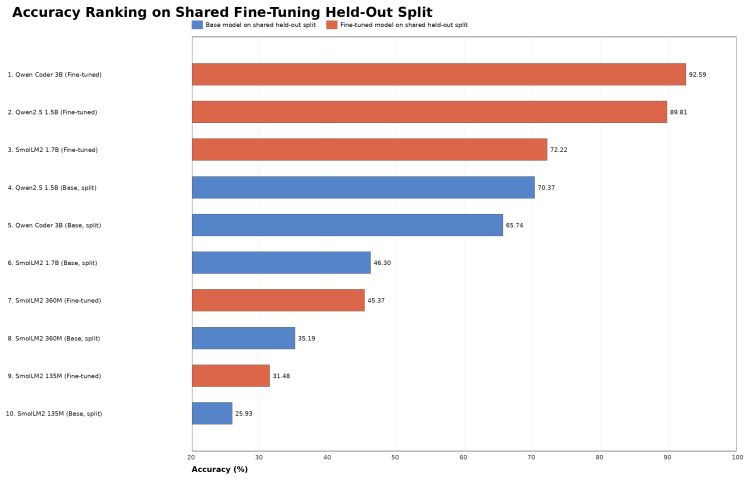
The central discovery is a conditional one: a meaningful subset of compact open-weight models already satisfies a strict, format-constrained answer contract on structured micro-tasks, and parameter-efficient fine-tuning can convert that base competence into substantially higher operating accuracy. The paper shows the largest gains appear in models that already have strong format control but retain semantic headroom, which is why it frames PEFT as decision-boundary specialization rather than output-shape repair. The strongest result: after adaptation, the leading 3B model reaches 92.59% strict accuracy on the shared held-out split, a +26.85 point jump, while all five adapted models improve by
What carries the argument
The load-bearing machinery is the benchmark itself plus the fine-tuning recipe. The benchmark fixes a single output contract — exactly one option letter — and scores strict correctness, so formatting is part of correctness. The adaptation pipeline freezes a 4-bit quantized backbone, trains low-rank adapters (LoRA style, with DoRA's direction/magnitude decomposition), and optimizes only the answer span via a completion-only collator. That combination lets a small lab, on a single L4-class GPU, measure which models' decision boundaries improve under supervision and which remain capacity-bound.
Load-bearing premise
The paper's fine-tuning conclusions rest on the assumption that a single 108-example, one-seed held-out split gives a stable estimate of how much each model improves; the paper's own confidence intervals are wide enough that a different split could reorder the gains or erase them for smaller models.
What would settle it
An experiment that fine-tunes the same five models on, say, five different random splits with a 500-item held-out set; if the observed deltas shrink (e.g., the largest gain drops below +10 points) or if the gain for the 135M model reverses sign, the claim that low-cost PEFT is decisive for sub-3B models would not survive.
If this is right
- A small organization can now run, audit, and specialize useful open models on commodity hardware for bounded tasks.
- PEFT is not a universal fix: it helps most when the base model already has strong format control, so the gains are concentrated in specific model-task combinations.
- The preferred way to think about deployment is a portfolio of local experts matched to task families, not a single winner-take-all leaderboard.
- Fine-tuning can sharpen some topic manifolds while slightly degrading others, so post-tuning validation must be topic-resolved.
Where Pith is reading between the lines
- The 108-example held-out split is small enough that the ordering of gains could be unstable; repeating the fine-tuning across multiple seeds and larger test sets would either confirm or overturn the claim that the top model's +26.85 point jump is robust.
- The benchmark's template structure may understate the gap to real user traffic; testing the same workflow on more linguistically diverse, freely generated prompts would show whether the gains are durable.
- If the local-expert story is right, routing each task to a specialist small model could beat a single large model on cost and accuracy per dollar, creating an economic incentive for SLM-based pipelines.
Editorial analysis
A structured set of objections, weighed in public.
Referee Report
Summary. The paper presents a two-stage study: (i) construction of a controlled 1,085-item, 16-topic multiple-choice benchmark for structured local deployment, and (ii) a parameter-efficient fine-tuning (PEFT) pipeline using 4-bit NF4 quantization with DoRA/LoRA-style adapters applied to five models. Base evaluation of nine 135M–3B models shows Qwen Coder 3B leading at 75.67% strict accuracy, followed by Qwen2.5 1.5B (67.10%) and Qwen3.5 2B (64.98%). On a shared 108-example held-out split, fine-tuning yields positive observed gains for all five adapted models, with the largest gains for Qwen Coder 3B (+26.85 pts) and SmolLM2 1.7B (+25.92 pts). The paper argues that a reproducible workflow of benchmarking, cross-model evaluation, and low-cost specialization makes a subset of sub-3B models viable as local experts for structured niche workloads.
Significance. The base evaluation is a model of methodological discipline: deterministic decoding, strict accuracy with format validity, Wilson confidence intervals, McNemar tests, topic-conditioned and difficulty-stratified analyses, and a transparent split. The benchmark and scripts appear reproducible, and the paper correctly frames the results as benchmark-conditional. If the fine-tuning results are robust, the work would be a valuable demonstration of PEFT for democratized deployment. However, the PEFT evidence is currently weaker than the base evidence: the 108-item single-seed split yields wide intervals and overlapping CIs for two of the five models, and the selection of fine-tuned models/configurations is not fully specified. The central claim that PEFT is 'frequently decisive' therefore needs either additional experiments or more cautious language.
major comments (2)
- [§7.1, Table 4] The fine-tuning deltas for SmolLM2 360M and 135M are not statistically significant: Wilson 95% CIs overlap heavily (360M: [26.8,44.6] vs [36.3,54.8]; 135M: [18.6,34.9] vs [23.5,40.7]). The §7.2 statement that 'PEFT is frequently decisive' is unsupported for these models. Moreover, the single seed-42 split (§5.3) yields baseline accuracy on the split that differs from the full benchmark by up to 10 points (e.g., Qwen Coder 3B 65.74 vs 75.67), so the deltas are measured against a noisy baseline. Please either provide multi-seed or larger held-out evaluation, or restrict the adaptation claims to the three models with non-overlapping intervals.
- [§5.3, §6] The criteria for choosing the five models for fine-tuning and the adapter rank (r=16 default) are not stated. If the choice was informed by base performance on the same 108-item split, the reported gains are vulnerable to selection bias. The paper should report the selection rule and ideally validate on a truly held-out split (e.g., a second split used only after model selection).
minor comments (5)
- [§7.2] The aggregate '+17.59 points mean improvement' mixes statistically significant and non-significant deltas; consider reporting it only for models with non-overlapping CIs or with a significance threshold.
- [§3.1] The paper refers to the 'v3 benchmark' without explaining earlier versions; define or remove the version label.
- [§5.3] The PEFT configuration uses RSLoRA, but no citation or explanation is given; please add a reference or a brief description.
- [§6.1] The McNemar discordant counts (203 vs. 199) are not self-explanatory; specify which model is the reference in each pairwise comparison.
- [Abstract, §7] Section 11 correctly flags the small split, but the abstract and Section 7 present the fine-tuning results without the same caveat; the headline deltas should be qualified as single-split estimates.
Circularity Check
No significant circularity: the benchmark, base evaluations, and fine-tuning deltas are measured outcomes under a fixed protocol; the acknowledged small split raises statistical precision, not circularity.
full rationale
The paper's claims are empirical measurements rather than derivations from fitted inputs. The benchmark is constructed from an independent category-first generator, and strict accuracy (Eqs. 1–2) is a scoring rule applied to fixed model outputs. The fine-tuning protocol in Section 5.3/Table 2 is specified a priori (fixed ranks, epochs, loss, and split seed 42), and the best checkpoint is selected by validation loss rather than by the held-out test split; the deltas in Table 4 are therefore measured, not predicted from the same data that set the configuration. The item-difficulty quantity d(q) in Eq. (3) is self-referential in that it is defined from the same model outcomes used in difficulty-stratified plots, but it is a descriptive analytic view and is not used to derive the headline viability or fine-tuning claims. The paper's own Section 11 flags the 108-example split and calls for multi-seed and larger held-out sets; that is a statistical precision limitation, not a circular reduction. All cited prior work is external, with no self-citation chain or imported uniqueness theorem. The phrase 'models with positive observed gains' is a selection in reporting, but the individual deltas are not defined by construction from the inputs. Overall, no claimed result reduces to its own inputs by definition.
Axiom & Free-Parameter Ledger
free parameters (2)
- Adapter rank r (tier-dependent) =
8 (T4), 16 (L4/A100-40GB), 32 (A100-80GB/H100)
- Learning rate 2e-4, warmup ratio 0.05, epochs 3, weight decay 0.01 =
2e-4, 0.05, 3, 0.01
axioms (3)
- domain assumption The 108-example held-out split is representative of the benchmark for fine-tuning evaluation.
- domain assumption Strict one-letter accuracy is the correct operational measure for structured deployment.
- domain assumption The base models' pretrained representations are compatible with the completion-only fine-tuning objective.
Cite this review
Pith. "Pith review of Democratizing AI with Small Language Models: Structured Benchmarking and Parameter-Efficient Fine-Tuning for Local Deployment." pith.science (2026). https://pith.science/paper/FRKR2KXC
@misc{pith2026260716202,
  author       = {Pith},
  title        = {Pith review of: Democratizing AI with Small Language Models: Structured Benchmarking and Parameter-Efficient Fine-Tuning for Local Deployment},
  year         = {2026},
  howpublished = {\url{https://pith.science/paper/FRKR2KXC}},
  note         = {Machine review of arXiv:2607.16202}
}
read the original abstract
AI democratization is not primarily a question of matching frontier-scale generality; it is a question of whether capable models can be selected, audited, and specialized under hardware and governance constraints that ordinary institutions can actually satisfy. This paper studies that problem through a controlled evaluation of nine open-weight language models between 135M and 3B parameters on a 1,085-example, 16-topic multiple-choice benchmark designed for structured local deployment. The benchmark emphasizes symbolic precision, constrained formatting, extraction, and short-horizon semantic decision making under a strict one-letter output protocol. A shared parameter-efficient fine-tuning pipeline then adapts a subset of models using 4-bit NF4 quantization with DoRA/LoRA-style adapters on an NVIDIA L4-class budget. In base evaluation, Qwen Coder 3B leads at 75.67% strict accuracy, followed by Qwen2.5 1.5B at 67.10%, Qwen3.5 2B at 64.98%, and Granite 3.3 2B at 64.61%. On the shared 108-example held-out fine-tuning split, adaptation improves Qwen Coder 3B by +26.85 points, SmolLM2 1.7B by +25.92, Qwen2.5 1.5B by +19.44, SmolLM2 360M by +10.18, and SmolLM2 135M by +5.55. Across ranking, topic-level heterogeneity, difficulty strata, failure composition, efficiency frontiers, and topic-conditioned transfer, the same conclusion recurs: a disciplined workflow of benchmark construction, cross-model evaluation, and low-cost specialization already makes a subset of sub-3B models viable as local experts for structured niche workloads.
Figures



Reference graph
Works this paper leans on
-
[1]
LoRA: Low-Rank Adaptation of Large Language Models
E. J. Hu et al. “LoRA: Low-Rank Adaptation of Large Language Models.” ICLR, 2022
2022
-
[2]
QLoRA: Efficient Finetuning of Quantized LLMs
T. Dettmers et al. “QLoRA: Efficient Finetuning of Quantized LLMs.” arXiv:2305.14314, 2023
Pith/arXiv arXiv 2023
-
[3]
DoRA: Weight-Decomposed Low-Rank Adaptation
S.-Y . Liu et al. “DoRA: Weight-Decomposed Low-Rank Adaptation.” arXiv:2402.09353, 2024
Pith/arXiv arXiv 2024
-
[4]
SmolLM2: When Smol Goes Big – Data-Centric Training of a Small Language Model
L. B. Allal et al. “SmolLM2: When Smol Goes Big – Data-Centric Training of a Small Language Model.” arXiv:2502.02737, 2025
Pith/arXiv arXiv 2025
-
[5]
L. Soldaini et al. “2 OLMo 2 Furious.” arXiv:2501.00656, 2025
Pith/arXiv arXiv 2025
-
[6]
A. Yang et al. “Qwen2 Technical Report.” arXiv:2407.10671, 2024
Pith/arXiv arXiv 2024
-
[7]
Qwen2.5-Coder Technical Report
Qwen Team. “Qwen2.5-Coder Technical Report.” arXiv:2409.12186, 2024
Pith/arXiv arXiv 2024
-
[8]
SmolLM2-135M-Instruct Model Card
Hugging FaceTB. “SmolLM2-135M-Instruct Model Card.” 2025
2025
-
[9]
SmolLM2-360M-Instruct Model Card
Hugging FaceTB. “SmolLM2-360M-Instruct Model Card.” 2025
2025
-
[10]
SmolLM2-1.7B-Instruct Model Card
Hugging FaceTB. “SmolLM2-1.7B-Instruct Model Card.” 2025
2025
-
[11]
stablelm-zephyr-3b Model Card
Stability AI. “stablelm-zephyr-3b Model Card.” 2024
2024
-
[12]
Qwen2.5-1.5B-Instruct Model Card
Qwen Team. “Qwen2.5-1.5B-Instruct Model Card.” 2024
2024
-
[13]
Qwen2.5-Coder-3B-Instruct Model Card
Qwen Team. “Qwen2.5-Coder-3B-Instruct Model Card.” 2024
2024
-
[14]
Qwen3.5-2B Model Card
Qwen Team. “Qwen3.5-2B Model Card.” 2026
2026
-
[15]
granite-3.3-2b-instruct Model Card
IBM Granite Team. “granite-3.3-2b-instruct Model Card.” 2025
2025
-
[16]
OLMo-2-0425-1B-Instruct Model Card
Allen Institute for AI. “OLMo-2-0425-1B-Instruct Model Card.” 2025
2025
-
[17]
Transformers Quantization with bitsandbytes Documentation
Hugging Face. “Transformers Quantization with bitsandbytes Documentation.” 2026
2026
-
[18]
PEFT LoRA Developer Guide
Hugging Face. “PEFT LoRA Developer Guide.” 2026
2026
-
[19]
TRL SFT Trainer Documentation
Hugging Face. “TRL SFT Trainer Documentation.” 2026
2026
-
[20]
NVIDIA L4 Tensor Core GPU Specifications
NVIDIA. “NVIDIA L4 Tensor Core GPU Specifications.” 2026
2026
-
[21]
On the Opportunities and Risks of Foundation Models
R. Bommasani et al. “On the Opportunities and Risks of Foundation Models.” arXiv:2108.07258, 2021
Pith/arXiv arXiv 2021
-
[22]
On the Dangers of Stochastic Parrots
E. M. Bender et al. “On the Dangers of Stochastic Parrots.” FAccT, 2021
2021
-
[23]
Energy and Policy Considerations for Deep Learning in NLP
E. Strubell, A. Ganesh, and A. McCallum. “Energy and Policy Considerations for Deep Learning in NLP.” ACL, 2019
2019
-
[24]
Carbon Emissions and Large Neural Network Training
D. Patterson et al. “Carbon Emissions and Large Neural Network Training.” arXiv:2104.10350, 2021. 16
Pith/arXiv arXiv 2021
-
[25]
FrugalGPT: How to Use Large Language Models While Reducing Cost and Improving Performance
L. Chen, M. Zaharia, and J. Zou. “FrugalGPT: How to Use Large Language Models While Reducing Cost and Improving Performance.” arXiv:2305.05176, 2023
Pith/arXiv arXiv 2023
-
[26]
TinyLlama: An Open-Source Small Language Model
P. Zhang et al. “TinyLlama: An Open-Source Small Language Model.” arXiv:2401.02385, 2024
Pith/arXiv arXiv 2024
-
[27]
Phi-3 Technical Report: A Highly Capable Language Model Locally on Your Phone
M. Abdin et al. “Phi-3 Technical Report: A Highly Capable Language Model Locally on Your Phone.” arXiv:2404.14219, 2024
Pith/arXiv arXiv 2024
-
[28]
MobileLLM: Optimizing Sub-Billion Parameter Language Models for On-Device Use Cases
Z. Liu et al. “MobileLLM: Optimizing Sub-Billion Parameter Language Models for On-Device Use Cases.” arXiv:2402.14905, 2024. 17
Pith/arXiv arXiv 2024
discussion (0)
Sign in with ORCID, Apple, or X to comment. Anyone can read and Pith papers without signing in.