Analytical connection between exact and approximate solutions of the periodically-driven two-level system starting from the Heun equation
pith:FRZDXMTHreviewed 2026-07-02 11:58 UTCmodel grok-4.3open to challenge →
The pith
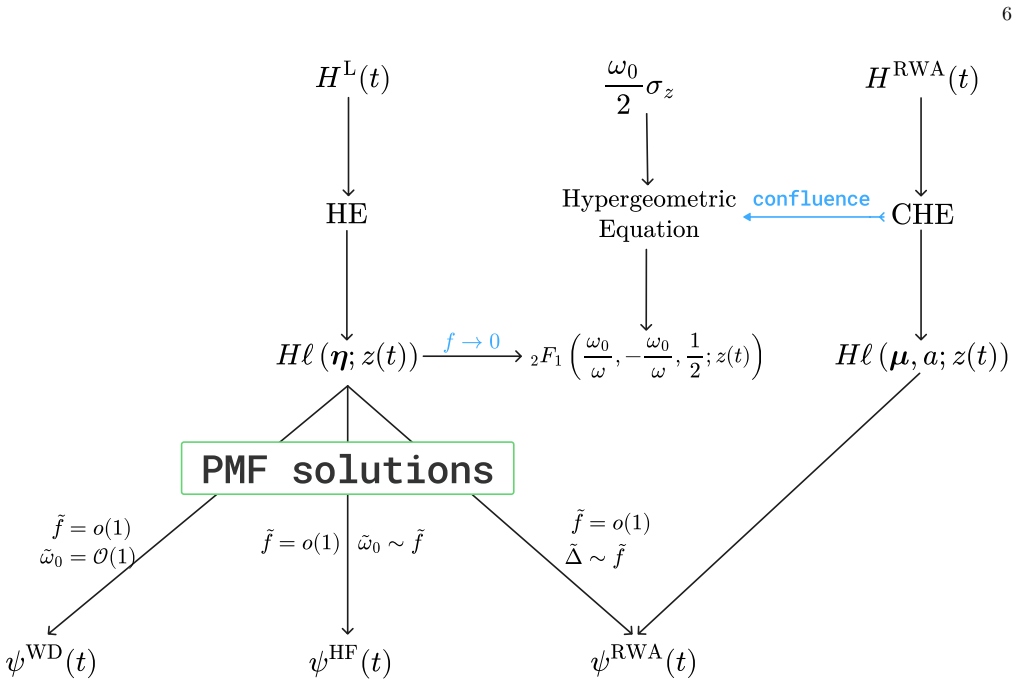
Exact solutions of the linearly driven two-level system connect analytically to the rotating-wave case through perturbative continued fractions from the confluent Heun equation.
A machine-rendered reading of the paper's core claim, the machinery that carries it, and where it could break.
Core claim
The authors demonstrate a direct analytic connection between the exact solutions for linear driving and those for the rotating-wave case by analyzing path-multiplicative Floquet solutions of the confluent Heun equation expressed as bilateral series. These lead to two continued-fraction expansions that are solved perturbatively by imposing a consistency condition, recovering not only the rotating-wave approximation itself but also the correct Stark and Bloch-Siegert shifts and the high-frequency approximation.
What carries the argument
Bilateral series solutions of the confluent Heun equation that generate continued-fraction expansions whose consistency condition is solved perturbatively to recover rotating-wave results.
If this is right
- The perturbative procedure recovers the rotating-wave approximation.
- It also yields the correct Stark and Bloch-Siegert shifts.
- It reproduces the high-frequency approximation.
- Local solutions are expressed in hypergeometric functions for both driving cases.
Where Pith is reading between the lines
- The same perturbative expansion could be continued to higher orders to generate systematic corrections beyond the rotating-wave regime.
- The method suggests a route to obtain approximate solutions for other periodic driving shapes by starting from their corresponding Heun equations.
- Quantum-control protocols that rely on precise frequency shifts could use the continued-fraction expansions to estimate corrections directly from the exact linear-driving solution.
Load-bearing premise
The consistency condition on the continued-fraction expansions arising from the bilateral series can be solved perturbatively in a manner that reproduces the rotating-wave approximation and the associated shifts without additional parameter tuning or post-hoc selection of orders.
What would settle it
Direct numerical integration of the driven two-level Schrödinger equation at intermediate frequencies where the perturbative continued-fraction result from the confluent Heun equation fails to match the known rotating-wave solution plus Stark and Bloch-Siegert shifts.
Figures
read the original abstract
We investigate and establish an analytic connection between the exact solutions describing the dynamics of a two-level system driven by periodic external fields, focusing on the cases of linear driving and the so-called rotating-wave approximation, or circular driving. In both cases, the exact solutions can be obtained by mapping the Schrodinger equation onto Heun equations: the confluent Heun equation for linear driving and the Heun equation for the rotating-wave case. In particular, we demonstrate a direct analytic connection between the exact solutions for linear driving and those for the rotating-wave case. This result is obtained by analyzing local solutions expressed in terms of hypergeometric functions, which, in the case of the confluent Heun equation, can be derived by considering path-multiplicative Floquet solutions involving a bilateral series. This series leads to two continued-fraction expansions that can be perturbatively solved by imposing a suitable consistency condition. The connection between the linear-driving and rotating-wave solutions is established through a perturbative procedure that allows us to recover not only the rotating-wave approximation itself, but also the correct Stark and Bloch-Siegert shifts, as well as the so-called high-frequency approximation.
Editorial analysis
A structured set of objections, weighed in public.
Referee Report
Summary. The paper maps the time-dependent Schrödinger equation for a two-level system under periodic driving to Heun equations (confluent Heun for linear driving, standard Heun for rotating-wave/circular driving). It expresses local solutions via path-multiplicative Floquet forms as bilateral series whose coefficients obey two continued-fraction relations; a consistency condition on these fractions is solved perturbatively to establish an analytic link between the exact linear-driving solutions and the rotating-wave approximation, recovering the RWA itself together with the linear Stark shift, quadratic Bloch-Siegert correction, and high-frequency limit.
Significance. If the perturbative treatment of the consistency condition is shown to be free of order-selection or post-hoc matching, the work supplies a unified analytic route from exact Heun solutions to standard approximations and shifts. This would be useful for driven quantum systems where both exact and approximate regimes are relevant, and the bilateral-series construction itself is a technically interesting extension of Floquet theory.
major comments (2)
- [Discussion of bilateral series and consistency condition (following the mapping to the confluent Heun equation)] The central load-bearing step is the perturbative solution of the consistency condition imposed on the two continued-fraction expansions arising from the bilateral series of the confluent Heun equation. The manuscript states that this procedure recovers the rotating-wave limit plus the exact Stark and Bloch-Siegert shifts, yet supplies neither the explicit recurrence relations at successive perturbative orders nor an error bound or convergence criterion. Without these, it is impossible to verify that the consistency condition alone fixes the coefficients without implicit truncation choices that reproduce known results.
- [Results section on recovered approximations and shifts] No numerical cross-checks against known exact or approximate solutions (e.g., Rabi formula in the rotating-wave limit, or high-frequency Magnus expansion) are presented to confirm that the recovered shifts match the literature values to the claimed orders. Such verification would be required to substantiate the claim that the connection is direct and parameter-free.
minor comments (2)
- [Introduction] The abstract and introduction refer to “path-multiplicative Floquet solutions” without a brief reminder of the definition or a reference to the standard literature on multiplicative Floquet theory; a short clarifying sentence would improve accessibility.
- [Section on bilateral series solutions] Notation for the two continued fractions (e.g., which coefficients enter each fraction) is introduced only in passing; a compact equation or diagram would clarify the setup before the perturbative analysis begins.
Simulated Author's Rebuttal
We thank the referee for the careful reading and constructive comments on our manuscript. We address each major comment below and will revise the manuscript accordingly to strengthen the presentation of the perturbative procedure and to include supporting numerical verifications.
read point-by-point responses
-
Referee: The central load-bearing step is the perturbative solution of the consistency condition imposed on the two continued-fraction expansions arising from the bilateral series of the confluent Heun equation. The manuscript states that this procedure recovers the rotating-wave limit plus the exact Stark and Bloch-Siegert shifts, yet supplies neither the explicit recurrence relations at successive perturbative orders nor an error bound or convergence criterion. Without these, it is impossible to verify that the consistency condition alone fixes the coefficients without implicit truncation choices that reproduce known results.
Authors: We agree that the manuscript would benefit from greater explicitness on this point. The consistency condition is imposed by expanding both continued fractions as power series in the driving amplitude and equating like powers; the resulting recurrence relations for the series coefficients are solved order by order without additional truncation or post-hoc adjustment. In the revised manuscript we will display the recurrence relations through the first few perturbative orders together with a brief discussion of the radius of convergence of the bilateral series, thereby making the systematic character of the procedure fully transparent. revision: yes
-
Referee: No numerical cross-checks against known exact or approximate solutions (e.g., Rabi formula in the rotating-wave limit, or high-frequency Magnus expansion) are presented to confirm that the recovered shifts match the literature values to the claimed orders. Such verification would be required to substantiate the claim that the connection is direct and parameter-free.
Authors: We accept that explicit numerical comparisons would strengthen the claims. The revised manuscript will include a new subsection presenting direct comparisons of the perturbatively recovered shifts with the Rabi formula (in the rotating-wave limit) and with the high-frequency Magnus expansion, confirming agreement to the stated orders. These checks will be performed for representative parameter values and will be accompanied by the corresponding analytic expressions. revision: yes
Circularity Check
No circularity: derivation derives known limits from Heun consistency condition without reduction to inputs by construction
full rationale
The paper maps both drivings to Heun equations, constructs bilateral-series Floquet solutions yielding continued-fraction expansions, then imposes a consistency condition solved perturbatively. The abstract states this recovers RWA plus Stark/Bloch-Siegert shifts, but the given text provides no equations showing the consistency condition is defined using those target shifts or that truncation/branch selection is performed by matching to known results. The procedure is presented as starting from the exact Heun solutions and obtaining the approximations as output, with no self-citation load-bearing the central step and no renaming or ansatz smuggling. This is the common case of an independent derivation whose correctness can be checked externally; no load-bearing step reduces by construction to its inputs.
Axiom & Free-Parameter Ledger
axioms (2)
- domain assumption The time-dependent Schrödinger equation for linear periodic driving maps exactly onto the confluent Heun equation and for circular driving onto the Heun equation.
- standard math Local solutions of the confluent Heun equation can be expressed via hypergeometric functions through path-multiplicative Floquet bilateral series whose coefficients obey continued-fraction relations.
Reference graph
Works this paper leans on
-
[1]
Alternative solution The other solutionψ R W A,II e (t) can be obtained in a similar way starting from the local solution with exponent r= 1−γ. The latter is obtained according to the general theory [14] by the relation Hℓ(1−γ) {0} (µ, a;z) =z 1−γHℓ(0) {0}(µ′, a;z),(37) where the new coefficients are given by α′ =α+ 1−γ, β ′ =β+ 1−γ, γ′ = 2−γ, δ ′ =δ, ϵ ′...
-
[2]
By substituting this result into theconsistency condition(57) we obtain according to Eqs
Zeroth-order solution The zeroth-order terms are given byL (0) n =−R (0) |n| = 0, which impliesg (0) n = 0 for alln̸= 0. By substituting this result into theconsistency condition(57) we obtain according to Eqs. (50) and (56) the resultB (0) 0 = (ν(0))2 −˜ω2 0 = 0, implying for the expression of the two path exponents of order zero ν(0)ω=± ω0 2 .(62) In or...
-
[3]
As anticipated,g 0 is the only coefficient contributing to zeroth-order
First-order solution To proceed at next order, we substituteR (0) n = 0 in the expansion (61), thus obtaining R(1) n = i ˜f(n+ ˜ω0) hn(±˜ω0,˜ω0) .(65) Inserting this expression along with the corresponding one forL (1) n into theconsistency condition(57) gives the first-order approximation for the path exponents ν(1)ω=± ω0 2 f2 (ω2 0 −ω 2) .(66) Up to fir...
-
[4]
I. I. Rabi, Physical Review49, 324 (1936)
work page 1936
- [5]
-
[6]
R. K. Wangsness and F. Bloch, Physical Review89, 728 (1953)
work page 1953
-
[7]
J. H. Shirley, Physical Review138, B979 (1965)
work page 1965
-
[8]
L. Allen and J. H. Eberly,Optical Resonance and Two Level Atoms(Wiley, 1976)
work page 1976
-
[9]
A. M. Ishkhanyan and A. E. Grigoryan, Journal of Physics A: Mathematical and Theoretical47, 465205 (2014)
work page 2014
-
[10]
T. A. Shahverdyan, T. A. Ishkhanyan, A. E. Grigoryan, and A. M. Ishkhanyan, Journal of Contemporary Physics (Armenian Academy of Sciences)50, 211 (2015)
work page 2015
-
[11]
D. Staicova and P. Fiziev, inLie Theory and Its Applications in Physics, edited by V. Dobrev (Springer, Singapore, 2016) pp. 303–308
work page 2016
-
[12]
Horta¸ csu, Advances in High Energy Physics2018, 8621573 (2018)
M. Horta¸ csu, Advances in High Energy Physics2018, 8621573 (2018)
work page 2018
-
[13]
Floquet system, Bloch oscillation, and Stark ladder
T. Ma and S.-M. Li, Floquet system, Bloch oscillation, and Stark ladder (2007), arXiv:0711.1458 [cond-mat]
work page internal anchor Pith review Pith/arXiv arXiv 2007
- [14]
-
[15]
H.-J. Schmidt, J. Schnack, and M. Holthaus, Applicable Analysis100, 992 (2021)
work page 2021
- [16]
-
[17]
Ronveaux,Heun’s Differential Equations(Oxford University Press, Oxford, 1995)
A. Ronveaux,Heun’s Differential Equations(Oxford University Press, Oxford, 1995)
work page 1995
-
[18]
S. Y. Slavyanov, W. Lay, S. Y. Slavyanov, and W. Lay,Special Functions: A Unified Theory Based on Singularities, Oxford Mathematical Monographs (Oxford University Press, Oxford, New York, 2000)
work page 2000
-
[19]
Schmidt, Journal f¨ ur die reine und angewandte Mathematik1979, 127 (1979)
D. Schmidt, Journal f¨ ur die reine und angewandte Mathematik1979, 127 (1979)
work page 1979
-
[20]
Schmidt, Zeitschrift f¨ ur Naturforschung A73, 705 (2018)
H.-J. Schmidt, Zeitschrift f¨ ur Naturforschung A73, 705 (2018)
work page 2018
- [21]
-
[22]
M. O. Scully and M. S. Zubairy,Quantum optics(Cambridge University Press, Cambridge, 1997)
work page 1997
-
[23]
Erd´ elyi, The Quarterly Journal of Mathematics15, 62 (1944)
A. Erd´ elyi, The Quarterly Journal of Mathematics15, 62 (1944)
work page 1944
-
[24]
Erd´ elyi, Duke Mathematical Journal9, 48 (1942)
A. Erd´ elyi, Duke Mathematical Journal9, 48 (1942)
work page 1942
-
[25]
Svartholm, Mathematische Annalen116, 413 (1939)
N. Svartholm, Mathematische Annalen116, 413 (1939)
work page 1939
-
[26]
W. G. Baber and H. R. Hass´ e, Mathematical Proceedings of the Cambridge Philosophical Society31, 564 (1935)
work page 1935
-
[27]
E. W. Leaver, Proceedings of the Royal Society of London. A. Mathematical and Physical Sciences402, 285 (1985)
work page 1985
-
[28]
S. H. Autler and C. H. Townes, Physical Review100, 703 (1955)
work page 1955
-
[29]
Holthaus, Physical Review Letters69, 351 (1992)
M. Holthaus, Physical Review Letters69, 351 (1992)
work page 1992
discussion (0)
Sign in with ORCID, Apple, or X to comment. Anyone can read and Pith papers without signing in.