REVIEW 4 major objections 7 minor 1 cited by
BayLing 2: A Multilingual Large Language Model with Efficient Language Alignment
T0 review · 4 major / 7 minor · reviewed 2026-08-12 · deepseek-v4-flash
Pith's one-line read BayLing 2's central claim is that fine-tuning an LLM on Chinese/English instructions plus cross-lingual translation tasks transfers knowledge and generative ability to 20+ low-resource languages.
desk verdict Useful multilingual alignment recipe at scale, but the paper must address FLORES/Belebele overlap before the capability-transfer claim is credible. read the letter →
The pith
A machine-rendered reading of the paper's core claim, the machinery that carries it, and where it could break.
The reading
What carries the argument
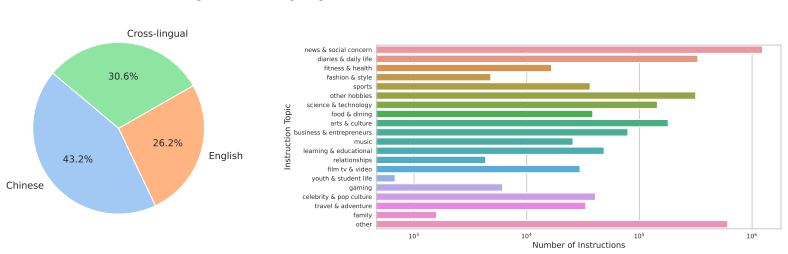
The load-bearing mechanism is the cross-lingual instruction, defined as a prompt that asks the model to transform or continue the same content across languages, chiefly through interactive translation, constrained translation, document-level translation, and single-sentence translation between Chinese/English and one of 100+ other languages. These instructions act as a bridge that ties the target language's surface form to the semantic space already occupied by the high-resource pivot languages, so knowledge and generation routines learned in Chinese and English can be reused in low-resource languages. The instruction dataset, 3.2 million instructions totaling about 1.47 billion tokens, deliberately mixes high-resource instructions with cross-lingual ones; the cross-lingual portion does the alignment work, while the high-resource portion preserves general instruction-following. Rendering the same sentence in multiple languages around a pivot, as in the paper's speed-of-light example, makes the semantic equivalence explicit to the model.
What would settle it
Take the reported low-resource test languages such as Bambara, Luganda, Swahili, Zulu, and Lao and build a fresh parallel and comprehension benchmark from sources not derived from the Flores corpus; if BayLing-2's advantage over the base Llama models shrinks to zero or reverses on that held-out data, the capability-transfer claim is falsified. A cheaper first check is to run a near-duplicate membership test between the 3.2-million-instruction dataset and the Flores-101/Belebele test sets.
Extended reading notes
Core claim
On its own terms, the paper's discovery is that a model does not need instruction data written in a target language to become capable in that language; it needs only a bridge. By fine-tuning Llama-based models on high-resource instructions (Chinese and English) interleaved with cross-lingual instructions that express the same content in another language, BayLing 2 aligns the representations of low-resource languages with the high-resource languages where the model already has strong knowledge and generation. The paper reports measurable improvements: for translation, consistent quality gains across most of the 101 Flores languages and top open-source results on WMT22; for knowledge and understanding, improvements across more than 20 low-resource languages on reading comprehension, commonsense inference, natural-language inference, and science reasoning. An ablation that removes all cross-lingual instructions shows both a drop in low-resource performance and a decline in Chinese benchmarks, which the paper attributes to inter-language conflict; reintroducing the cross-lingual bridge repairs both. The paper's conclusion is that language alignment through cross-lingual instruction tuning is an efficient route to multilingual LLMs and that it does not sacrifice high-resource-language performance.
Load-bearing premise
The evaluation benchmarks are assumed to contain no sentences that BayLing 2 saw during training; the paper does not state that Flores-101 or FLORES-200-derived data was excluded from the 3.2-million-instruction corpus, so if overlap exists, the reported low-resource gains could partly reflect memorization.
Editorial extensions
If this is right
- Low-resource language capability can be improved with translation data rather than hand-built instruction data for each language, since parallel text is abundant and cheaper to collect.
- Supervised fine-tuning for multilingual use should include cross-lingual instructions, not just target-language instructions; without them the model suffers inter-language conflict and loses low-resource and even Chinese performance.
- Off-target generation in low-resource languages, where the base model emits the wrong language or script, is reduced by alignment, making the model usable for translation into those languages.
- Models trained this way keep pace with or exceed other open-source models of the same size on translation and come close to closed-source systems on WMT22 high-resource pairs.
- Improvements on knowledge and reasoning benchmarks in 20+ low-resource languages imply that the transferred capability is not limited to translation itself but includes understanding and knowledge answering.
Reading between the lines
- Editorial inference: the same recipe should work with pivot languages other than Chinese and English; any high-capability language with abundant parallel text could act as the bridge, making the method a general recipe rather than a Chinese/English-specific result.
- Editorial inference: because the ablation only removes the cross-lingual instructions as a whole, it does not isolate whether the gains come from the translation objective itself or simply from exposing the model to more multilingual text; a control fine-tuned on matched monolingual low-resource text would separate these explanations.
- Editorial inference: the alignment account predicts a dose-response relationship, namely that languages with more cross-lingual training sentences should show larger gains; plotting per-language improvement against the number of training instructions per language would test that prediction directly.
- Editorial inference: the knowledge-transfer claim is currently demonstrated on multiple-choice benchmarks; evaluating BayLing-2 on open-ended generation tasks in languages like Bambara, Luganda, or Zulu would show whether the alignment transfers generative fluency as well as answer selection.
Editorial analysis
A structured set of objections, weighed in public.
Referee Report
Summary. The paper presents BayLing 2, a family of multilingual LLMs (BayLing-2-7B, BayLing-2-13B, BayLing-2-8B) obtained by instruction-tuning Llama models on a 3.2M-instruction corpus consisting of Chinese and English instructions plus cross-lingual translation instructions between those two pivot languages and 100+ other languages. The central claim is that this "language alignment" transfers knowledge, generative capability, and instruction-following ability from high-resource to low-resource languages without constructing native instruction data for each language. Evaluation covers translation (Flores-101, WMT22), multilingual understanding (Belebele, Multilingual HellaSwag, XNLI, Multilingual ARC), and English/Chinese general benchmarks, with an ablation that removes cross-lingual instructions.
Significance. If the central claim holds, the paper offers a practical and cost-effective recipe: translation-style parallel instruction data can improve a large number of low-resource languages, avoiding the prohibitive cost of annotating native instruction data for each language. The paper's strengths are its breadth—three model scales, 100+ languages, four multilingual understanding benchmarks, and comparisons against strong open baselines—and the public release of models and code. However, the evidence for the headline knowledge-transfer claim currently depends on an unverified assumption that training data are disjoint from the evaluation benchmarks, and on point estimates without uncertainty quantification; both of these gaps are load-bearing for the claimed transfer result.
major comments (4)
- [§3.1 (dataset construction; used in §4.1.1 and §4.1.2)] The training-data description never states that Flores-101/FLORES-200-derived sentences were excluded from the 3.2M instructions; it only says the instructions are "primarily sourced from news corpora." Since Flores-101 sentences come from news, travel guides, and books, and Belebele passages are explicitly built from FLORES-200, any inclusion of such sentences in the translation training pairs would inflate both the translation scores in §4.1.1 and the Belebele comprehension gains in §4.1.2. The latter is the main non-translation evidence for capability transfer, so the authors should state whether Flores/FLORES sentences were removed from training, report overlap statistics against the evaluation sets, or release the training corpus; without this, the central claim cannot be distinguished from memorization.
- [§4.1.2, Figure 8, Tables 9–12] The phrase "significant improvements across over 20 low-resource languages" is not supported by any significance test, error bar, or standard deviation; all reported numbers are point estimates from single evaluations, and Figure 8 shows only a selected subset of languages with no aggregate count or list. Several differences are near the noise floor (e.g., XNLI Urdu: 0.3454 vs 0.3454; Multilingual HellaSwag Vietnamese: 0.4025 vs 0.4021; Belebele Zulu: 0.3378 vs 0.3244), and on XNLI Bulgarian, BayLing-2-8B is worse than Llama-3-8B-Instruct (0.4510 vs 0.4518). The authors should provide variance or significance estimates, or soften the claim to a descriptive statement of observed improvements.
- [§4.3, Figure 10 and Figure 11] The ablation study is presented only graphically, with no numerical scores for the "w/o cross-lingual instructions" variant in the main text or the appendix. The claims that removing cross-lingual instructions causes a "significant performance decline" in low-resource languages and that the remaining variant suffers from inter-language conflicts are therefore not checkable from the paper. Exact numbers for both variants on Belebele and on the Chinese/English general benchmarks should be included in a table.
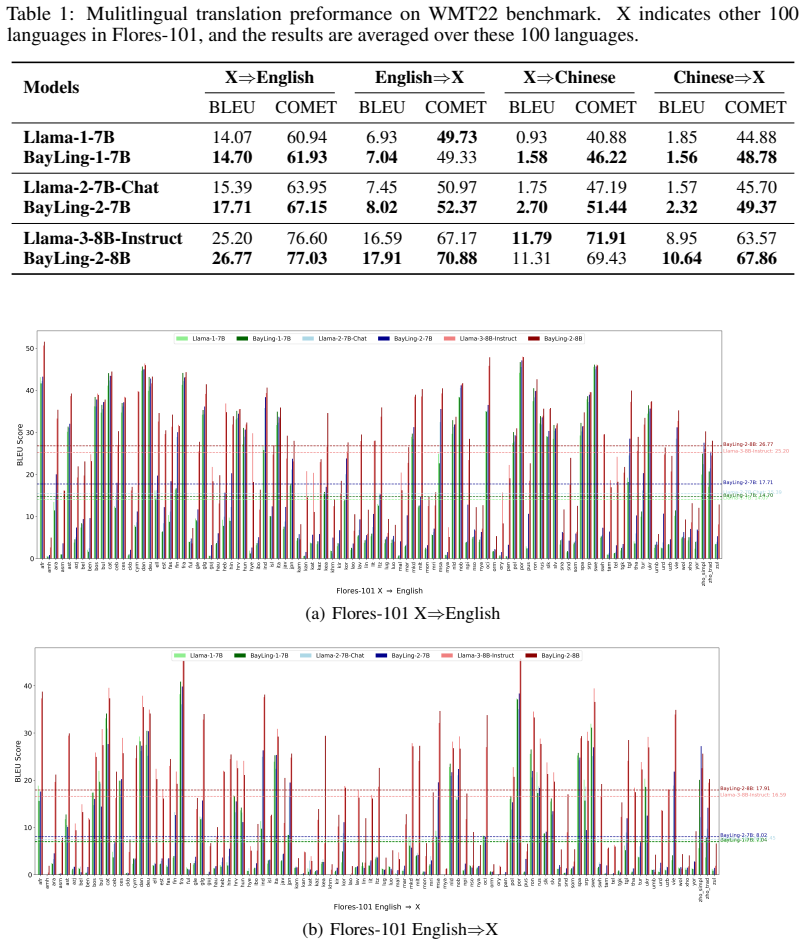
- [§4.1.1 (Table 1) and §4.1.2 (p. 9)] The translation gains in §4.1.1 are partly by construction because the model is fine-tuned on translation instructions and evaluated on translation tasks; they cannot by themselves establish the paper's broader claim of knowledge transfer to low-resource languages. The Belebele and multilingual-understanding results carry that weight, but they are currently under-quantified and potentially contaminated by train/eval overlap (as noted in the first major comment). The paper should make this reasoning explicit and present the required safeguards—benchmark disjointness and uncertainty quantification—together with the transfer claim.
minor comments (7)
- [Table 1] The caption says "WMT22 benchmark" but the table reports averages over roughly 100 Flores-101 languages; this appears to be a copy-paste error and should be corrected.
- [Tables 1 and 2] The header "BELU" in Table 2 and "Mulitlingual preformance" in Table 1 should be corrected to "BLEU" and "Multilingual performance."
- [§4.1.2, p. 9] The statement that BayLing's training data "does not include instruction data for these low-resource languages but only cross-lingual instructions" is misleading because cross-lingual instructions contain low-resource-language source or target text; it should be rephrased to say the corpus contains no monolingual instruction-following data in those languages.
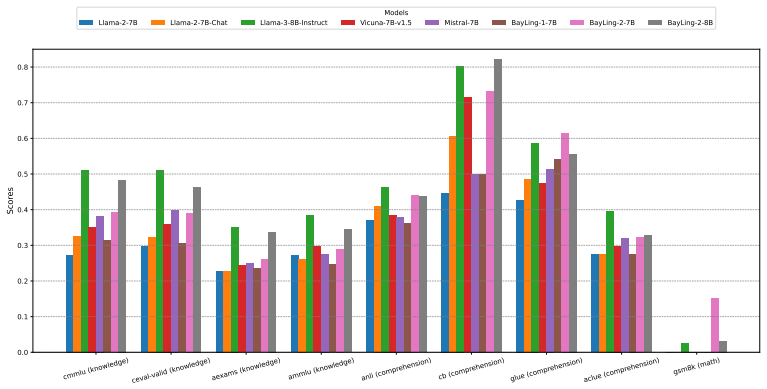
- [§4.2] The benchmark list uses "ammlu" and "aexams" without defining them in the text; these abbreviations should be expanded in the benchmark descriptions or table caption.
- [§4.2] GSM8K is described as being described in section 4.1.2, but it is first presented in §4.2; the cross-reference is incorrect.
- [Figures 10 and 11] These figures are visually dense and the legends are difficult to read; since they carry the ablation claim, a table of the underlying scores would be clearer and more useful to readers.
- [§4.1.2, Table 7] The text uses both "Swati" and "Swazi" for the same Belebele language subset; a single consistent label should be used throughout.
Circularity Check
No significant circularity: the central capability-transfer claim is tested on held-out benchmarks rather than derived from the training objective, and no fitted parameter is relabeled as a prediction.
full rationale
BayLing 2's derivation chain is empirical: a 3.2M-instruction corpus of Chinese/English instructions plus cross-lingual translation instructions is used for supervised fine-tuning (Section 3.1), and the resulting models are evaluated on Flores-101 and WMT22 for translation (Section 4.1.1) and on Belebele, Multilingual HellaSwag, XNLI, and Multilingual ARC for knowledge and understanding (Section 4.1.2). The knowledge-transfer conclusion is not definitional: neither Belebele nor ARC, HellaSwag, or XNLI is used to construct the training set, and no parameter is fitted to those benchmarks and then renamed a prediction. Translation is both a training task and an evaluation task, so translation gains are partly expected, but the paper's broader claim of transfer to low-resource languages rests on the comprehension benchmarks, which are external. The only load-bearing self-citation would be if BayLing 1's method were assumed; instead it is cited as prior work and the method is re-described here, so the self-citation is not load-bearing. A data-hygiene caveat exists: Section 3.1 describes the corpus only as 'primarily sourced from news corpora' and does not state whether Flores-101 or FLORES-200-derived sentences were excluded, while Belebele passages are explicitly built from FLORES-200; if overlap existed, comprehension gains could be inflated. However, the text does not establish that overlap, and under the no-speculation rule this is a correctness and reproducibility risk rather than a demonstrated circular step.
Assumptions & free parameters
free parameters (2)
- training learning rate =
2e-5 (7B/13B), 2e-6 (8B)
- instruction mix ratio =
43.2% Chinese, 26.2% English, 30.6% cross-lingual
assumptions (3)
- domain assumption Translation tasks serve as an effective mechanism for language alignment between high- and low-resource languages.
- domain assumption Performance on Belebele, Multilingual HellaSwag, XNLI, and Multilingual ARC measures knowledge and generative capability transfer.
- domain assumption BLEU and COMET scores faithfully reflect translation quality.
Cite this review
Pith. "Pith review of BayLing 2: A Multilingual Large Language Model with Efficient Language Alignment." pith.science (2026). https://pith.science/paper/FS5H5W7M
@misc{pith2026241116300,
  author       = {Pith},
  title        = {Pith review of: BayLing 2: A Multilingual Large Language Model with Efficient Language Alignment},
  year         = {2026},
  howpublished = {\url{https://pith.science/paper/FS5H5W7M}},
  note         = {Machine review of arXiv:2411.16300}
}
read the original abstract
Large language models (LLMs), with their powerful generative capabilities and vast knowledge, empower various tasks in everyday life. However, these abilities are primarily concentrated in high-resource languages, leaving low-resource languages with weaker generative capabilities and relatively limited knowledge. Enhancing the multilingual capabilities of LLMs is therefore crucial for serving over 100 linguistic communities worldwide. An intuitive approach to enhance the multilingual capabilities would be to construct instruction data for various languages, but constructing instruction data for over 100 languages is prohibitively costly. In this paper, we introduce BayLing 2, which efficiently transfers generative capabilities and knowledge from high-resource languages to low-resource languages through language alignment. To achieve this, we constructed a dataset of 3.2 million instructions, comprising high-resource language instructions (Chinese and English) and cross-lingual instructions for 100+ languages and performed instruction tuning based on the dataset to facilitate the capability transfer between languages. Using Llama as the foundation model, we developed BayLing-2-7B, BayLing-2-13B, and BayLing-2-8B, and conducted a comprehensive evaluation of BayLing. For multilingual translation across 100+ languages, BayLing shows superior performance compared to open-source models of similar scale. For multilingual knowledge and understanding benchmarks, BayLing achieves significant improvements across over 20 low-resource languages, demonstrating its capability of effective knowledge transfer from high-resource to low-resource languages. Furthermore, results on English benchmarks indicate that BayLing maintains high performance in highresource languages while enhancing the performance in low-resource languages. Demo, homepage, code and models of BayLing are available.
Figures


Figures from the paper (7 more)





Forward citations
Cited by 1 Pith paper
-
Less, but Better: Efficient Multilingual Expansion for LLMs via Layer-wise Mixture-of-Experts
A layer-wise expert allocation algorithm based on hidden-state similarity, plus a routing classifier, improves parameter efficiency and reduces forgetting when expanding LLMs to new languages.
Reference graph
Works this paper leans on
-
[4]
URL https://aclanthology.org/2022.wmt-1.52
Association for Computational Linguistics. URL https://aclanthology.org/2022.wmt-1.52. Wei-Lin Chiang, Zhuohan Li, Zi Lin, Ying Sheng, Zhanghao Wu, Hao Zhang, Lianmin Zheng, Siyuan Zhuang, Yonghao Zhuang, Joseph E. Gonzalez, Ion Stoica, and Eric P. Xing. Vicuna: An open-source chatbot impressing gpt-4 with 90%* chatgpt quality, March
work page 2022
-
[6]
URL https://zenodo.org/records/10256836. Lucas Bandarkar, Davis Liang, Benjamin Muller, Mikel Artetxe, Satya Narayan Shukla, Donald Husa, Naman Goyal, Abhinandan Krishnan, Luke Zettlemoyer, and Madian Khabsa. The belebele benchmark: a parallel reading comprehension dataset in 122 language variants. arXiv preprint arXiv:2308.16884,
-
[7]
Xnli: Evaluating cross-lingual sentence representations
Alexis Conneau, Ruty Rinott, Guillaume Lample, Adina Williams, Samuel Bowman, Holger Schwenk, and Veselin Stoyanov. Xnli: Evaluating cross-lingual sentence representations. In Proceedings of the 2018 Conference on Empirical Methods in Natural Language Processing , pages 2475–2485,
work page 2018
-
[8]
Think you have solved question answering? try arc, the ai2 reasoning challenge
Peter Clark, Isaac Cowhey, Oren Etzioni, Tushar Khot, Ashish Sabharwal, Carissa Schoenick, and Oyvind Tafjord. Think you have solved question answering? try arc, the ai2 reasoning challenge. ArXiv, abs/1803.05457,
-
[9]
C-eval: A multi-level multi-discipline chinese evaluation suite for foundation models
Yuzhen Huang, Yuzhuo Bai, Zhihao Zhu, Junlei Zhang, Jinghan Zhang, Tangjun Su, Junteng Liu, Chuancheng Lv, Yikai Zhang, Jiayi Lei, Yao Fu, Maosong Sun, and Junxian He. C-eval: A multi-level multi-discipline chinese evaluation suite for foundation models. arXiv preprint arXiv:2305.08322,
-
[10]
14 Momchil Hardalov, Todor Mihaylov, Dimitrina Zlatkova, Yoan Dinkov, Ivan Koychev, and Preslav Nakov. Exams: A multi-subject high school examinations dataset for cross-lingual and multilingual question answering. In Proceedings of the 2020 Conference on Empirical Methods in Natural Language Processing (EMNLP), pages 5427–5444,
work page 2020
-
[12]
Association for Computational Linguistics. doi: 10.18653/v1/W18-5446. URL https://aclanthology.org/W18-5446. Yixuan Zhang and Haonan Li. Can large langauge model comprehend Ancient Chinese? a preliminary test on ACLUE. In Proceedings of the Ancient Language Processing Workshop , pages 80– 87, Varna, Bulgaria, September
-
[13]
URL https:// aclanthology.org/2023.alp-1.9
INCOMA Ltd., Shoumen, Bulgaria. URL https:// aclanthology.org/2023.alp-1.9. Karl Cobbe, Vineet Kosaraju, Mohammad Bavarian, Jacob Hilton, Reiichiro Nakano, Christopher Hesse, and John Schulman. Training verifiers to solve math word problems,
work page 2023
Show all 14 references
-
[14]
Language Code Language belebele_bam_Latn Bambara belebele_ben_Latn Bengali belebele_hau_Latn Hausa belebele_ilo_Latn Ilocano belebele_kin_Latn Kinyarwanda belebele_lao_Laoo Lao belebele_lin_Latn Lingala belebele_lug_Latn Luganda belebele_luo_Latn Luo belebele_nso_Latn Northern...
-
[2018]
doi: 10.18653/v1/W18-6319
Association for Computational Linguistics. doi: 10.18653/v1/W18-6319. URL https:// aclanthology.org/W18-6319. Ricardo Rei, José G. C. de Souza, Duarte Alves, Chrysoula Zerva, Ana C Farinha, Taisiya Glushkova, Alon Lavie, Luisa Coheur, and André F. T. Martins. COMET-22: Unbabel...
-
[2019]
Alex Wang, Amanpreet Singh, Julian Michael, Felix Hill, Omer Levy, and Samuel Bowman
URL https://proceedings.neurips.cc/paper/2019/file/ 4496bf24afe7fab6f046bf4923da8de6-Paper.pdf. Alex Wang, Amanpreet Singh, Julian Michael, Felix Hill, Omer Levy, and Samuel Bowman. GLUE: A multi-task benchmark and analysis platform for natural language understanding. In Proce...
2019
-
[2020]
ISBN 9781450379984
Association for Computing Machinery. ISBN 9781450379984. doi: 10.1145/3394486.3406703. URL https://doi.org/10.1145/3394486.3406703. Tianqi Chen, Bing Xu, Chiyuan Zhang, and Carlos Guestrin. Training deep nets with sublinear memory cost,
-
[2022]
doi: 10.18653/ v1/2022.acl-long.26
Association for Computational Linguistics. doi: 10.18653/ v1/2022.acl-long.26. URL https://aclanthology.org/2022.acl-long.26. Jessica Ojo and Kelechi Ogueji. How good are commercial large language models on african languages?,
2022
-
[2023]
URL https: //lmsys.org/blog/2023-03-30-vicuna/ . Leo Gao, Jonathan Tow, Baber Abbasi, Stella Biderman, Sid Black, Anthony DiPofi, Charles Foster, Laurence Golding, Jeffrey Hsu, Alain Le Noac’h, Haonan Li, Kyle McDonell, Niklas Muennighoff, Chris Ociepa, Jason Phang, Laria Reyn...
2023
Reviewed August 12, 2026 · model on record in the stance chip above.
Discussion (0). Continue with ORCID to comment.