REVIEW 4 major objections 6 minor 2 cited by
Generalized Mission Planning for Heterogeneous Multi-Robot Teams via LLM-constructed Hierarchical Trees
T0 review · 4 major / 6 minor · reviewed 2026-08-10 · deepseek-v4-flash
Pith's one-line read The paper claims that a large language model, guided by structured APIs and predefined subtree routines, can turn a high-level mission objective into a hierarchical task tree, and that a recursive heuristic can decompose that tree into…
desk verdict A plausible LLM+TAEMS pipeline that is well-described but under-evaluated, with a real completeness bug in the pruning algorithm; deserves review but not acceptance as is. read the letter →
The pith
A machine-rendered reading of the paper's core claim, the machinery that carries it, and where it could break.
The reading
What carries the argument
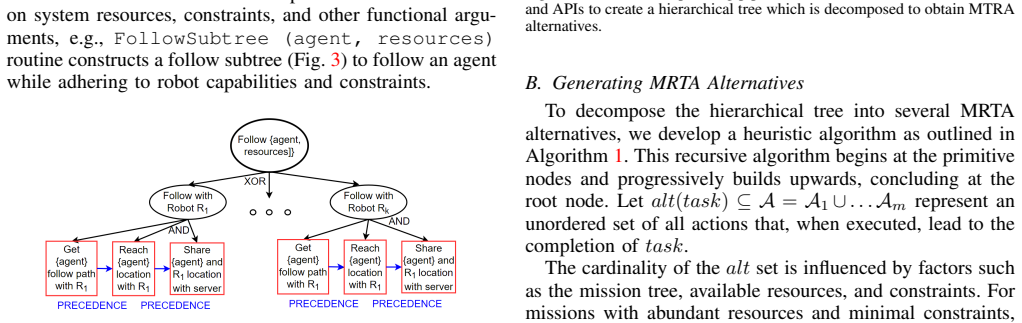
The load-bearing object is the hierarchical tree: round non-primitive nodes and rectangular primitive nodes connected by AND (all children required) or XOR (exactly one child required) logical constraints, with optional precedence edges between tasks. Around it sit the designer-written subtree routines—functions such as Follow(agent, resources) that inject a capability-based subtree including the primitive actions of every suitable robot—and the API set the LLM calls to construct and inspect the tree. The final piece is the recursive MRTA alternative algorithm, which builds action sets from primitive nodes upward, sums utilities over each alternative, checks resource consumption, and prunes to the top $\rho$ alternatives. Together these pieces convert an open-ended natural-language objective into a finite set of executable, resource-feasible per-robot task lists.
What would settle it
Run the pipeline on a mission whose required capability is absent from the subtree library, such as 'Recommend best Italian restaurants in the area,' and observe whether the LLM-built tree terminates: the paper's own Fig. 5e shows it does not, which would falsify the claim that the framework generalizes to any mission expressible with the library. A second check is to execute the cat-rescue alternative A2 and see whether the social robot's primitive 'Display message to cat' actually causes the cat to follow it.
Extended reading notes
Core claim
The central discovery is that LLM function-calling can be constrained well enough to build structured task hierarchies instead of free-form plans. Given a set of robot capabilities, the designer writes a library of subtree routines, such as follow, search, reach, transport, and combinations; each routine attaches a fixed subtree that lists the primitive actions available to every robot with the relevant capability. The LLM calls provided APIs to initialize the tree, add subtasks with AND or XOR logic, and attach subtrees, so every leaf is an executable primitive rather than a hallucinated step. Algorithm 1 then computes multi-robot task allocation alternatives recursively from the leaves upward, summing a per-action utility $u_a(i)=\alpha q_a(i)-\beta d_a(i)-\gamma c_a(i)$, enforcing resource feasibility, pruning to the $\rho$ best alternatives to avoid combinatorial explosion, and topologically sorting each assignment to respect precedence. The authors claim this yields multiple optimized schedules that align each task with the constraints and capabilities of the individual robot, and that the same routines and APIs transfer across missions.
Load-bearing premise
The framework assumes a small, designer-fixed set of subtree routines can express every mission the team will face, and that the language model will only combine them into executable plans; the restaurant example and the infeasible 'display message to cat' primitive show both halves can fail.
Editorial extensions
If this is right
- Mission specification can become a natural-language goal plus a reusable subtree library, removing the need for a human to hand-decompose each new mission into tasks.
- Robot selection and team formation happen inside tree construction, because each subtree includes nodes only for robots with the relevant capability; the same tree therefore encodes who does what.
- Because the algorithm outputs multiple alternatives, a human or higher-level controller can choose among them, avoiding alternatives whose primitive actions are infeasible in the real world.
- The same predefined subtree routines and APIs support different mission domains, so adding a new mission does not require new planning code as long as the needed capability has a subtree.
- Precedence constraints are handled by topological sorting, so schedules emitted by the pipeline are ordered consistently with inter-robot dependencies.
Reading between the lines
- A testable extension is to add an explicit completeness check before execution: verify that every branch of the LLM-built tree terminates in a known subtree and flag missions outside the capability library as infeasible rather than letting the LLM hallucinate.
- The utility-only pruning criterion makes schedule quality depend on the designer-chosen utility weights; measuring plan quality across varied $\alpha,\beta,\gamma$ settings would reveal how much of the result is carried by the tree structure versus the scoring function.
- The admitted infeasible 'Display message to cat' primitive in the cat-rescue alternative suggests that restricting subroutine arguments to object types the robot can actually act on would reduce the number of unusable schedules the pipeline emits.
- Since the paper leaves replanning for mission failures to future work, a natural next step is a closed-loop version where execution failures trigger the LLM to rebuild the affected subtree; this could be tested by injecting task failures into the current pipeline.
Signed reviews
Editorial analysis
A structured set of objections, weighed in public.
Referee Report
Summary. The paper proposes a mission-planning framework for heterogeneous multi-robot teams. It exposes a library of predefined subtree routines and APIs to an LLM, which uses function calling to construct a hierarchical AND/XOR tree whose leaves are robot-executable primitive actions. A heuristic recursive algorithm (Algorithm 1) then enumerates and prunes alternative multi-robot task assignments, followed by topological sorting for precedence constraints. The pipeline is demonstrated on four missions: reuniting a lost child, helping a woman with heavy luggage, saving a city from a monster, and rescuing a cat from a burning building; a fifth mission (recommending Italian restaurants) is shown as an incomplete tree. The paper claims that the framework effectively generates optimized schedules, adheres to robot constraints and capabilities, and is flexible and scalable across a wide range of missions.
Significance. If made to work reliably, the idea of constraining LLM hierarchical planning through capability-grounded subtree routines and API function calling is a useful and timely contribution to high-level mission planning for heterogeneous multi-robot teams, particularly for CD[ST-MR-TA] problems. The paper is clearly written, and the detailed function-call trace for the lost-child example makes the proposed interaction concrete and easy to follow. The paper also deserves credit for explicitly acknowledging several failure modes in Section IV and for being candid about the heuristic nature of the decomposition algorithm. However, the current evidence is far weaker than the claims: the results are four qualitative examples, two of which are admitted failures, with no quantitative metrics, no baselines, no ablations, and no closed-loop execution. In addition, Algorithm 1 has a load-bearing completeness gap that is not captured by the stated limitation of suboptimality. The contribution is therefore a promising prototype rather than an established framework.
major comments (4)
- [Section III-B, Algorithm 1]
- [Section IV]
- [Section IV, Table I]
- [Section III-A and Section V]
minor comments (6)
- [Section IV and Fig. 4]
- [Fig. 1 caption]
- [Algorithm 1]
- [Section II, Eq. (1)]
- [Section IV]
- [Section V]
Circularity Check
No significant circularity: MRTA outputs follow from openly stated inputs (hand-set utilities, predefined subtree routines, LLM-constructed tree), and no claim reduces by construction to a fitted parameter or self-citation.
full rationale
The paper's derivation chain is transparent: the LLM builds a hierarchical tree from designer-provided subtree routines and APIs; Algorithm 1 decomposes that tree using the explicit utility function of Eq. (1) (specialized to u_a(i)=q_a(i) with duration and cost set to zero); and the reported alternatives are direct outputs of that algorithm. The fact that high-utility robots (e.g., the tele-robot's Search utility of 1.0) appear in the preferred assignments is the intended behavior of an optimization procedure, not a circular prediction: the utility values are stated inputs, not parameters fitted to the outputs, and the paper does not claim the examples independently validate those utilities. The self-citations in the reference list are background citations (cooperative systems, trajectory planning, game-theoretic allocation) and are not load-bearing for the central framework. The paper explicitly acknowledges its reliance on the completeness of the designer-provided subtree library, the possibility of LLM hallucination, and the suboptimality of the pruning heuristic; these are honest limitations and correctness risks, not instances of circular reasoning. No equation, theorem, or fitted parameter is shown to be equivalent by construction to the claimed result. The absence of external benchmarks weakens the empirical strength of the demonstration, but that is an evidence-quality concern, not a circularity finding.
Assumptions & free parameters
free parameters (3)
- per-capability primitive utility =
e.g., Search: 1.0 for tele-robot, 0.3 for transportation robot; Follow: 0.5/0.3/0.3; Reach: 1.0/1.0/0.3/0.3; Carry…
- rho (maximum number of alternatives) =
not specified in text
- utility weights alpha, beta, gamma =
alpha=1, beta=0, gamma=0 used for experiments
assumptions (4)
- domain assumption The LLM's function-calling will reliably produce well-formed hierarchical trees when supplied with the designed APIs and subtree routines.
- domain assumption A comprehensive set of subtree routines covering all relevant robot capabilities is sufficient to express any mission the system will encounter.
- domain assumption Scene understanding provides the mission objective and the low-level planner can execute every primitive action.
- standard math TAEMS-style hierarchical task representation and additive utility decomposition are appropriate for mission planning.
Cite this review
Pith. "Pith review of Generalized Mission Planning for Heterogeneous Multi-Robot Teams via LLM-constructed Hierarchical Trees." pith.science (2026). https://pith.science/paper/FSGRQNYV
@misc{pith2026250116539,
  author       = {Pith},
  title        = {Pith review of: Generalized Mission Planning for Heterogeneous Multi-Robot Teams via LLM-constructed Hierarchical Trees},
  year         = {2026},
  howpublished = {\url{https://pith.science/paper/FSGRQNYV}},
  note         = {Machine review of arXiv:2501.16539}
}
read the original abstract
We present a novel mission-planning strategy for heterogeneous multi-robot teams, taking into account the specific constraints and capabilities of each robot. Our approach employs hierarchical trees to systematically break down complex missions into manageable sub-tasks. We develop specialized APIs and tools, which are utilized by Large Language Models (LLMs) to efficiently construct these hierarchical trees. Once the hierarchical tree is generated, it is further decomposed to create optimized schedules for each robot, ensuring adherence to their individual constraints and capabilities. We demonstrate the effectiveness of our framework through detailed examples covering a wide range of missions, showcasing its flexibility and scalability.
Figures


Figures from the paper (2 more)

Forward citations
Cited by 2 Pith papers
-
DEXTER-LLM: Dynamic and Explainable Coordination of Multi-Robot Systems in Unknown Environments via Large Language Models
DEXTER-LLM couples multi-stage LLM-based subtask generation with branch-and-bound search and mixed-integer programming to achieve dynamic, human-verified multi-robot task planning in unknown environments.
-
From Virtual Agents to Robot Teams: A Multi-Robot Framework Evaluation in High-Stakes Healthcare Context
Adding a structured knowledge base raised a simulated CrewAI healthcare robot team's process score from 45.29% to 72.94%, but five failure modes, including false completion and poor recovery, persisted.
Reference graph
Works this paper leans on
-
[1]
Cooperative multi-agent planning: A survey,
A. Torreno, E. Onaindia, A. Komenda, and M. ˇStolba, “Cooperative multi-agent planning: A survey,” ACM Computing Surveys (CSUR) , vol. 50, no. 6, pp. 1–32, 2017
work page 2017
-
[2]
Generalization in Cooperative Multi-Agent Systems
A. Mahajan, M. Samvelyan, T. Gupta, B. Ellis, M. Sun, T. Rockt¨aschel, and S. Whiteson, “Generalization in cooperative multi-agent systems,” arXiv preprint arXiv:2202.00104 , 2022
work page Pith review arXiv 2022
-
[3]
S. ˇSabanovi´c, “Robots in society, society in robots: Mutual shaping of society and technology as a framework for social robot design,” International Journal of Social Robotics , vol. 2, no. 4, pp. 439–450, 2010
work page 2010
-
[4]
Engineering pro-sociality with autonomous agents,
A. Paiva, F. Santos, and F. Santos, “Engineering pro-sociality with autonomous agents,” in Proceedings of the AAAI Conference on Artificial Intelligence, vol. 32, no. 1, 2018
work page 2018
-
[5]
Incentivizing collabora- tion in heterogeneous teams via common-pool resource games,
P. Gupta, S. D. Bopardikar, and V . Srivastava, “Incentivizing collabora- tion in heterogeneous teams via common-pool resource games,” IEEE Transactions on Automatic Control , vol. 68, no. 3, pp. 1902–1909, 2022
work page 1902
-
[6]
P. Gupta, Optimal & Game Theoretic Feedback Design for Efficient Human Performance in Human-Supervised Autonomy. Michigan State University, 2023
work page 2023
-
[7]
Learning of planning models for dexterous manipulation based on human demonstrations,
R. J ¨akel, S. R. Schmidt-Rohr, S. W. R ¨uhl, A. Kasper, Z. Xue, and R. Dillmann, “Learning of planning models for dexterous manipulation based on human demonstrations,” International Journal of Social Robotics, vol. 4, pp. 437–448, 2012
work page 2012
-
[8]
N. Daoud, J.-P. Gazeau, S. Zeghloul, and M. Arsicault, “A real- time strategy for dexterous manipulation: Fingertips motion planning, force sensing and grasp stability,” Robotics and Autonomous Systems , vol. 60, no. 3, pp. 377–386, 2012
work page 2012
Show all 38 references
-
[9]
Interaction-aware trajectory planning for autonomous vehicles with analytic integration of neural networks into model predictive control,
P. Gupta, D. Isele, D. Lee, and S. Bae, “Interaction-aware trajectory planning for autonomous vehicles with analytic integration of neural networks into model predictive control,” in 2023 IEEE International Conference on Robotics and Automation (ICRA) . IEEE, 2023, pp. 7794–7800
2023
-
[10]
Towards Physically Adversar- ial Intelligent Networks (PAINs) for safer self-driving,
P. Gupta, D. Coleman, and J. E. Siegel, “Towards Physically Adversar- ial Intelligent Networks (PAINs) for safer self-driving,” IEEE Control Systems Letters, vol. 7, pp. 1063–1068, 2022
2022
-
[11]
Towards scalable & efficient interaction-aware planning in autonomous vehicles using knowledge distillation,
P. Gupta, D. Isele, and S. Bae, “Towards scalable & efficient interaction-aware planning in autonomous vehicles using knowledge distillation,” in 2024 IEEE Intelligent Vehicles Symposium (IV) , 2024, pp. 2735–2742
2024
-
[12]
Coordinating robot teams for disaster relief,
M. Roberts, T. Apker, B. Johnson, B. Auslander, B. Wellman, and D. W. Aha, “Coordinating robot teams for disaster relief,” in The Twenty-Eighth International Flairs Conference , 2015
2015
-
[13]
GPT-4 technical report,
J. Achiam, S. Adler, S. Agarwal, L. Ahmad, I. Akkaya, F. L. Aleman, D. Almeida, J. Altenschmidt, S. Altman, S. Anadkat et al. , “GPT-4 technical report,” arXiv preprint arXiv:2303.08774 , 2023
2023 arXiv
-
[14]
Gemini: A family of highly capable multimodal models,
G. Team, R. Anil, S. Borgeaud, Y . Wu, J.-B. Alayrac, J. Yu, R. Soricut, J. Schalkwyk, A. M. Dai, A. Hauth et al., “Gemini: A family of highly capable multimodal models,” arXiv preprint arXiv:2312.11805, 2023
2023 arXiv
-
[15]
Llama: Open and efficient foundation language models,
H. Touvron, T. Lavril, G. Izacard, X. Martinet, M.-A. Lachaux, T. Lacroix, B. Rozi`ere, N. Goyal, E. Hambro, F. Azhar et al., “Llama: Open and efficient foundation language models,” arXiv preprint arXiv:2302.13971, 2023
2023 arXiv
-
[16]
A comprehensive taxonomy for multi-robot task allocation,
G. A. Korsah, A. Stentz, and M. B. Dias, “A comprehensive taxonomy for multi-robot task allocation,” The International Journal of Robotics Research, vol. 32, no. 12, pp. 1495–1512, 2013
2013
-
[17]
Multi-robot task allocation: A review of the state-of-the-art,
A. Khamis, A. Hussein, and A. Elmogy, “Multi-robot task allocation: A review of the state-of-the-art,” Cooperative Robots and Sensor Networks, pp. 31–51, 2015
2015
-
[18]
Sequential bayesian opti- mization as a pomdp for environment monitoring with uavs,
P. Morere, R. Marchant, and F. Ramos, “Sequential bayesian opti- mization as a pomdp for environment monitoring with uavs,” in 2017 IEEE International Conference on Robotics and Automation (ICRA) . IEEE, 2017, pp. 6381–6388
2017
-
[19]
Optimal fidelity selection for improved performance in human-in-the-loop queues for underwater search,
P. Gupta and V . Srivastava, “Optimal fidelity selection for improved performance in human-in-the-loop queues for underwater search,” arXiv preprint arXiv:2311.06381 , 2023
2023 arXiv
-
[20]
Planning for decentralized formation flight of uav fleets in uncertain environments with dec- pomdp,
B. Floriano, G. A. Borges, and H. Ferreira, “Planning for decentralized formation flight of uav fleets in uncertain environments with dec- pomdp,” in 2019 International Conference on Unmanned Aircraft Systems (ICUAS). IEEE, 2019, pp. 563–568
2019
-
[21]
A game-theoretic formulation of multi-agent resource allocation,
J. Bredin, R. T. Maheswaran, C. Imer, T. Bas ¸ar, D. Kotz, and D. Rus, “A game-theoretic formulation of multi-agent resource allocation,” in Proceedings of the fourth international conference on autonomous agents, 2000, pp. 349–356
2000
-
[22]
Achieving efficient collaboration in decentralized heterogeneous teams using common- pool resource games,
P. Gupta, S. D. Bopardikar, and V . Srivastava, “Achieving efficient collaboration in decentralized heterogeneous teams using common- pool resource games,” in 2019 IEEE 58th Conference on Decision and Control (CDC) . IEEE, 2019, pp. 6924–6929
2019
-
[23]
Multi-robot task allocation with auctions in harsh communication environments,
M. Otte, M. Kuhlman, and D. Sofge, “Multi-robot task allocation with auctions in harsh communication environments,” in 2017 international symposium on multi-robot and multi-agent systems (MRS) . IEEE, 2017, pp. 32–39
2017
-
[24]
Decentralized multi-robot allo- cation of tasks with temporal and precedence constraints,
E. Nunes, M. McIntire, and M. Gini, “Decentralized multi-robot allo- cation of tasks with temporal and precedence constraints,” Advanced Robotics, vol. 31, no. 22, pp. 1193–1207, 2017
2017
-
[25]
Distributed algorithms for multirobot task assignment with task deadline constraints,
L. Luo, N. Chakraborty, and K. Sycara, “Distributed algorithms for multirobot task assignment with task deadline constraints,” IEEE Transactions on Automation Science and Engineering , vol. 12, no. 3, pp. 876–888, 2015
2015
-
[26]
A multi-agent based optimiza- tion method for combinatorial optimization problems,
I. Sghir, I. B. Jaafar, and K. Gh ´edira, “A multi-agent based optimiza- tion method for combinatorial optimization problems,” International Journal on Artificial Intelligence Tools , vol. 27, no. 05, p. 1850021, 2018
2018
-
[27]
Multi- robot task and motion planning with subtask dependencies,
J. Motes, R. Sandstr ¨om, H. Lee, S. Thomas, and N. M. Amato, “Multi- robot task and motion planning with subtask dependencies,” IEEE Robotics and Automation Letters , vol. 5, no. 2, pp. 3338–3345, 2020
2020
-
[28]
Distributed mission planning of complex tasks for heterogeneous multi-robot systems,
B. A. Ferreira, T. Petrovi ´c, and S. Bogdan, “Distributed mission planning of complex tasks for heterogeneous multi-robot systems,” in 2022 IEEE 18th International Conference on Automation Science and Engineering (CASE) , 2022, pp. 1224–1231
2022
-
[29]
TAEMS: A framework for environment centered analysis & design of coordination mechanisms,
K. Decker, “TAEMS: A framework for environment centered analysis & design of coordination mechanisms,” Foundations of Distributed Artificial Intelligence, pp. 429–448, 1996
1996
-
[30]
The TAEMS white paper,
B. Horling, V . Lesser, R. Vincent, T. Wagner, A. Raja, S. Zhang, K. Decker, and A. Garvey, “The TAEMS white paper,” 1999
1999
-
[31]
Coordinators: TAEMS modeling and inter- facing for first response
J. Phelps and V . Guralnik, “Coordinators: TAEMS modeling and inter- facing for first response.” in AAAI Spring Symposium: AI Technologies for Homeland Security , 2005, pp. 1–8
2005
-
[32]
Scene understanding: perception, multi-sensor fusion, spatio-temporal reasoning and activity recognition,
F. Bremond, “Scene understanding: perception, multi-sensor fusion, spatio-temporal reasoning and activity recognition,” Ph.D. dissertation, Universit´e Nice Sophia Antipolis, 2007
2007
-
[33]
Social navigation in crowded environments with model predictive control and deep learning-based human trajectory prediction,
V .-A. Le, B. Chalaki, V . Tadiparthi, H. N. Mahjoub, J. D’sa, and E. Moradi-Pari, “Social navigation in crowded environments with model predictive control and deep learning-based human trajectory prediction,” arXiv preprint arXiv:2309.16838 , 2023
2023 arXiv
-
[34]
Multi-robot cooperative navigation in crowds: A game-theoretic learning-based model predictive control approach,
V .-A. Le, V . Tadiparthi, B. Chalaki, H. N. Mahjoub, J. D’sa, E. Moradi- Pari, and A. A. Malikopoulos, “Multi-robot cooperative navigation in crowds: A game-theoretic learning-based model predictive control approach,” in 2024 IEEE International Conference on Robotics and Auto...
2024
-
[35]
T. H. Cormen, C. E. Leiserson, R. L. Rivest, and C. Stein, Introduction to algorithms. MIT press, 2022
2022
-
[36]
Chain-of-thought prompting elicits reasoning in large language models,
J. Wei, X. Wang, D. Schuurmans, M. Bosma, F. Xia, E. Chi, Q. V . Le, D. Zhou et al. , “Chain-of-thought prompting elicits reasoning in large language models,” Advances in neural information processing systems, vol. 35, pp. 24 824–24 837, 2022
2022
-
[37]
Self-consistency improves chain of thought reasoning in language models,
X. Wang, J. Wei, D. Schuurmans, Q. Le, E. Chi, S. Narang, A. Chowd- hery, and D. Zhou, “Self-consistency improves chain of thought reasoning in language models,” arXiv preprint arXiv:2203.11171 , 2022
2022 arXiv
-
[38]
Fine-tuning pretrained language models: Weight initializations, data orders, and early stopping,
J. Dodge, G. Ilharco, R. Schwartz, A. Farhadi, H. Hajishirzi, and N. Smith, “Fine-tuning pretrained language models: Weight initializations, data orders, and early stopping,” arXiv preprint arXiv:2002.06305, 2020
2002 arXiv
Reviewed August 10, 2026 · model on record in the stance chip above.
Discussion (0). Continue with ORCID to comment.