REVIEW 2 major objections 1 minor 1 cited by
Towards Continuous-time Causal Foundation Models
T0 review · 2 major / 1 minor · reviewed 2026-06-29 · grok-4.3
Pith's one-line read Fine-grid integration with decoupled observation makes continuous-time causal models invariant to the observation schedule.
desk verdict The paper introduces a trajectory-law invariance criterion for continuous-time causal PFNs and shows empirical gains from fine-grid decoupled integration over naive methods, but the ablation demonstrates performance improvements rather than exact schedule independence. read the letter →
The pith
A machine-rendered reading of the paper's core claim, the machinery that carries it, and where it could break.
The reading
What carries the argument
Fine-grid integration with decoupled observation: the SDE is integrated on a fine auxiliary grid independent of the observation times, after which states are read out only at the actual observation instants.
What would settle it
Generate trajectories from the same underlying random-DAG process under two different irregular observation schedules versus a uniform fine grid and test whether the empirical distribution of the observed paths remains statistically indistinguishable only for the fine-grid decoupled construction.
Extended reading notes
Core claim
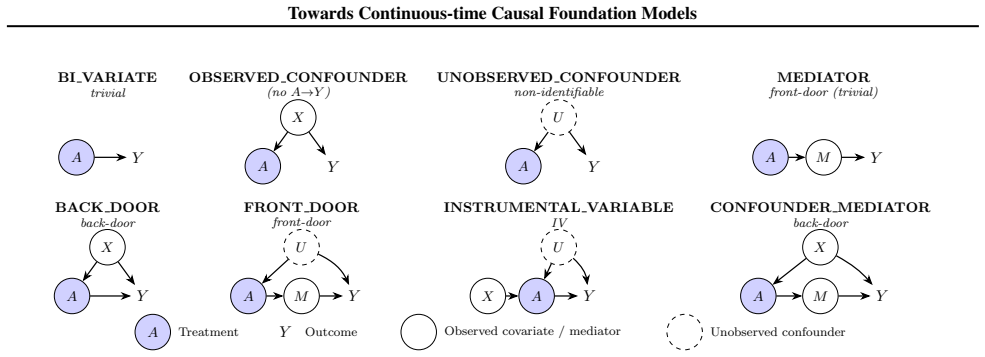
The central claim is that a random-DAG construction using OU or small-MLP nonlinear drifts, combined with fine-grid SDE integration and observation decoupled from the integration grid, realizes trajectory-law invariance to the observation schedule for irregular sampling and multiple intervention types.
Load-bearing premise
That fine-grid integration with decoupled observation truly renders the trajectory law independent of the observation schedule for the chosen random-DAG priors, rather than merely improving performance on the tested grids.
Editorial extensions
If this is right
- Models built this way produce consistent trajectory distributions across arbitrary irregular sampling patterns.
- The encoder component becomes non-critical once fine integration is used, whereas it matters under naive integration.
- The released prior supports preliminary zero-shot evaluation on pharmacokinetic and physical-system data.
- The performance advantage of fine integration grows as the test grid is refined.
Reading between the lines
- The same invariance property could allow a single model to be trained on mixed-frequency data without retraining for each new sampling regime.
- If the fine-grid criterion holds beyond the tested OU and small-MLP drifts, larger nonlinear mechanisms might inherit the same schedule independence.
- Causal discovery procedures that rely on these models would inherit robustness to changes in measurement frequency.
Editorial analysis
A structured set of objections, weighed in public.
Referee Report
Summary. The paper extends discrete-time causal Prior-data Fitted Networks to continuous time by representing mechanisms as SDEs. It introduces the criterion of trajectory-law invariance to the observation schedule, a three-tier taxonomy (discrete; naive observation-grid integration; fine-grid integration with decoupled observation), and a construction claimed to realize the top tier on random-DAG priors with OU or small-MLP nonlinear drifts, irregular sampling, and hard/soft/time-varying interventions. A 2x2 encoder x integrator ablation on linear and nonlinear priors reports that fine-grid integration outperforms naive integration on all 8 cells (sign-consistency p < 1/256), with the gap increasing on refined evaluation grids; the encoder axis is null under fine integration. The prior and a preliminary zero-shot protocol on pharmacokinetic and physical-system data are released.
Significance. If the construction achieves exact trajectory-law invariance rather than merely improved empirical performance, the work would supply a principled route to continuous-time causal foundation models that remain consistent under arbitrary observation schedules. The release of the prior and zero-shot protocol is a concrete strength that supports reproducibility and downstream testing.
major comments (2)
- [Abstract] Abstract: the claim that the construction 'realises the top tier' (exact trajectory-law invariance) is load-bearing for the central contribution, yet the only supporting evidence is the reported 2x2 ablation showing performance gains; no closed-form verification, exact distribution-matching argument, or proof that the generated measure is identical across schedules is supplied, even for the linear OU case.
- [Abstract] Abstract (ablation description): the sign-consistency result (p < 1/256 across 8/8 cells) is presented without implementation details, data-generation code, or explicit checks that the fine-grid choice was not post-hoc tuned to the evaluation grids, leaving open the possibility that the observed superiority reflects reduced but nonzero schedule dependence rather than invariance.
minor comments (1)
- [Abstract] Abstract: the three-tier taxonomy is named but the precise mathematical distinctions between 'naive observation-grid integration' and 'fine-grid integration with decoupled observation' are not stated; adding the governing equations or pseudocode would improve clarity.
Simulated Author's Rebuttal
Thank you for the constructive review and for highlighting the importance of trajectory-law invariance. We address the two major comments below. We agree that the abstract's claim of exact realisation of the top tier overstates the evidence, which is empirical rather than formal, and will revise accordingly. We will also expand the experimental details as requested.
read point-by-point responses
-
Referee: [Abstract] Abstract: the claim that the construction 'realises the top tier' (exact trajectory-law invariance) is load-bearing for the central contribution, yet the only supporting evidence is the reported 2x2 ablation showing performance gains; no closed-form verification, exact distribution-matching argument, or proof that the generated measure is identical across schedules is supplied, even for the linear OU case.
Authors: We acknowledge that the manuscript asserts the construction realises the top tier while supplying only the 2x2 ablation as supporting evidence, without a closed-form proof or distribution-matching argument (including for the linear OU case). The fine-grid integration with decoupled observation is designed to drive the generated trajectories toward schedule invariance by refining the numerical integration independently of observation times; the ablation demonstrates that this yields statistically consistent performance across schedules where naive integration does not. We will revise the abstract to state that the construction is proposed to realise the top tier and is supported by strong empirical evidence from the ablation, rather than claiming exact invariance without qualification. revision: yes
-
Referee: [Abstract] Abstract (ablation description): the sign-consistency result (p < 1/256 across 8/8 cells) is presented without implementation details, data-generation code, or explicit checks that the fine-grid choice was not post-hoc tuned to the evaluation grids, leaving open the possibility that the observed superiority reflects reduced but nonzero schedule dependence rather than invariance.
Authors: We agree that the current description lacks sufficient implementation details. In the revision we will add the precise data-generation procedure (including random-DAG sampling, OU/MLP drift parameters, and irregular schedule generation), the exact fine-grid step count per observation interval, the repository link containing the full code, and an additional ablation confirming that the performance gap persists across a range of fine-grid resolutions chosen independently of the final evaluation grids. The sign-consistency test was obtained by executing the full 2x2 ablation eight times with distinct random seeds; we will report the per-cell outcomes and the binomial test details explicitly. revision: yes
Circularity Check
No significant circularity detected
full rationale
The paper defines a new continuity criterion (trajectory-law invariance) and a three-tier taxonomy, then presents an explicit construction (fine-grid integration with decoupled observation on random-DAG priors with OU/MLP drifts) that is claimed to realize the top tier. The 2x2 ablation reports empirical performance differences but does not treat any fitted parameter as a prediction or rely on self-citation for the load-bearing step. The derivation chain remains self-contained: the invariance property is asserted by the integration scheme itself rather than by redefinition, renaming, or reduction to prior author work.
Assumptions & free parameters
Cite this review
Pith. "Pith review of Towards Continuous-time Causal Foundation Models." pith.science (2026). https://pith.science/paper/FSXU7UAZ
@misc{pith2026260528880,
  author       = {Pith},
  title        = {Pith review of: Towards Continuous-time Causal Foundation Models},
  year         = {2026},
  howpublished = {\url{https://pith.science/paper/FSXU7UAZ}},
  note         = {Machine review of arXiv:2605.28880}
}
abstract
Extending discrete-time causal Prior-data Fitted Networks for time series to continuous time invites writing the mechanism as a stochastic differential equation (SDE) -- but if the SDE is integrated \emph{once per observation gap}, the trajectory law depends on when it is observed, and the prior remains a discrete-time Markov model in SDE clothing. We propose a precise continuity criterion -- trajectory-law invariance to the observation schedule -- together with a three-tier taxonomy (discrete; naive observation-grid integration; fine-grid integration with decoupled observation) and a construction realising the top tier on a random DAG with OU or small-MLP nonlinear drifts, irregular observation schedules, and hard / soft / time-varying interventions. A $2 \times 2$ encoder $\times$ integrator ablation, run independently on a linear and a nonlinear prior, finds fine-grid integration beats naive on 8/8 cells (sign-consistency $p < 1/256$) with the gap growing as the eval grid refines; the encoder axis is null with fine integration but time-aware-leading with naive. We release the prior and a preliminary zero-shot protocol on pharmacokinetic and physical-system data.
Figures
Forward citations
Cited by 1 Pith paper
-
Temporal Causal Prior-Data Fitted Networks for Panel Data with Learned Reliability Signals
TCPFN is a zero-shot foundation model for temporal causal discovery on panel data that jointly predicts multiple causal aspects and reliability signals, with reported high AUROC on benchmarks and better scaling than P...
Reference graph
Works this paper leans on
-
[1]
Rubanova, Y ., Chen, R
URL https://openreview.net/forum? id=OaNbl9b56B. Rubanova, Y ., Chen, R. T. Q., and Duvenaud, D. Latent or- dinary differential equations for irregularly-sampled time series. InAdvances in Neural Information Processing Systems, volume 32, 2019. Shukla, S. N. and Marlin, B. M. Multi-time attention net- works for irregularly sampled time series. InInternati...
2019
-
[2]
URL https://openreview.net/forum? id=JbTgx2L9Z2. Tzen, B. and Raginsky, M. Neural stochastic differen- tial equations: Deep latent gaussian models in the diffu- sion limit, 2019. URL https://arxiv.org/abs/ 1905.09883. Xia, S. et al. Causal time series generation via diffusion models.arXiv preprint arXiv:2509.20846, 2025. Xie, S., Feofanov, V ., Alonso, M....
Reviewed June 29, 2026 · model on record in the stance chip above.
Discussion (0). Continue with ORCID to comment.