REVIEW 4 major objections 4 minor 38 references
FTNILO: Explicit Multivariate Function Inversion, Optimization and Counting, Cryptography Weakness and Riemann Hypothesis Solution Equation with Tensor Networks
T0 review · 4 major / 4 minor · reviewed 2026-08-16 · deepseek-v4-flash
Pith's one-line read The paper claims an explicit tensor-network integral formalism, FTNILO, that yields exact solution equations for multivariate inversion and optimization, an integral equation that decides the Riemann hypothesis, and a corollary that every…
desk verdict The paper's central delta identity is false—it drops the Jacobian—so its inversion, counting, crypto, and Riemann claims collapse; what remains correct is the standard Laplace/delta-framework formalism. read the letter →
The pith
A machine-rendered reading of the paper's core claim, the machinery that carries it, and where it could break.
The reading
What carries the argument
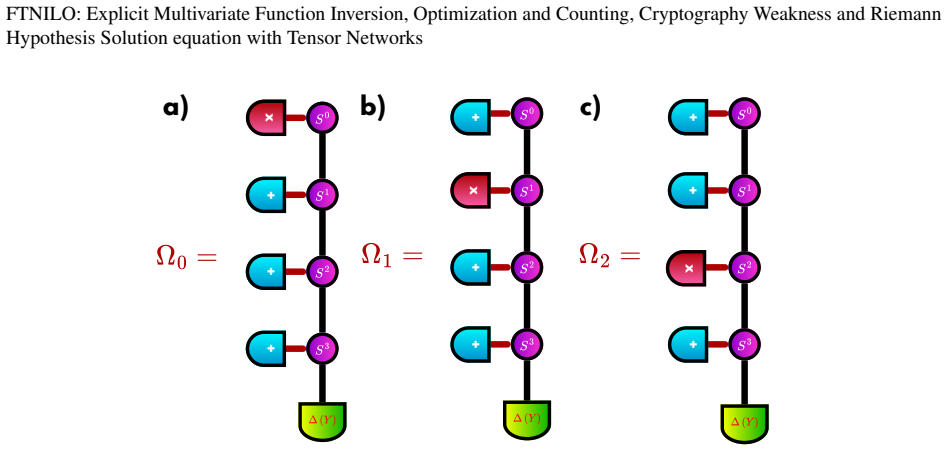
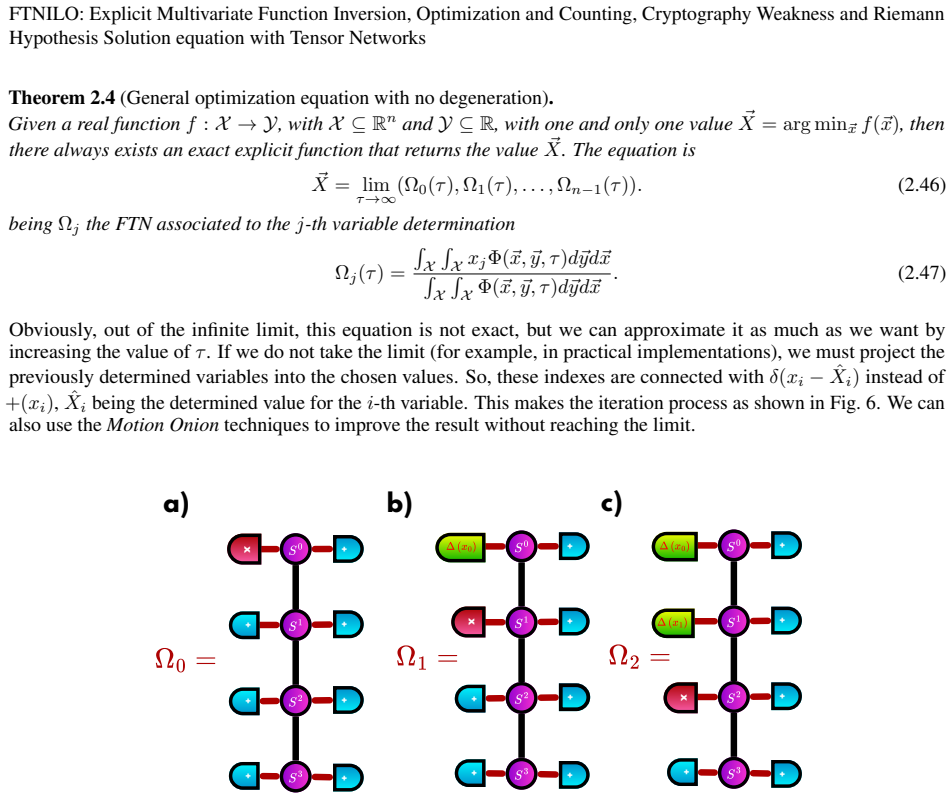
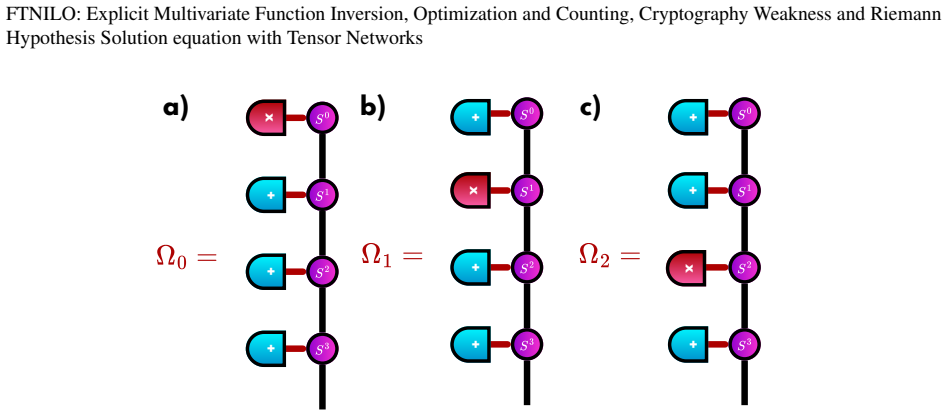
The central object is the Field Tensor Network Integral Logical Operator (FTNILO): a tensor network whose nodes are functions rather than arrays, with sums over discrete indices replaced by integrals over continuous variables. Each logical operator that receives $\vec{x}$ and outputs $\vec{y}=g(\vec{x})$ while multiplying the amplitude by $h(\vec{x})$ is tensorized as $h(\vec{x})\delta(\vec{y}-g(\vec{x}))$; chaining these operators and integrating over internal bond variables enforces the circuit's logic globally. Two extraction devices do the work of turning this network into solution coordinates: connecting One Constant functions to all free indices except the target coordinate, and the imaginary-time weight $e^{-\tau f}$ with the limit $\tau\to\infty$ concentrating the density at the global optimum. For zero counting, the same integrated network is interpreted as the FTNILO number, the number of points satisfying the imposed condition. The Riemann application rests on a circuit for a convergent series representation of $\zeta(s)$ valid in $\mathrm{Re}(s)>0$, with the critical line excluded by a factor $1-\chi_{1/2}(x_n)$; the paper's delta-consistency criterion reduces the Riemann hypothesis to checking whether the product of deltas in this network is consistently nonzero everywhere in the strip.
What would settle it
Evaluate equation (5.13) on a finite truncation of the zeta series over a bounded rectangle inside the critical strip and compare the result with a direct numerical count of the zeros of $\zeta(s)$ in that rectangle; a nonzero value where direct counting gives zero, or a zero where direct counting finds a non-trivial zero off the line, would refute the claimed zero-counting equation. For the inversion claim, apply the FTNILO formula to $f(x)=x^3$ on $\mathbb{R}$ and check whether the integral expression returns the actual root $X=Y^{1/3}$ as a well-defined delta integral.
Extended reading notes
Core claim
On its own terms, the paper's discovery is that a logical circuit for a function $f$ can be tensorized into a field tensor network whose nodes encode the circuit's operations as Dirac deltas, so that integrating out all but one coordinate produces the exact solution coordinate. For inversion of an injective $f:\mathbb{R}^n\to\mathbb{R}^m$, the $j$-th component of the solution is $\Omega_j = \int x_j\,\Phi(\vec{x},\vec{y})\,\delta(\vec{y}-\vec{Y})\,d\vec{y}\,d\vec{x}$, where $\Phi$ is the tensorized circuit; the paper calls this the restricted FTNILO inversion function. For optimization, the same construction is applied to $e^{-\tau f(\vec{x})}$, and the normalized density is taken to converge to a Dirac delta at the minimizer as $\tau\to\infty$, yielding the exact optimum as a limit of expectation values. Counting versions give the number of solutions $N=\int \Phi(\vec{x},\vec{y})\delta(\vec{y}-\vec{Y})\,d\vec{y}\,d\vec{x}$. On this basis the paper asserts that every injective function has an explicit inverse, that non-injective functions can be handled by a region-sampling protocol, that all function-based cryptographic schemes can be broken, and that the Riemann hypothesis is decided by evaluating the corresponding FTNILO zero-counting equation in the strip $0<\mathrm{Re}(s)<1$; the hypothesis is true exactly when that equation returns zero.
Load-bearing premise
The load-bearing assumption is that the delta-consistency test for the Riemann FTNILO equation can actually be carried out, since the paper states that this search is outside its scope and supplies no method, complexity bound, or numerical evidence, and more generally that the integral expressions written with Dirac deltas can be evaluated as explicit equations rather than merely re-encoding the original search problem.
Editorial extensions
If this is right
- Function inversion would no longer require search: every injective function with a known logical circuit would have its inverse given by a sequence of definite integrals, one per coordinate.
- Global optimization would reduce to evaluating the limiting expectation values of the imaginary-time density $e^{-\tau f}$, with the minimizer recovered exactly as $\tau\to\infty$ and approximated to arbitrary accuracy for finite $\tau$.
- Counting versions of inverse problems, such as how many inputs $x$ satisfy $f(x)=Y$, become a single integral, with a sampling protocol for isolating individual solutions in degenerate cases.
- The Riemann hypothesis would be decidable by evaluating one FTNILO integral, equivalently by checking delta consistency once, since the integral counts zeros in $0<\mathrm{Re}(s)<1$ off the critical line.
- Every cryptographic protocol whose encryption function can be represented as a circuit would have an exact secret-recovery equation, stated in the paper as Corollary 4.7.1.
Reading between the lines
- The explicit equations are formal integrals of products of Dirac deltas; whether they can be evaluated in a way that beats brute force is not addressed, so the practical reading of explicit remains open.
- The Riemann delta-consistency criterion appears to restate the problem: proving that no consistent assignment of deltas exists across the infinite limit is equivalent to proving an absence of zeros, and the paper's Section 5.3 places that search out of scope.
- If the formalism succeeds, analogous zero-counting equations could be written for other Dirichlet series or L-functions whose terms admit circuits, potentially connecting the framework to questions beyond the Riemann zeta function.
- The cryptographic corollary should be read as an existence-of-formula statement; for real encryption functions the corresponding integral may be computationally intractable, so the corollary does not by itself imply practical attacks.
Signed reviews
Editorial analysis
A structured set of objections, weighed in public.
Referee Report
Summary. The paper introduces FTNILO, a continuous 'field tensor network' formalism in which inverse problems, optimization problems, zero-counting problems, and the Riemann hypothesis are encoded as integrals over products of Dirac delta functions. The central claims are: Theorem 2.1 gives an explicit equation for the unique solution of f(X)=Y; Theorem 2.2 gives a counting/checker equation; Theorems 2.8–2.10 extend this to multiple solutions; Section 4 concludes that every function-based cryptographic protocol can be broken; and Section 5 derives 'Riemann FTNILO equations' and claims, via a 'delta consistency' criterion, to decide the Riemann hypothesis. The paper also claims to recover the discrete MeLoCoToN tensor-network formalism as a limiting case.
Significance. If the central inversion identity were correct, the framework would provide a uniform representation of inversion, optimization, and counting problems and would constitute a notable contribution. The paper correctly recognizes that δ(y−f(x)) is the natural free inversion density in Eq. (2.19), and the discrete limit in Section 3 is a plausible formal parallel to MeLoCoToN. However, the paper provides no reproducible algorithm, no numerical demonstration, and no rigorous distribution-theoretic development. More importantly, the central step Eq. (2.24) is false for non-unit Jacobians, so the claimed theorems do not follow. Consequently, despite the breadth of claimed implications, the significance of the formal contribution in its current form is low; the mathematical content beyond textbook delta calculus is not established.
major comments (4)
- [§2.3.1, Eq. (2.24)] The identity δ(Y−f(x)) = δ(x−X) for a unique solution X with Y=f(X) is false in general. In one dimension, the composition rule for the Dirac delta gives δ(Y−f(x)) = Σ_i δ(x−x_i)/|f'(x_i)|, and in several variables a Jacobian determinant appears. For the paper's own one-variable setting, f(x)=2x, X=1, Y=2 satisfies Y=f(X), but Eq. (2.32) yields Ω = ∫ x δ(2−2x) dx = 1/2, not 1. This is not a harmless normalization: the missing factor is precisely the quantity that converts a delta integral into a count. Because Eq. (2.24) is used to identify F(x) with δ(x−X) throughout, Theorems 2.1, 2.8, and 2.10, Lemma 4.1, Lemmas 4.6–4.7, and the Riemann counting equations in Section 5 all inherit the error. A repair would require inserting Jacobian factors into every delta composition, which is not done anywhere in the paper.
- [§2.4.1 and Theorem 2.2] Theorem 2.2 claims N=∫F(x)dx is positive exactly when a solution exists and zero otherwise. For continuous solution sets this is false as stated. The paper's own ReLU example (Eqs. (2.62)–(2.63)) gives N=δ(0)V(X′), which is not a finite number and is infinite or undefined in the usual sense. The 'renormalized search' in Eqs. (2.64)–(2.67) divides by δ(0) and compares volumes, but no rigorous definition of the quotient of two generalized-function values is supplied. Thus the counting theorem is not established for the degenerate cases that Protocol 2.7 is supposed to handle, and the caveat 'main limitation' in the text does not rescue the universal theorem statements.
- [§5.3, Theorem 5.1] The proof of the Riemann delta-consistency theorem is not a proof. Definition 5.1 of delta consistency is not a well-posed property: the product of distributions δ(f_i(x)) is not a pointwise function, and the condition '≠0 for all ρ(x)' is not defined as a rigorous distributional statement. The inference that a consistent product of deltas must have integral at least one is unsupported; standard delta calculus gives no such general implication. Moreover, since Eqs. (5.13) and (5.15) are built on the incorrect identity in Eq. (2.24), they do not count zeros of ζ(s) off the critical line; at best they represent weighted sums with reciprocal Jacobian factors, and they are undefined at multiple zeros where ζ′(s)=0. Therefore the abstract's claim of an explicit equation that 'gives the solution of the Riemann hypothesis' is not supported.
- [§2.3.1, Eq. (2.40) and text after Eq. (2.33)] The claimed 'explicitness' of the inversion equation is misleading. Eq. (2.40), after performing the y-integration, reduces to Ω_j = ∫ x_j δ(Y−f(x)) dx, whose evaluation is exactly the enumeration of solutions of f(x)=Y; the solution X does not appear in the integrand only because the delta already encodes the equation to be solved. This is a definitional restatement of the inverse problem rather than a new explicit representation that bypasses the need to solve it. The same observation applies to the optimization extraction in Eq. (2.47), where the τ→∞ limit of the normalized Gibbs expectation is the argmin by definition of the Laplace principle.
minor comments (4)
- [§5.1, Eq. (5.7)] The cyclic 'donut' construction with δ(x_{n%N}−x_{n−1}) is not obviously equivalent to the original linear circuit; the text does not justify that identifying the last output with the first input is legitimate for a function whose domain is not periodic.
- [§5.2, Eqs. (5.13) and (5.15)] The expressions use R^{2N+1}, R^{2(N+1)}, R^{2N}, and R_+^{2N} inconsistently, and the delta chains impose x_n=x_{n−1} while the integration limits are not written coherently; this makes the equations difficult to parse.
- [§2.4.1, Eq. (2.56)] The Heaviside function is defined with H(0)=1, but the treatment of half-open intervals in the partial moment formulas is not explained; the paper should specify the measure-zero conventions used.
- [§5.3 and Abstract] The paper states that the consistency search is 'outside the scope of this work' and offers no method, complexity bound, or numerical evidence, yet the abstract claims an 'explicit integral equation that gives the solution of the Riemann hypothesis'; this overstates what is actually shown.
Circularity Check
The FTNILO solution equations read off an X that is inserted by hand into the Dirac delta, and the Riemann 'resolution' restates the hypothesis as a zero-search that the paper leaves undone.
-
self definitional
[Section 2.2.1, Eq. (2.24); Section 2.3.1, Eqs. (2.31)-(2.32); Theorem 2.1, Eq. (2.40)]
"If ⃗Y = f(⃗X), the FTN represents the function F(⃗ x) = (1 if ⃗ x=⃗X, 0 if ⃗ x≠⃗X) ... or with the deltas F(⃗ x)=δ(⃗ x−⃗X). ... Ωj = ∫ Xj xjFj(xj)dxj = ∫ Xj xjδ(xj−Xj)dxj = Xj."
The solution X is introduced as the center of the Dirac delta in Eq. (2.24) by the assertion 'if Y=f(X)' rather than being derived from the field tensor network. The later 'extraction' equations (2.31)-(2.32) then recover X by the sifting property of the delta, so the output is exactly the X that was placed into the delta by hand. Theorem 2.1's formula X=(Ω0,...,Ωn−1) with Ωj=∫∫ xjΦ(x,y)δ(y−Y)dydx is therefore a definitional tautology: it returns the unknown solution because that unknown solution was already assumed as the center of δ(x−X). No independent computation from f is performed.
-
self definitional
[Section 2.3.2, Eqs. (2.42)-(2.47); Theorem 2.4]
"lim_{τ→∞} F(x,τ)/∫X F(x,τ)dx = lim_{τ→∞} e^{-τf(x)}χ_R(x)/∫X e^{-τf(x)}χ_R(x)dx = δ(x−X) ... Ωj(τ)=∫X∫X xjΦ(x,y,τ)dydx / ∫X∫X Φ(x,y,τ)dydx."
Eq. (2.42) states that the normalized Gibbs density concentrates on the argmin X, which is the standard Laplace principle. Eq. (2.47) then defines each variable as the τ→∞ expectation of x under that same density. The 'general optimization equation' X = limτ→∞(Ω0(τ),...) thus presupposes X as the concentration point of the limit distribution; it is the definition of the argmin rewritten as a weighted average, not an independent construction of the minimizer. The result is built into the exponential weight e^{-τf}, so the equation cannot fail to return the argmin in the limit, but it also cannot be said to derive it.
1 more flagged steps
-
renaming known result
[Section 5.3, Definition 5.1 and Theorem 5.1]
"The Riemann hypothesis is false if and only if all its deltas in the Riemann FTNILO equation are consistent. This means that if some subset of the deltas is not consistent, the Riemann hypothesis is true. ... This search is outside the scope of this work, but we can give some possible approaches."
Definition 5.1 declares deltas consistent when their product is nonzero for some assignment of the non-shared variables, which is exactly the existence of a simultaneous solution of the encoded equations. For the Riemann FTNILO equation, that existence is precisely the existence of a zero of the zeta function outside the critical line. Theorem 5.1 therefore renames the Riemann hypothesis as a 'delta consistency' statement: the equation is nonzero exactly when such a zero exists, and zero exactly when none exists. The abstract's promised 'explicit equation that gives the solution of the Riemann hypothesis' is just an indicator of whether the original zero-search succeeds, and the paper concedes that the search itself is outside the scope of the work.
full rationale
The derivation chain is circular in its central extraction step. Eq. (2.22) correctly obtains F(x)=δ(Y−f(x)), but Eq. (2.24) then replaces this with δ(x−X) by asserting the existence of a unique solution X with Y=f(X). That replacement inserts the unknown solution into the definition of the object that is supposed to find it; the subsequent integrals (2.31)-(2.32) and Theorem 2.1 merely use the sifting property of the delta to output the same X. The optimization version is no different: Eq. (2.42) states the normalized Gibbs density concentrates on the argmin X, and Eq. (2.47) computes the τ→∞ expectation, so the formula is the standard Laplace representation of the argmin with X presupposed as the concentration point. For the Riemann claims, Theorem 5.1 defines 'delta consistency' as nonvanishing of the product of deltas, which is equivalent to existence of a solution of the encoded equations, i.e., existence of a zero outside the critical line. Thus the abstract's 'explicit integral equation that gives the solution of the Riemann hypothesis' reduces to a delta-integral that is zero iff no such zero exists, and the consistency search is admitted to be outside the scope of the work. Separately, Eq. (2.24) omits the Jacobian factors required by the identity δ(f(x)−Y)=Σδ(x−x_i)/|det J|, so the counting equations (2.34), (2.68), (5.13), and (5.15) do not even compute the stated counts; that is a mathematical correctness failure independent of, and in addition to, the circularity. Self-citations to MeLoCoToN [30] are not load-bearing for the circularity finding; the circularity is internal to the delta construction and to the Riemann consistency restatement.
Assumptions & free parameters
free parameters (1)
- tau (inverse temperature) =
Infinity (limit)
assumptions (5)
- domain assumption Every target function f can be represented by a logical circuit and tensorized into a field tensor network of Dirac deltas.
- domain assumption The normalized Boltzmann weight e^{-τ f} χ_R / ∫ e^{-τ f} χ_R converges to a Dirac delta at the unique minimizer as τ → ∞.
- domain assumption The zero-counting integrals over products of Dirac deltas are well-defined and finite for isolated solutions.
- standard math The series representation ζ(s) = (1/(s-1)) Σ_n [n/(n+1)^s - n^{-s}/n^s] is valid for 0 < Re(s) < 1 and the factor 1/(s-1) can be neglected for zero counting.
- ad hoc to paper The delta consistency property of a product of deltas is a meaningful and checkable criterion for the Riemann hypothesis.
invented entities (1)
-
Delta consistency (Riemann criterion)
Cite this review
Pith. "Pith review of FTNILO: Explicit Multivariate Function Inversion, Optimization and Counting, Cryptography Weakness and Riemann Hypothesis Solution Equation with Tensor Networks." pith.science (2026). https://pith.science/paper/FT2DRWFG
@misc{pith2026250505493,
  author       = {Pith},
  title        = {Pith review of: FTNILO: Explicit Multivariate Function Inversion, Optimization and Counting, Cryptography Weakness and Riemann Hypothesis Solution Equation with Tensor Networks},
  year         = {2026},
  howpublished = {\url{https://pith.science/paper/FT2DRWFG}},
  note         = {Machine review of arXiv:2505.05493}
}
abstract
In this paper, we present a new formalism, the Field Tensor Network Integral Logical Operator (FTNILO), to obtain the explicit equation that returns the minimum, maximum, and zeros of a multivariable injective function, and an algorithm for non-injective ones. This method extends the MeLoCoToN algorithm for inversion and optimization problems with continuous variables, by using Field Tensor Networks. The fundamentals of the method are the conversion of the problem of minimization of $N$ continuous variables into a problem of maximization of a dependent functional of a single variable. It can also be adapted to determine other properties, such as the zeros of any function. For this purpose, we use an extension of the imaginary time evolution, the new method of continuous signals, and partial or total integration, depending on the case. In addition, we show a direct way to recover both the tensor networks and the MeLoCoToN from this formalism. We show some examples of application, such as the Riemann hypothesis resolution. We provide an explicit integral equation that gives the solution of the Riemann hypothesis, being that if it results in a zero value, it is correct; otherwise, it is wrong. This algorithm requires no deep mathematical knowledge and is based on simple mathematical properties.
Figures


Figures from the paper (12 more)





Reference graph
Works this paper leans on
-
[1]
A numerical method for finding the ground states of one-dimensional systems
Kevin Hood. A numerical method for finding the ground states of one-dimensional systems. Journal of Computational Physics, 89(1):187–206, 1990. ISSN 0021-9991. doi: https://doi.org/10.1016/0021-9991(90) 90122-H. URL https://www.sciencedirect.com/science/article/pii/002199919090122H
arXiv 1990
-
[2]
L. D. Landau and E. M. Lifschits. The Classical Theory of Fields, volume V olume 2 ofCourse of Theoretical Physics. Pergamon Press, Oxford, 1975. ISBN 978-0-08-018176-9
work page 1975
-
[3]
Fifty years of portfolio optimization
Ahti Salo, Michalis Doumpos, Juuso Liesiö, and Constantin Zopounidis. Fifty years of portfolio optimization. European Journal of Operational Research, 318(1):1–18, 2024. ISSN 0377-2217. doi: https://doi.org/10.1016/j. ejor.2023.12.031. URL https://www.sciencedirect.com/science/article/pii/S0377221723009827
doi:10.1016/j 2024
-
[4]
Robert Joppen, Sebastian von Enzberg, Dr.-Ing. Arno Kühn, and Prof. Dr.-Ing. Roman Dumitrescu. A practical framework for the optimization of production management processes.Procedia Manufacturing, 33:406–413, 2019. ISSN 2351-9789. doi: https://doi.org/10.1016/j.promfg.2019.04.050. URL https://www.sciencedirect. com/science/article/pii/S235197891930527X. S...
-
[5]
A survey of optimization methods from a machine learning perspective
Shiliang Sun, Zehui Cao, Han Zhu, and Jing Zhao. A survey of optimization methods from a machine learning perspective. IEEE Transactions on Cybernetics, 50(8):3668–3681, 2020. doi: 10.1109/TCYB.2019.2950779
arXiv 2020
-
[6]
A. Bolognesi, C. Bragalli, C. Lenzi, and S. Artina. Energy efficiency optimization in water distribution systems. Procedia Engineering, 70:181–190, 2014. ISSN 1877-7058. doi: https://doi.org/10.1016/j.proeng.2014.02.021. URL https://www.sciencedirect.com/science/article/pii/S187770581400023X. 12th International Conference on Computing and Control for the ...
-
[7]
Herbert E. Robbins. A stochastic approximation method. Annals of Mathematical Statistics, 22:400–407, 1951. URL https://api.semanticscholar.org/CorpusID:16945044
work page 1951
-
[8]
David F. Shanno. Conditioning of quasi-newton methods for function minimization. Mathematics of Computation, 24:647–656, 1970. URL https://api.semanticscholar.org/CorpusID:7977144
work page 1970
Show all 38 references
-
[9]
Sahinidis
Luis Miguel Rios and Nikolaos V . Sahinidis. Derivative-free optimization: a review of algorithms and comparison of software implementations. Journal of Global Optimization, 56(3):1247–1293, Jul 2013. ISSN 1573-2916. doi: 10.1007/s10898-012-9951-y. URL https://doi.org/10.1007/...
2013 doi
-
[10]
Deep learning via hessian-free optimization
James Martens. Deep learning via hessian-free optimization. In Proceedings of the 27th International Conference on International Conference on Machine Learning, ICML’10, page 735–742, Madison, WI, USA, 2010. Omnipress. ISBN 9781605589077. 30 FTNILO: Explicit Multivariate Funct...
2010
-
[11]
The multivariate bisection algorithm, 2017
Manuel López Galván. The multivariate bisection algorithm, 2017. URL https://arxiv.org/abs/1702. 05542
2017
-
[12]
Torres-Hernandez and F
A. Torres-Hernandez and F. Brambila-Paz. Fractional newton-raphson method.Applied Mathematics and Sciences An International Journal (MathSJ), 8(1):1–13, March 2021. ISSN 2349-6223. doi: 10.5121/mathsj.2021.8101. URL http://dx.doi.org/10.5121/mathsj.2021.8101
2021
-
[13]
Global dynamics of the real secant method
Antonio Garijo and Xavier Jarque. Global dynamics of the real secant method. Nonlinearity, 32(11):4557, oct
-
[14]
Borwein, David M
Jonathan M. Borwein, David M. Bradley, and Richard E. Crandall. Computational strategies for the riemann zeta function. Journal of Computational and Applied Mathematics, 121(1):247–296, 2000. ISSN 0377-0427. doi: https://doi.org/10.1016/S0377-0427(00)00336-8. URL https://www.s...
-
[15]
An Essay on the Riemann Hypothesis, pages 225–257
Alain Connes. An Essay on the Riemann Hypothesis, pages 225–257. Springer International Publishing, Cham,
-
[16]
Arthur M. Jaffe. The Millennium Grand Challenge in Mathematics. Not. Amer. Math. Soc., 53(6):652–660, 2006
2006
-
[17]
Inverse Problems in Vision and 3D Tomography
Ali Mohammad-Djafari. Inverse Problems in Vision and 3D Tomography. ISTE Ltd and John Wiley & Sons Inc, 01 2010. ISBN 9781848211728. doi: 10.1002/9781118603864
2010 doi
-
[18]
Perception viewed as an inverse problem
Zygmunt Pizlo. Perception viewed as an inverse problem. Vision Research, 41(24):3145–3161, 2001. ISSN 0042-6989. doi: https://doi.org/10.1016/S0042-6989(01)00173-0. URL https://www.sciencedirect.com/ science/article/pii/S0042698901001730
2001 doi
-
[19]
The Ocean Circulation Inverse Problem
Carl Wunsch. The Ocean Circulation Inverse Problem. Cambridge University Press, 1996
1996
-
[20]
Inverse Modeling
Gen Nakamura and Roland Potthast. Inverse Modeling. 2053-2563. IOP Publishing, 2015. ISBN 978-0-7503- 1218-9. doi: 10.1088/978-0-7503-1218-9. URL https://dx.doi.org/10.1088/978-0-7503-1218-9
2015 doi
-
[21]
Optical tomography in medical imaging
S R Arridge. Optical tomography in medical imaging. Inverse Problems, 15(2):R41, apr 1999. doi: 10.1088/ 0266-5611/15/2/022. URL https://dx.doi.org/10.1088/0266-5611/15/2/022
1999 doi
-
[22]
doi: 10.2118/18433-MS
Use of Parameter Gradients for Reservoir History Matching, volume SPE Symposium on Reservoir Simulation of SPE Reservoir Simulation Conference, 02 1989. doi: 10.2118/18433-MS. URL https://doi.org/10.2118/ 18433-MS
1989 doi
-
[23]
P.W. Shor. Algorithms for quantum computation: discrete logarithms and factoring. In Proceedings 35th Annual Symposium on Foundations of Computer Science, pages 124–134, 1994. doi: 10.1109/SFCS.1994.365700
1994
-
[24]
Kottmann, Tim Menke, Wai-Keong Mok, Sukin Sim, Leong-Chuan Kwek, and Alán Aspuru-Guzik
Kishor Bharti, Alba Cervera-Lierta, Thi Ha Kyaw, Tobias Haug, Sumner Alperin-Lea, Abhinav Anand, Matthias Degroote, Hermanni Heimonen, Jakob S. Kottmann, Tim Menke, Wai-Keong Mok, Sukin Sim, Leong-Chuan Kwek, and Alán Aspuru-Guzik. Noisy intermediate-scale quantum algorithms. ...
2022 doi
-
[25]
How to factor 2048 bit RSA integers in 8 hours using 20 million noisy qubits
Craig Gidney and Martin Ekerå. How to factor 2048 bit RSA integers in 8 hours using 20 million noisy qubits. Quantum, 5:433, April 2021. ISSN 2521-327X. doi: 10.22331/q-2021-04-15-433. URL https: //doi.org/10.22331/q-2021-04-15-433
-
[26]
A practical introduction to tensor networks: Matrix product states and projected entangled pair states
Román Orús. A practical introduction to tensor networks: Matrix product states and projected entangled pair states. Annals of Physics, 349:117–158, October 2014. ISSN 0003-4916. doi: 10.1016/j.aop.2014.06.013. URL http://dx.doi.org/10.1016/j.aop.2014.06.013
2014 doi
-
[27]
Hybrid tree tensor networks for quantum simulation
Julian Schuhmacher, Marco Ballarin, Alberto Baiardi, Giuseppe Magnifico, Francesco Tacchino, Simone Mon- tangero, and Ivano Tavernelli. Hybrid tree tensor networks for quantum simulation. PRX Quantum, 6:010320, Jan
-
[28]
Tensor networks in machine learning
Richik Sengupta, Soumik Adhikary, Ivan Oseledets, and Jacob Biamonte. Tensor networks in machine learning. European Mathematical Society Magazine, 126(126):4–12, 2022
2022
-
[29]
Symmetric tensor networks for generative modeling and constrained combinatorial optimization
Javier Lopez-Piqueres, Jing Chen, and Alejandro Perdomo-Ortiz. Symmetric tensor networks for generative modeling and constrained combinatorial optimization. Machine Learning: Science and Technology , 4(3): 035009, July 2023. ISSN 2632-2153. doi: 10.1088/2632-2153/ace0f5. URL h...
2023 doi
-
[30]
Explicit solution equation for every combinatorial problem via tensor networks: Melocoton,
Alejandro Mata Ali. Explicit solution equation for every combinatorial problem via tensor networks: Melocoton,
-
[31]
Anne E. B. Nielsen, Benedikt Herwerth, J. Ignacio Cirac, and Germán Sierra. Field tensor network states. Physical Review B, 103(15), April 2021. ISSN 2469-9969. doi: 10.1103/physrevb.103.155130. URL http: //dx.doi.org/10.1103/PhysRevB.103.155130
2021 doi
-
[32]
The Principles of Quantum Mechanics
Paul Dirac. The Principles of Quantum Mechanics. Clarendon Press, Oxford„ 1930
1930
-
[33]
Hadamard
J. Hadamard. Sur la distribution des zéros de la fonctionζ(s) et ses conséquences arithmétiques. Bulletin de la Société Mathématique de France, 24:199–220, 1896. doi: 10.24033/bsmf.545. URL https://www.numdam. org/articles/10.24033/bsmf.545/
-
[34]
31 FTNILO: Explicit Multivariate Function Inversion, Optimization and Counting, Cryptography Weakness and Riemann Hypothesis Solution equation with Tensor Networks
URL https://arxiv.org/abs/2502.05981. 31 FTNILO: Explicit Multivariate Function Inversion, Optimization and Counting, Cryptography Weakness and Riemann Hypothesis Solution equation with Tensor Networks
-
[38]
K. Knopp. Theory of Functions, Parts I and II. Dover Books on Mathematics. Dover Publications, 2013. ISBN 9780486318707. URL https://books.google.es/books?id=4NvCAgAAQBAJ. 32
2013
-
[2016]
doi: 10.1007/978-3-319-32162-2_5
ISBN 978-3-319-32162-2. doi: 10.1007/978-3-319-32162-2_5. URL https://doi.org/10.1007/ 978-3-319-32162-2_5
-
[2019]
URL https://dx.doi.org/10.1088/1361-6544/ab2f55
doi: 10.1088/1361-6544/ab2f55. URL https://dx.doi.org/10.1088/1361-6544/ab2f55
-
[2025]
URL https://link.aps.org/doi/10.1103/PRXQuantum.6
doi: 10.1103/PRXQuantum.6.010320. URL https://link.aps.org/doi/10.1103/PRXQuantum.6. 010320
Reviewed August 16, 2026 · model on record in the stance chip above.
Discussion (0). Continue with ORCID to comment.