REVIEW 5 major objections 5 minor 21 references
High-resistance YBa2Cu3O7-x grain-boundary Josephson junctions fabricated by electromigration
T0 review · 5 major / 5 minor · reviewed 2026-08-14 · deepseek-v4-flash
Pith's one-line read Applying an electric field perpendicular to the film drives oxygen from YBCO grain boundaries into a BaTbO3 layer, raising normal-state resistance from tens to hundreds of ohms while preserving the IcRn product.
desk verdict A fabrication paper with a credible low-temperature result and a load-bearing but unmeasured 77.9 K assumption. read the letter →
The pith
A machine-rendered reading of the paper's core claim, the machinery that carries it, and where it could break.
The reading
What carries the argument
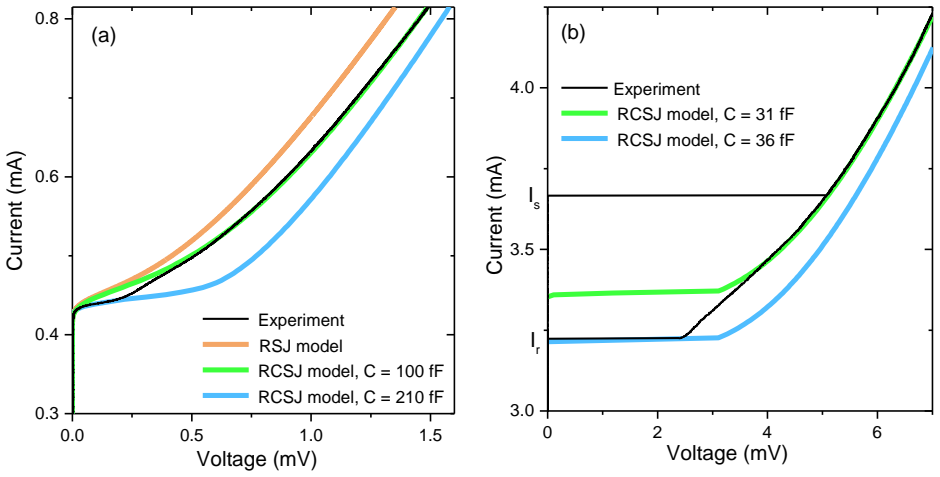
The load-bearing mechanism is oxygen electromigration driven along the grain boundary rather than across it: a current of order 100 μA between the top platinum electrode and the contact electrodes produces a nominal current density six to seven orders of magnitude below conventional across-boundary electromigration, yet enough to move oxygen out of the Cu-O chains and into the BaTbO3 cap, whose high oxygen mobility comes from the ability of terbium to take both 3+ and 4+ valence states. The diagnostic machinery is the resistively-and-capacitively-shunted-junction (RCSJ) model with two voltage-dependent capacitance values, used to extract Ic and Rn from measured IV curves, and the Simmons formula for metal-insulator-metal tunnelling, used to extract the barrier height and thickness from the quasiparticle current.
What would settle it
Measure the zero-sweep-rate switching current at 77.9 K on an electromigrated junction, or map oxygen content across the grain boundary and into the BaTbO3 layer by electron-energy-loss spectroscopy; a drop in the derived IcRn product below its as-fabricated value, or an oxygen profile that rules out migration into BaTbO3, would falsify the claim.
Extended reading notes
Core claim
The central claim is that oxygen electromigration can be redirected so that it removes oxygen from the grain-boundary region without depleting the superconducting electrodes. In the authors' devices a BaTbO3 layer deposited on top of the YBCO film serves as the oxygen sink, and a current of roughly 100 μA between a top electrode and the contact electrodes drives the migration along the grain boundary and perpendicular to the film. After this treatment the normal-state resistance Rn of the [100]-tilt bicrystal junctions increased from 2–3 Ω to up to 355 Ω, while the measured IcRn product at 4.2–4.3 K stayed essentially unchanged (5.4–7.0 mV before and 6.0–7.0 mV after the treatment once switching effects are accounted for). The same IV data, analysed with the resistively-and-capacitively-shunted-junction model, show the superconducting film thickness near the grain boundary shrinking to 8–60 nm. Fitting the high-bias quasiparticle current of the most resistive junction to the Simmons metal-insulator-metal formula gives an average barrier height φ = 80.93 ± 0.14 meV and thickness t = 1.9311 ± 0.0003 nm, markedly higher than the barrier height reported for [001]-tilt YBCO grain boundaries.
Load-bearing premise
If the product of critical current and normal-state resistance actually falls at 77.9 K, or if the resistance increase is caused by something other than oxygen electromigration into the BaTbO3 layer, the paper's central claim of undegraded high-resistance junctions collapses, and both premises are inferred from indirect evidence rather than directly measured.
Editorial extensions
If this is right
- High-resistance [100]-tilt YBCO junctions with Rn up to 355 Ω and IcRn ≈ 6–7 mV at 4.3 K become available for macroscopic quantum tunnelling experiments.
- The estimated crossover temperature Tcr ≈ 14–15 K for the electromigrated junctions means quantum escape should dominate thermal activation well above liquid-helium temperature.
- Because oxygen depletion is confined to a 1–2 nm region along the grain boundary, the superconducting electrodes keep their full order parameter, explaining why the IcRn product survives the resistance increase.
- The observed fall in junction capacitance after capping and electromigration indicates the superconducting film thickness near the boundary is reduced, giving a capacitance-based monitor of the barrier modification.
Reading between the lines
- A direct consequence the paper does not pursue is that the same BaTbO3 reservoir plus perpendicular-field geometry could be used as a post-fabrication trim knob, tuning junction resistance chip by chip without changing the substrate or the film growth.
- Because the claim of preserved IcRn at 77.9 K is inferred from 4.2 K data plus RCSJ corrections, a clean experimental test would be to measure the intrinsic switching-current distribution at 77.9 K directly; if that product is degraded, the method's advantage at high temperature would be reduced.
- The unexplained voltage jump in junction J4 at 450 nA after high-current electromigration sits outside the RCSJ picture; if it is reproducible, it may indicate a second switching channel in high-resistance [100]-tilt junctions.
- The barrier height extracted for the [100]-tilt boundary is several times larger than the [001]-tilt value; if different grain-boundary geometries can be compared systematically with this technique, the method becomes a probe of how boundary structure controls localised states.
Signed reviews
Editorial analysis
A structured set of objections, weighed in public.
Referee Report
Summary. The paper proposes a method to increase the normal-state resistance of [100]-tilt YBCO grain-boundary Josephson junctions by electromigration of oxygen into an overlying BaTbO3 layer, with the electric field applied perpendicular to the film and along the grain boundary. Four junctions are characterized at 4.2-4.3 K and 77.6-77.9 K at several fabrication stages; the authors report that after high-current electromigration the normal-state resistance rose from a few ohms to hundreds of ohms while the IcRn product remained essentially unchanged at low temperature. The paper also extracts a barrier height of 80.93 meV and a barrier thickness of 1.9311 nm from the high-voltage quasiparticle tunnelling current of one junction. The central claimed result is that the resistance increase is achieved without deterioration of the IcRn product, which is then used to argue that the junctions are promising for macroscopic quantum phenomena in high-Tc systems.
Significance. If substantiated, the method would be practically useful because high-resistance, high-IcRn grain-boundary junctions are desirable for macroscopic quantum experiments. The paper is strongest at low temperature: the directly measured IsRn products at 4.3 K after high-current electromigration (5.6-6.3 mV) overlap the as-fabricated range (4.7-7.1 mV), and the use of a reference junction and the observation of the 'healing' effect provide useful controls. However, the claim that the IcRn product is preserved at 77.9 K is not directly measured; it rests on an explicit assumption, and the RCSJ-based fluctuation correction is not independently validated. The barrier-parameter extraction and the oxygen-electromigration mechanism also need stronger support. The empirical fabrication result at 4.2 K is credible, but the high-temperature part of the claim and the secondary results require revision before the manuscript can be accepted.
major comments (5)
- [§3, Table 1 and text near Fig. 5] The abstract and Conclusions state that the normal-state resistance was increased 'without the deterioration of the IcRn-product' without restricting the claim to 4.2 K. At 77.6-77.9 K the directly measured switching-current products after the high-current EM are IsRn ≈ 0.35-0.40 mV for J2 and J3 and ≈ 0.15 mV for J4, compared with 0.78-0.88 mV as-fabricated. The text explicitly says: 'we assume that it remained the same at 77.9 K as well. Therefore, we calculate the fluctuation-free critical current at T = 77.9 K required for the numerical simulations based on this assumption.' Because the simulations that produce the fluctuation-free Ic at 77.9 K are based on this assumption, the conclusion that IcRn is preserved at 77.9 K is not supported by independent measurement. This is load-bearing for the abstract claim and for the stated promise of high-temperature quantum experiments; the paper should either measure IcRn at 77.9 K directly (for example, with a carefully validated fluctuation correction) or explicitly restrict the no-degradation claim to low temperature.
- [§3, Fig. 4 and the paragraph following Eq. (1)] The correction of the measured switching current to the fluctuation-free Ic at 77.9 K is performed with RCSJ simulations whose capacitance C1 is a fit parameter for each IV curve. The paper acknowledges that Eq. (1) could not be used and that the simulation input Ic is chosen from the assumption that IcRn is unchanged. Thus the agreement between the simulated and measured IV curves after EM is partly constructed by the fitting procedure rather than being an independent validation of the fluctuation correction. An independent determination of the capacitance (for example, from retrapping dynamics or microwave measurements) and a sensitivity analysis with respect to C are needed before the corrected IcRn values at 77.9 K can be accepted.
- [§3, Fig. 5 and the paragraph on J4] After the high-current EM, the highest-resistance junction J4 (Rn = 355 Ω) does not show a superconducting branch at 77.6 K because EJ < kT, and the observed voltage jump at 450 nA is described as having 'unclear' origin and as a subject of further study. The absence of a clear Josephson branch in the very junction that best approaches the desired high-resistance regime weakens the claim that the processed junctions are suitable for high-temperature operation. This behavior should be either explained or explicitly excluded from the claim.
- [§3, Eq. (2) and Fig. 6] The barrier height and thickness are obtained from a single IV curve of J4 using the rectangular MIM barrier formula, with J0 as an additional adjustable prefactor. The quoted uncertainties (φ = 80.93 ± 0.14 meV, t = 1.9311 ± 0.0003 nm) are least-squares statistical errors and do not include systematic uncertainties from the assumed barrier shape, junction area, voltage offset, or possible residual self-heating. Since the comparison with [001]-tilt barriers (t = 2.1 nm, φ = 23 meV) is presented as a quantitative result, a more careful error budget is needed; otherwise the values should be presented as estimates.
- [§3, paragraphs on the top-electrode fabrication and the 'hole wind' estimate] The assignment of the resistance increase to oxygen electromigration into BaTbO3 is inferred indirectly from resistance and capacitance changes and from the valence flexibility of Tb; no direct oxygen concentration profile (for example, by EDX, ion-beam analysis, or Hall measurements) is provided. The estimate of the EM area as 5000-10000 nm2 assumes the 'hole wind' mechanism rather than testing it. The central device result does not depend on the microscopic mechanism, but the abstract's claim that 'oxygen diffuses ... to a BaTbO3 layer' is stronger than the evidence presented.
minor comments (5)
- [Abstract and §1] There are several typos: 'Appling' should be 'Applying'; the phrase 'an n YBCO film' should be 'a YBCO film'; and in §3 'ar the voltages' should be 'at the voltages'.
- [Table 1] The temperature entries are not fully consistent: columns are labelled 77.9 K and 77.6 K for nominally the same measurement temperature, and 4.2 K and 4.3 K similarly. Please unify the notation or explain the differences explicitly.
- [§1 and Fig. 1] The bicrystal notation '2x12°' is introduced without definition; please specify the misorientation angle convention and how it produces the [100]-tilt geometry.
- [Reference [21]] The first author of reference [21] is spelled 'Liatti' whereas the manuscript uses 'Lyatti'; please harmonize the spelling.
- [Fig. 3 and Fig. 5] The captions indicate that red lines show voltage switching; in monochrome reproduction these lines may be difficult to distinguish. Please add distinct line styles or symbols.
Circularity Check
At 77.9 K the preserved IcRn-product is assumed, then used to compute the very critical currents that 'confirm' it; only the 4.2 K result is directly measured.
-
self definitional
[Section 3, paragraph after the high-current EM treatment, discussing Figure 5 and Table 1; echoed in Section 4 Conclusions.]
"Taking into account that the IcRn-product of the junctions was not changed at 4.2 K, we assume that it remained the same at 77.9 K as well. Therefore , we calculate the fluctuation-free critical current at T = 77.9 K required for the numerical simulations based on this assumption."
The claimed high-temperature preservation of the IcRn-product is not independently derived at 77.9 K; it is the explicit premise. Section 3 states that the fluctuation-free critical current at 77.9 K was calculated from the assumption that the 4.2 K IcRn value 'remained the same at 77.9 K as well,' and the resulting RCSJ curves are then presented as consistent with the measured IVs. Thus the high-temperature no-degradation conclusion restates the input rather than being a prediction from measured 77.9 K data. The directly measured 77.6 K switching-current product drops from 0.78-0.88 mV to 0.35-0.40 mV, and recovering the assumed IcRn depends on capacitance values C1 fitted to each IV curve plus the assumed IcRn itself.
full rationale
The paper's strongest claim, that the normal-state resistance was increased to several hundred ohms without deterioration of the IcRn-product, is supported by direct measurement only at 4.2 K, where the switching-current product after high-current electromigration (5.6-6.3 mV) is close to the as-fabricated range (4.7-7.1 mV) and thermal fluctuations are negligible. The 77.9 K part of the claim is not a measurement or an independent derivation: the paper explicitly assumes that the 4.2 K IcRn value remained unchanged at 77.9 K and then calculates the fluctuation-free critical current used in the RCSJ simulations from that assumption. Consequently, the simulated consistency at 77.9 K is not evidence for the assumed IcRn; it is the assumption recycled through the model. The barrier height and thickness (φ = 80.93 ± 0.14 meV, t = 1.9311 ± 0.0003 nm) are obtained by explicitly fitting a standard Simmons MIM tunneling expression to the J4 IV curve; this is a fit to the same data, not a prediction, so it is not circular in the sense of this review. Reference [21] is a self-citation supporting the interpretive statement that no local states exist in the barrier, but that interpretation is not load-bearing for the main extraction or for the low-temperature resistance claim. Overall, the independent 4.2 K result and the explicit barrier fit keep the paper from being wholly circular, but the high-temperature no-degradation conclusion reduces by construction to its own assumption.
Assumptions & free parameters
free parameters (5)
- RCSJ capacitance C1, C2 =
C1 = 0.32-100 fF; C2 = 1.1-210 fF depending on junction and temperature
- MIM tunneling prefactor J0 =
not reported
- Barrier thickness t =
1.9311 +/- 0.0003 nm
- Barrier height phi =
80.93 +/- 0.14 meV
- Fluctuation-free Ic at 77.9 K after EM =
not directly measured; set by assuming IcRn unchanged from 4.2 K
assumptions (6)
- domain assumption Oxygen electromigration in YBCO proceeds by hole-wind momentum transfer to O1 chain oxygen atoms.
- domain assumption BaTbO3 acts as an oxygen reservoir with high oxygen diffusivity and forms an atomically sharp interface with YBCO.
- domain assumption The STO substrate has frequency- and temperature-dependent dielectric constant requiring two capacitance values.
- ad hoc to paper Use of two voltage-independent capacitances C1 and C2 captures the frequency-dependent substrate response.
- ad hoc to paper The IcRn product at 77.9 K is unchanged because it was unchanged at 4.2 K.
- domain assumption The Simmons rectangular-barrier MIM tunnel formula applies to the [100]-tilt YBCO grain boundary.
Cite this review
Pith. "Pith review of High-resistance YBa2Cu3O7-x grain-boundary Josephson junctions fabricated by electromigration." pith.science (2026). https://pith.science/paper/FTDXB4W6
@misc{pith2026190803784,
  author       = {Pith},
  title        = {Pith review of: High-resistance YBa2Cu3O7-x grain-boundary Josephson junctions fabricated by electromigration},
  year         = {2026},
  howpublished = {\url{https://pith.science/paper/FTDXB4W6}},
  note         = {Machine review of arXiv:1908.03784}
}
read the original abstract
[100]-tilt grain-boundary YBa2Cu3O7-x (YBCO) junctions are promising for investigation of macroscopic quantum phenomena in high-Tc Josephson junctions. However, fabrication of the [100]-tilt grain-boundary YBCO junctions with a high resistance, which are required to study quantum effects, is difficult because of a high transparency of a tunnel barrier in this type of junctions. Here, we demonstrate a modification of grain-boundary barrier properties with a new approach to an oxygen electromigration in the YBCO grain-boundary junctions when the oxygen diffuses under an applied electric field from the grain-boundary to a BaTbO3 layer deposited atop of an YBCO film. Using this approach, we changed the normal-state resistance of the junctions from tens to several hundred Ohms without a degradation of their characteristic voltage IcRn and determined a barrier height and thickness by measuring the quasiparticle tunnelling current.
Figures
Reference graph
Works this paper leans on
-
[1]
Kawabata S, Kashiwaya S, Asano Y, Tanaka Y, Kato T and Golubov A A 2007 Supercond Sci Tech 20 S6-S9
work page 2007
-
[2]
Nappi C, De Nicola S, Adamo M, and Sarnelli E 2012 Phys. Rev. B 86 024517
work page 2012
-
[3]
Gundareva I I, Gubankov V N, Divin Y Y, Lyatti M V, Pavlovskiy V V and Volkov O Y 2012 Physics Proc 36 217-22
work page 2012
-
[4]
Sydow J P, Berninger M, Buhrman R A and Moeckly B H 1999 Supercond Sci Tech 12 723-5
work page 1999
-
[5]
Moeckly B H, Lathrop D K and Buhrman R A 1993 Physical Review B 47 400-17
work page 1993
-
[6]
Poppe U, Hojczyk R, Jia C L, Faley M I, Evers W, Bobba F, Urban K, Horstmann C, Dittmann R, Breuer U and Holzbrecher H 1999 IEEE Trans Appl Supercond 9 3452-5
work page 1999
-
[7]
Jia C L, Hojczyk R, Faley M, Poppe U and Urban K 1999 Philos Mag A 79 873-91
work page 1999
-
[8]
Staub U, Antonio M R, Soderholm L, Guillaume M, Henggeler W and Furrer A 1994 Phys Rev B 50 7085-91
work page 1994
Show all 21 references
-
[9]
V 2011 IEEE Trans App
Volkov O Y, Divin Y Y, Gubankov V N, Gundareva I I and Pavlovskiy V. V 2011 IEEE Trans App. Supercond 21 306-10
2011
-
[10]
Mccumber D E 1968 J Appl Phys 39 3113-8
1968
-
[11]
Froehlich O M, Richter P, Beck A, Koelle D and Gross R 1997 IEEE Trans Appl Supercond 7 3189-92
1997
-
[12]
Winkler D, Zhang Y M, Nilsson P A, Stepantsov E A and Claeson T 1994 Phys Rev Lett 72 1260-3
1994
-
[13]
Zhang Y M, Winkler D, Nilsson P A and Claeson T 1995 Phys Rev B 51 8684-7
1995
-
[14]
Fedorov I, Zelezny V, Petzelt J, Trepakov V, Jelinek M, Trtik V, Cernansky M and Studnicka V 1998 Ferroelectrics 208 413-27
1998
-
[15]
Tinkham M 1996 Introduction to superconductivity (New York: McGraw-Hill, Inc.)
1996
-
[16]
Jorgensen J D, Veal B W, Paulikas A P, Nowicki L J, Crabtree G W, Claus H and Kwok W K 1990 Phys Rev B 41 1863-77
1990
-
[17]
Baumans X D A et al 2017 Small 13 1700384
2017
-
[18]
Huerth S H, Taylor M P, Hallen H D and Moeckly B H 2000 Appl Phys Lett 77 2127-9
2000
-
[19]
Herrmann K, Pauza A J, Baudenbacher F, Santiso J S and Moore D F 1997 Physica C 274 309-16
1997
-
[20]
Simmons J G 1963 J Appl Phys 34 1793-803
1963
-
[21]
Liatti M V, Poppe U and Divin Y Y 2006 Appl Phys Lett 88 152504
2006
Reviewed August 14, 2026 · model on record in the stance chip above.
Discussion (0). Continue with ORCID to comment.