REVIEW 3 major objections 7 minor 91 references
LiDAR scans can be completed to photogrammetric detail by growing Gaussian surfels only where the scan is ambiguous.
Reviewed by Pith at T0; open to challenge. T0 means a machine referee read the full paper against a public rubric. the ladder, T0–T4 →
T0 review · deepseek-v4-flash
2026-08-03 18:51 UTC pith:FUDD4VWQ
load-bearing objection A practical, well-engineered LiDAR completion pipeline with a real blind spot: the ambiguity heuristic only fires when a missing structure leaves a density shadow, and the paper never tests the common perpendicular-thin-structure case. the 3 major comments →
SurfFill: Completion of LiDAR Point Clouds via Gaussian Surfel Splatting
The pith
A machine-rendered reading of the paper's core claim, the machinery that carries it, and where it could break.
Core claim
The paper's core claim is that LiDAR incompleteness can be located without knowing what is missing. It defines ambiguity per point as the mean distance to k nearest neighbors scaled by a device-dependent spacing: low values mark well-scanned regions, high values mark transition zones, and these zones are exactly the borders of missing geometry. The paper then constrains a Gaussian surfel model to densify and optimize in those zones, guided by image-space normal uncertainty, an edge gradient loss, scale regularization, and opacity-aware filtering, and samples the surviving surfels back into the scan. The authors report a mean F1 of 0.9176 and a mean Chamfer distance of 0.0055 across five test
What carries the argument
The central object is the ambiguity score p(x), a per-point inverse-density estimate computed as the mean distance to k nearest neighbors divided by the typical LiDAR point spacing. Small p means dense, well-scanned; large p means transition toward a gap. This score drives non-uniform downsampling, controls the initial surfel scale, guides densification and pruning, informs training-view sampling, and later filters out low-ambiguity Gaussian surfels. The second mechanism is focused Gaussian surfel optimization: flat Gaussian primitives are grown only into flagged regions, with a max-gradient densification heuristic, positional jitter for exploration, a gradient edge loss, scale regularizatio
Load-bearing premise
The ambiguity heuristic assumes every missed structure sits next to a measurable transition zone of low but nonzero point density; a fully isolated missed object or a surface that returns no laser signal produces no ambiguity signal, so it would never be targeted.
What would settle it
Run SurfFill on a scene where a thin metal rod is visible in the RGB images but has been removed from the LiDAR scan, ensuring no residual points and no low-density transition zone remain around the rod; if the pipeline adds no points over the rod, the density-border premise fails. A simpler check is to compute the ambiguity score on a scan after deleting one isolated chair leg and verify whether the surrounding k-nearest-neighbor distance rises measurably at all.
If this is right
- LiDAR and photometric reconstruction are complementary in exactly the way the artifact analysis suggests: the same regions where LiDAR is weak, such as thin structures, edges, and dark surfaces, are the regions where image-based reconstruction is strong.
- Combining completed points with the original scan does not measurably degrade precision in flat, well-scanned regions, according to the reported precision and F1 scores.
- Building-scale scans with tens of millions of points remain processable: chunked training runs in parallel and completes a six-room office scan in about 70 minutes on six GPUs.
- The added heuristic and filtering stages cost little runtime; the total time is close to baseline splatting, around 25 minutes on the test scenes.
- Direct learning-based point cloud completion methods trained on object-level benchmarks do not transfer to these LiDAR-scale scenes, as the paper reports far lower F1 scores for those methods.
Where Pith is reading between the lines
- The ambiguity heuristic is effectively a saliency map for LiDAR failure; it could be reused outside Gaussian surfel splatting as a general prior for any photometric completion method, though the paper does not test that transfer.
- Because the pipeline relies on RGB images, it inherits photometric failure modes: sparse camera views, dynamic objects, and lighting changes limit completion, which the paper acknowledges as a limitation.
- A natural stress test would be completing a fully unobserved structure, such as a table leg with no residual neighboring points at all; in that case the density-based ambiguity signal would be absent and the heuristic would need image-only cues to fire.
- The chunking extension introduces small artifacts at chunk borders, with about a 0.6% F1 drop on one small scene; this suggests that smarter inter-chunk blending is a promising refinement, as the paper notes.
Editorial analysis
A structured set of objections, weighed in public.
Referee Report
Summary. SurfFill proposes a pipeline for completing missing fine structures in LiDAR point clouds by combining a 3D point-density ambiguity heuristic with a 2D-Gaussian-Splatting optimization that is focused, via image-space uncertainty masks and adapted losses, on the detected ambiguous regions. After training, Gaussian surfels in these regions are filtered and sampled back into the LiDAR cloud. A divide-and-conquer chunking scheme extends the method to large building-scale scans. The paper reports quantitative results on five synthetic test scenes (ATTIC, KITCHEN, MUSEUM, MEETINGROOM, CATERPILLAR) with F1-score improvement from 0.8781 (2DGS) to 0.9176, lower Chamfer distance, and roughly 25 minutes runtime per scene, plus qualitative results on real-world scans. Ablations quantify the contribution of each component.
Significance. If the central claim holds, the paper provides a practical, efficient way to integrate photometric reconstruction into LiDAR scans without degrading their precision, which would be valuable for industrial scanning and scene reconstruction. The approach is well-motivated by a physically grounded analysis of LiDAR beam divergence and mixed pixels. The authors ship code and a project page, and the ablation study is fairly thorough. The method is not derived from its outputs and the KITCHEN removed-point recovery check is a genuinely held-out quantitative evaluation. However, the load-bearing evaluation is entirely synthetic, using the authors' own point-removal artifact model, and the ambiguity heuristic's coverage of real LiDAR failure modes is not quantitatively demonstrated.
major comments (3)
- [§5.1, Eq. (1); §11] The ambiguity heuristic p(x) = mean kNN distance / δ assumes that every region requiring completion is bordered by a transition zone of low, non-zero point density. This assumption fails for a common geometry: a thin structure rising perpendicularly from a dense, well-scanned surface, e.g., a chair leg or fence bar on a floor. For a floor point near the base of the missing structure, the k nearest neighbors are other floor points at distance ~δ; the absent structure contributes no neighbor, so p(x) remains near the well-scanned baseline. The region is not marked ambiguous, receives no focused densification bias, and may be filtered out. The synthetic test data (Fig. 11) is generated by deleting entire structures, which creates large voids and thus clear transition zones, so the evaluation is biased toward cases where the heuristic fires. The real-world qualitative results (e.g., fence ba
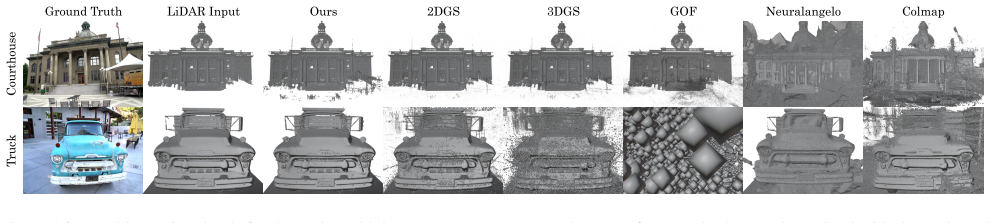
- [§10, Appendix E, Fig. 11] The quantitative evaluation is entirely synthetic: input LiDAR clouds are created by deleting points from ground truth scans using a point-removal scheme that mimics 'typical LiDAR artifacts' and in ATTIC 'the exact regions missing in the real dataset'. This protocol is reasonable, but it creates input clouds that are precisely those for which the ambiguity heuristic is designed to fire (large contiguous removed structures with surrounding transition zones). The paper does not report a quantitative experiment on real-world scans, where missing structures are often partially missing, fragmented, or accompanied by noise rather than cleanly removed whole structures. To strengthen the central claim, please add a robustness analysis with different deletion patterns (e.g., removing only portions of thin structures, or deleting points on dark/absorbent surfaces without creating a large void) an
- [§10.3 'Missing Points'] The removed-point recall reported for KITCHEN — 35% within 10 mm, 60% within 20 mm, 74% within 30 mm — indicates that a substantial fraction of the deleted structures is not recovered even in the synthetic setting that is most favorable to the heuristic. This is not necessarily a flaw, but it should be contextualized. Please report the same recall metric for the baselines (2DGS, 3DGS, GOF, COLMAP, Neuralangelo) and, ideally, for the other four test scenes. Without this, the reader cannot tell whether the F1-score improvement comes primarily from completing the deleted structures or from adding points near existing surfaces that slightly increase recall.
minor comments (7)
- [§7, Eq. (3)] The notation 'M(and the inverse M)' is ambiguous in the text; please define M and ar{M} clearly as the uncertainty mask and its complement. The equation itself is understandable but the surrounding text could be more explicit.
- [§8, first paragraph of 'Filtering'] The sentence 'Next, original Gaussians via the "was-densified" flag as well as Gaussians with remaining high ambiguity are removed' is confusing. It seems to say that both the original (non-densified) Gaussians and the high-ambiguity ones are discarded, but the goal of filtering is to keep splats that grew into missing areas. Please rewrite to state exactly which Gaussians are kept and which are removed, and how 'remaining high ambiguity' is computed.
- [§5.1, Eq. (1)] The parameter δ ('typical distance between points') is not given a precise computational definition. It is stated to depend on the LiDAR device and preprocessing, but the paper should specify how δ is estimated in practice (e.g., median kNN distance over a subsample of well-scanned points). This is important for reproducibility.
- [§2, Related Work] The phrase 'we present the first approach to evaluate artifacts and complete LiDAR scans using Gaussian Splatting' appears to be an overclaim given existing works that incorporate LiDAR into Gaussian splatting (e.g., Li-GS [31]) even if they do not target completion. Please soften the wording to 'the first approach to explicitly focus on LiDAR artifact completion with Gaussian surfels' or similar.
- [§10.3, Fig. 10] The initialization experiment (2DGS + ambiguity preprocessing vs. 2DGS + uniform downsampling) is informative, but the caption and text could clarify that the comparison uses the same total point budget after downsampling, so the effect is attributable to the non-uniform distribution rather than to different point counts.
- [Appendix F.3, Fig. 13] The pose robustness experiment reports only qualitative results for the ATTIC scene. A numeric F1/Chamfer comparison with and without pose noise would strengthen the claim that the method is 'less susceptible' to pose noise.
- [§10, Table 2] The COLMAP result for CATERPILLAR (CD=4.8968, F1=0.6338) is far worse than for other scenes, likely due to a failure case. The paper reports the mean including this outlier; a more robust statistic (e.g., median) or a breakdown discussion would be helpful.
Circularity Check
No significant circularity: heuristics and losses are method components; the held-out removal-recall test is not forced by construction.
full rationale
The claimed derivation chain is not circular. The ambiguity heuristic (Eq. 1) defines a point-wise density proxy; it is an input-dependent detector, not a quantity derived from the completion output. The completion itself is produced by Gaussian surfel optimization (Sec. 7) with external image-based losses, followed by filtering/sampling (Sec. 8). Eq. 4 selects Gaussians by distance to the input cloud but does not encode the ground-truth completed points; F1/Chamfer require spatially accurate placement, which is an empirical result rather than a logical consequence of the filter. The synthetic benchmarks (Appendix E) delete structures from ground truth to mimic LiDAR artifacts; the deletions are not chosen by Eq. 1, and the KITCHEN recall against removed points (Sec. 10.2) is a genuinely held-out measure. Real-world qualitative results on ScanNet++, Tanks & Temples, and the BRIDGE failure in Sec. F.8 provide independent evidence and an explicit admission of dependence on visual data quality. The paper's self-citations (e.g., VET, TRIPS) are related-work context and are not load-bearing for the central completion claim. Although Appendix B tunes the ambiguity threshold on the synthetic ATTIC scene and the synthetic removals are aligned with the paper's artifact model, this is an evaluation-validity caveat, not a reduction of the output to the input by construction.
Axiom & Free-Parameter Ledger
free parameters (6)
- point ambiguity threshold τ =
0.04
- uncertainty mask threshold =
0.2
- δ (typical point distance)
- k for KNN searches =
3 and 5
- distance filter bounds t_min, t_max =
0.01 m, 3 m
- loss weights γ, ρ, α, β, λ =
λ=0.4; others unspecified
axioms (5)
- domain assumption Regions that need completion are bordered by transition zones of low, non-zero point density.
- domain assumption LiDAR beam divergence is the main cause of missing thin structures and edges, and these are feature-rich regions recoverable from photos.
- domain assumption Registered RGB images with sufficient overlap and photometric information are available for the ambiguous regions.
- domain assumption Gaussian surfel optimization constrained as in Sec. 7 converges to geometry that fills the missing regions rather than hallucinating.
- ad hoc to paper Uncertainty maps from Bae et al. normal estimation identify image regions where LiDAR is incomplete.
read the original abstract
LiDAR-captured point clouds are often considered the gold standard in active 3D reconstruction. While their accuracy is exceptional in flat regions, the capturing is susceptible to miss small geometric structures and may fail with dark, absorbent materials. Alternatively, capturing multiple photos of the scene and applying 3D photogrammetry can infer these details as they often represent feature-rich regions. However, the accuracy of LiDAR for featureless regions is rarely reached. Therefore, we suggest combining the strengths of LiDAR and camera-based capture by introducing SurfFill: a Gaussian surfel-based LiDAR completion scheme. We analyze LiDAR capturings and attribute LiDAR beam divergence as a main factor for artifacts, manifesting mostly at thin structures and edges. We use this insight to introduce an ambiguity heuristic for completed scans by evaluating the change in density in the point cloud. This allows us to identify points close to missed areas, which we can then use to grow additional points from to complete the scan. For this point growing, we constrain Gaussian surfel reconstruction to focus optimization and densification on these ambiguous areas. Finally, Gaussian primitives of the reconstruction in ambiguous areas are extracted and sampled for points to complete the point cloud. To address the challenges of large-scale reconstruction, we extend this pipeline with a divide-and-conquer scheme for building-sized point cloud completion. We evaluate on the task of LiDAR point cloud completion of synthetic and real-world scenes and find that our method outperforms previous reconstruction methods.
Figures




Reference graph
Works this paper leans on
-
[1]
Neural point-based graph- ics
Kara-Ali Aliev, Artem Sevastopolsky, Maria Kolos, Dmitry Ulyanov, and Victor Lempitsky. Neural point-based graph- ics. InEuropean Conference on Computer Vision, pages 696–712. Springer, 2020. 3
2020
-
[2]
Es- timating and exploiting the aleatoric uncertainty in surface normal estimation
Gwangbin Bae, Ignas Budvytis, and Roberto Cipolla. Es- timating and exploiting the aleatoric uncertainty in surface normal estimation. InProceedings of the IEEE/CVF Interna- tional Conference on Computer Vision, pages 13137–13146,
-
[3]
Bagdasarian, Paul Knoll, Yi-Hsin Li, Florian Barthel, Anna Hilsmann, Peter Eisert, and Wieland Morgen- stern
Milena T. Bagdasarian, Paul Knoll, Yi-Hsin Li, Florian Barthel, Anna Hilsmann, Peter Eisert, and Wieland Morgen- stern. 3dgs.zip: A survey on 3d gaussian splatting compres- sion methods, 2024. 3
2024
-
[4]
MVSFormer: Multi-view stereo by learning robust image features and temperature-based depth.Trans
Chenjie Cao, Xinlin Ren, and Yanwei Fu. MVSFormer: Multi-view stereo by learning robust image features and temperature-based depth.Trans. Mach. Learn. Res., 2022,
2022
-
[5]
MVSFormer++: Revealing the devil in transformer’s details for multi-view stereo
Chenjie Cao, Xinlin Ren, and Yanwei Fu. MVSFormer++: Revealing the devil in transformer’s details for multi-view stereo. InInternational Conference on Learning Represen- tations (ICLR), 2024. 2 11
2024
-
[6]
Shapenet: An information-rich 3d model repository.arXiv preprint arXiv:1512.03012, 2015
Angel X Chang, Thomas Funkhouser, Leonidas Guibas, Pat Hanrahan, Qixing Huang, Zimo Li, Silvio Savarese, Manolis Savva, Shuran Song, Hao Su, et al. Shapenet: An information-rich 3d model repository.arXiv preprint arXiv:1512.03012, 2015. 2
Pith/arXiv arXiv 2015
-
[7]
Silhouette-aware warping for image-based rendering
Gaurav Chaurasia, Olga Sorkine, and George Drettakis. Silhouette-aware warping for image-based rendering. In Computer Graphics Forum, pages 1223–1232. Wiley Online Library, 2011. 3
2011
-
[8]
Hanlin Chen, Chen Li, and Gim Hee Lee. Neusg: Neural im- plicit surface reconstruction with 3d gaussian splatting guid- ance.arXiv preprint arXiv:2312.00846, 2023. 3
Pith/arXiv arXiv 2023
-
[9]
A space-sweep approach to true multi- image matching
Robert T Collins. A space-sweep approach to true multi- image matching. InProceedings CVPR IEEE Computer So- ciety Conference on Computer Vision and Pattern Recogni- tion, pages 358–363. Ieee, 1996. 2
1996
-
[10]
Letsgo: Large-scale garage modeling and rendering via lidar-assisted gaussian primitives.ACM Trans- actions on Graphics (TOG), 43(6):1–18, 2024
Jiadi Cui, Junming Cao, Fuqiang Zhao, Zhipeng He, Yifan Chen, Yuhui Zhong, Lan Xu, Yujiao Shi, Yingliang Zhang, and Jingyi Yu. Letsgo: Large-scale garage modeling and rendering via lidar-assisted gaussian primitives.ACM Trans- actions on Graphics (TOG), 43(6):1–18, 2024. 3, 16
2024
-
[11]
High-quality surface recon- struction using gaussian surfels
Pinxuan Dai, Jiamin Xu, Wenxiang Xie, Xinguo Liu, Huamin Wang, and Weiwei Xu. High-quality surface recon- struction using gaussian surfels. InACM SIGGRAPH 2024 Conference Papers, pages 1–11, 2024. 3, 6
2024
-
[12]
Floating textures
Martin Eisemann, Bert De Decker, Marcus Magnor, Philippe Bekaert, Edilson De Aguiar, Naveed Ahmed, Christian Theobalt, and Anita Sellent. Floating textures. pages 409–
-
[13]
Comprehensive review of deep learning-based 3d point cloud completion processing and analysis.IEEE Transactions on Intelligent Transportation Systems, 23(12):22862–22883, 2022
Ben Fei, Weidong Yang, Wen-Ming Chen, Zhijun Li, Yikang Li, Tao Ma, Xing Hu, and Lipeng Ma. Comprehensive review of deep learning-based 3d point cloud completion processing and analysis.IEEE Transactions on Intelligent Transportation Systems, 23(12):22862–22883, 2022. 2
2022
-
[14]
VET: visual error tomography for point cloud completion and high-quality neural render- ing
Linus Franke, Darius R ¨uckert, Laura Fink, Matthias Inn- mann, and Marc Stamminger. VET: visual error tomography for point cloud completion and high-quality neural render- ing. InSIGGRAPH Asia Conference Papers, New York, NY , USA, 2023. ACM. 3
2023
-
[15]
TRIPS: Trilinear Point Splatting for Real-Time Ra- diance Field Rendering.Computer Graphics Forum, 43(2),
Linus Franke, Darius R ¨uckert, Laura Fink, and Marc Stam- minger. TRIPS: Trilinear Point Splatting for Real-Time Ra- diance Field Rendering.Computer Graphics Forum, 43(2),
-
[16]
Vr- splatting: Foveated radiance field rendering via 3d gaussian splatting and neural points.Proc
Linus Franke, Laura Fink, and Marc Stamminger. Vr- splatting: Foveated radiance field rendering via 3d gaussian splatting and neural points.Proc. ACM Comput. Graph. In- teract. Tech., 8(1), 2025. 3
2025
-
[17]
Efros, and Xiaolong Wang
Yang Fu, Sifei Liu, Amey Kulkarni, Jan Kautz, Alexei A. Efros, and Xiaolong Wang. Colmap-free 3d gaussian splat- ting. InProceedings of the IEEE/CVF Conference on Com- puter Vision and Pattern Recognition (CVPR), pages 20796– 20805, 2024. 11
2024
-
[18]
Multi-view stereo for commu- nity photo collections
Michael Goesele, Noah Snavely, Brian Curless, Hugues Hoppe, and Steven M Seitz. Multi-view stereo for commu- nity photo collections. In2007 IEEE 11th International Con- ference on Computer Vision, pages 1–8. IEEE, 2007. 2
2007
-
[19]
Eggs: Edge guided gaussian splatting for ra- diance fields.International Conference on 3D Technologies for the World Wide Web, 2024
Yuanhao Gong. Eggs: Edge guided gaussian splatting for ra- diance fields.International Conference on 3D Technologies for the World Wide Web, 2024. 6
2024
-
[20]
Sugar: Surface- aligned gaussian splatting for efficient 3d mesh reconstruc- tion and high-quality mesh rendering
Antoine Gu ´edon and Vincent Lepetit. Sugar: Surface- aligned gaussian splatting for efficient 3d mesh reconstruc- tion and high-quality mesh rendering. InProceedings of the IEEE/CVF Conference on Computer Vision and Pattern Recognition, pages 5354–5363, 2024. 3
2024
-
[21]
Efficient perspective-correct 3d gaussian splatting using hybrid trans- parency.arXiv, 2024
Florian Hahlbohm, Fabian Friederichs, Tim Weyrich, Li- nus Franke, Moritz Kappel, Susana Castillo, Marc Stam- minger, Martin Eisemann, and Marcus Magnor. Efficient perspective-correct 3d gaussian splatting using hybrid trans- parency.arXiv, 2024. 3
2024
-
[22]
INPC: Implicit neural point clouds for radiance field rendering
Florian Hahlbohm, Linus Franke, Moritz Kappel, Susana Castillo, Martin Eisemann, Marc Stamminger, and Marcus Magnor. INPC: Implicit neural point clouds for radiance field rendering. InInternational Conference on 3D Vision,
-
[23]
Inovis: Instant novel-view syn- thesis
Mathias Harrer, Linus Franke, Laura Fink, Marc Stam- minger, and Tim Weyrich. Inovis: Instant novel-view syn- thesis. InSIGGRAPH Asia 2023 Conference Papers, pages 1–12, New York, NY , USA, 2023. ACM. 3
2023
-
[24]
Cambridge university press,
Richard Hartley and Andrew Zisserman.Multiple View Ge- ometry in Computer Vision. Cambridge university press,
-
[25]
Scalable inside-out image-based rendering
Peter Hedman, Tobias Ritschel, George Drettakis, and Gabriel Brostow. Scalable inside-out image-based rendering. ACM Transactions on Graphics (TOG), 35(6):1–11, 2016. 3
2016
-
[26]
Deep blending for free-viewpoint image-based rendering.ACM Transactions on Graphics (TOG), 37(6):1–15, 2018
Peter Hedman, Julien Philip, True Price, Jan-Michael Frahm, George Drettakis, and Gabriel Brostow. Deep blending for free-viewpoint image-based rendering.ACM Transactions on Graphics (TOG), 37(6):1–15, 2018. 3
2018
-
[27]
Georg Hess, Carl Lindstr ¨om, Maryam Fatemi, Christoffer Petersson, and Lennart Svensson. Splatad: Real-time li- dar and camera rendering with 3d gaussian splatting for au- tonomous driving.arXiv preprint arXiv:2411.16816, 2024. 3
Pith/arXiv arXiv 2024
-
[28]
A comparison of outdoor 3d reconstruction between visual slam and lidar slam
Yi-Tian Hong and Han-Pang Huang. A comparison of outdoor 3d reconstruction between visual slam and lidar slam. In2023 International Automatic Control Conference (CACS), pages 1–6. IEEE, 2023. 1
2023
-
[29]
2d gaussian splatting for geometrically ac- curate radiance fields
Binbin Huang, Zehao Yu, Anpei Chen, Andreas Geiger, and Shenghua Gao. 2d gaussian splatting for geometrically ac- curate radiance fields. InACM SIGGRAPH 2024 Conference Papers, pages 1–11, 2024. 1, 2, 3, 4, 5, 6, 10, 16
2024
-
[30]
Vegs: View extrapolation of urban scenes in 3d gaussian splatting using learned priors
Sungwon Hwang, Min-Jung Kim, Taewoong Kang, Jayeon Kang, and Jaegul Choo. Vegs: View extrapolation of urban scenes in 3d gaussian splatting using learned priors. InEuro- pean Conference on Computer Vision, pages 1–18. Springer,
-
[31]
Changjian Jiang, Ruilan Gao, Kele Shao, Yue Wang, Rong Xiong, and Yu Zhang. Li-gs: Gaussian splatting with lidar incorporated for accurate large-scale reconstruction.arXiv preprint arXiv:2409.12899, 2024. 3
Pith/arXiv arXiv 2024
-
[32]
Percep- tual losses for real-time style transfer and super-resolution
Justin Johnson, Alexandre Alahi, and Li Fei-Fei. Percep- tual losses for real-time style transfer and super-resolution. CoRR, abs/1603.08155, 2016. 16 12
Pith/arXiv arXiv 2016
-
[33]
3d gaussian splatting for real-time radiance field rendering.ACM Transactions on Graphics, 42 (4), 2023
Bernhard Kerbl, Georgios Kopanas, Thomas Leimk ¨uhler, and George Drettakis. 3d gaussian splatting for real-time radiance field rendering.ACM Transactions on Graphics, 42 (4), 2023. 3, 5, 6, 10, 16
2023
-
[34]
A hierarchical 3d gaussian representation for real-time ren- dering of very large datasets.ACM Transactions on Graphics (TOG), 43(4):1–15, 2024
Bernhard Kerbl, Andreas Meuleman, Georgios Kopanas, Michael Wimmer, Alexandre Lanvin, and George Drettakis. A hierarchical 3d gaussian representation for real-time ren- dering of very large datasets.ACM Transactions on Graphics (TOG), 43(4):1–15, 2024. 3, 5, 7, 19
2024
-
[35]
3d gaussian splat- ting as markov chain monte carlo
Shakiba Kheradmand, Daniel Rebain, Gopal Sharma, Wei- wei Sun, Yang-Che Tseng, Hossam Isack, Abhishek Kar, Andrea Tagliasacchi, and Kwang Moo Yi. 3d gaussian splat- ting as markov chain monte carlo. InAdvances in Neural Information Processing Systems (NeurIPS), 2024. Spotlight Presentation. 3, 5, 7, 16
2024
-
[36]
Tanks and temples: Benchmarking large-scale scene reconstruction.ACM Transactions on Graphics, 36(4), 2017
Arno Knapitsch, Jaesik Park, Qian-Yi Zhou, and Vladlen Koltun. Tanks and temples: Benchmarking large-scale scene reconstruction.ACM Transactions on Graphics, 36(4), 2017. 1, 4, 7
2017
-
[37]
Point-based neural rendering with per- view optimization.Computer Graphics Forum, 2021
Georgios Kopanas, Julien Philip, Thomas Leimk ¨uhler, and George Drettakis. Point-based neural rendering with per- view optimization.Computer Graphics Forum, 2021. 3
2021
-
[38]
Neural point cata- caustics for novel-view synthesis of reflections.ACM Trans- actions on Graphics (TOG), 41(6):1–15, 2022
Georgios Kopanas, Thomas Leimk ¨uhler, Gilles Rainer, Cl´ement Jambon, and George Drettakis. Neural point cata- caustics for novel-view synthesis of reflections.ACM Trans- actions on Graphics (TOG), 41(6):1–15, 2022. 3
2022
-
[39]
Xiaolei Lang, Laijian Li, Hang Zhang, Feng Xiong, Mu Xu, Yong Liu, Xingxing Zuo, and Jiajun Lv. Gaussian-lic: Photo-realistic lidar-inertial-camera slam with 3d gaussian splatting.arXiv preprint arXiv:2404.06926, 2024. 3
Pith/arXiv arXiv 2024
-
[40]
Pu-gan: a point cloud upsampling ad- versarial network
Ruihui Li, Xianzhi Li, Chi-Wing Fu, Daniel Cohen-Or, and Pheng-Ann Heng. Pu-gan: a point cloud upsampling ad- versarial network. InProceedings of the IEEE/CVF inter- national conference on computer vision, pages 7203–7212,
-
[41]
Neuralangelo: High-fidelity neural surface reconstruction
Zhaoshuo Li, Thomas M ¨uller, Alex Evans, Russell H Tay- lor, Mathias Unberath, Ming-Yu Liu, and Chen-Hsuan Lin. Neuralangelo: High-fidelity neural surface reconstruction. In IEEE Conference on Computer Vision and Pattern Recogni- tion (CVPR), 2023. 2, 3, 10
2023
-
[42]
KITTI-360: A novel dataset and benchmarks for urban scene understanding in 2d and 3d.Pattern Analysis and Machine Intelligence (PAMI),
Yiyi Liao, Jun Xie, and Andreas Geiger. KITTI-360: A novel dataset and benchmarks for urban scene understanding in 2d and 3d.Pattern Analysis and Machine Intelligence (PAMI),
-
[43]
Vastgaussian: Vast 3d gaus- sians for large scene reconstruction
Jiaqi Lin, Zhihao Li, Xiao Tang, Jianzhuang Liu, Shiyong Liu, Jiayue Liu, Yangdi Lu, Xiaofei Wu, Songcen Xu, You- liang Yan, and Wenming Yang. Vastgaussian: Vast 3d gaus- sians for large scene reconstruction. InCVPR, 2024. 3, 7, 19
2024
-
[44]
Dynamic 3d gaussians: Tracking by per- sistent dynamic view synthesis
Jonathon Luiten, Georgios Kopanas, Bastian Leibe, and Deva Ramanan. Dynamic 3d gaussians: Tracking by per- sistent dynamic view synthesis. In3DV, 2024. 3
2024
-
[45]
McManamon.LiDAR Technologies and Systems
Paul F. McManamon.LiDAR Technologies and Systems. SPIE, 2019. 3
2019
-
[46]
Nerf: Representing scenes as neural radiance fields for view syn- thesis.Communications of the ACM, 65(1):99–106, 2021
Ben Mildenhall, Pratul P Srinivasan, Matthew Tancik, Jonathan T Barron, Ravi Ramamoorthi, and Ren Ng. Nerf: Representing scenes as neural radiance fields for view syn- thesis.Communications of the ACM, 65(1):99–106, 2021. 3
2021
-
[47]
Compressed 3d gaussian splatting for accelerated novel view synthesis
Simon Niedermayr, Josef Stumpfegger, and R ¨udiger West- ermann. Compressed 3d gaussian splatting for accelerated novel view synthesis. InProceedings of the IEEE/CVF Conference on Computer Vision and Pattern Recognition (CVPR), pages 10349–10358, 2024. 3
2024
-
[48]
Michael Niemeyer, Fabian Manhardt, Marie-Julie Rakoto- saona, Michael Oechsle, Daniel Duckworth, Rama Gosula, Keisuke Tateno, John Bates, Dominik Kaeser, and Federico Tombari. Radsplat: Radiance field-informed gaussian splat- ting for robust real-time rendering with 900+ fps.arXiv preprint arXiv:2403.13806, 2024. 3
Pith/arXiv arXiv 2024
-
[49]
Unisurf: Unifying neural implicit surfaces and radiance fields for multi-view reconstruction
Michael Oechsle, Songyou Peng, and Andreas Geiger. Unisurf: Unifying neural implicit surfaces and radiance fields for multi-view reconstruction. InInternational Con- ference on Computer Vision (ICCV), 2021. 3
2021
-
[50]
Pointnet: Deep learning on point sets for 3d classification and segmentation
Charles R Qi, Hao Su, Kaichun Mo, and Leonidas J Guibas. Pointnet: Deep learning on point sets for 3d classification and segmentation. InProceedings of the IEEE conference on computer vision and pattern recognition, pages 652–660,
-
[51]
StopThePop: Sorted Gaussian Splatting for View-Consistent Real-time Rendering.ACM Trans
Lukas Radl, Michael Steiner, Mathias Parger, Alexan- der Weinrauch, Bernhard Kerbl, and Markus Steinberger. StopThePop: Sorted Gaussian Splatting for View-Consistent Real-time Rendering.ACM Trans. Gr., 4(43), 2024. 3
2024
-
[52]
Stable view synthesis
Gernot Riegler and Vladlen Koltun. Stable view synthesis. InProceedings of the IEEE/CVF Conference on Computer Vision and Pattern Recognition, pages 12216–12225, 2021. 3
2021
-
[53]
Adop: Approximate differentiable one-pixel point rendering.ACM Transactions on Graphics (TOG), 41(4):1–14, 2022
Darius R ¨uckert, Linus Franke, and Marc Stamminger. Adop: Approximate differentiable one-pixel point rendering.ACM Transactions on Graphics (TOG), 41(4):1–14, 2022. 3
2022
-
[54]
Structure- from-motion revisited
Johannes L Sch ¨onberger and Jan-Michael Frahm. Structure- from-motion revisited. InProceedings of the IEEE con- ference on computer vision and pattern recognition, pages 4104–4113, 2016. 2
2016
-
[55]
Pixelwise view selection for un- structured multi-view stereo
Johannes Lutz Sch ¨onberger, Enliang Zheng, Marc Pollefeys, and Jan-Michael Frahm. Pixelwise view selection for un- structured multi-view stereo. InEuropean Conference on Computer Vision (ECCV), 2016. 2, 10
2016
-
[56]
Review of image-based rendering techniques
Harry Shum and Sing Bing Kang. Review of image-based rendering techniques. InVisual Communications and Image Processing 2000, pages 2–13. SPIE, 2000. 3
2000
-
[57]
Photo tourism: exploring photo collections in 3d
Noah Snavely, Steven M Seitz, and Richard Szeliski. Photo tourism: exploring photo collections in 3d. InACM siggraph 2006 papers, pages 835–846. 2006. 2
2006
-
[58]
A compar- ative analysis of depth-discontinuity and mixed-pixel detec- tion algorithms
Pingbo Tang, Daniel Huber, and Burcu Akinci. A compar- ative analysis of depth-discontinuity and mixed-pixel detec- tion algorithms. InSixth International Conference on 3-D Digital Imaging and Modeling (3DIM 2007), pages 29–38. IEEE, 2007. 4
2007
-
[59]
Tchapmi, Vineet Kosaraju, Hamid Rezatofighi, Ian Reid, and Silvio Savarese
Lyne P. Tchapmi, Vineet Kosaraju, Hamid Rezatofighi, Ian Reid, and Silvio Savarese. Topnet: Structural point cloud decoder. In2019 IEEE/CVF Conference on Computer Vision and Pattern Recognition (CVPR), pages 383–392, 2019. 10, 18 13
2019
-
[60]
Velodyne LiDAR Inc., 2019
Velodyne2019.VLP-16 User Manual. Velodyne LiDAR Inc., 2019. 4
2019
-
[61]
Pointattn: You only need attention for point cloud completion.Proceedings of the AAAI Con- ference on Artificial Intelligence, 38(6):5472–5480, 2024
Jun Wang, Ying Cui, Dongyan Guo, Junxia Li, Qingshan Liu, and Chunhua Shen. Pointattn: You only need attention for point cloud completion.Proceedings of the AAAI Con- ference on Artificial Intelligence, 38(6):5472–5480, 2024. 2, 10, 17, 18
2024
-
[62]
Neus: Learning neural im- plicit surfaces by volume rendering for multi-view recon- struction.Advances in Neural Information Processing Sys- tems, 34:27171–27183, 2021
Peng Wang, Lingjie Liu, Yuan Liu, Christian Theobalt, Taku Komura, and Wenping Wang. Neus: Learning neural im- plicit surfaces by volume rendering for multi-view recon- struction.Advances in Neural Information Processing Sys- tems, 34:27171–27183, 2021. 3
2021
-
[63]
Neus2: Fast learning of neural implicit surfaces for multi-view recon- struction
Yiming Wang, Qin Han, Marc Habermann, Kostas Dani- ilidis, Christian Theobalt, and Lingjie Liu. Neus2: Fast learning of neural implicit surfaces for multi-view recon- struction. InProceedings of the IEEE/CVF International Conference on Computer Vision, pages 3295–3306, 2023. 2, 3
2023
-
[64]
4d gaussian splatting for real-time dynamic scene rendering
Guanjun Wu, Taoran Yi, Jiemin Fang, Lingxi Xie, Xiaopeng Zhang, Wei Wei, Wenyu Liu, Qi Tian, and Xinggang Wang. 4d gaussian splatting for real-time dynamic scene rendering. InProceedings of the IEEE/CVF Conference on Computer Vision and Pattern Recognition, pages 20310–20320, 2024. 3
2024
-
[65]
Recent advances in 3d gaussian splatting.Computational Visual Media, 10(4):613– 642, 2024
Tong Wu, Yu-Jie Yuan, Ling-Xiao Zhang, Jie Yang, Yan- Pei Cao, Ling-Qi Yan, and Lin Gao. Recent advances in 3d gaussian splatting.Computational Visual Media, 10(4):613– 642, 2024. 3 [66]lixel l2. XGRIDS, 2024. https://www.xgrids.com/lixell2. 7
2024
-
[67]
Haodong Xiang, Xinghui Li, Xiansong Lai, Wanting Zhang, Zhichao Liao, Kai Cheng, and Xueping Liu. Gaussian- room: Improving 3d gaussian splatting with sdf guidance and monocular cues for indoor scene reconstruction.arXiv preprint arXiv:2405.19671, 2024. 5
Pith/arXiv arXiv 2024
-
[68]
SnowflakeNet: Point cloud completion by snowflake point deconvolution with skip-transformer
Peng Xiang, Xin Wen, Yu-Shen Liu, Yan-Pei Cao, Pengfei Wan, Wen Zheng, and Zhizhong Han. SnowflakeNet: Point cloud completion by snowflake point deconvolution with skip-transformer. InProceedings of the IEEE International Conference on Computer Vision (ICCV), 2021. 2, 10, 17, 18
2021
-
[69]
Learning compact representations for lidar comple- tion and generation
Yuwen Xiong, Wei-Chiu Ma, Jingkang Wang, and Raquel Urtasun. Learning compact representations for lidar comple- tion and generation. InProceedings of the IEEE/CVF Con- ference on Computer Vision and Pattern Recognition, pages 1074–1083, 2023. 2
2023
-
[70]
Multi-scale geometric consistency guided multi-view stereo
Qingshan Xu and Wenbing Tao. Multi-scale geometric consistency guided multi-view stereo. InProceedings of the IEEE/CVF Conference on Computer Vision and Pattern Recognition, pages 5483–5492, 2019. 2
2019
-
[71]
Multi-scale geometric consistency guided and planar prior assisted multi-view stereo.IEEE Transactions on Pat- tern Analysis and Machine Intelligence, 45(4):4945–4963,
Qingshan Xu, Weihang Kong, Wenbing Tao, and Marc Polle- feys. Multi-scale geometric consistency guided and planar prior assisted multi-view stereo.IEEE Transactions on Pat- tern Analysis and Machine Intelligence, 45(4):4945–4963,
-
[72]
Point-nerf: Point-based neural radiance fields
Qiangeng Xu, Zexiang Xu, Julien Philip, Sai Bi, Zhixin Shu, Kalyan Sunkavalli, and Ulrich Neumann. Point-nerf: Point-based neural radiance fields. InProceedings of the IEEE/CVF Conference on Computer Vision and Pattern Recognition, pages 5438–5448, 2022. 3
2022
-
[73]
Depth completion from sparse li- dar data with depth-normal constraints
Yan Xu, Xinge Zhu, Jianping Shi, Guofeng Zhang, Hujun Bao, and Hongsheng Li. Depth completion from sparse li- dar data with depth-normal constraints. InProceedings of the IEEE/CVF International Conference on Computer Vi- sion, pages 2811–2820, 2019. 2
2019
-
[74]
Depth anything: Unleashing the power of large-scale unlabeled data
Lihe Yang, Bingyi Kang, Zilong Huang, Xiaogang Xu, Jiashi Feng, and Hengshuang Zhao. Depth anything: Unleashing the power of large-scale unlabeled data. InProceedings of the IEEE/CVF Conference on Computer Vision and Pattern Recognition, pages 10371–10381, 2024. 16
2024
-
[75]
Mvsnet: Depth inference for unstructured multi-view stereo
Yao Yao, Zixin Luo, Shiwei Li, Tian Fang, and Long Quan. Mvsnet: Depth inference for unstructured multi-view stereo. InProceedings of the European Conference on Computer Vi- sion (ECCV), pages 767–783, 2018. 2
2018
-
[76]
V ol- ume rendering of neural implicit surfaces.Advances in Neu- ral Information Processing Systems, 34:4805–4815, 2021
Lior Yariv, Jiatao Gu, Yoni Kasten, and Yaron Lipman. V ol- ume rendering of neural implicit surfaces.Advances in Neu- ral Information Processing Systems, 34:4805–4815, 2021. 3
2021
-
[77]
Bakedsdf: Meshing neural sdfs for real- time view synthesis
Lior Yariv, Peter Hedman, Christian Reiser, Dor Verbin, Pratul P Srinivasan, Richard Szeliski, Jonathan T Barron, and Ben Mildenhall. Bakedsdf: Meshing neural sdfs for real- time view synthesis. InACM SIGGRAPH 2023 Conference Proceedings, pages 1–9, 2023. 3
2023
-
[78]
Scannet++: A high-fidelity dataset of 3d indoor scenes
Chandan Yeshwanth, Yueh-Cheng Liu, Matthias Nießner, and Angela Dai. Scannet++: A high-fidelity dataset of 3d indoor scenes. InProceedings of the International Confer- ence on Computer Vision (ICCV), 2023. 1, 4, 7, 16
2023
-
[79]
Up-sampling method for low-resolution lidar point cloud to enhance 3d object detec- tion in an autonomous driving environment.Sensors, 23(1): 322, 2022
Jihwan You and Young-Keun Kim. Up-sampling method for low-resolution lidar point cloud to enhance 3d object detec- tion in an autonomous driving environment.Sensors, 23(1): 322, 2022. 4
2022
-
[80]
Pu-net: Point cloud upsampling network
Lequan Yu, Xianzhi Li, Chi-Wing Fu, Daniel Cohen-Or, and Pheng-Ann Heng. Pu-net: Point cloud upsampling network. InProceedings of the IEEE conference on computer vision and pattern recognition, pages 2790–2799, 2018. 2
2018
-
[81]
Gsdf: 3dgs meets sdf for improved rendering and reconstruction.arXiv preprint arXiv:2403.16964, 2024
Mulin Yu, Tao Lu, Linning Xu, Lihan Jiang, Yuanbo Xiangli, and Bo Dai. Gsdf: 3dgs meets sdf for improved rendering and reconstruction.arXiv preprint arXiv:2403.16964, 2024. 3
Pith/arXiv arXiv 2024
discussion (0)
Sign in with ORCID, Apple, or X to comment. Anyone can read and Pith papers without signing in.