REVIEW 4 major objections 5 minor 294 references
Replaying only the artifact-dense regions of a face, not the whole image, reduces memory and improves incremental deepfake detection while also cutting identity leakage from the replay buffer.
Reviewed by Pith at T0; open to challenge. T0 means a machine referee read the full paper against a public rubric. the ladder, T0–T4 →
T0 review · deepseek-v4-flash
2026-08-01 19:40 UTC pith:FV3RYK75
load-bearing objection The core idea is sound and interesting, but the reported SOTA comparisons are not auditable and two ablation tables contain copy errors; treat the numbers as unverified and ask for a re-run. the 4 major comments →
InfoDense: Density-Aware Regional Decisive Replay for Memory-Efficient Incremental Face Forgery Detection
The pith
A machine-rendered reading of the paper's core claim, the machinery that carries it, and where it could break.
Core claim
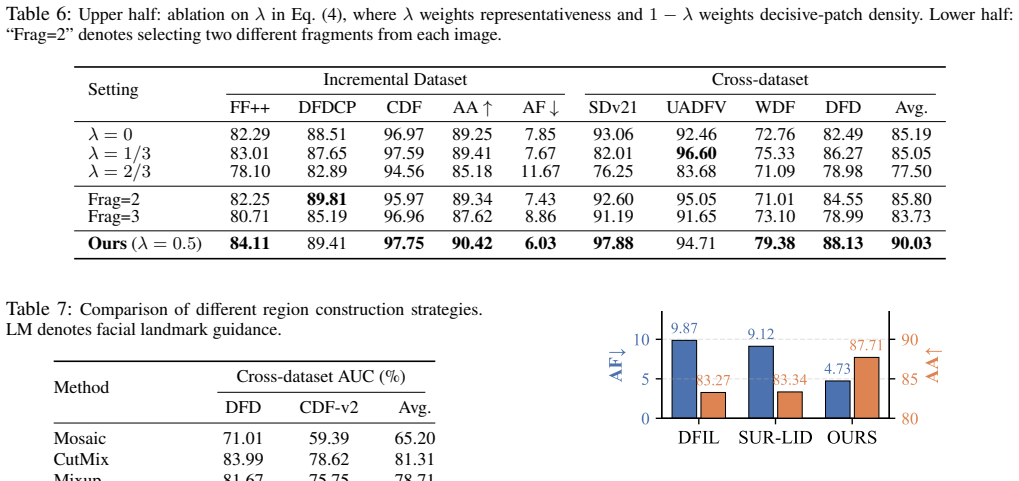
InfoDense's central claim is that facial forgery evidence is spatially concentrated and center-symmetric, so replaying an entire face is wasteful. The paper retains, for each historical face, only the fan-shaped segment with the largest number of 'decisive patches' — the top-10 CLIP image tokens most similar to a forgery-representative text embedding. Candidate segments are ranked by a weighted sum of cosine similarity to the task's feature centroid (representativeness) and decisive-patch count (information density), and the top-m are stored. At training time, stored segments are pasted onto current-task images with a binary mask, using four real/fake label combinations across tasks plus int
What carries the argument
The carrying mechanism is the 'decisive patch' — a local image region whose CLIP embedding aligns most closely with forgery semantics. Around it, InfoDense builds three operations: InfoDense Cut uses a two-pointer scan over ClockMix fan-shaped segments to find the segment that covers the maximum number of decisive patches; InfoDense Select ranks segments by a weighted combination of latent-space centroid distance and decisive-patch count; InfoDense Fuse reconstructs unbiased training inputs by masking stored segments onto current-task images with inter-task and intra-task mixing. The underlying assumption is that forgery cues are redundant enough across the face that one compact, center-anch
Load-bearing premise
The reported wins over prior methods rest on the assumption that those baselines would fare the same on the CLIP ViT-L/14 backbone under an identical replay-memory budget, which the paper does not itself re-run.
What would settle it
Re-run the leading baselines (e.g., DFIL, SUR-LID) on the same CLIP ViT-L/14 backbone with the same replay-buffer byte budget and sample count; if their average AUC reaches or exceeds InfoDense's, the regional-selection strategy is not the source of the gain. Alternatively, swap the CLIP-similarity decisive-patch scorer for random scores while keeping the same cut-and-fuse pipeline; a non-drop would show density-awareness is not doing the work.
If this is right
- Under a fixed memory budget, storing 1/n-size segments enables roughly n times more historical samples to be replayed, which should reduce catastrophic forgetting for any replay-based continual detector.
- Replay selection based on decisive patches steers the model toward intrinsic manipulation cues rather than dataset-specific background, which the paper shows as higher AUC on unseen diffusion and wild datasets.
- Storing fragments instead of full faces reduces identity-retrieval recall to near zero, turning replay storage into a partial de-identification mechanism.
- Global lossy compression (JPEG) degrades high-frequency forgery traces, whereas spatial compression preserves original pixels in decisive areas, so the paper's spatial-selection strategy dominates quality-compression at matched storage.
- The fusion scheme's combination of inter-task and intra-task mixing prevents fusion-boundary shortcuts, as evidenced by the ablation that drops performance when only inter-task fusion is used.
Where Pith is reading between the lines
- The decisive-patch scoring depends on CLIP's text-image alignment and on the encoder having acquired some forgery awareness from earlier tasks; a natural test is whether using the detector's own attention or a non-CLIP local-artifact score changes the gains, which would separate the density prior from the backbone.
- The main tables compare InfoDense's CLIP ViT-L/14 results against baselines reproduced from other architectures, so the incremental and cross-domain gaps may shrink if every method is re-run on the same backbone and the same byte budget; a direct re-implementation would settle how much of the gain is the regional-decisive strategy itself.
- If the facial-redundancy hypothesis is right, similar regional-decisive replay should benefit other continual perception tasks with localized cues (e.g., forgery of documents, medical image artifacts), where full-image replay is also memory-inefficient.
- The privacy argument is measured only by face-recognition retrieval; membership inference or attribute inference on fused samples could still leak identity, so the de-identification claim is narrower than 'privacy-safe'.
Editorial analysis
A structured set of objections, weighed in public.
Referee Report
Summary. The paper proposes InfoDense, a replay-based incremental face forgery detection (IFFD) method that stores only compact, forgery-decisive facial regions instead of full images. The pipeline consists of InfoDense Cut (CLIP-based localization of decisive patches and extraction of the fan-shaped segment containing the most such patches), InfoDense Select (ranking candidates by a weighted combination of latent-space representativeness and decisive-patch density), and InfoFuse (reconstructing training inputs by fusing stored segments with current-task samples, including inter-task and intra-task mixing). The authors report state-of-the-art results on a Protocol 1 benchmark: incremental average AUC 90.42 vs. 86.29 for SUR-LID, and cross-dataset average AUC 90.03 vs. 82.61 for GPL, while claiming substantial storage reduction and privacy benefits. The paper also includes ablations on compression strategies, selection strategies, fusion strategies, and storage-performance trade-offs.
Significance. The core idea — that regional decisive replay can reduce memory, increase replay diversity, and simultaneously improve cross-domain generalization — is well-motivated and potentially impactful for continual deepfake detection. The privacy analysis with ArcFace/CosFace retrieval is a useful and notable addition, and the proposed selection criterion in Eq. (4) is concrete and falsifiable. If the empirical claims are confirmed under controlled conditions, InfoDense would be a meaningful step toward memory-efficient and privacy-aware IFFD. However, the central empirical claim is currently not established: the main comparison is not controlled for backbone or replay budget, and the internal ablation tables contain apparent copy errors. These issues are load-bearing and must be addressed before the contribution can be assessed.
major comments (4)
- [§3.2, Table 1] The headline comparison is not controlled. Implementation Details (§3.1) state that InfoDense uses a pre-trained CLIP ViT-L/14 backbone, but the table gives no information about the backbone, replay memory budget, or buffer size m for any baseline row. The text claims 'under the same memory budget,' but the budget is never specified. Because the baseline rows are taken from published papers (e.g., DFIL MM'23, SUR-LID CVPR'25) that use different architectures, the reported gains (+4.13 incremental, +7.42 cross-dataset vs. the best baselines) could reflect the stronger backbone or a larger replay count rather than the regional replay strategy. Please re-run all baselines on the same CLIP ViT-L/14 backbone with identical replay storage budget, training epochs, and optimizer, and report the budget explicitly.
- [§3.3, Tables 2 and 3] The ablation tables contain apparent copy errors that make the internal evidence unreliable. In Table 2, the Base(DFIL) cross-dataset row (43.36, 88.31, 51.90, 63.87, 61.86) is identical to the L-Bound row of Table 1, not to DFIL's own row in Table 1 (76.53, 84.87, 70.01, 87.03, 79.61). In Table 3, the Random cross-dataset row is identical to the ClockMix row of Table 2 (83.40, 84.56, 73.78, 81.20, 80.58). These inconsistencies prevent the reader from verifying the claimed advantages of density-aware selection over random selection and of InfoDense over the DFIL baseline. Please correct the tables and re-verify all numbers.
- [§2.2, Eq. (1)–(4); Appendix 7.2] The decisive-patch scorer (Eq. (1)) and the representativeness term (Eq. (4)) both use the same CLIP-based model f(·, θ_{t-1}) that is being incrementally trained. Appendix 7.2 confirms that the score is only used after the model has learned forgery-awareness from prior tasks, so the replay selection is not independent of the model's current inductive bias. This creates a self-reinforcing loop: the model selects fragments it already considers decisive, which may amplify dataset-specific artifacts rather than intrinsic forgery cues. The cross-domain generalization claim would be substantially strengthened by comparing against an independent localizer (e.g., zero-shot CLIP or a fixed Grad-CAM from a pre-trained backbone) and showing that the gains persist. Please add such an experiment or otherwise control for this effect.
- [§3.1, Fig. 4; Appendix 2] The memory-efficiency claim is expressed only as a pixel-compression ratio n, but actual storage cost depends on the image encoding. Appendix 2 proposes a row-array encoding to make storage reduction 'strictly match' n%, but it is not stated whether the experiments in Fig. 4 and Tables 1–4 use this encoding or simply store masked/cropped images. Furthermore, the replay buffer size m is never specified in the main text. To make the efficiency claim auditable, please report actual storage in bytes (or the number of stored fragments per task) and state m for InfoDense and all baselines.
minor comments (5)
- [Throughout] The method is called 'InfoDense Fuse' in the abstract and Section 1, but 'InfoFuse' in Section 2.3. Please use one name consistently.
- [§3.1, PD definition] The definition PD = M0 − MN is ambiguous: M0 and MN are described as average AUC in the base and final sessions, but it is unclear which datasets are included in these averages. Please define explicitly.
- [§3.3, Table 2 caption] Table 2 is captioned 'Ablation study on compression strategies,' but the paragraph 'Impact of Regional Shapes and Patch Selection' refers to Table 2 for CutMix vs. ClockMix and CutMix+PD. Either the table or the paragraph should be retitled to avoid confusion.
- [Appendix and text] There are stray '/uni0000...' strings in the manuscript (e.g., after Table 4 and in the appendix figure captions), which appear to be corrupted Unicode/PDF artifacts. These need to be removed in the production version.
- [Reproducibility] No statement is provided about code or trained model release. For a paper whose central contribution is an algorithmic pipeline, a code-availability statement would be valuable.
Circularity Check
No significant circularity: the central empirical claim is grounded in external benchmark AUCs; the self-referential replay selection and nSeg metric are design-internal, not definitional predictions.
full rationale
The paper's derivation chain is a heuristic replay design (CLIP-based decisive-patch scoring, segment selection by representativeness and decisive-patch count, and fusion), and its headline claims are empirical AUC results on held-out frames and unseen datasets, not quantities that are definitionally equal to the method's inputs. The replay selector uses the same model that is later trained (Eqs. 1 and 4), which creates a self-reinforcing bias, but this does not force the reported test AUC: the model must still generalize to unselected test frames. The nSeg ablation compares the method against its own selection objective, so the finding that InfoDense has higher decisive-patch coverage is partially self-definitional, but the central conclusions are also supported by AUC, making this non-load-bearing. The uncontrolled backbone/memory-budget comparison and the apparent table copy errors are correctness/statistical-validity concerns, not circularity. Hyperparameter choices (K=10, λ=0.5) appear to have been selected using the same Protocol 1 evaluation, which is a test-set-selection risk, but the reported metrics are not fitted parameters renamed as predictions. Applying the prompt's strict standard of exhibiting a definitional reduction, no load-bearing circular step is present.
Axiom & Free-Parameter Ledger
free parameters (5)
- K (number of decisive patches) =
10
- lambda (representativeness vs. density weight) =
0.5
- n (compression ratio / fan angle divisor) =
Unspecified for Table 1
- m (replay buffer size in segments) =
Unspecified
- CLIP learnable prompt token / z_f =
Learned via adapter, value not reported
axioms (4)
- domain assumption Facial images contain substantial redundancy: discriminative forgery cues are concentrated in small regions, and the rest is irrelevant for replay.
- domain assumption CLIP cosine similarity between image patches and a text embedding is a valid forgery-decisive score.
- domain assumption Baseline results in Table 1 are comparable to InfoDense despite possibly different backbones and memory budgets.
- domain assumption 'Any inclusion of a fake segment implies the fused sample is fake' is a correct labeling rule.
read the original abstract
The rapid evolution of face forgery techniques has introduced an increasing variety of manipulations. Incremental Face Forgery Detection (IFFD), which incrementally adds new forgery data to fine-tune previously trained models, has emerged as a promising approach to handle evolving forgery threats. However, conventional replay-based IFFD methods suffer from catastrophic forgetting. Storing full historical images under limited memory often either fails to preserve subtle forgery cues or introduces domain bias, reducing the model's ability to learn intrinsic and transferable manipulation characteristics. In this paper, we propose a Density-Aware Regional Decisive replay strategy, termed InfoDense, to address these challenges. InfoDense prioritizes artifact-dense and forgery-critical regions, significantly reducing storage requirements while maintaining high-fidelity forgery evidence. We first introduce InfoDense Cut to localize decisive patches using CLIP-based embeddings. Then, InfoDense Select ranks candidate segments by combining latent-space representativeness and decisive patch counts, ensuring both diversity and information density in the replay buffer. Finally, InfoDense Fuse reconstructs unbiased training inputs by adaptively merging stored segments with current-task samples, enhancing knowledge retention and generalization. Extensive experiments on challenging incremental deepfake benchmarks demonstrate that InfoDense effectively mitigates catastrophic forgetting while improving cross-domain generalization.
Figures


Reference graph
Works this paper leans on
-
[1]
Bousselham, W.; Boggust, A.; Chaybouti, S.; Strobelt, H.; and Kuehne, H. 2025. Legrad: An explainability method for vision transformers via feature formation sensitivity. In Proceedings of the IEEE/CVF International Conference on Computer Vision, 20336--20345
2025
-
[2]
I.; Khvedchenya, E.; Parinov, A.; Druzhinin, M.; and Kalinin, A
Buslaev, A.; Iglovikov, V. I.; Khvedchenya, E.; Parinov, A.; Druzhinin, M.; and Kalinin, A. A. 2020. Albumentations: fast and flexible image augmentations. Information, 11(2): 125
2020
-
[3]
Cao, J.; Ma, C.; Yao, T.; Chen, S.; Ding, S.; and Yang, X. 2022. End-to-End Reconstruction-Classification Learning for Face Forgery Detection. In IEEE Conference on Computer Vision and Pattern Recognition, 4113--4122
2022
-
[4]
Chattopadhay, A.; Sarkar, A.; Howlader, P.; and Balasubramanian, V. N. 2018. Grad-cam++: Generalized gradient-based visual explanations for deep convolutional networks. In 2018 IEEE winter conference on applications of computer vision (WACV), 839--847. IEEE
2018
-
[5]
Chefer, H.; Gur, S.; and Wolf, L. 2021. Transformer interpretability beyond attention visualization. In Proceedings of the IEEE/CVF conference on computer vision and pattern recognition, 782--791
2021
-
[6]
Chen, L.; Zhang, Y.; Song, Y.; Liu, L.; and Wang, J. 2022. Self-supervised learning of adversarial example: Towards good generalizations for deepfake detection. In IEEE Conference on Computer Vision and Pattern Recognition, 18710--18719
2022
-
[7]
Chen, S.; Yao, T.; Chen, Y.; Ding, S.; Li, J.; and Ji, R. 2021. Local relation learning for face forgery detection. In AAAI Conference on Artificial Intelligence, volume 35, 1081--1088
2021
-
[9]
Cheng, J.; Yan, Z.; Zhang, Y.; Hao, L.; Ai, J.; Zou, Q.; Li, C.; and Wang, Z. 2025 a . Stacking brick by brick: Aligned feature isolation for incremental face forgery detection. In IEEE Conference on Computer Vision and Pattern Recognition, 13927--13936
2025
-
[10]
Cheng, J.; Yan, Z.; Zhang, Y.; Luo, Y.; Wang, Z.; and Li, C. 2024. Can we leave deepfake data behind in training deepfake detector? Advances in Neural Information Processing Systems, 37: 21979--21998
2024
-
[11]
Cheng, J.; Zhang, Y.; Zou, Q.; Yan, Z.; Liang, C.; Wang, Z.; and Li, C. 2025 b . Ed ˆ4: Explicit data-level debiasing for deepfake detection. IEEE Transactions on Image Processing
2025
-
[12]
Cui, X.; Li, Y.; Luo, A.; Zhou, J.; and Dong, J. 2025 a . Forensics Adapter: Adapting CLIP for Generalizable Face Forgery Detection. In IEEE/CVF Conference on Computer Vision and Pattern Recognition, 19207--19217
2025
-
[13]
Cui, X.; Li, Y.; Luo, A.; Zhou, J.; and Dong, J. 2025 b . Forensics adapter: Adapting clip for generalizable face forgery detection. In IEEE Conference on Computer Vision and Pattern Recognition Conference, 19207--19217
2025
-
[14]
Deng, J.; Guo, J.; Xue, N.; and Zafeiriou, S. 2019. Arcface: Additive angular margin loss for deep face recognition. In Proceedings of the IEEE Conference on Computer Vision and Pattern Recognition, 4690--4699
2019
-
[16]
Dong, S.; Wang, J.; Ji, R.; Liang, J.; Fan, H.; and Ge, Z. 2023. Implicit identity leakage: The stumbling block to improving deepfake detection generalization. In Proceedings of the IEEE Conference on Computer Vision and Pattern Recognition, 3994--4004
2023
-
[17]
Guo, J.; Zhu, X.; Zhao, C.; Cao, D.; Lei, Z.; and Li, S. Z. 2020. Learning meta face recognition in unseen domains. In IEEE Conference on Computer Vision and Pattern Recognition, 6163--6172
2020
-
[18]
Huang, B.; Wang, Z.; Yang, J.; Ai, J.; Zou, Q.; Wang, Q.; and Ye, D. 2023. Implicit Identity Driven Deepfake Face Swapping Detection. In IEEE Conference on Computer Vision and Pattern Recognition, 4490--4499
2023
-
[19]
A.; and Afghah, F
Kashiani, H.; Talemi, N. A.; and Afghah, F. 2025. Freqdebias: Towards generalizable deepfake detection via consistency-driven frequency debiasing. In IEEE Conference on Computer Vision and Pattern Recognition, 8775--8785. IEEE
2025
-
[20]
Kim, M.; Tariq, S.; and Woo, S. S. 2021. Cored: Generalizing fake media detection with continual representation using distillation. In ACM International Conference on Multimedia, 337--346
2021
-
[21]
Li, L.; Bao, J.; Zhang, T.; Yang, H.; Chen, D.; Wen, F.; and Guo, B. 2020 a . Face x-ray for more general face forgery detection. In IEEE Conference on Computer Vision and Pattern Recognition, 5001--5010
2020
-
[22]
Li, Y.; Chang, M.-C.; and Lyu, S. 2018. In ictu oculi: Exposing ai created fake videos by detecting eye blinking. In IEEE International Workshop on Information Forensics and Security, 1--7
2018
-
[23]
Li, Y.; Yang, X.; Sun, P.; Qi, H.; and Lyu, S. 2020 b . Celeb-df: A large-scale challenging dataset for deepfake forensics. In IEEE Conference on Computer Vision and Pattern Recognition, 3207--3216
2020
-
[24]
Li, Z.; and Hoiem, D. 2017. Learning without forgetting. IEEE Transactions on Pattern Analysis and Machine Intelligence, 40(12): 2935--2947
2017
-
[25]
Liang, J.; Shi, H.; and Deng, W. 2022. Exploring disentangled content information for face forgery detection. In European Conference on Computer Vision, 128--145. Springer
2022
-
[26]
Luo, Z.; Liu, Y.; Schiele, B.; and Sun, Q. 2023. Class-incremental exemplar compression for class-incremental learning. In IEEE Conference on Computer Vision and Pattern Recognition, 11371--11380
2023
-
[28]
R.; and Andrew Gully, J
Nick Dufour, G. R.; and Andrew Gully, J. 2019. Deep Fake Detection Dataset. https://ai.googleblog.com/2019/09/contributing-data-to-deepfake-detection.html
2019
-
[29]
Pan, K.; Yin, Y.; Wei, Y.; Lin, F.; Ba, Z.; Liu, Z.; Wang, Z.; Cavallaro, L.; and Ren, K. 2023. Dfil: Deepfake incremental learning by exploiting domain-invariant forgery clues. In ACM International Conference on Multimedia, 8035--8046
2023
-
[30]
Qian, Y.; Yin, G.; Sheng, L.; Chen, Z.; and Shao, J. 2020. Thinking in frequency: Face forgery detection by mining frequency-aware clues. In European Conference on Computer Vision, 86--103. Springer
2020
-
[31]
W.; Hallacy, C.; Ramesh, A.; Goh, G.; Agarwal, S.; Sastry, G.; Askell, A.; Mishkin, P.; Clark, J.; et al
Radford, A.; Kim, J. W.; Hallacy, C.; Ramesh, A.; Goh, G.; Agarwal, S.; Sastry, G.; Askell, A.; Mishkin, P.; Clark, J.; et al. 2021. Learning transferable visual models from natural language supervision. In International conference on machine learning, 8748--8763. PMLR
2021
-
[32]
Rebuffi, S.-A.; Kolesnikov, A.; Sperl, G.; and Lampert, C. H. 2017. icarl: Incremental classifier and representation learning. In IEEE Conference on Computer Vision and Pattern Recognition, 2001--2010
2017
-
[33]
Rossler, A.; Cozzolino, D.; Verdoliva, L.; Riess, C.; Thies, J.; and Nie ner, M. 2019. Faceforensics++: Learning to detect manipulated facial images. In IEEE International Conference on Computer Vision, 1--11
2019
-
[34]
R.; Cogswell, M.; Das, A.; Vedantam, R.; Parikh, D.; and Batra, D
Selvaraju, R. R.; Cogswell, M.; Das, A.; Vedantam, R.; Parikh, D.; and Batra, D. 2017. Grad-cam: Visual explanations from deep networks via gradient-based localization. In Proceedings of the IEEE international conference on computer vision, 618--626
2017
-
[35]
Shiohara, K.; and Yamasaki, T. 2022. Detecting deepfakes with self-blended images. In IEEE Conference on Computer Vision and Pattern Recognition, 18720--18729
2022
-
[36]
Sun, K.; Chen, S.; Yao, T.; Sun, X.; Ding, S.; and Ji, R. 2025. Continual face forgery detection via historical distribution preserving. International Journal of Computer Vision, 133(3): 1067--1084
2025
-
[37]
Sun, K.; Yao, T.; Chen, S.; Ding, S.; Li, J.; and Ji, R. 2022. Dual contrastive learning for general face forgery detection. In AAAI Conference on Artificial Intelligence, volume 36, 2316--2324
2022
-
[38]
Tian, J.; Yu, C.; Wang, X.; Chen, P.; Xiao, Z.; Han, J.; and Chai, Y. 2024. Dynamic mixed-prototype model for incremental deepfake detection. In ACM International Conference on Multimedia, 8129--8138
2024
-
[39]
Wang, C.; and Deng, W. 2021. Representative forgery mining for fake face detection. In IEEE Conference on Computer Vision and Pattern Recognition, 14923--14932
2021
-
[40]
Wang, H.; Wang, Y.; Zhou, Z.; Ji, X.; Gong, D.; Zhou, J.; Li, Z.; and Liu, W. 2018. CosFace: Large Margin Cosine Loss for Deep Face Recognition. In IEEE Conference on Computer Vision and Pattern Recognition, 5265--5274
2018
-
[42]
Yan, S.; Xie, J.; and He, X. 2021. Der: Dynamically expandable representation for class incremental learning. In IEEE Conference on Computer Vision and Pattern Recognition, 3014--3023
2021
-
[43]
Yan, Z.; Luo, Y.; Lyu, S.; Liu, Q.; and Wu, B. 2024 a . Transcending forgery specificity with latent space augmentation for generalizable deepfake detection. In IEEE Conference on Computer Vision and Pattern Recognition, 8984--8994
2024
-
[44]
Yan, Z.; Wang, J.; Jin, P.; Zhang, K.-Y.; Liu, C.; Chen, S.; Yao, T.; Ding, S.; Wu, B.; and Yuan, L. 2025 a . Orthogonal Subspace Decomposition for Generalizable AI-Generated Image Detection. In International Conference on Machine Learning, 70268--70288
2025
-
[45]
Yan, Z.; Wang, J.; Wang, Z.; Jin, P.; Zhang, K.-Y.; Chen, S.; Yao, T.; Ding, S.; Wu, B.; and Yuan, L. 2025 b . Effort: Efficient orthogonal modeling for generalizable ai-generated image detection. In International Conference on Machine Learning
2025
-
[47]
Yan, Z.; Zhang, Y.; Fan, Y.; and Wu, B. 2023 a . UCF: Uncovering Common Features for Generalizable Deepfake Detection. In IEEE International Conference on Computer Vision, 22412--22423
2023
-
[49]
Zhang, X.; Zhu, P.; Zhang, C.; Yan, Z.; Cheng, J.; Lao, M.; Cai, S.; and Guo, Y. 2025. Generalization-Preserved Learning: Closing the Backdoor to Catastrophic Forgetting in Continual Deepfake Detection. In Proceedings of the IEEE/CVF International Conference on Computer Vision, 3798--3808
2025
-
[50]
Zhao, H.; Zhou, W.; Chen, D.; Wei, T.; Zhang, W.; and Yu, N. 2021. Multi-attentional deepfake detection. In IEEE Conference on Computer Vision and Pattern Recognition, 2185--2194
2021
-
[51]
Zhou, Y.; He, X.; Lin, K.; Fan, B.; Ding, F.; and Li, B. 2026. Simplicity Prevails: The Emergence of Generalizable AIGI Detection in Visual Foundation Models. arXiv preprint arXiv:2602.01738
Pith/arXiv arXiv 2026
-
[52]
Zi, B.; Chang, M.; Chen, J.; Ma, X.; and Jiang, Y.-G. 2020. Wilddeepfake: A challenging real-world dataset for deepfake detection. In ACM International Conference on Multimedia, 2382--2390
2020
-
[53]
FirstName LastName , title =
-
[54]
FirstName Alpher , title =
-
[55]
Journal of Foo , volume = 13, number = 1, pages =
FirstName Alpher and FirstName Fotheringham-Smythe , title =. Journal of Foo , volume = 13, number = 1, pages =
-
[56]
Journal of Foo , volume = 14, number = 1, pages =
FirstName Alpher and FirstName Fotheringham-Smythe and FirstName Gamow , title =. Journal of Foo , volume = 14, number = 1, pages =
-
[57]
IEEE Conference on Computer Vision and Pattern Recognition , pages =
FirstName Alpher and FirstName Gamow , title =. IEEE Conference on Computer Vision and Pattern Recognition , pages =
-
[58]
ACM SIGGRAPH 2008 papers , pages=
Face swapping: automatically replacing faces in photographs , author=. ACM SIGGRAPH 2008 papers , pages=
2008
-
[59]
IEEE International Conference on Computer Vision , pages=
Fast face-swap using convolutional neural networks , author=. IEEE International Conference on Computer Vision , pages=
-
[60]
IEEE International Conference on Computer Vision , pages=
Everybody dance now , author=. IEEE International Conference on Computer Vision , pages=
-
[61]
Acm Transactions on Graphics , volume=
Deferred neural rendering: Image synthesis using neural textures , author=. Acm Transactions on Graphics , volume=. 2019 , publisher=
2019
-
[62]
IEEE Conference on Computer Vision and Pattern Recognition , pages=
High-fidelity and arbitrary face editing , author=. IEEE Conference on Computer Vision and Pattern Recognition , pages=
-
[63]
IEEE International Workshop on Information Forensics and Security , pages=
Mesonet: a compact facial video forgery detection network , author=. IEEE International Workshop on Information Forensics and Security , pages=
-
[64]
IEEE Conference on Computer Vision and Pattern Recognition , pages=
On the detection of digital face manipulation , author=. IEEE Conference on Computer Vision and Pattern Recognition , pages=
-
[65]
IEEE International Conference on Acoustics, Speech and Signal Processing , pages=
Capsule-forensics: Using capsule networks to detect forged images and videos , author=. IEEE International Conference on Acoustics, Speech and Signal Processing , pages=
-
[66]
IEEE International Conference on Computer Vision , pages=
Faceforensics++: Learning to detect manipulated facial images , author=. IEEE International Conference on Computer Vision , pages=
-
[67]
AAAI Conference on Artificial Intelligence , volume=
Exploiting fine-grained face forgery clues via progressive enhancement learning , author=. AAAI Conference on Artificial Intelligence , volume=
-
[68]
AAAI Conference on Artificial Intelligence , volume=
F ^3 Net: fusion, feedback and focus for salient object detection , author=. AAAI Conference on Artificial Intelligence , volume=
-
[69]
IEEE Conference on Computer Vision and Pattern Recognition , pages=
ArcFace: Additive Angular Margin Loss for Deep Face Recognition , author=. IEEE Conference on Computer Vision and Pattern Recognition , pages=
-
[70]
IEEE Conference on Computer Vision and Pattern Recognition , pages=
CosFace: Large Margin Cosine Loss for Deep Face Recognition , author=. IEEE Conference on Computer Vision and Pattern Recognition , pages=
-
[71]
IEEE Conference on Computer Vision and Pattern Recognition , pages=
Curricularface: adaptive curriculum learning loss for deep face recognition , author=. IEEE Conference on Computer Vision and Pattern Recognition , pages=
-
[72]
DeepFakes , author =
-
[73]
IEEE Conference on Computer Vision and Pattern Recognition , pages=
Face2face: Real-time face capture and reenactment of rgb videos , author=. IEEE Conference on Computer Vision and Pattern Recognition , pages=
-
[74]
Asian Conference on Computer Vision , pages=
Fsnet: An identity-aware generative model for image-based face swapping , author=. Asian Conference on Computer Vision , pages=. 2018 , organization=
2018
-
[75]
arXiv 2018 , author=
Rsgan: Face swapping and editing using face and hair representation in latent spaces. arXiv 2018 , author=
2018
-
[76]
IEEE Conference on Computer Vision and Pattern Recognition , pages=
Towards open-set identity preserving face synthesis , author=. IEEE Conference on Computer Vision and Pattern Recognition , pages=
-
[77]
IEEE International Conference on Computer Vision , pages=
Fsgan: Subject agnostic face swapping and reenactment , author=. IEEE International Conference on Computer Vision , pages=
-
[78]
arXiv preprint arXiv:1912.13457 , year=
Faceshifter: Towards high fidelity and occlusion aware face swapping , author=. arXiv preprint arXiv:1912.13457 , year=
Pith/arXiv arXiv 1912
-
[79]
ACM International Conference on Multimedia , pages=
Simswap: An efficient framework for high fidelity face swapping , author=. ACM International Conference on Multimedia , pages=
-
[80]
IEEE Conference on Computer Vision and Pattern Recognition , pages=
Information bottleneck disentanglement for identity swapping , author=. IEEE Conference on Computer Vision and Pattern Recognition , pages=
-
[81]
ACM International Conference on Multimedia , pages=
Spatiotemporal inconsistency learning for deepfake video detection , author=. ACM International Conference on Multimedia , pages=
-
[82]
European Conference on Computer Vision , pages=
Two-branch recurrent network for isolating deepfakes in videos , author=. European Conference on Computer Vision , pages=. 2020 , organization=
2020
-
[83]
IEEE International Conference on Biometrics Theory, Applications and Systems , pages=
Multi-task learning for detecting and segmenting manipulated facial images and videos , author=. IEEE International Conference on Biometrics Theory, Applications and Systems , pages=
-
[84]
AAAI Conference on Artificial Intelligence , volume=
Dual contrastive learning for general face forgery detection , author=. AAAI Conference on Artificial Intelligence , volume=
-
[85]
ACM International Conference on Multimedia , pages=
Wilddeepfake: A challenging real-world dataset for deepfake detection , author=. ACM International Conference on Multimedia , pages=
-
[86]
arXiv preprint arXiv:1409.1556 , year=
Very deep convolutional networks for large-scale image recognition , author=. arXiv preprint arXiv:1409.1556 , year=
discussion (0)
Sign in with ORCID, Apple, or X to comment. Anyone can read and Pith papers without signing in.