REVIEW 4 major objections 5 minor 10 cited by
A data-driven decomposition of GWTC-4 shows that the 35 solar-mass peak is produced by one subpopulation of equal-mass, isotropically spinning binaries, and that this subpopulation can be entirely assembled in globular clusters with black h
Reviewed by Pith at T0; open to challenge. T0 means a machine referee read the full paper against a public rubric. the ladder, T0–T4 →
T0 review · deepseek-v4-flash
2026-08-03 19:50 UTC pith:FVPRRSES
load-bearing objection Careful 3D BGP characterization of the 35 M_sun peak, but the exclusive-GC and merger-rate-lower-bound claims rest on a four-curve CMC grid and post-hoc subpopulation selection. the 4 major comments →
Characterizing Binary Black Hole Subpopulations in GWTC-4 with Binned Gaussian Processes: On the Origins of the 35M_(odot) Peak
The pith
A machine-rendered reading of the paper's core claim, the machinery that carries it, and where it could break.
Core claim
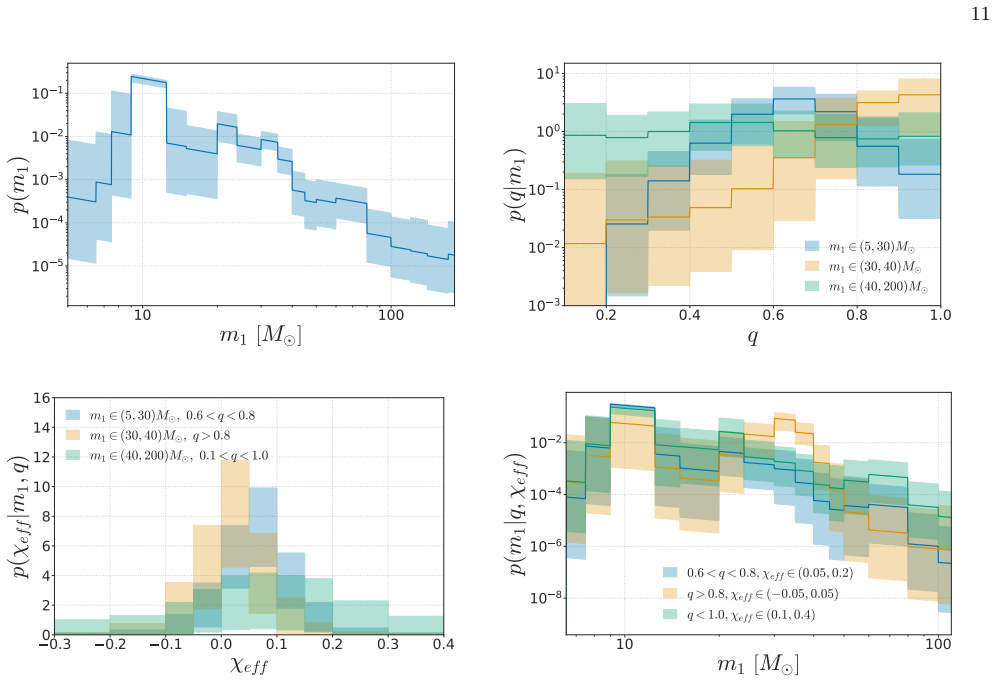
Central claim: in the joint space of primary mass, mass ratio, and effective inspiral spin, the inferred merger rate density of GWTC-4 decomposes into three subpopulations, and only one of them—spanning roughly 31.6–44.2 M⊙—carries the 35 M⊙ peak. This subpopulation is characterized by mass ratios that rail against q≈1 and a χeff distribution symmetric about zero, the signature of isotropic spin orientations. Comparing this component with published Cluster Monte Carlo simulations of first-generation globular cluster mergers, the authors find it is fully consistent at the 90% level with a purely dynamical origin, but only for black hole birth spins in the range 0.1–0.2; higher or lower birth
What carries the argument
The central object is a binned Gaussian process (BGP) merger rate density, nγ = dNγ/(dlog m1 dq dχeff dVc dts), a three-dimensional piecewise-constant model of the rate density in primary mass, mass ratio, and effective inspiral spin, regularized by a Gaussian-process prior that smooths over bins. The GP prior handles sparse regions of parameter space, and the joint posterior over rate densities and GP hyperparameters (mean, amplitude, correlation length scales) is sampled with Hamiltonian Monte Carlo. This machinery does two jobs: it reconstructs the joint distribution without imposing a parametric form, letting subpopulations emerge directly from the data; and it yields rate-density bounds
Load-bearing premise
The load-bearing premise is that the four precomputed Cluster Monte Carlo simulations—first-generation mergers with birth spins of only 0, 0.1, 0.2, and 0.5—faithfully represent the globular cluster channel, since the exclusivity and the 0.1–0.2 birth-spin constraint come from matching the data to those curves at the 90% level rather than from a posterior over cluster parameters.
What would settle it
If future, larger catalogs show the 30–40 M⊙ subpopulation's effective-spin distribution is not symmetric about zero, or its mass-ratio distribution does not rail toward q≈1, the exclusive globular cluster claim would be falsified; likewise, re-running the CMC comparison with hierarchical mergers and a continuous birth-spin grid would falsify the 0.1–0.2 constraint if no birth-spin value reproduces the inferred width.
If this is right
- If correct, the 30–40 M⊙ excess in GWTC-4 is produced predominantly by dynamically assembled binaries in globular clusters, not by a pile-up of pair-instability supernovae.
- Black hole birth spins in the globular cluster channel would be pinned to roughly 0.1–0.2, because neither the 0, 0.1, nor 0.5 simulation reproduces the inferred effective-spin width.
- The globular cluster merger rate is at least 0.69^{+0.23}_{-0.33} Gpc^{-3} yr^{-1}, a lower bound consistent with the range 0.2–57 Gpc^{-3} yr^{-1} spanned by theoretical predictions.
- The other two subpopulations (low-mass and high-mass) require substantial contributions from other formation channels, so the 35 M⊙ feature is not a universal mass-spin correlation of all black hole mergers.
- No significant mass-ratio–effective-spin correlation is required to explain the data, indicating the identified subpopulations are not an artifact of marginalizing over an underlying q–χeff correlation.
Where Pith is reading between the lines
- The 0.1–0.2 birth-spin window, if real, becomes a direct constraint on stellar collapse simulations; a continuous grid of natal spins would sharpen it into a posterior rather than a four-point comparison.
- The paper's logic implies the 35 M⊙ peak may be a 'shoulder'—a roughly flat globular-cluster mass distribution falling off above ≈40 M⊙—so searches for a sharp, narrow peak at exactly 35 M⊙ may be looking for the wrong signature.
- Because χeff only measures the projection of spins onto the orbit, measuring the precession parameter χp for events in the 30–40 M⊙ subpopulation would provide an independent test: dynamically assembled binaries should show measurable precession, whereas isolated binaries would not.
- The three-subpopulation split is suggestive rather than model-selected, since the inference does not produce Bayesian evidences; a parametric model guided by these trends could convert the lower bound into a full posterior over globular cluster merger rate.
Editorial analysis
A structured set of objections, weighed in public.
Referee Report
Summary. The paper presents a binned Gaussian-process (BGP) analysis of the joint distribution of primary mass, mass ratio, and effective spin for 153 BBH events in GWTC-4. It identifies three subpopulations: a low-mass group (5–31.6 Msun), a mid-mass group (31.6–44.2 Msun) containing the 35 Msun peak with equal-mass and isotropic-spin preferences, and a high-mass group (>44.2 Msun). The paper argues that the mid-mass subpopulation can be exclusively explained by dynamically assembled BBHs in globular clusters (GCs), specifically for black hole birth spins in 0.1–0.2, based on comparison with four fixed CMC simulation tracks. It further quotes a lower bound on the GC BBH merger rate of 0.69^{+0.23}_{-0.33} Gpc^{-3} yr^{-1}. The authors conclude that dynamical formation in GCs is a strong candidate for the 30–40 Msun excess.
Significance. If the central interpretation were fully supported, this would be an important result: a data-driven identification of a subpopulation responsible for the 35 Msun peak, with specific implications for GC formation and BH birth spins. The methodological infrastructure is a clear strength: Monte Carlo integration convergence is penalized in the likelihood (App. D), an uncorrelated injection study checks against model artifacts (App. C), an alternate binning is shown to give consistent results (App. B), and the gppop pipeline is public. These elements substantiate the non-parametric inference itself. However, the astrophysical conclusion—exclusive GC origin and the GC rate lower bound—rests on a post-hoc consistency check against a fixed, discrete set of CMC predictions, not on a statistical model comparison. As written, the gap between the inference and the astrophysical claims is the main weakness.
major comments (4)
- [Sec. 4 / Fig. 3] The claim that Subpopulation 2 'can exclusively comprise' GC binaries with birth spins 0.1–0.2 is supported only by comparing the inferred conditional chi_eff and q distributions to four noiseless CMC curves (birth spins 0, 0.1, 0.2, 0.5). No mixture model includes a GC fraction; there is no posterior over birth spin or over cluster population parameters; and the phrase 'fully consistent (at the 90% level of the inferred distributions)' is not defined by a quantitative statistic. At most this analysis shows that the data are consistent with one of the four tracks; it does not license an exclusivity claim. A proper model comparison, or at least an explicit Bayes factor or posterior-predictive p-value, is needed.
- [Sec. 4 / merger-rate lower bound] The step from the inferred binned rate in the 31.6–44.2 Msun, q>0.8, chi_eff near 0 region to a 'lower bound on the merger rate of BBHs in globular clusters' (0.69^{+0.23}_{-0.33} Gpc^{-3} yr^{-1}) is not justified. That rate is the total merger rate over all formation channels in that slice of parameter space. Without a model separating GC from field/other channels, it cannot be a lower bound on the GC channel unless one has already assumed that the region is exclusively GC—which is exactly the claim in question. The text should clarify that 0.69 is the inferred total rate in that slice, not a channel-specific rate.
- [Sec. 3.1 / Sec. 4] The subpopulations are defined post hoc: Subpopulation 2 is selected as the mass range (31.6–44.2 Msun), q>0.8, chi_eff near 0 because these are the signatures expected from GCs. The subsequent agreement with CMC predictions is therefore not independent confirmation. The 'more than 90% significance' statements in Sec. 3.1 are conditional posterior overlaps, not model-comparison significances, and no multiple-testing correction is applied. This weakens the evidential weight of the central claim; the analysis should be framed as exploratory, with confirmation requiring targeted parametric models (as the authors themselves note in the final paragraph).
- [Fig. 3 caption / Sec. 4] The CMC comparison uses only 1G+1G mergers and omits hierarchical mergers, which can be a significant fraction of GC events (as acknowledged in the same section for Subpopulation 3, Fig. 5). Without an assessment of the hierarchical-merger contribution in the 31.6–44.2 Msun range and its effect on chi_eff, the 'exclusively' claim is premature. Additionally, with only four discrete birth-spin values, the statement that birth spins are in 'the range (0.1–0.2)' is not a posterior constraint on a continuous parameter; it is a statement about two grid points. The language should be changed accordingly.
minor comments (5)
- [Abstract] The abstract says the subpopulation 'can exclusively comprise' GC systems, while Sec. 4 concludes the 35 Msun feature 'likely arises' from GCs; these are different epistemic claims. Please align the language.
- [Table 1] The notation 'log-uniform(5, 200, 23)' is not self-explanatory; clarify whether it means 23 bins log-uniformly spaced between 5 and 200 Msun, and consider listing the actual bin edges.
- [Sec. 3] The text says 'excluding clear population outliers' but does not specify which events or criteria were used. This matters for reproducibility and for interpreting the sample size of 153.
- [Fig. 2] The 'Prior' curve for the Pearson correlation coefficient is shown but the text does not explain how it is computed from the GP prior; please add a sentence of description.
- [References] Several DOIs appear to be placeholders (e.g., Antonini et al. 2025a, doi: 10.1103/nxnr-pdyx; Essick et al. 2025, doi: 10.1103/44x3-hv3y). These should be verified before publication.
Circularity Check
Central GC-origin claim rests on an external CMC comparison rather than a circular reduction; one internal step (defining the peak-exhibiting subpopulation around the 35 M_sun over-density) is partially definitional.
specific steps
-
self definitional
[Sec. 3.1 (subpopulation definitions) and Sec. 4 (first paragraph)]
"Guided by the over-densities in the marginal mass-distribution, we reconstruct the conditional distribution of BBH mass-ratios given different ranges of primary mass... Subpopulation 2 contributes to the ∼35M⊙ peak in the mass distribution... By reconstructing the primary mass distributions of each subpopulation, we find that only Subpopulation 2 demonstrates the 35M⊙ peak, whereas the other two exhibit a monotonic fall off."
Subpopulation 2's mass window (31.6–44.2 M_sun) is selected because it contains the over-density / 35 M_sun peak in the marginal m1 distribution. The later statement that only Subpopulation 2 exhibits the 35 M_sun peak is therefore partly a restatement of the bin definition rather than an independent finding. The non-trivial content—the symmetric chi_eff distribution near zero, the q distribution railing at 1, and consistency with the external CMC tracks at birth spins 0.1–0.2—does not reduce to the bin choice and carries the paper's substantive inference.
full rationale
The chain from data to population inference is self-contained and non-circular: the BGP rate-density model (Eqs. 1–2) is a flexible, data-driven three-dimensional binned inference with a GP prior, validated against uncorrelated injections (Appendix C), alternative binning (Appendix B), and Monte Carlo convergence checks (Appendix D). The central astrophysical claim—that the 35 M_sun-peak subpopulation can be exclusively GC dynamical mergers if BH birth spins are ~0.1–0.2—is tested against the fixed external CMC simulations of Rodriguez et al. (2019) / the Zevin (2020) data release; those simulations are not fitted to GWTC-4 data, so the agreement is an external consistency check rather than a self-fulfilling fit. The quoted lower bound on the GC merger rate (0.69^{+0.23}_{-0.33} Gpc^{-3} yr^{-1}) is derived conditionally from the inferred rate in the 30–40 M_sun range given the argued GC dominance; it is a logical step, not an identity with the input. The paper explicitly disclaims what it cannot do: "the sampling techniques necessitated by such complex models do not yield Bayesian evidences, which makes it difficult to rigorously ascertain how much the data prefers the existence of these specific subpopulations" and states that targeted parametric modeling / model comparison is "ongoing"; this caveat is weighed here as evidence that the subpopulation interpretation is presented as an indication, not a forced result. The only partially definitional element is the segmentation itself: Subpopulation 2's mass window is chosen from the over-density at the 35 M_sun peak, and the paper then reports that this subpopulation is the one exhibiting the peak. Because the distinctive chi_eff and q signatures and the CMC comparison are not definitional, this is a mild labeling artifact. Score 3 reflects one modest self-definitional step while the principal derivation remains independent of its inputs.
Axiom & Free-Parameter Ledger
free parameters (3)
- Per-bin merger rate densities n_gamma =
joint posterior (23 m1 bins x 16 chi_eff bins x 9 q bins, minus unphysical bins)
- GP hyperparameters (mean, covariance amplitude, length scales) =
inferred simultaneously; priors standard normal, half-normal, log-normal
- Redshift evolution parameter kappa =
not stated in text
axioms (7)
- standard math Poisson process likelihood for an inhomogeneous Poisson population (Eq. 2) with hierarchical Bayesian inference
- domain assumption Planck2015 cosmology used for source-frame masses and luminosity distances
- domain assumption GWTC-4 detection sample, injections, and selection function accurately represent the detector population; 'clear population outliers' are excluded without specification
- domain assumption The binned GP prior with exponential quadratic kernel and chosen length-scale priors adequately regularizes the 3D rate field; only alternate m1 binning is checked, not alternate q or chi_eff binning
- domain assumption CMC simulations from Rodriguez et al. (2019)/Zevin (2020) with 1G+1G mergers and discrete birth spins {0, 0.1, 0.2, 0.5} represent the GC dynamical formation channel
- domain assumption A symmetric chi_eff distribution peaking at zero is interpreted as isotropic spin orientations
- domain assumption The redshift-evolution parameter kappa is fixed or inferred but unreported; conclusions may depend on its value
read the original abstract
Understanding the astrophysical origins of binary black holes requires accurate and flexible modeling of multi-dimensional population properties. In this \textit{Letter}, using a data-driven framework based on binned Gaussian processes, we characterize the joint distribution of BBH primary masses, mass ratios, and effective inspiral spins. We identify three distinct subpopulations in the GWTC-4 sample of observations and investigate their astrophysical origins. We find that only one of the three subpopulations exhibits the $35M_{\odot}$ peak, which is characterized by a strong preference for equal mass systems and isotropic spin orientations. Our inferred distributions are consistent with a predominantly dynamical origin of this feature. By comparing with theoretical simulations, we further show that the subpopulation that exhibits the $35M_{\sun}$ peak can exclusively comprise dynamically assembled systems in globular clusters, specifically if black hole birth spins are in the range~$(0.1-0.2)$, whereas the other two subpopulations require substantial contributions from alternative formation channels. We constrain the \textit{lower bound} on the merger rate of BBHs in globular clusters to be $0.69^{+0.23}_{-0.33} \rm{Gpc}^{-3}\rm{yr}^{-1}$, which is consistent with most theoretical predictions(that can range from $0.2-57\rm{Gpc}^{-3}\rm{yr}^{-1}$ depending on modeling assumptions). We conclude that dynamical formation in globular clusters remains a strong candidate for the origin of this excess near $30-40M_{\odot}$ and that more data and targeted parametric models are necessary to rigorously establish this interpretation.
Figures



Forward citations
Cited by 10 Pith papers
-
A Four-dimensional Model-agnostic Probe into the Astrophysical Origins of Binary Black Hole Subpopulations
A GPU-accelerated binned Gaussian process yields the first model-agnostic 4D BBH population in (m1, q, χeff, χp), revealing four mass-based subpopulations and new spin-mass-ratio correlations.
-
Reversible-jump MCMC reveals binary black hole subpopulations with distinct redshift evolution
Reversible-jump MCMC analysis of LIGO binary black hole mergers identifies three subpopulations with distinct properties and independent redshift evolution.
-
Stable mass transfer in massive binaries leading to merging black holes
Stable mass transfer in massive binaries, modeled with the accreting star's altered structure, produces merging black holes matching LIGO/Virgo masses and spins.
-
Revealing Four Subpopulations of Binary Black-Hole Mergers with the Fifth Gravitational-Wave Transient Catalog
GWTC-5.0 black-hole mergers split into four subpopulations: a dominant ~10 solar-mass group, an unequal-mass branch, a near-equal-mass 30–35 solar-mass branch, and a rare high-mass hierarchical group.
-
A Strongly Parametrized Mass Ratio Model for the Stable Mass Transfer Channel: a Case Study of the $10 \, \rm{M}_{\odot}$ Peak
A parametrized analytical model for BBH mass ratios from the stable mass transfer channel is derived and applied to the 10 solar-mass peak in GWTC-4, favoring little mass-ratio reversal.
-
Second-Generation Mass Peak in the Gravitational-Wave Population as a Probe of Globular Clusters
Dynamical formation in globular clusters produces a robust second black-hole mass peak at ~70 solar masses from second-generation mergers when the first-generation spectrum is truncated by pair-instability supernovae.
-
Measurement prospects for the pair-instability mass cutoff with gravitational waves
Simulations show a 40-50 solar-mass black-hole cutoff is not guaranteed to be confidently recovered from GWTC-4-like catalogs, spurious detections are unlikely, and O4 data would reduce cutoff-mass uncertainty by at l...
-
Targeting black holes from metal-poor progenitors with next-generation gravitational-wave detectors
Introduces a target redshift z_t to isolate metal-poor black hole progenitors and a statistical framework to test merger-rate variations against forecasts from Einstein Telescope and Cosmic Explorer.
-
Compactness Peaks and Subpopulations: Probing Stellar Physics and Formation Channels of Merging Binary Black Holes
A stripped-star-motivated five-component model for binary black hole populations is preferred over the LVK baseline by a log10 Bayes factor of 7.69 and attributes the observed mass features to isolated, dynamical, and...
-
Is the Binary Black Hole Population Inference from Gravitational-Wave Data Robust?
Waveform modeling uncertainties can distort features in the binary black hole mass distribution inferred from gravitational-wave data more than statistical uncertainties.
Reference graph
Works this paper leans on
-
[1]
, " * write output.state after.block = add.period write newline
ENTRY address archivePrefix author booktitle chapter doi edition editor eprint howpublished institution journal key month number organization pages publisher school series title misctitle type volume year version url label extra.label sort.label short.list INTEGERS output.state before.all mid.sentence after.sentence after.block FUNCTION init.state.consts ...
-
[2]
write newline
" write newline "" before.all 'output.state := FUNCTION format.url url empty "" new.block "" url * "" * if FUNCTION format.eprint eprint empty "" archivePrefix empty "" archivePrefix "arXiv" = new.block " " eprint * " " * new.block " " eprint * " " * if if if FUNCTION format.doi doi empty "" " " doi * " " * if FUNCTION format.pid doi empty eprint empty ur...
-
[3]
- [1] #1 = = ^ ^ ^ .\!\!^ d .\!\!^ h .\!\!^ m .\!\!^ s .\!\!^ @mss
thebibliography [1] 20pt to REFERENCES 6pt =0pt -12pt 10pt plus 3pt =0pt =0pt =1pt plus 1pt =0pt =0pt -12pt =13pt plus 1pt =20pt =13pt plus 1pt \@M =10000 =-1.0em =0pt =0pt 0pt =0pt =1.0em @enumiv\@empty 10000 10000 `\.\@m \@noitemerr \@latex@warning Empty `thebibliography' environment \@ifnextchar \@reference \@latexerr Missing key on reference command E...
2021
-
[4]
Aasi, J., et al. 2015, Class. Quant. Grav., 32, 074001, 10.1088/0264-9381/32/7/074001
- [5]
-
[6]
---. 2025 b . 2508.18079
Pith/arXiv arXiv 2025
-
[7]
---. 2025 c . 2508.18083
Pith/arXiv arXiv 2025
-
[8]
Abbott, B. P., et al. 2019, Phys. Rev. X, 9, 031040, 10.1103/PhysRevX.9.031040
-
[9]
Abbott, R., Abbott, T. D., Abraham, S., et al. 2020, The Astrophysical Journal Letters, 896, L44, 10.3847/2041-8213/ab960f
-
[10]
2021, The Astrophysical Journal Letters, 913, L7, 10.3847/2041-8213/abe949
---. 2021, The Astrophysical Journal Letters, 913, L7, 10.3847/2041-8213/abe949
-
[11]
2023, Physical Review X, 13, 011048, 10.1103/PhysRevX.13.011048
---. 2023, Physical Review X, 13, 011048, 10.1103/PhysRevX.13.011048
-
[12]
2014, Classical and Quantum Gravity, 32, 024001, 10.1088/0264-9381/32/2/024001
Acernese, F., Agathos, M., Agatsuma, K., et al. 2014, Classical and Quantum Gravity, 32, 024001, 10.1088/0264-9381/32/2/024001
-
[13]
Adamcewicz, C., Galaudage, S., Lasky, P. D., & Thrane, E. 2024, Astrophys. J. Lett., 964, L6, 10.3847/2041-8213/ad2df2
-
[14]
Adamcewicz, C., Lasky, P. D., & Thrane, E. 2023, The Astrophysical Journal, 956, 63, 10.3847/1538-4357/acf763
-
[15]
Ade, P. A. R., et al. 2016, Astron. Astrophys., 594, A13, 10.1051/0004-6361/201525830
-
[16]
2021, Progress of Theoretical and Experimental Physics, 2021, 05A102, 10.1093/ptep/ptab018
Akutsu, T., Ando, M., Arai, K., et al. 2021, Progress of Theoretical and Experimental Physics, 2021, 05A102, 10.1093/ptep/ptab018
-
[17]
Alvarez-Lopez, S., Heinzel, J., Mould, M., & Vitale, S. 2025. 2506.20731
Pith/arXiv arXiv 2025
-
[18]
Antonini, F., Callister, T., Dosopoulou, F., Romero-Shaw, I. M., & Chattopadhyay, D. 2025 a , Phys. Rev. D, 112, 063040, 10.1103/nxnr-pdyx
-
[19]
2023, Monthly Notices of the Royal Astronomical Society, 522, 466, 10.1093/mnras/stad972
Antonini, F., Gieles, M., Dosopoulou, F., & Chattopadhyay, D. 2023, Monthly Notices of the Royal Astronomical Society, 522, 466, 10.1093/mnras/stad972
-
[20]
Antonini, F., & Perets, H. B. 2012, Astrophys. J., 757, 27, 10.1088/0004-637X/757/1/27
-
[21]
Antonini, F., Romero-Shaw, I., Callister, T., et al. 2025 b . 2509.04637
Pith/arXiv arXiv 2025
-
[22]
Antonini, F., Romero-Shaw, I. M., & Callister, T. 2025 c , Phys. Rev. Lett., 134, 011401, 10.1103/PhysRevLett.134.011401
-
[23]
Ashton, G., Hübner, M., Lasky, P. D., et al. 2019, The Astrophysical Journal Supplement Series, 241, 27, 10.3847/1538-4365/ab06fc
-
[24]
Banagiri, S., Thrane, E., & Lasky, P. D. 2025. 2509.15646
Pith/arXiv arXiv 2025
-
[25]
Bartos, I., Kocsis, B., Haiman, Z., & M \'a rka, S. 2017, Astrophys. J., 835, 165, 10.3847/1538-4357/835/2/165
-
[26]
Belczynski, K., Kalogera, V., & Bulik, T. 2001, Astrophys. J., 572, 407, 10.1086/340304
doi:10.1086/340304 2001
-
[27]
Belczynski, K., et al. 2020, Astron. Astrophys., 636, A104, 10.1051/0004-6361/201936528
-
[28]
Biscoveanu, S. 2025. 2502.04278
Pith/arXiv arXiv 2025
-
[29]
Briel, M. M., Stevance, H. F., & Eldridge, J. J. 2023, Mon. Not. Roy. Astron. Soc., 520, 5724, 10.1093/mnras/stad399
-
[30]
S., Stevenson, S., & Thrane, E
Broekgaarden, F. S., Stevenson, S., & Thrane, E. 2022, Astrophys. J., 938, 45, 10.3847/1538-4357/ac8879
-
[31]
2011, Handbook of Markov Chain Monte Carlo (Chapman and Hall/CRC), 10.1201/b10905
Brooks, S., Gelman, A., Jones, G., & Meng, X.-L. 2011, Handbook of Markov Chain Monte Carlo (Chapman and Hall/CRC), 10.1201/b10905
doi:10.1201/b10905 2011
-
[32]
Callister, T. A., & Farr, W. M. 2024, Phys. Rev. X, 14, 021005, 10.1103/PhysRevX.14.021005
-
[33]
Callister, T. A., Haster, C.-J., Ng, K. K. Y., Vitale, S., & Farr, W. M. 2021, The Astrophysical Journal Letters, 922, L5, 10.3847/2041-8213/ac2ccc
-
[34]
Callister, T. A., Miller, S. J., Chatziioannou, K., & Farr, W. M. 2022, Astrophys. J. Lett., 937, L13, 10.3847/2041-8213/ac847e
-
[35]
2022, , 513, 4527, 10.1093/mnras/stac1163
Chattopadhyay , D., Hurley , J., Stevenson , S., & Raidani , A. 2022, , 513, 4527, 10.1093/mnras/stac1163
-
[36]
Chattopadhyay, D., Stegmann, J., Antonini, F., Barber, J., & Romero-Shaw, I. M. 2023, Mon. Not. Roy. Astron. Soc., 526, 4908, 10.1093/mnras/stad3048
-
[37]
Cheng, A. Q., Zevin, M., & Vitale, S. 2023, Astrophys. J., 955, 127, 10.3847/1538-4357/aced98
-
[38]
de Mink, S. E., & Mandel, I. 2016, Mon. Not. Roy. Astron. Soc., 460, 3545, 10.1093/mnras/stw1219
-
[39]
N., Giacobbo, N., Mapelli, M., et al
Di Carlo, U. N., Giacobbo, N., Mapelli, M., et al. 2019, Mon. Not. Roy. Astron. Soc., 487, 2947, 10.1093/mnras/stz1453
-
[40]
Di Carlo, U. N., et al. 2020, Mon. Not. Roy. Astron. Soc., 498, 495, 10.1093/mnras/staa2286
-
[41]
Doctor, Z., Wysocki, D., O’Shaughnessy, R., Holz, D. E., & Farr, B. 2020, The Astrophysical Journal, 893, 35, 10.3847/1538-4357/ab7fac
-
[42]
2022, The Astrophysical Journal, 926, 34, 10.3847/1538-4357/ac3978
Essick, R., Farah, A., Galaudage, S., et al. 2022, The Astrophysical Journal, 926, 34, 10.3847/1538-4357/ac3978
-
[43]
2022, arXiv preprint arXiv:2204.00461
Essick, R., & Farr, W. 2022, arXiv preprint arXiv:2204.00461. 2204.00461
Pith/arXiv arXiv 2022
-
[44]
Essick, R., et al. 2025, Phys. Rev. D, 112, 102001, 10.1103/44x3-hv3y
-
[45]
Farmer, R., Renzo, M., de Mink, S., Fishbach, M., & Justham, S. 2020, Astrophys. J. Lett., 902, L36, 10.3847/2041-8213/abbadd
-
[46]
E., Marchant, P., & Justham, S
Farmer, R., Renzo, M., de Mink, S. E., Marchant, P., & Justham, S. 2019, The Astrophysical Journal, 887, 53, 10.3847/1538-4357/ab518b
-
[47]
Farr, W. M. 2019, Research Notes of the AAS, 3, 66, 10.3847/2515-5172/ab1d5f
-
[48]
M., Stevenson, S., Coleman Miller, M., et al
Farr, W. M., Stevenson, S., Coleman Miller, M., et al. 2017, Nature, 548, 426, 10.1038/nature23453
-
[49]
Fishbach, M., Holz, D. E., & Farr, B. 2017, The Astrophysical Journal Letters, 840, L24, 10.3847/2041-8213/aa7045
-
[50]
Fishbach, M., Holz, D. E., & Farr, W. M. 2018, Astrophys. J. Lett., 863, L41, 10.3847/2041-8213/aaf9a4
-
[51]
Foreman-Mackey, D., Hogg, D. W., & Morton, T. D. 2014, The Astrophysical Journal, 795, 64, 10.1088/0004-637X/795/1/64
-
[52]
Fuller, J., & Ma, L. 2019, Astrophys. J. Lett., 881, L1, 10.3847/2041-8213/ab339b
-
[53]
Gerosa, D., & Berti, E. 2017, Phys. Rev. D, 95, 124046, 10.1103/PhysRevD.95.124046
-
[54]
2021, Nature Astron., 5, 749, 10.1038/s41550-021-01398-w
Gerosa, D., & Fishbach, M. 2021, Nature Astron., 5, 749, 10.1038/s41550-021-01398-w
-
[55]
Godfrey, J., Edelman, B., & Farr, B. 2023, Cosmic Cousins: Identification of a Subpopulation of Binary Black Holes Consistent with Isolated Binary Evolution . 2304.01288
Pith/arXiv arXiv 2023
-
[56]
Golomb, J., Isi, M., & Farr, W. M. 2024, Astrophys. J., 976, 121, 10.3847/1538-4357/ad8572
-
[57]
Heinzel, J., Biscoveanu, S., & Vitale, S. 2024, Phys. Rev. D, 109, 103006, 10.1103/PhysRevD.109.103006
-
[58]
Heinzel, J., Mould, M., & Vitale, S. 2025, Phys. Rev. D, 111, L061305, 10.1103/PhysRevD.111.L061305
-
[59]
Heinzel, J., & Vitale, S. 2025. 2509.07221
Pith/arXiv arXiv 2025
-
[60]
Hendriks, D. D., van Son, L. A. C., Renzo, M., Izzard, R. G., & Farmer, R. 2023, Mon. Not. Roy. Astron. Soc., 526, 4130, 10.1093/mnras/stad2857
-
[61]
Hernandez, I. M., & Ray, A. 2024, arXiv preprint arXiv:2404.02522. https://arxiv.org/abs/2404.02522
Pith/arXiv arXiv 2024
-
[62]
D., & Gelman, A
Hoffman, M. D., & Gelman, A. 2014, Journal of Machine Learning Research, 15, 1593. https://www.jmlr.org/papers/volume15/hoffman14a/hoffman14a.pdf
2014
-
[63]
Husa, S., Khan, S., Hannam, M., et al. 2016, Phys. Rev. D, 93, 044006, 10.1103/PhysRevD.93.044006
-
[64]
Khan, S., Husa, S., Hannam, M., et al. 2016, Phys. Rev. D, 93, 044007, 10.1103/PhysRevD.93.044007
-
[65]
Kimball, C., et al. 2021, Astrophys. J. Lett., 915, L35, 10.3847/2041-8213/ac0aef
-
[66]
Kinugawa, T., Inayoshi, K., Hotokezaka, K., Nakauchi, D., & Nakamura, T. 2014, Mon. Not. Roy. Astron. Soc., 442, 2963, 10.1093/mnras/stu1022
-
[67]
Kinugawa, T., Nakamura, T., & Nakano, H. 2021 a , Mon. Not. Roy. Astron. Soc., 501, L49, 10.1093/mnrasl/slaa191
-
[68]
---. 2021 b , Mon. Not. Roy. Astron. Soc., 504, L28, 10.1093/mnrasl/slab032
-
[69]
C., Kremer, K., Vanderzyden, H
K ro g lu, F., Lombardi, J. C., Kremer, K., Vanderzyden, H. D., & Rasio, F. A. 2025b, Astrophys. J. Lett., 983, L9, 10.3847/2041-8213/adc263
-
[70]
K ro g lu , F., Kremer , K., Biscoveanu , S., Gonz \'a lez Prieto , E., & Rasio , F. A. 2025a, Astrophys. J., 979, 237, 10.3847/1538-4357/ada26b
-
[71]
Kremer, K., Spera, M., Becker, D., et al. 2020, Astrophys. J., 903, 45, 10.3847/1538-4357/abb945
-
[72]
Kulkarni, S. F., McMillan, S., & Hut, P. 1993, Nature, 364, 421, 10.1038/364421a0
doi:10.1038/364421a0 1993
-
[73]
Kıroğlu, F., Kremer, K., & Rasio, F. A. 2025c, Astrophys. J. Lett., 994, L37, 10.3847/2041-8213/ae1eeb
-
[74]
Maga \ n a Hernandez, I., & Palmese, A. 2025 a , Phys. Rev. D, 111, 083031, 10.1103/PhysRevD.111.083031
-
[75]
---. 2025 b . 2508.19208
Pith/arXiv arXiv 2025
-
[76]
Mahapatra, P., Chattopadhyay, D., Gupta, A., et al. 2025, Phys. Rev. D, 111, 023013, 10.1103/PhysRevD.111.023013
-
[77]
Mandel, I., Farr, W. M., Colonna, A., et al. 2017, Monthly Notices of the Royal Astronomical Society, 465, 3254, 10.1093/mnras/stw2883
-
[78]
Mandel, I., Farr, W. M., & Gair, J. R. 2019, Monthly Notices of the Royal Astronomical Society, 486, 1086, 10.1093/mnras/stz896
-
[79]
Mapelli, M., Bouffanais, Y., Santoliquido, F., Sedda, M. A., & Artale, M. C. 2022, Mon. Not. Roy. Astron. Soc., 511, 5797, 10.1093/mnras/stac422
-
[80]
Marchant, P., Langer, N., Podsiadlowski, P., Tauris, T. M., & Moriya, T. J. 2016, Astron. Astrophys., 588, A50, 10.1051/0004-6361/201628133
discussion (0)
Sign in with ORCID, Apple, or X to comment. Anyone can read and Pith papers without signing in.