Branching under First-Passage Resetting
Pith reviewed 2026-05-19 20:49 UTC · model grok-4.3
The pith
Stochastic timing fluctuations in first-passage triggered replication enhance population growth for fixed offspring number and mean time.
A machine-rendered reading of the paper's core claim, the machinery that carries it, and where it could break.
Core claim
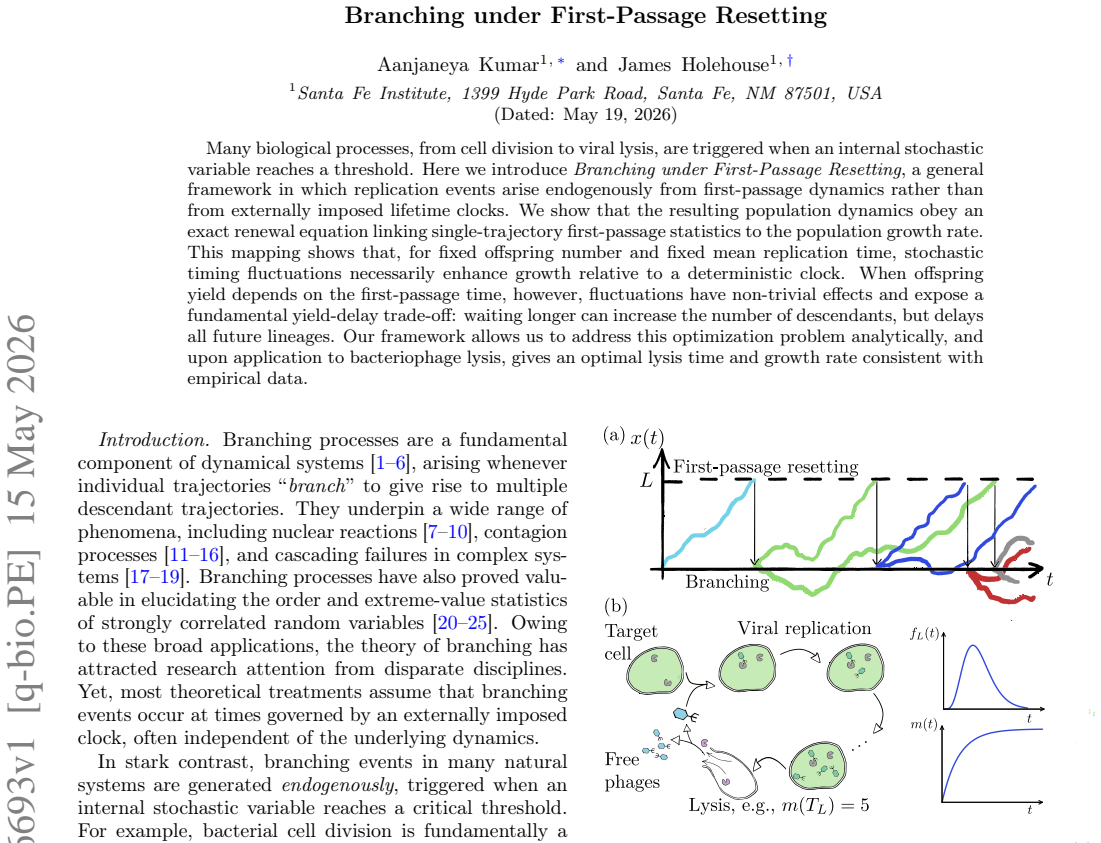
The population dynamics under first-passage resetting obey an exact renewal equation linking single-trajectory first-passage statistics to the population growth rate. This mapping shows that, for fixed offspring number and fixed mean replication time, stochastic timing fluctuations necessarily enhance growth relative to a deterministic clock. When offspring yield depends on the first-passage time, fluctuations have non-trivial effects and expose a fundamental yield-delay trade-off: waiting longer can increase the number of descendants, but delays all future lineages. The framework solves this optimization problem analytically and, when applied to bacteriophage lysis, yields an optimal lysis,
What carries the argument
The exact renewal equation that links single-trajectory first-passage statistics to the population growth rate.
If this is right
- For fixed offspring number and fixed mean replication time, stochastic timing fluctuations enhance growth relative to a deterministic clock.
- When offspring yield depends on first-passage time, a yield-delay trade-off appears that can be solved analytically for the optimal replication strategy.
- Application to bacteriophage lysis produces an optimal lysis time and corresponding growth rate consistent with empirical data.
Where Pith is reading between the lines
- The renewal mapping could be used to compare growth rates across different threshold distributions in other threshold-triggered biological systems such as cell division.
- The yield-delay trade-off identified here suggests that selection on replication timing may balance immediate yield against the compounding effect of earlier subsequent generations.
- Because the equation is exact, it offers a route to test whether observed timing variability in natural populations is consistent with growth-rate maximization.
Load-bearing premise
The population dynamics obey an exact renewal equation linking single-trajectory first-passage statistics to the population growth rate, which assumes that first-passage processes across independent lineages are statistically identical and that branching occurs precisely at the first-passage event.
What would settle it
Measure population growth rates in a controlled biological system under stochastic first-passage triggering versus an otherwise identical deterministic timing schedule with the same mean and offspring number, and check whether the stochastic case produces the higher growth rate predicted by the renewal equation.
Figures


read the original abstract
Many biological processes, from cell division to viral lysis, are triggered when an internal stochastic variable reaches a threshold. Here we introduce Branching under First-Passage Resetting, a general framework in which replication events arise endogenously from first-passage dynamics rather than from externally imposed lifetime clocks. We show that the resulting population dynamics obey an exact renewal equation linking single-trajectory first-passage statistics to the population growth rate. This mapping shows that, for fixed offspring number and fixed mean replication time, stochastic timing fluctuations necessarily enhance growth relative to a deterministic clock. When offspring yield depends on the first-passage time, however, fluctuations have non-trivial effects and expose a fundamental yield-delay trade-off: waiting longer can increase the number of descendants, but delays all future lineages. Our framework allows us to address this optimization problem analytically, and upon application to bacteriophage lysis, gives an optimal lysis time and growth rate consistent with empirical data.
Editorial analysis
A structured set of objections, weighed in public.
Referee Report
Summary. The paper introduces Branching under First-Passage Resetting, a framework in which replication events are endogenously triggered when an internal stochastic variable reaches a threshold, using a resetting mechanism. It claims that the resulting population dynamics obey an exact renewal equation that directly links single-trajectory first-passage time statistics to the population growth rate. For fixed offspring number and fixed mean replication time, stochastic timing fluctuations are shown to enhance growth relative to a deterministic clock. When offspring yield depends on first-passage time, the framework identifies a yield-delay trade-off and solves the associated optimization problem analytically; application to bacteriophage lysis yields an optimal lysis time and growth rate stated to be consistent with empirical data.
Significance. If the renewal mapping is rigorously derived and the assumptions hold, the work provides a valuable analytical bridge between microscopic first-passage processes and macroscopic branching population dynamics, with direct relevance to cell division and viral replication. The explicit identification of the yield-delay trade-off and its analytical optimization constitute a clear strength, as does the demonstration that fluctuations can be beneficial under fixed-mean constraints. The bacteriophage application, if shown to be a genuine a priori prediction rather than a fit, would add biological credibility. The paper is credited for attempting an exact (rather than approximate) renewal link from single-trajectory statistics to growth rate.
major comments (2)
- [Abstract, paragraph 2 and §2] Abstract, paragraph 2 and §2 (model definition): The central claim rests on an 'exact renewal equation' mapping first-passage statistics to population growth rate. The text must supply the full derivation, explicitly stating and justifying the assumptions that (i) every lineage is an independent, statistically identical copy of the same first-passage process and (ii) branching occurs precisely at the instant the internal variable hits the threshold with no additional state-dependent delay. Without this, the independence premise highlighted in the skeptic note remains unverified.
- [§4] §4 (bacteriophage application): The statement that the analytically obtained optimal lysis time and growth rate are 'consistent with empirical data' is presented as validation. The manuscript must clarify whether the functional form relating offspring yield to lysis time was taken from independent measurements or adjusted to produce consistency. If the latter, the result becomes a post-hoc fit and does not constitute an independent test of the yield-delay trade-off.
minor comments (2)
- [§2] The notation for the first-passage time distribution and the resetting kernel should be introduced with a dedicated equation block early in §2 to avoid ambiguity when the renewal equation is stated.
- [Figure 1] Figure 1 (schematic): Add explicit labels for the threshold value, the reset event, and the offspring initial condition to make the mapping from single trajectory to branching process visually immediate.
Simulated Author's Rebuttal
We thank the referee for the detailed and constructive report. We address each major comment below and have revised the manuscript to strengthen the presentation of the renewal derivation and the bacteriophage application.
read point-by-point responses
-
Referee: [Abstract, paragraph 2 and §2] The central claim rests on an 'exact renewal equation' mapping first-passage statistics to population growth rate. The text must supply the full derivation, explicitly stating and justifying the assumptions that (i) every lineage is an independent, statistically identical copy of the same first-passage process and (ii) branching occurs precisely at the instant the internal variable hits the threshold with no additional state-dependent delay.
Authors: We agree that the derivation and assumptions require explicit treatment. In the revised manuscript we have inserted a new subsection in §2 that derives the renewal equation from first principles. The derivation begins from the probability density of the first-passage time for a single trajectory and uses the fact that each daughter initiates an independent copy of the identical process. We explicitly state assumption (i): after division, each offspring inherits the same internal stochastic dynamics and resets to the initial condition, rendering lineages i.i.d. We state assumption (ii): the model defines replication as occurring exactly when the internal variable reaches threshold, with no additional state-dependent delay; this is justified by the biological interpretation that lysis or division is triggered at threshold crossing. These clarifications directly address the independence premise. revision: yes
-
Referee: [§4] The statement that the analytically obtained optimal lysis time and growth rate are 'consistent with empirical data' is presented as validation. The manuscript must clarify whether the functional form relating offspring yield to lysis time was taken from independent measurements or adjusted to produce consistency.
Authors: We appreciate the need for this clarification. The functional form relating yield to lysis time is taken directly from independent experimental measurements reported in the bacteriophage literature (specifically, burst-size versus lysis-time data from prior studies). The optimization is performed with this fixed, externally determined relation; the resulting optimal lysis time is then compared with observed values. We have revised §4 to state the provenance of the yield function explicitly and to note that the agreement tests the framework’s predictive capacity rather than constituting a post-hoc fit. revision: yes
Circularity Check
No significant circularity; derivation self-contained
full rationale
The paper introduces Branching under First-Passage Resetting and derives an exact renewal equation from the branching process definition, linking first-passage statistics to growth rate as a direct mathematical consequence rather than a redefinition or fit. The result that fluctuations enhance growth for fixed offspring number and mean replication time follows analytically from this equation without reducing to inputs by construction. The yield-delay trade-off and bacteriophage optimization are obtained by analyzing the same mapping under time-dependent yield, then compared to external empirical data for consistency; no parameter fitting is described that would force the reported optimum to match data tautologically. No self-citation chains, ansatz smuggling, or uniqueness theorems imported from prior author work appear load-bearing. The core chain remains independent of the target claims.
Axiom & Free-Parameter Ledger
free parameters (1)
- optimal lysis time
axioms (1)
- domain assumption Replication events arise endogenously from first-passage dynamics rather than from externally imposed lifetime clocks.
Lean theorems connected to this paper
-
IndisputableMonolith/Cost/FunctionalEquation.leanwashburn_uniqueness_aczel unclear?
unclearRelation between the paper passage and the cited Recognition theorem.
the resulting population dynamics obey an exact renewal equation linking single-trajectory first-passage statistics to the population growth rate... m ˜f_L(λ)≡m⟨e^{-λ T_L}⟩=1
-
IndisputableMonolith/Foundation/AbsoluteFloorClosure.leanreality_from_one_distinction unclear?
unclearRelation between the paper passage and the cited Recognition theorem.
since e^{-λ t} is strictly convex... λ ≥ ln m / ⟨T_L⟩
What do these tags mean?
- matches
- The paper's claim is directly supported by a theorem in the formal canon.
- supports
- The theorem supports part of the paper's argument, but the paper may add assumptions or extra steps.
- extends
- The paper goes beyond the formal theorem; the theorem is a base layer rather than the whole result.
- uses
- The paper appears to rely on the theorem as machinery.
- contradicts
- The paper's claim conflicts with a theorem or certificate in the canon.
- unclear
- Pith found a possible connection, but the passage is too broad, indirect, or ambiguous to say the theorem truly supports the claim.
Reference graph
Works this paper leans on
-
[1]
H. W. Watson and G. Galton, On the probability of the extinction of families, The Journal of the Anthropological Institute of Great Britain and Ireland4, 138 (1875)
-
[2]
R. Bellman and T. E. Harris, On the theory of age- dependent stochastic branching processes, Proceedings of the National Academy of Sciences34, 601 (1948)
work page 1948
-
[3]
T. E. Harris, Branching processes, The Annals of Math- ematical Statistics , 474 (1948)
work page 1948
-
[4]
T. E. Harriset al.,The theory of branching processes, Vol. 6 (Springer Berlin, 1963)
work page 1963
-
[5]
S.AsmussenandH.Hering,Branchingprocesses, (1983)
work page 1983
-
[6]
K. B. Athreya and P. E. Ney,Branching processes, Vol. 196 (Springer Science & Business Media, 2012)
work page 2012
-
[7]
T. E. Harris,On One-Dimensional Neutron Multiplica- tion(RAND Corporation, Santa Monica, CA, 1960)
work page 1960
-
[8]
M. M. R. Williams,Random processes in nuclear reactors (Elsevier, 1974)
work page 1974
-
[9]
I. Pázsit and L. Pál,Neutron fluctuations: A treatise on the physics of branching processes(Elsevier, 2007)
work page 2007
-
[10]
A. Zoia, E. Dumonteil, A. Mazzolo, C. de Mulatier, and A. Rosso, Clustering of branching brownian motions in confined geometries, Physical Review E90, 042118 (2014)
work page 2014
-
[11]
J. P. Gleeson, T. Onaga, P. Fennell, J. Cotter, R. Burke, and D. J. O’Sullivan, Branching process descriptions of informationcascadesontwitter,JournalofComplexNet- works8, cnab002 (2020)
work page 2020
-
[12]
L. A. Keating, J. P. Gleeson, and D. J. O’Sullivan, Mul- titype branching process method for modeling complex contagion on clustered networks, Physical Review E105, 034306 (2022)
work page 2022
-
[13]
A. Jamieson-Lane and B. Blasius, Calculation of epi- demic arrival time distributions using branching pro- cesses, Physical Review E102, 042301 (2020)
work page 2020
-
[14]
E. Dumonteil, S. N. Majumdar, A. Rosso, and A. Zoia, Spatial extent of an outbreak in animal epidemics, Pro- ceedings of the National Academy of Sciences110, 4239 (2013)
work page 2013
-
[15]
C. Jacob, Branching processes: their role in epidemiol- ogy, International journal of environmental research and public health7, 1186 (2010)
work page 2010
-
[16]
A. Kumar and D. Dhar, Improved upper bounds on the asymptotic growth velocity of eden clusters, Journal of Statistical Physics180, 710 (2020)
work page 2020
- [17]
- [18]
-
[19]
K. Sun, F. Y. Hou, W. Sun, and J. Qi,Power system con- trol under cascading failures: understanding, mitigation, and system restoration(John Wiley & Sons, 2019)
work page 2019
-
[20]
Lindvall, On the maximum of a branching process, Scandinavian Journal of Statistics , 209 (1976)
T. Lindvall, On the maximum of a branching process, Scandinavian Journal of Statistics , 209 (1976)
work page 1976
-
[21]
É. Brunet and B. Derrida, A branching random walk seen from the tip, Journal of Statistical Physics143, 420 (2011)
work page 2011
- [22]
- [23]
- [24]
-
[25]
S. N. Majumdar and A. Rosso, Extreme value statistics in a continuous time branching process: a pedagogical primer, Journal of Physics A: Mathematical and Theo- retical58, 475001 (2025)
work page 2025
-
[26]
Amir, Cell size regulation in bacteria, Physical review letters112, 208102 (2014)
A. Amir, Cell size regulation in bacteria, Physical review letters112, 208102 (2014)
work page 2014
-
[27]
F. Si, G. Le Treut, J. T. Sauls, S. Vadia, P. A. Levin, and S. Jun, Mechanistic origin of cell-size control and homeostasisinbacteria,CurrentBiology29,1760(2019)
work page 2019
-
[28]
I.-N. Wang, D. L. Smith, and R. Young, Holins: the pro- tein clocks of bacteriophage infections, Annual Reviews in Microbiology54, 799 (2000)
work page 2000
-
[29]
Redner,A guide to first-passage processes(Cambridge University Press, 2001)
S. Redner,A guide to first-passage processes(Cambridge University Press, 2001)
work page 2001
- [30]
-
[31]
M. R. Evans and S. N. Majumdar, Diffusion with stochasticresetting,PhysicalReviewLetters106,160601 (2011)
work page 2011
-
[32]
M. R. Evans and S. N. Majumdar, Diffusion with opti- mal resetting, Journal of Physics A: Mathematical and Theoretical44, 435001 (2011)
work page 2011
-
[33]
Pal, Diffusion in a potential landscape with stochastic resetting, Phys
A. Pal, Diffusion in a potential landscape with stochastic resetting, Phys. Rev. E91, 012113 (2015)
work page 2015
-
[34]
A. Pal, A. Kundu, and M. R. Evans, Diffusion under time-dependent resetting, Journal of Physics A: Mathe- matical and Theoretical49, 225001 (2016)
work page 2016
-
[35]
S. Reuveni, Optimal stochastic restart renders fluctua- tions in first passage times universal, Physical Review Letters116, 170601 (2016)
work page 2016
-
[36]
U. Bhat, C. De Bacco, and S. Redner, Stochastic search with poisson and deterministic resetting, Journal of Statistical Mechanics: Theory and Experiment2016, 083401 (2016)
work page 2016
- [37]
-
[38]
A. Chechkin and I. M. Sokolov, Random search with re- setting: aunifiedrenewalapproach,PhysicalReviewLet- ters121, 050601 (2018)
work page 2018
-
[39]
Eliazar, Branching search, Europhysics Letters120, 60008 (2017)
I. Eliazar, Branching search, Europhysics Letters120, 60008 (2017)
work page 2017
-
[40]
A. Pal, I. Eliazar, and S. Reuveni, First passage un- der restart with branching, Physical Review Letters122, 020602 (2019)
work page 2019
-
[41]
R. García-García, A. Genthon, and D. Lacoste, Linking lineage and population observables in biological branch- ing processes, Physical Review E99, 042413 (2019)
work page 2019
-
[42]
A. Genthon and D. Lacoste, Fluctuation relations and fitness landscapes of growing cell populations, Scientific Reports10, 11889 (2020)
work page 2020
-
[43]
A. Genthon, R. García-García, and D. Lacoste, Branch- ing processes with resetting as a model for cell division, Journal of Physics A: Mathematical and Theoretical55, 074001 (2022)
work page 2022
-
[44]
B. De Bruyne, J. Randon-Furling, and S. Redner, Opti- mization in first-passage resetting, Physical Review Let- ters125, 050602 (2020)
work page 2020
-
[45]
B. Sherman, The limiting distribution of brownian mo- tion in a bounded region with instantaneous return, The Annals of Mathematical Statistics29, 267 (1958)
work page 1958
-
[46]
R. Falcao and M. R. Evans, Interacting brownian motion with resetting, Journal of Statistical Mechanics: Theory and Experiment2017, 023204 (2017)
work page 2017
-
[47]
B. De Bruyne, J. Randon-Furling, and S. Redner, Op- timization and growth in first-passage resetting, Journal of Statistical Mechanics: Theory and Experiment2021, 013203 (2021)
work page 2021
-
[48]
B. De Bruyne, J. Randon-Furling, and S. Redner, First- passage-driven boundary recession, Journal of Physics A: Mathematical and Theoretical55, 354002 (2022)
work page 2022
-
[49]
B. De Bruyne, J. Randon-Furling, and S. Redner, A tale of two (and more) altruists, Journal of Statistical Me- chanics: Theory and Experiment2021, 103405 (2021)
work page 2021
- [50]
- [51]
- [52]
-
[53]
(12), (iii) analysis of the optimization prob- lem leading to Eq
See Supplemental Material for (i) details of the models and parameters used in figures to illustrate the results, (ii) detailed derivation of the small fluctuation expan- sion in Eq. (12), (iii) analysis of the optimization prob- lem leading to Eq. (16), and (iv) the application of the framework to bacteriophage lysis experiments
-
[54]
M. R. Clokie, A. D. Millard, A. V. Letarov, and S. Hea- phy, Phages in nature, Bacteriophage1, 31 (2011)
work page 2011
-
[55]
Wang, Lysis timing and bacteriophage fitness, Ge- netics172, 17 (2006)
I.-N. Wang, Lysis timing and bacteriophage fitness, Ge- netics172, 17 (2006)
work page 2006
-
[56]
S. Kullback and R. A. Leibler, On information and suf- ficiency, The annals of mathematical statistics22, 79 (1951)
work page 1951
-
[57]
Y. Shao and I.-N. Wang, Bacteriophage adsorption rate and optimal lysis time, Genetics180, 471 (2008). S1 Supplemental Material forBranching under First-Passage Resetting This Supplemental Material provides details of the stochastic models, parameter choices, asymptotic expansions, and comparisons with experimental bacteriophage data used in the main text...
work page 2008
-
[58]
First, a free phage searches for a susceptible host cell. We denote byAthe time needed to find and infect a host cell (adsorption time) and bygA(t)the adsorption-time density in the absence of free-phage removal. Free phage are removed at rateδP, sog A(t)e−δP t is the effective density for adsorption at timetbefore removal
-
[59]
This initiates lysis and is referred to as the lysis time
Next, after a phage successfully infects a host, intracellular assembly proceeds until a lysis thresholdLis reached at first-passage timeTL. This initiates lysis and is referred to as the lysis time. Consequently, the total time for one cycle to be completed (instance of renewal) isA+TL. As a simplifying assumption, we neglect stochasticity in the intrace...
work page 2006
discussion (0)
Sign in with ORCID, Apple, or X to comment. Anyone can read and Pith papers without signing in.