REVIEW 3 major objections 5 minor 11 references
Comment on N. Rijal et al. "Measurement of d + 7Be Cross Sections for Big-Bang Nucleosynthesis"
T0 review · 3 major / 5 minor · reviewed 2026-08-14 · deepseek-v4-flash
Pith's one-line read This comment argues that the new d+7Be rate from Rijal et al. is identical over BBN temperatures to the 1988 CF88 rate, so the experiment did not measure a new rate and its claimed 7Li reduction is not new.
desk verdict A useful critical comment whose central rate comparison is likely right, but whose headline claim about contradicting BBN theory overreaches what the cited private communications can support. read the letter →
The pith
A machine-rendered reading of the paper's core claim, the machinery that carries it, and where it could break.
The reading
What carries the argument
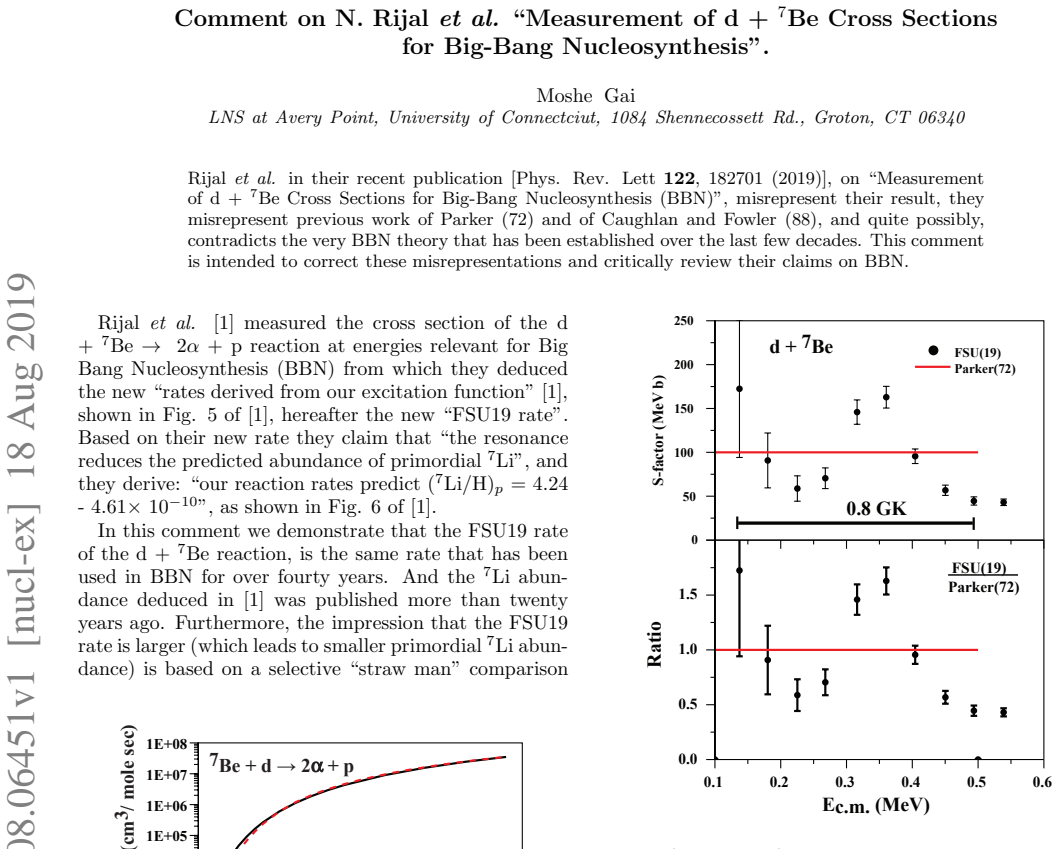
The load-bearing object is the ratio comparison of the FSU19 rate to the CF88 rate shown in the comment’s Fig. 1, which displays the two rates and their ratio over the BBN window and shows the ratio is one in that region. The CF88 rate, from the 1988 Caughlan–Fowler compilation, is based on Parker’s 1972 constant s-factor of ∼100 MeV b, which Parker obtained by multiplying Kavanagh’s data by a factor of ∼3 to account for higher excited states in 8Be. Supporting machinery includes the list of twelve canonical BBN reactions from Smith, Kawano, and Malaney, which excludes d+7Be, and the PRIMAT-based sensitivity estimate that the d+7Be rate would need to be ∼30 times larger than CF88 to matter for BBN.
What would settle it
Run a public BBN code such as PRIMAT with the published FSU19 d+7Be rate (or with the CF88 rate multiplied by factors up to 30) and compare the resulting \((^7\mathrm{Li}/\mathrm{H})_p\); if the abundance shifts by roughly 15% rather than <1%, the comment’s contradiction claim collapses. Alternatively, re-extract the FSU19 cross section and test whether it actually deviates from the CF88 rate by more than the quoted uncertainties over 0.5–0.9 GK.
Extended reading notes
Core claim
On the comment’s own terms, the central discovery is that the FSU19 d+7Be reaction rate, as published by Rijal et al., has central values identical to the CF88 rate of Caughlan and Fowler over the BBN region of interest (0.5–0.9 GK). Because the CF88 rate itself descends from Parker’s 1972 constant-s-factor educated guess, the comment concludes that Rijal et al. did not measure a new rate for the d+7Be interaction during BBN. The claimed reduction of primordial 7Li to \((4.24\text{--}4.61)\times $10^{{-10}}$\) was already implicit in BBN calculations from more than two decades ago, given the now-known baryon density. The comment further maintains that the large uncertainties in the FSU19 data, dominated by an ill-determined resonance energy, make the CF88 and FSU19 rates hardly different if not identical over the entire reported temperature range.
Load-bearing premise
The quantitative contradiction claim depends on the private computations cited in references [9] and [10] (PRIMAT usage by A. Coc and the analysis by K. Nollett) that give a threshold of about 30 times the CF88 rate for d+7Be to matter and a change in 7Li/H of no more than 1%; these calculations are not reproduced, versioned, or documented in the comment.
Editorial extensions
If this is right
- BBN practitioners who already use the CF88 or CFZ75 rates gain nothing by adopting the FSU19 rate, since the two are identical in the BBN temperature region.
- The d+7Be reaction remains outside the twelve canonical BBN reactions, and its neglect in standard BBN codes remains justified.
- The quoted \((^7\mathrm{Li}/\mathrm{H})_p = (4.24\text{--}4.61)\times 10^{-10}\) is not evidence for a new resonance, because the same range follows from BBN calculations from the 1990s using the known baryon density.
- Comparisons of the FSU19 rate with the Kavanagh and Angulo et al. rates are misleading for BBN, since those rates were never the ones used by BBN practitioners.
Reading between the lines
- If the central-value identity between FSU19 and CF88 holds within their uncertainties, the FSU data independently confirm Parker’s 1972 constant-s-factor guess, strengthening confidence in the old rate rather than providing new physics.
- A testable re-analysis would fix the proposed 9B resonance energy at 16.85 MeV versus leaving it free; the comment implies that the resonance is an artifact of the fit and that the data do not require it.
- The broader lesson for the field is that experimental claims of BBN impact should be benchmarked against the compilations actually built into BBN codes, rather than against arbitrary historical measurements.
- If the PRIMAT-based threshold of ∼30 times CF88 is robust, then future measurements would need to exceed the CF88 rate by more than an order of magnitude before d+7Be could affect primordial lithium, a sharp and falsifiable target.
Signed reviews
Editorial analysis
A structured set of objections, weighed in public.
Referee Report
Summary. This manuscript is a Comment on Rijal et al., PRL 122, 182701 (2019), which reported a new measurement of the d+7Be reaction rate and claimed that the rate reduces the predicted primordial 7Li abundance to (4.24-4.61) x 10^-10. Moshe Gai argues that the FSU19 rate is identical to the CF88 rate over the BBN temperature range 0.5-0.9 GK, that the comparison made by Rijal et al. to Kavanagh and Angulo rates is a 'straw man' because those rates were not used in BBN, that Parker's 1972 educated guess and the CF88/CFZ75 compilations are the historically relevant rates, and that the claimed 15% 7Li reduction contradicts established BBN theory. The Comment includes two figures comparing rates and S-factors, but no numerical table. The quantitative BBN sensitivity claims rely on two private communications (refs [9] and [10]) and on a suspicion of a coding error in Rijal et al.'s BBN calculation.
Significance. If correct, the primary claim that the FSU19 rate reproduces the old CF88 rate over the BBN window would be a substantive correction, undermining the novelty of the new rate for BBN and confirming that d+7Be remains a minor reaction in standard BBN. The Comment's strength is that it correctly identifies the historically used rates (CFZ75/CF88 based on Parker) and questions the selective comparison in the original paper. However, the more sensational claim that Rijal et al. 'quite possibly contradict the very BBN theory' is not supported by the evidence presented: the 30x and 1% thresholds are attributed to private communications without versioned inputs, and the suspected coding error is speculation. The manuscript would be more convincing if it included a numeric rate comparison and a documented reproduction of the BBN sensitivity calculation. The paper does not fit parameters and makes no circular use of assumptions, and the figures are helpful, but the lack of quantitative support for the central equivalence and for the BBN sensitivity claims is a substantial weakness.
major comments (3)
- [Fig. 1 and surrounding paragraph] The central assertion that 'the central values of the FSU19 rate is identical to the CF88 rate' over 0.5-0.9 GK is not substantiated numerically. The figure shows a ratio curve but provides no tabulated values, no uncertainty band on the ratio, and no quantitative criterion for what 'identical' means (e.g., within 1%, within chi-squared, within the combined experimental uncertainties). Because this equivalence is the basis for the claim that Rijal et al. did not measure a new rate, the Comment should include a table of FSU19 and CF88 rates at representative BBN temperatures, with uncertainties and ratios, so the claim can be checked. The additional remark that rates differing by up to a factor of 10 are consistent with the FSU19 data also needs a quantitative justification.
- [Paragraph beginning 'Perhaps a more disturbing observation'] The claim that 'the d + 7Be rate would have to be ~30 times larger than the CF88 rate to play a significant role in BBN' and that 'not including the Parker rate ... the practitioner of BBN concluded long ago a change in the 7Li/H abundance by no more than 1%' is supported only by private communications in refs [9] and [10]. No PRIMAT version, input baryon density, set of varied rates, or resulting 7Li/H values are provided, making the calculation unreproducible. Since the abstract advertises that the FSU19 result 'quite possibly contradicts the very BBN theory', this sensitivity analysis is load-bearing, not incidental. The comment should either reproduce these calculations with publicly documented inputs or, failing that, soften the conclusion to the rate-equivalence point only.
- [Last two paragraphs] The sentence 'We can only suspect a mistake in their unspecified code for BBN calculation' is presented without evidence. An allegation of a coding error in a published PRL requires either a reproduction of the calculation that identifies the error or at least a detailed comparison of the output with standard BBN codes. As written, this is speculation, not a demonstration, and it is inappropriate in a formal Comment. Either remove the suspicion or substantiate it with a concrete check (e.g., running the same inputs through PRIMAT or another BBN code and showing the discrepancy).
minor comments (5)
- [Abstract and first paragraph] The abstract contains several typos and grammatical errors that should be corrected: 'misrepresent' for 'misrepresent', 'critically review' should be 'critically review', and the phrase 'quite possibly, contradicts the very BBN theory' is awkwardly punctuated. More importantly, the wording 'quite possibly' is hedged while the body later makes a stronger unhedged claim; the hedge level should be consistent.
- [Address header] The author's affiliation line contains typos: 'Connectciut' should be 'Connecticut' and 'Shennec ossett Rd.' should be 'Shennecossett Rd.'.
- [Fig. 1 caption and text] The grammar in the sentence 'over the region of interest for BBN indicated in Fig. 5 of [1], of T= 0.8 GK, in of itself incorrect, it should read 0.5 - 0.9 GK' is garbled, making it unclear whether the error is attributed to Rijal et al. or to this Comment. Rewrite this sentence to state clearly that the relevant BBN temperature range is 0.5-0.9 GK and that the original paper's emphasis on 0.8 GK alone is misleading.
- [Reference list] Reference [9] is to a private communication but the text states that the PRIMAT code is publicly available; please provide a proper citation to the PRIMAT paper or a versioned URL with an access date. References [3], [4], and [11] have formatting issues (line breaks, missing spaces) that should be cleaned up.
- [Throughout] Typography: 'tweleve' should be 'twelve', 'a a more disturbing observation' has a doubled article, and the abundance value '4.24 - 4.61 × − 10' should be typeset as '(4.24 - 4.61) x 10^-10' or similar with a proper negative exponent. Also 'Rijal al.' should be 'Rijal et al.'.
Circularity Check
No significant circularity: the comment compares the FSU19 rate to independent prior compilations (CF88, Parker) and to external BBN calculations; no fitted quantity is relabeled as a prediction.
full rationale
The comment's central claim is that the FSU19 reaction rate is numerically identical to the CF88 rate over the BBN region, and therefore does not constitute a new rate. This is a direct comparison of an externally published excitation function with an independent tabulated rate; no parameter is fitted to the conclusion, and no quantity derived in the comment is used as an input to itself. The secondary claim that Rijal et al. contradict established BBN theory rests on two private communications (Refs. [9] and [10]) that are not reproduced or versioned, which is a legitimate concern about verifiability and support, but not a circularity: those calculations are external to the comment and are not derived from the comment's own conclusion. The comment also relies on the CF88 compilation and Parker's 1972 rate as historical benchmarks, which are independent of the present work. No equation in the comment reduces to its own input by construction, and no self-citation is used to forbid alternatives. The paper therefore contains no self-definitional, fitted-input, or self-citation-based circularity. Its weaknesses are evidentiary and procedural, not circular.
Assumptions & free parameters
assumptions (3)
- domain assumption The CF88 (and CFZ75) tabulation is the d+7Be rate actually used by BBN practitioners over the last 30 years.
- domain assumption The PRIMAT BBN code, as used privately by Coc, gives a threshold of about 30 times the CF88 rate for d+7Be to matter.
- domain assumption Parker's 1972 constant s-factor of about 100 MeV b is a reasonable approximation over the Gamow window.
Cite this review
Pith. "Pith review of Comment on N. Rijal et al. "Measurement of d + 7Be Cross Sections for Big-Bang Nucleosynthesis"." pith.science (2026). https://pith.science/paper/FWVYK7OD
@misc{pith2026190806451,
  author       = {Pith},
  title        = {Pith review of: Comment on N. Rijal et al. "Measurement of d + 7Be Cross Sections for Big-Bang Nucleosynthesis"},
  year         = {2026},
  howpublished = {\url{https://pith.science/paper/FWVYK7OD}},
  note         = {Machine review of arXiv:1908.06451}
}
abstract
Rijal, et al. in their recent publication [Phys. Rev. Lett {\bf 122}, 182701 (2019), arXiv:1808.07893], on "Measurement of d + $^7$Be Cross Sections for Big-Bang Nucleosynthesis (BBN)", misrepresent their result, they misrepresent previous work of Parker (72) and of Caughlan and Fowler (88), and quite possibly, contradicts the very BBN theory that has been established over the last few decades. This comment is intended to correct these misrepresentations and critically review their claims on BBN.
Figures

Reference graph
Works this paper leans on
-
[9]
A. Coc, private communication (to the authors of [1] and myself), July 10, 2019, PRIMAT: http://www2.iap.fr/users/pitrou/primat.htm
work page 2019
-
[10]
Nollett, Private communication, August 15, 2019
Kenneth M. Nollett, Private communication, August 15, 2019
work page 2019
- [1]
- [2]
- [3]
-
[4]
G.R. Caughlan and W.A. Fowler, At. Data Nucl. Data Tables, 40, 283 (1988)
work page 1988
-
[5]
William A. Fowler, Georgeanne R. Cuaghlan, and Bar- bara A. Zimmermann, Annu. Rev. Astro. Astrophys. 13, 69 (1975)
work page 1975
-
[6]
Michael S. Smith, Lawrence H. Kawano, and Robert A. Malaney, Astr. Phys. Jour. S85, 219 (1993)
work page 1993
Show all 11 references
-
[7]
R. H. Cyburt, A. M. Amthor, R. Ferguson, Z. Meisel, K. Smith, S.Warren, A. Heger, R. D. Hoffman, T. Rauscher, A. Sakharuk, H. Schatz, F. K. Thielemann, and M. Wi- escher, Astrophys. J. Suppl. Ser. 189, 240 (2010)
2010
-
[8]
P. D. Parker, Astrophys. J. 175, 261 (1972)
1972
-
[11]
Nollett and Scott Burles, Phys
Kenneth M. Nollett and Scott Burles, Phys. Rev. D 61, 1235005 (2000)
2000
Reviewed August 14, 2026 · model on record in the stance chip above.
Discussion (0). Continue with ORCID to comment.