REVIEW 4 major objections 6 minor 37 references
Determination of galaxy photometric redshifts using Conditional Generative Adversarial Networks (CGANs)
T0 review · 4 major / 6 minor · reviewed 2026-08-10 · deepseek-v4-flash
Pith's one-line read This paper proposes the first use of CGANs for photometric redshift estimation: on DES-Y1 data their point estimates and PDFs are close to a Mixture Density Network, though the MDN remains slightly more accurate.
desk verdict A plausible first proof-of-concept for CGAN photo-z, with an honest MDN comparison, but the PDF evaluation is underspecified to the point of being non-reproducible as written. read the letter →
The pith
A machine-rendered reading of the paper's core claim, the machinery that carries it, and where it could break.
The reading
What carries the argument
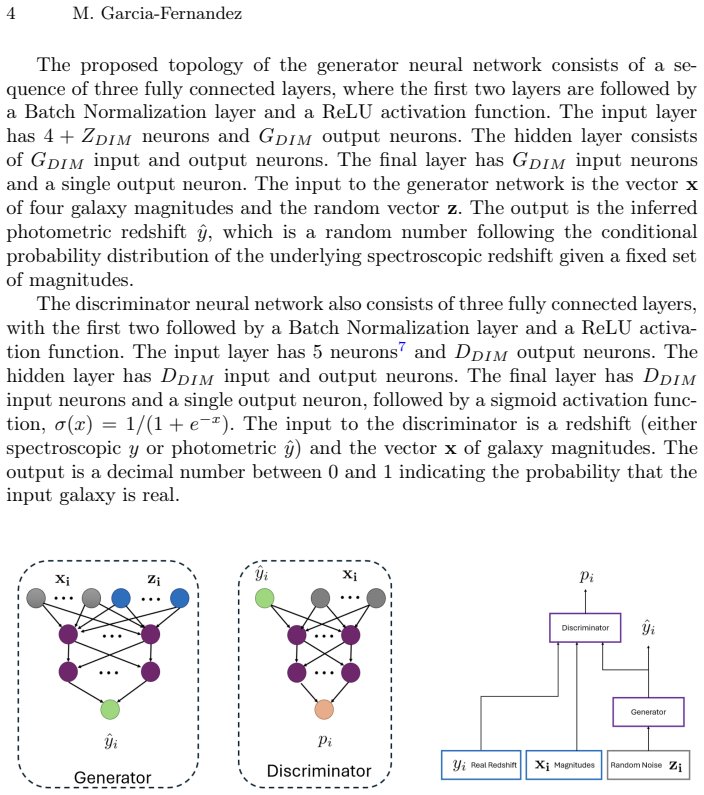
The load-bearing object is a Conditional Generative Adversarial Network with generator $G(z|x)$ and discriminator $D(y|x)$, trained by the f-divergence variational objective with the KL divergence, where the activation pair is $g_f(x)=x$ and $f^*(g_f(x))=e^{x-1}$. The generator draws a random vector $z$ and, conditioned on the four MAG_AUTO magnitudes in griz bands, outputs a photometric redshift $\hat{y}$; the discriminator classifies an input redshift as real spectroscopic or generated. This adversarial game makes $\hat{y}$ a random sample from the conditional density $\phi(z|x)$, so the method produces point estimates and PDFs without assuming a functional shape, in contrast with the Mixture Density Network baseline, which assumes a mixture of 30 Gaussians. The PDF quality metrics (PIT, Odds, Coverage) are then computed from these generated samples.
What would settle it
Re-run the same DES-Y1 experiment with a fully documented PDF estimator, for example 1,000 generator draws per galaxy and a Gaussian kernel density estimate with a stated bandwidth, and recompute the PIT, Odds, and coverage curves; if the coverage curve still falls below the expected $1-\alpha$ by more than the bootstrap uncertainty band, the claim of PDF quality comparable to the MDN would fail under a fixed, reproducible estimator.
Extended reading notes
Core claim
On its own terms, the paper claims that a CGAN whose generator maps a random vector and four griz magnitudes to a photometric-redshift sample, and whose discriminator tries to separate real spectroscopic redshifts from generated ones, learns the conditional distribution of redshift given photometry. Using the KL-divergence within the f-GAN variational framework, the generator outputs are draws from the conditional density, so the same network yields both a point estimate and a per-galaxy PDF without specifying a parametric family. Tested on 33,410 DES-Y1 galaxies with spectroscopic redshifts, the CGAN traces the true redshift distribution and achieves quality metrics close to the MDN baseline across all redshift bins, with the MDN showing slightly higher accuracy and the CGAN producing more outliers and slightly overconfident PDFs. The paper concludes that this is a proof of concept that CGANs are a viable alternative for photometric redshift estimation and opens the door to further exploration of adversarial networks in this field.
Load-bearing premise
The evaluation of the probability-density outputs assumes that drawing a finite number of random noise vectors from the trained generator and turning them into a density with some estimator faithfully represents the CGAN's conditional distribution; the paper does not state the number of draws per galaxy or the density-estimation procedure, so the PDF-calibration metrics rest on that unstated choice.
Editorial extensions
If this is right
- A single non-parametric CGAN can produce both point estimates and full PDFs for photometric redshifts, removing the need to specify a Gaussian or mixture shape in advance.
- On DES-Y1 data, the CGAN's point-estimation metrics and PIT/Odds distributions are close to the MDN's, so adversarial training is a viable alternative despite the MDN's small advantage in accuracy and outlier rate.
- The coverage test shows the CGAN PDFs are overconfident, identifying calibration as the main remaining weakness of the method.
- The stacked CGAN probability densities give a similar representation of the underlying redshift distribution as the MDN, though the MDN matches the spectroscopic data more closely.
- Conditioning on galaxy type and using larger samples, as the paper proposes for future work, should reduce the heterogeneity that limits current precision.
Reading between the lines
- The unstated number of generator draws and the unstated density estimator are a hidden degree of freedom: the reported PIT and coverage curves could shift by an amount comparable to the CGAN-MDN gap depending on how the empirical density is built, so a reproducibility appendix specifying them would materially strengthen the comparison.
- Because each galaxy's output is a stochastic sample, the CGAN naturally encodes redshift uncertainty and could be embedded in downstream weak-lensing or clustering analyses that need to propagate photo-z errors without assuming Gaussian shapes.
- The architecture should transfer to upcoming surveys with more photometric bands by simply enlarging the input layer, and the non-parametric density may be most valuable in parts of color space where galaxy types mix and multi-modal redshift distributions occur.
- A direct testable extension would be to train the same CGAN with a different f-divergence, for example Jensen-Shannon, and check whether the observed overconfidence is a property of the KL choice or of the adversarial training itself.
Editorial analysis
A structured set of objections, weighed in public.
Referee Report
Summary. The manuscript presents a proof-of-concept application of Conditional Generative Adversarial Networks (CGANs) to photometric redshift estimation. The CGAN is trained with an f-divergence objective (KL divergence) on DES-Y1 Stripe-82 galaxies with griz MAG_AUTO magnitudes, using an 80/10/10 train/test/validation split of 33,410 galaxies. The generator produces stochastic redshift draws conditioned on magnitudes, and these draws are used both for point estimation and, implicitly, for per-galaxy probability density functions. The model is compared with a Mixture Density Network (MDN) based on Ansari et al. (2021). Point-estimate metrics (mean absolute bias, sigma_NMAD, outlier fraction) and PDF metrics (PIT, Odds, coverage, stacked distributions) are evaluated on a held-out validation sample, with bootstrap confidence intervals. The reported result is that the MDN is slightly better but the CGAN metrics are comparable, establishing CGANs as a viable non-parametric alternative for photo-z estimation.
Significance. The significance of this work is as a proof of concept: if the comparison is credible, CGANs offer a way to estimate photometric-redshift PDFs without assuming a parametric family, which is potentially useful for current and future wide-field surveys. The paper's strengths include the use of a held-out validation set, bootstrap confidence intervals, a fixed external benchmark MDN, and a publicly available code repository. The central weakness is that the construction of PDFs from generator samples is not described, so the PDF-comparability claim is not currently reproducible from the text. The work is not circular: training and validation are separated, and no parameter-free derivation or model-independent prediction is claimed.
major comments (4)
- [Sec. 3.2, Eqs. (8)-(10)] The PDF metrics PIT, Odds, and Coverage all require a per-galaxy conditional density phi(z). For the CGAN this density is only available implicitly through repeated draws yhat_i(z_j) = G(z_j | x_i) (Sec. 2.1, Eq. 5). The manuscript never states how many latent draws are used per galaxy, what density estimator is applied (histogram, KDE, kernel shape, bandwidth, binning), or on what support and integration grid phi(z) is evaluated. Because Eqs. (8)-(10) and the stacked PDF in Fig. 6 depend on this unspecified estimator, all quoted calibration results could reflect the estimator choice rather than the trained CGAN distribution. This is the load-bearing gap for the paper's PDF-comparability claim; the companion repository may contain the details, but the submitted text is incomplete.
- [Sec. 3.1, Eq. (5)] G(z | x_i) is stochastic, yet the point estimates shown in Fig. 3 and used in Eqs. (6)-(7) require a definite value of yhat_i for each galaxy. The paper does not state whether the reported point estimate is a single Monte Carlo draw, the mean, or the median of G(z | x_i). Since the point-estimate metrics and their bootstrap intervals in Fig. 4 depend on this choice, the comparison with the MDN point estimates is not fully specified.
- [Sec. 3.1, bootstrap paragraph] The text states that quality metrics are computed over the validation sample, but the bootstrap description says 'generating 1,000 bootstrap samples from the test dataset.' Earlier, the test set is described as being used only to monitor overfitting during training. If the bootstrap resamples the test set rather than the validation set, the quoted confidence intervals are not computed on the same sample as the point estimates. Please clarify which sample is used and, if necessary, recompute the intervals on the validation sample.
- [Sec. 3, Figs. 4-5] No numerical values are reported for any quality metric; the support for the claim of 'comparable quality' is entirely visual. Please provide a table with the point-estimate and PDF metrics (for example, mean |Delta z|, sigma_NMAD, outlier fraction, PIT statistics, odds statistics, and coverage deviations) together with bootstrap intervals. Without numbers, a reader cannot judge whether the observed differences between CGAN and MDN are statistically significant or practically important.
minor comments (6)
- [Abstract and Introduction] The abstract and introduction describe this as the 'first' algorithmic approach to photometric redshifts using CGANs, but no literature search or comparison with prior CGAN-based photo-z work is provided. Please either document the novelty claim or soften the wording.
- [Sec. 2.1, Eq. (2)] The nested notation in Eq. (2), such as D(G(z_i | x_i); theta_G) | x_i; theta_D, is confusing; rewriting the discriminator as D(y, x; theta_D) and D(G(z | x), x; theta_D) would improve readability.
- [Sec. 2.1] The statement that Wasserstein GANs 'do not allow the interpretation of outputs as probability densities' is too categorical and is not established by the cited reference; please clarify what property is meant and how it follows from the Wasserstein formalism.
- [Sec. 3] The matching details with SDSS Stripe-82 spectroscopic redshifts are missing, including the matching radius, any redshift quality flags, and the treatment of duplicate or repeated observations. Please specify these choices.
- [Fig. 2 caption] The caption says the CGAN loss functions were shifted by +1 to avoid negative values, but the axes of the loss panels are not labeled. Please state explicitly which quantity is plotted on each axis.
- [Sec. 3] No random seed or reproducibility setting is reported for the data split, initialization, or training. Since GAN training is stochastic, a random seed or a statement about the number of independent training runs would help reproducibility.
Circularity Check
No circularity: this is an empirical CGAN-vs-MDN benchmark on held-out DES-Y1 data; the missing PDF-estimation details are a reproducibility gap, not a circular reduction.
full rationale
The paper makes no parameter-free derivation claim and does not fit any quantity to the metric it later reports. The CGAN and MDN are trained on an 80% split and evaluated on a separate validation sample, with point-estimate and PDF metrics computed against spectroscopic redshifts from SDSS. The f-divergence framework is adopted from external references (Nowozin et al., 2016), and the MDN baseline is an external implementation (Ansari et al., 2021). No prediction reduces to a fitted constant or to a self-citation chain, and there are no load-bearing self-citations. The unstated procedure for converting finite generator samples into per-galaxy PDFs (number of draws, density estimator, binning) undermines reproducibility of the PDF comparison but is not a circularity: the reported metrics are not defined in terms of the fitted parameters. Therefore the central empirical claim is self-contained and no circular step is present.
Assumptions & free parameters
free parameters (8)
- GDIM (generator hidden width) =
32
- DDIM (discriminator hidden width) =
32
- ZDIM (noise dimension) =
20
- Learning rate schedule =
initial 1e-4, decay factor 0.2 every 2000 epochs
- Number of training epochs =
10000 (CGAN), 5000 (MDN)
- Redshift cut =
0.0 < z_sp < 0.8
- MDN number of Gaussian components and hidden units =
30 components, 22 hidden units
- Number of noise samples per galaxy for PDF estimation =
not stated
assumptions (4)
- domain assumption The DES-Y1 Stripe-82 spectroscopic sample is representative and the spectroscopic redshifts are accurate.
- standard math With sufficient capacity and training, the f-GAN objective (KL divergence) makes the generator sample from the true conditional distribution p(y|x).
- domain assumption The galaxy population in the validation set is drawn from the same distribution as the training set.
- domain assumption The four MAG_AUTO magnitudes (griz) are sufficient to constrain redshift to the stated accuracy.
Cite this review
Pith. "Pith review of Determination of galaxy photometric redshifts using Conditional Generative Adversarial Networks (CGANs)." pith.science (2026). https://pith.science/paper/FWYAYBT2
@misc{pith2026250106532,
  author       = {Pith},
  title        = {Pith review of: Determination of galaxy photometric redshifts using Conditional Generative Adversarial Networks (CGANs)},
  year         = {2026},
  howpublished = {\url{https://pith.science/paper/FWYAYBT2}},
  note         = {Machine review of arXiv:2501.06532}
}
read the original abstract
Accurate and reliable photometric redshift determination is one of the key aspects for wide-field photometric surveys. Determination of photometric redshift for galaxies, has been traditionally solved by use of machine-learning and artificial intelligence techniques trained on a calibration sample of galaxies, where both photometry and spectrometry are available. On this paper, we present a new algorithmic approach for determining photometric redshifts of galaxies using Conditional Generative Adversarial Networks (CGANs). The proposed implementation is able to determine both point-estimation and probability-density estimations for photometric redshifts. The methodology is tested with data from Dark Energy Survey (DES) Y1 data and compared with other existing algorithm such as a Mixture Density Network (MDN). Although results obtained show a superiority of MDN, CGAN quality-metrics are close to the MDN results, opening the door to the use of CGAN at photometric redshift estimation.
Figures


Figures from the paper (3 more)


Reference graph
Works this paper leans on
-
[1]
Ansari, Zoe, Agnello, Adriano, Gall, Christa: Mixture models for photometric red- shifts. A&A 650, A90 (2021)
work page 2021
-
[2]
Arjovsky,M.,Chintala,S.,Bottou,L.:Wassersteingenerativeadversarialnetworks. In: Precup, D., Teh, Y.W. (eds.) Proceedings of the 34th International Conference on Machine Learning. Proceedings of Machine Learning Research, vol. 70, pp. 214–
-
[3]
Bishop, C.M.: Mixture density networks (1994)
work page 1994
-
[4]
In: International Conference on Learning Representations (2019)
Brock, A., Donahue, J., Simonyan, K.: Large scale GAN training for high fidelity natural image synthesis. In: International Conference on Learning Representations (2019)
2019
-
[5]
Deep Learning Approach to Photometric Redshift Estimation
Chunduri, K., Mahesh, M.: Deep Learning Approach to Photometric Redshift Es- timation. arXiv e-prints arXiv:2310.16304 (Oct 2023) 12 M. Garcia-Fernandez
work page Pith review arXiv 2023
-
[6]
Foundations and Trends® in Communications and Information Theory1(4), 417–528 (2004)
Csiszár, I., Shields, P.: Information theory and statistics: A tutorial. Foundations and Trends® in Communications and Information Theory1(4), 417–528 (2004)
work page 2004
-
[7]
Astronomy and Computing30, 100362 (2020)
Dalmasso, N., Pospisil, T., Lee, A., Izbicki, R., Freeman, P., Malz, A.: Conditional density estimation tools in python and r with applications to photometric redshifts and likelihood-free cosmological inference. Astronomy and Computing30, 100362 (2020)
work page 2020
-
[8]
Journal of the Royal Statistical So- ciety
Dawid, A.P.: Present position and potential developments: Some personal views: Statistical theory: The prequential approach. Journal of the Royal Statistical So- ciety. Series A (General)147(2), 278–292 (1984)
work page 1984
Show all 37 references
-
[9]
Generalized and pre-classification-less, image based, fully probabilistic redshifts
D’Isanto, A., Polsterer, K.L.: Photometric redshift estimation via deep learning. Generalized and pre-classification-less, image based, fully probabilistic redshifts. Astronomy and Astrophysics609, A111 (Jan 2018)
2018
-
[10]
Astrophysical Journal 715(2), 823–832 (Jun 2010)
Gerdes, D.W., Sypniewski, A.J., McKay, T.A., Hao, J., Weis, M.R., Wechsler, R.H., Busha, M.T.: ArborZ: Photometric Redshifts Using Boosted Decision Trees. Astrophysical Journal 715(2), 823–832 (Jun 2010)
2010
-
[11]
In: Proceedings of the 27th International Conference on Neural Information Processing Systems - Volume
Goodfellow, I.J., Pouget-Abadie, J., Mirza, M., Xu, B., Warde-Farley, D., Ozair, S., Courville, A., Bengio, Y.: Generative adversarial nets. In: Proceedings of the 27th International Conference on Neural Information Processing Systems - Volume
-
[12]
Astronomical Journal155(1), 1 (Jan 2018)
Graham, M.L., Connolly, A.J., Ivezić, Ž., Schmidt, S.J., Jones, R.L., Jurić, M., Daniel, S.F., Yoachim, P.: Photometric Redshifts with the LSST: Evaluating Sur- vey Observing Strategies. Astronomical Journal155(1), 1 (Jan 2018)
2018
-
[13]
2672–2680
p. 2672–2680. NIPS’14, MIT Press, Cambridge, MA, USA (2014)
2014
-
[14]
Hiriart-Urruty, C
Hiriart-Urruty, J.B., Lemaréchal, C.: Fundamentals of Convex Analysis / J.B. Hiriart-Urruty, C. Lemaréchal. (01 2001)
2001
-
[15]
Hermans, J., Begy, V., Louppe, G.: Likelihood-free mcmc with amortized approx- imate ratio estimators (2020)
2020
-
[16]
Jones, E., Do, T., Boscoe, B., Singal, J., Wan, Y., Nguyen, Z.: Improving photo- metric redshift estimation for cosmology with lsst using bayesian neural networks (2024), https://arxiv.org/abs/2306.13179
2024 arXiv
-
[17]
Astronomy and Computing16, 34–40 (2016)
Hoyle, B.: Measuring photometric redshifts using galaxy images and deep neural networks. Astronomy and Computing16, 34–40 (2016)
2016
-
[18]
The Astrophysical Journal881(1), 80 (aug 2019)
Leistedt, B., Hogg, D.W., Wechsler, R.H., DeRose, J.: Hierarchical modeling and statistical calibration for photometric redshifts. The Astrophysical Journal881(1), 80 (aug 2019)
2019
-
[19]
In: International Conference on Learning Representations (2018)
Karras, T., Aila, T., Laine, S., Lehtinen, J.: Progressive growing of GANs for improved quality, stability, and variation. In: International Conference on Learning Representations (2018)
2018
-
[20]
Lima, E., Sodré, L., Bom, C., Teixeira, G., Nakazono, L., Buzzo, M., Queiroz, C., Herpich, F., Castellon, J.N., Dantas, M., Dors, O., de Souza, R.T., Akras, S., Jiménez-Teja, Y., Kanaan, A., Ribeiro, T., Schoennell, W.: Photometric red- shifts for the s-plus survey: Is machine...
2022
-
[21]
IEEE Transactions on Information Theory52(10), 4394–4412 (2006)
Liese, F., Vajda, I.: On divergences and informations in statistics and information theory. IEEE Transactions on Information Theory52(10), 4394–4412 (2006)
2006
-
[22]
13 survey with LSTM neural networks
Luo, Z., Li, Y., Lu, J., Chen, Z., Fu, L., Zhang, S., Xiao, H., Du, W., Gong, Y., Shu, C., Ma, W., Meng, X., Zhou, X., Fan, Z.: Photometric redshift estimation for CSST Determination of photometric redshifts using CGAN. 13 survey with LSTM neural networks. Monthly Notices of t...
2024
-
[23]
Monthly Notices of the Royal Astronomical Society 527(4), 12140–12153 (12 2023)
Lu, J., Luo, Z., Chen, Z., Fu, L., Du, W., Gong, Y., Li, Y., Meng, X.M., Tang, Z., Zhang, S., Shu, C., Zhou, X., Fan, Z.: Estimating photometric redshift from mock flux for csst survey by using weighted random forest. Monthly Notices of the Royal Astronomical Society 527(4), 1...
2023
-
[24]
arXiv e-prints arXiv:1411.1784 (Nov 2014)
Mirza, M., Osindero, S.: Conditional Generative Adversarial Nets. arXiv e-prints arXiv:1411.1784 (Nov 2014)
2014 arXiv
-
[25]
arXiv e-prints arXiv:2409.09981 (Sep 2024)
Mahmud Pathi, I., Soo, J.Y.H., Jie Wee, M., Nadhilah Zakaria, S., Azwin Ismail, N., Baugh, C.M., Manzoni, G., Gaztanaga, E., Castander, F.J., Eriksen, M., Car- retero, J., Fernandez, E., Garcia-Bellido, J., Miquel, R., Padilla, C., Renard, P., Sanchez, E., Sevilla-Noarbe, I., ...
2024 arXiv
-
[26]
In: Platt, J., Koller, D., Singer, Y., Roweis, S
Nguyen, X., Wainwright, M.J., Jordan, M.: Estimating divergence functionals and the likelihood ratio by penalized convex risk minimization. In: Platt, J., Koller, D., Singer, Y., Roweis, S. (eds.) Advances in Neural Information Processing Systems. vol. 20. Curran Associates, I...
2007
-
[27]
Annual Review of Astronomy and Astrophysics60, 363–414 (Aug 2022)
Newman, J.A., Gruen, D.: Photometric Redshifts for Next-Generation Surveys. Annual Review of Astronomy and Astrophysics60, 363–414 (Aug 2022)
2022
-
[28]
Polsterer, K.L., D’Isanto, A., Gieseke, F.: Uncertain photometric redshifts (2016)
2016
-
[29]
In: Lee, D., Sugiyama, M., Luxburg, U., Guyon, I., Garnett, R
Nowozin, S., Cseke, B., Tomioka, R.: f-gan: Training generative neural samplers using variational divergence minimization. In: Lee, D., Sugiyama, M., Luxburg, U., Guyon, I., Garnett, R. (eds.) Advances in Neural Information Processing Systems. vol. 29. Curran Associates, Inc. (2016)
2016
-
[30]
Journal of Machine Learning Research12(22), 731–817 (2011)
Reid, M.D., Williamson, R.C.: Information, divergence and risk for binary experi- ments. Journal of Machine Learning Research12(22), 731–817 (2011)
2011
-
[31]
Monthly Notices of the Royal Astronomical Society452(4), 3710– 3725 (08 2015)
Rau, M.M., Seitz, S., Brimioulle, F., Frank, E., Friedrich, O., Gruen, D., Hoyle, B.: Accurate photometric redshift probability density estimation – method comparison and application. Monthly Notices of the Royal Astronomical Society452(4), 3710– 3725 (08 2015)
2015
-
[32]
Astronomy and Astrophysics651, A55 (Jul 2021)
Schuldt, S., Suyu, S.H., Cañameras, R., Taubenberger, S., Meinhardt, T., Leal- Taixé, L., Hsieh, B.C.: Photometric redshift estimation with a convolutional neural network: NetZ. Astronomy and Astrophysics651, A55 (Jul 2021)
2021
-
[33]
Nature Astronomy 3, 212–222 (Jun 2019)
Salvato, M., Ilbert, O., Hoyle, B.: The many flavours of photometric redshifts. Nature Astronomy 3, 212–222 (Jun 2019)
2019
-
[34]
Astronomy and Computing49, 100886 (2024)
Teixeira, G., Bom, C., Santana-Silva, L., Fraga, B., Darc, P., Teixeira, R., Wu, J., Ferguson, P., Martínez-Vázquez, C., Riley, A., Drlica-Wagner, A., Choi, Y., Mutlu-Pakdil, B., Pace, A., Sakowska, J., Stringfellow, G.: Photometric redshifts probability density estimation fro...
2024
-
[35]
In: III, H.D., Singh, A
Song, J., Ermon, S.: Bridging the gap between f-GANs and Wasserstein GANs. In: III, H.D., Singh, A. (eds.) Proceedings of the 37th International Conference on Machine Learning. Proceedings of Machine Learning Research, vol. 119, pp. 9078–9087. PMLR (13–18 Jul 2020)
2020
-
[37]
Wei, S., Li, C., Zhang, Y., Cui, C., Tang, C., Zhang, J., Zhao, Y., Wu, X., Tao, Y., Fan, D., Li, S., Xu, Y., Huang, M., Yang, X., Kang, Z., Shi, J.: Photometric redshift estimation for emission line galaxies of desi legacy imaging surveys by cnn-mlp (2025), https://arxiv.org/...
2025 arXiv
-
[223]
PMLR (06–11 Aug 2017)
2017
Reviewed August 10, 2026 · model on record in the stance chip above.
Discussion (0). Continue with ORCID to comment.