REVIEW 3 major objections 5 minor 48 references
Controllable thickness inhomogeneity and Berry-curvature-engineering of anomalous Hall effect in SrRuO3 ultrathin films
T0 review · 3 major / 5 minor · reviewed 2026-08-14 · deepseek-v4-flash
Pith's one-line read In SrRuO3 ultrathin films, hump-like Hall anomalies can be produced by a controllable thickness inhomogeneity that creates two anomalous Hall channels of opposite sign, rather than by magnetic skyrmions.
desk verdict A well-executed growth and imaging study that makes a strong case for two-channel AHE as the cause of hump Hall features in inhomogeneous SrRuO3, but the quantitative superposition evidence in Fig. 4 is underdocumented. read the letter →
The pith
A machine-rendered reading of the paper's core claim, the machinery that carries it, and where it could break.
The reading
What carries the argument
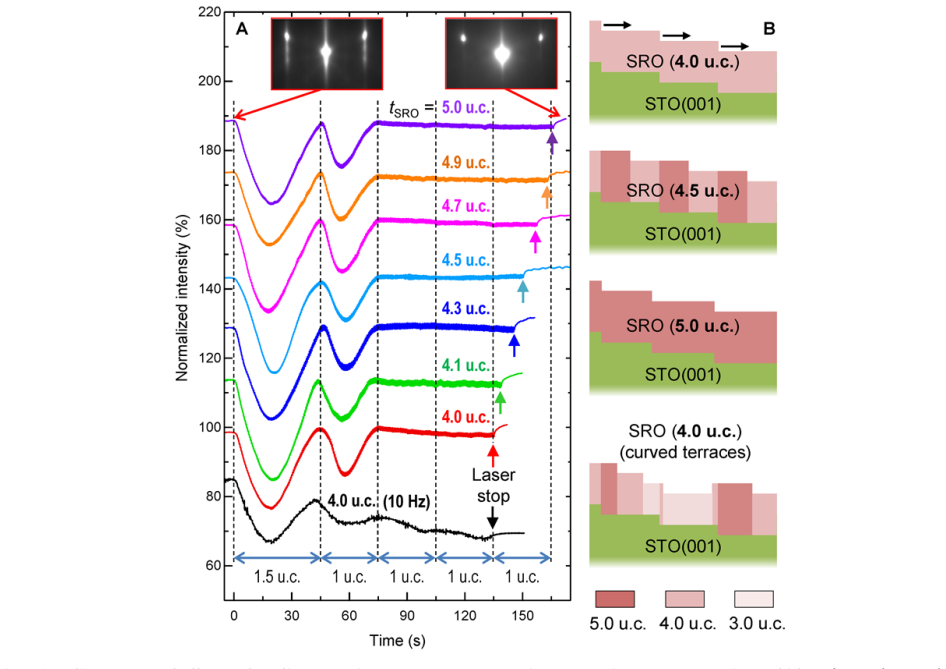
The central object is the two-channel anomalous Hall effect: the total Hall resistance $R_{xy}=R_0H+R_{AHE}$ of an inhomogeneous film is modeled as a linear superposition of the anomalous Hall loops of its 4.0 and 5.0 unit-cell regions, which have opposite signs of the anomalous Hall coefficient and different coercive fields. The mechanism that creates these channels is the coupling between film thickness, ferromagnetism, and the momentum-space Berry curvature (a geometric property of the band structure that governs the intrinsic anomalous Hall effect), combined with step-flow growth that organizes the thickness difference into ordered stripes. The linear-superposition fit and the directly imaged two-step magnetic switching carry the argument.
What would settle it
Grow an SrRuO3 film with the same nominal 4.5 unit-cell thickness but with all terraces completed so the thickness is uniform: the two-channel model predicts no hump-like Hall anomaly and no two-step magnetic switching, while a skyrmion-based explanation would not require thickness stripes. Observing humps in such a uniform film would refute the two-channel attribution.
Extended reading notes
Core claim
The paper's central claim is that a deliberate one-unit-cell thickness inhomogeneity in SrRuO3 ultrathin films produces two independent anomalous Hall channels with opposite signs and distinct coercive fields, so their superposition generates hump-like Hall anomalies similar to the topological Hall effect. The authors show that the relative weight of the two channels, and hence the shape of the Hall loop, can be continuously tuned by sub-unit-cell control of the nominal film thickness. They further identify two-step magnetic switching in magnetization hysteresis and stripe-like ferromagnetic domains aligned with terrace edges as microscopic fingerprints that distinguish this two-channel anomalous Hall effect from a skyrmion-induced topological Hall effect.
Load-bearing premise
The total Hall resistance of an inhomogeneous film is exactly an areal-weighted linear superposition of the independent Hall loops of the 4.0 and 5.0 unit-cell regions, with no significant current shunting, longitudinal conductance differences, or interface coupling between them.
Editorial extensions
If this is right
- Hump-like features in Hall-resistance curves alone cannot be taken as evidence of skyrmions in SrRuO3-based heterostructures, because thickness inhomogeneity can generate the same signature.
- The amplitude and sign of the hump can be continuously engineered through sub-unit-cell control of nominal thickness, offering a practical tuning knob for anomalous Hall response.
- Two-step magnetic switching in magnetization hysteresis and stripe-like ferromagnetic domains provide a concrete way to identify the two-channel anomalous Hall effect and separate it from the topological Hall effect.
- Growth-induced disorder, such as that produced at high laser repetition rates, creates uncontrolled thickness inhomogeneity and spurious Hall humps, so careful growth control is a prerequisite for any topological Hall effect study.
- The step-flow method for producing controlled thickness inhomogeneity should transfer to other epitaxial oxide systems, opening a route to harness correlated topological phases in devices.
Reading between the lines
- If the two-channel picture is generic, earlier reports attributing hump-like Hall anomalies in SrRuO3 heterostructures solely to skyrmions may need to be revisited with thickness and terrace characterization, since even nominally uniform films can contain mixed 4.0 and 5.0 unit-cell regions.
- One could design a deliberately patterned two-channel device with alternating 4.0 and 5.0 unit-cell stripes whose Hall response encodes the area ratio, turning the effect into a sensitive probe of thickness uniformity.
- The same superposition logic should apply to other materials where the anomalous Hall sign reverses across a sharp thickness, doping, or strain threshold: any coexistence of the two regimes will produce hump-like anomalies.
- A concrete test would be to grow a uniform 4.5-unit-cell-equivalent film by completing all terraces and verifying that the hump and two-step switching disappear, which would separate the two-channel mechanism from any residual intrinsic effect.
Signed reviews
Editorial analysis
A structured set of objections, weighed in public.
Referee Report
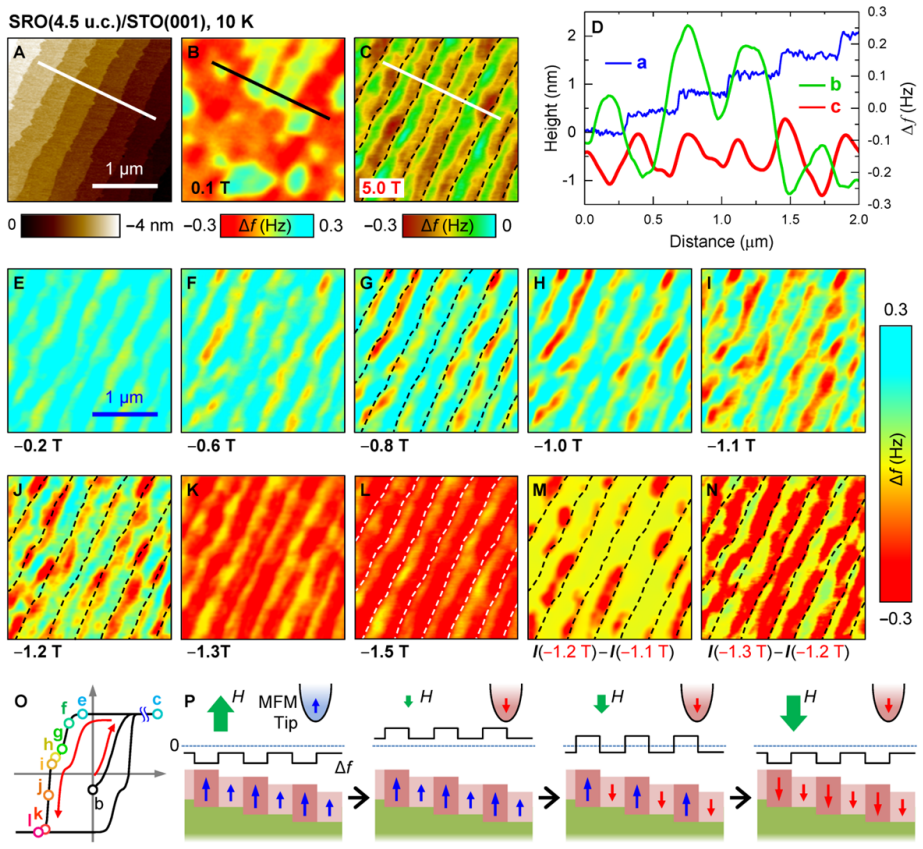
Summary. The manuscript investigates magnetotransport in SrRuO3 ultrathin films with controlled thickness inhomogeneity. The authors grow films with nominal thickness tSRO between 4.0 and 5.0 u.c. using step-flow growth, producing stripe-like regions of 4.0 and 5.0 u.c. thickness. They report that the anomalous Hall resistance (RAHE) of these inhomogeneous films exhibits hump-like features similar to those previously attributed to the topological Hall effect (THE), with the hump amplitude peaking at tSRO = 4.5 u.c. They show that the RAHE-H curves can be 'well reproduced' by linear superposition of the RAHE-H curves of uniform 4.0 and 5.0 u.c. films. They further observe two-step magnetic switching in M-H loops and stripe-like ferromagnetic domains in MFM images, with the stripe geometry matching the terrace structure. These observations are interpreted as evidence for a two-channel anomalous Hall effect (AHE) arising from two distinct k-space Berry curvature channels, and the authors propose the two-step M-H and MFM stripe domains as fingerprints to distinguish this scenario from skyrmion-induced THE.
Significance. If the central claim holds, this work would provide a controlled platform for engineering Berry-curvature-related transport via thickness inhomogeneity and would offer practical criteria for distinguishing two-channel AHE from skyrmion-induced THE in SrRuO3 heterostructures. The microscopic evidence — two-step magnetic switching and terrace-aligned stripe domains in MFM — is strong and largely independent of the transport model; these data support the existence of two distinct magnetic channels and link the hump in RAHE to their sequential switching. However, the quantitative superposition analysis in Fig. 4, which is central to the claim that the hump is quantitatively captured by the two-channel model, suffers from an unresolved weighting problem (detailed in Major Comment 1). The paper does not provide machine-checked proofs or code, but the experimental dataset is systematic across tSRO and temperature and the MFM imaging with pixel-by-pixel subtraction is a notable strength.
major comments (3)
- [Results, 'Tunable AHE in SRO films with inhomogeneous tSRO'] The central quantitative claim that the RAHE-H curves in Fig. 4B–F are 'well reproduced by linear superposition' is not substantiated because the weights of the two components are unspecified. The text does not state whether the grey fits use the nominal area fractions (w4 = 5 - tSRO, w5 = tSRO - 4) or whether the weights were floated. In the Hall-bar geometry, the current flows along the terrace edges, so the 4.0 and 5.0 u.c. stripes act as parallel conductors. The measured Hall resistance should then be a sheet-conductance-weighted average, R_AHE,eff = (g4 R_AHE,4 + g5 R_AHE,5)/(g4 + g5), with g_i proportional to the sheet conductance of each stripe, not an area-weighted average. Fig. S2B explicitly shows that the longitudinal resistance follows a parallel-resistor combination, indicating different sheet conductances for the two thicknesses. If the weights were fixed to area fractions, the model is likely quantitatively incorrect wherever the conductivities differ; if the weights were free, the reproduction is a two-parameter fit and the agreement is partly a consistency check. The authors need to state the weights and, ideally, redo the fits with conductance weighting.
- [Fig. 4 caption] The caption does not provide the superposition weights or the procedure used to obtain the grey curves. Without this information, the reader cannot assess whether the 'continuous engineering' of the hump with tSRO is a genuine prediction of the two-channel model or an interpolation with adjustable parameters. Please provide the weights and an error estimate for the fits.
- [Results, 'Identifying the magnetic inhomogeneity in SRO films'] The two-step M-H curves in Fig. 5C are qualitatively consistent with the two-channel model, but the paper does not quantitatively compare the plateau magnetization with the area-weighted or conductance-weighted sum of the individual 4.0 and 5.0 u.c. M-H curves. Such a comparison would directly test whether the magnetic inhomogeneity matches the nominal thickness fractions and would strengthen the link between the M-H fingerprint and the transport model.
minor comments (5)
- [Abstract and title] The phrase 'Berry-curvature-engineering' is ambitious given that no direct measurement of Berry curvature is presented; the evidence is indirect. Consider softening the claim, e.g., 'Berry-curvature-sensitive engineering'.
- [Discussion] There is a typo: 'It pave s experimental routes' should read 'It paves experimental routes'.
- [Fig. S3] The STEM measurement is performed on a 15 u.c. film to infer the interface structure of thinner films. This approximation should be acknowledged, as the interface structure may be thickness-dependent.
- [Fig. 4] The light grey fitting curves in Fig. 4B–F are difficult to distinguish from the data; using a different color or dashed style would improve readability.
- [References] Reference 39 is an arXiv preprint; if a peer-reviewed version exists, it should be cited instead.
Circularity Check
No significant circularity: the two-channel AHE superposition is a model-data consistency check supported by independent two-step M-H and MFM fingerprints, not a prediction forced by its inputs.
full rationale
The paper does not claim to derive the hump-like Hall anomaly from first principles; it models the inhomogeneous films as a linear superposition of the measured uniform 4.0 and 5.0 u.c. RAHE loops and compares that superposition with independently measured curves. The weights are tied to nominal thickness fractions (e.g., tSRO = 4.3 u.c. gives 70% 4.0 u.c. and 30% 5.0 u.c. area), so the comparison is parameter-free in its central form. The two-step M-H switching and stripe-like MFM domains are experimental outcomes not used to construct the transport model and therefore provide independent support. The skyrmion comparison uses prior work by the same authors (ref. 34) as empirical benchmark data, not as an unverified theorem; the AHE sign-reversal mechanism is explicitly left for future ARPES/DFT work, so no result is imported by self-citation. The possible objection that parallel stripes should be conductance-weighted rather than area-weighted is a quantitative validity concern, not a circularity: it does not make the model's output equal to its input by construction. No fitted parameter is relabeled as a prediction, and the paper itself calls the grey curves 'fitting curves' rather than independent predictions. The central evidence for distinguishing the two-channel AHE from skyrmion-induced THE rests on the M-H and MFM fingerprints, which are not derived from the RAHE data being explained.
Assumptions & free parameters
free parameters (1)
- superposition weights w4, w5 =
not stated in paper; nominal tSRO implies w4 = 0.7 and w5 = 0.3 for 4.3 u.c., 0.5 and 0.5 for 4.5 u.c.
assumptions (3)
- domain assumption The film consists of two laterally separated regions with uniform thicknesses of 4.0 and 5.0 u.c., with area fractions equal to the fractional part (and complement) of the nominal tSRO.
- ad hoc to paper The total transverse Hall resistance of the inhomogeneous film is the areal-weighted linear superposition of the individual uniform film Hall resistances.
- domain assumption The AHE of SrRuO3 is dominated by intrinsic k-space Berry curvature, so sign reversal with thickness reflects band-structure changes.
Cite this review
Pith. "Pith review of Controllable thickness inhomogeneity and Berry-curvature-engineering of anomalous Hall effect in SrRuO3 ultrathin films." pith.science (2026). https://pith.science/paper/FX6DXERB
@misc{pith2026190808211,
  author       = {Pith},
  title        = {Pith review of: Controllable thickness inhomogeneity and Berry-curvature-engineering of anomalous Hall effect in SrRuO3 ultrathin films},
  year         = {2026},
  howpublished = {\url{https://pith.science/paper/FX6DXERB}},
  note         = {Machine review of arXiv:1908.08211}
}
read the original abstract
In quantum matters hosting electron-electron correlation and spin-orbit coupling, spatial inhomogeneities, arising from competing ground states, can be essential for determining and understanding topological properties. A prominent example is Hall anomalies observed in SrRuO3 films, which were interpreted in terms of either magnetic skyrmion-induced topological Hall effect (THE) or inhomogeneous anomalous Hall effect (AHE). To clarify this ambiguity, we systematically investigated the AHE of SrRuO3 ultrathin films with controllable inhomogeneities in film thickness (tSRO). By harnessing the step-flow growth of SrRuO3 films, we induced microscopically-ordered stripes with one-unit-cell differences in tSRO. The resultant spatial distribution of momentum-space Berry curvatures enables a two-channel AHE, which shows hump-like anomalies similar to the THE and can be continuously engineered via sub-unit-cell control of tSRO. In these inhomogeneous SRO films, we microscopically identified a two-step magnetic switching and stripe-like ferromagnetic domains. These features are fingerprints for distinguishing the two-channel AHE from the skyrmion-induced THE.
Figures


Figures from the paper (3 more)


Reference graph
Works this paper leans on
-
[1]
W. Witczak-Krempa, G. Chen, Y. B. Kim, L. Balents, Annu. Rev. Condens. Matter Phys. 5, 57-82 (2013)
work page 2013
-
[2]
R. Schaffer, E. Kin-Ho Lee, B. J. Yang, Y. B. Kim, Reports Prog. Phys. 79, 094504 (2016)
work page 2016
-
[3]
B. J. Kim et al., Phys. Rev. Lett. 101, 076402 (2008)
work page 2008
-
[4]
B. J. Kim, H. Ohsumi, T. Komesu, S. Sakai, T. Morita, H. Takagi, Science 323, 1329–1332 (2009)
work page 2009
-
[5]
X. Wan, A. M. Turner, A. Vishwanath, S. Y. Savrasov, Phys. Rev. B. 83, 205101 (2011)
work page 2011
- [6]
- [7]
- [8]
Show all 48 references
-
[9]
Tokura, K
Y. Tokura, K. Yasuda, A. Tsukazaki, Nat. Rev. Phys. 1, 126–143 (2019)
2019
-
[10]
Y. Ando, J. Phys. Soc. Japan. 82, 102001 (2013)
2013
-
[11]
M. Z. Hasan, J. E. Moore, Annu. Rev. Condens. Matter Phys. 2, 55–78 (2010)
2010
-
[12]
Dagotto, Science 309, 257–262 (2005)
E. Dagotto, Science 309, 257–262 (2005)
2005
-
[13]
Mathur, P
N. Mathur, P. Littlewood Phys. Today. 56, 25–30 (2003)
2003
-
[14]
Wang et al., Nat
W. Wang et al., Nat. Phys. 14, 791–795 (2018)
2018
-
[15]
E. Y. Ma et al., Science 538, 538–542 (2015)
2015
-
[16]
M. V. Berry, Proc. R. Soc. L. 392, 45–57 (1984)
1984
-
[17]
D. Xiao, M. C. Chang, Q. Niu, Rev. Mod. Phys. 82, 1959–2007 (2010)
2010
-
[18]
Nagaosa, J
N. Nagaosa, J. Sinova, S. Onoda, A. H. MacDonald, N. P. Ong, Rev. Mod. Phys. 82, 1539–1592 (2010)
2010
-
[19]
Manna, Y
K. Manna, Y. Sun, L. Muechler, J. Kübler, C. Felser, Nat. Rev. Mater. 3, 244–256 (2018)
2018
-
[20]
Yao et al., Phys
Y. Yao et al., Phys. Rev. Lett. 92, 037204 (2004)
2004
-
[21]
Taguchi, Y
Y. Taguchi, Y. Oohara, H. Yoshizawa, N. Nagaosa, Y. Tokura, Science 291, 2573–2576 (2001)
2001
-
[22]
Everschor-Sitte, M
K. Everschor-Sitte, M. Sitte, J. Appl. Phys. 115, 172602 (2014)
2014
-
[23]
Neubauer et al., Phys
A. Neubauer et al., Phys. Rev. Lett. 102, 186602 (2009)
2009
-
[24]
Soumyanarayanan et al., Nat
A. Soumyanarayanan et al., Nat. Mater. 16, 898–904 (2017)
2017
-
[25]
Sürgers, G
C. Sürgers, G. Fischer, P. Winkel, H. v. Löhneysen, Nat. Commun. 5, 3400 (2014)
2014
-
[26]
Nakatsuji, N
S. Nakatsuji, N. Kiyohara, T. Higo, Nature. 527, 212–215 (2015)
2015
-
[27]
A. K. Nayak et al., Sci. Adv. 2, e1501870 (2016)
2016
-
[28]
P. K. Rout, P. V. P. Madduri, S. K. Manna, A. K. Nayak, Phys. Rev. B. 99, 094430 (2019). 14
2019
-
[29]
Ahadi, L
K. Ahadi, L. Galletti, S. Stemmer, Appl. Phys. Lett. 111, 172403 (2017)
2017
-
[30]
K. S. Takahashi et al., Sci. Adv. 4, eaar7880 (2018)
2018
-
[31]
Koster et al., Rev
G. Koster et al., Rev. Mod. Phys. 84, 253–298 (2012)
2012
-
[32]
Matsuno et al., Sci
J. Matsuno et al., Sci. Adv. 2, e1600304 (2016)
2016
-
[33]
Ohuchi et al., Nat
Y. Ohuchi et al., Nat. Commun. 9, 213 (2018)
2018
-
[34]
Wang et al., Nat
L. Wang et al., Nat. Mater. 17, 1087–1094 (2018)
2018
-
[35]
K. Y. Meng et al., Nano Lett. 19, 3169–3175 (2019)
2019
-
[36]
Qin et al., Adv
Q. Qin et al., Adv. Mater. 31, 1807008 (2019)
2019
-
[37]
D. Kan, T. Moriyama, K. Kobayashi, Y. Shimakawa, Phys. Rev. B. 98, 180408 (2018)
2018
-
[38]
Gerber, Phys
A. Gerber, Phys. Rev. B. 98, 214440 (2018)
2018
-
[39]
D. J. Groenendijk et al., arXiv:1810.05619
-
[40]
Fang et al., Science
Z. Fang et al., Science. 302, 92–96 (2003)
2003
-
[41]
Mathieu et al., Phys
R. Mathieu et al., Phys. Rev. Lett. 93, 016602 (2004)
2004
-
[42]
Rijnders, D
G. Rijnders, D. H. A. Blank, J. Choi, C. -B. Eom, Appl. Phys. Lett. 84, 505–507 (2004)
2004
-
[43]
J. Choi, C. -B. Eom, G. Rijnders, H. Rogalla, D. H. A. Blank, Appl. Phys. Lett. 79, 1447–1449 (2001)
2001
-
[44]
Hong et al., Phys
W. Hong et al., Phys. Rev. Lett. 95, 095501 (2005)
2005
-
[45]
Y. J. Chang et al., Phys. Rev. Lett. 103, 057201 (2009)
2009
-
[46]
L. Si, Z. Zhong, J. M. Tomczak, K. Held, Phys. Rev. B 92, 041108 (2015)
2015
-
[47]
Kang et al., Phys
S. Kang et al., Phys. Rev. B. 99, 045113 (2019)
2019
-
[48]
Kurenkov et al., Adv
A. Kurenkov et al., Adv. Mater. 31, 1900636 (2019). 15 Fig. 1. Two-channel anomalous Hall effect and magnetic skyrmion-induced topological Hall effect. (A) Schematic illustration of topological Hall effect (THE), which originates from the real-space Berry curvature acquired by...
2019
Reviewed August 14, 2026 · model on record in the stance chip above.
Discussion (0). Continue with ORCID to comment.