Membrane-based Acoustic Microrobots
Pith reviewed 2026-06-26 14:39 UTC · model grok-4.3
The pith
A thin PDMS membrane over microcavities blocks gas diffusion so acoustic microrobots maintain stable streaming and propulsion for more than 24 hours.
A machine-rendered reading of the paper's core claim, the machinery that carries it, and where it could break.
Core claim
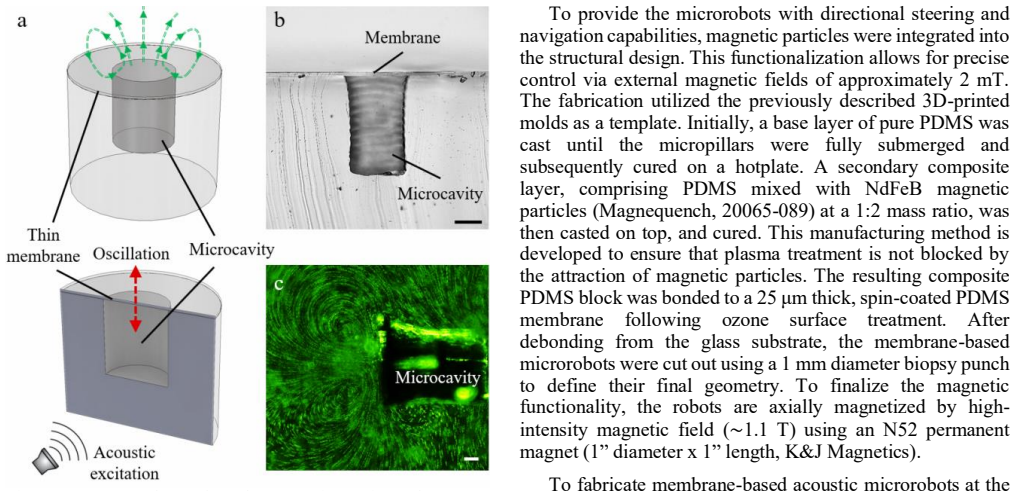
Bonding a thin flexible PDMS membrane over confined microcavities physically prevents gas diffusion in acoustic microrobots. This maintains stable resonance and produces consistent microstreaming and propulsion for over 24 hours of continuous operation even at high actuation voltages. Embedding magnetic microparticles in the body permits directional control with 2 mT external fields, and the overall architecture scales down to approximately 100 micrometers.
What carries the argument
Thin flexible PDMS membrane bonded over confined microcavities that seals against gas diffusion while permitting acoustic microstreaming.
If this is right
- Consistent streaming and propulsion continue for over 24 hours of continuous operation at high voltages.
- Actuators function as microswimmers with directional control from low-intensity 2 mT external magnetic fields.
- The architecture scales down to approximately 100 micrometers while retaining function.
- The sealed design provides a framework for high-endurance acoustic microactuators and microrobots suited to long-term tasks.
Where Pith is reading between the lines
- The sealing method could be tested in other fluid-filled microsystems that lose performance from gas leakage.
- Embedding drug carriers inside the same body might allow sustained release during multi-hour missions without resonance drift.
- Further reduction below 100 micrometers could be checked to see whether membrane thickness still permits effective streaming.
Load-bearing premise
The PDMS membrane remains intact, securely bonded, and does not degrade, detach, or change acoustic properties during prolonged high-voltage operation.
What would settle it
A test in which streaming velocity drops or resonance shifts within 24 hours of continuous high-voltage actuation because the membrane fails or gas escapes would falsify the stability claim.
Figures
read the original abstract
Acoustic microrobots have emerged as a promising frontier for targeted drug delivery and minimally invasive medicine due to their high-power density and biocompatibility. Despite wide-ranging designs, conventional acoustic microrobots mostly rely on air microbubbles trapped within confined microcavities within the robot body, which suffer from limited operational longevity due to rapid gas dissolution and resultant shifts in resonance frequency. In this paper, we propose a robust, membrane-based acoustic microrobot that overcomes these limitations by employing a thin flexible Polydimethylsiloxane (PDMS) membrane bonded over confined microcavities for microstreaming. The introduced design physically prevents gas diffusion, ensuring stable performance over extended periods at high actuation voltages. We systematically characterized the membrane-based acoustic actuator longevity, demonstrating consistent streaming and propulsion for over 24 hours of continuous operation. In addition, by embedding magnetic microparticles into the structural body, these actuators were successfully employed as microswimmers with directional control using low-intensity (2 mT) external magnetic fields. Finally, we demonstrate the scalability of the proposed design architecture down to ~100 um. This membrane-based approach establishes a reliable framework for the development of high-endurance acoustic microactuators and microrobots capable of performing long-term tasks.
Editorial analysis
A structured set of objections, weighed in public.
Referee Report
Summary. The manuscript proposes a membrane-based acoustic microrobot that bonds a thin flexible PDMS membrane over confined microcavities to trap air for microstreaming. It claims this design physically prevents gas diffusion, enabling consistent streaming and propulsion for over 24 hours of continuous operation at high actuation voltages, with additional demonstrations of magnetic directional control using embedded microparticles under 2 mT fields and scalability down to ~100 μm.
Significance. If supported by direct evidence that the membrane prevents diffusion and sustains resonance without gas loss, the approach would address a key limitation in acoustic microrobotics and support longer-duration tasks in biomedical applications.
major comments (1)
- [Abstract] Abstract: The central claim that the PDMS membrane 'physically prevents gas diffusion' is load-bearing for the 24-hour stability result, yet the known high gas permeability of PDMS (oxygen permeability ~600 barrer) permits diffusion through the membrane bulk regardless of edge bonding. No membrane thickness, permeation rate calculation, or time-series measurement of internal gas pressure/volume is referenced to rule out this mechanism.
minor comments (1)
- [Abstract] The abstract states that 'systematic characterization' of longevity was performed, but provides no details on sample size, voltage levels, error bars, or controls for alternative explanations of streaming stability (e.g., membrane compliance).
Simulated Author's Rebuttal
We thank the referee for their constructive comment on the abstract's central claim. We address the concern point-by-point below and will revise the manuscript accordingly.
read point-by-point responses
-
Referee: [Abstract] Abstract: The central claim that the PDMS membrane 'physically prevents gas diffusion' is load-bearing for the 24-hour stability result, yet the known high gas permeability of PDMS (oxygen permeability ~600 barrer) permits diffusion through the membrane bulk regardless of edge bonding. No membrane thickness, permeation rate calculation, or time-series measurement of internal gas pressure/volume is referenced to rule out this mechanism.
Authors: We agree that the phrasing 'physically prevents gas diffusion' is imprecise and not fully supported. PDMS is permeable, so diffusion through the bulk membrane cannot be ruled out by edge bonding alone. The design seals the microcavity opening with a thin membrane to reduce direct gas escape and maintain air trapping for microstreaming, which empirically yields >24 h stability in our tests, but we provide no permeation calculations, pressure/volume time-series data, or explicit thickness values to quantify the contribution of reduced diffusion versus other factors (e.g., geometry or actuation conditions). We will revise the abstract to remove the load-bearing claim, replace it with a description of the sealed-cavity architecture enabling prolonged operation, and add the membrane thickness to the methods. We will also note the empirical longevity result without asserting mechanistic prevention of diffusion. revision: yes
Circularity Check
No circularity: purely experimental design and characterization
full rationale
The paper is an experimental report describing fabrication, bonding of a PDMS membrane over microcavities, and direct measurements of streaming stability over 24 hours. No equations, derivations, fitted parameters, or mathematical predictions appear in the abstract or described content. Claims rest on physical demonstration rather than any derivation chain. No self-citations, uniqueness theorems, or ansatzes are invoked. The central claim of prevented gas diffusion is an empirical observation from longevity tests, not a reduction to prior inputs by construction.
Axiom & Free-Parameter Ledger
axioms (2)
- domain assumption PDMS membrane can be bonded over microcavities to form a durable gas-tight seal without compromising acoustic resonance
- domain assumption Embedding magnetic microparticles does not interfere with acoustic streaming performance
Reference graph
Works this paper leans on
-
[1]
Rotational manipulation of single cells and organisms using acoustic waves,
D. Ahmed et al., “Rotational manipulation of single cells and organisms using acoustic waves,” Nat. Commun., vol. 7, no. 1, p. 11085, Mar. 2016, doi: 10.1038/ncomms11085
-
[2]
3D steerable, acoustically powered microswimmers for single-particle manipulation,
L. Ren et al., “3D steerable, acoustically powered microswimmers for single-particle manipulation,” Sci. Adv., vol. 5, no. 10, p. eaax3084, Oct. 2019, doi: 10.1126/sciadv.aax3084
-
[3]
Microporous Magnetic Soft Materials with Programmable Locomotion and On-Demand Liquid Cargo Release,
Y. Zhou, F. Kocabas, and Y. Alapan, “Microporous Magnetic Soft Materials with Programmable Locomotion and On-Demand Liquid Cargo Release,” in 2025 International Conference on Manipulation, Automation and Robotics at Small Scales (MARSS), West Lafayette, IN, USA: IEEE, Jul. 2025, pp. 01–06. doi: 10.1109/MARSS65887.2025.11072793
-
[4]
M. B. Akolpoglu et al., “Magnetically steerable bacterial microrobots moving in 3D biological matrices for stimuli-responsive cargo delivery,” Sci. Adv., vol. 8, no. 28, p. eabo6163, Jul. 2022, doi: 10.1126/sciadv.abo6163
-
[5]
Microrobotics and Microorganisms: Biohybrid Autonomous Cellular Robots,
Y. Alapan, O. Yasa, B. Yigit, I. C. Yasa, P. Erkoc, and M. Sitti, “Microrobotics and Microorganisms: Biohybrid Autonomous Cellular Robots,” Annu. Rev. Control Robot. Auton. Syst., vol. 2, no. 1, pp. 205–230, May 2019, doi: 10.1146/annurev-control-053018- 023803
-
[6]
Mobile Microrobots for Active Therapeutic Delivery,
P. Erkoc, I. C. Yasa, H. Ceylan, O. Yasa, Y. Alapan, and M. Sitti, “Mobile Microrobots for Active Therapeutic Delivery,” Adv. Ther., vol. 2, no. 1, p. 1800064, Jan. 2019, doi: 10.1002/adtp.201800064
-
[7]
Shape- encoded dynamic assembly of mobile micromachines,
Y. Alapan, B. Yigit, O. Beker, A. F. Demirörs, and M. Sitti, “Shape- encoded dynamic assembly of mobile micromachines,” Nat. Mater., vol. 18, no. 11, pp. 1244–1251, Nov. 2019, doi: 10.1038/s41563- 019-0407-3
-
[8]
F. Kocabas, O. Oguztuzun, Y. Zhou, and Y. Alapan, “Magnetic Programming of Soft Materials Using Digitally Processed Laser Heating,” in 2025 IEEE International Conference on Robotics and Automation (ICRA), Atlanta, GA, USA: IEEE, May 2025, pp. 15350–15355. doi: 10.1109/ICRA55743.2025.11127804
-
[9]
Multifunctional biohybrid magnetite microrobots for imaging-guided therapy,
X. Yan et al., “Multifunctional biohybrid magnetite microrobots for imaging-guided therapy,” Sci. Robot., vol. 2, no. 12, p. eaaq1155, Nov. 2017, doi: 10.1126/scirobotics.aaq1155
-
[10]
Actuation of Mobile Microbots: A Review,
H. Hussein et al., “Actuation of Mobile Microbots: A Review,” Adv. Intell. Syst., vol. 5, no. 9, p. 2300168, Sep. 2023, doi: 10.1002/aisy.202300168
-
[11]
Acoustically Powered Nano- and Microswimmers: From Individual to Collective Behavior,
J. M. McNeill and T. E. Mallouk, “Acoustically Powered Nano- and Microswimmers: From Individual to Collective Behavior,” ACS Nanosci. Au, vol. 3, no. 6, pp. 424–440, Dec. 2023, doi: 10.1021/acsnanoscienceau.3c00038
-
[12]
Artificial Acousto‐Magnetic Soft Microswimmers,
D. Ahmed, C. Dillinger, A. Hong, and B. J. Nelson, “Artificial Acousto‐Magnetic Soft Microswimmers,” Adv. Mater. Technol., vol. 2, no. 7, p. 1700050, Jul. 2017, doi: 10.1002/admt.201700050
-
[13]
Selectively manipulable acoustic-powered microswimmers,
D. Ahmed et al., “Selectively manipulable acoustic-powered microswimmers,” Sci. Rep., vol. 5, no. 1, p. 9744, May 2015, doi: 10.1038/srep09744
-
[14]
Acoustically powered surface-slipping mobile microrobots,
A. Aghakhani, O. Yasa, P. Wrede, and M. Sitti, “Acoustically powered surface-slipping mobile microrobots,” Proc. Natl. Acad. Sci., vol. 117, no. 7, pp. 3469–3477, Feb. 2020, doi: 10.1073/pnas.1920099117
-
[15]
Cavitation microstreaming and stress fields created by microbubbles,
J. Collis et al., “Cavitation microstreaming and stress fields created by microbubbles,” Ultrasonics, vol. 50, no. 2, pp. 273–279, Feb. 2010, doi: 10.1016/j.ultras.2009.10.002
-
[16]
T. G. Leighton, “The Sound Field,” in The Acoustic Bubble, Elsevier, 1994, pp. 1–66. doi: 10.1016/B978-0-12-441920-9.50006-7
-
[17]
Micropropulsion by an acoustic bubble for navigating microfluidic spaces,
J. Feng, J. Yuan, and S. K. Cho, “Micropropulsion by an acoustic bubble for navigating microfluidic spaces,” Lab. Chip, vol. 15, no. 6, pp. 1554–1562, 2015, doi: 10.1039/C4LC01266F
-
[18]
Multiorifice acoustic microrobot for boundary-free multimodal 3D swimming,
N. Mahkam, M. C. Ugurlu, S. K. Kalva, A. Aghakhani, D. Razansky, and M. Sitti, “Multiorifice acoustic microrobot for boundary-free multimodal 3D swimming,” Proc. Natl. Acad. Sci., vol. 122, no. 4, p. e2417111122, Jan. 2025, doi: 10.1073/pnas.2417111122
-
[19]
Propulsion of Bubble-Based Acoustic Microswimmers,
N. Bertin et al., “Propulsion of Bubble-Based Acoustic Microswimmers,” Phys. Rev. Appl., vol. 4, no. 6, p. 064012, Dec. 2015, doi: 10.1103/PhysRevApplied.4.064012
-
[20]
Ultrasound-driven programmable artificial muscles,
Z. Shi et al., “Ultrasound-driven programmable artificial muscles,” Nature, vol. 646, no. 8087, pp. 1096–1104, Oct. 2025, doi: 10.1038/s41586-025-09650-3
-
[21]
Acoustic Bubble: Controlled and Selective Micropropulsion,
D. Ahmed, “Acoustic Bubble: Controlled and Selective Micropropulsion,” The Pennsylvania State University, 2015
2015
-
[22]
Imaging-guided bioresorbable acoustic hydrogel microrobots,
H. Han et al., “Imaging-guided bioresorbable acoustic hydrogel microrobots,” Sci. Robot., vol. 9, no. 97, p. eadp3593, Dec. 2024, doi: 10.1126/scirobotics.adp3593
-
[23]
Acoustic microstreaming around an isolated encapsulated microbubble,
X. Liu and J. Wu, “Acoustic microstreaming around an isolated encapsulated microbubble,” J. Acoust. Soc. Am., vol. 125, no. 3, pp. 1319–1330, Mar. 2009, doi: 10.1121/1.3075552
-
[24]
Acoustic microstreaming around an encapsulated particle,
A. A. Doinikov and A. Bouakaz, “Acoustic microstreaming around an encapsulated particle,” J. Acoust. Soc. Am., vol. 127, no. 3, pp. 1218–1227, Mar. 2010, doi: 10.1121/1.3290997
-
[25]
Robust acoustofluidic micromixer based on an ultrathin PDMS microballoon oscillator,
Y. Yang et al., “Robust acoustofluidic micromixer based on an ultrathin PDMS microballoon oscillator,” Sens. Actuators B Chem., vol. 448, p. 139009, Feb. 2026, doi: 10.1016/j.snb.2025.139009
discussion (0)
Sign in with ORCID, Apple, or X to comment. Anyone can read and Pith papers without signing in.