REVIEW 4 major objections 5 minor 6 cited by
ChatVLA-2: Vision-Language-Action Model with Open-World Embodied Reasoning from Pretrained Knowledge
T0 review · 4 major / 5 minor · reviewed 2026-08-07 · deepseek-v4-flash
Pith's one-line read ChatVLA-2 shows a robot can solve math and spatial tasks it was never trained on by keeping its pretrained vision-language knowledge intact.
desk verdict Plausible architecture and real-robot results, but the 'untrained generalization' claim is contradicted by the paper's own training data. read the letter →
The pith
A machine-rendered reading of the paper's core claim, the machinery that carries it, and where it could break.
The reading
What carries the argument
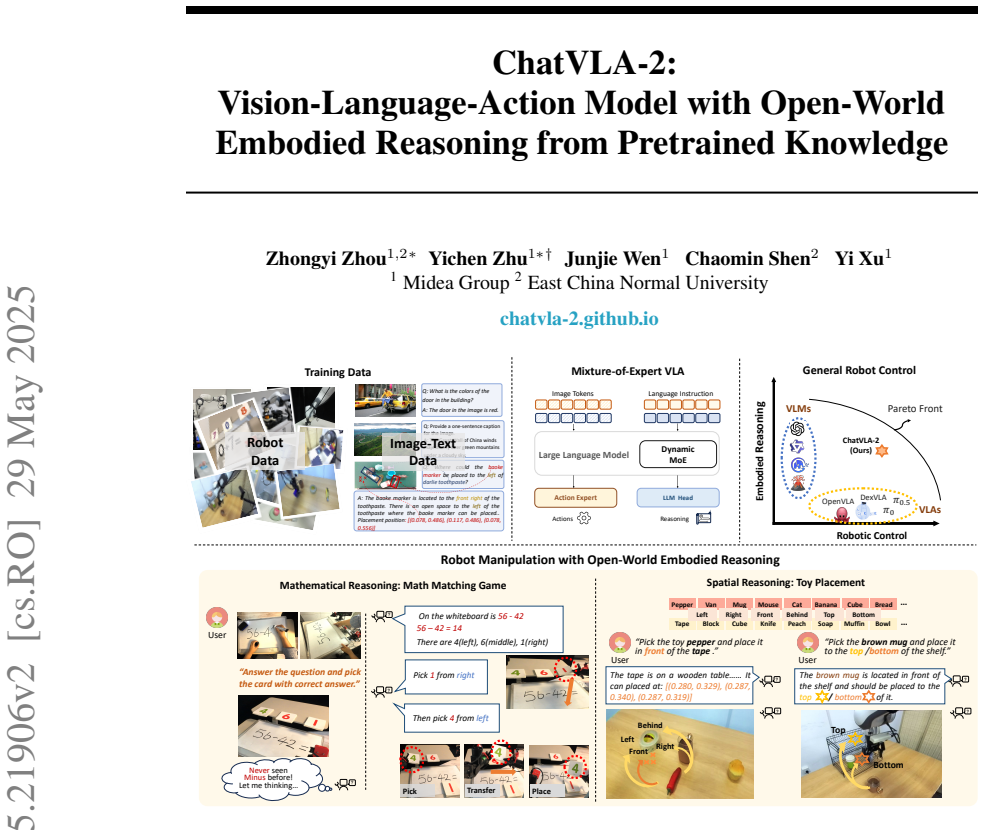
The load-bearing mechanism is a dynamic mixture-of-experts layer inside the pretrained vision-language backbone. Rather than a fixed assignment of experts, a router selects a small subset of experts for each input, so some experts specialize in multimodal understanding, some in robot control, and some stay shared; the paper argues this preserves the intact LLM structure and avoids the knowledge loss that static experts cause. The second mechanism is a reasoning-following enhancement module that replaces the observation embedding with projected reasoning tokens and uses them to generate scale-and-shift conditioning in the latter half of a pretrained diffusion action expert. Together with a two-stage training scheme—co-training on image-text and robot data, then freezing the VLM while training only the action expert—these components carry the claim that actions can be made to follow the model's internal reasoning.
What would settle it
Audit the training and augmentation logs: list every equation, card layout, object name, and spatial phrase in the 600 math-matching and 300 placement trajectories, the image-text samples, and the model-augmented reasoning phrases, then check for exact or near-duplicate overlap with the open-world test items. If any test equation or toy-and-direction combination appears, the open-world success rates do not establish generalization. A cleaner falsifier is a pre-registered held-out split generated after training with guaranteed zero overlap, rerun under the same protocol.
Extended reading notes
Core claim
The central claim is that a VLA can preserve and actively use the pretrained knowledge of its vision-language backbone instead of eroding it during robotic fine-tuning. On the authors' own terms, ChatVLA-2 demonstrates this by separating multimodal understanding and robot control into different expert pathways within a dynamic mixture-of-experts layer, while keeping a set of shared experts that carry transferable features such as spatial reasoning. A reasoning-following module then feeds the backbone's reasoning tokens into the latter half of the action-expert layers, and a second training stage freezes the VLM so the action expert learns to act on out-of-distribution reasoning. The authors report that this recipe yields near-perfect in-domain manipulation and, unlike all compared baselines, nonzero open-world success on unseen equations and unseen spatial instructions, including math and OCR scores that were never explicitly trained in the VLA pipeline.
Load-bearing premise
The load-bearing premise is that the open-world test items are genuinely out of distribution: the handwritten equations, cards, toys, and directional phrases used at test time must not appear in the 600 math-matching trajectories, the 300 placement trajectories, the co-trained image-text data, or the language-model-augmented reasoning annotations.
Editorial extensions
If this is right
- If the central claim holds, robot fine-tuning no longer has to trade away a VLM's pretrained capabilities, so a single model can keep answering visual questions and doing math while also controlling a robot.
- Open-world instructions could be executed end-to-end: a robot could read a novel equation or hear a novel spatial phrase and produce a correct action without an external planner or symbolic reasoner.
- The two-stage recipe gives a concrete way to diagnose and repair reasoning-following failures: co-training restores the knowledge, and the frozen-backbone second stage binds that knowledge to action.
- The same architecture could make smaller robot datasets sufficient for generalization, since the heavy lifting is done by preserved pretrained knowledge rather than by in-domain demonstrations.
Reading between the lines
- A natural next test the paper leaves implicit is a contamination audit: release the full training and test equation and object sets so independent readers can verify that the open-world numbers are not boosted by leakage through the language-model reasoning augmentation.
- The dynamic-MoE principle could transfer to other VLA backbones and embodiments; if the retention result is robust, one would expect mobile or long-horizon versions to show the same out-of-distribution reasoning advantage, not just tabletop pick-and-place.
- Because the method is framed as preserving pretrained knowledge, its ceiling is set by what the VLM already knows; extending the recipe to a stronger reasoning backbone or tool-augmented arithmetic would be a testable way to push beyond that ceiling.
Signed reviews
Editorial analysis
A structured set of objections, weighed in public.
Referee Report
Summary. The paper presents ChatVLA-2, a mixture-of-experts vision-language-action model built on Qwen2-VL and a ScaleDP action expert, with a two-stage training pipeline intended to preserve pretrained VLM knowledge while enabling robot control. The core claim is that the model exhibits open-world OCR, mathematical reasoning, and spatial reasoning in real-robot math-matching and toy-placement tasks, even though these abilities are said not to be explicitly trained. The authors report strong open-world results (e.g., 82.7% manipulation success on the math game, 81.4% on toy placement) and support the claims with ablations on the MoE design, training stages, expert count, and reasoning-injection layer.
Significance. If the central claim were established, the paper would make a valuable contribution: a practical recipe for preventing catastrophic forgetting of VLM capabilities during VLA fine-tuning, with real-robot evidence on two tasks. The dynamic-MoE architecture, two-stage co-training, and reasoning-following module are concrete, reproducible design choices, and the authors include multiple ablations (Tables 3-6) and comparisons against several strong baselines. However, the headline interpretation that the demonstrated reasoning abilities were 'not explicitly trained' is contradicted by the paper's own training data, and the open-world evaluation is not fully auditable. The engineering contribution is significant, but the scientific claim about retention of pretrained knowledge needs substantial reframing and additional evidence.
major comments (4)
- [Abstract and §3.3] The abstract and Section 3.3 claim that mathematical reasoning and OCR capabilities are exhibited 'despite these abilities not being explicitly trained within the VLA.' This is contradicted by the training protocol in §3.3 and §B.2: the robot data consists of 600 math-matching trajectories and 300 toy-placement trajectories, which include whiteboard equations, handwritten digits, card values and positions, answer-selection actions, and spatial-relation instructions. These trajectories are used to train the VLA in Stage 1, so OCR, arithmetic, and spatial reasoning are explicitly trained. The sentence 'We deliberately avoid selecting training data to bias the VLA toward specific skills such as OCR, mathematical reasoning, or spatial reasoning' (§3.3) is therefore misleading. As a result, Tables 1 and 2 cannot separate the contribution of pretrained knowledge from direct supervised learning of the same task families.
- [§4.1 and §4.2] The open-world evaluation is a held-out split of the same two task families used for training, but the paper does not list the training and test equation sets, object sets, card arrangements, or direction-object pairs. The statement that 'the mathematical equations tested are entirely absent from the training data' (§4.1) and the analogous claim for toy placement (§4.2) cannot be audited. Because the reasoning annotations are augmented with GPT-4o (§B.2), there is also a risk that test-like phrases or content are injected into training examples. Without a full disclosure of the train/test splits, the out-of-distribution premise underlying the open-world claim is unsupported.
- [§4.1, Table 1 and §4.2, Table 2] The comparisons with OpenVLA, DexVLA, π0, and other baselines do not state whether these baselines were fine-tuned on the same 600 math-matching and 300 toy-placement trajectories used for ChatVLA-2. If the baselines are evaluated with their publicly released checkpoints, the comparison conflates architecture differences with differences in training data exposure. A fair comparison would require training each baseline on the same robot data mixture; otherwise, the reported superiority in open-world settings may reflect the presence of task-specific training data rather than the proposed MoE and reasoning-following mechanisms.
- [§4.3, Tables 3-6] The ablation studies that select the number of experts and top-k (Table 5) and the reasoning-injection layer (Table 6) are evaluated on the same math-matching benchmark used for the main claims, with no separate validation set. This creates a risk that these hyperparameters are chosen to optimize the reported open-world scores, which would inflate the main results. The authors should either use a separate validation split or report the selection procedure explicitly.
minor comments (5)
- [Abstract and Introduction] The phrase 'despite these abilities not being explicitly trained within the VLA' should be revised or precisely qualified, since the robot training data in §3.3 directly supervises the same abilities.
- [§4.1, Evaluation metrics] The OCR scoring rubric assigns 1 point for hand-written numbers, 1 point for card values and positions, and 2 points for the sign, but the text does not explain how partial credit is handled when the model outputs a correct value but wrong position, or when only one of two digits is correct. A short clarification would improve reproducibility.
- [§4.2, Evaluation metrics] The 'open-world object recognition' metric refers to object recognition in the reasoning output, but the paper does not specify how the recognition score is computed from the output reasoning, e.g., whether it is based on the predicted bounding boxes or their labels. Please add a precise definition.
- [§3.2] The paragraph 'Why static/shared experts are not used?' is more of a design discussion than an empirical result; consider moving it to the appendix or compressing it to keep the main text focused.
- [References] Several references are cited as arXiv preprints without version numbers; while acceptable, the authors should update to peer-reviewed versions where available, particularly for OpenVLA and π0.
Circularity Check
The central 'open-world reasoning from pretrained knowledge' claim is compromised because the VLA is explicitly trained on 600 math-matching and 300 toy-placement trajectories, so the held-out open-world scores are trained task competence, not an independent prediction from retained VLM knowledge.
-
fitted input called prediction
[Abstract and Section 3.3 (Training Strategy)]
"Remarkably, our method exhibits exceptional mathematical reasoning and OCR capabilities, despite these abilities not being explicitly trained within the VLA. ... For robot data, we collect 600 trajectories from a math-matching game and 300 trajectories from a toy placement experiment."
The premise 'not explicitly trained' is contradicted by the paper's own training recipe. Stage 1 trains the VLA on 600 math-matching and 300 toy-placement trajectories, i.e., demonstrations of the exact skills later scored (handwritten-digit OCR, card value/position reading, sign recognition, answer selection, relative-direction placement). The 'open-world' evaluation is a held-out split of these same two task families, so the high OCR/math/spatial scores can be explained by task-specific supervised learning rather than by retained pretrained VLM knowledge. The paper does not list training vs. test equations or objects, so the OOD premise is unauditable; the headline result is a trained outcome, not an independent probe of preserved knowledge.
full rationale
The derivation chain breaks at the evaluation step. The paper's central claim is that OCR and mathematical reasoning appear 'despite these abilities not being explicitly trained within the VLA,' and that spatial reasoning transfers to novel objects and directions. However, Section 3.3 explicitly trains on 600 math-matching and 300 toy-placement trajectories, which are the same two task families used for the open-world tests. The open-world condition is defined only as equations never appearing in the training data or objects entirely unseen during training, but no training/test equation or object lists are provided, and a held-out split of the same task family still contains the same OCR, arithmetic, card-selection, and directional-placement structure the model was fitted to. Therefore the headline numbers (OCR 3.58/4, math 1.73/2, 82.7%, and 81.4%) are at least partly learned task competence, not a demonstration of preserved pretrained knowledge. Additionally, the final configuration (8 experts, top-2 routing, latter-half-layer injection) was selected via ablations on the same benchmark (Tables 3, 5, and 6), compounding selection bias; this is a test-set selection issue rather than an equation-level circularity, but it further weakens the headline. The paper's self-citations to ChatVLA [7] and DexVLA [2] are architectural and motivational rather than load-bearing uniqueness claims, so the score is 6 rather than 8.
Assumptions & free parameters
free parameters (3)
- Number of MoE experts and top-k =
8 experts, top-k=2
- Reasoning injection layer location =
latter-half layers of the action expert
- Stage 1 training steps =
50k in main text, 15k in Appendix B.1
assumptions (4)
- domain assumption Qwen2-VL's pretrained knowledge includes OCR, arithmetic, and spatial reasoning capabilities.
- domain assumption Dynamic MoE routing preserves the pretrained LLM architecture and therefore its knowledge.
- domain assumption Reasoning tokens generated by the VLM are causally used by the action expert to produce actions.
- domain assumption The held-out test items genuinely do not appear in training data.
Cite this review
Pith. "Pith review of ChatVLA-2: Vision-Language-Action Model with Open-World Embodied Reasoning from Pretrained Knowledge." pith.science (2026). https://pith.science/paper/FXW3JPZU
@misc{pith2026250521906,
  author       = {Pith},
  title        = {Pith review of: ChatVLA-2: Vision-Language-Action Model with Open-World Embodied Reasoning from Pretrained Knowledge},
  year         = {2026},
  howpublished = {\url{https://pith.science/paper/FXW3JPZU}},
  note         = {Machine review of arXiv:2505.21906}
}
read the original abstract
Vision-language-action (VLA) models have emerged as the next generation of models in robotics. However, despite leveraging powerful pre-trained Vision-Language Models (VLMs), existing end-to-end VLA systems often lose key capabilities during fine-tuning as the model adapts to specific robotic tasks. We argue that a generalizable VLA model should retain and expand upon the VLM's core competencies: 1) Open-world embodied reasoning - the VLA should inherit the knowledge from VLM, i.e., recognize anything that the VLM can recognize, be capable of solving math problems, and possess visual-spatial intelligence, 2) Reasoning following - effectively translating the open-world reasoning into actionable steps for the robot. In this work, we introduce ChatVLA-2, a novel mixture-of-expert VLA model coupled with a specialized two-stage training pipeline designed to preserve the VLM's original strengths while enabling actionable reasoning. To validate our approach, we design a math-matching task wherein a robot interprets math problems written on a whiteboard and picks corresponding number cards from a table to solve equations. Remarkably, our method exhibits exceptional mathematical reasoning and OCR capabilities, despite these abilities not being explicitly trained within the VLA. Furthermore, we demonstrate that the VLA possesses strong spatial reasoning skills, enabling it to interpret novel directional instructions involving previously unseen objects. Overall, our method showcases reasoning and comprehension abilities that significantly surpass state-of-the-art imitation learning methods such as OpenVLA, DexVLA, and pi-zero. This work represents a substantial advancement toward developing truly generalizable robotic foundation models endowed with robust reasoning capacities.
Figures


Figures from the paper (1 more)

Forward citations
Cited by 6 Pith papers
-
SpatioLM: Towards General Physical Spatial Intelligence in Vision-Language Models
SpatioLM is a parameter-efficient side module for frozen VLMs, trained with pseudo depth and camera supervision, that achieves state-of-the-art spatial perception and understanding while preserving general capabilities.
-
Generalizable VLA Finetuning via Representation Anchoring and Language-Action Alignment
Preserving pretrained VLM features with layer-wise distillation plus supervising the language head on discretized action directions improves OOD generalization of VLA policies on LIBERO, CALVIN, and a real xArm7.
-
Last-Meter Precision Navigation for UAVs: A Diffusion-Refined Aerial Visual Servoing Approach
A coarse trigonometric pose regressor plus diffusion-based visual imagination improves single-step image-goal aerial navigation on a new 4.8M-pair PairUAV benchmark, though residual errors remain large.
-
VLA-Arena: An Open-Source Framework for Benchmarking Vision-Language-Action Models
An open benchmark with 170 graded manipulation tasks shows current VLA robot policies memorize their training settings, degrade sharply under visual shifts, ignore safety constraints, and fail to compose long-horizon skills.
-
RationalVLA: A Rational Vision-Language-Action Model with Dual System
RAMA, a new benchmark with defective instructions, and RationalVLA, a dual-system model with <ACT> and <REJ> tokens, let a robot reject infeasible commands while still performing unseen executable tasks, with higher s...
-
HMVLA: Hyperbolic Multimodal Fusion for Vision-Language-Action Models
A vision-language-action robot policy that embeds text and image features in hyperbolic space with a soft expert-routing module reports higher LIBERO success than Dita and other baselines.
Reference graph
Works this paper leans on
-
[1]
Kevin Black, Noah Brown, Danny Driess, Adnan Esmail, Michael Equi, Chelsea Finn, Niccolo Fusai, Lachy Groom, Karol Hausman, Brian Ichter, et al. pi_0: A vision-language-action flow model for general robot control.arXiv preprint arXiv:2410.24164, 2024
-
[2]
Junjie Wen, Yichen Zhu, Jinming Li, Zhibin Tang, Chaomin Shen, and Feifei Feng. Dexvla: Vision-language model with plug-in diffusion expert for general robot control.arXiv preprint arXiv:2502.05855, 2025
arXiv 2025
-
[3]
Physical Intelligence, Kevin Black, Noah Brown, James Darpinian, Karan Dhabalia, Danny Driess, Adnan Esmail, Michael Equi, Chelsea Finn, Niccolo Fusai, et al. pi0.5: a vision- language-action model with open-world generalization.arXiv preprint arXiv:2504.16054, 2025
arXiv 2025
-
[4]
Minjie Zhu, Yichen Zhu, Jinming Li, Zhongyi Zhou, Junjie Wen, Xiaoyu Liu, Chaomin Shen, Yaxin Peng, and Feifei Feng. Objectvla: End-to-end open-world object manipulation without demonstration.arXiv preprint arXiv:2502.19250, 2025
arXiv 2025
-
[5]
Paligemma: A versatile 3b vlm for transfer.arXiv preprint arXiv:2407.07726, 2024
Lucas Beyer, Andreas Steiner, André Susano Pinto, Alexander Kolesnikov, Xiao Wang, Daniel Salz, Maxim Neumann, Ibrahim Alabdulmohsin, Michael Tschannen, Emanuele Bugliarello, et al. Paligemma: A versatile 3b vlm for transfer.arXiv preprint arXiv:2407.07726, 2024
arXiv 2024
-
[6]
Jinze Bai, Shuai Bai, Shusheng Yang, Shijie Wang, Sinan Tan, Peng Wang, Junyang Lin, Chang Zhou, and Jingren Zhou. Qwen-vl: A versatile vision-language model for understanding, localization, text reading, and beyond.arXiv preprint arXiv:2308.12966, 1(2):3, 2023
arXiv 2023
-
[7]
Zhongyi Zhou, Yichen Zhu, Minjie Zhu, Junjie Wen, Ning Liu, Zhiyuan Xu, Weibin Meng, Ran Cheng, Yaxin Peng, Chaomin Shen, et al. Chatvla: Unified multimodal understanding and robot control with vision-language-action model.arXiv preprint arXiv:2502.14420, 2025
arXiv 2025
-
[8]
Language models don’t always say what they think: Unfaithful explanations in chain-of-thought prompting.Advances in Neural Information Processing Systems, 36:74952–74965, 2023
Miles Turpin, Julian Michael, Ethan Perez, and Samuel Bowman. Language models don’t always say what they think: Unfaithful explanations in chain-of-thought prompting.Advances in Neural Information Processing Systems, 36:74952–74965, 2023
2023
Show all 68 references
-
[9]
Reasoning models can be effective without thinking.arXiv preprint arXiv:2504.09858, 2025
Wenjie Ma, Jingxuan He, Charlie Snell, Tyler Griggs, Sewon Min, and Matei Zaharia. Reasoning models can be effective without thinking.arXiv preprint arXiv:2504.09858, 2025
2025 arXiv
-
[10]
Openvla: An open-source vision-language-action model
Moo Jin Kim, Karl Pertsch, Siddharth Karamcheti, Ted Xiao, Ashwin Balakrishna, Suraj Nair, Rafael Rafailov, Ethan Foster, Grace Lam, Pannag Sanketi, et al. Openvla: An open-source vision-language-action model
-
[11]
3d diffusion policy: Generalizable visuomotor policy learning via simple 3d representations
Yanjie Ze, Gu Zhang, Kangning Zhang, Chenyuan Hu, Muhan Wang, and Huazhe Xu. 3d diffusion policy: Generalizable visuomotor policy learning via simple 3d representations. In ICRA 2024 Workshop on 3D Visual Representations for Robot Manipulation, 2024
2024
-
[12]
Visual reinforcement learning with self-supervised 3d representations.IEEE Robotics and Automation Letters, 8(5):2890–2897, 2023
Yanjie Ze, Nicklas Hansen, Yinbo Chen, Mohit Jain, and Xiaolong Wang. Visual reinforcement learning with self-supervised 3d representations.IEEE Robotics and Automation Letters, 8(5):2890–2897, 2023
2023
-
[13]
Discrete policy: Learning disentangled action space for multi-task robotic manipulation.arXiv preprint arXiv:2409.18707, 2024
Kun Wu, Yichen Zhu, Jinming Li, Junjie Wen, Ning Liu, Zhiyuan Xu, Qinru Qiu, and Jian Tang. Discrete policy: Learning disentangled action space for multi-task robotic manipulation.arXiv preprint arXiv:2409.18707, 2024
2024 arXiv
-
[14]
Cogact: A foundational vision-language-action model for synergizing cognition and action in robotic manipulation.arXiv preprint arXiv:2411.19650, 2024
Qixiu Li, Yaobo Liang, Zeyu Wang, Lin Luo, Xi Chen, Mozheng Liao, Fangyun Wei, Yu Deng, Sicheng Xu, Yizhong Zhang, et al. Cogact: A foundational vision-language-action model for synergizing cognition and action in robotic manipulation.arXiv preprint arXiv:2411.19650, 2024
2024 arXiv
-
[15]
Any2policy: Learning visuomotor policy with any-modality.Advances in Neural Information Processing Systems, 37:133518–133540, 2024
Yichen Zhu, Zhicai Ou, Feifei Feng, and Jian Tang. Any2policy: Learning visuomotor policy with any-modality.Advances in Neural Information Processing Systems, 37:133518–133540, 2024. 10
2024
-
[16]
Any-point trajectory modeling for policy learning.arXiv preprint arXiv:2401.00025, 2023
Chuan Wen, Xingyu Lin, John So, Kai Chen, Qi Dou, Yang Gao, and Pieter Abbeel. Any-point trajectory modeling for policy learning.arXiv preprint arXiv:2401.00025, 2023
2023 arXiv
-
[17]
Retrieval-augmented embodied agents
Yichen Zhu, Zhicai Ou, Xiaofeng Mou, and Jian Tang. Retrieval-augmented embodied agents. InProceedings of the IEEE/CVF Conference on Computer Vision and Pattern Recognition, pages 17985–17995, 2024
2024
-
[18]
Rt-1: Robotics transformer for real-world control at scale.arXiv preprint arXiv:2212.06817, 2022
Anthony Brohan, Noah Brown, Justice Carbajal, Yevgen Chebotar, Joseph Dabis, Chelsea Finn, Keerthana Gopalakrishnan, Karol Hausman, Alex Herzog, Jasmine Hsu, et al. Rt-1: Robotics transformer for real-world control at scale.arXiv preprint arXiv:2212.06817, 2022
2022 arXiv
-
[19]
Rt-affordance: Affordances are versatile intermediate representations for robot manipulation, 2024
Soroush Nasiriany, Sean Kirmani, Tianli Ding, Laura Smith, Yuke Zhu, Danny Driess, Dorsa Sadigh, and Ted Xiao. Rt-affordance: Affordances are versatile intermediate representations for robot manipulation, 2024
2024
-
[20]
Rdt-1b: a diffusion foundation model for bimanual manipulation.arXiv preprint arXiv:2410.07864, 2024
Songming Liu, Lingxuan Wu, Bangguo Li, Hengkai Tan, Huayu Chen, Zhengyi Wang, Ke Xu, Hang Su, and Jun Zhu. Rdt-1b: a diffusion foundation model for bimanual manipulation.arXiv preprint arXiv:2410.07864, 2024
2024 arXiv
-
[21]
Lift3d foundation policy: Lift- ing 2d large-scale pretrained models for robust 3d robotic manipulation.arXiv preprint arXiv:2411.18623, 2024
Yueru Jia, Jiaming Liu, Sixiang Chen, Chenyang Gu, Zhilue Wang, Longzan Luo, Lily Lee, Pengwei Wang, Zhongyuan Wang, Renrui Zhang, et al. Lift3d foundation policy: Lift- ing 2d large-scale pretrained models for robust 3d robotic manipulation.arXiv preprint arXiv:2411.18623, 2024
2024 arXiv
-
[22]
Robomind: Benchmark on multi-embodiment intelligence normative data for robot manipulation.arXiv preprint arXiv:2412.13877, 2024
Kun Wu, Chengkai Hou, Jiaming Liu, Zhengping Che, Xiaozhu Ju, Zhuqin Yang, Meng Li, Yinuo Zhao, Zhiyuan Xu, Guang Yang, et al. Robomind: Benchmark on multi-embodiment intelligence normative data for robot manipulation.arXiv preprint arXiv:2412.13877, 2024
2024 arXiv
-
[23]
Mail: Improving imitation learning with selective state space models
Xiaogang Jia, Qian Wang, Atalay Donat, Bowen Xing, Ge Li, Hongyi Zhou, Onur Celik, Denis Blessing, Rudolf Lioutikov, and Gerhard Neumann. Mail: Improving imitation learning with selective state space models. In8th Annual Conference on Robot Learning
-
[25]
Rt-2: Vision-language- action models transfer web knowledge to robotic control.arXiv preprint arXiv:2307.15818, 2023
Anthony Brohan, Noah Brown, Justice Carbajal, Yevgen Chebotar, Xi Chen, Krzysztof Choro- manski, Tianli Ding, Danny Driess, Avinava Dubey, Chelsea Finn, et al. Rt-2: Vision-language- action models transfer web knowledge to robotic control.arXiv preprint arXiv:2307.15818, 2023
2023 arXiv
-
[26]
Vision-language foundation models as effective robot imitators.arXiv preprint arXiv:2311.01378, 2023
Xinghang Li, Minghuan Liu, Hanbo Zhang, Cunjun Yu, Jie Xu, Hongtao Wu, Chilam Cheang, Ya Jing, Weinan Zhang, Huaping Liu, et al. Vision-language foundation models as effective robot imitators.arXiv preprint arXiv:2311.01378, 2023
2023 arXiv
-
[27]
An embodied generalist agent in 3d world
Jiangyong Huang, Silong Yong, Xiaojian Ma, Xiongkun Linghu, Puhao Li, Yan Wang, Qing Li, Song-Chun Zhu, Baoxiong Jia, and Siyuan Huang. An embodied generalist agent in 3d world. InICLR 2024 Workshop: How Far Are We From AGI
2024
-
[28]
Tinyvla: Towards fast, data-efficient vision-language-action models for robotic manipulation.arXiv preprint arXiv:2409.12514, 2024
Junjie Wen, Yichen Zhu, Jinming Li, Minjie Zhu, Kun Wu, Zhiyuan Xu, Ning Liu, Ran Cheng, Chaomin Shen, Yaxin Peng, et al. Tinyvla: Towards fast, data-efficient vision-language-action models for robotic manipulation.arXiv preprint arXiv:2409.12514, 2024
2024 arXiv
-
[29]
Fast: Efficient action tokenization for vision-language-action models.arXiv preprint arXiv:2501.09747, 2025
Karl Pertsch, Kyle Stachowicz, Brian Ichter, Danny Driess, Suraj Nair, Quan Vuong, Oier Mees, Chelsea Finn, and Sergey Levine. Fast: Efficient action tokenization for vision-language-action models.arXiv preprint arXiv:2501.09747, 2025
2025 arXiv
-
[30]
π0: A vision-language-action flow model for general robot control, 2024
Kevin Black, Noah Brown, Danny Driess, Adnan Esmail, Michael Equi, Chelsea Finn, Niccolo Fusai, Lachy Groom, Karol Hausman, Brian Ichter, Szymon Jakubczak, Tim Jones, Liyiming Ke, Sergey Levine, Adrian Li-Bell, Mohith Mothukuri, Suraj Nair, Karl Pertsch, Lucy Xiaoyang Shi, Jam...
2024
-
[31]
Openvla: An open-source vision-language-action model.arXiv preprint arXiv:2406.09246, 2024
Moo Jin Kim, Karl Pertsch, Siddharth Karamcheti, Ted Xiao, Ashwin Balakrishna, Suraj Nair, Rafael Rafailov, Ethan Foster, Grace Lam, Pannag Sanketi, Quan Vuong, Thomas Kollar, Benjamin Burchfiel, Russ Tedrake, Dorsa Sadigh, Sergey Levine, Percy Liang, and Chelsea Finn. Openvla...
2024 arXiv
-
[32]
Diffusion policy: Visuomotor policy learning via action diffusion.arXiv preprint arXiv:2303.04137, 2023
Cheng Chi, Siyuan Feng, Yilun Du, Zhenjia Xu, Eric Cousineau, Benjamin Burchfiel, and Shuran Song. Diffusion policy: Visuomotor policy learning via action diffusion.arXiv preprint arXiv:2303.04137, 2023
2023 arXiv
-
[34]
Sparse diffusion policy: A sparse, reusable, and flexible policy for robot learning.arXiv preprint arXiv:2407.01531, 2024
Yixiao Wang, Yifei Zhang, Mingxiao Huo, Ran Tian, Xiang Zhang, Yichen Xie, Chenfeng Xu, Pengliang Ji, Wei Zhan, Mingyu Ding, et al. Sparse diffusion policy: A sparse, reusable, and flexible policy for robot learning.arXiv preprint arXiv:2407.01531, 2024
2024 arXiv
-
[35]
Consistency policy: Accelerated visuomotor policies via consistency distillation.arXiv preprint arXiv:2405.07503, 2024
Aaditya Prasad, Kevin Lin, Jimmy Wu, Linqi Zhou, and Jeannette Bohg. Consistency policy: Accelerated visuomotor policies via consistency distillation.arXiv preprint arXiv:2405.07503, 2024
2024 arXiv
-
[36]
Training diffusion models with reinforcement learning.arXiv preprint arXiv:2305.13301, 2023
Kevin Black, Michael Janner, Yilun Du, Ilya Kostrikov, and Sergey Levine. Training diffusion models with reinforcement learning.arXiv preprint arXiv:2305.13301, 2023
2023 arXiv
-
[37]
Zero-shot robotic manipulation with pretrained image-editing diffusion models.arXiv preprint arXiv:2310.10639, 2023
Kevin Black, Mitsuhiko Nakamoto, Pranav Atreya, Homer Walke, Chelsea Finn, Aviral Kumar, and Sergey Levine. Zero-shot robotic manipulation with pretrained image-editing diffusion models.arXiv preprint arXiv:2310.10639, 2023
2023 arXiv
-
[38]
The ingredients for robotic diffusion transformers.arXiv preprint arXiv:2410.10088, 2024
Sudeep Dasari, Oier Mees, Sebastian Zhao, Mohan Kumar Srirama, and Sergey Levine. The ingredients for robotic diffusion transformers.arXiv preprint arXiv:2410.10088, 2024
2024 arXiv
-
[39]
Data scaling laws in imitation learning for robotic manipulation, 2024
Fanqi Lin, Yingdong Hu, Pingyue Sheng, Chuan Wen, Jiacheng You, and Yang Gao. Data scaling laws in imitation learning for robotic manipulation, 2024
2024
-
[40]
Multimodal diffusion transformer: Learning versatile behavior from multimodal goals
Moritz Reuss, Ömer Erdinç Ya ˘gmurlu, Fabian Wenzel, and Rudolf Lioutikov. Multimodal diffusion transformer: Learning versatile behavior from multimodal goals. 2024
2024
-
[41]
Aloha unleashed: A simple recipe for robot dexterity
Tony Z Zhao, Jonathan Tompson, Danny Driess, Pete Florence, Seyed Kamyar Seyed Ghasemipour, Chelsea Finn, and Ayzaan Wahid. Aloha unleashed: A simple recipe for robot dexterity. In8th Annual Conference on Robot Learning
-
[42]
Fine- tuning of continuous-time diffusion models as entropy-regularized control.arXiv preprint arXiv:2402.15194, 2024
Masatoshi Uehara, Yulai Zhao, Kevin Black, Ehsan Hajiramezanali, Gabriele Scalia, Nathaniel Lee Diamant, Alex M Tseng, Tommaso Biancalani, and Sergey Levine. Fine- tuning of continuous-time diffusion models as entropy-regularized control.arXiv preprint arXiv:2402.15194, 2024
2024 arXiv
-
[43]
Feedback efficient online fine-tuning of diffusion models.arXiv preprint arXiv:2402.16359, 2024
Masatoshi Uehara, Yulai Zhao, Kevin Black, Ehsan Hajiramezanali, Gabriele Scalia, Nathaniel Lee Diamant, Alex M Tseng, Sergey Levine, and Tommaso Biancalani. Feedback efficient online fine-tuning of diffusion models.arXiv preprint arXiv:2402.16359, 2024
2024 arXiv
-
[44]
Gemini robotics: Bringing ai into the physical world.arXiv preprint arXiv:2503.20020, 2025
Gemini Robotics Team, Saminda Abeyruwan, Joshua Ainslie, Jean-Baptiste Alayrac, Montser- rat Gonzalez Arenas, Travis Armstrong, Ashwin Balakrishna, Robert Baruch, Maria Bauza, Michiel Blokzijl, et al. Gemini robotics: Bringing ai into the physical world.arXiv preprint arXiv:25...
2025 arXiv
-
[45]
Humanoid-vla: Towards universal humanoid control with visual integration.arXiv preprint arXiv:2502.14795, 2025
Pengxiang Ding, Jianfei Ma, Xinyang Tong, Binghong Zou, Xinxin Luo, Yiguo Fan, Ting Wang, Hongchao Lu, Panzhong Mo, Jinxin Liu, et al. Humanoid-vla: Towards universal humanoid control with visual integration.arXiv preprint arXiv:2502.14795, 2025
2025 arXiv
-
[46]
Openhelix: A short survey, empirical analysis, and open-source dual-system vla model for robotic manipulation.arXiv preprint arXiv:2505.03912, 2025
Can Cui, Pengxiang Ding, Wenxuan Song, Shuanghao Bai, Xinyang Tong, Zirui Ge, Runze Suo, Wanqi Zhou, Yang Liu, Bofang Jia, et al. Openhelix: A short survey, empirical analysis, and open-source dual-system vla model for robotic manipulation.arXiv preprint arXiv:2505.03912, 2025
2025 arXiv
-
[47]
Quar-vla: Vision-language-action model for quadruped robots
Pengxiang Ding, Han Zhao, Wenjie Zhang, Wenxuan Song, Min Zhang, Siteng Huang, Ningxi Yang, and Donglin Wang. Quar-vla: Vision-language-action model for quadruped robots. In European Conference on Computer Vision, pages 352–367. Springer, 2024
2024
-
[48]
Hybridvla: Collaborative diffusion and autoregression in a unified vision-language-action model.arXiv preprint arXiv:2503.10631, 2025
Jiaming Liu, Hao Chen, Pengju An, Zhuoyang Liu, Renrui Zhang, Chenyang Gu, Xiaoqi Li, Ziyu Guo, Sixiang Chen, Mengzhen Liu, et al. Hybridvla: Collaborative diffusion and autoregression in a unified vision-language-action model.arXiv preprint arXiv:2503.10631, 2025
2025 arXiv
-
[49]
Towards synergistic, generalized, and efficient dual-system for robotic manipulation
Qingwen Bu, Hongyang Li, Li Chen, Jisong Cai, Jia Zeng, Heming Cui, Maoqing Yao, and Yu Qiao. Towards synergistic, generalized, and efficient dual-system for robotic manipulation. arXiv preprint arXiv:2410.08001, 2024. 12
2024 arXiv
-
[50]
Univla: Learning to act anywhere with task-centric latent actions.arXiv preprint arXiv:2505.06111, 2025
Qingwen Bu, Yanting Yang, Jisong Cai, Shenyuan Gao, Guanghui Ren, Maoqing Yao, Ping Luo, and Hongyang Li. Univla: Learning to act anywhere with task-centric latent actions.arXiv preprint arXiv:2505.06111, 2025
2025 arXiv
-
[51]
Robomamba: Efficient vision- language-action model for robotic reasoning and manipulation.Advances in Neural Information Processing Systems, 37:40085–40110, 2024
Jiaming Liu, Mengzhen Liu, Zhenyu Wang, Pengju An, Xiaoqi Li, Kaichen Zhou, Senqiao Yang, Renrui Zhang, Yandong Guo, and Shanghang Zhang. Robomamba: Efficient vision- language-action model for robotic reasoning and manipulation.Advances in Neural Information Processing Systems...
2024
-
[52]
Deer-vla: Dynamic inference of multimodal large language models for efficient robot execution.Advances in Neural Information Processing Systems, 37:56619–56643, 2024
Yang Yue, Yulin Wang, Bingyi Kang, Yizeng Han, Shenzhi Wang, Shiji Song, Jiashi Feng, and Gao Huang. Deer-vla: Dynamic inference of multimodal large language models for efficient robot execution.Advances in Neural Information Processing Systems, 37:56619–56643, 2024
2024
-
[53]
Graspvla: a grasping foundation model pre-trained on billion-scale synthetic action data.arXiv preprint arXiv:2505.03233, 2025
Shengliang Deng, Mi Yan, Songlin Wei, Haixin Ma, Yuxin Yang, Jiayi Chen, Zhiqi Zhang, Taoyu Yang, Xuheng Zhang, Heming Cui, et al. Graspvla: a grasping foundation model pre-trained on billion-scale synthetic action data.arXiv preprint arXiv:2505.03233, 2025
2025 arXiv
-
[54]
Uni-navid: A video-based vision-language-action model for unifying embodied navigation tasks.arXiv preprint arXiv:2412.06224, 2024
Jiazhao Zhang, Kunyu Wang, Shaoan Wang, Minghan Li, Haoran Liu, Songlin Wei, Zhongyuan Wang, Zhizheng Zhang, and He Wang. Uni-navid: A video-based vision-language-action model for unifying embodied navigation tasks.arXiv preprint arXiv:2412.06224, 2024
2024 arXiv
-
[55]
Con- rft: A reinforced fine-tuning method for vla models via consistency policy.arXiv preprint arXiv:2502.05450, 2025
Yuhui Chen, Shuai Tian, Shugao Liu, Yingting Zhou, Haoran Li, and Dongbin Zhao. Con- rft: A reinforced fine-tuning method for vla models via consistency policy.arXiv preprint arXiv:2502.05450, 2025
2025 arXiv
-
[56]
Chain-of-thought prompting elicits reasoning in large language models
Jason Wei, Xuezhi Wang, Dale Schuurmans, Maarten Bosma, Fei Xia, Ed Chi, Quoc V Le, Denny Zhou, et al. Chain-of-thought prompting elicits reasoning in large language models. Advances in neural information processing systems, 35:24824–24837, 2022
2022
-
[57]
Robotic control via embodied chain-of-thought reasoning.arXiv preprint arXiv:2407.08693, 2024
Michał Zawalski, William Chen, Karl Pertsch, Oier Mees, Chelsea Finn, and Sergey Levine. Robotic control via embodied chain-of-thought reasoning.arXiv preprint arXiv:2407.08693, 2024
2024 arXiv
-
[58]
Improving vision-language-action models via chain-of-affordance.arXiv preprint arXiv:2412.20451, 2024
Jinming Li, Yichen Zhu, Zhibin Tang, Junjie Wen, Minjie Zhu, Xiaoyu Liu, Chengmeng Li, Ran Cheng, Yaxin Peng, and Feifei Feng. Improving vision-language-action models via chain-of-affordance.arXiv preprint arXiv:2412.20451, 2024
2024 arXiv
-
[59]
Cot-vla: Visual chain-of-thought reasoning for vision-language-action models.arXiv preprint arXiv:2503.22020, 2025
Qingqing Zhao, Yao Lu, Moo Jin Kim, Zipeng Fu, Zhuoyang Zhang, Yecheng Wu, Zhaoshuo Li, Qianli Ma, Song Han, Chelsea Finn, et al. Cot-vla: Visual chain-of-thought reasoning for vision-language-action models.arXiv preprint arXiv:2503.22020, 2025
2025 arXiv
-
[60]
Video prediction policy: A generalist robot policy with predictive visual representations.arXiv preprint arXiv:2412.14803, 2024
Yucheng Hu, Yanjiang Guo, Pengchao Wang, Xiaoyu Chen, Yen-Jen Wang, Jianke Zhang, Koushil Sreenath, Chaochao Lu, and Jianyu Chen. Video prediction policy: A generalist robot policy with predictive visual representations.arXiv preprint arXiv:2412.14803, 2024
2024 arXiv
-
[61]
Diffusion-vla: Scaling robot foundation models via unified diffusion and autoregression.arXiv preprint arXiv:2412.03293, 2024
Junjie Wen, Minjie Zhu, Yichen Zhu, Zhibin Tang, Jinming Li, Zhongyi Zhou, Chengmeng Li, Xiaoyu Liu, Yaxin Peng, Chaomin Shen, et al. Diffusion-vla: Scaling robot foundation models via unified diffusion and autoregression.arXiv preprint arXiv:2412.03293, 2024
2024 arXiv
-
[62]
Qwen2-vl: Enhancing vision-language model’s perception of the world at any resolution.arXiv preprint arXiv:2409.12191, 2024
Peng Wang, Shuai Bai, Sinan Tan, Shijie Wang, Zhihao Fan, Jinze Bai, Keqin Chen, Xuejing Liu, Jialin Wang, Wenbin Ge, et al. Qwen2-vl: Enhancing vision-language model’s perception of the world at any resolution.arXiv preprint arXiv:2409.12191, 2024
2024 arXiv
-
[63]
Scaling diffusion policy in transformer to 1 billion parameters for robotic manipulation.arXiv preprint arXiv:2409.14411, 2024
Minjie Zhu, Yichen Zhu, Jinming Li, Junjie Wen, Zhiyuan Xu, Ning Liu, Ran Cheng, Chaomin Shen, Yaxin Peng, Feifei Feng, et al. Scaling diffusion policy in transformer to 1 billion parameters for robotic manipulation.arXiv preprint arXiv:2409.14411, 2024
2024 arXiv
-
[64]
Deepseekmoe: Towards ultimate expert specializa- tion in mixture-of-experts language models.arXiv preprint arXiv:2401.06066, 2024
Damai Dai, Chengqi Deng, Chenggang Zhao, RX Xu, Huazuo Gao, Deli Chen, Jiashi Li, Wangding Zeng, Xingkai Yu, Yu Wu, et al. Deepseekmoe: Towards ultimate expert specializa- tion in mixture-of-experts language models.arXiv preprint arXiv:2401.06066, 2024
2024 arXiv
-
[65]
Pointvla: Injecting the 3d world into vision-language-action models.arXiv preprint arXiv:2503.07511, 2025
Chengmeng Li, Junjie Wen, Yan Peng, Yaxin Peng, Feifei Feng, and Yichen Zhu. Pointvla: Injecting the 3d world into vision-language-action models.arXiv preprint arXiv:2503.07511, 2025
2025 arXiv
-
[66]
Gr00t n1: An open foundation model for generalist humanoid robots.arXiv preprint arXiv:2503.14734, 2025
Johan Bjorck, Fernando Castañeda, Nikita Cherniadev, Xingye Da, Runyu Ding, Linxi Fan, Yu Fang, Dieter Fox, Fengyuan Hu, Spencer Huang, et al. Gr00t n1: An open foundation model for generalist humanoid robots.arXiv preprint arXiv:2503.14734, 2025. 13
2025 arXiv
-
[67]
Microsoft coco: Common objects in context
Tsung-Yi Lin, Michael Maire, et al. Microsoft coco: Common objects in context. InComputer Vision–ECCV 2014: 13th European Conference, Zurich, Switzerland, September 6-12, 2014, Proceedings, Part V 13, pages 740–755. Springer, 2014
2014
-
[68]
Towards vqa models that can read
Amanpreet Singh, Vivek Natarajan, et al. Towards vqa models that can read. InProceedings of the IEEE/CVF conference on computer vision and pattern recognition, pages 8317–8326, 2019
2019
-
[69]
Gqa: A new dataset for real-world visual reasoning and compositional question answering
Drew A Hudson and Christopher D Manning. Gqa: A new dataset for real-world visual reasoning and compositional question answering. InProceedings of the IEEE/CVF conference on computer vision and pattern recognition, pages 6700–6709, 2019
2019
-
[70]
Octo: An open-source generalist robot policy
Octo Model Team, Dibya Ghosh, Homer Walke, Karl Pertsch, Kevin Black, Oier Mees, Sudeep Dasari, Joey Hejna, Charles Xu, Jianlan Luo, Tobias Kreiman, You Liang Tan, Lawrence Yun- liang Chen, Pannag Sanketi, Quan Vuong, Ted Xiao, Dorsa Sadigh, Chelsea Finn, and Sergey Levine. Oc...
2024
Reviewed August 7, 2026 · model on record in the stance chip above.
Discussion (0). Continue with ORCID to comment.