REVIEW 3 major objections 4 minor 26 references
Interpretable Diffusion Models with B-cos Networks
T0 review · 3 major / 4 minor · reviewed 2026-08-06 · deepseek-v4-flash
Pith's one-line read This paper claims that a diffusion model built from B-cos modules yields token-level attributions that link each prompt word to the pixels it influenced, and that these attributions reveal when the model ignored a prompt concept.
desk verdict First B-cos text-to-image diffusion U-Net with sensible design choices, but the per-token attribution faithfulness claim rests on one sample and one failure case; needs a counterfactual test before it can be accepted as stated. read the letter →
The pith
A machine-rendered reading of the paper's core claim, the machinery that carries it, and where it could break.
The reading
What carries the argument
The load-bearing object is the B-cos transform $f_{\mathrm{B-cos}}(x; w) = (|\cos(x, w)|^{B-1} \hat{w})^T x$, which replaces ordinary linear layers and, by forcing input-weight alignment, lets an arbitrarily deep network be summarized by one dynamic linear map $W(x)$ with no bias term. In the diffusion setting the paper makes three design choices to keep that summary meaningful: it replaces the value projection in cross-attention with a B-cos layer, it predicts the clean image $x_0$ rather than the noise $\epsilon$ so that the $(r, g, b, 1-r, 1-g, 1-b)$ encoding stays consistent, and it uses DDIM with $\sigma_t = 0$ so sampling adds no fresh noise. Explanations are read out as $R(x) = W(x)x$, normalized through the redundant channels, and token relevance is the aggregated absolute contribution $S_i(x) = |\sum_{h,w,c} W(x)_{i} x_i| / \sum_j |\sum_{h,w,c} W(x)_{j} x_j|$, computed in a single backward pass.
What would settle it
Generate a large set of prompts that name a known object, run many seeds, label whether the object is actually visible in each image, and check whether that object's token relevance is near zero exactly when the object is absent; observing images with a visible object but near-zero relevance, or a normalized-reconstruction error averaged much above the reported 0.0045, would break the claimed faithfulness.
Extended reading notes
Core claim
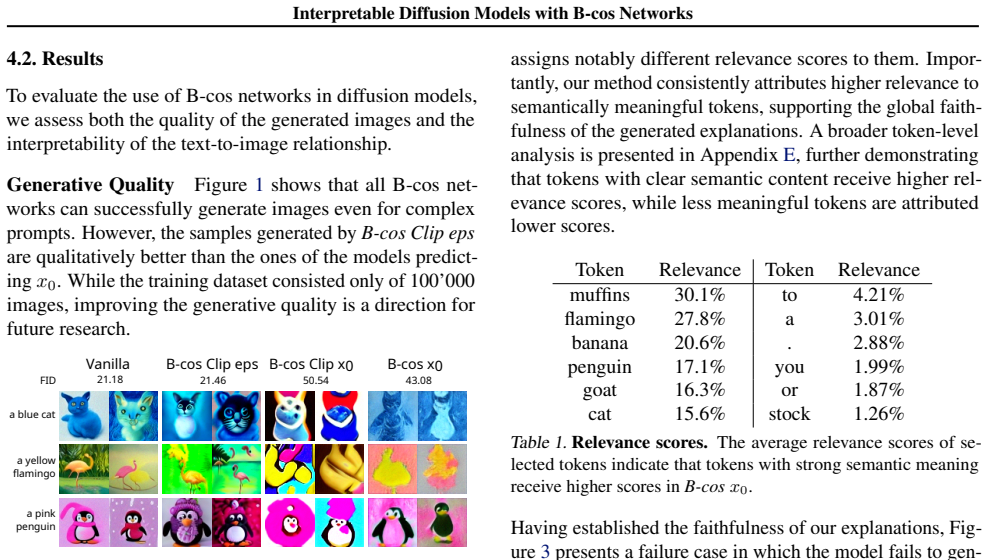
On the paper's own terms, the discovery is that a text-to-image diffusion model can be built from B-cos modules and still generate recognizable images, while each generation carries an explanation of how prompt tokens moved the output. The B-cos U-Net is summarized by a dynamic linear map $W(x)$, and applying the summary to the prompt embedding reconstructs the generated image; the normalized reconstruction matches the sample with a mean squared error of 0.0045, which the paper takes as evidence that the summary captures the relevant computations despite biases. Aggregating $W(x)$ over pixels and channels gives a relevance score per token, and across thousands of examples semantic tokens such as muffins, flamingo, banana, penguin, goat, and cat score far higher than function words such as a, to, or, and stock. The diagnostic value is illustrated by the prompt "a penguin and a shark": the shark token receives 0.18% relevance because the model did not generate a shark, so the explanation flags the generation as misaligned with the prompt.
Load-bearing premise
The load-bearing premise is that the dynamic linear summary $W(x)$ still captures nearly all of the prompt-to-image computation once the diffusion sampler, the shifted noise mean and variance, and the CLIP token encodings have introduced biases that the B-cos theory says should be absent.
Editorial extensions
If this is right
- A user can detect a failed generation without extra models: a token whose relevance is near zero, like shark at 0.18%, tells them the concept was not rendered, so the sample should be regenerated.
- The explanation is cheap: all token attributions come from one backward pass through the B-cos U-Net, with no prompt perturbation and no repeated sampling.
- The alignment signal is sample-specific, applying to the actual generated image rather than an aggregate score produced by a pretrained vision-language model.
- Because semantically meaningful tokens consistently outrank function words across thousands of captions, the relevance ranking can serve as a global check on what the model treats as important.
Reading between the lines
- The same dynamic linear summary could be used during training as a direct optimization target, penalizing generations in which a required prompt token contributes near-zero relevance; the paper stops at detection and regeneration.
- The design ties interpretability to $x_0$ prediction in low-resolution pixel space, so extending the method to latent diffusion would require a B-cos variational autoencoder and would likely reintroduce biases the current setup avoids.
- The one-backward-pass attribution is architecture-agnostic in principle and should transfer to other conditional diffusion backbones that consume token-level embeddings directly, though the paper only demonstrates it on its modified Stable Diffusion U-Net.
Editorial analysis
A structured set of objections, weighed in public.
Referee Report
Summary. The paper extends B-cos networks, which replace standard linear/convolutional operations with transformations whose dynamic linear summary W(x) satisfies f(x) = W(x)x, to a text-to-image diffusion model. The authors build on Stable Diffusion 2.1 by B-cosifying the U-Net, operating in pixel space on a 6-channel (r,g,b,1-r,1-g,1-b) representation, and training to predict x0 rather than the noise. They propose to explain a generated sample by reconstructing the output as W(x)x, normalizing the six channels to recover information lost to biases, and computing per-token relevance scores S_i from the rows of W(x). The paper reports FID scores for several model variants, one reconstruction MSE on a single sample, corpus-averaged token relevance tables, and a qualitative failure case for the prompt 'a penguin and a shark'. The central claim is that these relevance scores provide faithful, sample-specific, token-to-pixel alignment diagnostics that can identify prompt-image misalignment in a single backward pass.
Significance. If the central claim were established, the method would be a useful addition to interpretability tools for text-to-image diffusion: it promises sample-specific attributions without extra forward passes, perturbation, or an external vision-language model, and it is architecturally grounded in the B-cos linear-summary theory rather than in attention-map heuristics. The paper also makes a practical engineering contribution by identifying and partially solving the input/target encoding, noise-mean, and bias issues that arise when porting B-cos modules to diffusion. The authors are transparent about several limitations, including the incomplete end-to-end summary in the presence of external biases and the reduced generative quality. However, the validation of the load-bearing attribution and failure-detection claims is currently very thin, and the paper's own Appendix E.2 contains caveats that directly undercut those claims. More rigorous empirical validation is needed before the method can be said to provide faithful prompt-image alignment diagnostics.
major comments (3)
- [§3.4, Eq. (7), Fig. 2] The faithfulness of the model summary is validated by a single sample: the normalized reconstruction MSE of 0.0045 in Fig. 2 is reported for one generated image and one prompt. The normalized reconstruction in Eq. (7) divides the first three channels by their sum with the complementary channels, which removes any constant scale or channel-wise offset and therefore cannot certify that the raw per-token terms W_i x_i entering Eq. (8) faithfully capture the model's computations. The authors should report reconstruction error over many prompts, seeds, and sampling steps, and should additionally evaluate the raw (non-normalized) reconstruction error or otherwise show that the normalization does not mask per-channel biases that affect the relevance scores.
- [Fig. 3 and Appendix E.2] The failure-detection claim is supported only by the 'a penguin and a shark' example, whose low relevance for 'shark' is confounded by the fact that shark is not among the five training objects (banana, cat, goat, flamingo, penguin). A low score for an out-of-vocabulary token may simply indicate that the model has no representation of that concept, not that it can generally detect when a prompted concept is missing from the generated image. This is not a minor issue: it is the paper's strongest application claim. The authors should provide a counterfactual faithfulness test, for example by (a) generating prompts whose objects are all in the training set but deliberately omitting one object from the generated composition and showing that its token receives low relevance, or (b) perturbing or removing individual tokens and comparing the resulting image changes with the attribution scores, or (c) validating the spatial localization of high-relevance tokens against an independent segmentation or detection of the rendered objects. Appendix E.2 itself states that the relationship between token relevance and image changes is 'not immediately clear' and that high token relevance does not imply correct semantic understanding; this undercuts the claim that the relevance scores directly measure prompt-image alignment.
- [Tables 1 and 2, Eq. (8)] The corpus-averaged relevance scores in Tables 1 and 2 do not establish sample-specific faithfulness. Aggregating S_i over many prompts can reflect token frequency, embedding norms, common caption patterns, or co-occurrence with the training-object nouns, rather than whether a token actually rendered content in a particular image. Moreover, Eq. (8) sums W(x)_i x_i over all pixel and channel locations before taking the absolute value, so a token can receive a high score without having any localized spatial influence that matches the generated object. The paper needs per-sample evidence that high-relevance tokens correspond to pixels in the generated image, for instance by showing token-specific attribution maps side-by-side with the image for multiple diverse prompts and comparing them against human-labeled or automatically segmented object regions.
minor comments (4)
- [Fig. 1] It is difficult to tell which FID value belongs to which model configuration; the row of numbers is placed under 'a blue cat' without column headers or color-coded labels, and the text mentions only 'all B-cos networks' in the caption. Please add explicit labels for B-cos Clip eps, Vanilla, B-cos Clip x0, and B-cos x0.
- [§3.1, Eq. (3)] The text refers to the newly introduced noise in the reverse-sampling step as a 'bias'; zero-mean noise does not shift the expected value, so it would be clearer to distinguish between a stochasticity that is not captured by the summary and an actual additive bias term.
- [§3.4, Eq. (8)] The indexing in Eq. (8) is not fully specified: W(x)_i x_i is written as a scalar contribution after summation over h,w,c, but the dimensions of W(x), x, and the meaning of the row index i should be defined explicitly, especially because W(x) is not materialized in the implementation.
- [Appendix E.2] The caption of Fig. 6 says the relationship between token relevance and image changes is not immediately clear; this is an important caveat and should be moved into the main paper's discussion rather than appearing only in the appendix, because it qualifies the central interpretability claim.
Circularity Check
No circularity: the B-cos dynamic linear summary is definitional, but the faithfulness claims are empirically tested rather than assumed.
full rationale
The paper's central decomposition R(x)=W(x)x (Eq. 6) is the defining property of a B-cos network, not a circular prediction: W(x) is constructed during the forward pass as the exact linearized summary of the B-cos modules, so reconstructing the output from it is a consistency check, not an assumption. The faithfulness of this summary in the diffusion setting is then tested empirically via the normalized reconstruction (Eq. 7), with a reported MSE of 0.0045 on one sample. The token relevance score S_i (Eq. 8) is by definition the contribution of token i through W(x), so statements such as 'the shark token has 0.18% relevance' are direct readings of the linearized model; they become a claim about prompt-image alignment only insofar as W(x) faithfully captures the full generation process, which the paper explicitly acknowledges is incomplete due to biases (Section 3.1). The one-sample reconstruction and the single out-of-vocabulary failure case are weak evidence, and Appendix E.2 itself warns that 'a high token relevance does not mean that the model understands a concept correctly,' but this is an evidentiary limitation, not a circular reduction. No load-bearing step in the derivation is equivalent to its own input, and there are no self-citations used to justify the central premise. The paper's own equations and experiments provide independent, if limited, support for its claims.
Assumptions & free parameters
free parameters (3)
- B-cos exponent B =
not stated in paper (prior B-cos works use values such as 2 or 4)
- Forward diffusion noise mean mu =
0.5
- Forward diffusion noise standard deviation sigma =
0.5
assumptions (5)
- domain assumption A stack of B-cos transformations can be summarized by a single dynamic linear transformation, and nonzero outputs imply input-weight alignment.
- domain assumption External biases introduced by iterative sampling, the shifted noise mean, and multiple inputs are small enough that the normalized reconstruction approximates the true output.
- domain assumption Replacing the value projection in cross-attention with a B-cos layer, while treating X as a non-additive constant, yields a complete module summary with respect to the conditioning Y.
- domain assumption CLIP subword embeddings, with SOS, EOS, and padding tokens masked, carry the semantic meaning of prompt tokens without needing contextual token encodings.
- ad hoc to paper The six-channel encoding and the shifted noise distribution are a valid input and target representation for B-cos diffusion.
Cite this review
Pith. "Pith review of Interpretable Diffusion Models with B-cos Networks." pith.science (2026). https://pith.science/paper/FY3OTG2N
@misc{pith2026250703846,
  author       = {Pith},
  title        = {Pith review of: Interpretable Diffusion Models with B-cos Networks},
  year         = {2026},
  howpublished = {\url{https://pith.science/paper/FY3OTG2N}},
  note         = {Machine review of arXiv:2507.03846}
}
read the original abstract
Text-to-image diffusion models generate images by iteratively denoising random noise, conditioned on a prompt. While these models have enabled impressive progress in image generation, they often fail to accurately reflect all semantic information described in the prompt -- failures that are difficult to detect automatically. In this work, we introduce a diffusion model architecture built with B-cos modules that offers inherent interpretability. Our approach provides insight into how individual prompt tokens affect the generated image by producing explanations that highlight the pixel regions influenced by each token. We demonstrate that B-cos diffusion models can produce high-quality images while providing meaningful insights into prompt-image alignment.
Figures


Figures from the paper (3 more)


Reference graph
Works this paper leans on
-
[1]
write newline
" write newline "" before.all 'output.state := FUNCTION n.dashify 't := "" t empty not t #1 #1 substring "-" = t #1 #2 substring "--" = not "--" * t #2 global.max substring 't := t #1 #1 substring "-" = "-" * t #2 global.max substring 't := while if t #1 #1 substring * t #2 global.max substring 't := if while FUNCTION format.date year duplicate empty "emp...
-
[2]
B-cosification: Transforming deep neural networks to be inherently interpretable
Arya, S., Rao, S., B\" o hle, M., and Schiele, B. B-cosification: Transforming deep neural networks to be inherently interpretable. In Advances in Neural Information Processing Systems, volume 37, pp.\ 62756--62786, 2024
work page 2024
-
[3]
On pixel-wise explanations for non-linear classifier decisions by layer-wise relevance propagation
Bach, S., Binder, A., Montavon, G., Klauschen, F., M \"u ller, K.-R., and Samek, W. On pixel-wise explanations for non-linear classifier decisions by layer-wise relevance propagation. PloS one, 10 0 (7): 0 e0130140, 2015
work page 2015
-
[4]
Is attention explanation? an introduction to the debate
Bibal, A., Cardon, R., Alfter, D., Wilkens, R., Wang, X., Fran c ois, T., and Watrin, P. Is attention explanation? an introduction to the debate. In Proceedings of the 60th Annual Meeting of the Association for Computational Linguistics (Volume 1: Long Papers), pp.\ 3889--3900, 2022
work page 2022
-
[5]
B-cos networks: Alignment is all we need for interpretability
B \"o hle, M., Fritz, M., and Schiele, B. B-cos networks: Alignment is all we need for interpretability. In Proceedings of the IEEE/CVF Conference on Computer Vision and Pattern Recognition, pp.\ 10329--10338, 2022
work page 2022
-
[6]
B-cos alignment for inherently interpretable cnns and vision transformers
B \"o hle, M., Singh, N., Fritz, M., and Schiele, B. B-cos alignment for inherently interpretable cnns and vision transformers. IEEE Transactions on Pattern Analysis and Machine Intelligence, 46 0 (6): 0 4504--4518, 2024
work page 2024
-
[7]
Hessel, J., Holtzman, A., Forbes, M., Bras, R. L., and Choi, Y. Clipscore: A reference-free evaluation metric for image captioning. arXiv preprint arXiv:2104.08718, 2021
arXiv 2021
-
[8]
Gans trained by a two time-scale update rule converge to a local nash equilibrium
Heusel, M., Ramsauer, H., Unterthiner, T., Nessler, B., and Hochreiter, S. Gans trained by a two time-scale update rule converge to a local nash equilibrium. Advances in neural information processing systems, 30, 2017
2017
Show all 26 references
-
[9]
Denoising diffusion probabilistic models
Ho, J., Jain, A., and Abbeel, P. Denoising diffusion probabilistic models. Advances in neural information processing systems, 33: 0 6840--6851, 2020
2020
-
[10]
Kong, X., Liu, O., Li, H., Yogatama, D., and Steeg, G. V. Interpretable diffusion via information decomposition. In The Twelfth International Conference on Learning Representations, 2024
2024
-
[11]
Self-discovering interpretable diffusion latent directions for responsible text-to-image generation
Li, H., Shen, C., Torr, P., Tresp, V., and Gu, J. Self-discovering interpretable diffusion latent directions for responsible text-to-image generation. In Proceedings of the IEEE/CVF Conference on Computer Vision and Pattern Recognition, pp.\ 12006--12016, 2024
2024
-
[12]
Lundberg, S. M. and Lee, S.-I. A unified approach to interpreting model predictions. Advances in neural information processing systems, 30, 2017
2017
-
[13]
W., Hallacy, C., Ramesh, A., Goh, G., Agarwal, S., Sastry, G., Askell, A., Mishkin, P., Clark, J., et al
Radford, A., Kim, J. W., Hallacy, C., Ramesh, A., Goh, G., Agarwal, S., Sastry, G., Askell, A., Mishkin, P., Clark, J., et al. Learning transferable visual models from natural language supervision. In International conference on machine learning, pp.\ 8748--8763. PmLR, 2021
2021
-
[14]
why should i trust you?
Ribeiro, M. T., Singh, S., and Guestrin, C. "why should i trust you?" explaining the predictions of any classifier. In Proceedings of the 22nd ACM SIGKDD international conference on knowledge discovery and data mining, pp.\ 1135--1144, 2016
2016
-
[15]
S., and Teixeira, L
Rio-Torto, I., Gon c alves, T., Cardoso, J. S., and Teixeira, L. F. On the suitability of b-cos networks for the medical domain. In 2024 IEEE International Symposium on Biomedical Imaging (ISBI), pp.\ 1--5. IEEE, 2024
2024
-
[16]
High-resolution image synthesis with latent diffusion models
Rombach, R., Blattmann, A., Lorenz, D., Esser, P., and Ommer, B. High-resolution image synthesis with latent diffusion models. In Proceedings of the IEEE/CVF Conference on Computer Vision and Pattern Recognition (CVPR), pp.\ 10684--10695, June 2022
2022
-
[17]
U-net: Convolutional networks for biomedical image segmentation
Ronneberger, O., Fischer, P., and Brox, T. U-net: Convolutional networks for biomedical image segmentation. In Medical image computing and computer-assisted intervention--MICCAI 2015: 18th international conference, Munich, Germany, October 5-9, 2015, proceedings, part III 18, ...
2015
-
[18]
Laion-5b: An open large-scale dataset for training next generation image-text models
Schuhmann, C., Beaumont, R., Vencu, R., Gordon, C., Wightman, R., Cherti, M., Coombes, T., Katta, A., Mullis, C., Wortsman, M., et al. Laion-5b: An open large-scale dataset for training next generation image-text models. Advances in neural information processing systems, 35: 0...
2022
-
[19]
Denoising diffusion implicit models
Song, J., Meng, C., and Ermon, S. Denoising diffusion implicit models. In International Conference on Learning Representations, 2021
2021
-
[20]
and Fleuret, F
Srinivas, S. and Fleuret, F. Full-gradient representation for neural network visualization. Advances in neural information processing systems, 32, 2019
2019
-
[21]
What the DAAM : Interpreting stable diffusion using cross attention
Tang, R., Liu, L., Pandey, A., Jiang, Z., Yang, G., Kumar, K., Stenetorp, P., Lin, J., and Ture, F. What the DAAM : Interpreting stable diffusion using cross attention. In Proceedings of the 61st Annual Meeting of the Association for Computational Linguistics (Volume 1: Long P...
2023
-
[22]
Diffuse attend and segment: Unsupervised zero-shot segmentation using stable diffusion
Tian, J., Aggarwal, L., Colaco, A., Kira, Z., and Gonzalez-Franco, M. Diffuse attend and segment: Unsupervised zero-shot segmentation using stable diffusion. In Proceedings of the IEEE/CVF Conference on Computer Vision and Pattern Recognition, pp.\ 3554--3563, 2024
2024
-
[23]
J., Theis, F
Tran, M., Lahiani, A., Dicente Cid, Y., Boxberg, M., Lienemann, P., Matek, C., Wagner, S. J., Theis, F. J., Klaiman, E., and Peng, T. B-cos aligned transformers learn human-interpretable features. In International Conference on Medical Image Computing and Computer-Assisted Int...
2023
-
[24]
Diffusion model is secretly a training-free open vocabulary semantic segmenter
Wang, J., Li, X., Zhang, J., Xu, Q., Zhou, Q., Yu, Q., Sheng, L., and Xu, D. Diffusion model is secretly a training-free open vocabulary semantic segmenter. arXiv preprint arXiv:2309.02773, 2023
2023 arXiv
-
[25]
On discrete prompt optimization for diffusion models
Wang, R., Liu, T., Hsieh, C.-J., and Gong, B. On discrete prompt optimization for diffusion models. arXiv preprint arXiv:2407.01606, 2024
2024 arXiv
-
[26]
Prompt-free diffusion: Taking" text" out of text-to-image diffusion models
Xu, X., Guo, J., Wang, Z., Huang, G., Essa, I., and Shi, H. Prompt-free diffusion: Taking" text" out of text-to-image diffusion models. In Proceedings of the IEEE/CVF Conference on Computer Vision and Pattern Recognition, pp.\ 8682--8692, 2024
2024
Reviewed August 6, 2026 · model on record in the stance chip above.
Discussion (0). Sign in to comment.