Mapping twist fields to local operators via tensor networks
Pith reviewed 2026-06-29 21:40 UTC · model grok-4.3
The pith
Explicit local operators on physical degrees of freedom reproduce twist field actions in matrix product states exactly when tensors are injective and at orthogonality center.
A machine-rendered reading of the paper's core claim, the machinery that carries it, and where it could break.
Core claim
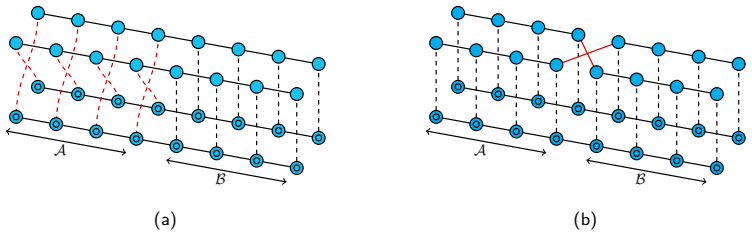
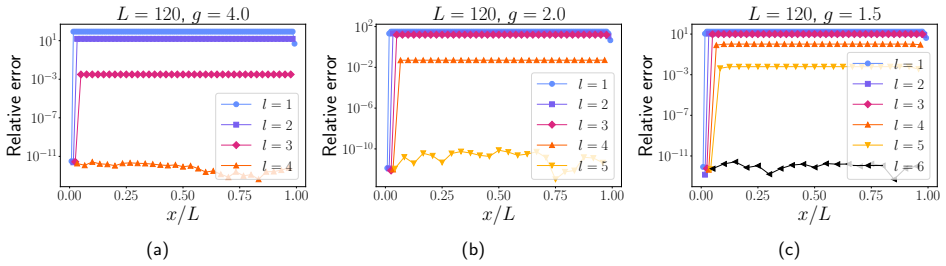
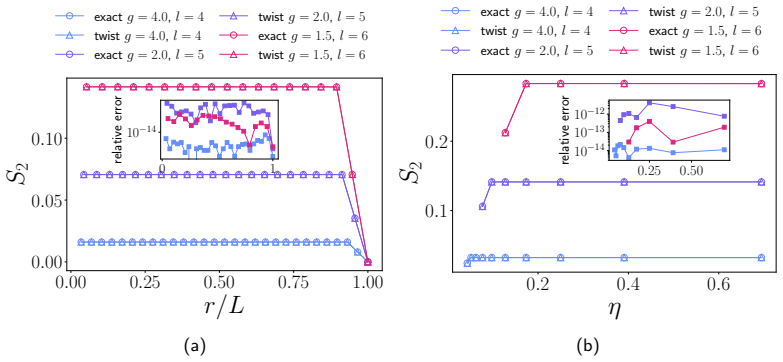
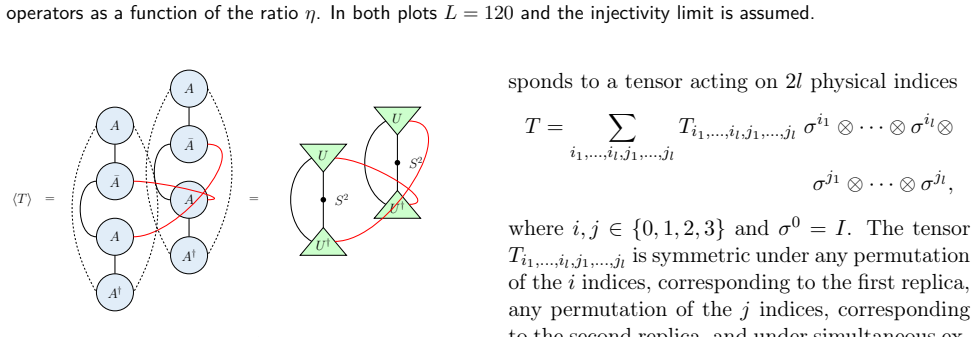
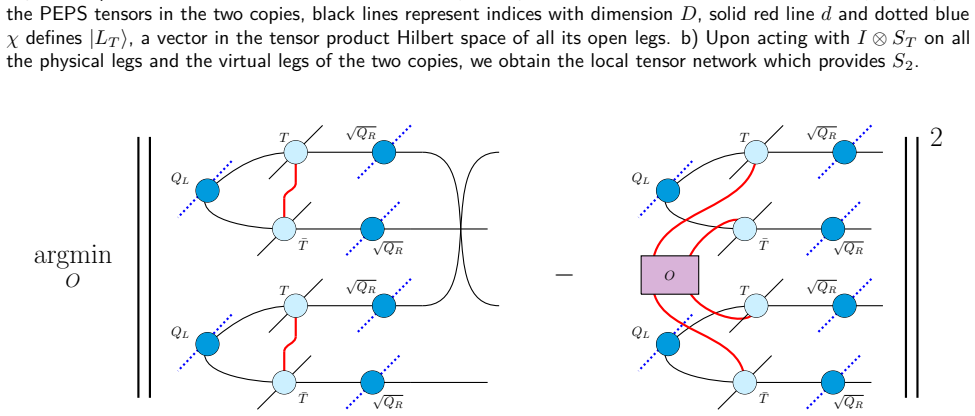
We construct explicit local operators acting on the physical Hilbert space whose expectation values reproduce the action of twist fields in matrix product states. Our construction is exact in the injectivity limit and when the tensor is chosen at the center of orthogonality, and provides a direct operational method to evaluate Rényi entropies without accessing auxiliary tensor indices.
What carries the argument
The exact mapping of twist fields to local physical operators, achieved by evaluating the MPS tensor at the center of orthogonality under the injectivity condition.
If this is right
- Rényi entropies become computable from expectation values of physical operators alone, without reference to virtual indices.
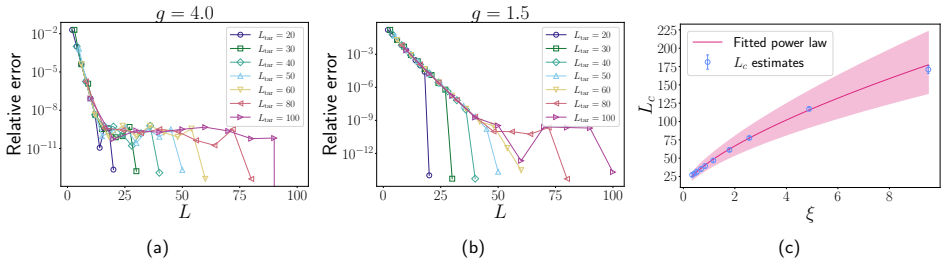
- The method converges rapidly to the exact entanglement entropy once the injectivity scale is reached.
- Operators determined on small reference systems transfer to larger systems once reference size exceeds the correlation length.
- The operators admit a finite decomposition into local observables, enabling direct experimental access in quantum simulators.
Where Pith is reading between the lines
- The transferability implies that a model-specific scale set by the correlation length determines when the operators become effectively universal across system sizes.
- Direct measurement of these local operators on quantum hardware could yield entanglement estimates without requiring full tomography or access to virtual degrees of freedom.
- Similar constructions may extend to other tensor-network ansatzes such as projected entangled pair states if analogous injectivity conditions can be identified.
Load-bearing premise
The MPS tensor must satisfy the injectivity condition and sit at the center of orthogonality for the physical-operator expectations to equal the twist-field action without approximation.
What would settle it
Numerical computation of the constructed local-operator expectation values in the transverse-field Ising model at large bond dimension that deviates from the known Rényi entropy would falsify the exact mapping.
Figures
read the original abstract
Twist fields are a powerful formal tool to compute R\'enyi entropies in quantum many-body systems, but their conventional formulation in tensor network states involves operations acting on virtual degrees of freedom, which are not directly accessible in experiments. In this work, we construct explicit local operators acting on the physical Hilbert space whose expectation values reproduce the action of twist fields in matrix product states. Our construction is exact in the injectivity limit and when the tensor is chosen at the center of orthogonality, and provides a direct operational method to evaluate R\'enyi entropies without accessing auxiliary tensor indices. We test our formulation numerically in the transverse-field Ising model, demonstrating rapid convergence to the exact entanglement entropy as the injectivity scale is reached. Furthermore, we show that twist operators determined from relatively small reference systems can be reliably transferred to larger systems, once the reference size exceeds a characteristic scale set by the correlation length. Since the resulting operators admit a decomposition in terms of a finite number of local observables, our results provide a scalable and experimentally accessible framework to probe entanglement in quantum simulators.
Editorial analysis
A structured set of objections, weighed in public.
Referee Report
Summary. The paper constructs explicit local operators on the physical Hilbert space of matrix product states (MPS) whose expectation values reproduce the action of twist fields, enabling computation of Rényi entropies without access to virtual indices. The mapping is exact in the injectivity limit when the MPS tensor is at the center of orthogonality. Numerical tests on the transverse-field Ising model demonstrate rapid convergence to exact entanglement entropy values, and the operators are shown to transfer reliably from small reference systems to larger ones once the reference size exceeds a scale set by the correlation length.
Significance. If the central mapping holds under the stated conditions, the work provides a scalable, experimentally accessible framework for probing entanglement in quantum simulators using only finite local observables. The exactness under injectivity and orthogonality conditions, combined with the demonstrated transferability, strengthens its utility for many-body systems where virtual degrees of freedom are inaccessible.
minor comments (2)
- [Numerical results] The definition of the 'injectivity scale' and its relation to the correlation length could be stated more explicitly in the main text (near the numerical results section) to aid readers less familiar with MPS injectivity.
- [Figures] Figure captions for the Ising model convergence plots should include the specific bond dimension and system sizes used to allow direct reproduction of the reported rapid convergence.
Simulated Author's Rebuttal
We thank the referee for their careful reading of the manuscript, their positive assessment of its significance, and their recommendation to accept. No major comments were raised in the report.
Circularity Check
No significant circularity; derivation is self-contained from MPS properties
full rationale
The paper derives an explicit mapping from twist fields (virtual indices) to local physical operators in MPS under the stated conditions of injectivity and center of orthogonality. This construction is presented as following directly from tensor network definitions and properties, with numerical tests confirming convergence to exact values once conditions are met. No steps reduce by construction to fitted parameters, self-definitions, or load-bearing self-citations; the central claim remains independent of its inputs and externally verifiable via the reported numerics on the Ising model.
Axiom & Free-Parameter Ledger
axioms (1)
- domain assumption MPS tensors admit an injective limit and can be placed at the center of orthogonality
Reference graph
Works this paper leans on
-
[1]
Takayanagi,Essay: Emergent Holographic Spacetime from Quantum Information,Phys
T. Takayanagi. “Essay: Emergent Holo- graphic Spacetime from Quantum Informa- tion”. Phys. Rev. Lett.134, 240001 (2025). arXiv:2506.06595
-
[2]
B. Zeng, X. Chen, D.-L. Zhou, and X.-G. Wen. “Quantum Information Meets Quan- tum Matter: From Quantum Entanglement to Topological Phases of Many-Body Sys- tems”. Quantum Science and Technology. Springer. (2019). arXiv:1508.02595
work page internal anchor Pith review Pith/arXiv arXiv 2019
-
[3]
On measures of information and entropy
A. Rényi. “On measures of information and entropy”. In Jerzy Neyman, editor, The fourth Berkeley Symposium on Mathemat- ics, Statistics and Probability 1960. Pages 547–561. (1961)
1960
-
[4]
G. Vidal. “Entanglement monotones”. J. Mod. Opt.47, 355 (2000). arXiv:quant- ph/9807077
-
[5]
Entanglement entropy and quantum field theory
P.CalabreseandJ.L.Cardy. “Entanglement entropy and quantum field theory”. J. Stat. Mech.0406, P06002 (2004). arXiv:hep- th/0405152
-
[6]
Detecting topological order in a ground state wave function
M. Levin and X.-G. Wen. “Detecting Topo- logical Order in a Ground State Wave Func- tion”. Phys. Rev. Lett.96, 110405 (2006). arXiv:cond-mat/0510613
work page internal anchor Pith review Pith/arXiv arXiv 2006
-
[7]
Topological entanglement entropy
A. Kitaev and J. Preskill. “Topological en- tanglement entropy”. Phys. Rev. Lett.96, 110404 (2006). arXiv:hep-th/0510092
work page internal anchor Pith review Pith/arXiv arXiv 2006
- [8]
-
[9]
Probing entanglement entropy via randomized measurements
T. Brydges et al. “Probing Rényi en- tanglement entropy via randomized mea- surements”. Science364, aau4963 (2019). arXiv:1806.05747
work page internal anchor Pith review Pith/arXiv arXiv 2019
-
[10]
Predicting many properties of a quan- tum system from very few measure- ments
H.-Y. Huang, R. Kueng, and J. Preskill. “Predicting many properties of a quan- tum system from very few measure- ments”. Nature Phys.16, 1050–1057 (2020). arXiv:2002.08953
-
[12]
The Conformal Field The- ory of Orbifolds
L. J. Dixon, D. Friedan, E. J. Martinec, and S. H. Shenker. “The Conformal Field The- ory of Orbifolds”. Nucl. Phys. B282, 13– 73 (1987)
1987
-
[13]
Form factors of branch-point twist fields in quantum integrable models and entanglement entropy
J. L. Cardy, O. A. Castro-Alvaredo, and B. Doyon. “Form factors of branch-point twist fields in quantum integrable models and entanglement entropy”. J. Statist. Phys. 130, 129–168 (2008). arXiv:0706.3384
work page internal anchor Pith review Pith/arXiv arXiv 2008
-
[14]
Mutual information and the structure of entanglement in quantum field theory
B. Swingle. “Mutual information and the structure of entanglement in quantum field theory” (2010). arXiv:1010.4038
work page internal anchor Pith review Pith/arXiv arXiv 2010
-
[15]
Twist operators in higher dimensions
L.-Y. Hung, R. C. Myers, and M. Smolkin. “Twist operators in higher dimensions”. JHEP10, 178 (2014). arXiv:1407.6429
work page internal anchor Pith review Pith/arXiv arXiv 2014
-
[16]
Twist Fields in Many- Body Physics
B. Doyon. “Twist Fields in Many- Body Physics”. Entropy27, 1230 (2025). arXiv:2509.15064
-
[17]
Finitely Correlated States on Quantum Spin Chains
M. Fannes, B. Nachtergaele, and R. F. Werner. “Finitely Correlated States on Quantum Spin Chains”. Commun. Math. Phys.144, 443–490 (1992)
1992
-
[18]
Efficient classical simulation of slightly entangled quantum computations
G. Vidal. “Efficient Classical Simulation of Slightly Entangled Quantum Computa- tions”. Phys. Rev. Lett.91, 147902 (2003). arXiv:quant-ph/0301063
work page internal anchor Pith review Pith/arXiv arXiv 2003
-
[19]
Matrix Product State Representations
D. Pérez-García, F. Verstraete, M. M. Wolf, and J. I. Cirac. “Matrix product state rep- resentations”. Quant. Inf. Comput.7, 401– 430 (2007). arXiv:quant-ph/0608197
work page internal anchor Pith review Pith/arXiv arXiv 2007
-
[20]
F. Verstraete, V. Murg, and J. I. Cirac. “Matrix product states, projected entan- gled pair states, and variational renormal- ization group methods for quantum spin systems”. Adv. Phys.57, 143–224 (2008). arXiv:0907.2796
work page internal anchor Pith review Pith/arXiv arXiv 2008
-
[21]
Density matrix formulation for quantum renormalization groups
S. R. White. “Density matrix formulation for quantum renormalization groups”. Phys. Rev. Lett.69, 2863–2866 (1992)
1992
-
[22]
Density-matrix algorithms for quantum renormalization groups
S. R. White. “Density-matrix algorithms for quantum renormalization groups”. Phys. Rev. B48, 10345–10356 (1993)
1993
-
[23]
Matrix prod- uct states represent ground states faithfully
F. Verstraete and J. I. Cirac. “Matrix prod- uct states represent ground states faithfully”. Phys. Rev. B73, 094423 (2006). arXiv:cond- mat/0505140
-
[24]
Scaling of entanglement support for Matrix Product States
L. Tagliacozzo, T. R. de Oliveira, S. Iblisdir, and J. I. Latorre. “Scaling of entanglement support for Matrix Product States”. Phys. Rev. B78, 024410 (2008). arXiv:0712.1976
work page internal anchor Pith review Pith/arXiv arXiv 2008
-
[25]
On R\'enyi entropies of disjoint intervals in conformal field theory
A. Coser, L. Tagliacozzo, and E. Tonni. “On Rényi entropies of disjoint intervals in con- formal field theory”. J. Stat. Mech.1401, P01008 (2014). arXiv:1309.2189
work page internal anchor Pith review Pith/arXiv arXiv 2014
-
[26]
A canonical form for Projected Entangled Pair States and applications
D. Pérez-García et al. “Characterizing symmetries in a projected entangled pair state”. New J. Phys.12, 025010 (2010). arXiv:0908.1674
work page internal anchor Pith review Pith/arXiv arXiv 2010
-
[27]
A generalization of the injectivity condition for Projected Entangled Pair States
A. Molnár, Y. Ge, N. Schuch, and J. I. Cirac. “A generalization of the injectiv- ity condition for Projected Entangled Pair States”. J. Math. Phys.59, 021902 (2018). arXiv:1706.07329
work page internal anchor Pith review Pith/arXiv arXiv 2018
-
[28]
Renormalization algorithms for Quantum-Many Body Systems in two and higher dimensions
F. Verstraete and J. I. Cirac. “Renormaliza- tion algorithms for quantum-many body sys- tems in two and higher dimensions” (2004). arXiv:cond-mat/0407066
work page internal anchor Pith review Pith/arXiv arXiv 2004
-
[29]
Self-Consistent Tensor Product Variational Approximation for 3D Classical Models
T. Nishino et al. “Self-consistent tensor product variational approximation for 3D classical models”. Nucl. Phys. B575, 504– 512 (2000). arXiv:cond-mat/0001083
work page internal anchor Pith review Pith/arXiv arXiv 2000
-
[30]
Two-Dimensional Tensor Product Variational Formulation
T. Nishino et al. “Two-Dimensional Tensor Product Variational Formulation”. Prog. Theor. Phys.105, 409–417 (2001). arXiv:cond-mat/0011103
work page internal anchor Pith review Pith/arXiv arXiv 2001
-
[31]
Tensor Product Variational Formulation for Quantum Systems
Y. Nishio, N. Maeshima, A. Gendiar, and T. Nishino. “Tensor Product Varia- tional Formulation for Quantum Systems”. cond-mat/0401115 (2004). arXiv:cond- mat/0401115
work page internal anchor Pith review Pith/arXiv arXiv 2004
-
[32]
Renormalization group transformations on quantum states
F. Verstraete et al. “Renormalization group transformations on quantum states”. Phys. Rev. Lett.94, 140601 (2005). arXiv:quant- ph/0410227
-
[33]
Tangent Space Generators of Matrix Product States and Exact Flo- 14 quet Quantum Scars
M. Ljubotina, E. Petrova, N. Schuch, and M. Serbyn. “Tangent Space Generators of Matrix Product States and Exact Flo- 14 quet Quantum Scars”. PRX Quantum5, 040311 (2024)
2024
-
[34]
Finding Periodic Orbits in Projected Quantum Many-Body Dynamics
E. Petrova, M. Ljubotina, G. Yalnız, and M. Serbyn. “Finding Periodic Orbits in Projected Quantum Many-Body Dynamics”. PRX Quantum6, 040333 (2025)
2025
-
[35]
Tensor network Python (TeNPy) version 1
J. Hauschild et al. “Tensor network Python (TeNPy) version 1”. SciPost Phys. Codeb. 41, 1 (2024). arXiv:2408.02010
-
[36]
Measuring entanglement using quantum quenches
J. Cardy. “Measuring Entanglement Using Quantum Quenches”. Phys. Rev. Lett.106, 150404 (2011). arXiv:1012.5116
work page internal anchor Pith review Pith/arXiv arXiv 2011
-
[37]
Measuring Entanglement Entropy of a Generic Many- Body System with a Quantum Switch
D. A. Abanin and E. Demler. “Measuring Entanglement Entropy of a Generic Many- Body System with a Quantum Switch”. Physical Review Letters109, 020504 (2012)
2012
-
[38]
Measuring Entanglement Growth in Quench Dynamics of Bosons in an Optical Lattice
A. J. Daley, H. Pichler, J. Schachenmayer, and P. Zoller. “Measuring Entanglement Growth in Quench Dynamics of Bosons in an Optical Lattice”. Physical Review Letters 109, 020505 (2012)
2012
-
[39]
Measuring entanglement en- tropy in a quantum many-body system
R. Islam et al. “Measuring entanglement en- tropy in a quantum many-body system”. Na- ture528, 77 (2015)
2015
-
[40]
Quantum ther- malization through entanglement in an iso- lated many-body system
A. M. Kaufman et al. “Quantum ther- malization through entanglement in an iso- lated many-body system”. Science353, 794– 800 (2016)
2016
-
[41]
An atom-by-atom assem- bler of defect-free arbitrary two-dimensional atomic arrays
D. Barredo et al. “An atom-by-atom assem- bler of defect-free arbitrary two-dimensional atomic arrays”. Science354, 1021– 1023 (2016)
2016
-
[42]
Experimental investigations of Dipole–Dipole interactions between a few Rydberg atoms
A. Browaeys, D. Barredo, and T. La- haye. “Experimental investigations of Dipole–Dipole interactions between a few Rydberg atoms”. Journal of Physics B: Atomic, Molecular and Optical Physics49, 152001 (2016)
2016
-
[43]
Probing many-body dy- namics on a 51-atom quantum simulator
H. Bernien et al. “Probing many-body dy- namics on a 51-atom quantum simulator”. Nature551, 579–584 (2017)
2017
-
[44]
Quantum simulation of 2D antiferromagnets with hundreds of Rydberg atoms
P. Scholl et al. “Quantum simulation of 2D antiferromagnets with hundreds of Rydberg atoms”. Nature595, 233–238 (2021)
2021
-
[45]
Probing topological spin liquids on a programmable quantum simula- tor
G. Semeghini et al. “Probing topological spin liquids on a programmable quantum simula- tor”. Science (New York, N.Y.)374, 1242– 1247 (2021)
2021
-
[46]
Benchmarking highly en- tangled states on a 60-atom analogue quan- tum simulator
A. L. Shaw et al. “Benchmarking highly en- tangled states on a 60-atom analogue quan- tum simulator”. Nature628, 71–77 (2024)
2024
-
[47]
Quantum simula- tions with trapped ions
R. Blatt and C. F. Roos. “Quantum simula- tions with trapped ions”. Nature Physics8, 277–284 (2012)
2012
-
[48]
Probing Rényi entan- glement entropy via randomized measure- ments
T. Brydges et al. “Probing Rényi entan- glement entropy via randomized measure- ments”. Science364, 260–263 (2019)
2019
-
[49]
Exploring large-scale en- tanglement in quantum simulation
M. K. Joshi et al. “Exploring large-scale en- tanglement in quantum simulation”. Nature 624, 539–544 (2023)
2023
-
[50]
A site-resolved two- dimensional quantum simulator with hun- dreds of trapped ions
S.-A. Guo et al. “A site-resolved two- dimensional quantum simulator with hun- dreds of trapped ions”. Nature630, 613– 618 (2024)
2024
-
[51]
Observation of a finite- energy phase transition in a one-dimensional quantum simulator
A. Schuckert et al. “Observation of a finite- energy phase transition in a one-dimensional quantum simulator”. Nature Physics21, 374–379 (2025)
2025
-
[52]
Quantum walks on a pro- grammable two-dimensional 62-qubit super- conducting processor
M. Gong et al. “Quantum walks on a pro- grammable two-dimensional 62-qubit super- conducting processor”. Science372, 948– 952 (2021)
2021
-
[53]
Evidence for the utility of quantum computing before fault tolerance
Y. Kim et al. “Evidence for the utility of quantum computing before fault tolerance”. Nature618, 500–505 (2023)
2023
-
[54]
Probing entangle- ment in a 2D hard-core Bose–Hubbard lat- tice
A. H. Karamlou et al. “Probing entangle- ment in a 2D hard-core Bose–Hubbard lat- tice”. Nature629, 561–566 (2024)
2024
-
[55]
Thermalization and criticality on an analogue–digital quantum simulator
T. I. Andersen et al. “Thermalization and criticality on an analogue–digital quantum simulator”. Nature638, 79–85 (2025)
2025
-
[56]
Mixed-state entan- glement from local randomized measure- ments
A. Elben et al. “Mixed-state entan- glement from local randomized measure- ments” (2020). arXiv:2007.06305
-
[57]
Predicting many properties of a quantum system from very few measurements
H.-Y. Huang, R. Kueng, and J. Preskill. “Predicting many properties of a quantum system from very few measurements”. Na- ture Physics16, 1050–1057 (2020)
2020
-
[58]
The minimal canonical form of a tensor network
A. Acuaviva et al. “The minimal canonical form of a tensor network”. In 2023 IEEE 64th Annual Symposium on Foundations of Computer Science (FOCS). Pages 328–362. (2022). arXiv:2209.14358
-
[59]
Gauge fixing, canonical forms and optimal truncations in tensor networks with closed loops
G. Evenbly. “Gauge fixing, canonical forms, and optimal truncations in tensor networks with closed loops”. Phys. Rev. B98, 085155 (2018). arXiv:1801.05390
work page internal anchor Pith review Pith/arXiv arXiv 2018
-
[60]
Entanglement Transi- tions from Holographic Random Tensor Net- works
R. Vasseur, A. C. Potter, Y.-Z. You, and A. W. W. Ludwig. “Entanglement Transi- tions from Holographic Random Tensor Net- works”. Phys. Rev. B100, 134203 (2019). arXiv:1807.07082. 15
-
[61]
Computational complexity of injective projected entangled pair states
D. Harley, F. Witteveen, and D. Malz. “Computational complexity of injective projected entangled pair states” (2025). arXiv:2509.19963
-
[62]
Tensor Network Renormalization
G. Evenbly and G. Vidal. “Tensor Network Renormalization”. Phys. Rev. Lett.115, 180405 (2015). arXiv:1412.0732
work page internal anchor Pith review Pith/arXiv arXiv 2015
-
[63]
Entanglement spectrum and boundary theories with projected entangled-pair states
J. I. Cirac, D. Poilblanc, N. Schuch, and F. Verstraete. “Entanglement spectrum and boundary theories with projected entangled- pair states”. Phys. Rev. B83, 245134 (2011). arXiv:1103.3427. 16
work page internal anchor Pith review Pith/arXiv arXiv 2011
discussion (0)
Sign in with ORCID, Apple, or X to comment. Anyone can read and Pith papers without signing in.